I’m just sayin’…
Tuesday, May 26th, 2009
Governor Pawlenty’s discipline is tutelage for Republicans everywhere.
Congressional Republicans — the ones who got tossed because of their embrace of spending and earmarks — might start looking for a message up north. Fiscal responsibility? “It is the fundamental tenet of our party, and the conservative coalition more broadly,” says Mr. Pawlenty, nicely. “If we don’t have that, we are nothing.”
If Republicans are looking to get back their conservative groove, they could do worse than study Minnesota’s budget brawl. Mr. Pawlenty deftly (and amusingly) outmaneuvered his Democratic opposition, not only saving his state from huge tax increases but clearing the way to cut government spending. Call it a refreshing break from the financial-crisis norm.
While liberal TV ads equate fairness with sticking it to the “rich”…
…Mr. Pawlenty kept voicing three simple principles. “Number one, we must have [because of the constitution] and should have a balanced budget,” he told me. “Number two, the state government needs to live within its means, just like everybody else. Number three, we shouldn’t raise taxes in the worst recession in 60 years.” Minnesota already has one of the highest tax burdens in the nation.
While in Washington, Comrade Obama increases the Federal Government and National Debt at unprecedented speed…
this will be one of the first times in modern Minnesota history that the state will reduce the size of government in real terms, not just slow its rate of growth. “The correlation in recent history has been between job growth and states that have reasonable government cost structures,” he says. These cuts, he says, will position Minnesota to take advantage of the recovery when it comes.
A Crisis Not Wasted™ indeed, Governor.
“See? Look! Obama is a great president! The Dow is rallying!”
Right. In the same say that your family’s economy “rallies” when someone gives you another credit card. Government – governments around the world, really – Aare printing money faster than “Twilight” novels.
I’m not buying shares if that’s what you mean. Not at all,” Rogers told “Squawk Box Asia.””The bottom will probably come later this year, next year, who knows when,” he added.
Governments have not solved the essential problems that caused the crisis but instead they “flooded the world with money,” according to Rogers. Trying to solve the problem of too much consumption and too much debt with more consumption “defies belief” and will not work, he said.
“I mean … you give me 5 or 6 trillion dollars, I’ll show you a very good time, there’s no question about that,” Rogers said.
Indeed, dropping five or six trillion dollars from airplanes over the country would probably do the world a lot more long-term good than the government’s plan – if you could find enough planes to haul that much money.
One nice thing about conservatism, especially the whole “limited government” and “fiscal responsibility” bits; when government runs out of pockets to pick, suckers to borrow from and marks to shake down, eventually conservative policy becomes your only option.
After talking a good game in his first election, California governor Arnold Schwarzenegger has morphed into a governor that nobody can possibly mistake for a conservative. But as California’s fiscal doldrums – exacerbated by generations of frivolous, stupid liberal leadership from both parties – spiral toward terminal velocity, Dah Gahvenah is being forced to get real:
Gov. Arnold Schwarzenegger today will propose selling San Quentin Prison, the Los Angeles Coliseum and other state-owned properties in a bid to raise cash to counter the state’s daunting budget shortfall.
Ahhold wants to sell a shopping list of state properties, from San Quentin and the LA Colisseum all the way down to the Orange County Fairgrounds.
The sale of those properties would generate upward of $600 million and possibly more than $1 billion for the state, according to a copy of Schwarzenegger’s proposal. But proceeds from those sales would not arrive for another two to five years.
Note to aspiring government leaders: the next step is to not have government buying, building or seizing these sorts of things in the first place.
No matter what it is; colisseums, heath insurance systems, or anything in between.
S/He who forgets history is condemned to repeat it.
S/He who forgets economics is condemned to repeat history while broke.
Thomas Sowell field-strips the Financial Crisis. Like so many crises, it’s an unintended consequence of the response to a non-existent crisis – the”Affordable Housing” crisis (remember that one? If you voted for Obama, I bet not) a few years back.
When the political crusade for affordable housing took off and built up steam during the 1990s, the share of their incomes that Americans were spending on housing in 1998 was 17 percent, compared to 30 percent in the early 1980s. Even during the housing boom of 2005, the median home took just 22 percent of the median American income.
What created the illusion of a nationwide problem was that, in particular localities around the country, housing prices had skyrocketed to the point where people had to pay half their income to buy a modest-sized home and often resorted to very risky ways of financing the purchase. In Tucson, for example, “roughly 60% of first-time home buyers make no down payment and instead now use 100% financing to get into the market,” according to the Wall Street Journal. Almost invariably, these locally extreme housing prices have been a result of local political crusades in the name of locally attractive slogans about the environment, open space, “smart growth,” or whatever other phrases had political resonance at the particular time and place.
Pick a housing market with high prices and terrible rents. You’ll find government intervention in some form or another – New York’s rent controls, Portland’s “smart growth” – behind most of ’em.
Where housing markets have been more or less left alone — in places like Houston or Dallas, for example — housing did not take even half as big a share of family incomes as did comparable housing in places like the San Francisco Bay Area, where heavily hyped political crusades had led to severe restrictions on building. It was in precisely these extremely high housing-cost enclaves that the kind of people for whom the national housing crusade expressed much concern — minorities, low-income people and families with children — were forced out disproportionately.
Few things blind human beings to the actual consequences of what they are doing like a heady feeling of self-righteousness during a crusade to smite the wicked and rescue the downtrodden.
And that’s where the real problems – the real crisis – began.
Even where loudly proclaimed concern for the poor and minorities gave impetus to the drive for over-riding traditional mortgage lending standards, this is not to say that the poor and minorities were the sole beneficiaries or even the main beneficiaries. When you open the floodgates, you cannot tell the water where to go. Housing speculators — “flippers” — found the new and looser home mortgage rules a bonanza. So did many others. It is by no means clear that the poor or minorities came out ahead at all, after the housing boom turned to bust and many were left with mortgage payments they couldn’t meet on homes they couldn’t afford.
With rich rewards available — politically, ideologically, and financially — from the “affordable housing” crusade, there were ample incentives to keep this crusade going for years. Meanwhile, various special interests found ways to benefit themselves from all this, whether as home builders, real-estate investors, or others, and therefore added their voices in support of the open-ended goal of more home ownership through various ways of achieving, or seeming to achieve, affordable housing.
So how do we dig out of this government-created crisis?
Well, not through more government action:
While some congressional Democrats have proposed a moratorium on mortgage foreclosures or allowing judges to change the terms of mortgage contracts, Senate Republicans have proposed “providing government-backed, 4% fixed mortgages to any credit-worthy borrower.” What these proposals from politicians of both parties all have in common is an utter absence of any serious consideration of the repercussions in multiple directions of arbitrary government fiats.
Read the whole thing.
Better yet, find your Congressperson, and make them read it before you go all Jack Bauer on them.
Americans that lived through The Great Recession of “Ought Nine” will not soon forget the lessons learned and in fact US savings rates are up; consumer debt has fallen like a rock.
In the end, history will point an impeaching finger at liberals whose “high-mindedness” led to the most catastrophic and costly financial crisis in American history.
And yet…
Grants of as much as [$16,000] to first-time buyers and the lowest interest rates in 49 years have emboldened more than 40,000 young [home buyers] to take out home loans since October, stoking demand for properties that cost less than [$385,000].
These buyers may be vulnerable when interest rates begin rising, potentially triggering a jump in foreclosures that will drive down property prices, cut profits at banks and damp household spending, which accounts for half the economy. A surge in defaults in America was a key trigger for the financial crisis that pushed the global economy into its worst recession since World War II.
History repeats itself indeed, only this is in Australia, where the toilet swirls the other way and lessons are apparently learned the hard way.
“We’re mirroring what happened to the U.S. three years ago, when people who shouldn’t have been in the market bought houses,” said Martin North, managing director of Fujitsu Australia, a Sydney-based property-consulting company. “It’s a strategy set for an unfortunate outcome.”
G’Luck, mate!
Chrysler takes Denny Hecker down a half billion.
The financial services arm of automotive giant Chrysler won a $476.9 million judgment against embattled car dealer Denny Hecker in the latest blow to his crumbling auto dealership empire.
Well, at least he has the mortgage and real estate businesses to fall back on. I’m sure they’re doing swell.
When General Motors euthanized Oldsmobile the public’s reaction was a non-reaction. Nobody cared – well, except some dealerships. The last Oldsmobile rolled off the line in 2004, ending a 107-year history.
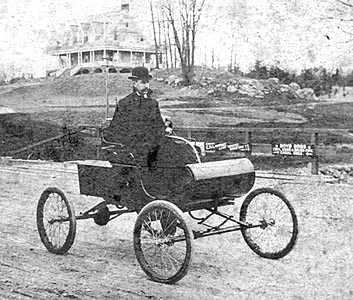
Save America’s first mass-produced front-drive car, the Toronado…

…Oldsmobile really never had a raison d’etre – never really produced an icon like Buick’s Riviera, Chevy’s Camaro and Corvette, Cadillac’s various De Villes or Pontiac’s Bonneville.
That’s not to say there wasn’t some semblance of logic for the existence of the different divisions. Loosely, Chevrolet was the “bread and butter” division, Pontiac the “sporty”; Buick “near luxury”, Cadillac “luxury” and GMC the “professional truck” division – oh and Oldsmobile – “your father’s car?”
Rumor has it Pontiac will also go burbling into the night as early as next week and this time people will take note. There are a lot of Pontiacs out there and Pontiac has shown us some real (relative) talent of late: The G8 and the Solstice are a couple examples…but alas, GM, true to form, is late to the party and all the best girls are already on the dance floor.
GM has fallen victim to the unions GM execs enabled for decades but also to their own invention – brand engineering – where platforms are modified superficially and then force-fed to the various divisions. Many Chevrolet’s, Buick’s, Oldsmobiles, Pontiacs and even Cadillac models were almost indistinguishable from each other in the 70’s and 80’s as arrogant GM execs thought Americans would buy whatever their factories pooped out the door.
Only now are they realizing the error of design redundancy and being forced by market conditions and economic forces to thin the ranks. Pontiac will reportedly be the next casualty; then maybe GMC, along with possible sales of Saab, Opel and Hummer.
American industrial dominance and ingenuity have seen better days.
So at the risk of having a funeral before the body arrives, here are some of my favorite Pontiacs, a couple of them icons of American Muscle, for your enjoyment: The Bonneville, Firebird, GTO, Solstice, Trans Am and G8.


Government (or pseudogovernmental) actions have unintended consequences; these consequences are often worse than the original problem.
History is full of such examples. Peter Huber in City Journal Bdemonstrates how Obama’s “Green Economy” is going to screw up the ecology even faster than whatever’s happening now.
Snip:
Ten countries ruled by nasty people control 80 percent of the planet’s oil reserves—about 1 trillion barrels, currently worth about $40 trillion. If $40 trillion worth of gold were located where most of the oil is, one could only scoff at any suggestion that we might somehow persuade the nasty people to leave the wealth buried. They can lift most of their oil at a cost well under $10 a barrel. They will drill. They will pump. And they will find buyers. Oil is all they’ve got.Poor countries all around the planet are sitting on a second, even bigger source of carbon—almost a trillion tons of cheap, easily accessible coal. They also control most of the planet’s third great carbon reservoir—the rain forests and soil. They will keep squeezing the carbon out of cheap coal, and cheap forest, and cheap soil, because that’s all they’ve got. Unless they can find something even cheaper. But they won’t—not any time in the foreseeable future.
Read the whole thing; it’s Economics 300, which to be fair seems to be about 200 farther than the Administration ever got.
in unrelated-yet-germane news, Charles Gasparino at the NYPost looks into the role Elliot Spitzer’s “investigation” (which, according to the story, was mostly a repackaging of AIG’s own internal probe) played in turning a former pillar of good, sober management into financial chum and a not-so-funny punchline of the current economic crisis.
Conclusion:
THE former AIG executives I’ve been interviewing lately say many people deserve blame for the tragedy that is AIG: Sullivan, for taking his eye off the growing exposure; Greenberg, for hanging onto power as CEO even in his 80s and for creating the financial-products group without grooming a competent successor — and, of course, the guys who directly ran the credit-default-swap business.
But they save their harshest criticism and contempt for Eliot Spitzer for how his investigation, as trivial as it was, so consumed AIG’s management at possibly the most important time in its history — and for nothing more than a few cheap headlines.
The whole thing is worth a read.
Watching Wall Street (for the umteenth time) this week had me thinking about my last post and our Great Recession. Conservatives accurately lay the blame at the feet of liberals who forced banks to loan money where it should not have been loaned in the interest of “fairness.”
Liberals lay the blame at the feet of greed, capitalism, lax regulation – or all of the above.
But greed and capitalism are not the same thing – although liberals will assert otherwise; if not in their words, then certainly in their policy making.
While greed is a necessary element of capitalism, as attraction is to procreation, the villain in this Great Recession is not greed or capitalism.
In Oliver Stone’s Wall Street, Gordon Gekko’s “Greed is Good” speech to the shareholders of Teldar Paper is widely celebrated and at the same time offered as a cautionary tale respectively by proponents and opponents of the American entrepreneur’s quest for profit.
Having heard it again in its entirety, I was reminded of another famous passage, misused and misunderstood by those who would unintentionally, or intentionally as it were, twist its meaning by ignoring it’s full context or deliberately plucking it therefrom.
Exhibit A: “Money is the root of all evil” which is derived from scripture. Observe it however, in full context:
1 Timothy 6:10 (KJV) [emphasis mine]: For the love of money is the root of all evil: which while some coveted after, they have erred from the faith, and pierced themselves through with many sorrows.
Exhibit B: The infamous and polarizing “Greed is Good.” Now, behold the famous passage from Gordon Gekko [emphasis mine]:
Well, ladies and gentlemen, we’re not here to indulge in fantasy, but in political and economic reality. America, America has become a second-rate power. Its trade deficit and its fiscal deficit are at nightmare proportions. Now, in the days of the free market, when our country was a top industrial power, there was accountability to the stockholder. The Carnegies, the Mellons, the men that built this great industrial empire, made sure of it because it was their money at stake. Today, management has no stake in the company!
…
The new law of evolution in corporate America seems to be survival of the unfittest. Well, in my book you either do it right or you get eliminated.
…
The point is, ladies and gentleman, that greed — for lack of a better word — is good.
Greed is right.
Greed works.
Greed clarifies, cuts through, and captures the essence of the evolutionary spirit. Greed, in all of its forms — greed for life, for money, for love, knowledge — has marked the upward surge of mankind.
And greed — you mark my words — will not only save Teldar Paper, but that other malfunctioning corporation called the USA.
Thank you very much.
As an aside, read it again.
…and pretend he’s not speaking in 1985.
Now there have been plenty of bubbles and subsequent crises where unchecked greed coupled with insufficient regulatory oversight or intervention led to systemic havoc and widespread suffering.
This just isn’t one of them.
Only the federal government led by ill-informed “visionaries” can create a crisis this wide and this deep. More of the same can not and will not restore our economy.
It’s high time the other 53% of us came to grips with that fact.
…as they say in every investment ad and prospectus.
But hopefully this time it offers tuition for those that would rebuild Wall Street. Again.
Wall Street, or what remains of it, has dealt a catastrophic blow to its reputation in the past eight months of bonuses, bailouts and bankruptcies. What its current leaders, and the young who are lucky enough to be entering business, have to do now is begin rescuing and restoring that reputation.
This will, in fact, be the great work of a generation of American business leaders.
More is at stake than their standing. At stake is the standing of a free-market system that has flourished since America’s founding and made it the wealthiest nation in the history of man.
Peggy Noonan likens these days to those not so long ago when Wall Street was literally rebuilding itself after an unprecedented disaster.
Those days offer hope to those that would count Capitalism dead. They serve as a blueprint for redemption for those vilified justifiably, or more predominantly in this left-dominated environment, those vilified for the sake of political opportunism – lest this crisis be “wasted.”
And so the next morning, Monday, Sept. 17, 2001, the New York Stock Exchange opened with a podium full of firemen, cops, emergency medical workers and elected officials. A Marine Corps major sang “God Bless America.” There was silence. Then a Port Authority police officer, one of the last guys to come out of the pile, began to ring the bell. The others on the podium joined in. And as the bell rang out in triumph, the traders on the floor began to cry and cheer and shout themselves hoarse. Catherine Kinney was below the podium. “Was there a cheer—oh my God, you wouldn’t believe. I cried, I did. And prices start to go across the tape . . .”
America was open for business again.
It was a great moment in Wall Street history.
I dare say, despite speaking from the bottom of a metaphysical crater this time, that Wall Street has had a great many more good days than bad, for all Americans.
Financial advisors are by no means infallible but tend to work with clients that plan for the future, heavily discount government’s role in their planning, and are self-employed. As such, they probably tend to have a pretty good handle on what drives investors and the economy – not to mention often times being self employed themselves.
What say they regarding our governments efforts to salvage our economy?
from Financial Planning Magazine yesterday:
Brinker Capital, an investment management firm, published its Brinker Barometer, a gauge of financial advisor confidence and sentiment related to the economy and the markets. It concluded that advisors across the industry are skeptical of the government’s attempts to shore up the economy. “Financial advisors continue to be concerned about the state of the U.S. economy and are critical of the Obama Administration’s efforts to introduce a meaningful stimulus package,” said John Coyne, president of Brinker Capital, in a public statement. “Fully 77% of respondents say the final stimulus plan will not be effective, while 88% of advisors contend that the plan itself was not the product of a bipartisan effort.”
About 43% of advisors surveyed said that government’s efforts should have job creation as the top priority. Tax cuts came in second at 30%, with housing and mortgage relief third at 16%.
How about Mr. Obama himself?
When asked to grade President Obama’s performance so far with a mock school-grading system, nine percent gave him an “A,” while 66% graded him between “C” and “F.”
Despite the Governments worst (and predictable given the current administration) efforts, advisors think that the markets, in anticipation of the economy, will improve – albeit slowly – despite the Obama Administrations ill-advised tactics.
Sixty percent of respondents think that the economy will emerge from recession in 2010. And more than one-third of respondents believe that it will take more than six years’ for portfolios to recoup their losses.
Just in time for Obama to take credit although it will be too late as his supporters will have realized by then that they are still making their own mortgage payments and filling their own tanks with gas.
So the banks – some of them, anyway, who bet long on toxic assets and lent like 14 year olds with too-big-allowances – are in trouble. The government, rightly or (koff, koff) wrongly, is stepping in and socializing the major bank industry in all but name, and spreading the love downstream with an immense “stimulus” program that promises money to just about everyone.
The question is, how is this going to be paid for?
“Borrowing?” Sure – but eventually loans need to be paid back (unless the government has ordered Fannie and Freddie to underwrite the loans, but that doesn’t apply in this situation). And that’ll be “The taxpayer”
Who is this “taxpayer?”
Well, let’s find out who it’s not.
For starters, let’s leave out the 91 million Americans who pay no tax at all, leaving 209 million people to pay taxes.
Who are the patriarchs who caused the problem? Men! That leaves out the 51% of the population that are women, taking us down to 98 million.
Remove those in State and Federal prison, (3.8 million), as well as the 3% of Americans on parole (another 9 million), and you’re at just under 86 million people on the hook for these plans.
Of course, you can’t count the 73.5 million Americans who are below age 18, obviously. They’re kids. It’s not their fault. That leaves 12.5 million of us – except we’re going to have to leave out 10 million illegal immigrants, leaving us at 2.5 million), the military (since they’re busy), the employees of federal and state governments (since they’ll be the ones solving the problem and…
…that leaves two Americans. You, and me. We are the ones who are going to wind up paying for all this.
One of the most galling memes of the last eight years was the notion, passed on by thousands of talking-point-gurgitating, historically-illiterate, but sometimes well-meaning lefties at all levels of the media, alt-media and society, was that the Democrats – the party of the NRO, the CCC, the WPA, the Great Society, Ted Kennedy, Tip O’Neil and Phyllis Kahn – were the party of “fiscal responsibility”.
Especially this past eight years,when we were saddled with a president and Congress who spent like crack whores with stolen gold cards (by the standards we were used to anyway), allowing the Tics to frame the debate entirely in terms of “balanced budgets” and deficits, rather than spending.
Of course, we knew the meme was a bunch of baked wind. We merely hoped the US wouldn’t have to find out with the greatest lesson in negative consequences in the history of the free world.
But that’s pretty much what’s gonna happen:
Already in the first 45 days of his administration, the federal government has authorized more debt spending than Ronald Reagan did in eight years in office.Then last week the Democrats’ own Congressional Budget Office found that the ten-year deficits of the Obama plan will be about $2.3 trillion higher than the $6.97 trillion the White House is projecting. This is the policy of the party that was swept back into power in 2006 and 2008 promising a return to an era of fiscal responsibility.
Welcome to the Obama doctrine.
“Tax and Spend” is the meme we on the right have assigned to liberal policy for several generations now. It was pretty much a breezy device, in retrospect, compared to today, where Obama proposes to spend ghastly, brain-spinning sums today in exchange for job-killing, growth-shredding, future-mortgaging taxes tomorrow.
But the news on the red ink front is much worse than the president or even the CBO’s budget report suggests. If all of Obama’s “transformational” policy objectives–from global warming taxes to universal health care to doubling the Department of Energy’s budget–are enacted, the debt is likely
to increase from about 40 percent of GDP today to close to 100 percent of GDP by 2018. The ten-year debt is likely to be at least $6 trillion higher–or more than one-half trillion of higher deficits a year from now until forever–than the Obama budget projects.These are uncharted levels of debt for the United States–though not for such high-flying nations as Argentina, Bolivia, and Mexico.
To be fair, Obama did promise change.
We’re changing into a third world country.
This crisis will not be wasted – especially since he created it.
I can’t even pretend to be surprised by these scumbags’ designs to socialize America any more:
In comments before testimony from both Treasury Secretary Tim Geithner and Fed chief Ben Bernanke Tuesday, Frank said he wants to regulate pay on Wall Street — even for companies that aren’t getting bailouts.
Frank, one of the chief architects of the housing mess that’s brought us so low, isn’t satisfied merely with pretending he and his Democratic pals aren’t to blame for all this. No, exploiting voter anger over the now-infamous AIG bonuses, he also wants to dictate to American capitalism what it can earn and what it can’t.
This is the kind of thing that normally happens in Third World countries ruled by tinhorn dictators, or in fascist states, where the democratic rule of law has collapsed. Not the U.S.
Yet, that’s where we find ourselves today, isn’t it? Democrats in Congress, who steadfastly rejected virtually all efforts to reform Fannie Mae and Freddie Mac as they went on the wildest, most irresponsible lending binge in the history of finance, now pose themselves as the saviors of fallen capitalism.
The hypocrisy is nothing short of stunning.
Click through and read the whole thing. Liberals are doing everything they can to destroy our country from within.
Americans are pissed – and rightfully so – that taxpayers got shafted in the AIG debacle, 90% tax rates and givesies backsies notwithstanding. Wait’ll ya see what happens when there’s a burglar outside or a fire burning inside their home…
…and no one shows up.
…we are just starting to see the unraveling of public pension systems that could well shake some of society’s basic foundations. Policemen, policewomen, firefighters, teachers and other public employees form the backbone of society. Many of these people happily take jobs offering lower wages in return for the psychic income of public service and, of equal importance, the financial income of a generous pension when they retire.
…expect a wave of [municipal] bankruptcies over the next decade as municipal pension plans get washed away by a tsunami of demographics and breakthroughs in longevity. In New York City, the average policeman retires at full pension at 48 years old and can expect to be paid over $2.1 million during the remainder of his life. In Houston, city workers can retire at full pension at 45 years old.
A generation of politicians agreed to absurd promises to public workers because they knew it would be some other politician’s problem.
And to whose feet shall we lay the blame for this?
Conservatives?
Not so much. Try again.
…but not to That One That Won, comrade.
The captain of the USS Jimmy Carter II is painting opponents to his plans to Socialize America with a broad brush as if Republicans are the villains in pointing out the flaws in his plans for the bankrupting of America Federal budget.
President Barack Obama said he won’t scale back his plans to revamp the health-care and education systems in his proposed $3.6 trillion budget and challenged Republican critics to do more than “just say no.”
They should say “Thank You.”
Thank you Mr. Obama for demonstrating to America so quickly and efficiently why we don’t usually have Democrats in power during an economic crisis and thereby restoring America’s short memory.
Thank you Mr. Obama for making George W. Bush look like a fiscal conservative by comparison.
Thank you for making me forget about my athlete’s foot fungus by starting my hair on fire.
Obama, gearing up for a fight in Congress over his fiscal 2010 spending blueprint, met privately with the chairmen of the House and Senate budget committees before issuing a public rebuttal to Republicans who have criticized his plan as including too much spending at a time when deficits are ballooning.
Silly Republicans. You picked a fine time to grow some cojones. Quit worrying so much about fiscal responsibility and living within our means and focusing on the crisis at hand rather than thirty years of pent-up liberalism.
“‘Just say no’ is the right advice to give your teenagers about drugs. It is not an acceptable response” to economic policies “proposed by the other party,”
…unless their timing is monumentally assenine and most Americans are against them.
“The American people sent us here to get things done and at this moment of enormous challenge, they are watching and waiting for us to lead,” he said.
…and they will be waiting a long time it appears. Picking up where the last liberal majority left off is not leadership – especially given the current environment.
I think our junior President might be surprised to find that those “things to get done” didn’t include a much larger government, policies that amount to kicking the can further down the path and a crippling national debt.
So stay out of the way Republicans. It’s Barack and his posse’s turn to screw our kids.
Leave it to an economist to emit understatement so monumental as to be particularly humorous.
Several economists have said the stimulus package will not meet the administration’s goal of saving or creating 3.5 million jobs by the end of next year because the final package was smaller than expected and contained several provisions that they say are unlikely to be particularly effective.
…which is to say our misguided federal government is going to keep borrowing and spending; not because it will prove to be “particularly effective,” rather because that’s what liberals do.
Sort of reminds of the old saying “the beatings will continue until morale improves.”

Jeepers, Paul – grow a couple will ‘ya?
Just as people who move to New York from elsewhere become the most preening, arrogant New Yorkers, some of us who come to conservatism from liberalism are the most vituperative about our rejection of vast swathes of our former beliefs.
So I don’t give liberals a whole lot of credence on economics.
Still, it can be useful to see what they’re telling themselves.
Jeff Rosenberg shut down “Twin Cities Daily Liberal” to join “MNPublius” last week. Congrats to both Jeff and the MNPublii; one hopes the hire was accompanied by Aaron Landry being perp-walked from the MNPublius office as jeering onlookers pelt him with rocks and garbage.
But I digress.
Jeff’s a good guy, and he’s made the odd good point in his oeuvre – but Emperor’s Clothes-watchers should perk up at this bit from MNPub yesterday, titled “Under Obama, the stock market is stabilizing“.
Of course it’s “stabilizing”. As long as companies still produce things that people need to buy, some companies will retain some value, and that value will be reflected in the equity market for their stocks. Until this nation resorts to being a subsistence-farming economy with a barter currency system, companies will be worth something.
Yes, I know conservatives say the stock market is experiencing a catastrophic collapse under Obama, but they also said the fundamentals of the economy were strong under Bush.
And both are true. If the former were not true, the market would, tautologically, not be off 43% in the past year; if the latter weren’t fact, there’d be no talk of recovery, no matter who to thank. “Strong fundamentals” – a capable workforce, a currency capable of supporting commerce, management that can find and exploit opportunity – are the reason that 70-90% of us are not subsistence farmers, as our anscestors were 100-300 years ago, and why we’re unlikely to revert to that, even now.
You have to take conservative arguments with a grain of salt.
(Although not due to anything you’ll read here – but I digress. Ed.)
The truth is that, in Obama’s first six weeks, the market’s volatility has decreased, and though the declines of the Bush economy haven’t stopped, they haven’t become worse, either.
That’s because, short of complete monetary collapse and reversion to barter and subsistence farming – in short, as long as there’s a market out there – then there is a bottom. Where is that bottom? As a theoretical matter, when the market capitalization of publicly-traded companies is equal to their physical and financial assets; when the combined value of alll the hundreds of millions of shares of 3M stock, for example, is the same as the value of 3M’s buildings, computers, inventory and bank accounts – presuming that any of those things have worth at all (again with the “forestalling monetary collapse and not heading to the woods with your rifle and your bag of oat seeds”). The real bottom, presuming the fundamentals of the economy are strong enough to see us into a recovery, is somewhere north of that, depending on the potential investors see or, paradoxically, less than that for companies that have no future.
The trouble is that conservatives and the media like to use charts like this, which ignore even the recent past [courtesy of Media Matters]:
The trouble is that liberals use charts from Media Matters. Let’s break it down:
But the truth looks more like the chart below. Under Bush, the Dow Jones lost 6,000 points, or about 43 percent of its value, from its peak in 2007. That includes about 3,000 points lost since September 2008. Under Obama, the Dow has continued to slide, but it is only down about 1,000 points since its low during the Bush administration.
Which makes sense, until you get into the “why” of it all.
The first 3,000 was the impact of the collapse of the housing bubble. No question about it: it was a financial catastrophe. And while the Bush Administration and Congressional Republicans did try to beat back some of the governmental idiocy that subsidized the inflation of the bubble in the first place (the systematic socialization of risk and privatization of reward – read “distortion of the free market” – that allowed the bubble to grow and put Fanny Mae and Freddie Mac on the hook to clean up when it popped), there’s plenty of blame to go around; the failure of the Bush Administration to expend the political capitol needed to turn the idiocy back; the Dems complete ignorance of the issue going back to 1998, when the Clinton Administration started instituting the policies that led us to disaster, and so on.
That’s 3,000 points over a little over a year; figure about 250 points a month.
Which, by many accounts (and let’s be honest; if you put 100 economists into a room, you’ll get 175 theories) pretty much covered the correction from the housing bubble.
Then, from September – in the waning months of the Bush Administration, when it became pretty clear that Obama and his socialist, interventionist policies were going to hold sway, and when the (frankly) spendthrift Bush Administration did its level best under Henry Paulson to speed the transition to government funding of the whole mess, the market justifiably reacted – through January, the market shed another couple thousand points. That’s around 400 points a month, depending on where you demarcate your starting and finish lines.
And in the past 45 days, the market has reacted to Obama’s his full-throttle power-dive into a socialist command economy, his tax-hiking, and (I think it’s fair to say) indications of his administration’s incompetence, and burned through over 1,000 points, speeding to what may or may not (the coming weeks will tell us) be close to the Dow’s hard bottom.
You do the math; that’s a 401K-shredding 600-point-per-month pace.
So yes, Jeff – while “sloughing off all value to the point where the market is down to not much above asset value” is a form of “stabilization” (in the same sense that a crashing airplane doesn’t get much below ground level, provided the ground below the plane doesn’t open beneath it and swallow the plane up whole), Obama has “stabilized” the market.
By your leave, we’ve had enough of this kind of “stability”; we’d like him to stop before he “stabilizes” healthcare, home values, Americans’ net worth, and our foreign policy.
By your leave.
CORRECTION: TC Daily Liberal, not MN Liberal Report. To be fair, Twin Cities leftyblogs sorta run together after a while. MNBlue, MNSpeak, MN Liberal Report, Daily Liberal, Powerliberal, PowerMonkey, Daily Monkey, MNObserver, MNObsessive, MNCompulsive…who’da thunk “branding” was the one thing Mark Gisleson (“Norwegianity”) would excel at?
I have a theory; a hunch is a better moniker, that our economic recovery will germinate from a small and isolated seed of confidence. To paraphrase, extrapolate and else wise apply the teachings of a favorite advisor and author of mine, Nick Murray, our economic recovery’s timing is unknowable, it’s manifestation inevitable.
We can undeniably trace the origins of our current crisis to a seed delivered to the fertile soil of our economy via a turd laid by liberal Democrats of the Carter era, and germinated by the blue thumbs of the Clinton era. My hunch is that our nation’s, and in turn the world’s economies will be restored in much the same way.
That seed however, will be seemingly small and insignificant in its time but will retrospectively be shown to be the beginning of the end of the worst crisis since the Great Depression.
I could be; probably am wrong – but this morning I read this…
Stocks Post Best Rally of 2009 on Improving Citigroup Outlook
Citigroup Inc. said it was having its best quarter since 2007, spurring speculation the worst of the banking crisis is over. Treasuries fell, while oil and copper gained.
and this…
…it occurred to me that this is a very large, visible bank exhibiting a rare and precious commodity of late: profits and optimism and at the same time consumer confidence exhibits a slight, if temporary uptick.
Now don’t be fooled for a moment into thinking that our nation’s financial crisis is going to vanish overnight. Rather, be prepared for multiple fits and starts – to reuse the President’s recent and widely panned phraseology – but I believe, even if this is not that seed, a future forensic analysis of our inevitable recovery will reveal an initial catalyst such as we have seen today.
An ever-so-slight restoration of confidence will lead to a loosening of lending and spending which at the same time will allow real estate and the financial markets to establish their lows in earnest.
An excruciatingly slow, uneven but evident march to recovery will ensue.
And the World will breathe a collective sigh of relief.
Or…
…none of the above is coming and we’re all screwed.
I suffer from Optimism, despite all it’s flaws and blind spots, so I’m going with the former.
…for now.
The Minnesota Twins Mpeg discount tix prices to the Dow:
The Twins will discount certain seats for Monday home games, based on the Dow Jones Industrials. The promotion will tie the cost of tickets in the “Home Run Porch” area in lower left field to the number the Dow closes at on the preceding Friday.
For example, if it’s in the 8,000s on Friday, those seats will cost $8 on Monday. If it’s in the 7,000s, it’s $7.
The regular price of those seats is $21. The deal excludes the April 6 opener and Memorial Day, and there’s a limit of eight tickets per person.
The way forward from this is obvious: as long as Obama is in office, we can count on more carnage on the Dow. So I plan on borrowing some friends’ tickets, short-selling them in anticipation of big Monday morning selloffs reacting to bad economic choices Obama tries to hide after 5PM Friday, taking the call-back, and making a ton of money.
Then, I plan on offering a derivatative security based on the price fluctuation in Twins tickets, not so much because I think it’s a good idea for a security as the incarceration of Petters, Madoff and Stillwater leave a huge hole in the “ready to pluck a sucker” market, and what could be better to plug that gap than a derivative based on the shorting of baseball tickets?
Soon, I’ll own the Netherlands – hopefully before the Ticket Bubble bursts. And best of all, the Obama Administration will bail me out!
Go Twins! And Go Bears!
Ladies and Gentlemen, welcome to the Obama Bear Market, named for it’s cause.
“It’s the Obama bear market,” said Dan Veru, who helps oversee $2.8 billion at Palisade Capital Management in Fort Lee, New Jersey. “We don’t know what the rules are in so many different areas the government is touching.”
In all fairness, the market had been sinking long before Obama won the election, but looked to be turning a corner, maybe even establishing a bear market low, after November 20th. The market gained double digits after that day, then Obama started making his plans known, and Jimmy Carter II took it down another notch.
Traders continue to cite the Obama Administration’s plans as the primary driver of stocks — and while miracles cannot be achieved overnight, investors have been left wanting by what they’re interpreting as inaction or an effort, through additional funds provided to zombie institutions, to kick problems a ways down the road.
The stock market is a collective of our wealth and a predictor of the health of our economy. Barack Obama is making all the wrong moves and we are all paying for it.
Had we seen tax cuts and a simple shoring up of “safety net” programs, like unemployment insurance, social security and medicaid, already in place for times like these, we’d already be on our way to a recovery and the market would be reflecting that.
As it stands, the American people are getting all the things from Barack Obama that so-called extreme conservatives warned us about, and to which the media turned a blind eye and a tingling leg.
A massive and poorly-timed stimulus package that will have absolutely no immediate benefit to the economy, and a tax increase for Americans best positioned to pull us out of this recession.
So is the very real question of whether the $787 billion stimulus plan is sufficiently robust or properly focused. The new spending pathetically “repeats the mistakes that got us here,” says Robert Albertson, a principal at Sandler O’Neill and a former Goldman Sachs banker.
“After 18 years of record spending, much of it on credit, consumers must and will de-lever and save the next $1 trillion to $2 trillion of income. Only private businesses create job multiplication and true future spending power,” says Albertson. “That requires a savings and investment program, not a doomed spending program. The latter tact ate up the resource base for six years during the 1930s Depression, with little or no effect on unemployment.”
But Obama sees our would-be saviors, business owners, investors and risk-takers as the enemy. The market disagrees.
Earlier in the week, Bespoke Investment Group analysts observed that the Dow has never had this poor a beginning of the year in its history.
The Dow Jones Industrial Average fell 20 percent since Inauguration Day, the fastest drop under a new president in at least 90 years, according to data compiled by Bloomberg.
…and that is no coincidence.
“President Obama said Tuesday that he is not intently focused on the ‘day-to-day gyrations of the stock market,’ comparing the downward roller-coaster on Wall Street to the fickle nature of political polls,” the NYT reports.
” ‘You know, it bobs up and down day to day,’ Mr. Obama said. ‘And if you spend all your time worrying about that, then you’re probably going to get the long-term strategy wrong.’ “
You’ve already taken care to accomplish that Mr. President. The next falling index, sir, shall be your approval numbers. We don’t need Jim Cramer to tell us that.
…but I wish I could short them right now.
An axiom of economic downturns; companies that a) produce things people actually need, and b) manage themselves fairly well, often thrive during hard times.
With this in mind, note that TCF Bank, our locally owned bank chain, wants nothing to do with the bailout:
TCF Financial Corp. plans to return more than $361 million it got from the federal government four months ago, saying the “the rules have definitely changed” since it accepted the money from the government.The bank holding company, which has operations in seven states, has asked permission from federal regulators to return the money it received in November under the Troubled Asset Relief Program.
Of course, TCF is every Twin Cities liberal’s ideological kicktoy; the CEO is former MNGOP chair Bill Cooper; Scott Johnson of Powerline is their chief legal counsel (and the left has tried to spin that into “TCF Supports Powerline” for years now); they’re about to vote on the Minnesota’s taxes and banking regulations with their corporate feet.
And now – daring to throw Chairman President Obama’s money back in his face?
The temerity.
…but Kansas looks pretty good about now.

…click the pic for more detail.


You are currently browsing the archives for the Business, The Economy and The Markets category.


