Archive for the 'Media' Category

Friends Of Knowing Stuff

Monday, December 14th, 2009

Nick Coleman, longtime disparager of blogs and “buh-LAW-gers”, is leaving comments on blogs.

Of course, it’s not like he’s venturing into dangerous territory; it’s only David Brauer’s  Braublog at MinnPost – an excellent blog, of course, even if overtly left-leaning and also a cruel joke on any German speakers who click in thinking they’re going to find a blog about beer.  It’s a safe place for Coleman, sorta – Brauer seems to be among the mass of news people who, for whatever reason, think Coleman is a fantastic, truth-to-power-speaking, afflicted-comforting-and-comfortable-afflicting gumshoe reporter with a (former) column.

Anyway – Nick’s working for a think tank these days.   I’m not sure what the job is, but as we noted a few months back, it seems to involve doing surface rewrites on MN2020 talking points.

As I noted in the most recent episode of my examination of Tony Kennedy’s Strib piece on charter school bonding, David Brauer’s been doing a decent, seemingly fairly dispassionate job of fact-checking the Strib’s assertions.

Coleman got involved in a comment thread at Braublog, opening with this bit here (emphasis added):

To avoid mention of [Twin Cities Federal Bank]’s top honcho Bill Cooper — who is a former chair of the MN GOP Party and still a player in conservative string-pulling strategies — in any discussion of charter school problems is difficult to do. But perhaps the better part of valor. Cooper’s “Friends of Education” sponsors 17 charter schools in Minnesota, including St Croix Prep. Seventeen!!??

Yep – seventeen.  Check them yourself.  They actually had eighteen, but they shut one of them down due to financial management issues.  If only public disticts and governments had that kind of integrity.

Cooper has become a walking argument for the case for a cap on the number of charter schools.

Coleman has a longstanding beef with Cooper – the whole story’s right here, here and here for those who care – tracing back to an incident in 2004 where the Strib got its knuckles rapped for defaming my friend and former NARN colleague, Power Line blogger Scott Johnson.  More on that later.

But I’m less interested in resurrecting blog history (even if it was a staggering blogging victory over the sclerotic mainstream media) than in poking at Coleman’s claim that Cooper’s schools are a “walking argument for the case for a cap on the number of charter schools”.

But charter schools are an areas where I, ahem, “know stuff”.

We’re going to take a head-to-head look at the competition between every Friends of Education school for which “No Child Left Behind” statistics exist (two of the school are too new to have them yet) and the public district in which they are located.

In the tables below, the columns mean the following:

  • Took Math/Reading Test: Number of students in school or district that took the associated test.
  • Math/Reading % Prof: Percent of students with “proficient” results.
  • Low Income/Special Ed/ESL/Mobile:  The percent of students taking (respectively) the Math and Reading tests that were low-income, were receiving Special Education services, were English as a Second Language students, or had moved in the previous year.

Before we start, one observation:  In my three years’ experience in charter schools, I’ve noticed a few categories of students and parents who actually go to charters:

  1. Lifeboat Seekers“: Parents who are disgusted by their public school’s performance as a group.  These are the masses of Afro-American, Indian, Latino and immigrant parents who’ve observed the public schools’ dismal graduation rates, reprehensible achievement gaps and the contempt they feel for parents, and decided to move elsewhere.  They populate many of the inner-city charter schools, including the Friends of Education schools in Minneapolis and Saint Paul.
  2. “Motivated Shoppers”: Parents who are motivated  by what they see as the low standards and factory mentality of huge public schools, and are looking for a better educational experience for their kids – smaller institutions, more-challenging or more-responsive curricula, more-motivated teachers and staff and any number of other factors.
  3. “Damage Fixers”: Parents whose kids individually floundered in the public system for whatever reason, from difference in learning styles to frustration with bureaucracy to simply desperately seeking a school experience that works for their kids.  As I’ve noted, I’m one of those.

So let’s compare Friends of Education schools with district schools, one by one.

Our first stop is Columbia Heights, with the Academy of BioScience:

Charter school (regular) or Public District (bold)

Took math test Math
% prof
Took reading
test
Read
% prof
Low Income Special Ed ESL Mobile  
Academy of BioScience – Columbia Heights 40 45 52 59 53 | 53 14 | 14 10 | 10 8 | 8

Col. Hts. District

559 50 754 54 66 | 71 18 | 16 11 | 25 10 | 9  

This is an odd example; while the Academy of BioScience’s results are mixed compared to the district (better at reading, a little lower at math), it’s interesting to note that the Columbia Heights district’s numbers are so bad even for a first-tier suburb. Many of the school’s families are “lifeboat seekers”, looking for a better experience for their kids.

BioScience is a fairly new school; it’ll be interesting to see what the next few years bring.

Now, Plymouth – where Beacon Academy and the Beacon Prep school square off against the long-troubled District 281, a very large district covering Robbinsdale, New Hope and Plymouth

Charter school (regular) or Public District (bold) Took math test Math
% prof
Took reading
test
Read
% prof
Low Income Special Ed ESL Mobile
Beacon Academy – Plymouth 174 71 189 77 19 | 19 15 | 15 – | – 4 | 4
Beacon Preparatory School – Plymouth 24 77 26 84 26 | 26 13 | 13 – | – 10 | 10
District 281 3299 59 4123 66 39 | 44 13 | 13 3 | 12 5 | 5

The Beacon schools get fantastic results – considerably higher than the local district.  The low-income numbers are lower than the district as a whole, but not dramatically so.  The Beacon schools attract the “Motivated Shoppers”; middle-class families of all ethnicities who are looking for a better school experience than the big-box warehouse schools give them; the numbers show they succeed.

Next, Anoka, where Cygnus Academy goes up against the state’s third-largest district, Anoka/Hennepin:

Charter school (regular) or Public District (bold) Took math test Math
% prof
Took reading
test
Read
% prof
Low Income Special Ed ESL Mobile
Cygnus Academy – Anoka 46 40 68 58 23 | 23 16 | 16 – | – 10 | 10
Anoka-Hennepin 13095 68 15402 75 25 | 29 10 | 10 1 | 7 3 | 3

Cygnus’ numbers are significantly lower than that of its district.  But look at the Special Ed and “Mobile” numbers; Cygnus is a middle school that attracts kids who have trouble in the public system, the kids that the public system has trouble reaching.  The kids who’d be shunted into an “Alternative Learning Center” in the big districts, mostly to get them off the books – and then forgotten about.  It’s a small school, that catches difficult kids at a very difficult time in their lives; comparisons are difficult.

But Cygnus also points out why so many parents across demographic lines are as fanatical about school choice as they are.  One statistic that is not available anywhere is “how do charter school kids individually do over time?”  It’d be interesting to follow Cygnus’ kids’ individual arcs.  If only we had a media that could tackle a job like that…

Next, Eden Prairie.  Eagle Ridge Academy – a pseudo-Catholic school that, in the interest of full disclosure, I’ll note is a former advertiser on my radio station, AM1280 –  caters to the “Motivated Shoppers”:

Charter school (regular) or Public District (bold) Took math test Math
% prof
Took reading
test
Read
% prof
Low Income Special Ed ESL Mobile
Eagle Ridge Academy – Eden Prairie 112 73 145 89 9 | 10 8 | 7 – | – 5 | 5
Eden Prairie 3794 76 4212 83 13 | 13 10 | 10 3 | 3 2 | 2

Eagle Ridge’s scores are about even with Eden Prairie – ostensibly one of the best districts in the state.  It also includes quite a few students who’ve had trouble in other districts (this I know from personal conversations with Eagle Ridge parents).  Of course, not everyone at Eagle Ridge is actually from Eden Prairie; it’s the destination for many “motivated shopper” families from many other districts – which is true for many, many charters.     I have no stats on Eagle Ridge’s “footprint”; my kids’ Saint Paul charters (none of them affiliated with “Friends of Education”) draw students from Forest Lake, Prior Lake and Hastings; Eagle Ridge, with its excellent academic reputation, is likely at least as widely popular.

Now, into the city of Minneapolis – where three Friends of Education charters face off against the state’s largest district.

Charter school (regular) or Public District (bold) Took math test Math
% prof
Took reading
test
Read
% prof
Low Income Special Ed ESL Mobile
Long Tieng Academy – Minneapolis 1 10 2 8 80 | 83 – | – 20 | 29 30 | 38
Minneapolis Academy – Minneapolis 33 46 68 54 76 | 87 14 | 9 – | 44 8 | 15
New Millennium Academy – Minneapolis 63 53 63 32 84 | 84 3 | 7 64 | 77 2 | 6
Minneapolis Public Schools
8168 48 7956 51 54 | 61 15 | 14 6 | 23 10 | 9

The other charters have numbers that are broadly similar to the district at large (Long Tieng, a brand-new H’mong-centered school, had only one student of age to be tested this past year, so it’s a bit of an outlier).

But check out the poverty and ESL numbers – they’re sharply higher than in the public distsrict.  These are lifeboat schools;  reading between the lines of New Millenium and Long Tieng’s mission statement, they deal with a lot of H’Mong kids who’ve slipped between the public system’s cracks which, for minority kids, are often yawning chasms; it’s replete with education-speak references to kids in gangs; these are the schools that parents go to because the public system has failed them completely.  Minneapolis Academy is a “back to basics” institution drawing motivated parents who want a better, higher-content learning experience than the Minneapolis public schools offer, one less likely to shunt their kids down through the cracks that swallow so many “urban youth”.

Next, Saint Paul.  Saint Paul is already crowded with charter schools, many of them focusing quite capably on “lifeboat seeker” and “damage fixer” families; there are large, excellent charters serving H’Mong, African-American and Latino families.

Friends of Education’s two charters in Saint Paul cater to the motivated shoppers, and the numbers show it:

Charter school (regular) or Public District (bold) Took math test Math
% prof
Took reading
test
Read
% prof
Low Income Special Ed ESL Mobile
Nova Classical Academy – St. Paul 235 86 254 93 11 | 11 7 | 7 – | – 2 | 2
Yinghua Academy – St. Paul 50 83 52 85 18 | 20 8 | 10 – | – 3 | 3
Saint Paul Public Schools 8179 46 9533 52 71 | 73 15 | 15 37 | 39 7 | 7

The performance numbers at Nova – a traditional/”classics” school – and Yinghua, a Chinese-language-immersion charter school – are spectacular.  Now, I can see a pro-public school demigogue jumping on the fairly low low-income and special ed numbers as a sign of discrimination – it’s a meme among charter school detractors that charters can pick and choose their students, which happens to be untrue.  Many Saint Paul charter schools, and schools in the immediate area, like Tariq Ibn-Ziyad and General Vessey, two very different non-FoE schools in the south ‘burbs that have very different models but cater to many inner-city parents, cater to the “lifeboat” and “damage repair” families (I can recommend some excellent ones from personal experience).  And the huge low-income numbers in the Saint Paul schools are at least partly a result of all the parents that have either pulled their kids out of the district (to charter, parochial, private and suburban schools), or moved their families out completely.  Saint Paul’s district is intensely dysfunctional.

It’s also a fact that Nova and Yinghua offer programs that are a bit outside the mainstream; Nova‘s program is rigorously classical, focusing on grammar, logic and rhetoric; Yinghua is a chinese-immersion program.  They cater almost by definition to the “discerning shopper”.

And what’s wrong with that?  We have a problem with choosing academic success?

Next, Rosemount/Apple Valley/Eagan:

Charter school (regular) or Public District (bold) Took math test Math
% prof
Took reading
test
Read
% prof
Low Income Special Ed ESL Mobile
Paideia Academy – Apple Valley 150 65 177 77 15 | 15 17 | 17 – | – 6 | 6
Rosemount/AV/Eagan Public Schools
9919 72 11412 80 16 | 18 14 | 14 1 | 4 4 | 3

The big public district is one of the better ones in the metro; Paideia Academy’s test scores don’t differ significantly.

Friends of Education has a school in Saint Cloud:

Charter school (regular) or Public District (bold) Took math test Math
% prof
Took reading
test
Read
% prof
Low Income Special Ed ESL Mobile
STRIDE Academy – Saint Cloud 97 72 97 72 51 | 51 14 | 14 – | – 5 | 5
St. Cloud Public Schools 2448 60 2848 64 39 | 45 19 | 18 2 | 11 5 | 5

STRIDE Academy is as stark an example as I can find of the effect of a small, motivated educational community on a charter school; while STRIDE’s low-income numbers are sharply higher than the St. Cloud public district, the achievement numbers are sharply better.

Next, Bloomington:

Charter school (regular) or Public District (bold) Took math test Math
% prof
Took reading
test
Read
% prof
Low Income Special Ed ESL Mobile
Seven Hills Classical Academy – Bloomington 106 78 110 81 15 | 15 20 | 20 – | – 1 | 1
Bloomington Public Schools 3495 66 4071 77 33 | 35 12 | 12 8 | 9 4 | 4

Seven Hills beats Bloomington.  Now, the now-income numbers are lower; a “classics” education (see Nova, above) is a hard sell for a lot of mainstream parents.  But the next time you see some charter-school opponent saying “charter schools can pick and choose their kids”, ask them for proof.  Watch them squirm.

More or less the same holds true in Stillwater:

Charter school (regular) or Public District (bold) Took math test Math
% prof
Took reading
test
Read
% prof
Low Income Special Ed ESL Mobile
St. Croix Preparatory Academy – Stillwater 348 79 375 88 – | – 8 | 8 – | – 6 | 6
Stillwater Public Schools 3070 72 3641 84 12 | 12 9 | 9 0 | 1 2 | 2

Again – St. Croix prevails over one of the state’s higher-scoring, best-regarded public districts.

“But there’s no comparing the numbers!”, the charter opponents will holler.  That’s true; that’s part of the point.  While there may or may not be a link between class size and achievement, there almost certainly is with school size.  A school where the principal knows all the students is going to be a lot harder to get lost in that one where the principle hides from the student body behind armored doors, and the superintendent has a driver to whisk her between meetings.

Coleman takes a whack at Cooper, whose mission at Friends of Education is to foster experimentation:

He isn’t “experimenting.” He’s building a rival education system, at taxpayer expense, that is draining resources from traditional public school districts…

Yes, it’s a rival system.  And by any rational measure, the rival does a better job, certainly with a population with whom the public system is failing.

And it’s “draining resources”, to an extent – but it’s also draining students.  And it’s draining students much faster than resources; charter students get about $10,000 a year, and no local public bonding.  Now – divide the budget at the Saint Paul Public Schools by the number of students:  a $500,000,000 budget divided by 38,000 comes to about $13,000 per student.  The public districts hypothetically profit $3,000 for every student they lose to a chater…

…and pushing a conservative “values” agenda that closely mimics his own conservative Catholic beliefs.

And it works.

Need we say more?

Avoiding mention of him is like avoiding the 800-pound gorilla at the tea party. You don’t want to piss him off. I know: Cooper canceled a TCF advertising contract at the STRIB a few years back when he was displeased by a column I wrote…

Right.  Nick Coleman’s a victim, doncha know.

But I don’t want to get back into that; I’ve had my fun with Coleman, and frankly charter schools are more important to my family and I than any of Coleman’s agenda-driven prattle.

But when Coleman, and the “think” tanks he parrots, say “Bill Cooper is a case study in the need to cap the number of charter schools”, you are now equipped to respond “no – he’s a case study in the need to abolish the public system and go all-charter”.
Unintended Consequences, Predictable Reactions, Part II

Wednesday, December 9th, 2009

 As I was digging in for a long bout of reporting to dig into some of the numbers behind Tony Kennedy’s piece in the Strib last week, I noticed that David Brauer at the MinnPost had already done the job.  Read the whole thing; it finds, as I’ve always found in digging through think tank material on charter schools, that there is a lot of carefully-jiggered context and punctiliously-selected facts.

One example:  the Strib piece trumpeted a “3600 percent increase in lease aid”.  Brauer added a helpful bit of context (and I’ll add some emphasis):

Given the front-page headline (“Junk bonds fuel a building spree …”), readers could be forgiven for assuming that charter construction was the big factor behind lease aid soaring 3600 percent in 15 years.

But the building boom had little to do with the spending boom. Here’s what did:

“Charter lease aid sees fast rise in use” because charter enrollment is rising fast. Since 2004, lease aid has been capped at $1,200 per pupil unit. (The state weights pupils based on their grade level; kindergarteners lower, high schoolers higher.)

Though a few schools are grandfathered in at a higher amount, the $1,200 cap hasn’t budged since ‘04, and you can see the impact on average per-pupil aid:

Unfortunately, when it comes to owning infrastructure, “economy of scale” becomes an issue.  It’s one of the reasons that the big public school districts have consolidated rural schools and abandoned neighborhood schools in the cities; it’s cheaper, in some ways, to run one building for 1,200 students than six buildings for 200.  As the administrative overburden on schools increases, there’s been an inexorable push to centralize more schools, build more, bigger buildings…

…which, I maintain, has been a huge problem for public education.  While the link between large classroom sizes and academic performance is arguable at best, I strongly suspect (but am unaware of any hard data at the moment) that big schools breed huge problems.  The anonymity of huge schools (like Saint Paul’s Central High, with around 2,000 students) makes it easy for a student to get lost in the shuffle, to feel disconnected and uprooted (I’m writing from the experiences of at least one of my children, here). 

One of the programs that public school supporters constantly bring up in support of public schools is the “International Baccalaureate” (IB) program.  IB programs do indeed get good results.  Part of it is that they focus their efforts on the kids who do excel at the “sit your butt in the chair, do what you’re told when you’re told to do it, and spend your evenings doing homework” model of education.  Not everyone works well in that kind of system – I’d have floundered – but the other key factor is IB programs are smaller.  At Central, the IB is a “school within a school”; all the staff know all the kids, and vice versa; it’s the rough equivalent of a smaller neighborhood school, substituting an intellectual “neighborhood” (the “elite” nature of the IB student base) for a traditional neighborhood. 

Which is one of the beauties of the charter system; when my ex-wife and I pulled our kids out of the Saint Paul schools, they ended up at charter schools with less than 200 kids each.  All the staff knew all the kids, and most of the parents; the parents largely got to know each other and many of the kids.  Most importantly, the kids felt they belonged to a larger group – something kids seek out instinctively. 

They certainly seek it out at the big factory-model schools; if the school or an athletic team or a church group doesn’t provide it, they’ll find it in the form of “the wrong crowd”; gangs, or whatever social circle is convenient; in a huge school, which is almost purpose-designed to alienate kids who don’t get with the program, there are plenty of alienated, disaffected, “dropped-through-the-cracks” kids to fall in with.

After dealing with that, a charter school was a blessed respite of sanity.

So when a school opts to try to build itself a permanent home base, through the thin loophole allowed in state law, by affiliating with a construction company, several things happen.

  1.  The school floats a bond issue.  Since the bonds are for a small organization, they are not rated by Moody 0r Standard and Poor – hence, they’re called “Junk Bonds”.
  2. Being “Junk” bonds, and because a charter school can’t pass a tax levy to make the payments, the interest rates are higher. 
  3. Since the interest rates are higher, there’s an imperative to get more revenue through the door, to buff up the cash flow. Since “lease aid” is capped at $1,200 per student per year, that means that to have enough revenue to both build the buiding and service the debt, they’ll need to get more students into the building, to get more of those $1,200 allotments.

Which drives up class sizes.

To lure the investors they need for new buildings, some educators are abandoning the intimate campuses their founders envisioned and are building large schools that look more like the conventional institutions that some families are fleeing. Some charter school advocates say the build-your-own trend could undermine an education movement built on small class size and parental involvement.

“It destroys the intent and initial purpose behind all of it,” said Paul Simone, director of the Math and Science Academy charter school in Woodbury, a National Blue Ribbon award winner under the No Child Left Behind Act.

But the problem isn’t “the charter school movement”.  The problem is the laws under which charter schools have to operate.  They are public schools in every way except their individual “corporate” governance; they use public money, but are controlled by a site-elected board. 

But when it comes to real estate, they are hamstrung by the unintended consequences of a law that not only puts them at a big economic disadvantage to public schools, but to private and parochial schools as well.  Public schools, being big public entities backed by big taxing authority, can float bonds at very advantageous rates; parochial schools operate with the tax advantages, as well as demographic strengths (and weaknesses) of a faith community; private schools can charge whatever tuition the market will bear, are less restricted in terms of fundraising, and the big ones can build endowments.

So why not allow charters to piggyback onto public bond issues, to build their buildings at the vastly lower interest rates that this would allow? 

Or why not allow charter schools to lease vacated public school buildings from their local districts?  Policies on this vary from district to district; some allow it, others don’t.

Why not, indeed?

For purposes of the Strib’s “investigation”, and the non-profits like MN2020 who have charter schools in their crosshairs, it’s because the goal isn’t to make charter schools viable; it’s to kill them off.

Friday: Coincidental similarities?

Gatekeeping At Its Dopest

Tuesday, December 8th, 2009

This one was in the WaPo:

A Nov. 26 article in the District edition of Local Living incorrectly said a Public Enemy song declared 9/11 a joke. The song refers to 911, the emergency phone number.

But be careful, WaPo and Public Enemy; you might look for Jesse Ventura to do an episode on “Why did a rap group in 1990 predict the 9/11 attack?” on Conspiracy Theory.

(more…)

Unintended Consequences, Predictable Reactions, Part I

Monday, December 7th, 2009

Tony Kennedy, writing in the Strib last week, addresses the latest charter school “crisis”:

Minnesota’s charter school movement, which sparked a national rethinking of public schooling nearly two decades ago, has been infected by an out-of-control financing system fueled by junk bonds, insider fees and lax oversight.

“Out of control”.

Interesting bit of hyperbole, there.  One might almost say it’s “unjournalistic”.

The vast majority of Minnesota’s charter schools putter away, doing their workadaddy hugamommy job of teaching kids, in rented quarters around the state.

Given the cost of rental property, especially in the Metro area, many charter schools gravitate toward low-rent warehouse, industrial and “incubator” space.  The western part of the Midway – full of low-rent office and warehouse buildings – is home to many charter schools; half a dozen are clustered within a few blocks of Fairview and University.  The rental space is affordable and up to code, generally – although if you’re used to public school spaces, to say nothing of showcases like Saint Paul’s Arlington High School, it’ll feel like you’re at a school set up in the garage.

And so some charter schools look for a home of their own, if you will, for reasons not a whole lot different than renters become homeowners; to have a secure home base; to be able to plan without the wacky exigencies of leasing; to have a “home”.

So some charter schools have found a way to own their own buildings.

It took some doing, of course – because state law forbids it, at least directly:

State law prohibits charter schools from owning property, but consultants have found a legal loophole, allowing proponents to use millions of dollars in public money to build schools even though the properties remain in the hands of private nonprofit corporations.

That’s one of those “tomayto-tomahto” things.  Another way to phrase it – arguably more fair and accurate – would be “state law prohibits charter schools from owning property, but they have found a legal loophole, allowing proponents to, in effect, rent their own schools from shadow corporations they set up to build and operate the property”.

The key to making it all work is the state’s lease aid program, which was created 11 years ago to help spur competition in public education by offering rental assistance to groups promoting alternatives to district schools. In the beginning, many charters were located in dumpy strip malls and received no real-estate grants.

But the once-obscure program has snowballed into one of the fastest growing expenses in the state, with building projects receiving little of the vetting that typically accompanies other public works.

It works like this:  the charter school’s governing board starts or affiliates with a company that, on the one hand, supervises construction and, on the other hand, floats a bond issue to pay for the building. 

Now, when a public body – say, the City of Minneapolis – floats a bond issue, they go into it with a certain amount of collateral; the city owns snowplows, artistic drinking fountains, computers, police cars, City Hall and other things that can be hocked to make the payments on the bond.  More importantly, they have taxing authority, meaning that if things get tight they can jack up taxes to make sure the payments get made. 

Big corporations, likewise, have collateral to put up against bonds they might float.  Not “taxes” per se, which is why corporate bonds are a little less popular and secure – a lot less secure in the case of, say, General Motors, after the Obama administration overturned contract law to make sure the unions got paid ahead of bondholders. 

But I digress.

Now, if you’re a tiny little entity – say, a barber shop – you can float a bond issue, presuming you jump through a few legal hoops.  Of course, most people won’t invest in your bond, since you have no collateral other than a Barbasol jar and some chairs, and you can’t raise taxes.  But entities somewhere in between the barber shop and GM can float bonds.  They have less revenue and fewer assets than Fortune 500 corporations; they have more than the corner barber shop; they can’t raise taxes on anyone.  So the bonds are a little, maybe a lot, secure an investment than a municipal or big-corporate bond.  Hence bond buyers expect more interest.

Now, the problem is that since the eighties, and the Michael Milken scandal (which, in those innocent days before Enron and Bernie Madoff, was considered a big scam), these bonds have had a name; a very pejorative name.  A name that the media uses for them as a sort of shorthand – perhaps not understading what it means, or perhaps understanding it perfectly but shooting for that whiff of pejoration that they need to sell the papers (and, perhaps, fulfill the mission that the story’s sources intended fulfilled):

In the past decade, 18 charter schools have been built with $178 million in junk bonds, with financing costs on some projects chewing up nearly a quarter of the funds raised. Twelve more charter schools have taken steps to buy or build facilities, and the state projects annual spending on lease aid to reach $54 million in 2013, up from just $1.1 million in 1998.

“Junk bonds”. 

The technical definitino of “junk bond” is a bond that isn’t rated by any of the big ratings services – Moody’s or Standard and Poor.   It doesn’t mean – to someone in the bond business – that a bond is bad, or good for that matter; merely that it’s un-rated.  Of course, rated bonds are generally considered safer than unrated ones – which is why the unrated, “junk” bonds have to pay higher interest. 

In a sense, “Junk Bonds” are no different than subprime mortgages; they are a way for a group that can’t ordinarily float a bond issue to get financing; the interest is higher and the terms are worse than the more-secure bonds – municipals and the like – but that’s how the market deals with getting financing to less credit-worthy people and organizations.  The only major difference is that nobody is requiring the Federal Government to pay for “junk” bonds that default.

But to “the American street”, the term “Junk Bond” has a corrosive connotation.  Now, I’m not sure if the Strib’s Tony Kennedy knew this – but I’m going to suggest that whomever his “sources” are on this story do. 

It’s not only unwarranted, but it paints charter schools with a brush that slops plenty of paint over onto regular schools, transit districts, water and soil commissions, and municipal governmetns.  Joe from Como Park – a person with considerable in-depth professional knowledge of how local government and bonding works, and who wrote to me under an assurance of anonymity – emailed me about the article:

…look at any small-town municipal bond for a fire station or sewer plant or for that matter, any school district building bond.  Local governments routinely pay hefty fees to financial consultants to help them with the bond process, people like the Ehlers firm mentioned [in the Kennedy article].  Bond financing is a highly regulated jungle of red tape and the people who know how to navigate it are worth their hire.  Criticizing charter schools for paying the same sort of consultant fees that school districts routinely pay for the same services is sheer gall.

People who know how bonds work, know that.  Most of Kennedy’s audience are, unfortunately, not part of that particular “in” crowd.

So why the concern?  Besides the money I mean?

Well, here’s one reason:

State lawmakers are frustrated by the building boom. Since 2000, at least 64 public school buildings in the metro area closed because of declining enrollment. Charter schools are responsible for recruiting away some of those students.

Voila; it’s the competition.  Charter schools are an example of “school choice”; parents are choosing; the district systems are losing.  The establishment sees that parents are fleeing; their response is to try to put a bookhself in front of the escape hatch.

“When district schools are closing, should we allow charter schools to build new buildings?” said Rep. Jim Abeler, R-Anoka, who was cleared in 2001 of legislative ethics charges for voting to boost lease aid even though he personally received the funds from a charter school he helped start. “These are being built with 100 percent state moneys, but who is minding the store on using that money well?”

More importantly, and disturbingly, Abeler was one of two members of the “Override Six” cleared by voters for voting to overturn Governor Pawlenty’s Tax Bill veto.  I don’t know Rep. Abeler’s voting record as re charter schools, but I’m going to guess from his statement above that he’s doing his best to stay nice ‘n tight with the Minnesota Federation of Teachers (please correct me if I’m in error). 

“Out Of Control” and “Junk Bonds”; that’s two inflammatory, almost disinformatory terms used so far to describe the charter school building boom in this piece.  Why not go for the trifecta?

Jim Markoe, a board member of both St. Croix Prep and the building company, said the insider payments were cleared by bond lawyers involved in the deal.

“Everybody has done everything morally, ethically and legally, and I’ll stand by that until the day I die,” Markoe said.

Sen. Kathy Saltzman, D-Woodbury, chair of the Minnesota Senate Subcommittee on Charter Schools, said lawmakers had no idea charter school insiders were taking such large fees on building projects.

“If they have enough lease aid to do bond deals that pay salaries or one-time bonuses to insiders, obviously they are getting more lease aid than they need,” Saltzman said.

“Insiders”.

It has such ugly connotations these days.  It was “insiders” that brought us the Savings and Loan collapse, the Enron debacle, the “backdating” scandal at local corporate giant United HealthGroup, and on, and on.

And the fees involved?  Issuing bonds is complex – as complex as a hundred mortgage closings all in one deal.  Attaching assets, taxes and collateral to what amounts to an otherwise-unsecured IOU – which is basically what a bond is, whether it’s issued by the United States Treasury or Kickapoo Creative Arts Charter and Construction – takes some fairly critical, and rare, expertise, both financial and legal.   Like getting a smooth house closing, or sueing a corporation, it’s not something that can be left to chance, or amateurs; professionals cost money.

On Wednesday, we’ll finish going through Mr. Kennedy’s piece.

And on Friday, we’ll take the concept of  “insider” a step further, and try to discuss Mr. Kennedy’s sources for this story, and their motivations.

Democrats: Criminalizing Dissent

Thursday, December 3rd, 2009

Democrats Diane Feinstein and Dick “Turban” Durbin – who have long been the Dems’ official trial-balloon-floaters for assaults on free speech like the “Fairness Doctrine” – are proposing an amendment to a Senate bill (S.448) clarifying the press shield law.

And it’s aimed squarely at citizen journalists like you and I.  Via RWN, here’s the amendment text, with some emphases added:

AMENDMENTS intended to be proposed by Mrs. FEINSTEIN (for herself and Mr. DURBIN )

Viz:

In section 10(2)(A), strike clause (iii) and insert the following:

[a “journalist” is shielded if he/she] (iii) obtains the information sought while working as a salaried employee of, or independent contractor for, an entity

(I) that disseminates information by print, broadcast, cable, satellite, mechanical, photographic, electronic, 1or other means; and

(II) that—

(aa) publishes a newspaper, book, magazine, or other periodical;

(bb) operates a radio or television broadcast station, network, cable system, or satellite carrier, or a channel or programming service for any such station, network, system, or carrier;

(cc) operates a programming service; or

(dd) operates a news agency or wire service;

In other words, you need to be an employee of a news business.  All of us hobby hacks in our pajamas in our basements are out in the cold.

In section 10(2)(B), strike ‘‘and’’ at the end.

In section 10(2)(C), strike the period at the end and insert ‘‘; and’’.

In section 10(2), add at the end the following:

(D) does not include an individual who gathers or disseminates the protected information sought to be compelled anonymously or under a pseudonym.

This would seem to be aimed at the likes of James O’Keefe and Hannah Giles – provided they’re not employed by a Major News Outlet, of course.

Leaving aside the obvious indication that this is the Democrats’ way of circling their wagons around ACORN – this is a fascinating look into the authoritarianism of the Democrat party at work.

The conservative blogosphere is dominated by independents who cover their fields of expertise, whatever they are (this blog: music, financial planning, wine, tomatos and Minnesota politics) for the pure, unadulterated love of the game.  From Power Line (which covers all they survey) to Speed Gibson (who patrols the ramparts of northwest-suburban education), we mostly do it because we want to, money be damned. 

The left, on the other hand, has built up a network of “business” entities and non-profits, from the pseudo-newspaper-y “MNPost” to the not-very-covert propagandists at the “Center for Independent Media” (parent of the Minnesoros “Indepdendent”), at exquisite cost; one might now presume that this money was spent to get ahead of the legislative curve that the Feinstein/Durbin proposal represents, as a further attempt to shut down independent, non-government-vetted thought in this country.

This is Obama’s America.

Q: What Does A Stealth Liberal Need, To Succeed?

Thursday, December 3rd, 2009

A:  A conservative lead-in.

Anderson Cooper – famous for impeccable silver-gray executive hair and his ability to throw politically-correct tirades on cue, and who is most famous for chuckling “it’s hard to talk when you’re tea-bagging” about a story about the Tea Parties – is getting clobbered in the ratings (empasis added):

The respected [sic] CNN anchor has seen his numbers slip significantly through the past year. His 10 p.m. show, “Anderson Cooper 360,” has declined 62% in total viewers and 70% in adults 25-54 from November 2008, according to Nielsen figures.

Last month, in Cooper’s time slot, Fox News’ “On the Record” attracted an average viewership of 1.9 million while “360” averaged 672,000; repeats of MSNBC’s “Countdown” and HLN’s Nancy Grace show averaged 655,000 and 458,000, respectively.

But in the ad-friendly 25-54 demo, those same repeats won out over Cooper with 224,000 (MSNBC) and 214,000 (HLN).

Wow.  That’s a pretty precipitous dropoff.  What on earth could have caused it?

Cooper — who became an overnight sensation during his Hurricane Katrina coverage — surely deserves better ratings

[Oh, really?  Do tell – Ed.].

From the start of 2009, he began losing a huge chunk of his nightly audience.

So what happened? Let’s see: There’s no presidential election to ramp up ratings

[What?  Fox’s competing show has a Presidential race to cover? Please elaborate – Ed.];

there’s heavy competition from centrist [sic] CNN’s noisier rivals (see: Fox News, the No. 1 cable news channel); there’s people catching up on DVR-ed TV shows in the late evening; then there’s the loss of Lou Dobbs in the 7 p.m. anchor chair, among other possible factors.

There’s that.

And the whole “incurring the wrath of everyone to the right of Arne Carlson with his moronic “tea-bagging” crack”.

But yeah.  Dobbs.

The Freudian Tingle

Wednesday, December 2nd, 2009

Chris Matthews:

West Point is “the enemy camp?

Wow.  Paranoid much, Mr. Tingly?

You Only Hurt The Ones That Adore You Ceaselessly

Tuesday, December 1st, 2009

After promising the most open, accessible Administration ever, Obama is strictly cutting his media face time:

The president, whose job-approval ratings have been on a steady slide, hasn’t held a formal news conference in 19 weeks, since July 22. That one ended badly, when Mr. Obama waded into a racial controversy by saying a white police officer “acted stupidly” when he arrested a black Harvard professor.

“It can’t be a total coincidence that the last time he faced the press corps, we ended with beers in the Rose Garden with Henry Louis Gates and James Crowley, when the focus was supposed to be health care,” said Julie Mason, a White House reporter for the Washington Examiner who also covered the Bush administration for the Houston Chronicle.

“It does seem like they are responding to the overexposure argument and trying to exert more control over his appearances,” she said.

I could see that backfiring; there is nobody in the world more petulant than a reporter who has, and then is denied, access to something.

Note To Local Leftybloggers

Monday, November 30th, 2009

I realize you get that sense of edgy rebellion by calling our governor “Timmy”.  And ordinarily I’d not be the one to rain on your parade, however pathetic “your parade” would seem to be.

However, he was elected by a plurality of your neighbors – twice.  So it’s actually “Governor Pawlenty” to you.

That is all.

It’s All Coming Back To Me Now

Monday, November 30th, 2009

Y’know, I have to confess – two weeks ago, when I ribbed the local “Minnesota Netroots Conference” – the last thing I’d have expected was that any of them would actually be reading me.  Partly because, I’ll be honest, my readership among local leftyboggers is pretty darn minimal, and partly because I don’t think a lot of them read outside their own little circle.

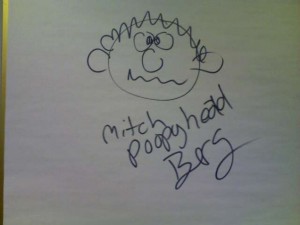
But a reader forwarded me this photo here, apparently taken from a local leftyblogger’s photostream:

14259_610855324329_45801136_36085916_8283331_n

Hm.

On the one hand, I do feel just a little bit younger, fielding “attacks” that I first fielded in second grade – which was the first of the several times in my life I’ve been smarter than all of my critics.

And it is both a more flattering rendition of me than any recent photo, and also nicer than anything my family or friends have called me in twenty years.

But I have to apologize; when I said that the local leftyblog community didn’t have a better cartoonist than Ken Weiner, I see I was, again, mistaken.

We can all learn, I guess.

Cheers, local leftybloggers!

(I’m no handwriting analyst – but in my mind’s eye, that looks like I’d imagine Robin “Rew” Marty’s flip-sheet scrawl looks).

UPDATE:  Robin submitted a sample of her flipchart writing (or…did she?) and it didn’t appear to be the same author (or…was it?)

Twin Cities Leftybloggers: Verdict – Guilty! Sentence – Ridicule!

Wednesday, November 25th, 2009

Here’s one for the Hall of Shame.

A few months ago, US Census worker Bill Sparkman was found dead.  The death was suspicious – he was found hanging, with anti-government graffiti scrawled on his chest.

This happened not long after Rep. Michele Bachmann spoke about her ambivalence about cooperating with a census that, at the time, the Obama Administration was overtly politicizing.

The Sorosphere leapt into action.  To pick three examples:

  • The direly-misnamed “Thinkprogress” took all of a day to conjure up a mythical right-wing terror movement  based on the death.
  • City Pages generic angst-filled hYpStR Matt Hoffman went all CSI on us before the police were even done at the crime scene:  “Now a census worker has been found in what appears to be an anti-government lynching. Does Bachmann own some responsibility?
  • Dusty “The Michael Brodkorb Of Snark” Trice delivered a verdict before they’d actually cut Sparkman’s body down: “I’m going to say it again because sadly I feel it bears repeating. I strongly believe that the inflammatory rhetoric Rep. Michele Bachmann thinks passes for policy debate is going to end in violence. 

“Inflammatory rhetoric”.  Heh. 

Heh.  Heh.

Oh, yeah.  It’s official; they were full of s**t (emphases added by me):

A part-time U.S. Census worker found dead near a secluded Clay County cemetery killed himself but tried to make the death look like a murder, authorities have concluded.

Bill Sparkman, 51, of London, apparently was trying to preserve payments under life insurance policies he had taken out, one as recently as May, which paid benefits if he died as a result of murder or accident, but not suicide or natural causes, police said.

Sparkman had survived a bout with cancer a few years ago, but he told a friend he believed the cancer had returned and that he would die, police said.

In a two-month investigation, police marshaled a number of reasons to conclude Sparkman ended his own life. Among other things, only Sparkman’s DNA was found on evidence at the scene, and he had told a friend details of his plan that matched what happened, police said at a news conference Tuesday.

And when, not if, some leftyblogging hamster tries to equivocate on this result, let it be repeated:

Police interviewed potential homicide suspects but ruled them out and found no evidence pointing to any conclusion except that Sparkman killed himself.

Matt?  Dusty?  “Think?” 

All of you leftyblog hamsters?

Do you have something to tell all the sane, responsible people?

Followup question:  Sparkman could have chosen many, many ways to cover up his suicide.  But as his last act on this earth, Sparkman apparently chose to go out in a way that, he would seem to have known, would implicate in his death a whole lot of peaceable, law-abiding people whose only “crime” is distrusting government; people like Rep. Bachmann and, incidentally, me (in addition to committing fraud).  Question:  Whose rhetoric is really doing the harm, here?

It Just Occurred To Me

Wednesday, November 25th, 2009

I ask people on the left, constantly, “so what, precisely, is the problem you have with Katherine Kersten – besides the fact that she’s a conservative?”

The closest thing I’ve seen to an answer that wasn’t solely fueled by politics was “she was never a reporter; she’s nothing but a think tank writer”.  In this story – one you usually hear from people in the media – the idea that spending years becoming a hard-drinking, dyspeptic “ink-stained wretch” is the bit of seasoning in the human stew that makes a columnist a columnist.  It’s sort of an echo of Nick Coleman’s  classic explanation of why he’s better than bloggers,  “I Know  Stuff”, where “stuff” equals “reporter” stuff – as if the life experience we all bring to the table doesn’t really give one a useful perspective on anything.  To these people, knowing the double-dog secret ace reporter handshake is the only real qualification.

Enh.

Another one – and this one is overtly partisan – is that “Kersten is closely linked to Power Line“.  I’ve heard it from any number of Twin Cities’ lefty writers, although Brian Lambert actually wrote it.

Now, I’ve seen a few leftymedia types jump from that to “Kersten and Powerline have the same opinions”, as if it’s unthinkable that four conservatives would have some occasional synchronicity, and ignoring that they, the critic, was usually in completely sync with “The Daily Kos” at any rate…

…but that’s not really the point.

I’m curious:  the leftymedia says that Kersten having the occasional episode of synchronicity with Power Line is a bad thing…

…while Nick Coleman  – the columnist against whom Kersten is constantly unfavorably compared because his decades as a reporter and columnist and just-plain observer – can get a complete pass for writing an uncritical, incurious, note-by-note regurgitation of a liberal think-tank piece to which Coleman added not a whiff of his vaunted no-nonsense reportorial curiosity or experience or world-weary inquisitiveness.  Indeed, Coleman added nothing but a little brow-beating prejudice.

So let me ask, again – what is the comparison, here?  Other than politics, of course?

The Schizo Pages

Wednesday, November 25th, 2009

Getting a job at the City Pages is apparently like getting a “diary” on Minnesota “Progressive” Project.

Otherwise, how would “Hart Van Denburg” have gotten to get this bit here published?

Last week, MinnPost gave controversial conservative scribe Katherine Kersten a free megaphone for her oft-repeated views on everything from gay marriage to liberal rage.

Ah.  So it’s a critique of “objective” (I slay me) publications allowing conservatives onto their pages.  Especially one that has drawn so much utterly deranged ire as Kersten.

…or – is it?

On Sunday, the St. Cloud Times did something similar for District 6 conservative Republican congresswoman Michele Bachmann.

Er…right?  She represents the district the Saint Cloud Times is in.  Worth an interview – right?  Especially given that it wasn’t two years ago that the lefty “alternative” media was in a lather because Bachmann purportedly didn’t do non-conservative media anymore. (Although as we found in the series I wrote, she does a lot more liberal media than Keith Ellison, Betty McCollum or Al Franken do conservative media).

Both interviews were published in a question-and-answer format in which the interviewers pitched softball questions and then never challenged their subjects on any of their assertions.

Ah.  I get it.  Now it critiques the interview style.  Because any time one interviews a conservative, one is supposed to bellow “You Are Teh Crazee!” until one loses bladder control.

St. Cloud Times Washington correspondent Larry Bivens penned the Bachmann interview. Here’s a sample exchange:

(Passage of interview in which Larry Bivens apparently did not jump on his desk and below “You are teh crazee” excised for brevity’s sake).

Just a month ago, Pawlenty joined forces with the likes of radio talk show host Rush Limbaugh and former Alaska Gov. Sarah Palin to endorse the Conservative Party’s Doug Hoffman in a campaign to unseat Republican Dede Scozzafava in New York’s District 23 congressional race.

Scozzafava was deemed not sufficiently conservative. She dropped out of the race.
Well, no, “Hart”.  She was deemed actually running a bit to the left of the Democrat.

Democrat Bill Owens won the election.

(Running against a third-party candidate who’d had weeks to mount a campaign on no budget, against not only Owens but against Scozzafava, who dumped a million into an election where she spent more time bagging on Hoffman than Owens, before bowing out).

But what is this piece trying to say?  “Bad Twin Cities media for talking to Kersten and Bachmann because Pawlenty joined with Limbaugh to endorse someone who didn’t win yet?”

Did I sit next to Hart Van Denburg on the bus the other day?

Their Master’s Voice

Tuesday, November 24th, 2009

Robin “Rew” Marty is leaving the Center for “Independent” Media – the “non-profit” that controls and bankrolls a whole slew of “independent” political propaganda sites like the Minnesoros “Independent“:

Over my years with the CIM my job became more and more operational based, and now that they are larger, they have hired enough people to move all operations into the DC office itself, and now having an operations person outside of DC just doesn’t make a lot of sense functionally. I’ll be wrapping up some advertising projects for them in the next two weeks, and then I’ll be moving on altogether.

In other words, any pretense of “independence” on the part of the Mindy would seem to be null and void; the national office has assumed control.

And is there a memory hole of some kind?  Remember – Robin was the Mindy’s first editor, back when they were still the Minnesoros Monitor.

But as I began to spend more time helping the CIM set up other state based networks, I moved internally to the CIM and Paul Schmelzer took over MinMon, probably the best thing to ever happen to that site.

I’ll agree that Schmelzer is a capable journalist, writer and editor – one of the best in the local leftyblogger market.

But – isn’t Robin forgetting someone?

Someone who bridged the time between Robin’s leaving and Paul’s accession?  Steve Perry, one of the more renowned muckraking journalists in the Twin Cities, who spent a year bringing over his pals from the City Pages to try to turn it into a real news organization…

…only to be rebuffed, as they found out after the election, when the CIM whacked most of the staff – because the mission (electing Obama) was accomplished?:

Robson became a casualty when MnIndy’s parent, the D.C.-based Center for Independent Media (CIM), eliminated the freelance budget entirely…However, Robson — who writes about arts for MinnPost and sports for The Rake — was caustic in his view [of] MnIndy’s Capitol overlords. He says CIM’s national staff was less interested in the organization’s professed mission — “a nonpartisan nonprofit organization that operates an independent online news network in the public interest” — than boosting the party of Barack Obama.

…after which Perry decamped?

Ah, well.  The left wrote the book on memory holes.

Anyway, Robin’s got big plans:

For now, I am going to be working on freelance and consulting projects, my first being a contract to work part time with one of my favorite advocacy groups

All the best, Robin!

(Via Luke Hellier on Twitter)

CORRECTION:  Apparently I’m the one who forgot:

[Schmelzer] took over MNindy in June of 2007 as editor, when [Marty] moved to the CIM itself.  Steve Perry came in as a senior editor in March of 2008, and then left in November of 2008.  Paul has been the editor all throughout that time.

In my defense, I’m a critic, not an HR person.

But duly noted.

Now The Strib Is A Giant Of Free Enterprise!

Monday, November 23rd, 2009

In the nearly eight years this blog has been a going concern, I’ve spent countless posts bagging on the Minneapolis Star/Tribune – usually for the relentlessly left-of-center orientation of the editorial board and columnists, although occasionally for really really bad reporting.  I’ve also noted, of course, that whatever their faults, they are a private organization.

On the other hand, I’ve noted plenty of times that while Minnesota Public Radio to a great extent reflects the prejudices and bigotries of its upper-middle-class Volvo-driving free-range-alpaca-wearing audience, and while they do in fact jump on every government subsidy they can get with both feet, they’ve at least made a fairly concerted effort to run a balanced news shop (an effort that NPR would do well to emulate while they can).

The Strib’s Mike Sweeney notes a conundrum in a Sunday editorial.

He tees up by noting that, as he sees it, the Strib’s recent bankruptcy reorganization have left the paper profitable and with the biggest news organization in the state.  And, says Sweeney, it needs to be:

In my 30 years in business, I have never seen a more exciting marketplace than today’s news industry. Citizens are more interested in news than ever, and there are countless organizations willing to provide it. For-profit businesses and nonprofits are all vying for your attention. Large technology-driven companies like Google and Yahoo are competing with niche businesses like Politico and the Huffington Post. And the nonprofit world has responded with terrific sites like Minnesota’s own e-democracy.org and MinnPost.

OK, so Sweeney doesn’t get out much.  e-“democracy” is a bunch of breathless DFL fanboys that actively squelches dissent and doesn’t so much “cover news” as it “spreads DFL press releases”.  Kind of like the Strib’s editorial board.

And hello Mike, but would it kill you to note that it was the very local, absolutely private phenenon of the conservative blogger – John Hinderaker and Scott Johnson at Power Line especially – that’s really led the change locally? Especially by shining a bright light on the worst of the Strib’s historical excesses?

It actually probably would.  I digress:

Against this robust backdrop, our community is facing important public policy questions. One that particularly concerns us is whether the government should provide taxpayer dollars to subsidize news media companies. From the Star Tribune’s perspective, the answer is a resounding “No!” We don’t want or need taxpayer subsidies, and we see no reason for government to disrupt an already robust, innovative market.

Well, good – we finally agree.

Minnesota Public Radio disagrees. This past week MPR convened a group of hand-picked speakers from across the country to proclaim the future of news. The selected panelists seemed to agree that newspapers could not evolve and that market intervention was necessary. Information about how newspapers were evolving and how entrepreneurs were innovating was shrugged off. There was apparent consensus that public radio could fill a perceived void by grabbing public funding. We have numerous concerns about publicly funded news, but our primary question is how an organization funded by government can objectively report on government.

Leaving aside the fact that the private (yay!) Strib does such a dodgy job of covering (one of the parties in our) government, that’s an excellent point.  Public media advocates (more the “socialize the media” crowd than the MPR crew) have long said that it’s impossible for commercial news operations to resist the whims and demands of the advertisers who support them.  They never actually answer when I ask “so how much better would it be if the group paying the freight  controls not merely an ad budget, but the police, the Department of Commerce, the Attorney General’s office and the Department of Revenue?”

For example, MPR has successfully lobbied state government for years to secure millions in subsidies to help finance its nonprofit business expansions, most recently obtaining $2.65 million in Legacy Amendment funds over a two-year period. Apparently MPR will use some of those taxpayer funds to compete with private media companies. In a time of such scarce government resources, should public money be allocated to a healthy nonprofit so that it can compete more aggressively with private, for-profit businesses?

And for MPR’s czar Bill Kling, that answer will be a resounding “yes”.  Remember, governent’s subsidies of public radio go way beyond the financial.  “Public broadcasting” has the low end of the FM dial more or less reserved to it; they have never had to compete in the scrum for licenses (although they did buy the classical, 99.5FM frequency in the Twin Cities 18 years ago from the former WLOL, a major leap into what had been commercial air).  More than that, the Federal Communications Commission has spent the past 20-30 years stonewalling the licensing of Low Power FM (LPFM) Radio, which would allow community groups to set up small FM radio stations with ranges of a couple miles for as little as $1,000.  Leading that stonewalling effort?  Bill Kling of MPR.

MPR will respond, correctly, that public funding is a small part of their budget.   Commercial radio people will respond “Yes, but it’s a huge budget”; MPR’s $2.65 million Legacy Amendment grant, which is a tiny fraction of MPR’s budget, is larger than the entire annual budget for the operation at which I broadcast – AM1280 The Patriot, AM980 The Believer and AM1570 The Businessman.  And while MPR supports a huge newsroom (the largest radio newsroom in the state, and one of the biggest in the metro in any medium) and three big stations as well as a regional network, it also has a huge staff, facilities that’d make an Abu Dhabian oil sheik blanche, and a powerful, not-cheap lobbying operation.

And given that reality, and the fact that MPR does make an awful lot of money without government subsidies, and has developed large, significant, and generally-profitable for-profit spinoffs that should be able to support the parent corporation, I think Sweeney is even more correct in questioning the need, much less the rationale, for these subsidies given the market news organizations face.

Brauer on the MNPost notes that Sweeney is being disingenuous in pointing out a subsidy when the Strib is going to receive, he says, the biggest one of all; publicly-funded stadiums do a lot to buff up the Strib’s balance sheet – especially if the state and team build a stadium on the site of their current headquarters building, making the property actually worth something.  It’s true, I note in the comment section – but it’s indirect, especially in the former case.  In the latter case – with the Strib playing its cards and its lobbying like mad to get the city/state/team/taxpayer to buy its land – it’s a little better case; it’d be disingenuous to claim that the Strib is no different than, say, a homeowner whose house is in the way of a new freeway.

The obvious answer, of course, is for government to stop subsidizing everything; business, poverty, the works.

More later.

When In Downtown Saint Paul Today…

Friday, November 20th, 2009

…and you’re wondering why there are forty nebbishy white guys with professor glasses and Elvis Costello hair cuts in front of you at Subway asking if there’s arugula and if the salami is free-range, and if the line at Caribou is paralyzed by perpetually outraged-looking women who look and sound like Sarah Vowell gabbing about why the Minnesota History Center is allowed to keep “his” in its name, and if you say “teabag” outloud and instead of a nervous titter or an uncomfortable shuffling of feet you get a round of applause so very very unanimous as to feel just a little bit odd?

Not to worry.  “Netroots Minnesota” is going on at the Hilton Garden.  “Progressive” bloggers will be coming from all over Minnesota and, one suspects, beyond, to demand more Hope and Change now!, and to respond in perfect enthusiastic unison “off what and how high?” when George Soros tells them to “Jump”.  Expect to see little clots of nervous twentysomethings who’ve never been east of the light rail wandering around lost; look for graying ex-hippies wandering the streets begging for cops to taze and teargas them so they can be in the news too, unaware that the RNC ended 14 months ago.

Look for the only people of color in the room to the on the panels or working for the hotel.

Some “highlights”

Tools to Hold Your Opponents AccountableSAT, 11/21/2009 – 3:30pm, Ballroom
Think your opponent has some skeletons in the closet? Are they prone to gaffes? Learn how to uncover their public records, negatives and voting record, as well as tracking the candidate on the campaign trail.
PANELISTS: Sally Jo Sorensen, Bluestem Prairie; DJ Danielson, Field Organizer, MN House DFL Caucus, 2008; Laura Askelin, President SEMN Labor Council; Liz McLoone, MN AFL CIO Field Representative & former Senate Majority staff.

In other words, “how to be a blog stalker”.   Because the local leftyblogosphere has such a shortage of ethics-challenged jagoffs who see themselves as ace reporters.

Push ‘N’ Pull: How Traditional Advocacy Organizations and Netroots Activists Can Create Progressive Change Through Impact Journalism and Action
SAT, 11/21/2009 – 10:15am, Town Square Ballroom

A one hour discussion with reporters, advocacy organizations and outreach communicators on how to create impactful stories, reach out to interested advocacy groups, and bring about action that will create real change. We will also walk through a case study of how one article written in September of 2008 eventually forced John McCain to concede Michigan.
PANELISTS: Paul Schmelzer, Center for Independent Media; Hanaa Rifaey, Center for Independent Media; Denise Cardinal, Alliance for a Better Minnesota

Hint to leftybloggers:  save the money on this one; all they do is tell you to call the Republican “crazy” in a thousand different ways.  A good thesaurus will do the trick.

Oh, yeah – and if you ever wondered about the rigorous fairness of the Strib’s coverage of regional politics, wonder no more (emphasis added by yours truly)!

Gubernatorial Candidate ForumFRI, 11/20/2009 – 6:00PM, Town Square Ballroom
DFL candidates for governor will join us at Netroots Minnesota to take questions directly from you. The candidates will be asked questions solicited online via Twitter, Facebook, and email, and in person, during a discussion moderated by Star Tribune writer Lori Sturdevant.

I wonder if Star Tribune writer Lori Sturdevant will badger the DFL candidates to move to the center to return to the sainted “bipartisan” glory days of Minnesota politics?

Any bets on that?

Hey – I wonder if I could get a Strib columnist to host the next MOB party?  Other than Lileks, I mean?

Anyway, welcome to Saint Paul, Netroots (and if I were a classy fella like some of the leftymedia, I’d come up with a borderline obscene sexual reference for your gathering, and believe me, with a term like Netroots, there are a zillion of them, but that just isn’t how I roll).  I’ll be the guy selling “free range cocktails” from the pushcart on the street.

UPDATE:  I missed one:

Netiquette: From Polite to Pit Bull, Where Do You Cross the Line?

FRI, 11/20/2009 – 3:30PM, Phalen Room

We all have candidates we love and candidates we hate. Now it’s time to have an open and frank discussion about how to help our favorites online. Does being polite get you ignored? Does being a pit bull make people hate the candidate as much as they hate you? When is it too much, and how to handle abusive commenters? And, as always, learn how what to deal with anonymous trolls on your sites.

PANELISTS: Minnesota Observer, blogger; Mark Giselson, Kurt Schiebel, blogs as Flash

Since the vast majority of leftybloggers are anonymous trolls (there are exceptions, but I’m talking the rule here), that discussion will be either very short and dry or very, very long and animated.

As far as that “Does being polite get you ignored? Does being a pit bull make people hate the candidate as much as they hate you?”  Well, Flash has the “polite” thing generally down, so I’m going to guess Gisleson is supposed to be the “pit bull”.  To which I’d love to ask – where does “pit bull” start, and “profane and overbearing” end?

And as far as “does it make the candidate hate you” – they really should be interviewing the Dump Bachmann people and, for an extra perspective, people from Bachmann’s office.  I’m fairly convinced that the Dump contributed at least a point to both of Bachmann’s victory margins; between them and the City Pages fairly loathsome cover story this week, I think there’s a two point floor right there that the lefthsphere has given the good Representative.

One Day At the MNPublius Offices

Monday, November 16th, 2009

SCENE:  11AM in the editorial board room of Minnesota-based politics blog MNPublius.

ZACK: (sitting in an overstuffed leather chair, sipping from a snifter of brandy as SEAN walks into the conference room).  Hey, Sean.  How’s it going?

SEAN: (pouring a scotch as he takes a seat by the highly-polished oak table) – Hey, Zack.  Just looking at the resumes from all of Dusty Trice’s minions.  Now that he’s closed shop, they’re all looking for work.

ZACK:  Huh.  (takes a sip, as SEAN feeds a ream of  resumes into a nearby paper shredder).  Where’s Matt? 

ZACK:  He’s texted me.  He’s just coming in from the parking ramp.  He had to get the Prius fixed.

SEAN: Ah. 

(JEFF enters the room, takes seat)

ZACK:  So what’s new, gentlemen?

SEAN:  Well, I spent Friday trading emails with Paul Harris of the London Observer.  He’s doing a piece on female conservatives, and he heard we were the authorities on Michele Bachmann.

ZACK:  And he didn’t go to Dump Bachmann

SEAN:  He’s a Brit journalist, but he’s not insane.

ZACK: Excellent!  So did you send the new glossy talking point sheet?

SEAN: Yep, the one that calls ’em all crazy and dangrous.  Or dangerous and crazy.  I forget.  Anyway,  I had to break open a new box of them, but yes.  I did. 

MATT: (enters room, yelling over shoulder as he takes a seat) And Consuela?  Have all my calls and texts held.  And get me a double-skim goat chai, stat!

CONSUELA (from anteroom) Si, senor Matt!

MATT:  Hey, guys.

ZACK:  Hey, Matt.  And did you send the ugliest picture of Bachmann you could find?

SEAN:  Oh, yeah.  I had to dig deep, but I finally found one that almost was too bad to be an Avidor photoshop. 

JEFF (sotto voce to MATT): “Avidor?”

MATT: Ken Weiner.

ZACK:  And you gave him a phone interview?

SEAN:  Er, huh? 

ZACK:  A phone interview.  We always do phone inter…

SEAN: Right.  The phone interview, I know.  I thought Jeff was doing the interview?

JEFF:  Um, no – I thought Matt was doing it.

MATT:  Um, no, I was busy doing oppo research on “Ben” and “Mall Diva”.  Er, hang on – Zack, I thought you handled all foreign media…

ZACK:  Oh, crap.  That means…

CONSUELA:  (Enters room, carrying bundle of newspapers) I brought the newspapers, sirs.  (places them on table, backs from room).

ZACK: (leaps to feet, looking agitated, thrashes through pile of papers) Independent…Independent…Indep…AH!  Here it is!  (flips through paper as SEAN, JEFF and MATT gather behind him to read).

SEAN:  There it is!

MATT:  Oh, crap:

 “It is hard to think that people take her seriously. But on a national level it is happening. It scares me,” said Aaron Landry, a senior correspondent at MNpublius.com, a Minnesota-based politics blog.

ZACK:  “Senior Correspondent?” 

MATT: {{Facepalm}}

SEAN:  Who the hell told him to call himself…

JEFF: Jeezus, Landry – you’re a blogger

MATT:  Good goddess; he’s Fecke’d us.

ZACK: (yells out the door) Consuela!  Get Cartman on the line!

SEAN:  (takes long drink, puts down glass, holds head in hands) Oh, man – we’re never gonna live this down.

(And scene).

Lashing Back At The Waves Of Stupid

Monday, November 16th, 2009

Trafalgar Square in London is one of London’s great memorials.  The tribute to Lord Nelson and his epic naval victory at Trafalgar is one of the signature sites in one of the world’s great cities.

The square has a series of  “plinths” – the technical term for statue-stands.  Three of them are occupied by statues of King George IV, Henry Havelock and Sir Charles Napier. The fourth of the plinths, built in 1841, has never been permanently occupied by a statue.  Over the years, it’s been the scene of stunts, demonstrations, and often occupied by temporary statues, some of them debuting on the plinth before being put in their permanent locations.  Some of them were of genuine British heroes; others, during the reight of London’s longtime socialist wackjob mayor wackjob mayor Ken Livingstone, were more, er, unconventional.

But the latest occupant of the Fourth Plinth is a statue of a hero that is someone obscure to Britons, and even moreso to Americans – even though he played an absolutely crucial role in the survival of western civilization seventy years ago.

It’s Air Vice Marshal Keith Park, a New Zealander who commanded the Royal Air Force’s “11 Group”, the fighters responsible for defending London and southeast England during the Battle of Britain.   Had 11 Group failed in its mission, Hitler would have won air superiority over the English Channel and the southwest of the UK.  It would have cleared the way for an invasion of the UK which, given the British Army’s badly-depleted state after Dunkirk, would likely have led to a Nazi victory in World War II.

The picture shows him in a fairly typical pose, pulling on one of his flight gloves as he got ready to climb into his personal Hawker Hurricane to keep up the relentless schedule of touring his airfields, checking up on his men, the hundreds of 20-25 year old pilots that died by the score, but saved the day for the UK and, incidentally, all of us.

I don’t know if it’s accurate to call Mary Wakefield, columnist for the London Independent, any more or less knowledgeable about history than any other “journalist”, here or there.  I don’t know if her knowledge of history is any more addled than that of any other Briton or American.  I don’t know if her giggly, show-biz-centered “mind” is any more  or less acute than that of any of the other bobbleheads in our “gatekeeping” class.

But reading this column about the Park statue…:

So Air Chief Marshal Sir Keith Park has made it up on to the fourth plinth in Trafalgar Square at long last. Arise, Sir Keith, good job. I salute you as I cycle past, for without you (I’m told) the Battle of Britain would have been lost and the free world a goner. OK, I’m lying. The truth is, I’d never heard of Keith Park GCB, KBE, MC before the campaign to plinth him began, and I still can’t quite figure out what all the fuss is about.

…I got a bad feeling about the answer.

Being one of the western world’s elite gatekeepers, one might think an enquiring mind like Mary Wakefield’s could have figured it out.

The campaign was frighteningly well organised and well funded: field marshals, MPs, Tony Benn, the vice-chancellor of Oxford ? they’ve been at it for years, pushing for Park, but why? Surely there are other, better known and just as heroic or deserving candidates.

Other than millions of other British World War II veterans?  Or the millions of civilians that survived the German blitz, the firebombing of London?  Perhaps – but it’d get crowded on that little plinth.

What about the Queen? There are other questions too. What were the Parkies thinking when they chose to depict their hero pulling on what looks like a pre-op surgical glove?

{{facepalm}}

And why such intensity and lack of humour?

We can forgive Mary Wakefield.  While the Battle of Britain may have lacked the gravitas of, say, the Spice Girls breaking up, it may have slipped her mind.

Clive James, writing for the Beeb, has a long, excellent  response.

Crackers

Monday, November 16th, 2009

As expected, Andy Birkey of the Minnesoros “Independent” was at last week’s “Appeal to Heaven” fundraiser for You Can Run But You Can Not Hide, a Christian group that evangelizes in the most hostile environment in America today – public schools.  (Pointless and unneeded disclosure that serves more as inter-station out-shouting: YCRBYCNH’s Bradlee Dean and Jake MacMillan co-host Sons of Liberty, on AM1280, which follows Ed and I on Saturday afternoons).

Everyone expected Birkey to show up, because the special guest speaker was Rep. Michele Bachmann.  If Rep. Bachmann stops for a hamburger, the “Independent” is there.

Now, I didn’t attend the event – I had a school thing for one of my kids to go to.

But I was drawn to this bit here in Birkey’s coverage (with emphasis added by me):

The almost exclusively white crowd had assembled at the Sheraton ballroom in Bloomington to raise funds for the ministry

“Almost exclusively white?”

Part of me wonders if Birkey can qualify or quantify the phrase “almost exclusively white”.  How many non-white people were there?  One?  Ten? Five percent?  How does one contextualize “almost exclusively white” in a state that is, let’s remember, almost exclusively (over 90%) white (about four percent black, three percent Asian and about a fifth of a percent Hispanic).

The other part of me wants to stand on a soapbox and remind the world…

…that however “almost exclusively” white the crowd at YCRBYCNH’s rally may have been, it is and shall always be less so than the white, college-educated, middle-class staff of the Minnesoros “Independent” will ever be.  The Mindy’s staff, with the brief exception of Abdi Aynte, has always been vastly whiter than Minnesota as a whole.

For those of you who keep count of such things.

Nope. No Liberal Media Here.

Friday, November 13th, 2009

If, say, Ed Morrissey – my friend, radio colleague and longtime fellow Northern Alliance blogger – were to write something in incredibly dubious taste, and I wanted to do something to say “I’m not with him on this”, what would it be called?

Disavowing?

Repudiating?

Chiding?

You have a wide variety of English verbs to use for the purpose.

One of them would not be “Back Off”.  To back off of something implies you’ve done something in the first place to “back off” from.

Kevin Diaz, writing at the Strib’s “Hot Dish Politics” blog, notes that Rep. Bachmann has repudiated/chided some of the people who brought some fairly inappropriate placards to her demonstration on Capitol Hill last week:

U.S. Rep. Michele Bachmann, who’s been getting a lot of media attention since her starring role at a D.C. rally against the House health reform bill last week, has been distancing herself from the Holocaust imagery displayed by some of the participants in the event.

“Sadly, some individuals chose to marginalize tragic events in human history, such as the Holocaust, by invoking imagery and labels which have no purpose in a policy debate about health care,” the Minnesota Republican said in a statement she has been sending out to reporters in recent days.

Of course, whenever you go to a demonstration that is open to the general public, you’re going to draw a thin film of nutters.  They turned out to all three of the Minnesota Tea Parties – a tiny few of them, anyway (although the leftymedia coverering the event did in fact focus on them to the exclusion of the 99% majority of pretty regular workadaddy hugamommy people who showed up – a dishonesty far worse than Fox News’ inflation of the Bachmann rally’s numbers in its own way).   And if you’re a conservative, you get used to having to drag liberals back to the real conversation; to too many of them, the odd nutter at a conservative rally is like a shiny piece of tinfoil to a kitten.

The placard in question, the leftymedia bleated, was one showing piles of bodies at a concentration camp after World War II; it equated Obamacare to the Nazi healthcare plan applied to Jews.  As I noted in this blog last week, it was pretty stupid, partly for its historical ignorance, and more for the opening it gave the leftymedia to portray the event as if every protester and Rep. Bachmann was carrying one. 

(I also noted that it’s great, absolutely fabulous in fact, that the left…


…has gotten so very conscientious…

…about not wanting to cheapen the horror of the Holocaust and the Nazi regime…

…for moronic political effect.

Well played, Left!

At any rate, it was a stupid placard.  And Rep. Bachmann repudiated/chided it:

“These regrettable actions negatively shift the focus of the current discussion on this issue,” her statement continues. “The American people deserve an open and honest debate to ensure the best possible solution to our health care problems, and I agree that these unfortunate instances are wholly inappropriate.”

Of course, Bachmann’s demonstration drew blood, and the left realizes it needs to marginalize it as much as possible – in this case, by trying to convince the world that a duck is not a duck, or in this case that a moron with an inappropriate placard is really an official statement by Rep. Bachmann (in the same way that the right ascribed the many, many trivializations of Naziism that became such a cottage industry on the left, to the left):

Bachmann’s statement comes after U.S. Rep. Steve Israel, a Jewish Democrat from Long Island, called on her to apologize for the offending images at the Capitol Hill rally, which she’s been largely credited with inspiring and organizing.

 Yadda yadda.

At any rate, this is all background to the real point of this post.  Now, with newspaper headlines in print editions, headlines are usually not the responsibility of the writer/reporter who does the actual story.  It’s a copy editor who writes those.

I’m not sure who writes the headlines on the Strib’s online publications – if it was Kevin Diaz, or some minion in the copy or web department.  But someone put a title on Diaz’ post:

Bachmann backs off from Holocaust images

Er, yeah.  But Bachmann didn’t use any Holocaust images.  She never mentioned the Holocaust, to my knowledge, in the history of the healthcare debate, much less at her demonstration.  It was someone in the audience.

How can Bachmann “back off” something she, herself, never did, said or implied?

And if your answer is “the leader is responsible for the actions of even his/her most demented follower”, then I’ll await your collective apology, from President Obama, Nancy Pelosi, Barbara Boxer and Howard Dean on down, for the repeated, slanderous “Nazi” references that conservatism and conservatives have endured this past nine years.

Deal?

When I Say “People Are Still Upset…

Thursday, November 12th, 2009

…about 60 Minutes’ fraudulent “Texas Air National Guard Memos” story from 2004″…

…I don’t mean to be anthrocentric.

At Long Last Scruples

Thursday, November 12th, 2009

Fox News got busted altering photos of Rep. Bachmann’s rally to make it look bigger than it was.  (As if getting 10,000 people from around the country to turn out on almost no notice was any mean feat).

Bad Hannity.  Bad boy.  Give your radio show to someone else in penance.  Like me.

But isn’t the left just a tad disingenuous in baying “foul” at the moon over using pictures to lie?  Laura, writing at the Greenroom, has been keeping a list and checking it twice:

There is no excuse for what Fox News did, and I’m glad they were caught at it.  I’m not aware of anyone on the right defending it.  But spare me the outrageously outrageous outrage, lefties.  You don’t have a leg to stand on.

Always remember Berg’s Seventh Law – when they accuse conservatives of hatred or perfidy, they’re projecting.

Conventional Stupidity

Tuesday, November 10th, 2009

“Conservatives hate women” is conventional wisdom…

…among people who aren’t all that wise

– in this case, Politico’s Meredith Shiner and Glenn Thrush:

But the growing schism between the Republican Party’s ascendant right wing and its shrinking moderate core has clear gender undertones — and Scozzafava’s departure raises fresh questions about the GOP’s ability to recruit, elect and even tolerate the sort of moderate women who used to be part of its ruling mainstream.

While Republicans scored a pair of impressive electoral victories in New Jersey and Virginia with solid support among female voters, the events of the last week offer harbingers of serious trouble ahead with the largest swing voter bloc in the country — women.

Right.  Because Dede Scozzafava is the only woman in the GOP.

As opposed to Sarah Palin and Sarah Palin?  Or – here in Minnesota – conservative movement stalwarts Pat Anderson and Laura Brod?

Rob Port from Say Anything:

The problem with this analysis?  It’s awfully selective.  It leaves out people like Arlen Spector and Lindsey Graham, both frequent targets ofthe conservative base.  And it also leaves out Sarah Palin and Michele Bachmann, both very popular figures within the resurgent conservative movement.

If the tea party movement had a problem with women, why would people like Sarah Palin and Michele Bachmann figure so prominently in it?  And why wouldthe opposition to so-called “RINOS” or ‘moderates” include both men and women?

Leave aside the fact that many of the Tea Parties – including the Twin Cities’ ones – are largely organized by…women?

Politico has a conclusion in search of data.

Kersten: The Shorter “Every Liberal’s Critique”

Monday, November 9th, 2009

There is no person in the Twin Cities media that inspires more unreasoning derangement than Katherine Kersten.  When it was announced, several years ago, that she’d be joining the columnist staff at the Strib, the “journalist” community acted like management had proposed mandatory sodomy during work breaks.

The Twin Cities’ “journalist” community – which has tolerated all manner of abuses of contact, fact and selective omission and mangling of context with scarcely a peep – was concerned about the “journalistic integrity” of the Strib’s famously biased, fact-challenged editorial pages.

But for these many years, I’ve been trying to press these people for details.

Here’s a typical exchange (*) from a local chat room frequented by media and near-media:

[Writer A]: Katherine Kersten is teh suck.

Mitchberg: Er, why do you say that?

[Writer A]: Have you read her latest article in the Strib?

Mitchberg: Yeah.  What about it?

[Writer A]: She says that marriage is about having kids.

Mitchberg: Yeah.  And…?

[Writer A]: That And she says that people who don’t have kids should get married!

[Editor B]: Hah!  She is teh crazee! LOLZ!  Can I haz baybee?

Mitchberg: Y Er, OK, both of you – I read the whole article.  She says no such thing.  Merely that the institution of marriage, traditionally and historically, throughout the world’s many, impossibly diverse cultures, is pretty universally about bringing men and women together to have children.  And that the dissolution of this tradition has caused lots of problems in our society.

[Writer A]: Marriage is about kids?  What?  What about adults?

Mitchberg: You’ve never been married, have you?

[Writer A]: No, and what does that have to do with it?

Mitchberg: Er, never mind.  Look, her main point is that marriage has always been how societies see to the upbringing and protection of children.  It goes back to prehistory.

[Writer A]: Marriage was always about property.

Mitchberg: Well, yeah, managing property, sure…

[Writer A]: No, because women were property.

Mitchberg: Er, yeah.  Put down the Womyn’s Studies textbook.  There are a zillion societies on earth, and their treatment of women varied widely.  In some, they were chattel.  In others, they were second-class citizens at best. In sub-saharan Africa, most societies were matriarchal, and in much of Asia many societies had a stealth matriarchy.  The treatment of women varies, historically, as widely as possible.  Others were not a whole lot different than we see ourselves today.  And some societies detested homosexuality with a homicidal passion, and others tolerated it with no major issues.  The variations were almost infinite.  And yet every single one of these societies had one thing in common; they were an institution in which man/men came together with woman/women to have, protect and raise children.  What do you suppose the odds were, given the vast number of permutations in every other facet of male-female relationships, that pretty much every one would see marriage as a union of males and females to raise kids?

Mitchberg: Hello?

[Writer A]: So people who don’t have kids shouldn’t marry?

[Editor B]: LOLZ!  ShE Iz tha CrayXEE, Beeyotch!

Mitchberg: Ed, yeah, got it.  A, I didn’t say that.  Could you show me where she does?  Of course you can’t.  Kersten neither prescribes nor proscribes.  She merely points out that the institution of marriage exists for a reason, and that reason isn’t sharing employee benefits.  Do I believe having kids is the only justification for marriage?  I dunno.  In the extremely unlikely event I marry again, I’m sure not having any more.  I’ve done my time.

[Writer A]: So you agree with her.

Mitchberg: Er, that’s kinda NOT what I said.

[Producer C]: I would think as a conservative you’d want the Strib to hire a smart conservative to represent your side.

Mitchberg: Let’s stay, hypothetically, that Katherine Kersten really is a poor writer, and that, as you also say, everyone always knew it.  Given the panic the Strib’s editorial board and columnists went into over hiring the putatively sub-par Kersten, do you honestly think they’d go and hire an even better conservative?  I mean, even as things are and/or putatively are, Kersten give them aneurysms.  Can you imagine if they had a bigger, badder one in the newsroom?

[Writer A]: So  you think marriage is about kids.  Isn’t it about adults?

Mitchberg: You may have perfectly summed up the crux of the Culture War.  Some believe marriage is about benefits, status and adult concerns.  Some of us believe it’s about raising kidst.  It seems the twain will never meet.

[Writer A]: This is futile.  She is teh dumb.

[Editor B]: And she a looser.

(*) Of course it’s satire.  Any resemblance to conversations I’ve had with people in the Twin Cities media and sorta-media in past – especially in the past 48 hours – is purely coincidental.  All celebrity written voices are impersonated – badly .

Mitchberg: Yeah.  And…?

Not To Indulge In Stereotypes, Necessarily…

Tuesday, November 3rd, 2009

…but really, what kind of a he-man do you have to to flex on your newspaper’s “Style” reporter?

Oh, this is about the throwdown in the WaPo newsroom between Style reporter Manuel Roig-Franzia and Henry Allen:

Multiple Post sources independently confirmed to POLITICO that Roig-Franzia got hit while defending colleague Monica Hesse from harsh criticism leveled by her editor, Allen. 

Allen, according to the Washingtonian, had told Hesse that a piece she had written was “the second worst story I have seen in Style in 43 years.”

 Roig-Franzia, also working a story with Hesse that ran Saturday, told Allen not to be such a “c—sucker.”

Q: When two newspapers reports slug it out, who wins?

A:  The whole world.

--> Site Meter -->