Archive for the 'WW1 – Fact and Myth' Category

No Man’s Holiday

Thursday, December 25th, 2014

The legendary “Christmas Truce” was 100 years ago, obviously, this morning.

The event was commemorated by an ad by a British supermarket chain last month:

It was an ad that received some criticism – and some articulate defense

It was also not nearly as rare as one might have thought.

As the war ground from its grisly summer – the Battle of the Frontier, Mons, the Marne and First Ypres – and the front lines stabilized, the war shifted from a war of mobility slowly ground down into the positional, stalemated war of attrition that we associate with the war today.   Troops started by digging foxholes for cover, when the war of movement stalled out.  Then troops connected their foxholes with their neighbors.  These trenches quickly connected squads, then platoons, companies, battalions, regiments, brigades, divisions, corps, field armies, and finally the entire front, from the Belgian town of Niewport on the North Sea all the way to the Swiss border. 

And they were famously miserable places, especially in rain-sodden Flanders.  Stories emerged of trenches becoming completely flooded near Ypres in 1914, and the rival British and German troops reaching a tacit agreement not to shoot at each other as they climbed out of their holes and dried off and waited for the water to recede.

And as the war dried out but froze over in the winter of 1914, soldiers of both sides – homesick, exhausted, and tired of the war – started staging little mini-truces.

The first one was on December 11, 1914; two companies of the 2nd Battalion of the Essex Regiment made tentative contact with German soldiers of the 181st Regiment of the 19th Saxon Corps.

A letter to the editor described the December 11 incident:

Amusing trench incident. “Tommy” [slang for any British soldier, much like the much-later “GI”, only much more prevalent as slang] and “Fritz” exchange presents. One of the oddities of the war in the Western battlefields at all events (says the Daily Chronicle) is the close proximity of the opposing forces in the trenches, thus giving opportunities for conversation. But the record must surely be made by an incident described in a letter from Private H Scrutton, Essex Regiment, to relatives at Wood Green, Norwich. He writes:- As I told you before our trenches are only 30 or 40 yards away from the Germans. This led to an exciting incident the other day. Our fellows have been in the habit of shouting across to the enemy and we used to get answers from them. We were told to get into conversation with them and this is what happened:- From out trenches: “Good morning Fritz.” (No answer). “Good morning Fritz.” (Still no answer). “GOOD MORNING FRITZ.” From German trenches: “Good morning.” From our trench: “How are you?” “All right.” “Come over here, Fritz.” “No. If I come I get shot.” “No you won’t. Come on.” “No fear.” “Come and get some fags, Fritz.” “No. You come half way and I meet you.” “All right.” One of our fellows thereupon stuffed his pocket with fags and got over the trench. The German got over his trench, and right enough they met half way and shook hands, Fitz taking the fags and giving cheese in exchange. It was good to see the Germans standing on top of their trenches and the English also, with caps waving in the air, all cheering. About 18 of our men went half way and met about the same number of Germans. This lasted about half an hour when each side returned to their trenches to shoot at each other again. What I have written is the truth but don’t think we got chums as two of our fellows were killed the same night, and I don’t know how many (sic) of them.

As many as 100,000 troops may have participated in spontaneous truces between various opposing units on Christmas Eve and Christmas Day.  Historians disagree on the details – some claim that while soccer games broke out, they were mostly among troops on the same side.  Others point to 3-4 Brit-vs.-German matches along the trench line, altogether. 

Fraternization was, of course, not part of the plan for those whose job it was to try to bring the war to an end by conquering the enemy.  Measures were taken to prevent further such truces; higher command rotated troops among different trench areas, to prevent units becoming too  familiar with one another.  They scheduled artillery bombardments for Christmas Eve and Christmas Day, to make fraternizing dangerous.  And over the course of the war, the go-along-to-get-along attitude of the first winter was replaced by a lot of survivors’ emnnity. 

Ian Tuttle, writing in National Review, responded to criticism of the video above – and touches on a much deeper point:

“If only it were all so simple!” wrote the great Soviet dissident Aleksandr Solzhenitsyn.

“If only there were evil people somewhere insidiously committing evil deeds, and it were necessary only to separate them from the rest of us and destroy them. But the line dividing good and evil cuts through the heart of every human being.”

[Guardian columnist and ad critic Iain] Fogg wishes “to retain those [soldiers’] deaths with respect and a degree of reverence.” But to try to do that by denying to the Great War all beauty — especially the beauty of gratuitous, unjustifiable human compassion — would strip those honored dead of the very reason they deserve respect and reverence: because they were human, because the line dividing good and evil cut through their hearts, too. And while it occasioned much carnage and misery, it also spurred acts of compassion, generosity, and more, which generated beauty even in the midst of desolation. Why would one seek to bury that fact?

America today is divided by trenches much less violent than the ones that divided Europe 100 years ago.

And so whatever side you’re on, Merry Christmas.  Or Fröhliche Weinachten.

Of Warriors And Pals

Monday, September 1st, 2014

Throughout history, the art and craft of war – of using violence in the interest of one’s family, village, clan, tribe, city-state, state, barony, duchy, kingdom or country, has taken one of three, sometimes-interleaving paths.

In some states – mostly smaller ones with little demographic freeboard for such things as specialized militaries, but also nations ranging from Athens, Switzerland, Israel and, in theory and through about 1900 practice in the United States – “defense” was considered part of the freight, along with taxation and jury duty, of belonging to society.  The theory was that the citizen militia, fighting to defend home and hearth, would prevail over any invaders – and shouldn’t be called upon to invade.

Yep, they’re Americans. A Philadelphia “Zouave” regiment, patterned after French North African troops that were all the rage in 1861, musters at the beginning of the Civil War, in the American style – muster locally, and then serve the federal government.

In still others – from many a feudal fiefdom through Napoleon’s legions through war machines as diverse as the USA and USSR in World War 2 – the common non-warrior, be he a knave, serf, peasant or citizen – could be expected to  be impressed into some form of service as some degree of cannon-fodder or another when the duke, king or Country needed cannon-fodder, on the theory that the citizen/fyrd/serf owes some form of service, up to and including their life, to the state, and the additional theory that having as many people under arms as possible was the best way to ensure victory.

A cartoon lampooning Napoleon’s conscript military. Bonaparte introduced mass conscription, teaching his peasant soldiers the bare rudiments in a tactical doctrine that emphasized speed and brute force, and so conquering most of Europe.

Finally – in some states that developed enough size and wealth to support the specialization, and the philosophy that war was best fought by the professionals, came the idea of the professional caste of warrior elites.   These elites stated in legendary antiquity – the Spartan soldier and the Roman Legionary were both long-service elites – and carries forth in the idea of the “volunteer military” that the US, UK and most NATO countries have adopted since the end of the Vietnam and Cold Wars.  In between the two extremes, the “armies” of most European monarchies were, to one degree or another, long-serving professional military elites (fear of the repressive power of which led the United States to adopt the “citizen militia” noted above, at least in its early years).

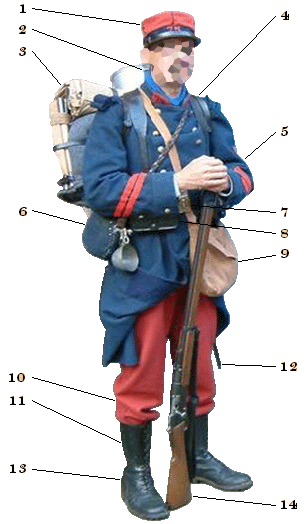
A French infantryman, 1914. By the end of the year, the red was gone – but the blue remained, on the theory that it was a difficult color to see in action. Maybe it worked, maybe it didn’t; the French army retained “horizon bleu” as its standard battledress color until 1940.

The three systems – especially the mass levy and professional military systems – have collided many times over the centuries.  But it was 100 years ago this past week that they collided in a way that is still shaking the respective societies involved to this day.

The Industrial Disease:  As Europe slid into world war 100 years ago this summer, the Continental powers – in whom the memory of Napoleon was still vivid and only 100 years in the past, and the two largest of which (France and Germany) had fought a mass, industrial war in the living memory of its political class (the Franco-Prussian war of 1871) – had all adopted large, mass armies; French, Austrian and German youth (outside the university class) were inducted for military training and decades of service in the reserves; each nation at the beginning of World War I could mobilize massive armies of reservists; 1.5 million Frenchmen were in uniform when the war kicked off; there were more Germans still.  The Russian military was larger still, formed from long-service conscripts (an institution dreaded by the peasantry of the day).

German cavalry on a training exercise, 1912.

The Warriors:  Against them, the British Army was a relatively tiny force of seven divisions each of about 15,000 men.  With cavalry and support troops, the British Expeditionary Force numbered less than 175,000 men.

BEF troops, lining up for inspection as they land in France, 100 years ago last July

The British Army of 1914 reflected centuries of British hesitancy over large militaries – Parliament still smelled the gunsmoke from the War of the Roses – and more centuries of colonial practice.  Britain’s empire was built as much through diplomatic craft, technology and exploitation of human nature as through raw force of arms.  It defeated Napoleon as much through its domination of the seas and the enlistment of continental allies as by British infantry’s guts and skill at Waterloo.  It conquered India and much of the rest of the world as much by playing coalitions of lesser tribes against larger tribes, neutralizing each other and providing loyal allies to assist the tiny numbers of British troops in maintaining control of places like India, South Africa and, for a time, the United States.  When open battle was joined, British technology – the breech-loading rifle and Gatling Gun against the Zulus, the steam frigate against the Algerian pirates – frequently multiplied the meager British forces.

The Few, The Proud:  Beyond that?  British units had something that’s foreign to most Americans, outside of those who follow the US Marines.

British infantry and cavalry, on enlisting in the military, would join a (usually) local “regiment” – which in the case of the infantry was less a fighting unit than a training depot and a repository of traditions and customs set off, usually, by some distinctive flashes in the unit uniform.  A  young man joining the infantry in the lowlands east of Glasgow, for example, would join the “Black Watch (42nd Infantry)”, a Scots regiment with several hundred years of history, dozens of battle honors, and a mythology every bit as long and exemplary as that of the US Marine Corps…

…and for exactly the same reason; to imbue in those soldiers an esprit de corps based on a standard of skill and behavior that would guide and inspire them in action.

The Royal Munster Fusiliers. The regiment was recruited in what is now the Irish Republic, and after WWI the unit became part of the Army of the Irish Republic – although the Irish disbanded the regiment by 1920. The Munster Fusiliers were heroes at the the Marne, and were reduced to a shadow of their former strength at Ypres and the Somme.

And just as it does with the USMC, it did (and to this day does) the same for the British soldier.

And at no time was that esprit de corps more firmly entrenched than with the British Army in 1914.

The Army was tiny by later standards – but every man among them was a volunteer, a long-service “regular” (backed by a “Territorial Army” of part-time soldiers that was a bit like our modern Army Reserve) who took immense pride in his skill at arms.

The Scots Guards leaving the Tower of London en route to France


And in none of those units did the Corps have more De Esprit than the Guards Regiments.  These men were screened not only for physical aptitude as infantrymen, but were all over six feet tall (so as to make the most imposing appearance on guard duty) and other martial virtues.  And in a day and age when ammunition was dirt cheap, they spent time on the rifle range that would dazzle even modern American soldiers, honing their marksmanship to a sheen not seen in any mass military before or since.

100 years ago last week, the cream of the Army – the BEF – had been held as a reserve as the French and German armies duked it out across Belgium and northern France, waiting for the situation to develop as the two belligerents met on August 22 in the Battle of the Frontier, the bloodiest single day of the war (yes, bloodier than any single day at the Somme, Verdun or Ypres).  The Frontiers battle ended in the French Army being stretched to breaking point (and the Belgians beyond theirs), with the Germans closing in in Paris.  And so the high command committed the BEF to the line at the First Battle of Mons.

BEF machine gunners at the Oise River, in the opening weeks of the war.

And at Mons the mass German force ran – over open terrain, toward shallow foxholes and ditches dug by the Brits – smack into all of that highly-trained rifle fire.  The British regulars scourged the German attacks, brutalizing them with rapid, accurate rifle fire so heavy that the German infantry thought they faced massed machine guns.  Far from it – the British issued two machine guns per battalion of 700 men, in the first year of the war.  It was British “tommies”, their skill with their bolt-action Lee Enfields such that they could work the bolts on their well-worn pieces with their thumbs without taking their fingers from their triggers, achieving rates of fire almost equal to the semi-automatic rifles the British infantryman wouldn’t get until the late 1950s, and accuracy that’d make a Navy SEAL cock an eyebrow from respect.

And the German Army – the mass of over a million draftees, recalled from the farms and factories and given rifles – battered itself half to death against the BEF’s line.  It was a scene of carnage that may have partially inspired Tolkein’s depiction of Elf fighting Orc at Helm’s Deep…

…including in its denouement.   Mons led to the First Battle of the Marne, the German high-water mark.  Then Le Cateau, and the Battle of the Aisne, where for the first time the side started digging trenches.  And then the First Battle of Ypres, in Belgium.  All between the third week of August and the beginning of October.

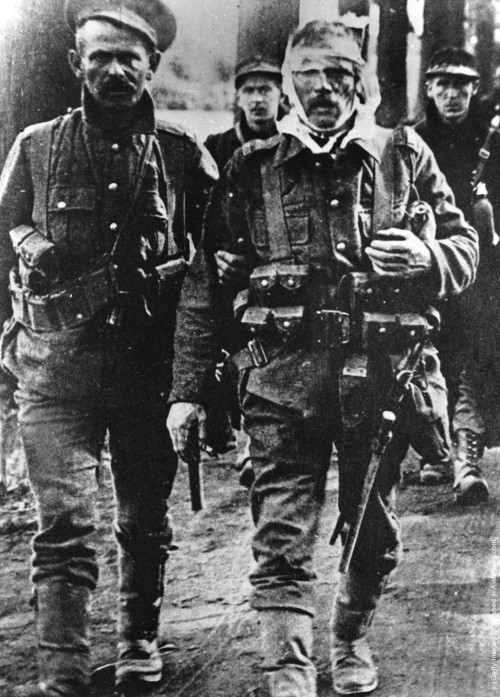
British and Belgian “walking wounded” at Mons.

And the constant attacks, and endless fighting, wore the BEF, perhaps the most elite mass army ever sent to war, down to a shadow of its former self.

The British Army had to resort to casting ever-wider nets for volunteers – eventually recruiting the “New Model Army” in time for the Somme in 1916, by which time the last of the veterans of the BEF were salted away as senior NCOs, a thin film of survivors leading a mass army of newbies and, after the bloodbath of the Somme and Second Ypres, the unthinkable; draftees.

It was the wearing down of the elite of the BEF that led, eventually, to the draft – an immense leap forward in government power over the individual that, in many ways, opened the way (in Britain as it would in the US) for further government intervention in the life of the individual even as the Great War was eating away at the barriers between the public and private sectors in the UK.

And 25 years later, when British troops went to war again, they jumped immediately to the draft, and to the mass levies that characterized, for the first time in human history, modern industrial warfare.

Just as would the US.

Battle of the Silver Helmets

Tuesday, August 12th, 2014

As a site, it was hard to miss the marching of the 4th German Cavalry Division on August 12, 1914.  Wearing the spiked Pickelhaube helmet, with steel lances and breastplates, and freshly-polished swords, the 4th Cavalry could have easily looked as if on parade.  Only instead of parade grounds, the men and horses of the unit marched through enemy Belgian territory.

Ordered to charge against the southern flank of the small town of Haelen, the 4th Cavalry squared off against a fellow cavalry unit, equally resplendent in their dress uniforms.  The 4th Cavalry led, quite literally, with the tips of lances.  The Belgians, dismounted from their horses, led with their guns.  The gentlemanly charm of the 19th Century military was about to collide with the vicious precision of the 20th.

—-

Speed had been the essence of German military planning for a war in Europe.

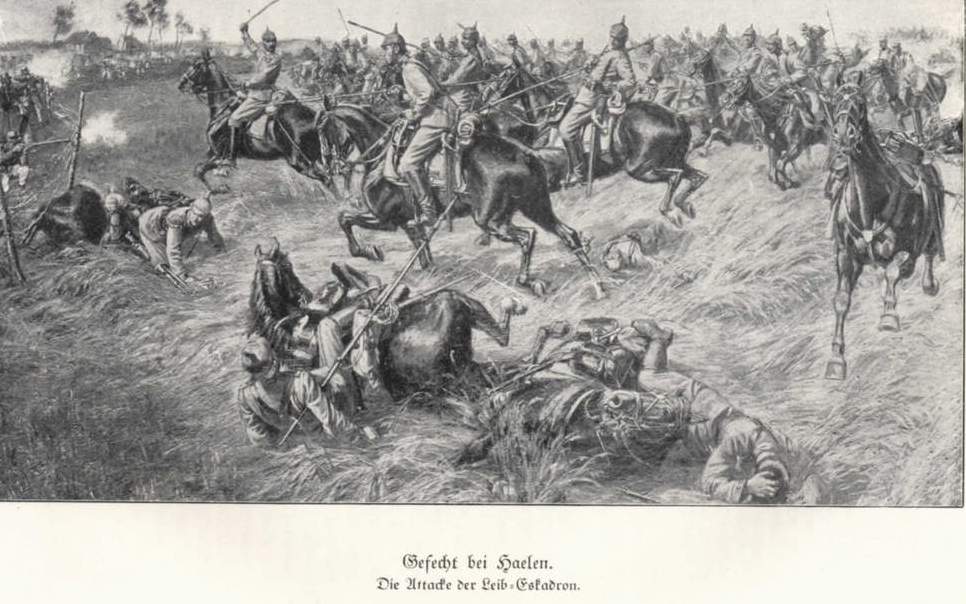
The somewhat romanticized view of the Battle of Haelen – dashing German cavalry units charging headlong into the Belgian line

(more…)

Scrambled

Thursday, August 7th, 2014

The British flag hung over the customs building in Lomé, Togoland, hoisted after 14 English troops, and a few conscripted police officers, had occupied the location.  A telegraph operator was sent for via bicycle to try and repair the recently cut line.  The small contingent waited for a larger British force, marching overland 50 miles in grueling August heat, to arrive and relief them.

Only days into their war with the German Empire, the British had their first new colonial possession – a small town in Western Africa that had been defended by 460 German colonists and Schutztruppe (Black African “protection forces”) the day before.  The “Scramble for Africa” among the European powers was over.  The scramble to claim as much German colonial territory as possible was on.

—-

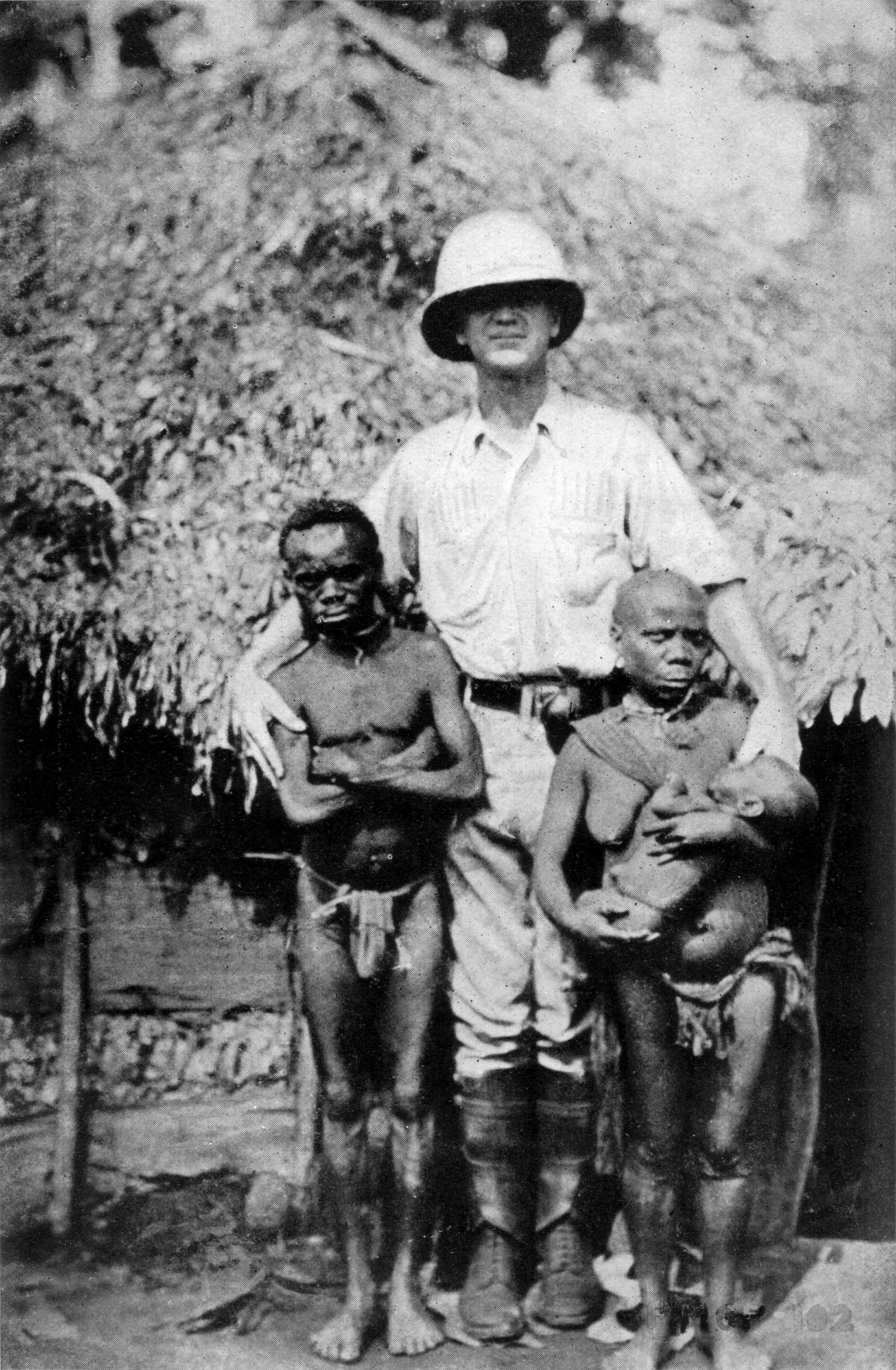
White Man’s Burden; Colonial Empire’s Opportunity – the patronizing view of Africa from the early 20th Century European perspective. The Allies claimed they were liberating Africans from brutal German rule (which was true, in some cases). But the war in Europe was nothing more than a causa belli to acquire more territory

The war didn’t have to come to Africa.  In fact, many in Africa had assumed it would bypass them completely.

(more…)

Scraps of Paper

Sunday, August 3rd, 2014

The telegram had been sent in haste, but time was of the essence at 4:23pm on August 1st, 1914.  From London, German ambassador Karl Max, the Prince of Lichnowsky, had sent to Berlin word that Britain would take steps to guarantee French neutrality in a conflict that had developed a momentum of it’s own.  The French, eager to diffuse the situation, had informed the Russians that they viewed their treaty as merely defensive, trying to halt the planned Russian mobilization that had spooked Germany into a mobilization of her own.  French Premier René Viviani went so far as to move French troops 60 miles away from the French/German border as a sign of goodwill.

Kaiser Wilhelm II gleefully accepted Britain’s terms.  Perhaps the war could be avoided – or at least the conflict would be a short one against Russia until either Austria was in Belgrade, the Serbs surrendered, or Russia realized the need to demobilize.  Wilhelm II quickly told his General Staff, led by Helmuth von Moltke to cancel the execution of the Schlieffen Plan and an attack on France.  Von Moltke was taken aback.  German troops had already started invading Luxembourg – the first steps towards invading Belgium and then France.  It was simply too late to stop.

The Great War had begun.

—-

Kaiser Roll (over): Wilhelm vacillated between supporting his Austrian ally and reining them in over Serbia. His mixed signals and general indecision gave his ally a “blank cheque” while suggesting Germany had no stomach for a fight to their opponents. It was a deadly combination

(more…)

The Peace to End All Peace

Saturday, June 28th, 2014

Muhamed Mehmedbašić might have hardly believed his luck.  Slowly motoring in front of him, armed with only the lightest of security (60 police officers total between the motorcade and destinations), sat the heir to the hated Austo-Hungarian Empire, Archduke Franz Ferdinand.  Mehmedbašić, armed with a bomb and accompanied by one of several accomplices, Vaso Čubrilović, had his chance to strike a blow for Bosnian nationalism, even if it was in service to Serbian nationalists.  This was the mission he and three others had been trained for.

Ferdinand’s motorcade sped closer to Mehmedbašić’s position at the garden of the Mostar Cafe.  And…he hesitated.  Mehmedbašić couldn’t do it.  His partner, Vaso Čubrilović, despite being armed with a pistol, couldn’t do it either.  However, the group’s third conspirator, Nedeljko Čabrinović, could.  Čabrinović threw his hand grenade at Ferdinand…and it promptly bounced off his car, rolling under the next vehicle and exploding.  16-20 people were wounded.  The Archduke was not among them.

By 10:30am on the morning of July 28th, 1914, it seemed that Europe had come perilously close to an act of war only to be pulled back again from the brink.

Eve of Regicide: (left-right standing) King Haakon VII (Norway), Tsar Ferdinand (Bulgaria), King Manuel II (Portugal), Kaiser Wilhelm II (Germany), King George I (Greece), King Albert I (Belgium); seated: King Alfonso XIII (Spain), King George V (Britain) and King Frederick VIII (Denmark)

Given the decades of carnage that followed, a certain mythology arose about the era before 1914.  An image of a world at peace, held together by seasoned diplomats and threatened by aristocratic dilettantes, grew as royalty was replaced by revolutionaries, eager to re-write the history of the preceding nearly 100 years. Europe, after the Napoleonic wars, was supposedly an Elysium peace undone between the monarchies and the anarchists that followed them.

But to believe such a narrative ignores decades of bloody history written between Napoleon’s final exile in Saint Helena and the declarations of war that started on August 1st, 1914.  The revolutions of 1848, wars of Italian and German unification in the 1860s and 1870s, the Crimean War, or even the Balkan Wars of 1912/13 showed Europe’s royalist peace was, at best, a facade.  Rather, Europe on the eve of June 28th, 1914 was a centuries-long Cold War that was looking for an excuse to steam to a boil.

A False Peace: Europe had seen years of war before 1914. The Balkan Wars of 1912-13, pictured here, set the stage of redrawing the map of Europe.

Continental European affairs had long been a struggle for a balance of power. France had been balanced against a collection of German states on the continent, and checked by Britain abroad.  The Italian states were a buffer against Austrian ambitions while Austria played the same role against Ottoman incursions into Europe.  Russia was simultaneously a European power and not – an ally for the burgeoning Balkan states, but also an enemy the rest of Europe looked at warily for it’s ambitions in Central Asia – against the Ottomans and also Britain.

This uneasy balance had been permanently altered by the Napoleonic age.  Not only had the concept of overthrowing monarchies become en vogue, but it saw that one powerful state could rule all of Europe – and thus potentially the world.  France in 1815 was little different than Germany in 1914 – a continental superpower who threatened political and economic stability by seeking dominance.  From the end of the Napoleonic wars to 1870, France was viewed as a state-level contagion; unable to be completely isolated and thus needing to be carefully watched and contained by her neighbors.

Archduke Franz Ferdinand being welcomed by Sarajevo’s Mayor. One attempt on the Archduke’s life had already been made that day

The unification of Germany flipped this script.  Britain, and the rest of Europe, suddenly realized a unified Germany represented a far greater threat to Europe’s balance of power than a clearly weakened France.  Germany, unable to comprehend that Britain’s prior alliances were born of political necessity, quickly grew to view their former ally as a future opponent and sought to challenge Britain in terms of naval force and colonial gains.  The speedy ascension of Germany’s battleships, including the mega battleship Dreadnought, and the Kaiser’s colonial possessions in Africa and Asia deeply worried European diplomats and monarchs.  Germany’s alliance with Austra-Hungary, the Duel Alliance, further inflamed fears that Germany was priming to dominate Europe.

In order to try and maintain the “cold war” atmosphere of dynastic détente, a series of new alliances arose.  Mortal enemies Britain and France now had a common fear – Imperial Germany.  While Britain still didn’t trust Tsar Nicholas II’s Russia, as the two nations competed in Central Asia in what would be known as “the Great Game”, France wanted to surround Germany, and thus an alliance was born.  Russia, fearful of having an allied Germany and Austria-Hungary on its borders, supported it’s fellow Slavic Serbs, who had just recently acquired independence.  The political calculations of the previous century, the roots of some of which stretched back further centuries, had shifted.  But the motivations that had compelled those prior alliances had not.

Fly the Bloody Flag: the blood-soaked remains of Ferdinand’s uniform

The balance of power brought about by these series of interlocking alliances worked as long as nothing tested them.  But the potential flashpoints were few and far between. Foreign political conflicts, like the Moroccan Crisis of 1906, saw war between the European powers threatened but come of nothing.  Only in the Balkans, where borders and boundaries were constantly shifting, and nationalists on all sides were attempting to seize control, did it seem likely that conflict among the major powers might occur.

Entering into this dangerous mixture was the former Ottoman Vilayet of Bosnia (Bosnia-Herzegovina today) and Archduke Franz Ferdinand.

Austria-Hungay had been given control of the region from the Ottomans in 1878 in return for the recognition of Serbia as an independent state.  Relations between the two monarchies were healthy, despite Serbian nationalist influences.  But the bloody overthrow of the pro-Austrian Serbian monarchy in 1903 completely changed that dynamic.  A pro-Russian monarchy took its place, leading a nervous Austria-Hungary to annex Bosnia in 1909, over Serbian protests. Serbian nationals responded with a series of assassination attempts, some successful, against Austrian officials in Bosnia.  Thus, the visit from the heir to the Austrian throne seemed especially unwise.
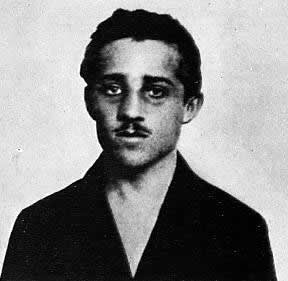
Gavrilo Princip: the face that launched 16 million deaths. Princip was no Lee Harvey Oswald. He received aid from Serb’s Chief of Military Intelligence.

But if Slavic nationalism had any friends in the Austro-Hungarian monarchy, it would have been Ferdinand.  The Archduke was a major proponent of creating yet a third crown for the Empire – a sort of Austro-Slavic-Hungarian Empire.  But instead of regarding Ferdinand’s desire for increased Slavic authority in the monarchy as a boon, Serbian nationals saw it as a threat and an attempt, which it was, to keep Serbian-Austrian nationals loyal to the crown.  Ferdinand’s ethnic diplomacy would be his undoing.

Serbian nationalist terrorists had unified, somewhat, under the organization known as The Black Hand.  At nearly 3,500 members in 1914, including major Serbian army officials, the Black Hand was the Serbian al-Qaeda or Taliban of its day – a terrorist organization, but one fully supported by a sovereign government.  The members of the Black Hand chosen to kill Ferdinand had received training and support from the highest officials in the Serbian military and intelligence community.  The Serbian Prime Minister was informed of their smuggling into Bosnia.  A half-hearted recall of these sleeper agents was attempted two weeks before the assassination as Serbian officials began to doubt how much Russia would come to their aid if it was discovered that the Serbian government had planned to kill another monarch.  The recall either never reached the Black Hand or was ignored.  There was no turning back.

One of the Serbian conspirators being dragged into jail as crowds attempt to grab him

Ferdinand and his wife Sophie arrived at Sarajevo’s Town Hall quite shaken.  The bomb had failed to harm them, but many of their entourage had been severely hurt.  “Mr. Mayor, I came here on a visit and I get bombs thrown at me. It is outrageous,” Ferdinand supposedly complained to his mayoral host.  But calmed by his wife, Ferdinand delivered his short speech and left, choosing to visit his wounded compatriots at the hospital.  Now more security conscience than before, the driver choose to avoid the heavily-trafficked city center for a side street.  At 10:45am, they turned right onto Franz Josef Street, a mistaken turn.  Ferdinand ordered the car to back up.

Watching all this, perhaps with slight amazement, was Gavrilo Princip.  He had been a part of the Black Hand’s assassination planning, but he was not a Serbian nationalist. Calling himself a “Yugoslav nationalist,” Princip’s only political goal was to see Bosnians, Croats, and Serbs unified…just under any government but Austria’s.  Princip had been told the first attempt on Ferdinand’s life had failed, and while trying to get to the city center, where he assumed Ferdinand would go, luck had delivered the Archduke right in front of him.  Thus a Serb who wanted unity with other Slavs, on orders from a Serbian nationalist group whose ideology preached Serbian superiority, leveled his gun at a Royal who wanted to provide the same sort of unification to Slavs, only as equals.  With two gunshots, the dreams of Gavrilo Princip and Archduke Franz Ferdinand, so similar yet so far apart, died.

Ferdinand was hit in the jugular while his wife, Sophie, was shot in the stomach.  Sophie died first, despite Ferdinand’s impassioned pleas that she hold on, and the Archduke’s seemingly more serous wound.  Ten minutes after arriving at the Governor’s residence to be treated by trustworthy doctors, both the Archduke and his wife were dead.  Princip had been arrested on the spot.  His only stated regret was shooting the Archduke’s wife.  He claimed he had been aiming for the seated Bosnian Governor, accompanying the couple throughout the day.

The immediate impact showed that the Black Hand did not speak for Bosnia.  The next day, riots engulfed Austria and Bosnia – 1,000 Serbian homes and shops were burned and looted.  The local police forces did nothing to protect Serbian civilians, whose only crime had been their ethnicity.  It was a sign of things to come.
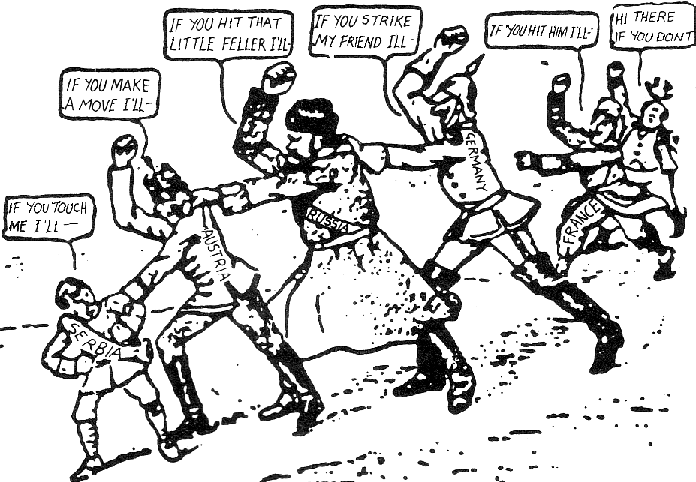
Descent into Madness: even newspaper opinion cartoons of the time understood what was about to happen. What would become the “July Crisis” would end in a global war.

A show trial of Gavrilo Princip would not start until October – by then the world was at war and few cared about the man who started it.  While many members of the conspiracy were hung, and Austria-Hungary had gone to war with Serbia over the assassination of it’s heir, Princip’s life was spared, sort of.  Too young by Austrian legal standards to face execution, Princip was given 20 years – that’s it.  He wouldn’t live to see the end of the war.  Imprisonment was brutal for Princip, who suffered from malnurishment and skeletal tuberculosis so bad that it ate away his bones until his right arm had to be amputated.  He died weighing merely 88-pounds.  Perhaps an execution would have been kinder.

If Princip suffered indignities in captivity, Franz Ferdinand suffered indignities in death – and his slights perhaps caused millions more to perish.

Ferdinand’s rival, Alfred, 2nd Prince of Montenuovo and head of the Royal Court, worked to turn Ferdinand’s funeral into a royal snub.  While foreign dignitaries were originally invited, in addition to the entire Austro-Hungarian monarchy, Alfred purposefully chose to keep the funeral to immediate family.  He ordered soldiers not to salute Ferdinand’s coffin as it was transported and even tried to make his children foot the bill for the funeral!  Alfred’s actions were deemed so cruel, the new Archduke led a minor internal revolt to force Alfred to allow Ferdinand the burial honors according to his rank.

But the real cost of snubbing Ferdinand was unknown to Alfred, or others in the Austrian monarchy.  Kaiser Wilhelm II of Germany, soon to become history’s villain for the forthcoming Great War, had communicated his willingness to use the funeral as a summit to prevent a conflict.  After all, most of the royal families that were about to declare war would be attending.  What better place to calm tempers, as he happened in previous dilemmas?

With Alfred’s snub, perhaps the last best chance to avoid war was missed.  There would be peace in the summer of 1914, for now.  But it was a peace to end all peace.

It Was 100 Years Ago Tomorrow

Friday, June 27th, 2014

It was 100 years ago tomorrow that Gavril Princep, a Bosnian Serb nationalist, killed Archduke Franz Ferdinand of Austria.   It’s an event that your junior high history teacher told you started World War I.  Your teacher was right, in the same sense that a buckling road “causes” a sinkhole.

And if you’ve been following my “World War II – Fact And Myth” series marking the seventieth anniversaries of key events in World War 2, you may not be shocked to know that First Ringer and I – frustrated historians, both of us us – are going to be rolling out a similar series, “World War I – Fact and Myth”, touching on the same sorts of events in the First World War at their 100th anniversaries.  The series will obviously overlap for the next 15 months or so – which makes perfect sense, since they really were two different phases of the same war.  Indeed, much of what is going on in the Middle East, Eastern and Southern Europe today is directly tied to what happened in World War I.

So that works.

Of course, it also means a fair amount of re-reading World War I history for both of us!

As a palate-cleanser before the series starts?  Austin Bay on the ways in which World War 1 is still going on.

--> Site Meter -->