Archive for the 'History And Its Making' Category

Veterans Day

Tuesday, November 11th, 2008

I’d hoped to try to write something in honor of Veteran’s Day along the lines of the piece I wrote last year, about my hometown’s National Guard unit, which under various names has fought in all of America’s wars except Vietnam (for which the Guard was only selectively called up) and Desert Storm. 

I wasn’t able to do it this year.

But to be honest, I’m still kinda proud of last year’s piece.  And honestly, except for Jamestown’s Guard company changing names (it’s now the 817th Engineer (Sapper) Company) and the end of a second tour in Iraq (ended without serious casualties several months ago), there’s nothing new to report.

So I’ll link to last year’s piece, solemnly submitted in memory of an awful lot of good North Dakota farm boys and city kids, who left the lone prairie to fight all over the world for the rights we all share today.

Thanks to all of you, then and now.

It Always Amazes Me…

Wednesday, October 8th, 2008

…that they can still solve mysteries like this one – the sinking during World War II of the USS Grunion.

The sons of the boat’s commander led the expedition themselves; they found the boat’s remains last year, and confirmed its identity last week.

Relatives of the Navy crew members who perished in the 1942 sinking of the USS Grunion, including the Newton family of its lieutenant commander, had already been planning to gather in Cleveland later this week to memorialize the men.

But an announcement from the Navy on Thursday that it had verified the discovery of the ship’s wreckage has heightened that gathering’s significance.

“It is very valuable to have them do that recognition,” said Bruce Abele, son of the vessel’s commander, Lieutenant Commander Mannert L. Abele of Quincy, who, along with his two brothers, hired the search team that pinpointed the wreckage site in 2006. “It’s everything, because what it says is there’s credibility to [our discovery], and that’s what’s important.”

The Navy’s Pacific Fleet credited the Abele family’s efforts in announcing that the wreckage discovered off the coast of the Aleutian Islands, a volcanic chain in the North Pacific about 1,200 miles southwest of Alaskan Peninsula, was indeed that of the World War II submarine, which was declared lost by the Navy on Aug. 16, 1964, 22 years after it disappeared for still unknown reasons.

“Closure” is a grossly-overused word in our society these days; in this case, it seems to fit.

Thursday, September 11th, 2008

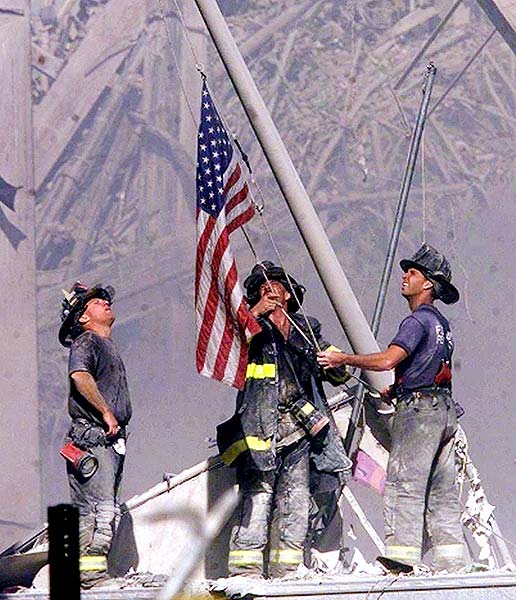
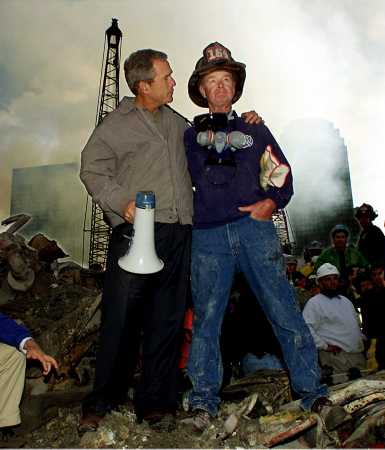
Remember.

We will see your Change and Raise You One Reform(er)

Saturday, August 30th, 2008

This campaign for President will get a lot more interesting and a lot more relevant when the debates begin and we can hope for a shift of the conversation to the issues and less on the candidates’ backgrounds.

Then again, one candidate has an apparent history of picking the wrong friends and mentors…so the opposing camp may never let go of that lever.

Maybe Obammy’s momma (or grand momma) should have told him to be careful who he spends his time with.

WSJ: On the bus from Invesco 1,609 Meter High Stadium back to civilization last night, we sat next to a Hillary Clinton delegate from New Jersey. She was not a bitter-ender; she intends to vote for Barack Obama and said there was never any chance she would not support the Democratic nominee. But she was decidedly unenthusiastic about Obama. She said she expected that more would come out about his relationship with Jeremiah Wright (the nominee’s America-bashing erstwhile “spiritual mentor”), and she readily agreed with our observation that Obama’s friendship with an unrepentant terrorist (that would be Bill Ayers) would not go over well with ordinary Americans.

So does that mean we saw a stadium filled with extra-ordinary Americans?

The conversation turned to John McCain’s vice presidential choice, and our interlocutor said she thought McCain could help himself among Mrs. Clinton’s backers by choosing a woman. We asked if Obama would have helped himself by choosing a woman, and she said no, Mrs. Clinton’s backers would have seen that as a slight.

As it turns out, they saw not getting vetted and not being chosen, despite 18 million votes in her pocket, as a slight any way. Polls of late have shown as much as 27% of Clinton voters currently intend to vote for McCain and that was before his choice of running mate Sarah Palin.

Two things are clear now. One, Obama made a huge mistake not picking Hillary. That might have been game over right there.

Two, John McCain admittedly made his choice in response to Obama’s miscalculation. But the choice of Sarah Palin doesn’t make everything easier for the Republicans. (emphasis mine)

The biggest drawback of the Palin pick is that it complicates the argument that Obama is too inexperienced to be president. At 44, Palin is actually younger than Obama, and she has two years’ less experience in statewide office than he does. On the other hand, she has more executive experience than McCain, Obama and Joe Biden combined, and the Democrats have a rookie at the top of the ticket.

Obama spokesman Bill Burton quickly denounced McCain for proposing to put “the former mayor of a town of 9,000 with zero foreign policy experience a heartbeat away from the presidency.” This took a degree of chutzpah, since the Democrats have just spent four days touting Obama’s experience as a “community organizer” as a central qualification to put him no heartbeats away. Even after listening to those speeches, we’re still not sure what a “community organizer” is.

We will see your Change and Raise You One Reform

A Reform Ticket

If any doubt remained that former fighter pilot John McCain loves to take unconventional risks, he put them to bed Friday by picking Alaska Governor Sarah Palin as his running mate. Introduced in Dayton by Mr. McCain, Governor Palin swung the bat pretty well. We’ll now see if she can hit curve balls.

But will Windy Joe be just as afraid to debate a woman with vigor without appearing to be unstatesmanlike

It’s a daring pick because Mrs. Palin has never faced national scrutiny and hasn’t had to deal with foreign policy. Most VP choices are designed to do no harm, and we tend to agree with the maxim. Democrats are already saying they can’t wait for Mrs. Palin’s debate against “statesman” Joe Biden.

And then will she kick his saggidy ass?

On the other hand, the record shows that Sarah Palin’s political career is a case study in taking on the big boys. We suspect her record of fighting the status quo was uppermost in John McCain’s decision.

…come to think of it, we’ll take your Change too

Barack Obama aside, Senator McCain’s biggest problem is a Republican brand that has suffered — both among independents and the GOP base — from the party’s business-as-usual mentality in Washington. The public wants change. This pick could prove Mr. McCain is serious about changing his party.

…and when you compare VP selections, it becomes clear who is really interested in change, even if it means losing the election if the choice of Sarah Palin proves to be a mistake.

Sarah Palin’s reform resume would be remarkable in any political career. She entered politics at 28, winning a seat on the Wasilla city council as an opponent of tax increases. After she defeated Wasilla’s three-term incumbent mayor four years later, she swept the mayor’s cronies out of the bureaucracy.

In 2003, Alaska Governor Frank Murkowski appointed her to the state’s Oil and Gas Conservation Commission. Bear in mind that Mr. Murkowski had already served as junior U.S. Senator from Alaska for 22 years.

Shortly after joining the oil and gas commission, Mrs. Palin commenced an ethics probe of the state’s Republican party chairman, Randy Ruedrich, involving conflicts of interest with oil companies. The probe resulted in a $12,000 fine for the party chair.

She crossed party lines in 2004 to join a Democratic representative’s ethics complaint over an international trade deal against the Republican Attorney General Gregg Renkes, who had ties to the Murkowski machine. Mr. Renkes resigned.

In late 2005, Mrs. Palin announced her run for Governor before then-Governor Murkowski had announced his intention to stand for re-election.

Obama/Biden best be wary about throwing around the already once corrected/retracted “lack of experience” mantra within earshot of McCain/Palin, and vice versa. In effect, McCain’s choice takes the argument away mutually, and may (hopefully) force debate to the issues (and specifics).

For starters, we’d say Governor Palin’s credentials as an agent of reform exceed Barack Obama’s. Mr. Obama rose through the Chicago Democratic machine without a peep of push-back. Alaska’s politics are deeply inbred and backed by energy-industry money. Mr. Obama slid past the kind of forces that Mrs. Palin took head on. This is one reason her selection — despite its campaign risks — seems to have been so well received by Republicans yesterday. They are looking for a new generation of leaders.

Don’t expect this remarkable personal Palin narrative to get an Obama-like break from the national media. Their main focus will be her lack of experience, claiming it undercuts Mr. McCain’s criticism of Barack Obama. One mispronounced foreign leader’s name, and she’s going to be hammered.

Reform: The New Republican Platform?

Mr. McCain’s instinct clearly is to offer himself to voters as a reformer. With Sarah Palin, a genuine reformer, Mr. McCain may have found the right idea and the right person to make his run.

John McCain’s choice yesterday was a tactical one. A bold one. It was a high-risk/high-reward move that will make political history one way or the other.

Do Svedanya, Ivan Denisovich

Monday, August 4th, 2008

Aleksandr Solzhenitzyn is dead at 89.

Through unflinching accounts of the eight years he spent in the Soviet Gulag, Solzhenitsyn’s novels and non-fiction works exposed the secret history of the vast prison system that enslaved millions. The accounts riveted his countrymen and earned him years of bitter exile, but international renown.

And they inspired millions, perhaps, with the knowledge that one person’s courage and integrity could, in the end, defeat the totalitarian machinery of an empire.

Along with Paul Johnson, Fyodor Dostoyevskii and P.J. O’Rourke, Solzhenitzyn was one of the authors that paved the way to my becoming a libertarian-conservative, 25 years ago.

Beginning with the 1962 short novel “One Day in the Life of Ivan Denisovich,” Solzhenitsyn (sohl-zheh-NEETS’-ihn) devoted himself to describing what he called the human “meat grinder” that had caught him along with millions of other Soviet citizens: capricious arrests, often for trifling and seemingly absurd reasons, followed by sentences to slave labor camps where cold, starvation and punishing work crushed inmates physically and spiritually.

His “Gulag Archipelago” trilogy of the 1970s shocked readers by describing the savagery of the Soviet state under the dictator Josef Stalin. It helped erase lingering sympathy for the Soviet Union among many leftist intellectuals, especially in Europe.

But his account of that secret system of prison camps was also inspiring in its description of how one person — Solzhenitsyn himself — survived, physically and spiritually, in a penal system of soul-crushing hardship and injustice.

Sheila O’Malley:

Shaking my head. Strange. How it feels like a personal loss.

The world was a better place, a more honorable place, a place where bravery was possible, and where truth was always louder than lies … because he was in it.

Jay Reding:

His influence helped foster in the end of the Soviet empire and the dawn of a new age of freedom. His willingness to speak out against the evils of the Soviet system helped forge the moral case against Communism. 

Read Ivan Denisovich and The Gulag. Great stories, great lessons – and history that mankind will forget only at its immense peril.

UPDATE:  One thing that’s important to remember about Solzhenitzyn; he was Russian, first and foremost.

While The Gulag was a key motivator that helped bring down the USSR, Solzhenitzyn also endorsed the authoritarian Putin, and supported many of the former KGB officer’s crackdowns and power-grabs.  This is not out of character with the “Russian personality”, of course; in a land that’s been a kick-toy for invaders for millenia, security trumps “liberty” in the traditional western sense, and Solzhenitzyn embodies this trait.

Minnesota 2050 – Part V

Wednesday, July 23rd, 2008

History marches on.  After the great Eden Prairie riots (which occurred after a “police beating” in Blaine, for reasons that were chalked up to confusion among the “demonstrators”), more violence broke out in the ring of decrepid, desperate, DFL-dominated suburbs surrounding the city.

(The scare quotes around “demonstrators” will be explained later.

This takes us into the mid-2040’s.

———-

July 8, 2041
Burbs Still Cleaning Up After Cataclysmic Riots: Residents Demand Answers
Megan Megan Megan-Megan, Minnesota Codependent

The fallout from the Great Suburban Riots is still reverberating throughout the suburbs.

Eden Prairie, Blaine, Lakeville, Woodbury and Lino Lakes were all heavily damaged during riots after a pair of policemen were acquitted for assaulting a couple of local men.

The rebuilding effort is running into some obstacles.

“Part of the problem” according to Bluffy Sansevere, of “Suburbs Need Money” , a performance-art advocacy group, “is that homeowners aren’t moving back to the suburbs”.

“We’ve been trying to emulate the tactic that worked so well for the uncaring Republican inner-city – having all sorts of housing stock available for people to move into.  We even started a program putting people to work at government expense to bring these buildings up to full city, state, federal, emotional and ethical code, and passing the cost on to the uncaring Republican who buys the home.  But we haven’t had any takers”.

Another problem; the vandalism continues.  “We’ve actually rebuilt some houses – as high-density group homes, naturally – and they’ve been promptly burned down.  And there’s been nothing we could do about it, since the Plochman case”, says Annette Plover, DFL senator from Wellstone (formerly Minnetonka).  He’s referring to Plochman Vs. Inver Grove Heights, a Supreme Court case that affirmed that vandalism was a form of art protected by the First Amendment.  The case, which was handed down during the Obama Administration in 2018 by former Chief Justice Kucinich (appointed in 2011 by then-President Obama) has not yet been reversed.

“It’s like pushing a hose up a hill” she added.

In related news, “Hose Esteem” – a program that taught self-esteem by teaching troubled suburban teens to push hoses up hills – was cancelled due to excessive vandalism.

 ———-

September 6, 2044
Cities Abolish Property Tax: Residents Demand Answers
Achmad Epstein, Fraters Omnisciens

Mayors Trixie Coleman of Saint Paul and Bucky Prathanshaniam of Minneapolis met at the crown of the Marshall-Lake Bridge yesterday, and tossed a symbolic, bronzed property-tax assessment into the Mississippi River to mark the end of the property tax.

The tax – long a standard revenue-generator in the Twin Cities – became obsolete due to increasing sales taxes and user fees.

“These cities”, Mayor Coleman noted in her prepared speech “make so much money due to the whole ‘overheated economy’ thing, that morality demands we stop taking so friggin’ much of it!”

A thin film of protesters gathered at the Mall of America to demonstrate against the abolition.  “In the whole history of my family”, said Annabelle-Annaliese Fromholz-Bisbee of Elko, “nobody has ever been able to find Saint Paul – so we met here.  Anyway – this is money that should by all rights be going to the needy in Savage and Forest Lake!” 

———-

April 12, 2046
DFL Suburbs Unveil “Happy To Pay For The Great Leap” Plan
Mark 3, Generic News

Mayor Kim Jung-Bill of Maple Grove declared the first step of his five-year plan to revitalize Maple Grove “a complete success”.

“To help prevent ‘white flight’ – people moving farther out in the ‘burbs to avoid suburban blight and find more progressive policies – we’ve found that some of the traditional incentives, like taxing people and businesses that tried to move away, while useful, didn’t go far enough”. 

The “Human Severance Tax” Jung-Bill instituted in 2040 didn’t make a lot of money – but it did create a new revenue stream.  “People trying to leave Maple Grove started trying to load up trucks and move out under cover of darkness.  Arresting and fining them bough us some time, but Illlegal Emigration remained a seriously problem”

“Finally”, he adds, “we had to build The Happy To Live Here For A Better Maple Grove Wall”.  The controversial 15 mile brick wall, with gates at six key exits, has cut down drastically on emigration from Maple Grove.

“The standard of living, and government revenue, haven’t increased just yet.  But it’s right around the corner!”.

———-

Friday:  The conclusion.

Minnesota 2050 – Part IV

Tuesday, July 22nd, 2008

While the shocking sea change in Minnesota politics – the inversion of political power in the cities and the suburbs due to the free-market politics of St. Paul’s Mayor Lopez (joined, in 2017, by Republican Minneapolis Mayor Anatolii Dolokhov, elected after Green Party mayor Loaf Beziers was indicted for attempting to donate an entire Minneapolis neighborhood and its residents to Greenpeace) and the growing DFL-centricity of the suburbs – snuck up on Minnesota, the events of 2039 came more suddenly – and were more shocking.

———-

August 22, 2039
Blaine Cleans Up After Riots
Tylenol Harris, Minnesota Democrats Exposed On IMax

The city of Eden Prairie is cleaning up after three days of the worst rioting in Minnesota history.

Some say the emotional damage will take a lot longer to clean up.

The streets of this troubled southwest metro suburb exploded in rage after Eden Prairie Police Sgt. Thai O’Riordan and Patrolman Jeff “Lumpy” Al-Khalid were acquitted in the beating of Justin Prince-Adddams and Tylenol Lundgren.

“For the millionth time”, says defense attorney Cassandra Blodgett, “It wasn’t a beating.  It wasn’t a beating.  It was NOT A BEATING!”.

Blodgett notes that the video seems to confirm the officers’ defense – that they merely pushed the men up against the side of their squad car after they were caught huffing paint and butane while skateboarding with bags of stolen clothing.

However, a new Eden Prairie law didn’t allow police to touch suspects; the seven-member Eden Prairie City Parliament, which had been merged with the 75-member School Board, had passed a law to adopt school disciplinary rules for the city as a whole.  As a result, the officers were not legally allowed to impart physical force in arresting suspects.  A Grand Jury refused to indict the officers on charges of Sexual Abuse and Molestation, but returned charges of Aggravated Assault and Larceny of Self-Esteem.

Community groups started posturing long before the trial began.  White liberals complained of systematic discrimination.  “Look at where we live!”, exclaimed Fidel Klempfer, leader of “Eden Prairie Needs Money For The Children”.  “Moldy McMansions!  Man-made lakes lined with tenements!  Streets crawling with unemployed anthropology majors, social networking life coaches and vegan consultants!  This city needs help!”

“There are two Minnesotas” proclaimed Ed Johnson of “Give Us What We Need” “The part of Minnesota that won life’s lottery, and the part that is still waiting at the track for their number to come up”.

As the verdicts were read, Eden Prairie riot police stood by, awaiting the worst.

They got it.

As the “not guilty” verdicts trailed out, one by one, the gathered crowd fell silent.

Then, someone in the gathered crowd from the Barrista’s Union threw a brick, hitting someone from “Vegans For Emotional Justice”.

“That was all it took”, said Lieutenant Phong Leung of the State Patrol.

What started as a scuffle between Vegans and Barristas morphed into a city-wide riot, as other disaffected overeducated young white liberals crowded mass transit to get to the city.

At the end of three days of rioting, 4,000 houses and businesses were burned.  Anderson Lakes Parkway – the epicenter of Eden Prairie’s drug trade – lay in ruins.  Eden Prairie Center, a former shopping center than had been converted into a Kabbala center and had lain vacant for a decade attracting drug addicts and intellectual navel-gazers, became a charnel-house before it collapsed.  Hundreds were injured.  Police reported no injuries to law-enforcment; “Oddly”, said Lt. Leung, “Police weren’t targeted.  They were all going after each other.  Like crabs in a pot, pulling in the ones that tried to get out”.

Standing in the ruins of William Kling High School, School Board/Parliament member Alabassah Mortenssen shakes her head.

“There were signs of a rebirth in Eden Prairie; last fall, we actually beat back some free-market, low-tax challengers!  This time, we coulda done it, but for those damn Republicans!”

She shakes her head.

And the barristas”.

———-

Tomorrow – as Eden Prairie rebuilds, Minnesota tries to heal in that way that places with big nasty political divides always “heal”. 

Minnesota 2050 – Part III

Monday, July 21st, 2008

On Friday, we looked into the ragged, rough beginnings of Minnesota’s renaissance, back in the 2020’s.

Today – well, we’ll take a walk through the dingy side of Minnesota’s political transformation, see how the children are doing, and…well, we’ll indulge in some foreshadowing.

———-

January 3, 2033
Decaying Housing Stock Causes Big Worries In ‘Burbs
Tim Plott, Minnesota Utterly Dependent

Father PZ Myers III has inherited a real mess. And he thinks he knows why.

The new priest at Saint Ignatius Church in Chanhassen – one of a wave of churches built during the huge rush to the suburbs in the 1990s – inherited a lot of problems that would have baffled his predecessor.

“It’s sort of a perfect storm of problems. For starters, most of the McMansions built in the 1990s were, to put it in terms I think the good Lord himself would understand, pieces of crap. Shoddy, poorly built, just garbage.”

“And then”, Myers continues as he walks through the cots at the homeless shelter the parish has set up in its basement, “between that and the fuel costs in the ’00s, the collapse of the transit system, the growth of the telecommuting service economy and the revival of the city, pretty soon all the middle class families that used to keep places like Chanhassen and Chaska going fled for places like Minneapolis and Saint Paul. Or, since telecommuting is so ubiquitous, far far outstate.”

Myers pauses, exhausted at the parade of misery he sees around him. “It might have worked”, he said, “except that – well, some of the people that moved out to the ‘burbs didn’t help things one bit”.

“No”, he adds hastily, “I’m not talking about the poor. I’m talking, frankly – and I do hate to get political – but I’m talking about the DFLers that flocked out here when the Southwest LRT started running. That was…”

He looks about the rows of cots, full of men who’ve staggered off the dismal, blighted streets of Chanhassen. The train station that used to carry suburban government workers from homes in Chanhassen and Chaska to jobs in Edina and St. Louis Park is now sodden with grafitti. Crack dealers terrorize the area at night. Vacant blocks of houses, some collapsing on themselves, bear mute witness to an experiment that failed, and failed badly.

Father Myers shakes his head. “That was when our problems started”.

But others see opportunity.

“What you have here”, says Gretel Lackey-Grotnick-Willey of “Homes And Money”, a non-profit advocacy group based in inner-suburban Lakeville, “is a situation where rich Republicans took all the good, solid, inner-city housing stock after the foreclosure crisis in the ’00s, leaving the poor out in the shoddily-built “mcmansions” in places like Lakeville and Eden Prairie. They had the connections to know that with gas prices rising, homes near work would be vital. This disenfranchised the poor, who, lured to the ‘burbs by artificially low prices and massive, publicly-subsidized public transit, got into the transit trap”.

“The key”, asserts Lackey-Grotnick-Willey, “is to completely fund the Aid to Local Governments And Environs program”.

Andrea Loang, professor of Suburban Pathology at the University of Minnesota’s Strom School for Public Policy, agrees and disagrees. “Homes and Money is right about construction techniques – but that’s about it. ALGAE was an organized subsidy of failure and poverty – basically, paying failing suburbs to get it wrong, and keep getting it wrong. The renaissance of Minneapolis, Saint Paul and outstate Minnesota show us that the free market not only works, it kicks ass”.

Lackey-Grotnick-Willey remains undeterred. “We need to start getting affordable housing in the city. The government needs to give these people dreams, too”, she says.

———-

January 3, 2034
Morales Goes To Nationals
Local Girl Dominant Yet Again
Buffy Moltke, Minnesota, Wisconsin and Dakotas Public Radio

For the third straight year, Phuong Morales of Saint Paul has won the state High School Combat Marksmanship title.

A senior at Margaret Thatcher International Charter Academy in Minneapolis, Morales held off a late surge by junior Ahmad Szarkowski of Hibbing with a rolling double-tap bullseye in double-overtime.

Morales victory continues a six-year tradition of inner-city shooting sports dominance at Reagan, where Tad Haukeboe had a three-peat before Morales’ string.

Morales will be attending Texas Tech next year on a combat shooting scholarship, and plans to major in nuclear engineering.

But the Morales dynasty seems likely to continue; younger brother Chuck placed fifth in state, after winning the state Junior Varsity last year.

The rise of high school pistolcraft programs, which only started a decade ago, has been astounding. Critics say the competitions “send the wrong message”, and emphatically deny any link between armed teenagers and the recent descent of crime rates in the Twin Cities prosperous inner-city to less than measurable levels.

And this one – which seemed fairly innocuous in context: 

———-

July 9, 2039
Trial Begins In Eden Prairie Beating Case
Belton Farouk, Network Of The Moderate Left

The trial of two Eden Prairie police officers accused in the beatings of Eden Prairie teens Jarrod Mondale and Bentley Pogemiller begins today at the Department of Public Esteem in Eden Prairie.

The officers – Sgt. Thai O’Riordan and Jeff “Lumpy” Al-Khalid – are charged with holding the two teens against a car during a paint-huffing bust last summer.  The case has stirred up passions in this troubled city which, in recent years, has not shared in the prosperity of the city to its northeast and the rural area to its southwest.

“This bit of brutality shows the community that it’s us against them”, says Celine Murchisson-Koblecki, leader of “Eden Prairy’s for Justice”, a group formed to protest police brutality in the wake of the alleged beatings.

———-

We’ll follow up tomorrow.

Minnesota 2050 – Part II

Friday, July 18th, 2008

Yesterday, we looked back on 42 years of reforms in Minnesota.

But how did the state get to that point?

Today, we start at the beginning.

———-

September 21, 2021
A Tale Of Two Schools
Molybdenum Priestley, StarTribuneSunVillager Weekly Shopper

Willow Brockley-Stensrud-Mauer-Hoff, age ten, is in her third school in five years.

“Daddy keeps moving us farther and farther out”, says Ms. Brockley-Stensrud-Mauer-Hoff, a fifth-grader at Fidel Castro Middle School in Annandale. “He says we need to stay at least two tiers of suburbs away from the ‘scum'”, she adds, doodling in a notebook.

Ashley Brockley-Mauer, 55, a life coach who works for the State Department of Health in downtown Minneapolis, drops Willow off at school before getting on the train to go to her job in downtown Minneapolis. Her life partner, Ian Hoff-Hoff-Stensrud-Hoff, 58, was recently laid off from a position with the Minneapolis Department of Green Enforcement. He’s seeking a position with the Stearns County Lifestyle Patrol – but things look dismal. “There were two hundred applicants for one opening”, he notes. “But I look at the interregnum as a bit of a growth experience”.

Annandale, once a Republican stronghold, has had its politics switch drastically in recent years. When the city was connected to the Northstar Line, the city was inundated with Minneapolitans. Drawn by an excellent school system, low housing costs and low crime, the urban expats – 99.8% white, registered DFL members – quickly put their imprint on the town.

“Once we took control”, recalls Ms. Brockley-Mauer, “thanks to Instant Runoff Voting, we instituted rigorous Green environmental standards and sustainable growth practices on regional businesses, and outcome-based juvenile justice and corrections practices. We gave the teachers and public employees unions voting seats on the City Parliament, and instituted the “FairBallot” for all city spending votes, abolishing the non-progressive secret ballot. We also put a price cap on local homes to make sure housing would remain affordable, and established a living wage ordinance for all jobs. We also began the “Diversity Through Unity” program at the school system”. She nods with satisfaction. “It was about then that Willow was born”.

Despite the improvements, problems started cropping up. Crime rates inexplicably rose, student achievement dropped, and the available housing stock, mostly built in the 1990s, wasn’t being renewed. A wave of business bankruptcies rapidly followed, and area unemployment zoomed upward.

“Temporary hiccups on the great progressive leap forward”, Brockley-Mauer asserts. “We’ve kept DFL legislators in office in this district for the past ten years, so things are bound to improve.”

The troubled-but-cozy suburb has its share of controversies, of course. Malcolm X High School briefly instituted a Junior ROTC Program imported from Saint Paul to help bolster achievement among troubled suburban teens.

“It was great”, recalls Justin Yetterboe, 17, of Waite Park. “Before JROTC, I was a shiftless, paint-huffing skate bum. Sergeant Xiong – the JROTC leader – changed all that. He taught me some pride in myself. He made me reach for more.”

But the program was cancelled last year amid a flurry of controversy. “This was the sort of thing we left Minneapolis to try to escape”, says Mr. Hoff-Hoff-Stensrud-Hoff, a key activist in getting the program scrapped. “Halliburton Bushitler Chimpy Chimp”, he adds, reprising his closing argument at the public meeting that led to the cancellation of the program and the public burning of all its course materials.

“We moved out here to get the life we wanted, and we will have it”, he nods with emphasis.

———-

Fifty miles east-southeast, 13 year old Anna Strachan and 14 year old LaKeisha Morris sit at computers in the rough-hewn looking but cozy classroom at Phil Krinkie Academy, a charter school in Saint Paul.

“The teachers here preach one thing only – your life is your responsibility, and you’re the only one who can live up to it. So have some self-respect”, says Morris, the daughter of Shondra and DahnDre Morris of Saint Paul.

“We built this school ourselves, from the ground up, once we took over the old building”, recalls DahnDre Morris of the school’s early years after it took over the former Arlington High School, off Rice Street in Saint Paul. “I didn’t want my kids going through what I did”.

“No kidding”, adds his wife. “The only thing I remember learning in four years of high school was that I needed self-esteem. But I never did learn why!”

Parents of four kids ages six through 17, the couple is used to hard work. DahnDre is a CNC machinist with PowerTec, a precision parts manufacturer in Saint Paul. Shondra runs a soul food restaurant on Rice Street. “Rice used to be a wasteland, just empty storefronts and crappy bars”, Shondra remembers. “Now, the biggest problem is finding space for the new businesses that are moving in”.

The couple, newly-married and with a baby back in 2005, tried moving out to suburban Burnsville to raise their young family. “It started out well”, DahnDre explains. “The schools and the city were pretty free of some of the inner city BS”.

But then, about the time of the great Mortgage Meltdown of 2008, things started changing.

“As the inner city got more run down and torn down”, DahnDre starts, “and about the time gas prices rose up so that I couldn’t drive to work, more and more of the white, middle class types started leaving the city – for pretty much the same reason we did. Lower taxes, better schools, etc, etc.”

“But”, Shondra interjects, “they brought their politics with”.

Taxes zoomed. School achievement started dropping. Crime skyrocketed.

The final straw came in 2017. “The school called and said they’d caught DeShawn, our oldest, huffing paint. They suspended him…”, DahnDre reports, eyes wide with amazement he still visibly feels “…not for huffing, but for skipping Gay Pride class. They called it a “hate infraction”. Can you believe that?”.

(Burnsville school district Diversity supervisor Poppy Fleeber declined to comment on the case).

So the Morrises moved back to Saint Paul, drawn not only by the ample cheap housing, but by a subtle but intense change in atmosphere.

“After some of the scandals that happened in the late ’00s and early teens – the Saint Paul Land Grab, the Minneapolis Atheism Accord, the Met Council Sex Ring, that sort of thing, people took a look around. And they saw it was time for a real change”.

The turning point was the 2013 election of Mayor Annaluisa Lopez, the first Republican elected mayor of Saint Paul as a Republican since the mid-1900s.

“I led quite the coalition”, Lopez recalls via phone from her office in Washington, DC. Sworn in last January as Minnesota’s first Latina Senator, Lopez led a motley collection of supporters – Asian free-enterprise activists, Afro-American education reformers, Hispanic social conservatives, and Eritrean and working-class white crime hawks – against a phalanx of traditional DFL constituencies. “Everyone predicted we’d lose and lose big”, Lopez reminisces. “The turning point was when Garrison Keillor called me Tija Tomasina (broken spanish for “Auntie Tom”)”. The outrage filled Lopez’ electoral sails – she beat incumbent Chris Coleman 51-49$ in the ’13 election, despite Council President Dave Thune’s call for Governor Pogemiller to declare martial law, famously claiming “A Republican Mayor would be a natural disaster”.

She slashed taxes and city bureaucracy, and instituted a “homestead” program for vacant housing and commercial property, privatized public housing, and instituted a citywide “Smack Down Crime” program, giving cash prizes for the most creative capture of criminals by civilians. “Some liberals from Lake Elmo called it “vigilante justice”. We just called it fun!” Lopez remembers.

Lopez rode to victory in 2017 by a 60-40 margin over DFL challenger Marcy Piffle, a middle school teacher, performance artist and pro-Palestinian poet.

“That”, says DahnDre Morris, “was the first time I voted Republican in my life”.

“I told you so!”, Shondra laughs, nudging him. Shondra voted for President Palin in 2012, and a framed picture of Ronald Reagan hangs on the wall of her restaurant. “Some of the old timers give me guff about it. But not much”.

DeShawn, their oldest, has turned things around since his run-in in Burnsville. He graduated from the Krinkie Academy last fall, and just started attending the Naval Academy a few weeks ago.

“I shudder to think what would have happened had we stayed out there in Burnsville”, DahnDre shakes his head. Then, eyes wide open in disbelief, he jumps to his feet. “I gotta show you this!” he bellows.

“Oh, yeah”, says Shondra. “This is hilarious”.

DahnDre returns with a letter on Burnsville City letterhead. “It’s a demand that we move back and be happy to pay for a better People’s City of Burnsville!”

———-

Monday? Well, not every part of Minnesota fared as well as Rice Street.

Minnesota 2050 – A Look Back

Thursday, July 17th, 2008

This looks like it’s going to be a rough election for Republicans, in Minnesota and nationwide. While I think Mac has a decent shot in upending the Messiah in the stretch, here, I think Congress is going to be just brutal. As I’ve said in the past, I think that if the Democrats come up with less than an 80-20 majority in the Senate, and less than 340 seats in the House, it’ll be tantamount to a defeat. It’s been pointed out that that is technically impossible – there aren’t that many seats up for election this year. That is technically true, and still false; the electoral debacle should prompt the requisite number of Republicans to resign, or be impeached, or attacked and carried from office by mobs with pitchforks and torches. 80 and 340, or bust, Democrats.

And yet, being a conservative, I temper my pragmatism about people and temporal trends with unshakeable optimism for the future.  As such, I’m not merely pondering the “future” this November. I was looking waaay off into the great wide open.

Someone – I think it was either Mark Twain, Abraham Lincoln or Winston Churchill – said “the best way to learn about the future is to look back on it”. 

So I decided to do just that.  I took a little dig through the archives of the future.  I wondered – given the long-term trends that are just starting to poke their noses into the public consciousness, what will Minnesota – especially the Twin Cities metro – look like in 2050?

And the message?  Well, it was surprising.

———-

November 2, 2050
Nguyen In Landslide:  Third-Place DFL Ponders Future
Ozriel Phamagagides, Hot Air (Saint Paul Bureau)

The outcome of the top of the race was never in much doubt; Conservative Republican John F. Nguyen won his second term as governor of Minnesota.  The Nguyen/Moss ticket’s 56% majority was two points stronger than the election-eve Rasmussen/Hajib/Lepkowitz poll predicted, indicating that the generation-old conservative powerhouse in Minnesota politics continues unabated.

The only real question was would the DFL – at one time Minnesota’s dominant, supermajority party – hold on to second-party status. 

“We think the results are more optimistic for us than some predicted”, said State DFL Chairbeing Starfish Bronkhorst-Rabbit, referring to a late prediction on the ultra-left HuffingtonPod that “the ground will open up and swallow the DFL”. 

But the results still don’t bode well.  The statewide votes for all Legislative, Constitutional and Local offices, according to the Secretary of State’s office, broke out like this:

GOP: 51%
Independence Party:  19%
Democrat/Farmer/Labor:  16%
La Raza USA: 14%

Bronkhorst-Rabbit is undeterred.  “I think we’re well-positioned for a comeback.  I think Minnesota is more ready than it’s been in years for the DFL’s message”.

Larry Jacobs of the University of Minnesota isn’t so sure.  “Look – the DFL finished third behind the conservative GOP, the pragmo-moderate Independence Party, and barely ahead of the ultra-social-conservative, pro-legal-immigration, hardline-anti-illegal La Raza.  That says something; that the party of Hubert Humphrey isn’t what it used to be.”

“I think the DFL faces two big questions.  First:  do the people of Minnesota still want a party whose platform of returning to the long-rejected Factory School model, economic shrinkage, a state parliament, institutionalized state guilt, catch-and-release sentencing, unrestricted immigration, socialized medicine, union featherbedding and open-ballot intimidation, and forced reparations to gays, the handicapped and the mentally ill in power?  And, second, given that the party’s entire base of support is concentrated in the third through fifth tiers of suburbs, and is nonexistent in the inner city and outstate Minnesota, will they even be able to retain major-party status?

Duffy Shabazz, four-term GOP representative from Thief River Falls, agrees.  “Given that they barely even beat La Raza in their own former home turf, really, what future is there for the DFL?”

The biggest question for many DFL rank-and-file, today, is “how did we get to this point?”

How, indeed?

With that in mind, I’m going to devote some time on this blog to a series, “Minnesota 2050”, in which we will look back on the next 42 years of Minnesota history.  And while this look will be both satirical and speculative, I’m correct in pointing out that all of my frighteningly accurate predictions started out as satirical swags.

Shot in the Dark – blurring the line between satire and secular prophecy for 78 months. 

The First Minnesota

Thursday, July 3rd, 2008

In the rush of other events yesterday, I neglected to write a post I’ve had in my mental notes for years. July 2 was the 145th anniversary of the epic charge of the First Minnesota Regiment.

The charge was one of the pivotal moments in the Union victory in the battle of Gettysburg, and arguably of the entire Civil War.

The first of nine regiments of Minnesota troops that fought in the war, the First was the only one to serve in the Army of the Potomac, the key eastern theatre of the war (the other eight regiments served up and down the Mississippi, and in fighting against the Indians in Minnesota and the Dakota Territory).

The First had served throughout the Army of the Potomac’s operations throughout the war; like most veteran regiments, it was down from its initial strength of about 1,000 men when it mustered at Fort Snelling, to 262 on the morning of July 2; the Union army didn’t replace men lost to casualties or illness, preferring to muster new regiments (with the attendant political appointments that went along with forming a new unit).

The First was part of the wave of reinforcements that raced to Gettysburg when it became clear that Lee’s invasion of the North was heading into central Pennsylvania; the day before, Union cavalry under General Buford and the First Union Corps had stopped Lee’s advance in a furious rear-guard action in and around the town of Gettysburg; the First Brigade of the First Division of the First Corps, the “Iron Brigade” – largely Wisconsin and Michigan troops – had suffered eighty percent casualties repelling the Confederate advance until evening and the wave of reinforcements that brought the Minnesotans to the scene.

On July 2, we take up the story by Wayne Pafko at the U of M, and a website on the Regiment:

“To support Maj. Gen. Dan Sickles’ hard-pressed Third Corps, Brig. Gen. John C. Caldwell’s division of the Second Corps was moved to the left, leaving a large gap in the center of the Union line. About 5:00 p.m., parts of Hall’s and Harrow’s brigades were shifted to the left to fill that gap. The First Minnesota was shifted to the left about six hundred yards in support of Evan Thomas’ Company C. Fourth United States Artillery on Cemetery Ridge. From this position, the Minnesotans had a grandstand seat from which to observe some of the war’s most savage and bloody fighting, although at times the smoke of battle obscured their view… When at times the smoke lifted enough to see, the First watched with increasing anxiety as the Union left crumbled under the sledgehammer blows of Longstreet’s Corps. They witnessed the disasters taking place before them, and their apprehension increased rapidly as they saw Sickles’ Third Corps fallback, slowly at first, then in some disorder. The men felt a foreboding of disasters to come. The First Minnesota now occupied the former position of Caldwell’s division. The 262 Minnesotans were hardly an adequate replacement… It was a very thin line, and the batteries on Cemetery Ridge were in grave danger.”

In the fog of war, under immense Confederate pressure, there’d been a snafu, and a Union division had bailed, leaving a hole in the line big enough for Lee to march his entire army through.

It was clear that something had to be done. “…General Hancock, commander of that portion of the battlefield, quickly studied the situation and determined that this Southern rush must be halted, regardless of the hazard. With only a single aid he rode desperately toward the station of the First Minnesota. Reserves had been sent for, they were known to be coming, but the delay might be fatal. If only the approaching troops could be delayed for five minutes, the impending catastrophe could be averted. Hancock galloped madly up to Colonel Colvill and demanded to be told the name of the latter’s regiment; on being told it was the First Minnesota he immediately gave the order to ‘Charge those lines’ and at the same time pointed to the oncoming Confederates.” (P1,p.71)

“Colvill, and every member of the First realized what they were being asked to do – sacrifice themselves to gain the few minutes Hancock and the Union army so desperately needed. Without hesitation, the Minnesotans responded quickly to Colvill’s orders, and, in a moment, the regiment was moving down the gentle slope on the double. The eight companies of 262 men present formed a front of not much more than a hundred yards, as they headed towards the Confederate brigade of more than a thousand men.”

It couldn’t end well, naturally:

The First Minnesota was engaging a force over four times its size. Alfred Carpenter described the advance… “We advanced down the slope till we neared the ravine, and ‘Charge’ rung along the line, and with a rush and a yell we went. Bullets whistled past us; shells screeched over us; canister and grape fell about us; comrade after comrade dropped from the ranks; but on the line went. No one took a second look at his fallen companion. ‘We had no time to weep.'” (C1)

Henry Coates also described the charge… “It seemed as if every step was over some fallen comrade. Yet no man wavers, every gap is closed up… bringing down their bayonets, the boys press forward in unbroken line. Men stumbled and fell. Some stayed down but others got up and continued.” (M1, p.82)
“When the Confederates were only about thirty yards away, Colvill ordered his men to fire a volley into their faces, causing much confusion. Wilcox’s second line returned the fire through the remnants of their own first line, and, according to Colvill, ‘felling more of their own men then ours.’ Colvill shouted, ‘Charge,’ and with a wild yell and leveled bayonets, the First sprang forward, smashing head-on into the somewhat disorganized first line of Wilcox, which recoiled in the confusion back into his second line; both fell back across the dry run and a distance up the far slope…Quickly, the men of the First took whatever shelter they could find behind rocks and the shallow banks of the creek bed, as they began the struggle to win those precious five minutes of time Hancock and the Union army needed. Seemingly confused by the audacious and savage attack upon him, Wilcox’s Alabamians kept their distance from the First, but poured a continuous and heavy fire into the ranks of the Minnesotans. Casualties were extremely heavy…Receiving fire from the front and both flanks, the First could not hold its position much longer, but the attack gained the precious five minutes of time, and a bonus, that the Army of the Potomac needed. Fifteen minutes or more went by – an eternity to the men in the smoky glen. The Confederates poured a murderous fire into the regiment. Meanwhile, Hancock succeeded in rallying some of the Humphrey’s division, which re-entered the fight.”

At last the reserves reached the First Minnesota, and the danger was ended. But at what cost…

Of the 262 that started off on the charge, 47 walked out. 82 percent of the regiment was killed or wounded that day.

But it made all the difference; the charge gave Hancock time to reinforce the position along the row of hills, forcing the Confederates back to the lowlands to the west. Reinforced overnight, the row of hills became an impregnable position, into which Lee sent Pickett’s division the next day on its ill-fated charge into a the meatgrinder that broke the back of the Confederate invasion, and with it General Lee’s will and the future of the rebellion.

A monument to the First stands across from the Cathedral above downtown Saint Paul. Many of the First’s officers and men, including Colonel Colvill, are the namesakes of streets around and about Saint Paul.

No word on whether the MinnPost would just as soon forget the whole thing, but for my part, I won’t.

Forgetful

Thursday, July 3rd, 2008

The MinnPost, in observance of Minnesota’s 150th birthday, is compiling a list of Minnesota events they’d just as soon forget.

And some of them, to be honest, make me wonder.  I mean, I know, I know – you don’t dare insult anyone’s patriotism, yadda yadda – but:

1943
The Minnesota Legislature asks the federal government to set up a prisoner-of-war camp to replace the droves of workers joining the military in World War II. About 3,000 POWs were held in 21 camps between 1943 and 1945, according to “Uncle John’s Bathroom Reader Plunges into Minnesota.”

Why would we want to “forget” that?  For starters, it was a fact – the war left Minnesota’s farms drastically short of labor.

Beyond that?  It was a huge success.  The father of a German friend of mine from college had a father who was captured during the war, and spent time at a camp near New Ulm.  The treatment he received at the hands of his captors convinced him that the American way was the right one.  Steven Ambrose in Citizen Soldiers mentions other German Kriegsgefangene who, after spending time “incarcerated” in the New Ulm area (where many people spoke and still speak German), decided to immigrate.  It’s exactly the sort of thing Michael Yon talks about as America’s greatest strength in the global war of ideas.

Forget it?  We oughtta celebrate it.

Of course, one person’s “thing to forget” is another person’s “reason to celebrate”, I suppose:

1984
Nov. 6 — Democratic presidential candidate Walter Mondale of Minnesota loses 49 states, and the election, to Ronald Reagan.

Walter Mondale and Geraldine Ferraro

Courtesy of the Minnesota Historical SocietyWalter Mondale and Geraldine Ferraro campaigning in 1984.

I always save a few extra fireworks for election day, just to celebrate the landslide.  But I guess I can see why the MinnPost doesn’t.

And there’s this other one that pops up several times:

1865
By the end of the Civil War, 1,800 Minnesotans lose their lives in the war between the North and the South.

1918
2,716 Minnesotans lose their lives in World War I by its end in 1918.

1945
By the end of World War II, 6,278 Minnesotans lose their lives serving in the war effort.

1953  
By the end of the Korean War, 688 Minnesotans have died in the fighting.

1975
By the end of the Vietnam War, 1,072 Minnesotans lose their lives.

Nah.  Not forgetting anything.

Of course, some things unite Minnesotans across most divides:

1919
Minnesota Congressman Andrew Volstead fashions legislation, called the Volstead Act, to criminalize booze. He is later tossed out of office and spends years heading prohibition enforcement for the Midwest out of offices in what is now Landmark Center in St. Paul. The Women’s Christian Temperance Union built a monument to him in Rice Park, which for some reason has disappeared.

Atomizer?

Obamashington’s Farewell Address

Wednesday, July 2nd, 2008

Kouba at TvM wonders – what if the Obamesseiah were the father co-parent of our country?  What would his farewell address have looked like?:

My fellow Subjects of the British Crown,

In looking forward to the moment, which is intended to terminate the career of my public life, my feelings do not permit me to suspend the deep acknowledgment of that debt of gratitude, which my country owes me.

When I pulled back our forces from Yorktown, it was because we had already been fighting for far longer than any world war I could possibly imagine. It was time to end that illegal war and bring peace, peace which can only come when we talk to our enemies.

Oh, read the whole thing already.

Question for Eric Black

Friday, June 20th, 2008

McCain came to town.

I didn’t have an invite.

But reading the leftymedia’s contortions on the subject is probably almost as much fun anyway. It ranged, as usual, from the sublime to the ridiculous.

Or at least from the groaningly obvious and cliche-driven to the moderately interesting.

For the former, we turn to former City Pages writer GR Anderson at the MNPost – who uncovered a real scoop:

Shocker! McCain’s visit to bring out the wealthy, protestors

GOP presidential candidate John McCain’s visit to the Hilton in downtown Minneapolis for a fundraiser this afternoon promises to be a moneyed affair: To qualify to be on the host committee, McCain’s web site says, “individuals or couples must raise or contribute $20,000.” For the less fortunate, “tickets for the Photo Opportunity & Dinner are $2,300 per person. Tickets for the Main Reception and Dinner are $1,000 per person.”

Right. As opposed to those Democrat fundraiser$, where $your $pocket $change will get you in?

Who says the economy is bad?

(I don’t have an exhaustive list, but I do know that the MNPost and the Minnesoros Independent will be calling it “Bad” until 18 months after the recovery is generally accepted as undeniable, or Barack Obama’s inauguration, whichever comes first. But I digress).

Seriously – does GR Anderson think that big-buck fundraisers are a Republican franchise?

Eric Black’s article was more interesting – or at least a little less predictable:

Senator McCain. Welcome to Minnesota. Thank you for your service. My question is about the occupation of Iraq.

I agree that some Democrats have tried to have a little too much fun with your “100 years in Iraq” quote a while back. I take you at your word that you didn’t mean 100 more years resembling the last five — 100 years of steady U.S. casualties. In explaining what you really meant, you have said that it would be fine with you if U.S. troops had a long-term presence in Iraq, like the troops have had in Germany, Japan and Korea.

Well, we’re off to a good start. That’s more honest than most of Black’s colleagues have been with that question.

Many Americans may think that sounds fine. I’m not so sure. No other country has huge military installations around the world.

But that’s a fairly recent development – not so long ago, plenty of other countries maintained genuine empires; Britain, France, Spain, Portugal and even Belgium had or have imperial possessions within my lifetime and, incidentally, Eric Black’s.

It’s not only expensive, but it smacks of imperialism.

Let’s touch on both of those assertions.

It “smacks” of imperialism, because it is – sort of – and always has been. And yet unlike every single other imperial power in history, our “imperialism” has left behind largely functional, largely democratic countries; Germany, Japan and South Korea are world leaders and, at least by their previous standards, incredibly liberal in that small-“l” way that even I approve of.

And the “expense” has to be based on costs and benefits – indeed, Black touches on that concept later, so we’ll come back to it. The “expense” of any “imperial” entanglement has to be judged against the benefits; the Cold War, for example, has to be gauged against the general good of having contained the Soviets until they collapsed.

Ask yourself how the U.S. — specifically the McCain administration — would view it if another powerful country — let’s say China for the sake of illustration — toppled the government of our neighbors — let’s say Mexico, and said that one of its goals was to leave behind a Mexican government that would be an ally of China. Let’s say China did install a Mexican government friendly to China and then reached a deal with its puppet government for a permanent military base close to our borders in order to protect what China declared to be its “vital interests” in the Americas. And then let’s say China announced that it would be fine if the bases were there for 100 years. My hunch is, the McCain administration wouldn’t like it, wouldn’t tolerate it, would view it as a threat and an act of aggression against the United States and a statement of China’s intent to dominate our hemisphere. Please correct me if I’m wrong about that.

Black is right – sort of. The Monroe Doctrine has pretty much been established policy, one we’ve enforced for almost 200 years.

Of course, the analogy makes Iran – a murderous dictatorship that has been in a de facto state of war with us for my entire adult lifetime – the moral equal of the United States.  Is that a dock  you wanna walk down, Eric Black?

There is, of course, another difference; China has not secured UN resolutions condemning our human rights abuses, our acts of war against China and their allies, our pursuit of Weapons of Mass Destruction and our defiance of previous agreements caused by our previous aggression.  We don’t pose a threat to China and the rest of the world.

The parallel, Mr. Black, really isn’t there.

And I know – your analogy doesn’t depend on the parallel, necessarily. But let’s just say that some of Mr. Black’s audience doesn’t know this.

Of course, the USA is not just any country. We are the world’s only superpower. How we use that position is essential to how the rest of the world views us as we try to repair some of the damage that President Bush — and the Iraq misadventure — have done to the our image in the world.

Actually, Mr. Black, Iraq has very little to do with the world’s “elites'” views of us. There’s another entire post brewing on that subject – but suffice to say that Europe’s opinion-class have never much cared for us (except when we’ve saved them from, say, Hitler or post-war starvation) and they never really will. The left’s conceit that Europeans will generally love the US once this “misadventure” is over are, at best, wishful thinking and utterly ahistorical.

I know I’m making more assertions than posing questions here, but the question is: If, as you hope, U.S. troops will be in Iraq for 100 years, what will that do to the perception that the U.S. seeks to dominate Middle East?

A “perception” that the left and media (pardon the redundancy) are trying to reinforce in every reference to the subject?

Your reference to the long-term U.S. troop presence in Germany, Japan and Korea is designed to illustrate that U.S. troops can be present in foreign bases without facing daily combat or casualties. My question is: How soon and at what cost in blood and treasure do you believe that the situation in Iraq — specifically the situation regarding the safety and normalcy of U.S. troops in Iraq — will resemble the situations in Germany, Japan and Korea?

I can answer that for Sen. McCain; “when the sentient terrorists realize that their chances of achieving their goals aren’t worth their lives”.

And Germany, Japan and Korea are bad examples (although to a nation of people who are largely ignorant of history, they may be the best we can do). The Philippines and El Salvador are better ones; insurgencies that died off (literally and metaphorically) as the result of an extended, judicious combination of military and civil action. It took six years for the Philippines’ insurgency to tail off a century ago; El Salvador is fairly recent history. Neither accomplishment was achieved without pain; both had the good luck to be either too early or too obscure for the attentions of the modern-day American media.

It’s wonderful that the level of violence in Iraq has fallen over recent months. But more than 200 U.S. troops, and a much larger number of Iraqis, have been killed in the less than half-year of 2008 so far.

Context counts, though. The number has been falling for a year, is at its lowest level of the war so far, and seems for the moment to be continuing to fall. Everyone from Petraeus to Michael Yon says to expect a counterattack to try to influence the election, and that’s reasonable. But if the violence continues to drop, the Iraqi government continues to improve (I notice you haven’t written, Mr. Black, about the fact that the Maliki government has quietly achieved most of the 18 criteria for recognizing Iraq as a legitimate government that the Dems were howling about last year), as Al Quaeda continues to be killed off (again, the MNPost is silent), it seems reasonable to believe things will tail off over the course of years rather than decades.

I hope, as you do, that the number continues to drop and soon gets close to zero. I assume we agree that the reasons for the decline in violence are several and complex and, as Gen. Petraeus said, “fragile” and “reversible.” Do you agree, “fragile” and “reversible?”

I agree with the General that it’s best not to be overconfident – but that while the fragility is a function of a difficult Iraqi situation, the progress will “reverse” only because of decisions made in Washington DC.

I suspect we may disagree, but I believe that there is no likely benefit to ordinary Americans of the invasion and occupation of Iraq that will outweigh the costs already incurred.

Those costs are already incurred and we can’t get them back. But decisions about war, including the future policy in Iraq, cannot and should not be shielded from the logic of cost/benefit analysis.

OK.  Let’s look those costs and benefits over:

Costs:  4,000-odd dead American troops, hundreds of billions of dollars.  (I’m not going to count “international goodwill”, becuase for the most part that is mercurial and cultural and if it hadn’t tanked over the Iraq war, it would have over soccer rules or trade balance or Susan Lucci’s Daytime Emmy or whatever they Euros are always whinging about whenever we’re not disposing of their genocidal dictators for them).

Benefits: Iran is firmly counterbalanced.  In a few years, the countries of the Middle East will very likely have a safe, stable neighbor against whom the people can find their own dictatorships and medieval baronies sorely wanting.  We have a base to contest Iran’s control of – I stress this – two thirds of the world’s currently-working oil reserves, which may be of much more importance to the third world and developing nations like China and India than to us.  Absent a serious US presence and counterbalance on the ground, Iran could close the Straits of Hormuz more or less at will (indeed, has been building for a decade and a half a force capable to doing that, with North Korean and Chinese anti-ship missiles and Russian submarines), with terrible effects on the US economy and potentially cataclysmic effects on the developing world.

You can, of course, easily reply that there are never any guarantees in war except that it will be bloody and awful. I agree. It’s one reason we should not get into unnecessary wars. But seriously, given the entire regional and historical context in which Iraq sits, what is your level of confidence — and how can you convince skeptical listeners to share your confidence — that the situation of U.S. troops in Iraq will resemble the situation in Germany within 20 years? Or, I don’t know, why not make it 100?

That’s easy.  There’s a zero percent chance that Iraq will ever resemble any of those countries.  Unlike Germany, its two primary religious factions are still in a low-level war (as opposed to “500 years ago”).  Unlike Japan and Korea, Iraq is ethically as well as religiously heterodox.  Unlike Germany and Japan, there was no clean, legal end to a conventional war, after which the people of both countries pretty much toed the occupier’s line. 

What we can hope for, and have worked for, is that Iraq will turn into the best Iraq it can be.

So I called this “Question for Eric Black”, didn’t I?  Here’s the question, then:  Given continued improvement on the ground, and assuming that over the course of the next year or two the insurgency dies off to a fairly background-level problem, and that the US involvement starts to draw down (as Gen. Petraeus has said) to a small garrison of mostly civil affairs and special forces troops over the course of the next 2-5 years, what do you think Iraq is most likely to turn into.  What do you think, given the above (and the above seems not all that unreasonable these days), are the best, worst and most likely cases for Iraqi civil society over the next decade or two?

Take it away.

“…this great and noble undertaking”

Friday, June 6th, 2008

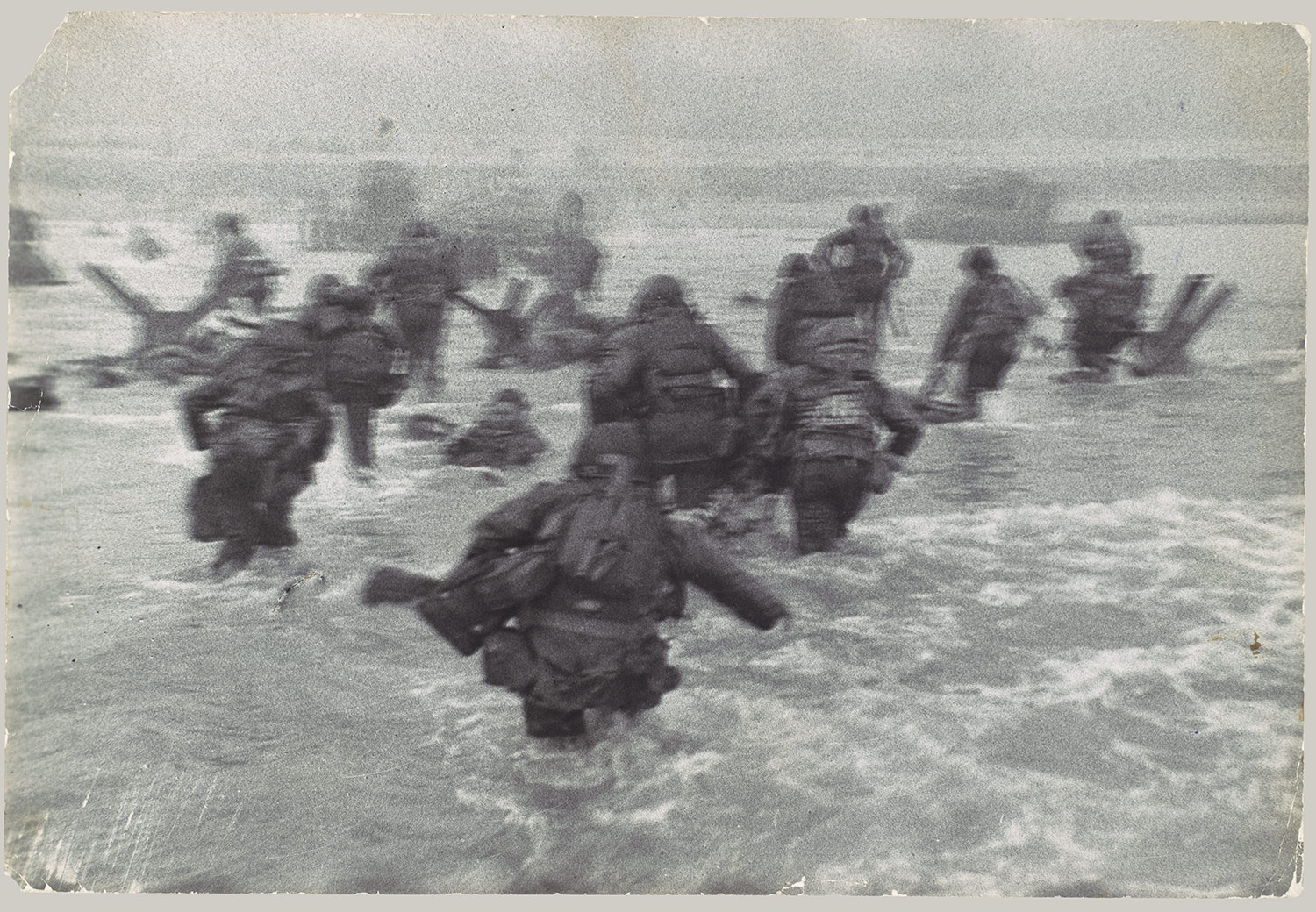
It was sixty-four years ago today that the Allies started taking Western Europe back from the Nazis.

The first, inevitable step was to get past the Westwall – perhaps the most immense set of fortifications ever built, with the intention of making the beaches from Denmark to the Spanish border a bloodbath for any troops trying to cross the beaches.

In places, it worked:

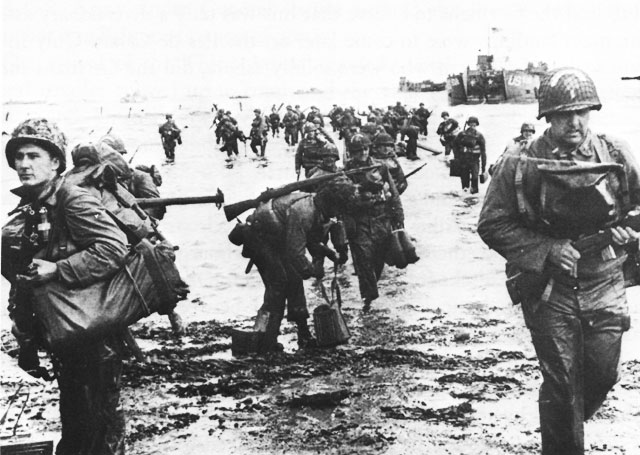
In some places, the troops had to overcome the near-impossible:

And yet by the end of the day, nine allied divisions were ashore, a toehold for a bridgehead that would eventually expand, ten months later, across Western Europe.

There were troops from the US, of course, on the two western beaches…

…and farther east, beaches with Brits…

…and Scots…

And in the middle, linking the two and meeting the worst resistance other than Omaha, the Canadians:

…along with troops-in-exile from elsewhere in occupied Europe; French commandos – some of whom had spent four years in exile, and who spent the next year belying the notion that the French were cowards…:

…and Norwegians, who’d been without a homeland for four years…

…and Poles, who’d been in exile for five years and would, in some cases, remain there for forty-five more:

The world may see nothing like it again.

Anyway – thank a D-Day veteran.

Memorial Day

Monday, May 26th, 2008

Steam Valve at TvM notes something I’ve posted before on Memorial day:

It is the Soldier, not the minister
Who has given us freedom of religion.

It is the Soldier, not the reporter
Who has given us freedom of the press.

It is the Soldier, not the poet
Who has given us freedom of speech.

It is the Soldier, not the campus organizer
Who has given us freedom to protest.

It is the Soldier, not the lawyer
Who has given us the right to a fair trial.

It is the Soldier, not the politician
Who has given us the right to vote.

It is the Soldier who salutes the flag,
Who serves beneath the flag,
And whose coffin is draped by the flag,
Who allows the protester to burn the flag.

It is, of course, Memorial Day – the day when Americans pay homage to those who’ve died defending this country.

Along with remembering the sacrifice, though we need to remember the results of the sacrifices of so many of our nation’s heroes; our independence; the credibility of our independence; expansion, of course; the sanctity of the union and of human freedom;

the viability of freedom against industrial fascism;

the viability of the free world itself.

But what of the 4,000+ Americans who’ve died in our current war? There are those who insist their sacrifice is in vain – who would make that view our national policy, which would, indeed, be a national nightmare.

And yet, John Hinderaker shows us, that is not the case. The world before 9/11 was a dangerous place:

1988
February: Marine Corps Lt. Colonel Higgens, Chief of the U.N. Truce Force, was kidnapped and murdered by Hezbollah.

December: Pan Am flight 103 from London to New York was blown up over Scotland, killing 270 people, including 35 from Syracuse University and a number of American military personnel.

1991
November: American University in Beirut bombed.

1993
January: A Pakistani terrorist opened fire outside CIA headquarters, killing two agents and wounding three.

February: World Trade Center bombed, killing six and injuring more than 1,000.

1995
January: Operation Bojinka, Osama bin Laden’s plan to blow up 12 airliners over the Pacific Ocean, discovered.

November: Five Americans killed in attack on a U.S. Army office in Saudi Arabia.

1996
June: Truck bomb at Khobar Towers kills 19 American servicemen and injures 240.

June: Terrorist opens fire at top of Empire State Building, killing one.

1997
February: Palestinian opens fire at top of Empire State Building, killing one and wounding more than a dozen.

November: Terrorists murder four American oil company employees in Pakistan.

1998
January: U.S. Embassy in Peru bombed.

August: Simultaneous bomb attacks on U.S. Embassies in Kenya and Tanzania killed more than 300 people and injured over 5,000.

1999
October: Egypt Air flight 990 crashed off the coast of Massachusetts, killing 100 Americans among the more than 200 on board; the pilot yelled “Allahu Akbar!” as he steered the airplane into the ocean.

2000
October: A suicide boat exploded next to the U.S.S. Cole, killing 17 American sailors and injuring 39.

2001
September: Terrorists with four hijacked airplanes kill around 3,000 Americans in New York, Washington and Pennsylvania.

December: Richard Reid, the “shoe bomber,” tries to blow up a transatlantic flight, but is stopped by passengers.

And since then?

The September 11 attack was a propaganda triumph for al Qaeda, celebrated by a dismaying number of Muslims around the world. Everyone expected that it would draw more Muslims to bin Laden’s cause and that more such attacks would follow.

In fact, though, what happened was quite different: the pace of successful jihadist attacks against the United States slowed, decelerated further after the onset of the Iraq war, and has now dwindled to essentially zero. Here is the record:

2002
October: Diplomat Laurence Foley murdered in Jordan, in an operation planned, directed and financed by Zarqawi in Iraq, perhaps with the complicity of Saddam’s government.

2003
May: Suicide bombers killed 10 Americans, and killed and wounded many others, at housing compounds for westerners in Saudi Arabia.

October: More bombings of United States housing compounds in Riyadh, Saudi Arabia killed 26 and injured 160.

2004
There were no successful attacks inside the United States or against American interests abroad.

2005
There were no successful attacks inside the United States or against American interests abroad.

2006
There were no successful attacks inside the United States or against American interests abroad.

2007
There were no successful attacks inside the United States or against American interests abroad.

2008
So far, there have been no successful attacks inside the United States or against American interests abroad.

When you remember what the world looked like on September 12 – rumors of more attacks, the US embarking on an invasion of a nation that had played a disproportionate role in gutting the USSR, visions of a big chunk of the world dancing in the streets at the sight of the towers falling – it seems incredible that we’ve gotten to this point.

And we didn’t get here by prostrating ourselves in front of our enemies, or via diplomacy for that matter.

So this Memorial Day, remember those who’ve sacrificed everything for this country.

Then, and now.

(more…)

A Night At The Museum

Thursday, May 22nd, 2008

I haven’t had much to say about Ted Kennedy because, honestly, everyone with anything to say has already said it and better.

Except, of course, for the fact that I’m praying for Mr. Kennedy, and hope he recovers and lives many more years.  Life is much more important than politics.

First Ringer has the best compendium of Kennedy’s career I’ve yet read:

From his choices in policies to his choices in politics, Teddy has remained the well-groomed rebel, the slightly mainstreamed radical.  But Kennedy’s flair for risk did not serve him as well as it did his brother.  Clutching a bare 38% of the primary vote and slightly over 1,100 delegates, Kennedy carried on a quixotic floor fight culminating in his convention address that may well have signaled the beginning of the second phase of Kennedy’s political career.  [He defined] himself as the champion of the “New Deal” and “Great Society” liberal Democrats…

Ted Kennedy, even when I was a kid, seemed to be the figure in which paleoliberalism showed its age – where the sixties started fraying into the seventies and spun off the rails in the eighties.

It remains more than a little tempting to ravage Kennedy, who in the preceeding 28 years after that address personified every liberal stereotype in the eyes of both conservative critics and skeptical independents.  Sometimes a parody onto himself, Kennedy would bluster his way on to the national stage for every issue of note, spout the need for some massive government intervention, take a hard but blunt strike at Republican opponents of the measure and then retreat to Kennebunkport.  Often lacking title in the Democratic ranks yet still given deference by pols and the media alike, Kennedy seemed more like a member of the “Patres Conscripti” of the Roman Senate – old men selected by the Roman powers that be, unencumbered by such concerns as elections.  Given that Kennedy’s only received less than 60% twice in his Senate career (in 1962 and 1994), the description seems somewhat apt.

Perhaps.

I see him more like the British parliamentarians of the 1820’s; elected, but yet sitting in secure sinecures for life, loyal to factions that politically defined them.

Anyway – best wishes to Senator Kennedy.

Eretz Yisroyel

Thursday, May 8th, 2008

It was sixty years ago today that Israel declared its independence.

It was sixty years ago tomorrow that Egypt, Syria, Jordan, Iraq and much of the rest of the Arab world started trying to drive them into the sea…


…an effort that has, directly and indirectly, never stopped. The Israeli military – a hardscrabble bunch of Holocaust survivors, Allied military veterans of WWII and impassioned settlers armed with weapons cast off by other nations, bought on the sly or, in some cases, stolen from them (Israel’s first tank was a Cromwell tank that had been stolen from the occupying British in 1947) and outnumbered prohibitively, Israel nevertheless fought its attackers to a stalemate. Three other attempts to drive Israel into the sea – in ’56, ’67 and ’73 – failed.

They are plagued by the same Palestinian terrorism problem that bedeviled them when I was a child – a problem that is a creation of Arab governments who have for sixty years refused to help defuse the refugee situation by negotiating, absorbing the refugees (Jordan fought a war to expel them in 1971) or, perhaps most importantly of all, defusing the situation by acknowledging Israel’s right to exist.

Israel is the sole functioning democracy in the Middle East, at least until Iraq solves its political problems. Israel is an imperfect ally – they are driven by immutable self-interest when there’s any doubt – but they have contributed much to the world in technology, literature, art, agriculture, and above all reourcefulness and courage in the face of dismal odds and lumpen hatred.

Happy Birthday, Israel!

Less Than The Sum Of Its Parts

Wednesday, May 7th, 2008

“Summer Side of Life” is one of Gordon Lightfoot’s best songs.

The scandal of the “comfort women” – girls from Korea, the Philippines, Taiwan and other Asian nations (and a few Dutch internees as well) kidnapped to serve as sex slaves to the Japanese military during World War II – is one of the great human rights scandals of the 20th Century.

Somehow, it would never have occurred to me to combine the two.

And, I must say, it still does not.

Two Americas

Tuesday, May 6th, 2008

There are two Americas.

One of them admires former terrorist thug Bill Ayers.  Y’know – the major political influence that Barack Obama hasn’t tried to underbusify yet.


That is an American flag he’s standing on (although this first America doesn’t care much). 

The other America doesn’t.

Happy Patriots Day!

Saturday, April 19th, 2008

No, not the football team – the anniversary of Paul Revere’s ride to mobilize the militia against the British, and the Battles of Lexington and Concord.

By bypassing the mainstream media and taking the word directly to the people, Revere was in a sense the first conservative blogger; indeed, had his horse been named “Blog”, the metaphor would stand on its own.

Sadly, that is not the case.

However, a look through Massachusetts state archives reveals that, like a good conservative pundit in the public eye, Revere stirred up a firestom of controversy.

In the Bofton Ftar-Tribune, columnist Richelieu Sturdevaant wrote:

Patriots of olde have lamented to me that thif is a fad, far cry from the old days in Maffachufettes, where real patriots worked with the Britifh Government!

Zebulon Perry, writing the Maffachufsetf Monitor – a broadsheet funded by British parliamentarian and tax patriarch George Townsend, wrote:

Revere, who riddeth fourth against the lawful Brittifh taxes, is funded by the Sons of Liberty!

Hezekiel Martens, of Citizens for a British Massachusetts, noted:

The righte to keepe and bear armfe is clearly laid down in the Britifh Conftitutione to derive to the Militia, which is the Britifh Redcoatte. Mufkettes kill 1,000,000 Maffachufettef children a year.

Grace Kelleye, writing fo the broadsheet MassRed, wrote:

George Washington is the real fascist. We should all lay down on the roade in front of Mr. Revere.

Lord Jefferey Fleckey of Broadsheet of the Moderatte Royaliste simply wrote:

Revere if fo pwnn3edde

And Otis Coleman of the Ftrib wrote:

Fure, fit a ftupid overfexed filverfmith aftride a faft horfe, and fure, he’ll feel like a ftud. Fo what? He’fe no big cheefe. Af a feventh-grader fitting on my knapfack, sucking on a sucker, fifty yearf ago on the weft fide of Bofton, I faw that.

Really!

Happy Patriots Day!

Above And Beyond The Call Of Duty

Wednesday, April 9th, 2008

The fourth Medal of Honor of the Iraq War (CORRECTION: the third, actually) was presented yesterday, to Navy Seal Mike Monsoor.

From the President’s remarks:

In May 2006, Mike and another SEAL ran into the line of fire to save a wounded teammate. With bullets flying all around them, Mike returned fire with one hand while helping pull the injured man to safety with the other. In a dream about the incident months later, the wounded SEAL envisioned Mike coming to the rescue with wings on his shoulders.

On Saint Michael’s Day — September 29, 2006 — Michael Monsoor would make the ultimate sacrifice. Mike and two teammates had taken position on the outcropping of a rooftop when an insurgent grenade bounced off Mike’s chest and landed on the roof. Mike had a clear chance to escape, but he realized that the other two SEALs did not. In that terrible moment, he had two options — to save himself, or to save his friends. For Mike, this was no choice at all. He threw himself onto the grenade, and absorbed the blast with his body. One of the survivors puts it this way: “Mikey looked death in the face that day and said, ‘You cannot take my brothers. I will go in their stead.’”

His brothers in arms noticed, of course:

Perhaps the greatest tribute to Mike’s life is the way different service members all across the world responded to his death. Army soldiers in Ramadi hosted a memorial service for the valiant man who had fought beside them. Iraqi Army scouts — whom Mike helped train — lowered their flag, and sent it to his parents. Nearly every SEAL on the West Coast turned out for Mike’s funeral in California. As the SEALs filed past the casket, they removed their golden tridents from their uniforms, pressed them onto the walls of the coffin. The procession went on nearly half an hour. And when it was all over, the simple wooden coffin had become a gold-plated memorial to a hero who will never be forgotten.

Read the whole thing, of course.

Oddly, the New York Times has yet to cover the story. (UPDATE: They covered it, eventually. As of 6PM Central last night, when I originally wrote this piece, they had not).

It Was Forty Years Ago Today

Friday, April 4th, 2008

My dad doesn’t remember this – but I do.

We were driving down Sixth Street Southeast in Jamestown, heading toward the tracks.

Dad was listening to the radio (tuned in to KEYJ, naturally) in our old Mercury.  It was bright and clear outside.

And the announcer led with a story about “Martin Luther King” being shot.  It’d be absurd to say I knew what was going on – but I remember being familiar with the name.  He’d been on the TV a time or two.
And it seemed pretty obvious it was an important story.   I obviously didn’t know why – I was still probably ten years away from meeting my first black person.  Jamestown North Dakota was pretty white, back then.

More people remember.

Next Stop: Charles Manson!

Thursday, April 3rd, 2008

How Hanoi Jane spent her summer:

How Cmdr. McCain spent his:

Hey, they even have the same hand gesture…:

Jane and her friends had their rallies…:

[UPDATE:  Oops – that one’s a hoax.  I even remember something about that.  Blah.  Since I’m not Sixty Minutes, “fake but accurate” doesn’t cut it.  My bad.   But this one’s real…]

…and Mac? Well, he and his friends really had only one:

Oh, yeah; Fonda has endorsed Obama.

Ed writes:

In fact, Obama’s campaign will probably keep their heads down and hope this passes quickly. McCain’s narrative as a Vietnam War POW who suffered torture while Fonda gave his captors photo-ops will resonate even further if she takes to the stump on Obama’s behalf. Her presence would draw connections between Obama’s anti-war supporters and the radicals — like Ayers and Dohrn — of Fonda’s generation. While that might thrill the MoveOn crowd, it will likely lose Obama the heartland, independents, and centrists who will balk at that kind of radicalism, especially while the more moderate option in McCain is available.

Some might be surprised that Fonda didn’t support Hillary Clinton in gender solidarity. Hillary, in this one case, probably isn’t among them, but instead relieved to avoid Fonda’s baggage.

Well, if Obama wants it kept on the down-low, give the man what he wants.

Oh, the hell.

HANOI JANE ENDORSES OBAMA

There. I feel better now.

From Under Their Feet

Wednesday, April 2nd, 2008

While Islam is growing in many parts of the world, Diamand Dog at Freedom Dogs has some very good news.  The Dog notes:

According to the website Islam Watch, in Russia, some two million ethnic Muslims converted to Christianity last year. Ten thousand French Muslims converted, as did 35,000 Turkish Muslims. In India, approximately 10,000 people abandoned Islam for Christianity.
In his book Epicenter, author Joel Rosenberg details amazing stories of Muslims converting to Christianity. In Algeria, the birthplace of St. Augustine, more than 80,000 Muslims have turned to Christ in recent years. This, despite the stiff opposition from Islamic clerics who have passed laws banning evangelism.

In Morocco, newspaper articles openly worry that 25,000 to 40,000 Muslims have become followers of Christ in recent years.

There’s plenty more – read the whole thing.

And DD adds:

Osama bin Laden may be the greatest catalyst the world has ever seen to convert Muslims to Christ.

Here’s the thing I think is interesting; these conversions are largely happening in places where people can see the differences between the faiths and their effects on peoples’ lives and societies, face to face.

I’ve pointed this out for years; none of the 9/11 hijackers were from India, Bosnia, Senegal, Mali, Turkey, Albania, or any other place where Moslems live in social pluralism, relative economic as well as political freedom, and exposed to more than one point of view about the world, society and faith.  This isn’t to say that there aren’t extremist Madrassas in any or all of those countries.  But the extremism and militancy that breed jihadism are tempered by exposure to the notion that other societies not only have validity, but work pretty darn well.

Whether that means people convert to Christianity (something Christ bade me to work, pray and hope for – and I do) or merely justs files off the edges of the militant extremism that plagues Islam in less-pluralistic parts of the world, it’s all good.

--> Site Meter -->