Archive for the 'History And Its Making' Category

Operazioni Speciali

Monday, December 19th, 2011

One of the most enduring myths of World War 2, along with “the cowardly French” and “the incompetent Poles”, is “the inept, gutless Italians”.

Of course, with the Italians there is plenty of circumstantial evidence.

In 1940, Italian troops were routed in Mussolini’s attempt to invade Greece.  The Germans had to rescue the Italians – a humiliating setback for Mussolini.

The Italian attempt to join Germany in invading France was stopped cold by France’s line of border fortresses.  Italian gains in France were measured in yards, not miles.

Then, early in 1941, the Italian army in North Africa was demolished, with hundreds of thousands of POWs, by a much smaller British force.  This required the Germans to send Erwin Rommel – the leader of the Panzer group that had cut France in half the previous summer – to intervene with the German “Afrika Korps” – leading to a seesaw year and half of battling across Egypt and Libya.

Italy had several strikes against it, militarily.

Socialism: “But wait, Merg – Mussolini was a fascist!  Literally! Fascists are the opposite of communists!”  Only if you’re a professor with Marxist leanings.  Fact was, Mussolini made the trains run on time by nationalizing them – and much of everything else.  Since he seized control in 1922, Mussolini latched onto a vision of building a bigger, stronger Italy through aggressive government intervention in industry and economy.

As a result, Italy was deeply in debt when the war began; money that Italy could have used to modernize its military – to say nothing of its economy – was being paid out in debt servicing.

Just like in Obama’s USA.

Evolution: Italy was still a developing country in 1940.  Italy’s industrial GDP was only a sixth that of France or Britain.  It was still primarily an agricultural nation.

Bad Gear: In part because of industrial backwardness, but more because of the crushing debt burden, Italy’s military equipment was backward and largely obsolete, and sparse even so.

Not only was Italy’s primary tank during the war – the Fiat – yes, Fiat – Carro Armato M13/40 – a hopelessly obsolete mid-thirties antique even though it was built in 1940…

…but only 3,500 of them were built during the entire war – less than two months’ worth of production for the American Sherman tank.

Italy’s main fighter plane?  The Fiat (!!!) CR42…

A pair of CR42 biplanes.

…which was distinguished by being the last biplane in first-line service with any major air force.   It was, by the way, an excellent biplane fighter – which, in the life-or-death of air combat, is a poor consolation prize.

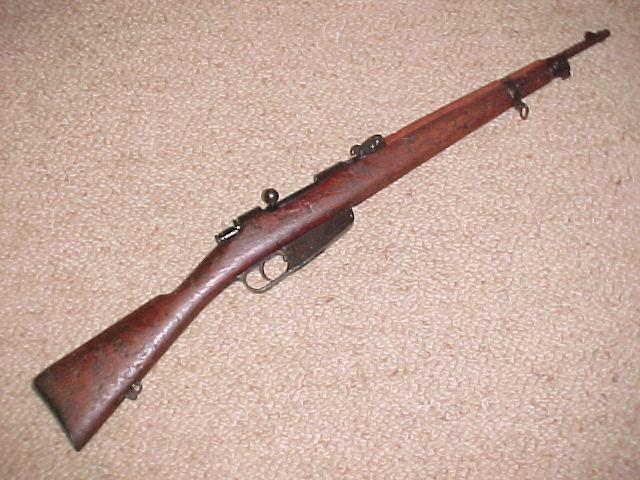
Italy’s rifle?  The “Terni”- the Mannlicher-Carcano M1891 – was, as its model number shows, entering its fiftieth year of service.

It was a small, underpowered turnbolt rifle with an obsolete and troublesome mechanism.  Worse, Italian doctrine and industry felt it sufficient for the Italian infantryman to be issued with 36 rounds of ammunition as his basic combat load.  Bubba Schlockdorf carries more ammo into the woods to hunt deer in the fall.

Bad Leadership: All armies to one extent or another distinguish between officers and enlisted men. Officers are usually separate from the men – largely so life-and-death decisions don’t get colored by being excessively close to the men.

The Italian military took this to a highly dysfunctional extreme.  Officers in the Royal Italian Army – remember, fascist government aside, Italy was still technically a monarchy – subscribed to many of the worst habits of militaries in monarchies; the enlisted men combined terrible living conditions, lousy pay and miserable status as draftees with a fairly weak non-commissioned officer corps.

As a result, Italian regular units’ morale often collapsed in the field under fire.

But Italian non-regular units – units selected from men who wanted to be there, and who were motivated to kick ass – fighter pilots, and especially men who fell under the very loose category “specal forces?”   That was another story.

It was seventy years ago tonight that Italian “special forces” carried out one of the most devastatingly successful special missions in the  history of warfare – one that very nearly changed the course of World War II.

———-

Ever since the Italian fleet had been gutted at Taranto the previous winter, the British fleet had kept the Italian Navy bottled up in harbor.

But seventy years ago tonight, a tiny team of six Italian Navy frogmen riding three torpedos that had been converted into transports launched from an Italian submarine.

An Italian manned torpedo. It was designed to carry two men, and a demolition charge, to the target; the men would swim to shore and attempt to escape.

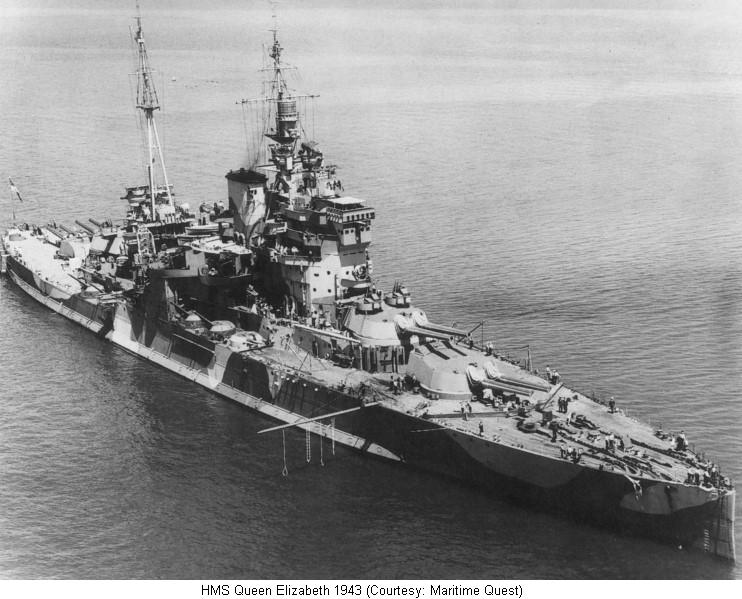
They slipped past the harbor defenses, and left a set of demolition charges underneath the British battleships Queen Elizabeth and Valiant, as well as a Norwegian oil tanker.

HMS Queen Elizabeth

And in the wee hours of the morning, all three charges exploded, ripping the stern off the tanker, and sinking the two battleships.  They sank in shallow water, and both were recovered and returned to action…

…after a year during which their absence was badly felt in the Mediterranean.

The six Italian marines were captured by Egyptian police and turned over to the British.

At any rate – one of the enduring myths of World War II was “the Italians were incompetent cowards”.  And – like “The French ran like scared bunnies” and “the Poles rolled over” – it’s as true as any wartime oppo propoganda ever is.

“Send More Japs”

Sunday, December 11th, 2011

It was seventy years ago today that an episode of American history occurred that is only just barely starting to see its due in our popular culture.

It may be too little, too late, as the generation that felt the reverence due the event passes from the public stage.

Consider this my attempt to fix that.

Wake Island was a tiny outpost in the middle of the west-central Pacific.  It was a stop

And seventy years ago today, the Japanese Navy (and its attendant Marines) planned to invade the island.

We’ll come back to that.

————

Wake Island, all 1,300-odd acres of it, is as barren a piece of real estate as there is in the world.  It had no permanent inhabitants – Marshall Islanders would hunt birds on the little coral atoll, but until the Western world invented long-range flight, the island served no habitable purpose to humanity.

The Pan-Am Clipper changed that.  The atoll’s three islets sheltered a lagoon whose calmer-than-the-open-ocean water was an ideal landing place for the Pan-Am Clipper’s flying boats (which was the mainstay of transoceanic travel in the 1930s, long before transcontinental jets).

A Clipper, anchored in the lagoon at Wake Island, 1936

So Pan-Am built a fuel and rest stop at Wake, with a hotel and a small village for the workers that would service the planes and the passengers as a near-last stop on the three-day, San Francisco to Hawaii, Midway Island, Wake Island, Guam, Manila, and Hong Kong itinerary.

And an airbase that was useful for long-range civilian aircraft was even more useful, in those years when we awaited war with Japan, to the military.  And so in the previous January, the Navy started buildng a base in the lagoon to support the fleet and, vitally in this pre-jet, pre-satellite days, long-range patrol aircraft.  The job was a crash program, bringin 1,200 American civilian workers to the island and, in August, in view of the skyrocketing tensions between the US and Japan, the island’s first permanent garrison, 400 Marines of the “First Marine Defense Battalion” and 55 more to run a dozen Grumman F4F Wildcat fighters of Marine Fighter Squadron 211.

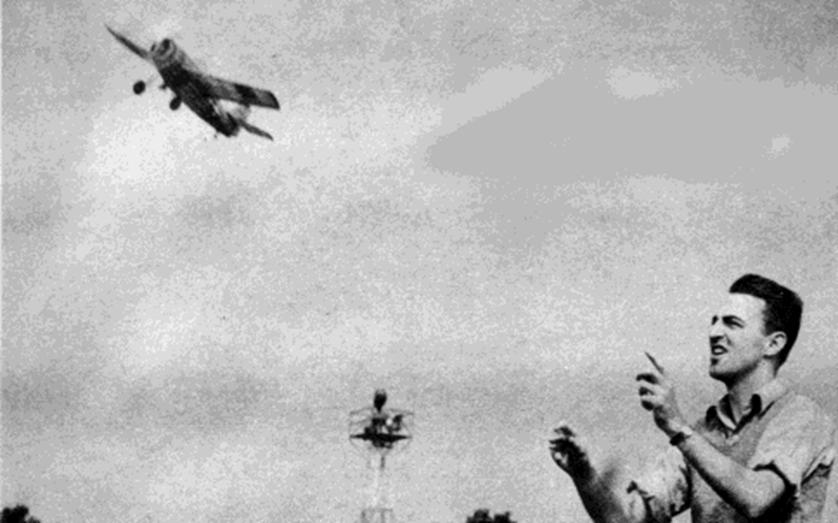
A Marine F4F Wildcat, flying over a ground crewman on Wake Island before the war.

Along with seventy sailors, that made up the entire American force on the island, commanded by Lieutenant Commander WInfield Cunningham, USN.

The island was, in the perspective of the vast Pacific, practically on Japan’s doorstep.

————

Four days before, on December 7 (the eighth on their side of the International Date Line, on which Wake also lay), as Japan bombed Pearl Harbor and invaded Malaysia, Hong Kong, Guam and the Philippines, a Japanese air force raid from nearby Saipan hit Wake.  Wake’s defenders fared about the same as those at Pearl Harbor – eight of the 12 Marine fighters were destroyed on the ground in a bombing raid that also killed or wounded most of the men in the Marine air detachment.  The four surviving planes couldn’t catch the bombers (on December 8, anyway; they did kill two Japanese bombers in a followup raid the next day.

And then, on the morning of December 11, the Japanese closed in for the coup de grace.

And the Marines – armed with a bunch of old pre-World-War-1 cannon that’d been removed earlier that year from a scrapped battleship –  waited until the Japanese were less than two miles offshore before opening up a withering bombardment.  One of the Marine shells hit the shell magazine of the Japanese destroyer Hayate, blowing it up, killing the entire crew.  It was the first Japanese surface ship sunk in World War 2.

IJN Hayate

In the meantime, the four surviving Marine Wildcats, loaded with light bombs, took off, and attacked the Japanese invasion fleet – which was operating without direct air support (no aircraft carrier).  One Wildcat landed a 250-pound bomb on the afterdeck of the destroyer Kisaragi; ordinarily a destroyer would have a decent chance of surviving a hit by such a small bomb…

IJN Kisaragi

….but the Japanese sailors, displaying a lack of damage-proofing that would plague their Navy throughout the war, had left the anti-submarine depth charges armed.  They exploded, sinking Kisaragi, also with all hands.

The Marines also hit the Japanese flagship, the old light cruiser Yubari, nearly a dozen times in the lightly-armored superstructure…

IJN Yubari, which was sunk in 1944 by an American submarine.

…killing dozens and prompting the Japanese commander, Admirial Shigeyoshi Inouye, to abort the landing attempt.

The news of the victory- the closest the US came to good news that first awful week of the war – was spread far and wide throughout the US, along with Commander Cunningham’s message back to the US, which ended with the phrase “Send more Japs”.  It was treated as a “remember the Alamo”-type act of defiance. It was most likely “padding” – extraneous phrases thrown into messages to throw off Japanese-native translators eavesdropping on the transmission. But it was the sort of story Americans wanted to hear amid the unrelenting bad news of that week.

It was the first and last time in history that an amphibious attack would be repelled by coastal defenses.

And with the US and British Pacific Fleets sunk, Hong Kong lost, the Philippines invaded, British troops being outfought and outmaneuvered on the Malay approaches to Singapore, that was as close to a victory as the Western Allies could find in that dismal first few weeks of World War 2.

It couldn’t last.  While the Pentagon pondered sending a relief mission, bigger priorities – defending Hawaii from an expected invasion, reinforcing the Philippines – took precedence.  The Japanese peeled off two aircraft carriers that were returning from Pearl Harbor, and dispatched a brigade of Japanese marines.  And 12 days later, those Marines rammed two old destroyers ashore on a Wake-island beach, clambered off, and in a short, sharp, ugly battle subdued the Marines. It was incredibly bloody; estmates are that nearly 800 of the Japanese attackers were killed (on top of the entire crews of the two destroyers).  About 100 Americans were killed all told, with the rest being bundled off into captivity. Some of the American civilians were kept on the island – where, in 1943, a Japanese commander had them all executed.  One survivor managed to carve the inscription “98 Wake Island 5-10-43” into a rock before being captured and killed himself.

The "98 Rock" on Wake Island - today, a monument to the American victims of the Japanese war crime.

The Japanese commander was executed for the war crime after the war.

It Was Seventy Years Ago Today…

Friday, December 9th, 2011

The 70 Years Project is re-running front page scans and stories from Minnesota newspapers on the relevant day in World War 2.

An Industrial Solution

Thursday, December 8th, 2011

Yesterday was the seventieth anniversary of Pearl Harbor.

Sunday has two anniversaries; one of them is the Nazi declaration of war on the US (and you’ll see the other one on Sunday).

But today is the seventieth anniversary of the war’s most ghastly contribution to human history; it was the opening of a “camp” near the Polish village of Chelmno, on the grounds of a former baronial manor.  It was a placid looking place that would add a new word to the world’s vocabulary of evil: the German Vernichtungslager.

We’ll come back to that.

———-

Concentration camps – places to put people who were for whatever reason inconvenient or needed to be held in one place – had existed for quite a while.  They got the name from the British during the Boer War, when they “concentrated” the families of Boer fighters in a few easily-guarded locations. They turned out to be ghastly places – not so much because the Brits intended it as through bureaucratic incompetence.

When the Nazis took power in Germany, their agenda bode ill for lots of people – gays, the mentally ill, Romany (“Gypsies”), Jehovah’s Witnesses, political dissidents of all stripes, and especially the Jews.  And, following Lenin’s lead, they started straight in with their own Konzentrazionslagern – the Germans called them “KZs” – as a place to put all manner of undesirables.  There were hundreds of KZs, starting with Buchenwald in 1937, in Germany and in every corner of the Reich. They served many purposes – holding tanks for political prisoners, forced labor camps, even propaganda facades.  And thousands died in the KZs – from disease, malnutrition, overwork exposure, the brutal and capricious “discipilne”, even the whim of the guards; 50,000 at Buchwald and Ravensbrück, similar numbers at Dachau, Nordhausen, Theresienscadt, and Sachsenhausen and many, many more.

But the process of hauling a prisoner off to a KZ, there to die slowly of any number of causes, didn’t serve the goal of ridding the world of Jews (first; the Slavs and other “Lower” races would follow) fast enough.   The Nazis, being analytical Germans, experimented with many different means of killing people without all the procedural overburden, and removing impediments like “the human will to survive and endure”, from the equation; roaming teams of SS who’d shoot people in the hundreds were the first method, tried over the previous year and a half since the fall of Poland.

The idea had been broached to make the process more an industrial than military one.  The next question was “what sort of industrial process”.  The idea of using some sort of poison gas was broached.

Being a nation of engineers, the Nazis thought to prototype a couple of different approaches, to remove all the variables and find the optimal approach before switching into full production.  Among the variables to be removed was the pesky issue of “neighbors”; unlike the KZs, which would be tucked in next to towns and factories and farm regions all over Germany and the occupied countries, the new camps, Vernichtungslagern, or “Extermination Camps”, and called “VZs” by the Germans, would be be located in rural Poland – a backward place in those days, far from any potentially friendly borders, away from prying media eyes, and very sparsely populated by European standards.

And it was at Chelmno, seventy years ago today, that the first approach – vehicle exhaust gases piped into the back of a panel van jammed with 60-odd victims.

The Chelmno gas van.

…followed by burial in a mass grave in a nearby forest, was first tried.

Like any good engineers and scientists, they kept meticulous notes.  The exhaust gas -mostly carbon monoxide – was just too slow.  And burial was far too labor intensive; at another “prototype” VZ at Treblinka, cremation seemed to work much more efficiently. All of the data points led to the conclusion that carbon monoxide was far too slow and inefficient a means of killing; when the Nazis designed camps to optimize the approach, they settled on Zyklon-B, a form of prussic acid (hydrogen cyanide) in pellet form, which worked twice as fast.

And so both of the “prototype” plants were shut down after relatively short runs in service; about 152,000 Jews, Poles and Gypsies died at Chelmno in the next two years.

We’ll have more on Treblinka later.

———-

If the above seems banal – it’s intentional.  The most jarring thing about reading about the Holocaust was its turning of modern industrial methods – the 1940’s equivalents of “Lean Six Sigma” and “Total Quality Management” – to the process of genocide, reducing it to a bean-counting, widget-producing exercise.  Genocide – the planned destruction of an entire race of humanity – had always been a brutal, bloody thing.

Seventy years ago today, the effort to turn it into just another waterfall project got underway for real.

Infamy

Wednesday, December 7th, 2011

It’s in all the papers; today is the seventieth anniversary of the attack on Pearl Harbor.

All the TV stations will show the familiar footage – the USS Arizona, ablaze from several bomb hits, exploding, spewing a geyser of greasy smoke hundreds of feet in the air, killing 1,000 men in a matter of seconds; the blazing and capsized battleships on Battleship Row…

…the rows and fields full of wrecked aircraft…:

All that’s true.

One thing Americans rarely see, or have to study, is that Pearl Harbor was just one of many similar attacks all around the Pacific Rim.  At the same time as the Japanese carrier-based planes were attacking Pearl Harbor, more planes, launched from Taiwan (then called Formosa) attacked America’s huge base at Clark Field, in the Phillipines:

25 US bombers and dozens of fighters were destroyed on the ground.

:The Japanese also captured Hong Kong, crossing from occupied China and taking the British colony (with its garrison of Brit, Canadian, and Chinese troops) in a short, sharp, brutal battle:

Singapore – Britain’s easternmost colony and naval base – was attacked.  More devastating to the Brits, the naval expedition they sent to reinforce Singapore, the battleship Prince of Wales and battlecruiser Repulse, were sunk off the south coast of Malaysia by Japanese torpedo bombers:

The Prince Of Wales and Repulse (background) burning on the left side of the photo. The ship moving in the foreround is a British destroyer.

At the same time, the Japanese invaded Guam…

..and attacked Wake Island, of which more later this month.

It was, in short, the the biggest – in terms of area covered – attack in the history of warfare.  And it plunged the half of the northern hemisphere that wasn’t already at war with Hitler into the greatest session of human bloodletting in history. This blog focuses mostly on the smaller stories, and the unknown ones, in the war.  There were many at Pearl Harbor – most notably to this blog’s audience, the fact that the first shots fired that morning were fired by Minnesotans.  A gun crew of Minnesota Navy Reserve sailors from Saint Paul, crewing a cannon on the U.S.S. Ward, a refurbished World War I destroyer on antisumbarine patrol off the entrance to the harbor, spotted a Japanese midget submarine that was attempting to infiltrate the harbor.

The crew of the starboard four-inch gun on the USS Ward. Some of the men, mostly from Saint Paul, are still with us, thank God. Their gun is on the state capitol grounds, on the frontage road by the Vets building near Wabasha street.

The Minnesotans – using the very cannon that currently sits in the yard at the Veterans building, at the foot of Capitol Mall in Saint Paul – hit the submarine twice, sinking it before it could get into position.  I wrote about them four years ago.

Here’s the long and short of it; to a generation of Americans who think – with reason – that 9/11 was a catastrophe…well, it was.  But our nation’s power and ability to respond to the aggression was not affected.  Clearly not – our military riposte was sudden and overwhelming.

Now – imagine an attack that sank three or four of our Supercarriers, the mainstays of our Navy, in the matter of an hour, and cut off and isolated, say, Korea, leaving its tens of thousands of American troops isolated, cut off from supplies, devoid of air cover, and pretty well helpless, and left us more or less unable to respond in kind without massive effort and sacrifice, at all?

Because that, adjusting for modern military doctrine, is what happened on December 7.  That was where this nation was at seventy years ago at this hour; not just bloodied, not just beaten , but truly unable to respond.

And very few Americans alive today can imagine that.

Couldn’t See This Coming…

Tuesday, November 15th, 2011

Meryl Streep’s portrayal of Margaret Thatcher is raising eyebrows in all the wrong ways:

The Iron Lady, a new biopic starring Meryl Streep as Baroness Thatcher, has drawn an angry response from friends over its portrayal of the former prime minister as a lonely figure sliding into dementia.

In the opening scenes, a frail Lady Thatcher is seen shuffling into a corner shop to buy a pint of milk and expressing shock at 21st-century prices.

Back at her Belgravia home, her security team fret that she has left the house unsupervised.

Another scene shows her oblivious to the fact that her husband, Sir Denis, is dead. She imagines him to be in the room and conducts conversations with him, before revisiting her glory years in a series of flashbacks.

The article goes on to note that Thatcher is portrayed as being a strong leader in re the Falkllands, the coal miner’s strike, and so on.

But it’s sorta fleshing out my theory that the only way the liberal media – and Hollywood is a part, maybe the biggest part, of that media – can portray conservatives is as either caricatures (see every “conservative” that’s turned up on Law and Order for the past 15 years), effective leaders with dark sides that counterbalance or negate it all (see the TV “Reagan” biopic a few years back) or jokes.

And Rahm Emanuel Is Combing Through It Looking For Tips

Friday, November 11th, 2011

Nixon’s Nix long-sealed grand jury testimony in re Watergate has been un-sealed:

Here’s what we know: In June 1975, a disgraced former President Richard M. Nixon testified before a grand jury about Watergate.

What exactly he said has been sealed for the last 36 years.

That will change today when the records will be released, thanks to the efforts UW-Madison emeritus professor Stanley Kutler.

The Obama Administration is reportedly listening carefully , considering blaming the continued high unemployment rate on Nixon.

Sparring

Monday, October 17th, 2011

As Americans from coast to coast scratch their heads and wonder about US troops being deployed to Uganda, it’s a good time to remember when brinksmanship really took a nation to the brink.

It was 70 years ago today that the destroyer USS Kearny was torpedoed.

USS Kearny

In the wake of the Battle of Britain – mainly, with the strong indication that the United Kingdom would survive – Franklin D Roosevelt ordered the beginning of “Lend Lease” shipments to the British.  He also traded fifty World-War-1-era destroyers to the British in exchange for bases in the Azores and Canada.

Which was just diplomatic business, really; it meant the US was taking sides, to be sure, but it didn’t put any Americans into harms way.

Now, October of 1941 was pretty close to the nadir of the Battle of the Atlantic, as far as the UK was concerned.

Part of convoy in 1941, shot from a British cruiser.

German U-Boats were sinking British and allied merchant ships far faster than they could be replaced – and killing about half of the even harder-to-replace merchant marine crews with each ship that sank.  And beyond that, the supply of “escort” ships – the destroyers, frigates, corvettes and sloops that tried to protect the merchant ships from the submarines’ depredations – was getting destroyed as well; Britain’s destroyer fleet had suffered grievous casualties at Dunkirk, in the Mediterranean, and defending Norway, as well as to the U-boats.  And the emergency building programs to replace them weren’t close to breaking even with the loss rate, much less making up for lost ground.

Churchill later confessed that of all the situations he faced during the war – Dunkirk, the Battle of Britain, the Siege of  Malta, the titanic battles in the Western Desert – only the Battle of the Atlantic genuinely frightened him.  Britain was within a hair’s breath of being starved into submission.

So what did put Americans into harm’s way was FDR’s concord with Churchill that, to help the British focus their endangered fleets of escort ships until the huge wartime shipbuilding programs could take effect – hopefully before Britain was starved to the negotiating table – American ships would escort Britain-bound convoys into the mid-Atlantic, to a hand-off point where British and Canadian forces would take over.  Roosevelt made it known that US ships would attack any U-Boats that crossed their paths.

This act – escorting war materiel to a belligerent power, and threatening to take military action against any interference – abrogated, practically and legally, any claim America had to its “neutrality”.  Which didn’t stop Roosevelt from waging the propaganda war to claim neutrality; he called the escort efforts “Neutrality Patrols”.

It was while on “Neutrality Patrol” that the Kearny and three other American destroyers were sent on a very un-neutral mission.  A Britain-bound convoy was being overwhelmed by a U-boat “Wolf Pack”, taking terrible losses; the four American ships were sent to assist in the convoy’s defense.

Which is not what “neutral” powers are supposed to do.

And it was at about 4AM on the morning of October 17 that the German submarine U-568 fired a spread of torpedoes, one of which hit the Kearny in its forward boiler room.   It was later speculated that the commander mistook Kearny for a British destoyer.No matter – eleven US sailors were killed.

The Kearny, with the hole in its forward "fireroom".

There really were two stories here.

One would be reflected in the nation’s slow slide into war.  FDR had been setting the nation up for war for years; the National Guard and the nation’s industry had been mobilizing for over a year.  The “Neutrality Patrols” were essentially daring Hitler to hit first.  And he would; in two weeks’ time, another American destroyer, the USS Reuben James, would be sunk by another U-boat in another similar incident, this time with much greater loss of American life.  And the “Neutrality Patrols” would become, in all but name, combat missions.  In many ways, at least as regards the battle in the Atlantic Ocean, Pearl Harbor and the German declaration of war was just this side of a formality.

One other story – not nearly as famous – would be reflected in the fact that “only” 11 American sailors died in the incident, and the Kearny survived, afloat, and was repaired to serve out the rest of the war (to be mothballed in 1946, and to be finally scrapped in the early seventies). It was the resolution of an engineering issue that had been roiling naval architects for a generation.

Kearmy, undergoing repair at the Boston Navy Yard

The Kearny, like all fast warships of the day, was steam-powered (gas turbine power was a generation in the future, and diesel engines don’t have nearly the power output per ton of power plant for ships this size).  Now, it’s more efficient to put the steam turbines (which drive the propellors) together near the rear of the ship, and the boilers together as close as possible near the boilers – more efficient in terms of space, engine efficiency, and cost.

But that also means that a bomb or shell or torpedo hit in the boiler room, or engine room, will knock out either all steam power or all engine power.  And so US naval architects started separating boilers and engines.  Now, destroyers are long, narrow ships – with a length to “beam” (width) ratio of 10:1 (your cruise ship may be more like 6:1) – so that meant half of the ships’ lengths were eaten up by a boiler room, an engine room (for the left propellor), and then another boiler room and the engine for the right prop.  It meant that a ship could – as the Kearny did – take a hit that would knock out one engine unit, but still allow it to steam to safety.  Now, a “destroyer meets torpedo” encounter usually ended with a sunken destroyer, and it usually did, throughout the war; life on destroyers was the second most dangerous one in the floating Navy, after submariners.  But this design redundancy made American destroyers, and the British and other foreign ships that copied it, able to survive damage that would have acrippled and sunk similar ships, and often did.

Beyond that, the Kearny incident first displayed what would become one of the US Navy’s great strengths during the war; damage control.  The US Navy stressed damage control in a way that no other navy did – allowing US Navy ships to survive damage that frequently did leave other nations’ ships crippled or sunk.

More on that later next year.

Since The Subject Is Education

Monday, October 10th, 2011

Ken Burns has a new documentary series, about Prohibition.

Lori Sturdevant shows her ability to tease the wrong lesson out of history – or, more accurately, the lesson she wants her less-informed readers to find:

[The series] doesn’t pound on the lessons for today that spring from the nation’s disastrous ban on the sale and purchase of alcohol between 1920 and 1933. It did not need to.

The roots of Prohibition the series identified are still visible. Moralists still try to tell other people how to conduct private lives.

And other “moralists” respond to conflict by trying to get big government to impose utopia on the “enemy”.

“There’s a chance the children of immigrants – or gun-clinging Jeebus freaks – might believe things that are inconvenient to those who control society; let’s centralize and standardize education under the government!”

“Guns scare us aren’t how civilized people settle their problems; let’s ban them from the highest level possible!”

“We don’t like too much (of our opponents’) money in politics; let’s create federal laws to make sure elections are unpolluted by (our opponents’) money!”

In small towns — the “real America,” in Sarah Palin’s parlance — many people still look askance at urban habits. Americans of longer standing still wish immigrants would change their ways.

And the fact that all people are “we-ists” mean that it will ever be thus; that people, including urban people, will intrinsically trust people who are more like them, and be less sympathetic to people less like them.

Prohibition’s message for 2011 in Minnesota and the rest of the nation seems to be a warning: Allow these roots to sprout and grow, and the consequences could well be unpredictable and undesirable.

And the other, bigger, real-er lesson?  The “we-ist” with the printing press gets to decide which ‘we-ists” get called ‘good” and “noble” and “upstanding”, and which don’t.

Well, they did, anyway.

That

Big Iron

Tuesday, September 27th, 2011

Seventy years ago today, the German U-Boat offensive was at its peak, and the battle that the German Luftwaffe had failed to win in the summer of 1940 was very, very nearly won by Germany’s submarine fleet.

Britain being an island, it depended on foreign trade.  And that trade – and the food, fuel and raw material it provided – were being choked off, rapidly rather than slowly, by the staggering attrition of the world’s merchant fleets.  It was later said that of all the threats the British home island faced during the war, the U-boat threat was by far the one that most vexed Churchill.

The British merchant fleet, and those of the rest of the countries that traded with the UK, were being sunk far faster than the world’s shipbuilding industries could replace them.

——–

With that in mind, it was 70 years ago today that the SS Patrick Henry was launched.

It wasn’t a warship.  It was, in fact, a dumpy, unprepossessing freighter.  Instead of the steam turbine engines that ran most of the world’s fleets of newer ships, and almost all warships, the Henry was powered by a reciprocating steam engine based on an 1890’s-era British design that could drive the ship at 11 knots, maybe, in smooth seas, but was really designed to keep the ship puffing along at a cruising speed of six knots for weeks at a time.

It was a good-sized freighter – 14,000-odd tons – but by no means remarkable in any other way, except for the sheer simplicity of its design.

And yet it was President Franklin D. Roosevelt that gave the ship’s commissioning speech.

What distinguished the Patrick Henry was that it was the first of 14 ships, more or less exactly identical, that would come down the ways that same day.  As a class, they were called “Emergency” freighters.  They were built by auto magnate Henry J. Kaiser, CEO of the Kaiser Motor Company, at the brand-new Kaiser shipyards and, eventually, at many other such yards around the US, using the same techniques pioneered by the American automobile and consumer products industries.

Shipbuilding had been a craftsman’s business since the dawn of navigation.  Even in ships of the same “class”, there had always been considerable differences; each ship was pretty much a one-of-a-kind project, built from the keel up in a slipway, launched, and replaced by another keel. It was more like building a house – even a tract house – than a car or a refrigerator.

But the “Liberty” ships changed all that; their components were as standardized as those of any automobile; indeed, the Kaiser yards adopted the full assembly line idiom, with the keels being trundled down the ways, with frames and engines and plating and fittings and entire prefabricated sections being riveted or welded on at each successive station.  And so the Liberty ships were effectively identical; there were stories, possibly apocryphal, of sailors boarding docked Liberty ships after nights in port and bunking down for the night, only realizing in the morning that they’d boarded the wrong identical ship.

The Kaiser yard at Vanport, Oregon, on the Columbia River. Henry Kaiser built an entire city of 40,000 to serve the yard.

It was a technique that promised to revolutionize shipbuilding – and, more importantly, build ships faster than the Nazis could sink them.

And that was why President Roosevelt orated long and hard about the contributions of the ship’s namesake, and promised that this ship – not one of the sleek new aircraft carriers on the ways, or the fleets of destroyers and submarines working their way from the drawing board to the builders yards – would bring liberty to the people of Europe.

Because it was the most visible symbol of perhaps the most defining feature of World War II; the complete harnessing of the sheer might of American industry in every possible respect.

Beause the Henry, and her thirteen sister ships launched that day, were the first of 2,710 “Liberty Ships” built during the war.

Think about that.  From seventy years ago today until VJ Day, there were roughly – in fact, almost exactly – 1,400 calendar days.

That means after the initial fourteen-ship orgy of launching seventy years ago today, American industry produced very close to two of these freighters every day. Seven days a week.

And that was just the tip of the iceberg.  The American shipbuilding industry, from 1941 to 1945, produced:

  • 33 aircraft carriers
  • 6 battleships
  • Dozens, plural, of 10,000-ton heavy and light cruisers
  • Close to 1,000 destroyers and smaller, slower “destroyer escorts”, many of which served into the 1970s
  • Over 200 submarines.
  • Over 1,000 “Landing Ship, Tank” ocean-going assault ships.
  • Thousands of other freighters, transports and tankers, in addition to the Liberty ships, including over 2,000 “C” class freighters, from the 1,200 ton “C1” class coastal luggers to the 20,000+-ton “C4” heavy lift haulers
  • On top of that, well over a thousand tankers.
  • Thousands of minesweepers, escort frigates,

A WWII-era "C1" steamer, in civilian use after the war.

All of those were ships – ranging from 1,000 ton minesweepers to 55,000-ton battleships.  It doesn’t even count the uncountable thousands of smaller boats – hundreds of PT Boats, sub-chasers, air-sea rescue boats and “PC” patrol craft, thousands of landing craft, and hundreds and hundreds of anonymous little utility craft; net tenders, buoy tenders, fuel lighters, and every other kind of boat needed to do every single job the Navy (and Army, which had its own navy) needed doing afloat.

The Bethlehem Steel Shipyard on Staten Island, which built cargo ships, tankers, landing craft, and a total of 43 destroyers. You can see some of each, here, with a few tankers for good measure.

And that is on top of the tens, plural, of thousands of aircraft, the 55,000+ tanks, and the hundreds (plural) of thousands of trucks, jeeps and other vehicles cranked out to support and supply not only our war effort, but those of most of the rest of the free and Communist worlds.

And it’s a fascinating look at how very different American industry is today compared to 70 years ago.

As he was planning Pearl Harbor – which was well underway seventy years ago today – Japanese admiral Isoroku Yamamoto warned his leadership that the strike against Hawaii would have to be a catastrophic one – because if America wasn’t knocked out of the war immediately, our industry would drown the Empire.

As, indeed, it did.

The most amazing comparison?  We couldn’t do it today if we tried.

Sunday, September 11th, 2011


Remember.

With Experts Like This…

Thursday, September 8th, 2011

To: History Channel
From: Mitch Berg, Mere Peasant
Re: “America: The Story Of Us”

Dear History Channel

I watched an episode of “America: The Story Of Us” – an episode focusing on the history of slavery.

In and among all your traditional low-budget camera herky-jerkery, there was a fairly well-told story there.

Your show follows the current fashion, interspersing commentary from experts – or “experts” – into the cinemetic story.  Anyone who’s ever watched a PBS cinementary knows the technique; academics adding bits of, well, academia to a larger story.

Now, some of the “experts” you picked – Colin Powell, Al Sharpton, Henry Louis Gates – are pretty predictable in a story on slavery.  So far so good.

But “Mack” Machiewitz, the overdramatic former SEAL whose claim to fame is having hosted “Future Weapons?”

Bill Maher? I say again, Bill Maher?

Who, to be fair, was at least more measured and sober than noted historian Sheryl “Share Your Toilet Paper” Crowe, whose comment “I think in the south today there are still people who believe in the rightness of slavery?” still strikes me, three days later, as one of the stupidest things I’ve ever heard?


History Via Hartman

Wednesday, September 7th, 2011

TREBEK: “The most annoying people in the world”.

BERG: “People who pedantically fuss over fairly meaningless, and usually wrong and out of context, ephemera in history to try to discredit their opponents among people who don’t pay much attention to the subject but like to think they do”.

TREBEK:  “Form of a question, Mr. Berg…”

BERG: “Who are who pedantically fuss over fairly meaningless, and usually wrong and out of context, ephemera in history to try to discredit their opponents among people who don’t pay much attention to the subject but like to think they do”

TREBEK: Correct, and you control the board.

I woke up in a cold sweat after dreaming the above exchange, and couldn’t get back to sleep.

So I fired up the computer, and – this is a completely bizarre coincidence – found  this piece in the blog PoliticsUSA, a liberal blog:

Progressive political commentator Thom Hartmann has something to say about the real history of the Boston Tea Party. Using a first-hand account written by one of the participants, he shows that it was not against government regulation; it was not against the size of government. It was not even really at its core about government at all, except to the extent that a government supported a huge mega-corporation that had a stranglehold on America’s economy. As Thom Hartmann says, the Boston Tea Party was “A revolt against corporate power and corporate tax cuts.”

It’s a good thing for Thom Hartman that there is liberal talk radio. Otherwise, he’d be, I dunno, a barrista or something.  A nutty barrista with a very selective sense of history.

Hartman – and the “account” from “one of the participants” – are right to a point; the British East India Company was a corporation.  And it definitely was powerful.

But not a corporation in the sense that we have today.  Mostly.

The BEIC was given a government charter – a legal monopoly – on trade between India and the rest of the British Empire.  It had its own special dispensations to defend that monopoly – like its own frigging Navy and Army.  Even Microsoft and Apple don’t have that kind of government-granted power (more or less).

So the BEIC was a corporation, indeed – at a time when corporations were very, very rare things that were created (if memory serves) by act of Parliament.  It served as a pseudo-government in large parts of India – and, indeed, several of the American colonies had been started by similar “corporations”.  With Armies.  And Navies.  And the power to levy taxes.

And it’s irrelevant – because the Tea Party was a reaction to Parliament’s “Tea Act“, which the BEIC passed on to the colonists in more or less the same way that Whole Foods passes on sales tax to Tom Hartman’s listeners.

There’s a reason that “discussion” with the Mos Eisly Cantina that is the AM950 audience is so futile; it’s that so much of what they “know” is crap.

“For God And Country—Geronimo, Geronimo, Geronimo”

Wednesday, August 3rd, 2011

Is the New Yorker’s account of the Bin Laden raid accurate?

History will tell us – maybe, someday.  Maybe not.

But fact, trail-obscuring fiction, or somewhere in between, it’s a gripping read.

(Does it seem likely to you that a SEAL – one of the “quiet professionals” – would say what the article says he did, the title of this post, on shooting Bin Laden?  It seems just south of plausible – but you wanna think so, anyway…)

Chanting Points Memo: “Reagan Was A Moderate!”, Part II

Monday, July 25th, 2011

Lately, there’s been a flurry of lefties claiming that today’s GOP wouldn’t vote for Ronald Reagan because “he was too moderate”.

Is it true?

I said it was lefties, didn’t I?  Of course not.

Last week, we dispensed with the idea that “Reagan raised taxes“, showing it was both a gross oversimplification and a complete lie.

Another point that the lefties will make is that Reagan signed the bill legalizing abortion in California.

Now, it’s a fact that I don’t follow pro-life issues as closely as some do.  I remember Reagan using his bully pulpit to attack abortion, but I don’t remember the details. I’m pro-life, to be sure, but it’s not my most important issue. I leave that beat to others.

Two of those others are Paul Kengor and Patricia Clark Doerner, whose National Review piece three years ago adds the context the leftybloggers weren’t told by their superiors to include don’t:

[Honest] discussions of Reagan’s record on the abortion issue admit that as California governor he signed into law a liberalization of abortion that led to an explosion of abortions in the nation’s largest state. Reagan critics and supporters alike recognize this fact — one that is particularly tough to swallow for staunch pro-lifers. The full story, however, is more complicated — and worth setting straight now, 35 years after Roe v. Wade.

As with all “Reagan was a moderate!” memes, the story the lefties give you is a grain of truth amid a wad of inconvenient, omitted context, in other words.

June 14, 1967, Ronald Reagan signed the Therapeutic Abortion Act, after only six months as California governor…How did this happen?

When the issue surfaced in the first months of his governorship, Reagan was unsure how to react. Surprising as it may seem today, in 1967 abortion was not the great public issue that it is today. Reagan later admitted that abortion had been “a subject I’d never given much thought to.” Moreover, his aides were divided on the question.

Reagan began to vigorously study the issue and the Therapeutic Abortion Act. He asked his longtime adviser and Cabinet secretary Bill Clark — a devout Catholic who had contemplated the priesthood — for counsel. “Bill, I’ve got to know more — theologically, philosophically, medically,” Reagan confided. Clark loaded up the governor with a box of reading materials, which he took home and read in semi-seclusion. Edmund Morris later said that, by the time the Therapeutic Abortion Act reached his desk, “Reagan was quoting Saint Thomas Aquinas.” Years later, Reagan remarked that he did “more studying and soul searching” on the issue than any other as governor.

Nonetheless, he signed the bill. Reagan and his staff calculated that if he vetoed the bill, his veto would be overridden by the state legislature. Therefore, he decided to do what he could to make the bill less harmful, arguing for the insertion of certain language that eliminated its worst features and allowed for abortion only in rare cases — such as rape or incest, or where pregnancy would gravely impair the physical or mental health of the mother.

In other words, Reagan seized the second-worst outcome available to him; he negotiated to try to make the bill less onerous.

And the results?  Today they’d call it a “teaching moment”:

The Therapeutic Abortion Act became law. And as would happen with nearly every abortion law in the years ahead, the mental-health provision was abused by patient and doctor alike….Reagan was shocked at the unintended consequences of his action. Morris said Reagan was left with an “undefinable sense of guilt” after watching abortions skyrocket. Cannon claims this was “the only time as governor or president that Reagan acknowledged a mistake on major legislation.” Clark called the incident “perhaps Reagan’s greatest disappointment in public life.”

And Reagan learned from the mistake and the  – spending the rest of his political career as one of the voices of the pro-life movement.

As we noted on the “Reagan Raised Taxes” issue, it’s not that Reagan was a moderate; it’s that he made the mistake of trusting Democrats on the tax issue, and ignoring the very real  political and social motivations behind the infanticide movement.

We all know better than that.

Your lefty friends, cow-orkers and neighbors likely do not.  So set them straight.

Chanting Points Memo: “Reagan Was A Moderate!”

Friday, July 22nd, 2011

Two things that make me think “something’s just not right here”, and warrant some investigation:

  • Teenagers asking “so, are you going out Friday night?”
  • Liberals citing Reagan.

Lately, there’s been a plague of liberals, in print/blogs/on Twitter, stating without fear of contradiction (because, if you’re a Twin Cities liberal, nobody has ever contradicted you) that “today’s conservatives would never nominate Ronald Reagan”.

It’s a claim based on two dubious premises:

  • Reagan wasn’t especially tough on abortion
  • The claim that “Reagan raised taxes”

We dispensed with the second point last week; leaving aside that the “Reagan tax hikes” were entirely a result of Reagan keeping up his end of a bargain and the Democrats welching on theirs, Reagan’s tax cuts were 50% bigger, in terms of percent of the budget, than his tax hikes.  The fact that the hikes accounted for in absolute dollars than in percentage in fact proves the conservative point; Reagan’s tax cuts contributed to the economy reversing from the Carter era malaise to the mid-eighties boom – a boom that could absorb some hikes (whether it was a wise idea or not) – certainly better than it could have in the middle of a recession.

As to the abortion issue – that, again,shows how little the left understands the Tea Party.  Abortion is a key conservative issue – but when the economy is in the tank, it’s not the most important issue facing the Chief Executive.  As Reagan allocated political capital among his key priorities – the economy, defeating communism – his metaphorical “abortion” budget was squeezed down to “using the bully pulpit against the practice”…

…which is pretty much where today’s Tea Partiers are with the issue; mortally opposed, but focused on other things at the moment.

The lesson?  As your liberal friends start parrotting these memes, by all means set ’em straight.

(Closed-circuit to liberal commenters: Go ahead.  Point out that “Reagan legalized abortion in California”.  I dare you)

Whilst Pondering

Friday, July 22nd, 2011

Summer – like any season, really – brings back a flood of memories.

When I think hot, dry humidity, I remember most summers in North Dakota, and being dry and hot – at baseball practice, caddying for my dad, sitting in the stands at baseball games craving a Coke.

But when it’s hot and the humidity is up near tropical, I think first about my time at International Music Camp, back in seventh and eighth grade.

Both years, I won scholarships to go to the camp, up at the International Peace Gardens, on the boarder between North Dakota and Manitoba.  The camp – about half a mile on the US side – was a summer program teaching a variety of genres of music in one-week chunks throughout the summer.  Being a cello player, I went for Orchestra both years.  It was a high-speed week, spent intensely rehearsing for a concert held every Sunday.  There were two full-group rehearsals a day, along with sectionals and small-group clinics to try to improve on the instrument.

Not being an especially good cellist at the time, I was in the “lower” of the two orchestras.  Both orchestras had guest directors brought in from hither and yon.  Both years, my director was a guy named Howard Leyton-Brown, an Australian native who was a violinist and conductor at the Regina Conservatory in Saskatechewan.  On the program, I noted that among his credits he listed having flown in the Royal Air Force during the war.

One day after a late rehearsal, I approached him, and asked what kind of plane he’d flown.  “I flew a Handley-Page Halifax”, he replied, seeming astonished that a bobble-headed American junior-high kid would ask – and moreso that I knew what he was talking about.

And apropos not much, it occurred to me to test the miracle of Google, and see if I could find any reference to Mr. Leyton-Brown.

And I did – in this case, an audio account of his time as a bomber pilot.

The Unit

Friday, July 1st, 2011

Every so often, America’s attention is drawn to small groups of men who very sincerely don’t want attention drawn to them.

US Navy SEALs fast-roping onto a carrier

The latest example – and, counterintuitively, one of the most spectacular examples in history – was the May raid by special forces, publicly credited to the Navy SEALS, that killed Osama Bin Laden.   There’ve been other examples; the long patient waiting game in the Arabian Sea last year that led to three simultaneous sniper shots killing three pirates; the rescue of kidnapped British missionaries in Iraq…

Polish GROM commandos. Modeled after the SEALs, GROM became highly-respected in Iraq.

…and, going back a few years, the rescue of passengers from a Lufthansa airliner in Somalia (killing the terrorists, rescuing the passengers), and the rescue of dozens of hostages from the Iranian Embassy in London, after the terrorists had actually started killing hostages.   Other missions – Entebbe, Mogadishu, and even Desert One – are household phrases among people who watch these things.

In every case, the missions were carried out by groups of men that their respective governments denied existed – indeed, actively deceived their publics about; for starters, “SEAL Team Six”, which the media credited with the Bin Laden raid, doesn’t actually exist, and hasn’t in decades (either does “Delta Force”, although the unit it refers to most certainly does).

These weren’t “just” “commandos” – whose debut, seventy years ago earlier this year, we covered – units like the Rangers, the Royal Marine Commandos and other units whose specialty was sneaking up on the enemy and then wreaking untrammeled mayhem.  These were units that combined the determined brawn of the commando and the paratrooper with a subtle precision that was, to those used to the mayhem of an infantry or tank attack, unusual for the military.

It was seventy years ago today that a British infantry captain, David Stirling, founded a small unit of men intended to launch focused, pin-prick but devastating raids deep behind German/Italian lines in Libya – indeed, a unit whose intention was to make “lines” irrelevant.  Some staff officer christened the unit the “Special Air Service”, to throw off German intelligence.  The name stuck.

Col. Stirling and an SAS

The SAS was formed for some of the same reasons as the Commandos – but with a different approach to a mission.  Where the Commandos, and the American “Ranger” units they spun off,  sought to descend on a target by surprise and with overwhelming force and inflict immense mayhem, the SAS was different; working in generally in groups of two to sixteen men, they’d slip in by parachute, or by heavily-modified Jeeps, deep into enemy territory and operate for long periods; sometimes to sabotage enemy airfields and bridges; others, to assassinate enemy officers or collaborationist politicians; others still, to scout targets for bombing raids; other times, to support and create resistance groups among locals deep in enemy territory.

A pair of wartime SAS jeeps. Armed with machine guns intended for air-to-air usage, they were very difficult to aim - but at the range they were used at, aim was superfluous.

The men selected were, above all, tough.  Not “strong”, as such, but men who were wired to go to any length, even death, before accepting failure.   They were trained to a razors edge; experts at stealth, fieldcraft, camouflage, combat demolitions, communications and the blocking and tackling of close-in infantry combat, they were drawn from the hardest men in the British empire; Cockney scouses, New Zealander farmers, highlanders, career soldiers who’d become bored with the lockstep to-and-fro of regular army life.

SAS patrol in Libya

How tough were they?  One patrol of four men, whose jeeps were knocked out, walked 100 miles through the Libyan desert to get to safety – with a two-gallon can of water.

How trained were they?  One man, carrying a truckload of captured Italian mines, heard the sound of a detonator arming itself, and dove instinctively from the truck just before it blew up.

How successful were they?  Hitler himself, after enduring SAS raids in North Africa, the Adriatic and Italy as well as  in France (where SAS patrols linked up with the French Maquis resistance in the Vosges mountains and created a resistance movement that essentially denied the area to the Germans for nearly a year until liberation came), ordered captured SAS men to be turned directly over to the Gestapo, and then executed.

By the end of the war, the SAS comprised five battalions – two of them French, and one of them Belgian.  Both countries’ current special forces units trace their lineage to those units.

French SAS troopers in a village in the Vosges mountains.

As, of course, does the current SAS, the British Army’s premiere special operations unit.

Belgian SAS troopers somewhere in Holland, World War 2

It is, of course, the armchair colonel’s most self-indulgent exercise to speculate who is “the best special forces unit”, especially given that any unit that doesn’t believe that it’s the best is probably not fit to fight.

But it’s worth noting that as we enter the second decade of a War on Terror that has put immense loads on the western world’s Special Forces – the men that can do the seemingly impossible – the number of units that trace their lineage directly back to World War II.

  • We noted some time ago the birth of “The Commandos”, and units like them – America’s Airborne Rangers, the British Special Forces Support Regiment, the French Parachute regiments, Australia’s various Commando Regiments.
  • The “US Special Forces” – the “green berets” of popular lore, born in the Cold War, honed in Vietnam, and 85 of whom (backed up with the full might of the US Air Force) routed the Taliban in 2002 at the head of the other “Northern Alliance”, were rooted in three units that were formed after Pearl Harbor; the “Office of Strategic Services”, which would parachute three-man teams of operatives into France to link up with resistance groups; the “1st Special Service Force“, a joint US-Canadian commando unit intended to infiltrate enemy territory in Norway and Italy, especially in winter, to destroy tunnels and hydroelectric dams; and the 99th Independent Infantry Battalion, recruited from Norwegian natives and fluent speakers in Minnesota, the Dakotas and Michigan, intended to land in Norway to form a guerrilla movement.  These three units all provided the basis for the “Green Berets” mission today; combat power plus cultural and language skills to carry out ‘Unconventional Warfare” – recruiting resisters – deep in enemy territory.  Other units – the “Alamo Scouts”, small groups of American operators that infiltrated the Philippines by submarine to link up with resistance groups – followed the same model.
  • Other units – like “Number 30 Assault Group”, a commando unit with which a young Ian Fleming served as a planner – blurred the line between “commando” and “intelligence operative”; they specifically sought and attacked German and Italian headquarters; adept in lockpicking, burglary, stealth and German as well as close-quarters battle, they sought plans, maps, rosters, communications, encryption equipment and, at the end of the war, data on Germany’s nuclear weapons program – and provided a rich vein of narrative for Fleming to mine in his “James Bond” series.
  • Long Range Reconnaissance Patrols as we know them today started with Britain’s “Long Range Desert Group” – groups of 6-8 men in converted Dodge trucks loaded with radios, weapons and, above all, fuel and water, that’d infiltrate German lines in the Western Desert to scout and report back targets for Allied aircraft to destroy.

But the first, and perhaps the most influential, and that one that brought all those threads together, was the SAS.   The unit fought throughout the war, was disbanded in 1945 but reformed in 1947, and has been the west’s leading “black bag” unit ever since.

SAS troopers in Aden - now called Yemen - in the sixties, in the midst of a very hot war.

A young American exchange officer, Charles Beckwith, used his experience with the unit as a template for the unit that became known as “Delta”, which serves the same role for the US Joint Special Operations Command today.

Are they Deltas? Are they even Americans? Nobody's supposed to know. But this is supposedly a sanitized photo of "Delta" operators in Afghanistan.

The British Marines’ equivalent of the SAS, the “Special Boat Service”, which spun off from the SAS during the missions to support Greek and Yugoslav rebels during the war, became (along with the US Navy’s “Frogmen”, close-recon and demolitions experts in their own right) the model for the US Navy SEALs.

World War II-era "Frogmen" - anscestors of the SEALs.

And the SAS led the world at learning how to fight terrorists at knife-point range…

SAS troopers assault the Iranian Embassy in London in 1980. Terrorists had begun killing hostages; the SAS pulled off the rescue.

…along with the Israelis, of course, whose elite unit, Sayaret Matkal, which carried out the Entebbe raid, is modeled on the SAS, and with whom it shares its’ motto, “Who Dares Wins”.

Israelis greet commandos returning from rescuing over 100 Israeli hostages from Idi Amin's clutches at Entebbe, Uganda, on July 4, 1976.

It’s the bleeding edge of warfare as it’s practiced today, spinning together the most rarified strands of intelligence and soldiering – and it started seventy years ago today in the Libyan desert.

Barbarossa

Wednesday, June 22nd, 2011

Throughout this series, I’ve been focusing on the smaller stories behind the big stories of World War 2 – one of mankind’s most defining event.  Little things that have been nearly lost to popular history; the myths behind things that popular culture and the government have told us about the war over the years.

But there’s nothing small about today’s piece.

It was seventy years ago today that the greatest single cataclysm in human history started.   It involved the most soldiers of any battle in history; seven million combatants on the first day, a total of 12 million men involved by the time winter fell, the first wave of a four year long battle that would involve tens of millions of soldiers, and leave tens of millions – 4-5 million Germans, over 25 million from the USSR, military and civilian.

The phase of the war that started on this date in 1941 – Unternehmen Barbarossa in German, for “Operation Barbarossa”, a reference to Friedrich the First, the Holy Roman Emperor who’d conquered northern Italy hundreds of years before  – was an attack by almost four million German soldiers and 3,500 tanks, on a front over a thousand miles wide.  It had three major objectives; in the north, seize the Russian approaches to the Baltic Sea at Leningrad, to forever safeguard the German coast from enemy naval attack; in the south, to take the agricultural heartland of Ukraine, and beyond them the oil fields of the Caucusus; in the center, the drive through the Russian heartland to Moscow to try to decapitate the Soviet government.

Every history book tells you that much.

Beyond that?  The four year war in the East reset the counter on “bloody” for all human history – so much, indeed, that it is incomprehensible to Americans today how bloody it was.  “The Eastern Front” had an air of menace on Hogan’s Heroes, an aura of Stalingrad and the frozen hell of the steppes and reek of death wafting over the taiga, which made trivial the fact that in four years, over 30 million people – soldiers, civilians, everyone – died.   There is no way to comprehend human numbers like that.

German soldiers accompany a tank across the steppe. As vaunted as were the mechanized Panzer divisions, most of Germany's military was horse-drawn, and could not keep up - a key part of the failure to take Moscow.

A smaller chunk?  OK – the casualties in Barbarossa – from June 22 to December 5, 1941, when the war entered its next phase, the hellish frozen stalemate at the gates of Moscow – totalled 1.2 million German and Soviet dead (including 800,000 that the Soviets would admit to; it was likely much higher).  Even taking the Soviets at their word, that’s more than the total of American dead from all of our wars in the past 236 years combined.  In under six months.  The Soviets suffered twice as many dead in these six months than the United Stated did in the entire war, and that’s just counting immediate, documented combat casualties; if you add in all the Soviet prisoners of war captured just during these six months that died in captivity, the Soviets lost three times as many people – by their own admission – as all the Americans that have died in every war in our history.

Soviet POWs march into captivity. 3 million Soviet soldiers were captured during Barbarossa. Less than 5% survived the war.

In six months.

And that was just the appetizer for the most intense orgy of bloodletting in human history – a war whose repercussions are still felt today; the historic wary paranoia of the Russians was supercharged; the horrors of the war turned the Germans from a warlike people to an exceedingly pacific one almost overnight, in historic terms.

And the machinery of the Holocaust?  The extermination camps of eastern Poland?  The invasion gave them cover (and charged interest in 1945, when trains that should have hauled supplies to the German Army were diverted to haul Jews around).

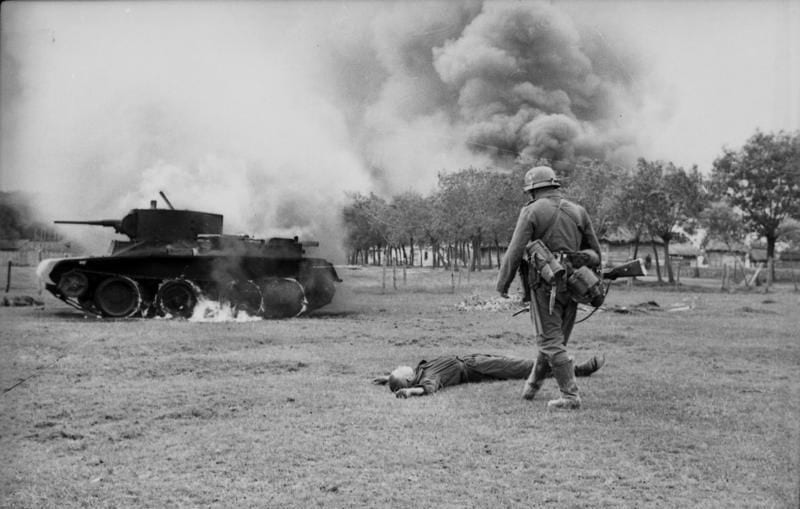
German soldier examines a dead Russian, and a blazing BT-7 tank.

But we had a long way to go to get to any of that.  By this time of the day, 70 years ago, the German Luftwaffe had destroyed 2,000 Soviet planes – many on the ground, shot up in long straight rows just like the Americans planes at Wheeler Field in Hawaii would be on December 7, only by the scores of hundreds rather than dozens – for a loss of 35 of their own.

Russian planes - Polikarpov trainers in this case - destroyed by a German dive bomber attack.

By the end of day three, nearly 4,000 Russian planes had been knocked out, and the Germans had complete air supremacy along the entire front.

The big story – that the Germans drove to the gates of Moscow, Leningrad and Stalingrad, but were bogged down first by poor logistics, then by autumn rains, then finally a fearsome Russian winter.

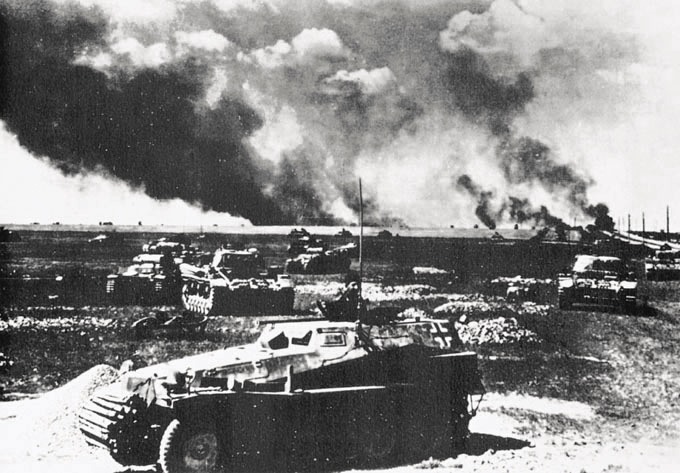
German tanks and "half-track" personnel carriers roll past blazing Russian tanks and buildings.

All that’s well in the future.

Seventy years ago today, the biggest meatgrinder in all human history was teeing up with a vengeance.

Improvisation

Monday, June 13th, 2011

Throughout this series, I’ve been highlighting the usual stuff about World War II – the battles and the personalities – but also the political and social events,  many of which still affect us today.

I’m also highlighting, bit by bit, over the next few years, some of the industrial trends that affect us today.  Great example coming up in future months – the fact that the US was able to build, on top of their thousands of tanks, aircraft and combat warships, over 4,000 units of one class of 5,000 ton merchant ships.  That’d be one of nine or ten different classes of ships, all of which were built in the hundreds or thousands.

We also undertook some of the most immense research and development projects in the history of science and engineering; in four years of frenetic research, we not only took the atomic bomb from the stuff of fuzzy-headed academics to Hiroshima – we also developed from scratch and built the plane to carry it, the B29 Superfortress – a plane whose development cost nearly as much as The Bomb, and may have been the most troubled, overrun-prone weapons development program in history, at least among weapons that actually got into service, the kind of thing that would have given William Proxmire a stroke, had those sorts of figures been made public back during the war.

We couldn’t do that today if we had to.

But today’s installment is about the opposite extreme – and it’s not about the US.

———-

Today, seventy years ago, the United Kingdom had just endured the worst year in its military history; driven from the Continent, the Brits had pulled off a miracle the previous June, evacuating most of its army at Dunkirk.  But that Army came home virtually without equipment; it had left all its tanks, artillery, machine guns – virtually everything heavier than the infantry’s rifles, and hundreds of thousands of them, too – lying in the sands and the approach roads to Dunkirk’s beaches.

And while they’d staved off Hitler’s first push to invade the island during the Battle of Britainthe previous summer, things were still dire. British industry, even though entirely harnessed to the war effort, was struggling to re-equip the British and Commonwealth militiaries for the invasion they still believed could come – as  well as for the war bubbling along in the Mediterranean, and which they also expected to erupt in the Pacific sooner than later.

They did have one advantage.  They’d captured thousands of tons of Italian ammunition in action the previous summer, as they’d swept aside the Italian , including a curiously large supply of 9mm ammunition.

That sparked a curious adaptation.

———-

The gun maker’s art in the years up to World War II was indeed an art.

The typical military firearm before World War II, all the way down to the lowliest infantry rifle, was a work of, if not art, at least craftsmanship.

The British "SMLE" Rifle. First built in 1903, it served until the 1950s.

With wooden furniture varnished to a fine sheen, and metal parts laboriously machined from solid blanks of high-quality steel, military weapons were high-quality pieces of equipment that took lots of time, money and skilled effort to manufacture.

The same was true of the newest addition to the infantryman’s armory – the submachine gun.

An Italian Beretta M38. With its milled wooden parts and perfectly-machined metal components, the M38 was a high-quality - and expensive - piece.

Basically a tiny machine gun that fired low-power pistol ammunition to make it manageable when being held in a rifleman’s hands (machine guns firing full-powered rifle ammo required a bipod or tripod), the submachine gun had evolved during World War 1 to bring extra close-range firepower to the infantryman.

The British Army, one of the world’s most conservative, came late to idea of issuing the submachine gun.  But after the drubbing in France, where they’d seen the effect the Germans MP38/40’s devastating effect in close-range action, they got into the market.

The MP38/40 - not to be confused with the Italian M38.

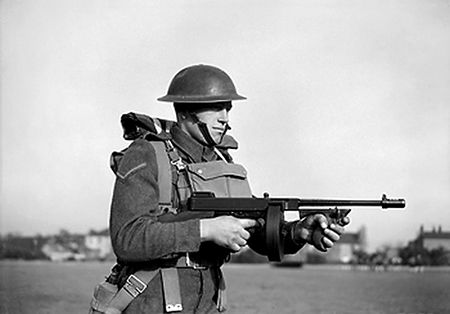
Their first attempt was to buy the American Thompson.  Most famous today as the preferred weapon of a generation of rumrunners and gangsters, British agents glommed onto every one they could find.

A Model 1928 Thompson.

Which wasn’t many.  The Thompson was a very old-school weapon, machined to a very high standard of finish, slow and laborious to build – and the US military was buying them as fast as factories could turn them out.

The Brits needed more, and they needed them fast.

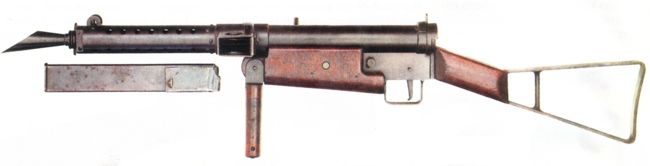
At the Enfield weapons works, two men – Major Reginald V. Shepherd and designer Harold Turpin – designed a simple, intentionally crude weapon, designed to be built quickly and cheaply and to use the mountains of Italian 9mm ammunition.  It looked like a couple of lengths of pipe with a crude wooden forearm.  The British military bureaucracy took the first initial of their last names, added “En” for “enfield”; and so the “Sten” was born.

The Sten Mark 1.

It was unbelievably crude by the standards of the weapon-makers craft.  It was designed to be built quickly, cheaply, mostly out of stampings and welded parts rather than machined metal, by less-skilled labor.  It cost a fraction of the time, money, skill and materiel of the Thompson.

And it was still too complex.  So after a few hundred Mark 1s were built, the factory simplified it even more, into the Mark II.

The Sten Mark 2

It looks crude and cheap.

It was crude and cheap. It was manufactured in the millions.  By the time production ramped up, it could be built with five man-hours of labor, for under $12 in 1940 money.

It was not a high-quality weapon.  The design of its 32 round magazine promoted jamming; some British paratroops joked that their Stens jammed every time they fired them. The safety mechanism tended to slip, allowing frequent accidental discharges after the locking pin wore down from heavy use.

But it was fast and cheap.

And as the war wore on, a cheap submachine gun that one had was worth more than a quality piece that was still being built.

In addition to (quickly) re-equipping the British and Commonwealth armies, the Sten was dropped by the thousands to resistance groups throughout Europe.

And, needing guns, they quickly reverse-engineered  the crude, simple Mark 2 and started building it in clandestine machine shops throughout Europe.  Sten Mark 2s were build in secret plants, or underground chains of machining and stamping and sheet metal fab shops, in Norway, Denmark, Poland and Yugoslavia.  And not in inconsiderable numbers, either; resistance guerillas build them in the hundreds, sometimes thousands.

A Polski Sten, with a custom-made short 10 round magazine, designed for easy concealment, perhaps for an assassin stalking German officers.

The Sten was fired for the first time seventy years ago today.  And while it’s a footnote in many ways, it showed the extent to which the heat of war caused western ingenuity to push western business and industry into behaviors it’d never considered before.

Across Britain and the US, the stresses of war- from imminent invasion to the more mundane issues of having to produce with rationed, scarce material and with unskilled labor as the skilled workforce got drafted – were causing industry to adapt in ways it’d be hard to imagine today.

A British "Mosquito", the most successful light bomber of the war. Built of a mostly plywood airframe, it was assembled from parts built by...Britain's furniture makers.

And locations.  As the US war effort ate up available shipyards along the US coasts, the booming submarine program prompted US industry to build a submarine construction yard…

…in Manitowoc, Wisconsin.

It is hard to imagine that sort of dislocation today, when it takes decades for the US military to pick a new pistol, where the Army has been noodling with replacing the venerable M16 for nearly four decades (and still issues fifty-year-old M14s to troops that need a reliable rifle in the sand) and US industry takes a decade to build a factory, if they build one at all.

More in coming months.

It Was 24 Years Ago Today

Sunday, June 12th, 2011

It still inspires me.

Perhaps we could stand at University and Wheeler and demand the same…

…This Great And Noble Undertaking

Monday, June 6th, 2011

I first wrote this piece three years ago.   Ive updated it a bit; I’m reprising it today:

———-

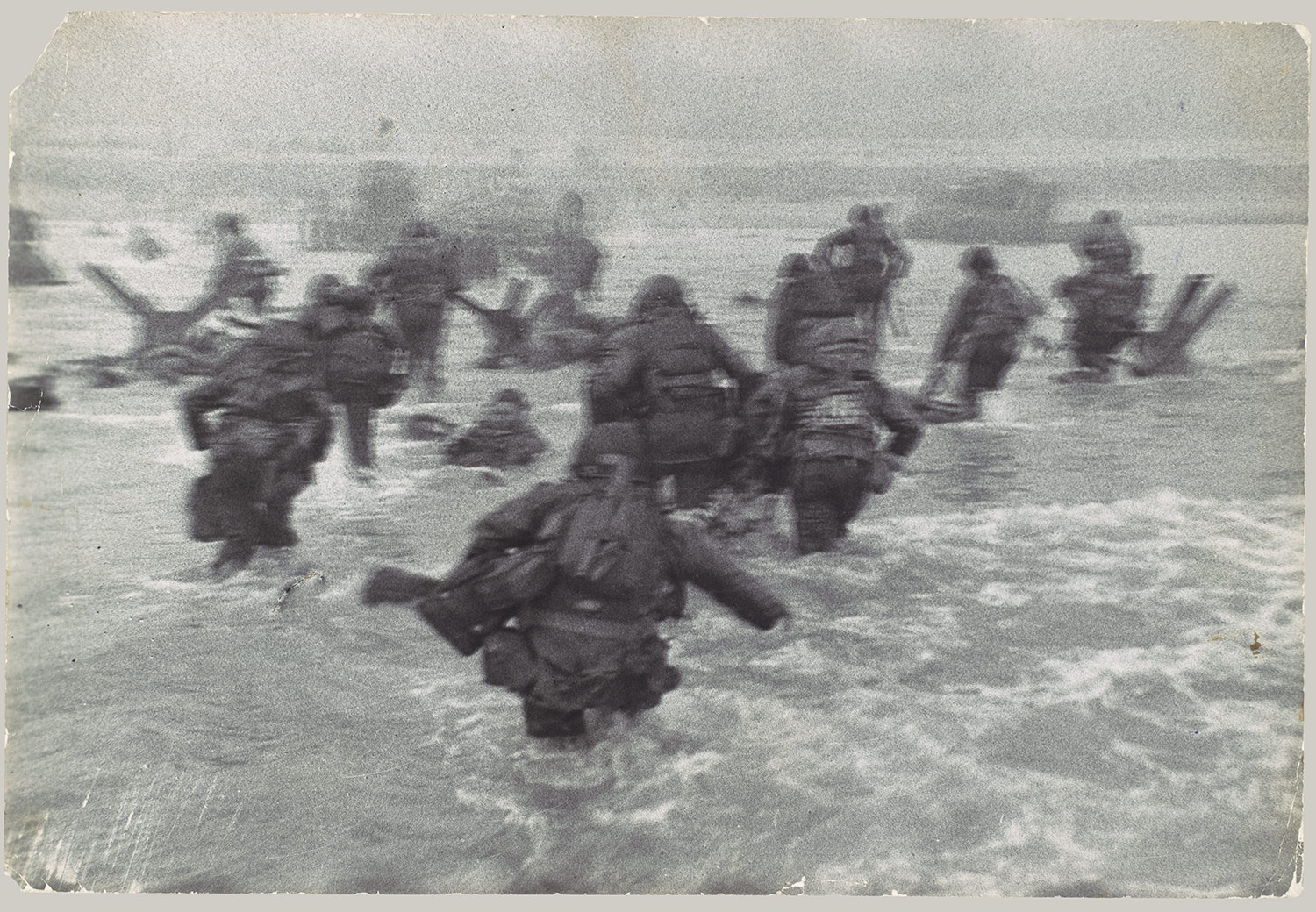
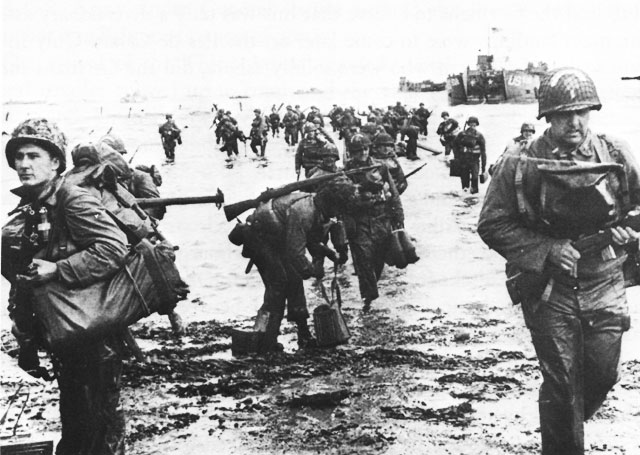
It was sixty-seven years ago today that the Allies started taking Western Europe back from the Nazis.

The first, inevitable step was to get past the Westwall – perhaps the most immense set of fortifications ever built, with the intention of making the beaches from Denmark to the Spanish border a bloodbath for any troops trying to cross the beaches.

In places, it worked:

In some places, the troops had to overcome the near-impossible:

And yet by the end of the day, nine allied divisions were ashore, a toehold for a bridgehead that would eventually expand, ten months later, across Western Europe.

There were troops from the US, of course, on the two western beaches…

…and farther east, beaches with Brits…

…and Scots…

And in the middle, linking the two and meeting the worst resistance other than Omaha, the Canadians:

…along with troops-in-exile from elsewhere in occupied Europe; French commandos – some of whom had spent four years in exile, and who spent the next year belying the notion that the French were cowards…:

…and Norwegians, who’d been without a homeland for four years…

HNoMS Svenner, sunk by German gunfire on DDay.

…and Poles, who’d been in exile for five years and would, in some cases, remain there for forty-five more:

The world may see nothing like it again.

Anyway – thank a D-Day veteran.

Memorial Day

Monday, May 30th, 2011

It’s Memorial Day today.

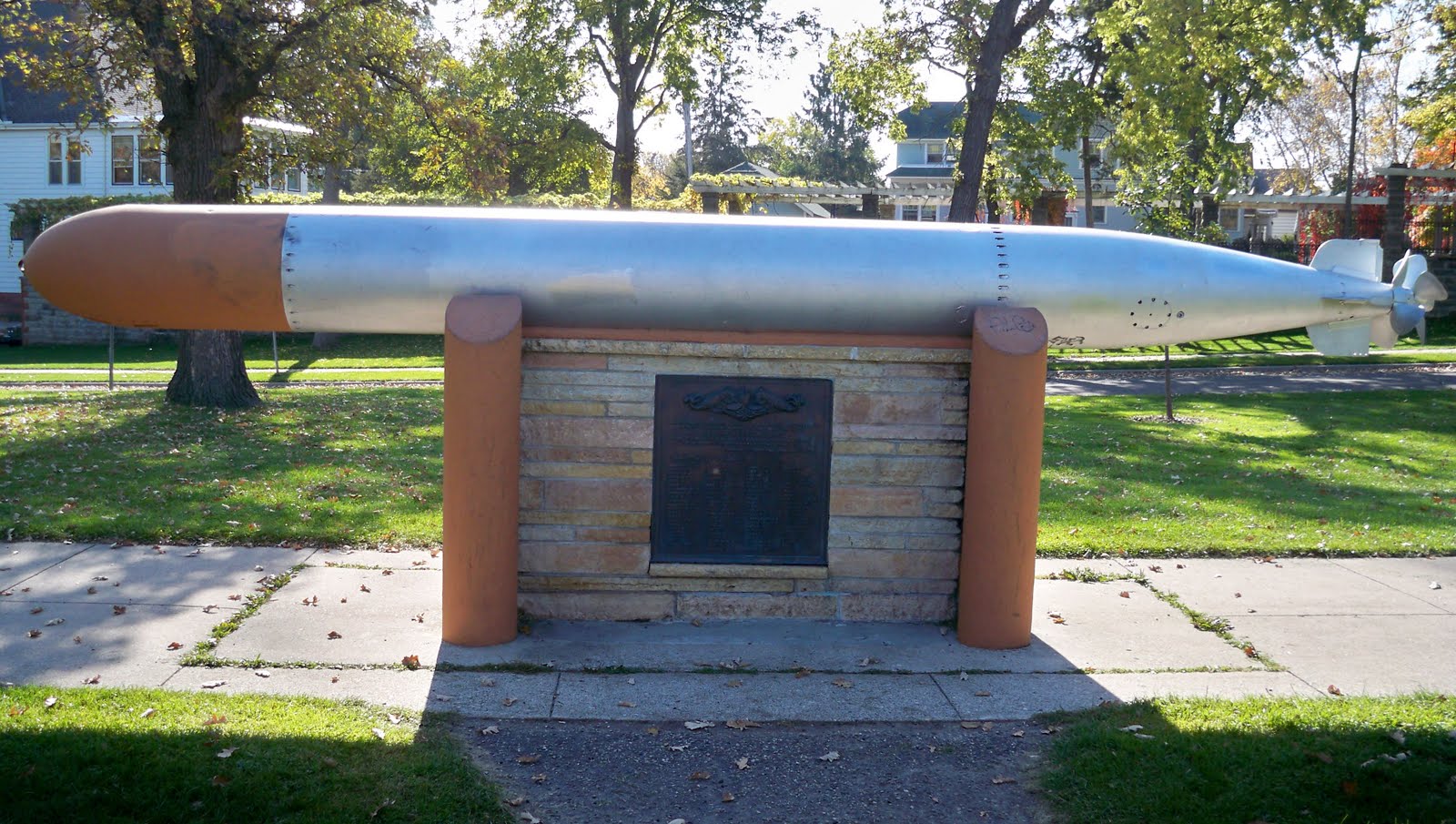
If you go to the south entrance to Como Park, along Lexington, you can see an unusual statue – an old torpedo on a stand.

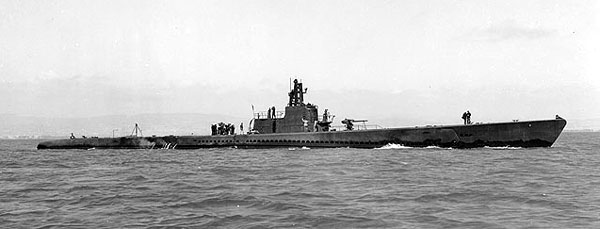
It’s a memorial to the crew of the USS Swordfish – an American submarine, built in the waning years of the 1930’s, which fought throughout World War II.

USS Swordfish

Swordfish had been at Pearl Harbor on December 7.  It set off on its first war patrol weeks after the attack, sinking Japanese freighers in Filipino waters – the first ships sunk by US submarines in World War II – before helping evacuate the Philippines’ president, Manuel Quezon, and key members of his government and military staffs.

There were eleven more patrols before Christmastime in 1944, when Swordfish set sail for Japanese home waters, with  a side mission to reconnoiter invasion beaches on Okinawa.

Sometime between January 3 and February 15, Swordfish disappeared.  There’s evidence it struck a mine off Okinawa on January 12.

The torpedo in Como Park is part of a nationwide project to honor the men of the 52 submarines lost during the war with a monument in each state (New York and California have two each).

Nobody in my family ever died serving the country (a great uncle apparently came pretty close in World War I; my father found some dire-sounding letters from the Argonne); my ex-father-in-law served on a destr0yer throughout the war in the Pacific, but close calls notwithstanding (kamikazes, yes, but his biggest injury came when the return spring on an Oerlikon 20mm gun he was maintaining sprang loose, throwing him over a rail to a deck below, injuring his back) he came home.

So most Memorial Days, I stop by Como Park and pay homage to the sub’s crew of 89.  Three of the crew were from Minnesota, two from North Dakota, and one from South Dakota.

Name Rate
1 Arthur Abrahamson CCS
2 Roy Gordon Arold MoMM2
3 Donald Baeckler PhoM3
4 Gilbert Speight Baker MoMM1
5 Joseph James Basta RM1
6 Mack Bates F1
7 Daniel Sparks Baughman, Jr. LCDR
8 Claude Joseph Benbennick MoMM2
9 Michael Billy RM3
10 Joseph Roger Leo Blanchard MoMM2
11 LeRoy Joseph Bleasdell MoMM2
12 Wesley Clement Bogdan MoMM3
13 Andrew Earl Braley SC1
14 Robert Joseph Brown CRT
15 Fred Morcombe Cauley, Jr. EM2
16 Allan Daniel Clark TM3
17 Timothy Joseph Connors RM3
18 Marshall Edward Cox, Jr. LT
19 Robert Francis Daly EM2
20 Herman Watson Davis LT
21 John Valentine Delladonna TM2
22 Warren Dillon S1
23 Gordon Kraft Draga EM2
24 Loris Henry Duncan MoMM1
25 Emory Webster Dunton, Sr. Bkr3
26 Leonard Oscar Echols TM2
27 George Vyell Edwards EM3
28 Robert Lesslie Emmingham GM3
29 Eugene Raymond Fausset S1
30 Kenneth Ferdinand Feiss TM1
31 Eugene James Forsythe S1
32 John Gerald Fowler EM1
33 Nick Funk SM2
34 Emery Andrew Galley, Jr. QM2
35 Dee Edward Gambrell, Jr.
36 Eleazar Garza MoMM3
37 Bernard Joseph Geraghty, Jr.From Minneapolis, Geraghty was a week shy of his 20th birthday when the boat was presumed lost. S1
38 Howard Marshal Gilfillan MoMM2
39 John Vincennes Graf MoMM1
40 George Patrick Graham RM3
41 William Penn Grandy StM1
42 Ralph Lewis Hafter EM1
43 Charles Edwin Hall CEM
44 Ralph Walter Haserodt MoMM1
45 Winslow Carlton Haskins EM3
46 Jack Edwin Haynes TM3
47 Ray Holland MoMM2
48 Robert Darlington Hoopes, Jr. LT
49 Fred Alfred Hrynko MoMM3
50 Robert Laurin Janes LTJG
51 Robert Eugene JohnsonFrom Saint Paul, Johnson was a 25-year-old “Motor Machinists Mate”, working on the boat’s diesel engines. MoMM3
52 Stephan John Johnson F1
53 John Robert Kelly St3
54 Vernon Kirk MoMM3
55 William Edward Kohler MM2
56 Richard Brissett Kremer TM3
57 Roy Earl Kroll, Jr. – from Egeland, in north-central North Dakota. F1
58 Hollis Oyer Lauderdale MoMM3
59 Douglas Cleveland Lindsay CY
60 Gerald Augusta Looney S1
61 Russell LoPresti TM3
62 John Joseph Madden, Jr. ENS
63 Paul Marvin
64 James Mosco Mayfield EM2
65 Morris Franklin McCaffrey RT3
66 William Thomas Meacham, Jr. FC2
67 Keats Edmund Montross CDR-CO
68 Kenneth Eugene Pence GM2
69 Fremont Petty BM2
70 Gordon Ralph Plourdthe boat’s “Pharmacist’s Mate” or medic, Plourd was from Duluth. PhM1
71 Claude Lee Pollard CQM
72 Earl W. Preston, Jr. LT
73 John Briscoe Pye Cox
74 Harry Newman Robinson, Jr. QM3
75 William Eugene Russell CMoMM
76 Karl DeWitt Schwendener
77 William Siskaninetz
78 James Adam Skeldon
79 Clifford Francis Slater MoMM2
80 Mike Soffes EM3
81 Frank Herbert Spencer, Jr. Mo
82 Wallace Greeley Statton MM1
83 Harold Albert Stone TM2
84 Fred A. Tarbox EM3
85 James Frank Taylor S1
86 Elwood Kenneth Van Horn TM3
87 Arnold John Wagner TM2
88 Thurman August Williams TM1
89 Joseph Edwin Wren EM3

Anyway – remember those who died for our country today. There are an awful lot of them.

For Want Of A Secret

Monday, May 9th, 2011

“Military Intelligence” is a both a sarcastic rejoinder about the meatheadedness of bureaucracy and a fairly smug standup comic’s conceit.  This past week, the assault on Obama Bin Laden after fifteen years showed the end result of intelligence work.

Of course, intelligence is rarely that spectacular, even in terms of end results.

Mostly, intelligence work involves thousands of hours of mind-numbing tedium trying to learn what ones opponent is doing, either in general in peacetime or in very specific terms in time of conflict.  It covers everything from listening to and decoding and translating millions of hours of radio transmissions, to compiling intercepts and triangulations of enemy’s radar and radio transmissions, to poring over photographs from satellite, reconaissance aircxraft, submarines and drones to figure out opponents’ numbers, equipment and intentions, to getting information from agents or reports from the battlefield and, most importantly, piecing information from all these sources together to form at least an educated guess as to what your opponent is doing, or planning to do.

The ultimate dream of every intelligence service? To be able to listen in on ones’ enemy’s most secret communications, and thereby know what he’s doing as soon as he does.

It is a dream, for the most part.  Almost invariably, the best your intelligence can do is piece together external signs into an educated guess.

But every once in a while the intelligence officer gets a lucky break.

Seventy years ago today was one of them.

———-

On the opposite side of the intelligence fact-gatherer is the array of people whose job it is to keep secrets from their enemies; from the soldier wearing camoulage, to the counterintelligence operator looking for signs of the enemy’s prying eyes with the aim of co-opting or neutralizing them, to the cryptographers inventing complex codes to try to stay several jumps ahead of the enemy’s cryptoanalysts decoding efforts and, in this case, the engineers who develop the machinery to make the job sustainable, fast and error-proof.

It was in 1918 that a German engineer, Arthur Scherbius, patented the first version of what would be the German solution to that problem during World War II – a machine that would become known as “Enigma”, and would be the result of an intelligence campaign that not only changed the course of the war, but led to developments that frame the entire Information Age.

A German "Enigma" machine.

This guy explains it pretty well; three rotors, each containing 26 embedded wires – one for each letter of the alphabet – performed simple ciphering of letters; if you pressed the “G” key, run through one rotor, might become a “W”.  Filtered through two more rotors, a “reflector”, and then back through all three, meant the initial character would be changed a total of seven times between the click of the key and the lighting of the lamp that gave the final results.  Then, after each character, the third rotor would rotate to its next position, meaning that the code cipher changed with every key stroke.  Every day, the combination of rotors and rotor starting positions was changed according to code books published by the various armed services; the first few characters of each message, already encoded, would tell the recipient (who had set the rotors to the same initial setting, per the code book) which further initial setting to use for each of the wheels, in theory making the system even more secure.

The Poles, as befits a nation surrounded by mortal enemies who bore it no good will, had developed a crackerjack intelligence service (much as Israel has throughout its existence).  In the mid to late Thirties, mathematician and cryptologist Jerzy Różycki working for Polish Intel’s Biuro Szyfrów (Cypher Burearu) began working out the mathematical methodology to at least start figuring out the initial cypher-wheel setting.

It was a start.

But the codes didn’t stay static.  The early Polish discoveries were eventually rendered obsolete by developments in the Enigma machine, and with their secure coding procedures.

Britain, too – with its long history in cryptography – recognized the importance of code-breaking in general, and Enigma in particular.  British Intelligence – MI6 – gathered the Polish refugees after Poland and France fell, and set up shop at the cold, barren estate of Bletchley Park.

And in one of the most intense frenzies of advanced pure applied mathematics ever put to solving a practical problem, the Brits began tackling the theoretical aspects of decoding messages intercepted from Enigma.

But it’d help ever so much to get hold of a machine.

———-

A German U-Boat, “U110”, had set off on March 1, 1941 on its second war patrol, under Kapitänleutnant Fritz-Julius Lemp, who’d commanded the boat ever had since its commissioning the previous November.   Lemp was an experienced U-boat commander; while commanding U30, he sank the first Allied vessel to fall to a U-Boat in the war, the passenger liner SS Athenia.   U-110 was his second command.

U110. It was a sister-ship of the U505, which is on permanent display at the Museum of Science and Industry in Chicago.

In the nine weeks it’d been on patrol, it had already sunk one cargo ship.  On May 9 Lemp, operating as a “wolf pack” with U201, closed in on convoy CB-318.

Lemp sank two merchant ships that day, approaching submerged and firing torpedos.  But on his last approach, he left his periscope up too long.  Accounts vary; one said Lemp was distracted by a malfunctioning torpedo, while another says he lingered to confirm a kill, without sweeping the horizon…

…to note that HMS Aubretia had sighted the periscope and was closing in.

HMS Aubretia. A "Flower" class corvette, basically a converted fishing trawler, it was one of hundreds of slow, dumpy but seaworthy ships of the class that tried to guard convoys from the depredations of the U-boats.

U110 dove fast – but Aubretia bracketed the submarine with a spread of depth charges which rattled the crew and popped valves open and, more importantly, gave Aubretia a firm sonar fix on the submarine.   Two more British destroyers – HMS Bulldog and HMS Broadway – closed in to help.

HMS Bulldog. Commissioned in 1931, it was an old ship that largely served on convoy escort duty thoughout the war.

Bulldog captured the sub on sonar, and dropped 15 depth charges.  Broadway closed in and did the same.
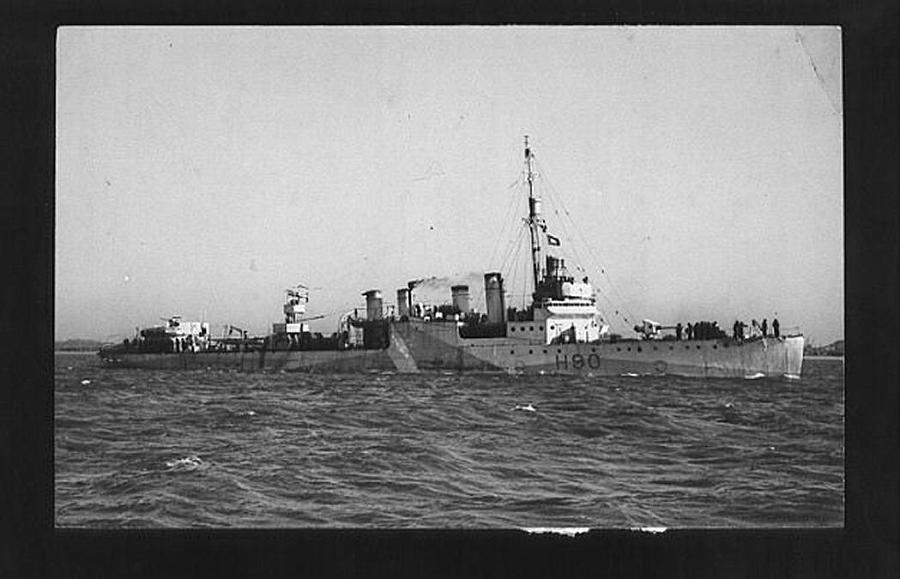
HMS Broadway. Formerly the USS Hunt, commissioned in World War One, it was one of the 50 overaged destroyers lent to the Royal Navy in exchange for bases in the Azores in 1940. It was a sister ship of the USS Ward which, with its crew of Minnesota navy reservists, will be a subject of a post in about seven months.

The depth charge attack did more than rattle the crew of the U110.  The power cut out, sprung valves started flooding the engine room, and Lemp decided to surface – if he could.  Compressed air valves were open, blowing water from the ballast tanks.   The boat made it to the surface, and Lemp ordered “Last stop, everyone off” – slang, it seems, for “Abandon Ship”.

The crew swarmed out the conning tower hatch. The crew of Bulldog initially thought the crew was coming up to turn its deck gun on the British destroyer – a last-ditch affair that could still be deadly at close range – so his machine guns opened fire as Bulldog’s commander, CMDR JOe Baker-Cresswell, ordered the destroyer to ram the sub, killing a few German sailors before it became obvious they were abandoning ship.

Lemp, for his part, had ordered all the ballast tank vents and hatches left open – and, seeing Bulldog closing to ram, figured his ship, and its secrets, including the ultra-secret Enigma machine, would soon be 8,000 feet below at the bottom of the Atlantic.  His crew took to the water…

…as Baker-Cresswell decided it might be worth trying to capture the boat.  Bulldog veered aside, missing the stricken sub and ordering a boarding party led by Sub-Lieutenant David Balme, to get ready in the destroyer’s whaleboat.

What happened next is controversial; Lemp apparently realized his mistake, and started swimming back to the boat.  Accounts vary; some said he was shot by a British sailor, while others say he drowned while swimming.    Aubretia, Bulldog and Broadway picked up 31 survivors, about 2/3 of the boat’s crew.

At any rate, Balme’s crew reached the boat, and took hours to pilfer everything worth taking – including the Enigma and the boat’s entire supply of code books.

Sub-Lieutenant Balme's team rigging U110 for towing. The boat is down by the stern, due both to filling ballast tanks and flooding in the engine room due to the depth charging.

Hearing the tightly-controlled news, MI6 realised the coup the RN had pulled off – and how quickly the Germans would change their codes if they knew that U110 had fallen, intact, into British hands.  So Bulldog, which had been towing the boat to England, was ordered to quietly let it sink.

And the secret stayed put.  MI6 was able to use the captured machine and code books to complete their breaking of the Enigma codes.  For the rest of the war, “Ultra” – the mega-secret British code-breaking team at Bletchley – was able to read German communications at the highest levels in almost real time. German leaders, thinking they were sending messages in complete security, would communicate freely via Enigma – and Allied commanders would often have the messages nearly as fast as their German counterparts.

It was estimated that the complete cracking of Enigma shortened the war in Europe by two to four years.

———-

Or at least that was the public story.  Like so many things in the world of intelligence, the public perception of how things actually went down has been carefully manicured over the years, to throw the enemy du jour off the scent of what the various intelligence services, friend and foe, really know.

Because while most of the public history of Enigma, Ultra and so forth were written in the fifties and sixties and seventies, when MI6 decided to release a story, focused heavily on the events of seventy years ago today, the fact was that as early as 1932, the Poles were breaking Enigma codes (although it didn’t become public knowledge until the nineties), with the help of French Intelligence, which managed to steal a copy of an early German code book and deliver it to their Polish allies.  By 1937, the Poles estimated they were breaking 3/4 of Germany’s general staff Enigma-encrypted radio traffic – and with adequate staff (it was incredibly labor-intensive work), they could have gotten 90%.  Polish Intelligence knew almost as much about Germany’s plan to invade Poland as the Germans did.

Which is not to underestimate the importance of the capture of the U110 seventy years ago today.  It’s always better to have a working model – at the very least, to validate the incredibly complex mathematical models that went into the theoretical solutions.

But let’s go back to the whole “labor intensive” bit.

In order to help process the masses of information  that the complete cracking of Enigma unlocked, and to assist in cracking the rotor settings of German messages, one of the British codebreakers, Alan Turing, developed techniques – the logical “bombe” algorithm and the theoretical “Turing Machine” – which contributed to the eventual architecture of the digital computer.

And the first digital computers, developed at the end of World War 2, were largely developed to help support codebreaking efforts.

Seventy years ago today, the stuff of what was then science fiction crashed into very real life in the icy North Atlantic.

Sliding Into History

Wednesday, April 20th, 2011

Back in college in North Dakota, I first encountered White Castle on a bitterly cold January Friday night.  A bunch of students from Chicago decided they’d gone long enough without “sliders”.  A few of them decided they’d undertake the sixteen-hour one-way trip back to Chi to get some, and maybe bring some back.   Helpfully, a Minneapolis kid told them there were Castles in the Twin Cities, cutting the trip in much less than half. So they took off, around 11PM.  And came back early the next afternoon, happy.
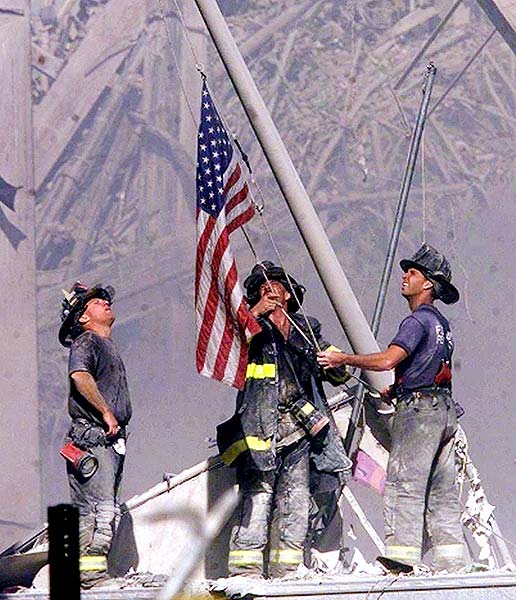
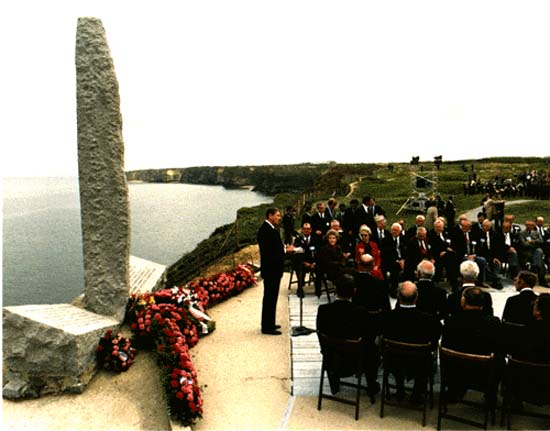
There are two morals to that story:

  • College kids in North Dakota in the 1980’s who didn’t have girlfriends or parties on the agenda could go really stir crazy.
  • White Castle generates incredible customer loyalty.

One of my English professors, Dr. Brucker, had White Castle as a hobby.  He somehow had wangled a subscription to the White Castle in-house magazine, and knew more White Castle trivia than anyone seemed to need.

I didn’t actually eat one myself until I moved to the Twin Cities.  The Sunday after I moved into my first apartment, not far off of East Lake Street, I wandered up to Lake and 36th, and saw the white tile cube, and figured it was worth a try.

I ordered four cheese sliders and a coke, and sat down.  A few moments later, as I was waiting for my order, a big fella – probably 6’2 and 350 pounds – walked in and loudly and sloppily proclaimed “I just got paid!  Gimme thirty sliders and a large Coke!”.  As I sampled my first sliders – yum! – I watched, just a tad amazed, as the big guy bolted the whole order down and staggered up the street.

Thanksgiving Dinner, in some parts of Chicago.

And back when I was producing the Don Vogel show?  We marked all major celebrations – good ratings books, last days before fun vacations, whatever – with Don flipping me a $20 and sending me to the ‘Castle on White Bear Avenue for sliders and scabs for the whole crew.

Anyway – White Castle just turned 90:

The restaurant chain, famous for its original sliders, first opened its doors March 10, 1921, in Wichita, Kan. The now Columbus, Ohio-based company is family-owned and does not franchise. It also owns its own meat production facilities and bakeries to ensure quality control.

“White Castle is proud to be 90 years young,” said Jamie Richardson, vice president of corporate and government relations. “Since 1921, White Castle has remained true to its original mission and values. Our name says it all — White signifying purity and Castle signifying strength and permanence.”

I do about 1-2 trips a year to White Castle.  One thing that has changed; 25 years ago, it used to be entertaining to watch the guys behind the grill stuffing sliders into the little cardboard boxes like Las Vegas card dealers, banging through a couple a second.  I haven’t seen that in a long time…

Anyway – gassy-but-happy America salutes you, White Castle!

--> Site Meter -->