Archive for the 'Geekery' Category

100 Years

Monday, January 23rd, 2012

How many products built before the year 1926 are still in production, in their original form, today?

Cars?  Here was a 1912 Ford Model T:

Toasters?

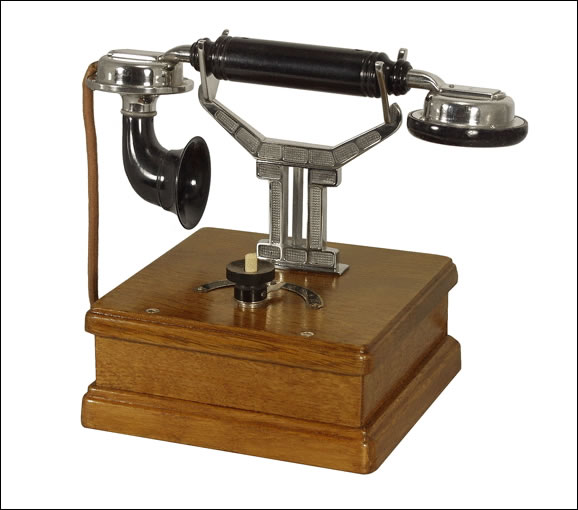
Telephones?

Computers?

Indeed, there are very, very few products built before 1926 that are built at all today, much less in almost exactly the same form that they were at the time.

But there’s a noticeable exception.  John Browning designed no less than fifteen products before his death in 1926 that are still in production, in very nearly their original form, today.

Atop every American tank and armored personnel carrier in service from 1941 until the present has been a Browning M-2 .50 caliber machine gun, first produced in 1919.

The Model 97 pump-action shotgun has been in steady production since, well, 1897.

The “Woodsman” varmint pistol?  Still cranking ’em out.

Even his Model 1885 single-shot varmint gun?  It’s been in production, in one form or another, since, ahem, 1885.

And let’s not forget today’s guest of honor – the M1911 .45 caliber pistol, which was adopted for service by the US Army 100 years ago today.

Perhaps the greatest handgun ever built, the 1911 is doggedly reliable, and its .45 slug is a reliable fight-stopper.  It soldiered through five major and countless minor wars, is still among the handguns of choice among soldiers who get to pick their handguns (special operations types, mostly), and it has not been out of production for any significant time in the past 100 years.

All of those firearms have one thing in common; they were all designed by John Browning, one of history’s great engineering and design geniuses.

Today is John Browning Day in Utah, the state of his birth back in 1655.

You’d Think…

Monday, January 2nd, 2012

…if the Mayans were so good at predicting things, they’d have predicted the Spaniards coming, met them at the beach, and killed them first.

Just saying.

Tis The Season

Friday, December 23rd, 2011


Real

Friday, October 14th, 2011

Let’s be clear about this: I do appreciate the leftybloggers and lefty pundits in the Twin Cities that can have a civilized debate for more than one round without diving straight into the name-calling.  They are rare, but given the number of “progressives” in the Twin Cities, there are still plenty of them.

That’s not just smack-talk.  I grew up in a liberal household, I was a liberal til my early twenties, and my parents still are (although all three of us Berg kids did in fact see the light), so I have no interest in demonizing or pointlessly antagonizing liberals; I have to visit them over Christmas, for crying out loud.

Anyway, I get along with Jeff Rosenberg just fine.  He’s a good guy.  Wrong about most things, but then so’s my Mom, and we get along too.

Anyway, Jeff bit on that most classic bit of inter-party smack talk, “The Real American”:

According to Sarah Palin during the 2008 presidential campaign, I’m not a “Real American,” because I live in a city.

That one seems to bug a lot of libs.  Which, to be fair, is what it was intended to do.  It’s “smack talk”; sorta like saying “your momma’s so fat, they can’t even find the search party they sent down her butt crack to find the missing airplane”; it doesn’t really mean that anyone’s missing, or that any of that could fit between “your momma’s” buttcheeks, or even that any of us have met your mother.

It’s just supposed to get you too angry to think about your game.  It gets me – the smack-talker – into your head.  It puts me in control.

And it worked!

Now, it is a fact that America’s urban areas tend to vote Democrat.  And it is a further fact that Democrats, while often proclaiming the depth of their patriotism, also have a really hard time with the idea of American exceptionalism; patriotism in a red county may be chock full of God Bless America and the Troops and “Shining City On A Hill”, while in a Blue county it is frequently more a matter of “We’re a lot less unlike France than we used to be, and with 12 more years of Obama and Dayton, we’ll get even better“, and yes, I know I’m simplifying things, but work with me here.

So it is a logical deduction that an urban American is less likely to believe that America is anything special.

Rosenberg:

Apparently, Palin isn’t the only one who feels that way. Minnesota Supreme Court Chief Justice Lori Gildea feels similarly: I’m also not a “Real Minnesotan.” At least, that’s what she told an audience in Brainerd:

Jeff quotes a City Pages piece:

“I’m so happy to be in real Minnesota,” Gildea said.

Okay, well, maybe Gildea was just coming down from an acid trip, and couldn’t tell if she’d actually been in the state of her birth. Let’s give her a chance to explain.

“Outside of the Twin Cities,” Gildea clarified.

Darn those SCOM justices and their smack talk!  Now, we’re going to have 50,000 leftybloggers’ undies in a bunch!

And Rosenberg must be wearing boxers, because the bunch is obviously painful:

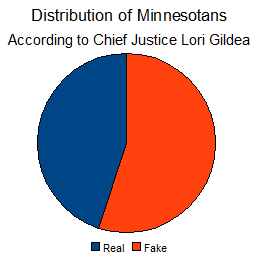
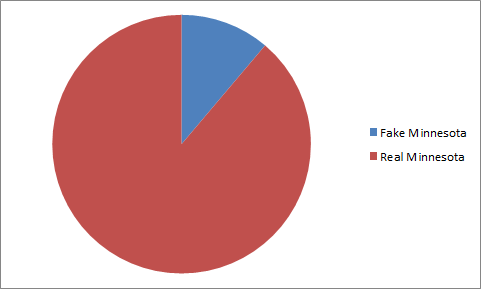
Got that, everyone? The only “real” Minnesotans are the ones who live outside of the Twin Cities, the place where most Minnesotans live. That made me wonder: Just what percentage of Minnesotans are real?

Warning:  A Democrat is about to attempt to work with empirical, geographical and demographic data.  This could get ugly.

That’s why I’ve put together a handy chart to give you an idea of how it breaks down. The chart uses the smallest possible definition of the Twin Cities, the seven-county area.

Here’s Jeff’s chart, for starters:

And can we get all you good Lakeville and Maple Grove “Real Minnesotans” to sound off here?  That’s not the smallest possible definition of the Twin Cities.

That would be, er, the Twin Cities; 667,646 people according to the 2010 census, between Minneapolis and Saint Paul.

So an accurate chart looks a little more like this:

I wasn’t sure if the exurbs were real; Gildea hasn’t yet clarified how many acres of land you must own to be a real Minnesotan.

All right.  Time for a cleansing breath, everyone.

(Whooosh).

OK.  If you’re going to get all knotted up over other peoples’ smack-talk, then the game is no fun.

Still, speaking on behalf of all conservatives, I’ll work with y’all on this.  Tell your buddies in the SEIU, MAPE, AFSCME, the MFT and the Teamsters to stop calling themselves “labor”, or at least “workers”.  I’m not in a union (anymore), but I most definitely work.  Indeed, among “real workers” in the private sector, 91% of us “workers” apparently aren’t “workers” according to “labor”.

As long as you wanna be all literal and all which, I stress, I don’t.  Not really.

That is all.

Apropos Not Much, Part VII

Friday, September 30th, 2011

So in my series on Defamation law so far, I’ve focused on the elements of the defamation case.

But what if you’re accused of defamation?  How do you defend yourself against a defamation suit?

As you may have figured out from an earlier installment, the best way is to prove that what you said is true…

II. Defenses to Defamation

A. Truth

Truth is a complete defense to a defamation claim. This is simply the flip side of the requirement that plaintiff prove the falsity of the alleged defamatory statement.

…or at least not completely false.

And when there’s some public interest to the subject – say, the target/plaintiff is some sort of public figure, or the story relates to some important public issue?   Then it gets a little more complicated.

The Supremes have spoken on this issue directly, although if you’re not a lawyer, not especially clearly.

B. The First Amendment

1. Public Officials/Public Figures: Actual Malice must be proven.

The First Amendment requires that a defamation plaintiff prove actual malice or reckless disregard of the truth when the plaintiff is a public official or public figure. New York Times v. Sullivan, 376 U.S. 254 (1964). This is a much higher burden of proof for a public figure plaintiff. Instead of showing objectively that a “reasonable person” knew or should have known the defamatory statement was false, a public figure plaintiff must prove the intent of the defendant was malicious, or that they acted with reckless disregard for the truth. This allows the defendant to prove its good faith intent and efforts as a defense.

This is a tricky bit – the kind of thing that keeps lawyers in Lexuses.

Here’s how it works:  If I claimed that Brad Carlson (of the Brad Carlson blog – a public figure, to be sure,and the Northern Alliance’s “The Closer” show), was”convicted of drunk driving” [*], and Brad shows it was false, he’d also have to prove that I was being malicious, or acting in reckless disregard of the truth.

How would that happen?

Would it be considered “malicious” if I had spent months tweeting about my anger toward and hatred of Brad [**}?

Or, perhaps, if it were pointed out to me that the “source” I’d used was bogus – like in the example we showed yesterday – and I not only refused to apologize and retract, but indeed doubled own on my story?

Well, again, that’s the kind of thing that makes some lawyers happy, wealthy people.

Therre is more to it, of course.  It’s the law; there’s always more to it:

2. Matter of Public Concern: Actual Malice must be proven.

In cases where the media defendant is treating an issue of public concern, the First Amendment also requires proof of actual malice or reckless disregard of the truth, even if the plaintiff is not a public figure. Gertz v. Robert Welch, 418 U.S. 323, 349-50 (1974). See also Hepps, 475 U.S. at 775 (In non-public concern, non-public plaintiff defamation case, First Amendment does not bar application of mere negligence standard for defamation); Dun & Bradstreet v. Greenmoss Builders, Inc., 472 U.S. 749, 761 (1985) (Powell, J., concurring).

In other words, if my quip about Brad’s (hypothetical) DUI were part of a larger story – say, Brad had uncovered a massive corruption scam at the Ramsey City Hall, and the defamation was part of the larger discussion?   Well, then Brad would have to prove that I acted maliciously, and the courts might well err on the side of protecting my right to free speech.

Maybe.  Probably.

But for purposes of this discussion, let’s just say there’s no larger issue; I just wanted to bag on Brad.  Then – if you read this the quote above at face value – the fact that I’d not gotten my facts straight would be considered, on its own, as malicious.

3. Matter of Public Concern: Plaintiff Must Prove Statement is False.

Proof of falsity required when media defendant addresses topic of public concern; regardless of public/private status of plaintiff. Hepps, 475 U.S. at 775-76.

4. Actual Malice must be Shown by “Convincing Clarity.”

Where the plaintiff is a public official, he must prove actual malice or reckless disregard of the truth with “clear and convincing proof”. New York Times v. Sullivan, 376 U.S. 254, 286 (1964); Gertz, 418 U.S. at 342; Hepps, 475 U.S. at 773.

That means the burden of proof would be on Brad.  And he’d pass that burden with panache, since the only place where Brad shows up as a drunk driver is here.

5. Falsity May Have to Shown by “Convincing Clarity.”

Public figure plaintiffs may have to prove falsity by “clear and convincing evidence” as protected under New York Times v. Sullivan. Sharon v. Time, Inc., 599 F. Supp. 538, 558 (S.D.N.Y. 1984); Firestone v. Time Inc., 460 F.2d 712, 722 (5th Cir. 1972), cert. den., 409 U.S. 875 (Bell, J., specially concurring).

In other words, gray areas are bad.

But there is no gray area there.  Brad never had a DUI, and there is no larger, compelling public interest in the story.

Smells like malice to me.

So go back to the first episode of this piece.  If I were to write – in earnest – that Brad “The Closer” Carlson had been convicted of drunk driving, and…:

  1. …it’s clearly false (which it objective is, with no gray areas) and…
  2. lt’s defamatory (and accusations of infamous crimes, including those involving potential jail time or moral turpitude are considered defamation per se under Minnesota law), and…
  3. One or more third parties heard or read the accusation, and…
  4. it can be shown that I made the accusation out of malice or reckless disregard for the facts at hand, and…
  5. There is no larger public interest served by invoking the First Amendment to defend my right to accuse Brad of drunk driving…

…well, we have not a few lawyers tuned in here.  Do you think Brad’d have a case?

I’m just curious.

More in two weeks or so.

[*] Which he was not.  I mean, seriously.  Not at all. This is just an example.

[**] Which, to be sure, I have not.  I have nothing  but respect for my broadcast colleague.  Indeed, he’s one of the godfathers of conservative political satire in this state, via his tenure as as Protest Warrior.


Apropos Not Much, Part VI

Thursday, September 29th, 2011

For the past week that I’ve been writing this series on defamation law in Minnesota, I’ve been focusing on the letter and spirit (as captured in case law) of the law.

Today, I’m going to go down a tangent, and talk about the mechanics of the law – specifically, how legal records work.

Or, rather, how they don’t work.

When you to google and search, for example, for “DUI Records Minnesota“, you get quite a few sites; once you get out of the ad hits with the pink backgrounds, you are helpfullly presented with  quite a few options purporting to allow you to “search Minnesota DUI records online!”.

Sounds promising!  And after all, isn’t that the wonder of the Internet? That all information is instantly available online?

I tried the first one after the ad links; “duirecords.org“, which promises that you can “Search MN DUI Public Arrest Records Online”.  And just to be curious, I typed in my own name.

And I got back something that made my heart sink into my stomach:


…that’s me!

But then I thought about it for a moment.  I’ve never had a DUI.  I’ve never had any form of impaired driving contact with the police – I’ve never been pulled over on suspicion of any sort of drunk driving.  Nothing,  Zero.  Zip.  Never.

There’s a reason for that.  I don’t drive drunk.  Indeed, I rarely have more than two drinks at a sitting.

And yet this site – this site that purports to “Search Public Records” to return DUI convictions – was saying that I’d had a DUI!

So I wondered – given that nearly 10% of Minnesotans do have a drunk driving record, what other Minnesotans have been convicted of driving under the influence?

I picked a few names, completely at random:  I started with Brian “Saint Paul” Ward, of Fraters Libertas, a bunch of known drinkers:
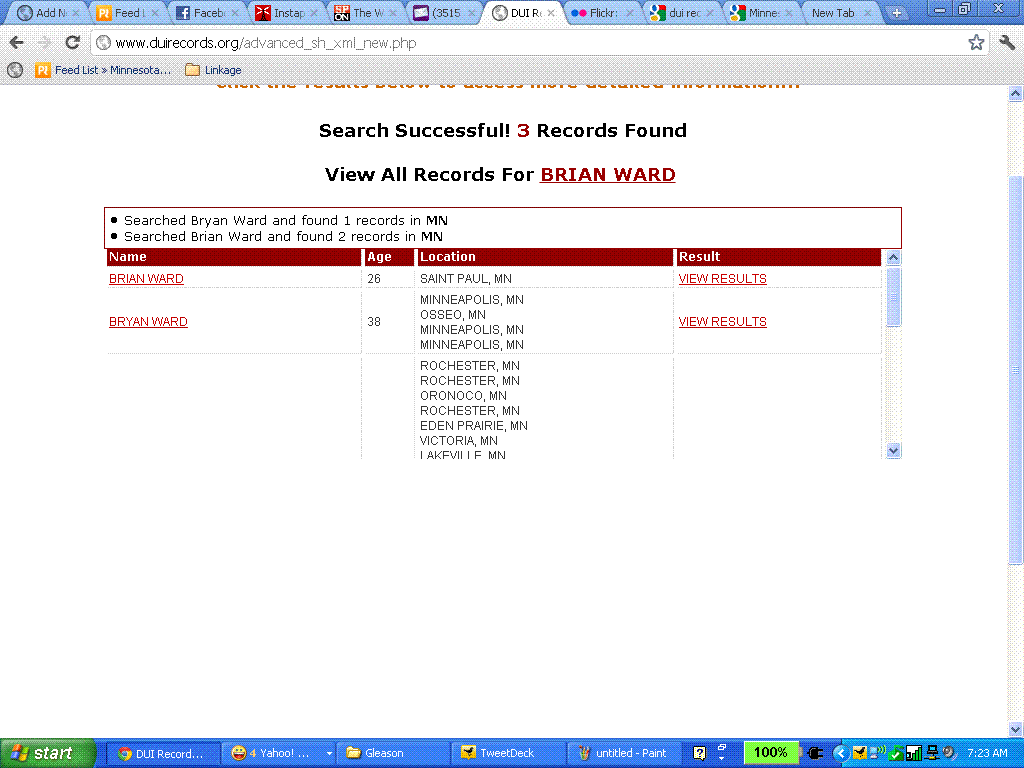
Wow.

Next,  I tried my friend and radio cohort, Ed Morrissey, who has publicly disclosed he lives in Eagan.

And I was shocked:

Holy crap.  You think you know a guy!

Next – since our last gubernatorial race was settled by a bogus “DUI” charge against Tom Emmer, I thought I’d see if what was fair for the goose were fair for the gander.  Does Mark Dayton have a “drunk driving record?”
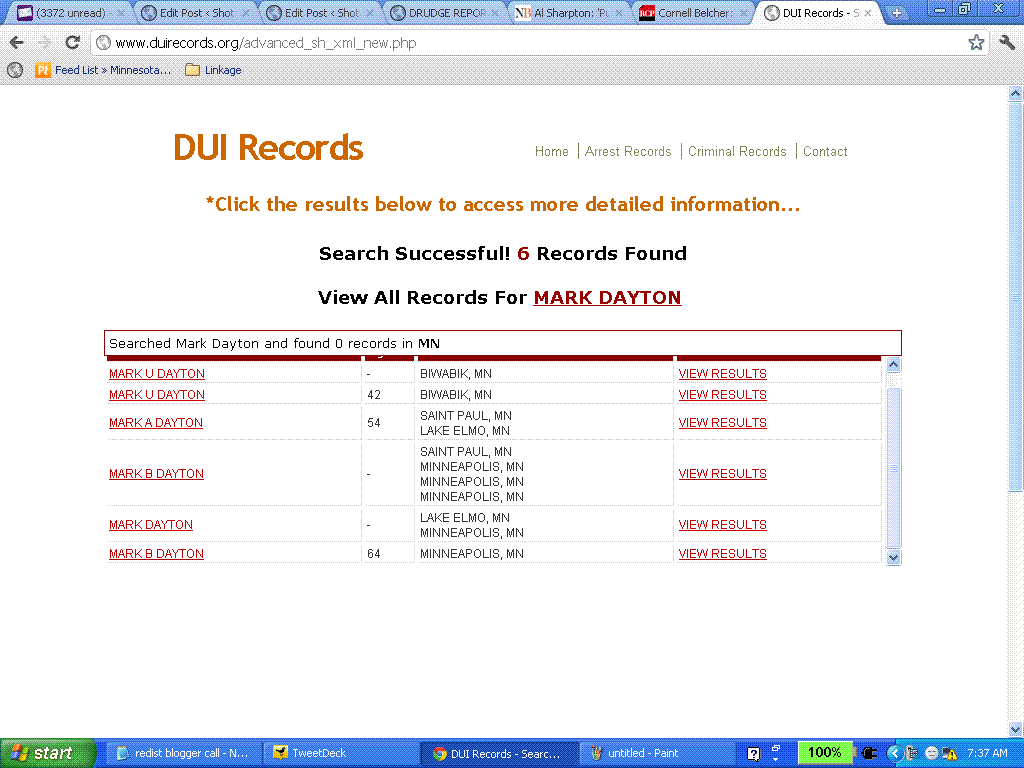
Wow!  Someone tell the media!

But I’m starting to smell a rat.  It almost looks as if this site will turn up a record on almost anyone.

I tried Archbishop John C. Nienstedt, the supreme poobah (I’m a little fuzzy on the terms of the Catholic hierarchy) of the Archdiocese of Minneapolis and Saint Paul:


And, finally, just out of a fit of untrammelled serendipity, I entered the name of my favorite Twin Cities’ blogger, a person whose keen insights, nimble wit and sparkling writing have enlivened many an idle morning, Professor William Gleason, a chemistry professor at the U of M:
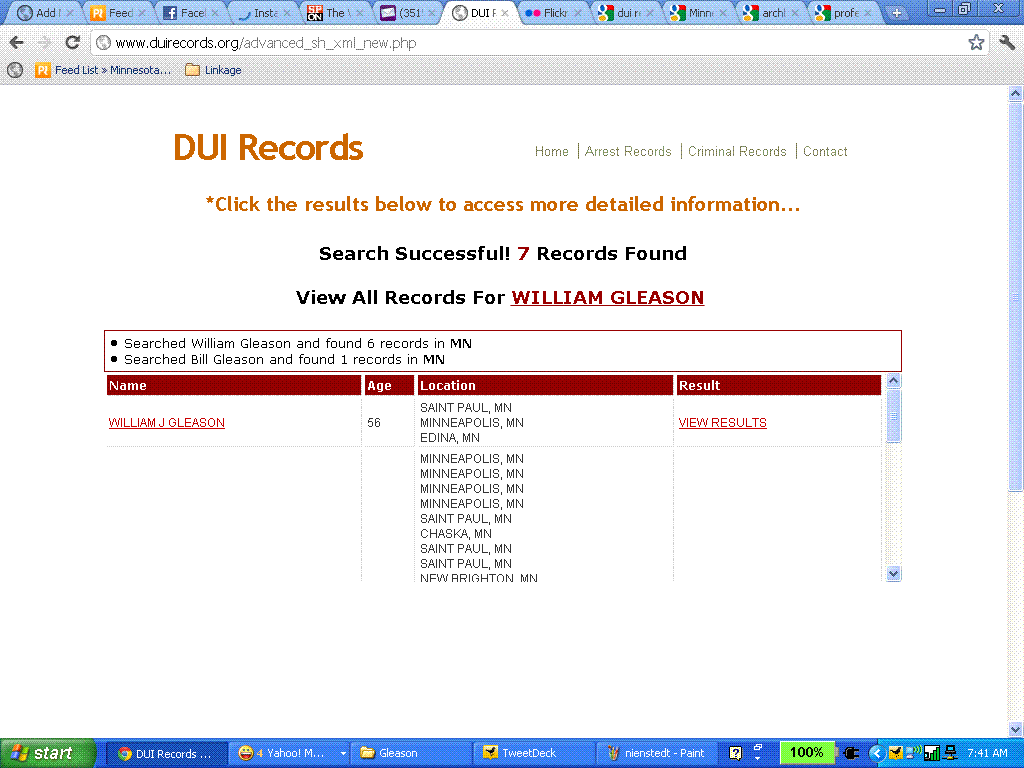
Note:  Someone pointed out that I got Gleason’s middle initial wrong.  No, I did not!  Go search the “database”; there are a plethora of William Gleasons out there!  Dozens!  Including the one with Professor and Blogger Gleason’s middle initial!

It  seems everyone has a DUI!

So I clicked on the “results” link:

What? I’ve gotta pay for public records?

Well,no.  The site above is an advertising site.  Indeed, it’s a form of spam.

Indeed, if you google virtually any form of legal activity – divorce, criminal records, bankruptcy – you will find pages and pages of these spam and scam sites, all designed to get you to pay money for what are, at most, slightly repackaged Google searches.

What “duirecords.org” does is take virtually any input you give it, run a search on, say, Google, spits back the results to make it look like it has something, sucks you in to a link to make you pay for…

…well, that’s as far as I pushed it.  I’m not going to pay to find out.

Now, you can get public records – or at least, names and charges and dates – from the official Minnesota court records (you have to click “Begin Search”, and accept the disclaimer).  Wherein you’ll find that in the past 15 years, there has been no “Mitchell P. Berg” convicted of DUI anywhere in Minnesota – and that I’ve been pulled over for expired tabs and forgetting my insurance card.

Expensive? Dumb?  Sure – but not DUI.

———-

The takeaway is this:  Say I were to write “John Doe, Age 46, of Mazeppa, was convicted of DUI” based on the output of the “DuiRecords.org” website…:
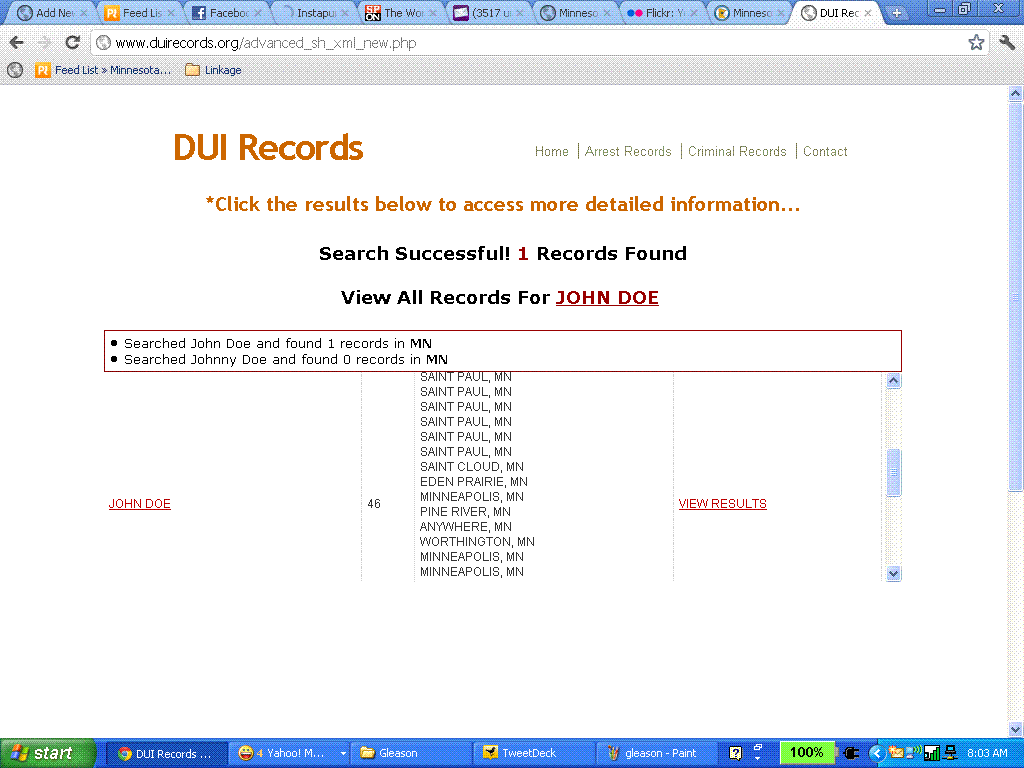
I specifically disclaim any insinuation that any Mr. Doe of Mazeppa has ever committed any crime, by the way. This is just an example.

… believing it to be a genuine public records website, rather than, as we’ve shown, an advertising site that turns up “records” on anyone.  

And ten, say, someone wrote to tell me, specifically, that “your “source” on Mr. Doe is an ad site, not a source of actual public records?”

And yet, I doubled down on my story – redoubling my assertion that Mr. Doe had been convicted of DUI?  Rather than retracting it and apologizing to Mr. Doe?

Well, that could fairly be seen as “failing to take reasonable care” to ensure that a defamatory statement (remember, accusations of infamous crimes are defamation per se under Minnesota law) is accurate”.

OK.  There is no serendipity at all in this series.  There’s a point.

We’re getting to it.

Apropos Not Much, Part V

Thursday, September 29th, 2011

Since I started this series a couple of weeks back, we’ve enjoyed a fascinating journey of learning – in this case, about what “defamation” – libel and slander – really really mean.

Here’s an interesting bit; as we noted yesterday, “false” can mean either “what the defendant said is false”, or “the defendant, with reasonable care, should have known it was false”.  Indeed, the case law makes it pretty clear:

D. Negligence Is Standard Of Liability

In Minnesota, the defendant is liable if it “knew or should have known in the exercise of reasonable care” that the defamatory statement was false. Jadwin, supra. This is the standard formulation for liability based on negligence, that is, liability arising from failure to take due care.

This is a low standard of liability.

In other words, if you accuse someone of having committed an infamous crime because you didn’t take the reasonable care to know that it was not factual, you are liable.

But what about free speech?

However, First Amendment considerations substantially limit the application of this standard.

So the courts will err on the side of free speech if there is any way to do so.

Still – if I were to write “Wang Fui Schlabotnik of Eden Prairie has a child porn conviction”, and Mr. Schlabotnik does not, Mr. Schlabotnik’s attorney might well argue that the First Amendment, free speech, and the rights of an open, unfettered press (in all its forms) aren’t served by my lying about his client’s criminal record – and defamation needs to be false, and false claims of infamous crimes are “defamation per se” under Minnesota Law (as we discussed last week).

And I suspect he’d have a point.

OK.  I’ll cop to it. This series on the legalities behind defamation is not entirely an academic exercise, and it’s really not completely a flight of blitheful serendipity.

But there’s plenty of time to talk about that.

99 weeks, to be exact.

More later.

Apropos Not Much, Part IV

Wednesday, September 28th, 2011

In the first couple parts of this series – admittedly something I’m writing out of pure unvarnished serendipity – I noted that Minnesota recognizes “defemation” when someone says something false and defamatory about someone, to someone else.

Today, we move on to the definition of “false”.  From this very useful site, which has been my source for much of this series, we will look – in effect, and with a nod to Bill Clinton – into what the meaning of the term “isn’t” is.

C. The defendant knew or should have known that the communication was false

Defamation allows recovery for unfair damage to reputation. As a consequence, if true statements are made about a person which damage their reputation, they cannot maintain a lawsuit.

That’s the first thing they teach you when you start learning how to be a reporter; make sure you’re writing the truth (or at least writing from verifiable fact).  And be ready to support the veracity of what you write; take good notes, and don’t toss them when the story’s done.  Have good solid cites for anything in contention.  Uses sources that you’re sure won’t burn you, and verify even the trustworthy ones. Don’t be a dummy.

Because the surest defense in a defamation suit is the truth.

It hasn’t always been this way:

This is a relatively recent development. One origin of libel and slander laws was a criminal cause of action by the English Crown used to silence its critics; hence, it was the truth of the alleged libel which provoked the lawsuit.

And this – the tradition of suiing over embarassing but true information – is one of the things that makes media work in the UK such a nasty, brutish business; it’s very easy to prove defamation.  And the absolutism with which our system approaches free speech (except when liberals are talking about talk radio) is at least in part a direct result of that tradition.

It’s part of Minnesota’s judicial canon.  I’m going to add just a little bit of emphasis to the following:

For example, the Minnesota Supreme Court has held:

We hold that a private individual may recover actual damages for a defamatory publication upon proof that the defendant knew or in the exercise of reasonable care should have known that the defamatory statement was false.

Remember those two bolded bits.  They may become important later.

Wait – I said this whole series was unvarnished serendipity, didn’t I?

Well, remember them anyway.

The conduct of defamation defendants will be judged on whether the conduct was that of a reasonable person under the circumstances.

Jadwin v. Minneapolis Star & Tribune Co., 367 N.W.2d 476, 491 (Minn. 1985). Other cases follow this reasoning. See LeDoux v. Northwest Publications, Inc., 521 N.W.2d 59, 67 (Minn. App. 1994) (“In order for a statement to be defamatory . . . it must be false.”); Janklow v. Newsweek, Inc., 759 F.2d 644, 648 (8th Cir. 1985), cert. den., 479 U.S. 883 (1987) (“Libel, by definition, consists of publication of a false and unprivileged fact.”).

The article takes great pains to estabish that falsity is a big-kahuna element of defamation..  It’s important.

This part is also pretty vital: the whole statement needs to be false.

Minor inaccuracies are not subject to defamation claims if the overall substance of the statement is true. “The plaintiff cannot succeed in meeting the burden of proving falsity by showing that only that the statement is not literally true in every detail. If the statement is true in substance, inaccuracies of expression or detail are immaterial.” Jadwin, supra, 390 N.W.2d at 441.

In other words, if I wrote “Todd Yamamoto, a Vikings fan from Edina, crashed into a tree”, and Mr. Yamamoto did crash into a tree, but was a Packers fan who is mortified to be associated with the purple and gold?  The suit is likely doomed!

But if I wrote “Bucky Yamamoto, Vikings Fan from Edina, crashed into a tree because he was free-basing with a drunk 16 year old girl”, and there was no freebase and the girl was 35 and his wife?  That’d be a problem.

(Dear Bucky Yamamoto – I don’t know that you exist. If you do, my apologies).

No Defamation by Implication. Failure to report all the facts may lead to a defamatory conclusion by the reader. But unless the overall substance of the statement can be proven false, no defamation claim will arise. “[T]he cause of action known as defamation by implication . . . is not recognized in Minnesota.” Kortz v. Midwest Communications, Inc., 20 Media Law Rep. (BNA) 1860, 1865 (Ramsey County Dist. Ct. 1992). A public official may not maintain a defamation by implication claim. Diesen v. Hessberg, 455 N.W.2d 446, 451 (Minn. 1990).

This was one that surprised, and sometimes infuriates me.  I thought the Strib’s Rochelle Olson defamed Alan Fine back in 2006, when it reported all the “facts” about his ancient domestic abuse arrest except the ones that could have exculpated him in the public eye, just in time for the election.  Not so; Ms. Olson and the Strib got the basic facts right; they just selected or omitted true facts in such a way as to ensure and maximize political damage to Fine and his campaign.

Slimy?  Sure – but not actionable.

Oh, the bit says that the defendant “knows or should have known” that their allegedly defamatory communication was false.

That means if they knew it was false, or they should have after taking reasonable care.

For example, say that I said that “Carrie Ann Trzeszelewska, age 22, of Forest Lake got a DUI”, and someone wrote me to say that there were two Carrie Trzeszelewskas – one age 22, that I wrote about and another woman, Carrie Raye Trzeszelewska, age 44 of Hugo, that actually had the DUI?  And that there was a state website where I could have checked that fact, either before writing the statement (as I should have) or as part of an immediate and humble retraction (as would have been the proper Plan B), but that I disregarded because I either didn’t care or was positive I had the right Carrie Trzeszelewska?

That might cause me a legal problem.

As I said, this entire series is borne of unvarnished serendipity.

OK.  Not entirely.

More tomorrow..

Apropos Not Much, Part III

Monday, September 26th, 2011

I’m just fascinated by the conversation with myself I started about a month ago, about how Defamation law works in  Minnesota.

Today – via this very helpful site – I’ll move on to the second element of a defamation case; there’s gotta be a third party:

B. The Statement was published to third persons

Defamatory statements must be communicated to a third party. You cannot defame someone by speaking to them alone, or by muttering to yourself. This element of defamation is virtually always satisfied when claims are made against newspapers and broadcast media.

Or, for example, when you write something false about someone in an email that only the other party sees (or is intended to see)?  .Or you say it to them on the phone, or when you’re at adjacent urinals in an otherwise-empty public rest room?  There’s no third party – and therefore there’s no defamation.  Your case is headed for a dismissal.

Write it on a blog, or on a social media site?  Like Twitter, to pick a totally hypothetical example?  Especially when other people chime in that they saw the defamatory communication?  As we’ve seen, there are three other criteria that need to be met – but that whole “third party” thing will be covered.

Tomorrow – what does “False” mean?

Again – this whole thing is just an unabashed flight of fancy.  No more.

Apropos Not Much, Part II

Friday, September 23rd, 2011

As I noted in a post about a month ago, I occasionally take off on flights of knowledge-seeking fancy.

Last month, it was over the subject of “Defamation” – the catchall term for what used to be called “Libel” and “Slander”, back when “old media” was the human voice and “new media” was the printing press.

As I explained back then, the various flavors of defamation occur when someone says, writes, or otherwise transmits…:

  •  …something that is defamatory – in other words, that has a reasonable chance of damaging the subject’s livelihood or reputation (where “reasonable” means “would convince a jury”)…
  • …to one or more third parties – meaning that someone besides the target has to hear it. The communication in question must be…
  • …untrue, as in “there is no truth to it”.
  • And if the target of the statement is a “public figure”, the target needs to prove the person making the statement acted out of malice.

Like most laws, the law as regards Defamation seems pretty straightforward on its surface.  But as anyone who’s had to try to read the law and is, as it happens, not a lawyer has noticed, while laws mean what they say, they also mean a lot more, and that “lot more” isn’t kept very clear for any of us lay people.

And so, as I did last month, I flipped through this site, which is an excellent resource on the subject.  I figured we’d take a quick jaunt through all four of the factors of Defamation, starting with the first.  What is Defamation?

A. A Defamatory Communication

What is a “defamatory” statement?

1. A statement which causes harm to reputation.

A statement is defamatory if it “tends to injure the plaintiff’s reputation and expose the plaintiff to public hatred, contempt, ridicule, or degradation.”

Seems fairly straightforward; if you say something about someone that harms their livelihood and reputation, it’s defamation.

Beyond that?  Some things are seriously fighting words; they are defined – sort of, to a certain level – as defamation any way you slice it:

2. Defamation Per se

Some statements are so defamatory that they are considered defamation per se; and the plaintiff does not have to prove that the statements harmed his reputation. The classic examples of defamation per se are allegations of serious sexual misconduct; allegations of serious criminal misbehavior; or allegations that a person is afflicted with a loathsome disease…When a plaintiff is able to prove defamation per se, damages are presumed, but the presumption is rebuttable.

In other words, if someone says you’re a pedophile, that’s pretty much defamatory.  If they say you killed someone, and you didn’t?  Defamatory!

Of course, it’s not quite that simple:

3. What Constitutes Injury to Reputation?

The plaintiff must establish proof of damage to reputation in order to recover any damages for mental anguish; see Gobin v. Globe Publishing Co., 232 Kan. 1, 649 P.2d 1239, 1244 (1982); Swanson v. American Hardware Mutual Ins. Co., 359 N.W.2d 705, 707 (Minn. App. 1984) (rev. denied) (“To establish a claim in a defamation action [plaintiff] must prove that the [defendant] made false and defamatory statements about them which injured their reputation.”).

If someone claims, for example, that you had been convicted of driving under the influence of alcohol?  Well, that’s a pretty infamous crime in this day and age.  Just ask Tom Emmer, who wasn’t even convicted of it, and still likely lost the Governor’s race – because of two non-convicted incidents that happened decades ago.  The incidents happened, of course – Emmer never hid the fact – so there was no defamation involved, although the context (as I noted at the time) of the DFL’s campaign was very dodgy.

But if there was no conviction, ever?

That’s why lawyers make so much money off of these sorts of cases!

Of course, there are some people that simply can’t be defamed…

The “libel-proof” plaintiff. A plaintiff is “libel-proof” when his reputation has been irreparably stained by prior publications. At the point the challenged statements are published, then, plaintiff’s reputation is already so damaged that a plaintiff cannot recover more than nominal damages for subsequent defamatory statements. Marcone v. Penthouse Int’l Magazine for Men, 754 F.2d 1072, 1079 (3rd Cir. 1985).

Now, we’re talking about people with drastically bad reputations; we’re not as a rule talking parking tickets, here.  Indeed, everyone…:

However, a court will not dismiss a defamation action merely because the plaintiff already has a bad reputation. Schiavone Construction Co. v. Time, Inc., 646 F. Supp. 1511, 1516 (D.N.J. 1986), rev’d, 847 F.2d 1069, 1072-73 (3rd Cir. 1988). Finklea, 742 S.W.2d at 516 (“[E]ven the public outcast’s remaining good reputation is entitled to protection.”) Rather the statement upon which the defamation claim is based should relate to the same matters upon which the prior bad reputation was founded, or to substantially similar matters.

…has a right to try to rehabilitate their reputation.

Well, almost everyone:

In extreme cases, a plaintiff’s general reputation may be so bad that a court will hold a plaintiff libel-proof on all matters. For example, Charles Manson or Adolph Hitler could not be damaged by defamatory statements. Langston v. Eagle Publishing Co., 719 S.W.2d 612, 623 (Tex. App. 1986).

So to sum up this first part:  “Defamation” is when someone says something about you that harms your reputation and livelihood – but you have to be able to show that it caused damage.  A drunk calling you naughty names in a bar – or on their blog – is not the kind of thing that’s going to convince a jury that you’ve been harmed.

Oh, of course there’s more to it than that.

More on Monday.

Again – this is purely a flight of unfettered fancy.

More Governors Like This

Thursday, September 1st, 2011

New Mexico governor Martinez NM gover shoots a 100 on her carry permit requalification:

Gov. Susana Martinez received perfect scores on recertification for her concealed-carry permit over the weekend in Las Cruces. She scored 100 percent with both .38- and .45-caliber handguns, her staff said.

It is, of course, serious business for Martinez:

She was a district attorney and a Republican candidate for governor when she first went through training and qualified to carry a concealed weapon. Her spokesman, Greg Blair, said Martinez’s personal and professional experiences motivated her to arm herself.

I’m not sure if this is her re-qual (the video says it is)…

…but it’s 11 hits for 14 shots in a quick fire drill, which ain’t chicken feed.

History Burns

Friday, June 17th, 2011

Bob Collins – MPR’s de facto aviation reporter – on the destruction of Liberty Belle, a World War II-era B17G which suffered an engine fire after takeoff from a Chicago-area airport over the weekend.

According to the pilot’s statement, they made a textbook emergency landing after the engine lit up…:

Directly below the B-17 was a farmer’s field and the decision was made to land immediately. Approximately 1 minute and 40 seconds from the radio report of the fire, the B-17 was down safely on the field. Within that 1:40 time frame, the crew shutdown and feathered the number 2 engine, activated the engine’s fire suppression system, lowered the landing gear and performed an on-speed landing. Bringing the B-17 to a quick stop, the crew and passengers quickly and safely exited the aircraft. Overhead in the T-6, Cullen professionally coordinated and directed the firefighting equipment which was dispatched by Aurora Tower to the landing location.

…but the almost-70-year-old plane was completely destroyed anyway:

you will see from photos taken by our crew that our Liberty Belle was undamaged by the forced landing and at the time of landing, the wing fire damage was relatively small. The crew actually unloaded bags, then had the horrible task of watching the aircraft slowly burn while waiting for the fire trucks to arrive. There were high hopes that the fire would be extinguished quickly and the damage would be repairable. Those hopes were diminished as the fire trucks deemed the field too soft to cross due to the area’s recent rainfall. So while standing by our burning B-17 and watching the fire trucks parked at the field’s edge, they sadly watched the wing fire spread to the aircraft’s fuel cells and of course, you all have seen the end result. There is no doubt that had the fire equipment been able to reach our aircraft, the fire would have been quickly extinguished and our Liberty Belle would have been repaired to continue her worthwhile mission.

They don’t make ’em like that anymore…

Priorities

Wednesday, May 25th, 2011

Governor Dayton vetoed all the GOP  budget bills, casting his vote for continued autopilot budget increases, an eternal burden on the state’s productive class, and forcing the rest of us to work ’til we’re 70 so that Dayton’s union supporters can retire at 55.

But at least Minnesota’s brewers got their money’s worth:

On the same day he vetoed most of the GOP-backed budget bills, Gov. Mark Dayton signed a bill allowing beer sales at a proposed new brewery and restaurant.

Minnesotans; broke, getting broker, force to be “happy to be paid for a better Minnesota” – but at least we can drink.

Keep ’em drunk and dependent.  Could be a state motto.

It Is Risen

Thursday, May 5th, 2011

The Nook – the teeny little Saint Paul bar and burger joint that burned down last December – is set to reopen today:

The restaurant, located on Hamline Avenue, across the street from Cretin-Derham Hall High School, has been around since 1938.

Their specialty was the Juicy Nookie, a burger stuffed with cheese. The restaurant was even featured on the Food Network show, Diners, Drive-ins and Dives.

I need say no more.

Hunting And Pecking Into History

Wednesday, April 27th, 2011

I miss typewriters.  My high school graduation present was a portable manual typewriter, which I used until long after I got my first computer.

But I miss them only in the most perverse, sentimental sense. I hated shopping for typewriter ribbons; I hated white-out and correction tape.  But in my day, I could type 70 words per minute on a Selectric, and not much less on my manual.  I even had a collectible one, once – something I picked up at a rummage sale that dated back to the thirties.

But the era of the typewriter is officially over; the world’s last typewriter factory just closed:

It’s an invention that revolutionised the way we work, becoming an essential piece of office equipment for the best part of a century.

But after years of sterling service, that bane for secretaries has reached the end of the line.

Godrej and Boyce – the last company left in the world that was still manufacturing typewriters – has shut down its production plant in Mumbai, India with just a few hundred machines left in stock.

Most of them were built for – I think this is hilarious – government.

UPDATE:  It seemed a little premature.  And it was; there are several other factories still operating.

Although the government is still the primary market.

Sliding Into History

Wednesday, April 20th, 2011

Back in college in North Dakota, I first encountered White Castle on a bitterly cold January Friday night.  A bunch of students from Chicago decided they’d gone long enough without “sliders”.  A few of them decided they’d undertake the sixteen-hour one-way trip back to Chi to get some, and maybe bring some back.   Helpfully, a Minneapolis kid told them there were Castles in the Twin Cities, cutting the trip in much less than half. So they took off, around 11PM.  And came back early the next afternoon, happy.

There are two morals to that story:

  • College kids in North Dakota in the 1980’s who didn’t have girlfriends or parties on the agenda could go really stir crazy.
  • White Castle generates incredible customer loyalty.

One of my English professors, Dr. Brucker, had White Castle as a hobby.  He somehow had wangled a subscription to the White Castle in-house magazine, and knew more White Castle trivia than anyone seemed to need.

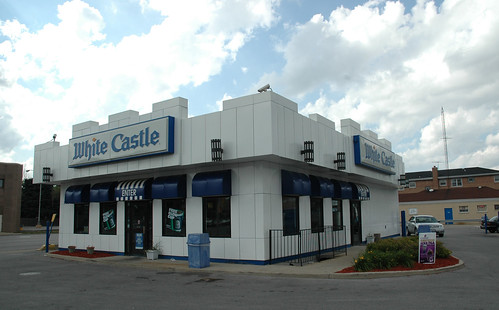
I didn’t actually eat one myself until I moved to the Twin Cities.  The Sunday after I moved into my first apartment, not far off of East Lake Street, I wandered up to Lake and 36th, and saw the white tile cube, and figured it was worth a try.

I ordered four cheese sliders and a coke, and sat down.  A few moments later, as I was waiting for my order, a big fella – probably 6’2 and 350 pounds – walked in and loudly and sloppily proclaimed “I just got paid!  Gimme thirty sliders and a large Coke!”.  As I sampled my first sliders – yum! – I watched, just a tad amazed, as the big guy bolted the whole order down and staggered up the street.

Thanksgiving Dinner, in some parts of Chicago.

And back when I was producing the Don Vogel show?  We marked all major celebrations – good ratings books, last days before fun vacations, whatever – with Don flipping me a $20 and sending me to the ‘Castle on White Bear Avenue for sliders and scabs for the whole crew.

Anyway – White Castle just turned 90:

The restaurant chain, famous for its original sliders, first opened its doors March 10, 1921, in Wichita, Kan. The now Columbus, Ohio-based company is family-owned and does not franchise. It also owns its own meat production facilities and bakeries to ensure quality control.

“White Castle is proud to be 90 years young,” said Jamie Richardson, vice president of corporate and government relations. “Since 1921, White Castle has remained true to its original mission and values. Our name says it all — White signifying purity and Castle signifying strength and permanence.”

I do about 1-2 trips a year to White Castle.  One thing that has changed; 25 years ago, it used to be entertaining to watch the guys behind the grill stuffing sliders into the little cardboard boxes like Las Vegas card dealers, banging through a couple a second.  I haven’t seen that in a long time…

Anyway – gassy-but-happy America salutes you, White Castle!

The Redstone Redmond Cops

Tuesday, March 22nd, 2011

The good news: one of the biggest spambot networks has been busted.

The Rustock botnet, an international network of virus-infected computers, had for years generated billions of emails per day, promoting unlicensed online pharmacies and cut-price impotence pills.

Good riddance.

But this was mildly jarring (emphasis added):

But on Wednesday, security firms noticed email traffic from Rustock completely collapsed. It has now been revealed that Microsoft, backed by US Marshals acting on a court order, seized servers that it’s estimated covertly controlled almost a million Windows PCs.

“We think this has been 100 per cent effective,” said Richard Boscovich, senior attorney in Microsoft’s digital crimes unit, according to the Wall Street Journal.

Well, that’s cool.  But back that thing up a minute.

Microsoft has a “digital crimes unit?”

Like, its own internal CTU?

OK, maybe.  But I’m just picturing what kind of equipment would be appropriate for a Microsoft SWAT team:

  • Firearms: The Chauchat light machine gun, the Sten Mark II submachine gun, and the Nambu 8mm pistol (1)
  • The Microsoft Cyber-Assault Vehicle (a ’77 Leyland Land Rover (2) with a TomTom)
  • Surveillance Cameras and Laptop Computers by Hewlett Packard
  • Arrest Warrant Printers by Lexmark.

What else?

(1) Note for non-gun-geeks; all three are legendary for their unreliability.  Sorta like Windows.

(2) Ditto

There Are Times…

Tuesday, March 22nd, 2011

…that I wish I could transition into being a food writer…

…so that once in my life I could write a piece like this.

An Experiment

Tuesday, March 8th, 2011

If I were to write an article saying that Justin Bieber, Lindsay Lohan, Kendra Wilson and Mumford and Sons had been photographed passing around a bottle of Cialis on the Vikings Sex Cruise with Bret Favre and Miley Cyrus, how many hits would it get me?

UPDATE: Mr. D. very correctly points out that I neglected to add a reference to Charlie Sheen’s porn star party.

I regret the oversight.

We Can’t Make It Up Fast Enough

Monday, February 21st, 2011

I used to think this was just fanciful and comedic.

Just goes to show you that nothing is too weird anymore.

The Depraved Gourmet

Wednesday, February 16th, 2011

Call the dour Calvinism of my Scandinavian anscestry rearing its head, but the wave of epicureanism – the Food Network’s various paeons to gluttony – have always rubbed me the wrong way.  Part of it is that the whole notion of glorifying ostentatious consumption strikes me as just wrong; you’re taking what you just plain don’t need (rural Scandinavians were crunchycons long before there was a term for it).  Part of it is the the way some “foodies” have turned gluttony into a secular religion, a cult of satiation.

B.R. Myers, writing in Atlantic, tackles the cult.  It’s a long read – four jumps – but very, very worth it.

Conclusion?

I used to reject that old countercultural argument, the one about the difference between a legitimate pursuit of pleasure and an addiction or pathology being primarily a question of social license. I don’t anymore. After a month among the bat eaters and milk-toast priests, I opened [former Motley Crue drummer] Nikki Sixx’s Heroin Diaries (2008) and encountered a refreshingly sane-seeming young man, self-critical and with a dazzlingly wide range of interests. Unfortunately, the foodie fringe enjoys enough media access to make daily claims for its sophistication and virtue, for the suitability of its lifestyle as a model for the world. We should not let it get away with those claims. Whether gluttony is a deadly sin is of course for the religious to decide, and I hope they go easy on the foodies; they’re not all bad. They are certainly single-minded, however, and single-mindedness—even in less obviously selfish forms—is always a littleness of soul.

Jumping to the conclusion, though, shortchanges you of a great read.  Go do that when you get a moment.

Forgive Me, Mr. Jobs, For I Have Sinned

Wednesday, February 9th, 2011

The Catholic Church has, um, given its blessing to a “ Confession” iPhone app:

A Catholic bishop in Indiana has approved “Confession: A Roman Catholic App,” created by a company called Little iApps.

For $1.99, Catholics can use their iPhone to help them examine their conscience as part of the sacrament of reconciliation.

But there’s a catch: The application is not designed to replace going into the confession booth.

You’ll still have to see a priest to be absolved from your sins.

(CLOSED CIRCUIT TO I.T. GEEKS)

The Catholic version uses a three-tiered architecture.  The Lutherans and Presbyterians are reportedly working on a two-tier version of the app.

(END CLOSED CIRCUIT)

Six Million Bottles of Beer on The Road, Six Million Bottles of Beer.

Saturday, January 8th, 2011

I suppose this isn’t the first time beer has stopped traffic.

A kilometre-long convoy of beer vats is on the move, shutting down roads and downing hydro and cable lines in its path.

Massive vats that can hold six million bottles of beer are being hauled from Hamilton Harbour to a Molson Coors facility near Pearson International Airport in Toronto.

The trip, which is expected to take four nights, began Friday night as the vats — loaded on six flatbed trailers — were slowly pulled out of the docks by transport trucks.

As for me, I prefer Surly, a local beer known for for it’s quality than it’s quantity.

…and at ten bucks for four cans, thusly priced as well.

Geek Question

Saturday, December 25th, 2010

All I want for Christmas (that I haven’t already gotten) is this:

Why does my Thinkpad T60’s monitor turn off within 1-3 minutes of booting or coming out of sleep/hibernation?     And how can I get it to stop?

If I put it into sleep or hibernation, it’ll usually turn back on, but only for a few minutes at most – then it’ll turn off again.

I have a hunch it’s one of those stupid inscrutable Thinkpad config settings that someone at Lenovo needs to get pummeled over.  But I can rarely get it to stay on long enough to get the stupid Thinkpad config screen to come up.

Anyone have any ideas?

(And “switch to Linux” is tempting, but I really really have to do my post-Christmas balancing of the checkbook in Quicken…)

Where Have All The Voters Gone?

Thursday, December 23rd, 2010

Cool web-toy at Forbes showing where people moved, county by county, in 2008.

--> Site Meter -->