A Musical Thanksgiving Note
Thursday, November 28th, 2013And I am.
I am thankful, for starters, that someone posted Linda Thompson’s version. Dave Swarbrick’s nasal delivery would put me off my thanksgiving meal…
And I am.
I am thankful, for starters, that someone posted Linda Thompson’s version. Dave Swarbrick’s nasal delivery would put me off my thanksgiving meal…
Generally, when I get involved with someone, I try to do it for the long term.
But I’m almost tempted to try to get into a serious relationship – ideally something with a hip-hop theme, no matter how convoluted – if only so I can break up using the line “you got 99 problems, but a Mitch ain’t one”.
OK, just so you don’t have to ask your kids…
Tom Gross at NRO notes a facet about the late Lou Reed – who passed away Sunday after a long battle with liver failure – that has gotten rare mention in the media; he was one of New York’s few arts intelligentsia who were staunchly pro-Israel:
I mention Reed’s Jewishness because not a single obituary I have read of him in the mainstream press mentions it, when for Reed it was an important factor.
Reed, who died yesterday of liver failure at the age of 71, was born Lewis Allan Reed to a Jewish family in Brooklyn. He said that while “he had no god apart from rock ‘n’ roll” his Jewish roots and standing up for Israel meant a lot to him. He was a frequent visitor to the country, last performing in Tel Aviv in 2008, and his aunt and many cousins live in Haifa and other Israeli towns.
Reed even had an Israeli spider named after him to thank him for his support for the country.
Like Gross, I remember his “Good Evening Mr. Waldheim”, from 1989’s New York album.
By way of going after the former UN Secretary General (who’d served in the SS during World War 2, Reed rips into Jesse Jackson – famous for supporting Farrakhan and the PLO, and for his “Hymietown” jape, noting that some of the civil rights workers murdered in the sixties in the deep south were Jewish.
Lou Reed died over the weekend, proving once and for all that only Keith Richards can ingest absolutely every recreational chemical known to modern science and live to tell the tale forever.
It took me a long time to really get into Lou Reed – which may seem really counterintuitive, if you know me and my taste in music (and if you read the “Music” category of this blog, you do, sort of; I haven’t written about everything, just yet). After all,everyoneknows Lou Reed and the Velvet Underground were the godfathers of punk – right?
Sure.
But even though the Venn diagram among the different outbreaks of “punk” in New York in the seventies has tons of overlaps, there was a yawning gap between the joyful, garage-band-y noise of the Ramones and the New York Dolls (and their Cleveland descendants, the Dead Boys) and the Greenwich Village scene that spawned Reed, crawling as it was with high-art pretension. The likes of Andy Warhol and William S. Burroughs saw and were seen among the rat-bitten warrens of the Village, hobnobbing with and encouraging the likes of the largely unlistenably shrill Patti Smith, the campy “Stilettos” (featuring a young Debbie Harry, who’d form “Blondie” by the mid-seventies), and of course Reed and the Velvets.
It probably wasn’t until I moved to the Cities and started doing music here that I took a step back, at the urging of my band’s old drummer. “Forget all the BS”, he said, “and just focus on the fact that he’s a guy who loves doing basic rock and roll”.
And in one sense it was true – the classic Lou Reed was all about the joy of playing the most basic rock and roll, simple and unadorned and pared down to its most basic components, filtered through a layer of New York grime.
Usually.
Reed was also an experimenter. In “The Original Wrapper” (from 1986’s Mistrial), he wryly claimed the title of the orignal, well, rapper – since he never so much “sang” as “spoke in rhythm”. He delved through jazz, experimental music, screeching noise…
…even some pared-down pseudo-classical music – as in this very, very, very pre-MTV video for his classic “Street Hassle”, featuring a spoken-word coda by Bruce Springsteen around the eight-minute mark:
r
So I’m going to find my old copy of “Rock and Roll Animal” this week here, and give it another spin.
Our government is doing its best to show you who serves who, here.
In a few years, the Chinese are going to be able to yank our nation’s chain and say “bark for your meal, bitch”.
Our state is run by bobbleheads, and the only pro sports team we have that isn’t a perennial embarassment is the WNBA team, which is itself a form of perennial embarassment.
But before you stick that .40 S&W in your mouth, just wait.
Because someone released the entire September 19, 1978 Bruce Springsteen and the E Street Band at the Capitol Theater in Passaic NJ concert – one of the greatest concerts ever recorded, ever, ever, in really really high quality audio.
Here’s Cam Winton’s website. You don’t have to live in Minneapolis to help Cam shock the world.
Here’s my piece about Daniel Henninger’s piece saying we should just let Obamacare collapse from its unwieldy incompetence.
And since it was “Springsteen Cover Saturday” in honor of Bruce’s 64th birthday last Monday – here’s my series on why Springsteen resonates with conservatives.
Fascinating article in “First Things” about an aspect of Warren Zevon I did not know the first thing about.
This is an update of a piece I wrote five years ago.
It was 30 years ago today that Big Country’s The Crossing was released.
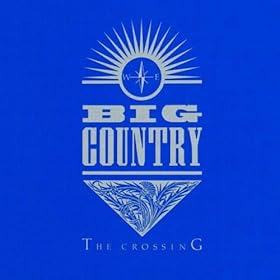
In America, Big Country has that “one-hit wonder” patina about them, which only goes to show that when it comes to music, too many Americans are ignorant clods.
While The Crossing‘s “In A Big Country” was, indeed, their only real entry into the Top40 in America, it’d be hard to overestimate what a blast of fresh air the album was in 1983.
1983 was a great year in music; it was also the year that provided many of the decade’s musical punch lines; “Putting On The Ritz” by Taco, “Mr. Roboto” by Styx, “Safety Dance” by Men Without Hats, Kajagoogoo and Culture Club and Asia and Naked Eyes and Laura Branigan and not one but two Jim Steinman bombast-fests (Bonnie Tyler’s “Total Eclipse Of The Heart” and Air Supply’s “Making Love Out of Nothing At All”) duked it out with some of the great pop music of all time; “Little Red Corvette”, Michael Jackson’s entire Thriller album back before he turned into a walking freak show, and a long list of other classics.
Amid all the good and all the bad, there was a definite trend; it was the era of the synthesizer. The battle between analog instruments like the guitar, bass, physical drums and mechanical and electromechanical keyboards like the piano and organ on the one hand and purely-electronic ones like the synth and the sequencer had just begun.
(And if you’ve listened to pop radio lately, you know that the electronics won. But we’re getting fifteen years ahead of ourselves).
Some declared the guitar dead. Articles in Rolling Stone said that the new wave (heh heh) of cheap electronic technology would finally euthanize the venerable analog stringed instrument. It was the year Yamaha’s revolutionary DX7 synthesizer hit the market, bringing digital Frequency Modulation technology down to around $1,000 for the first time, making it possible for pretty much anyone (with $1,000) to create any sound they wanted, save it onto cassettes (or, for a few bucks more, floppy disks!), play it onto the first inexpensive digital sequencers and MIDI processors and “drum machines” and essentially run a “band” from ones’ keyboard. The future of music, said the wonks, was pasty-faced geeks with hundred dollar haircuts in flamboyant suits, pecking away at keyboards as masses of lobotomized droogs bobbed away in the audience.
Straight into the face of those predictions charged Big Country – a band from Dunfermline, Scotland that mixed technical “wow” with actual fun (the Scottish football-hooligan atmosphere that accompanied their shows and appearances), they blew the knobs and faders off of the synth-wankers that glorious autumn.
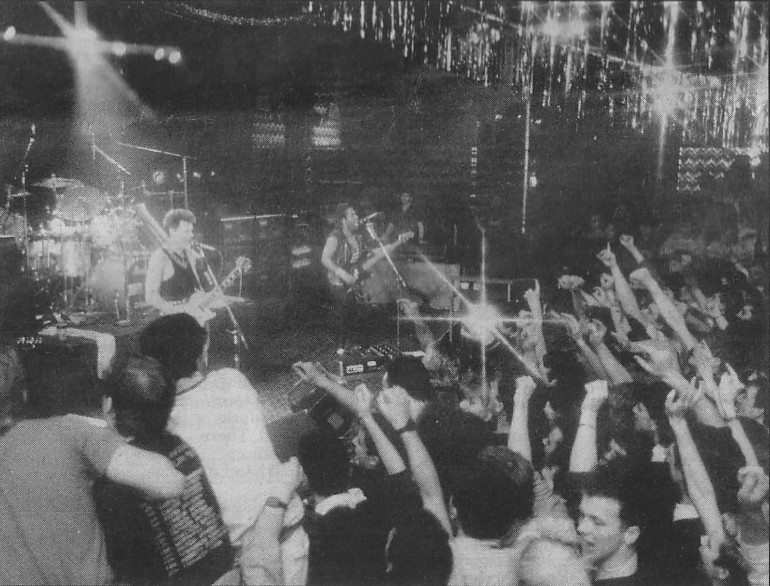
The band wrapped itself in “Scotland” – but ironically, none of the band’s members were native Scots. Bassist Tony Butler and drummer Mark Brzezicki were from London, guitarist Bruce Watson was Canadian, and guitarist and singer Stuart Adamson was from Manchester (although he grew up in Dunfermline. His impenetrable brogue was the real thing).

The “wow” came partly from technology (really cheap technology, like the MXR Pitch Transposer and the e-bow, basically a hand-held electromagnet that acts like an electronic violin bow, giving a guitar infinite sustain), great guitars (the lads favoredYamaha SG2000s and Fender Strats) clever engineering and pure guitar technique to wrench amazing impersonations from their instruments; they loosely modeled bagpipes, Irish fiddles, and all manner of supercharged traditional instruments which, combined with the Gaelic-y arrangements and playing technique, roused talk of a “Celtic revival” in that year that also brought U2, the Alarm and Simple Minds to the charts.
And of course, there was great musicianship; Butler and Brzezicki were superb session musicians before Big Country; Adamson and Watson were excellent in a more restrained, controlled way.
Adamson and Watson rarely played power chords, sticking to carefully-orchestrated one-and-two-note patterns over their carefully-built sound-setups to create a distinctive, loud, joyful noise.
Nearly every song on the album was a keeper:
The album was a huge splash in 1983.
But the band never really had much impact in the US after their debut; they only charted with one more single (“Wonderland“, from the next year, one of my favorites) which peaked at #86, while Steeltown, my favorite Big Country album, barely dented the album charts in the US (it debuted at #1 in the UK). Steeltown’s marquee single, the spectacular “Where The Rose Is Sown“, a Falklands War protest of sorts, didn’t show up at all.
I think I spent sixty hours over my “interim” period in 2004 (my college was on a 4-1-4 system – January was spent on one, all-day class for the whole month) learning how to play and imitate every single song on the album. I had the bagpipe thing figured out, anyway…

Adamson, after years of fighting alcoholism, committed suicide in December of 2001. The band knocked around in limbo for most of the last decade, held up with legal wrangling among the surviving members and the Adamson estate. They re-united last year, with former Alarm frontman Mike Peters singing lead, and Watson’s son Jamie sitting in on guitar.
I’m gonna down a Newcastle and break out the SG in honor of the anniversary.
This was the band I always wanted to have when I was in high school or, even moreso, college:
I mean, not necessarily with Steve Van Zandt (AKA “Silvio Dante”) sucking up all the oxygen – but a horn-based Stax/Volt knockoff kind of thing.
Oh, don’t mind me. I’ve been having one of those weekends where every single earworm was an Asbury Jukes song. Which is far from all bad.
But here’s a a trivia question. Look at the guitar player in the pink shirt (Bobby Bandiera) with the white guitar. That very guitar appeared in a major motion picture (along with the rest of the band).
Any guesses?
Put those Amy Winehouse records away.
Wherever you are, Duffy, take five.
Kelly Clarkson? I love you, hon, but take a knee and listen up.
Nicky Minaj? Lady Gaga? Taylor Swift? Take a seat.
(more…)
…I wish I was in New York this week.
I’m tired of writing about politics this week. I need to do something to stir up my blogging mojo.
Regular political blogging restarts, most likely, next week. ‘Til then, I’m going to follow through on an idea I first started noodling with close to three years ago, and see where it goes. It’s another of my loooong series on pop music history. But unlike my recent “Springsteen for Conservatives” series (which I had a stone-cold blast writing), I don’t have to try to keep up a cohesive narrative for weeks on end.
Which fits my attention span much better, these days.
———-
I graduated from high school in 1981. I grew up in North Dakota, which is still a bit of a national punch line for “isolation” (although these days North Dakotans are doing most of the laughing), but in those days before the Internet, was much, much moreso.
Pop culture came to my hometown, Jamestown, much later than most of Western Civilization. Until I was in elementary school, we only got two TV channels (or only two that Mom and Dad told me about, anyway). Only Algore had the Internet in those days.
For a couple of years, we didn’t even have a movie theatre in Jamestown. First the Grand Theatre on Main Street – a splendid old 1890’s opera house – got torn down to make way for the worst Holiday Inn in America. Then the Star Theater closed, probably due to health code violations; stories of people reaching into their popcorn and coming up with a handful of rodent were standbys in Jamestown’s urban legend library at the time. Without a theater? Forget about catching the tail end of one of the great eras in American film; we didn’t even see Star Wars or Jaws until a year after the rest of the country did.
Oh, we caught little bits and pieces of seventies culture when I was a kid; books and magazines had those gawdawful swishy seventies fonts and typefaces; polyester and bell-bottoms and suits made of corduroy or denim cropped up.
Entertainment? Well, I was too young to “get” some of the great stuff of the era, “The Rockford Files” and “Mary Tyler Moore” and the first “Bob Newhart Show”, among others. But if you were a kid, it was the heyday of Sid and Marty Kroft, and the beginning of Hanna-Barbara’s thirty-year nadir – most everything the former cartoon powerhouse produced between 1968’s “Banana Splits”, which I hated with a passion even as a kid, until 1998’s “Powerpuff Girls”, which I loved as an “adult”. And even then, I couldn’t stand much of it – from Gilligan’s Island reruns (to which my friends glued their faces every night after school) to The Brady Bunch, most of it annoyed me to one degree or another.
And as re music, which was then and now my primary whiff of pop culture? Jamestown’s only two radio stations played either country or, at the station I started at when I was 16, something radio people used to call “Middle of the Road” – a little Beatles (not the “hard” stuff, mind you, like “Daytripper”), a little Top 40 (the mild stuff) and any variety of pop standard going back to the forties and fifties. Think Ann Murray in her heyday.
Things changed a bit in seventh grade, when I finally got an AM radio of my own. Spinning the dial when I was home sick one day, I found radio stations from other places – WDAY in Fargo (which I’d been to maybe twice), KFYR in Bismarck, and – once I discovered night skip – WLS in Chicago.
And it was in eighth grade I discovered two things:
And the punks of the day exercised a studious disdain for the mainstream of the day. Whatever the mainstream was; from bloated art-rock holdouts like Pink Floyd, to the Album-Rock Top Forty warhorses like Bachman-Turner Overdrive, to the easy-listening pop of Linda Ronstadt and Jackson Brown and Fleetwood Mac, I cultivated a studied hatred of the whole noxious corporate (so I was told) stew that was Seventies music.
Oh, not all of it. I liked Bruce Springsteen and Tom Petty and Creedence Clearwater, all of whom had the seal of counterculture critical approval, sure (although I liked each before I knew that), but I also liked Boston because I had a blast learning to play their first album on guitar, critics be damned. And I loved Heart because I was a 15 year old guy with a standard-issue set of hormones (and a thing for Nancy Wilson’s fingerpicking style). And as a guitar player and wanna-be showman, I loved Van Halen, and so did everyone else, quit lying.
And throughout high school, I loved loved loved The Who, because Pete Townsend was a vainglorious pseudointellectual arrested-art-school adolescent drama duke, and I was a vainglorious wanna-be pseudointellectual actual-adolescent drama duke.
But, nearly alone in Jamestown North Dakota in the late seventies and early eighties, I sniffed derisively at the mainstream, at BTO and Bad Company and Pink Floyd and Shooter and Head East and REO Speedwagon and Styx and Kansas and Emerson Lake and Palmer and Ted Nugent and Rush, and the R ‘n B and Country Western of the era, and waved the flag for The Clash, the Sex Pistols, The Damned, The Dictators, Elvis Costello, the Cars (but only the first two albums), Television, The Police, Gary Numan and the Tubeway Army, the Pretenders, eventually U2 – and some of the more-traditional bands that kept or gained their critical cred during the New Wave; Petty, Springsteen, Bob Seger, Dire Straits, even AC/DC.
I was, in short, a teenage wanna-be hipster douchebag.
And being a wanna-be hipster douchebag with a garage band beat the crap out of being a greasy-haired acne-ridden geek who couldn’t run a fast break without slamming into the opposing team’s bench. As high school identities in rural North Dakota in the late seventies and early eighties went, it was a big step up.
———-
Well, I’m not 15 anymore. And I don’t have to adopt an attitude to throw in peoples’ faces, because when you’re a Republican in Saint Paul, one is a fish swimming in a contrarian sea with no need for artifice.
And a few years back I started listening to some of the music from the Seventies – much of which I’d spent the eighties through the mid-2000s aggressively ignoring in an ever-more-vestigial burst of “too cool for thou” – with a much more open mind.
And I thought I’d write about it a little.
Maybe once a week until I run out of ideas, anyway.
It was twenty years ago today that U2 played their famous -and controversial – gig on the roof of Los Angeles’ late Republic Records:
It was the video that brought on two reactions from me:
Joe Doakes emails:
My iPod collection is eclectic. Jefferson Starship’s “We Built This City (On Rock-and-Roll)” just played.
It occurs to me that if you’re talking about San Francisco, that’s probably true; Haight-Ashbury typifies that burg.
But New York or Cleveland? They weren’t built by rock-and-roll. They were built by Big Band and Swing, the music of the people who won The War and made American manufacturing the greatest force in the world throughout the 1940’s and 50’s.
Rock-and-roll was the Baby Boomers music. Rock-and-roll didn’t build those cities, it killed those cities, and many more. Detroit was Mo-Town when the old folks ran it; with Baby Boomers in charge, it’s Mo-Handout-Town. The fortunes of iron-ore-mining town Hibbing waned exactly as home-boy Bob Dylan’s waxed.
Okay, it’s only a song and not a very good one at that, not some great philosophical commentary on society.
Joe is too tactful. Starship’s “We Built This City” is perhaps the worst song in Top Forty history, rivaled only by Starland Vocal Band’s “Afternoon Delight”.
But that actually reinforces his point:
Still, I wonder how much difference it would make if popular culture turned away from “if it feels good, do it” and back to “Stars and Stripes Forever.”
Joe Doakes
Tangential thought: what does it say about either the music or the city that Minneapolis’ “Wedge” neighborhood (from Franklin to Lake between Hennepin and Lyndale) is exactly the same pompous, pretentious, overpriced wanna-be-artist’s-garret toilet now as it was before the Replacements’ heyday?
Speaking of which:
No, Joe’s right. America was the first culture in history to develop an “independent” “youth culture”. And now that those “youth” run the place, we’re completely screwed.
Arts criticism is, by its very nature, interpretation.
And the human trait of confirmation bias makes it possible for just about any human being to make just about any case for any art. It’d be hypothetically possible for someone to try to show that Raskolnikov, the protagonist in Dostoëvski’s Crime and Punishment, is really a homoerotic metaphor. Of course, the burden is on the person making the case that the interpretation is meaningful, or in fact not complete balderdash – a burden nobody has met in re Crime and Punishment or, to the best of my knowledge, ever attempted.
Music is among the more emotionally-evocative art forms – for me, anyway, and I know I’m not alone.
This entire series started last fall, just round election time. A friend of mine – a fairly mid-level Democrat organizer and consultant type – tweeted a while back something to the effect of “Have any of you Republican Springsteen fans actually listened to the music?”
My response; Yes. More than you have, and likely will. Springsteen’s been one of my musical favorites since my mid-teens, including my brief stretch of time as a liberal, into my early twenties. If anything I became a bigger fan after I became a conservative.
Springsteen didn’t become overtly political until much later in his career. His music was expressly non-political until at least the mid-nineties; his Ghost of Tom Joad album was the first to really noodle around in politics (and do it generally badly – Joad is one of his least-remembered records).
Indeed, at the height of his career he made a point of being studiously non-political, at least in terms of the partisan scrum. Liberals chortle about the 1984 episode where Springsteen rebuked Ronald Reagan for trying to co-opt “Born in the USA”; they – and the media that still mention the event – forget that days later, he did the same to Walter Mondale for trying to make his own hay out of the episode. Leftist rock critics like Dave Marsh – who was for decades my favorite rock critic, notwithstanding his habit of injecting his infantile socialist politics into every issue, and even as I started realizing “rock critics” were even more useless to this world than paparazzi and Kardashians – hooted and hollered about the political implications of Springsteen’s much-publicized donations of hundreds of thousands of dollars to charities along the way during his Born in the USA tour, ignoring the fact that conservatives as a rule support private charity.
As Springsteen got older, and his career cooled off a bit in the nineties, he got more overtly political – at about the point where his most notable right-of-center fans, the Chris Christies and Laura Ingrahams and Tim Pawlentys (also me) got more “out” about their fandom. Which led lefties to sniff, in their usual way, “you do know he’s a liberal, don’t you?”
Which led us to here.
———-
Springsteen during his, ahem, Glory Days was expressly non-political – but it’s entirely possible to listen to a song like “We Take Care Of Our Own” and identify, at least with the sing-along points, as a conservative.
Or as a liberal, for that matter:
Liberals “take care of their own”, too – by getting the larger society to subsidize them; conservatives do it, of course, by trying to make opportunity ubiquitous and giving people the freedom to succeed as well as fail. To quote Winston Churchill, liberals level out the peaks to fill in valleys (although not that level; Springsteen is well into “the 1%”, has been for 30 years, and will be the rest of his life); conservatives spread a safety net over the chasm.
But this series has largely been about the messages that don’t need to be debated – the messages that resonate with conservative fans because their messages resonate completely with what it takes to be a conservative.
And that’s what this series is about; resonance. Sprinsteen, despite his best efforts, resonates with conservatives…
…and – here’s the important part – he does it especially when he’s being apolitical.
One of my favorite songs in my crowded list of favorite Springsteen songs is “Land of Hopes and Dreams”:
So listen to it:
Grab your ticket and your suitcase
Thunder’s rollin’ down this track
Well, you don’t know where you’re goin’ now
But you know you won’t be back
Well, darlin’ if you’re weary
Lay your head upon my chest
We’ll take what we can carry
Yeah, and we’ll leave the rest
Big wheels roll through fields
Where sunlight streams
Meet me in a land of hope and dreams
Gospel-revival-style show-stopper? Sure.
Metaphor for everything conservative believe about America, the exceptional nation, the “Shining City on the Hill?”, where all of us…
This train…
Carries saints and sinners
This train…
Carries losers and winners
This train…
Carries whores and gamblers
This train…
Carries lost souls
I said this train…
Dreams will not be thwarted
This train…
Faith will be rewarded
…are equal in the eyes of God and the law?
Seriously – there may have been descriptions of the conservatives’ vision of America in the rock and roll era that are this good. But have there been any better?
The question – at least in re Springsteen’s greatest music, from ’74 to about ’87, with a bit of a surge after 2002, the “Holy Trinity” (Born to Run, Darkness on the Edge of Town, The River), Nebraska, Born in the USA, Tunnel of Love and The Rising and a few other odds and ends along the way – isn’t “why do conservatives find resonance in much of his best music”…
…but, vagaries of personal taste aside, how could they not?
Mention Irish rock megastars U2 to people, and the reactions you get will span the gamut.
To kids today, a generation after they first came out, it’s probably all about Bono – the peripatetic, bombastic lead singer who’s parlayed a magnificent singing voice and a global pop following into a second career as a global charity leader (and, it needs to be said, arch-capitalist).
To someone who came of age in the nineties? I’d imagine U2 was to them what the Rolling Stones were to me growing up in the late seventies and early eighties; dissipated celebrities noodling with making sense of their megastardom, albeit with less drugs and model-banging, but with a lot more artistic pretension ladled on top.
To hipsters of all eras? Once they left Dublin, they were trayf.
And U2 has been all of that to me, too (except maybe the hipster bit).
But mostly, U2 is the band that tied together two big strands in my own life. And the main catalyst for this, their breakthrough album War, was released thirty years ago today.

And the strands it tied together for me, and with style, were faith and rock and roll.
I’m gonna give you a two-fer here. We’ll cover two of Andrew Sullivan’s definitions of what makes a conservative in one article, since they’re both just a tad thin.
The first of the two – “Conservatives uphold voluntary community, quite as they oppose involuntary collectivism“? Gotta confess, that one’s pretty thin throughout the history of rock and roll. I’ll cop to it; other than “meeting beneath that giant Exxon sign”, or driving out to Greasy Lake, or meeting at Mary’s Place, it doesn’t pop up much.
We’ll let that one slide for now.
The other – “the Conservative recognizes the need for prudent restraint on power and passion?”
Well, there’s always “Roulette”, the often-bootlegged anti-nuke anthem:
Which isn’t really close, but it’s such a cool recording I don’t care much.
More seriously?
We’ll be back with the final parts of this series later in the week.
One of the fundamental tenets of the “classical liberalism” that is the basis of modern conservatism is the idea first recorded by John Locke – that men form governments to protect life, liberty and private property; that private property was in fact a cornerstone of real liberty, and that protecting it against the depredations of government and of other people is a key justification for having a government. To put it in Andrew Sullivan’s words – because it’s his definitions of “classical conservative” that I’m using as the basis for this exercise – “Conservatives are persuaded that freedom and property are closely linked”.
If we have no property rights, then we have no rights.
Now, John Locke isn’t a common theme in the history of rock and roll. And private property has had a mixed history in popular music; it’s been a metaphor for rites of passage (Jan and Dean’s “409”), or the high life (“Baubles, Bangles and Beads” by everyone from Eartha Kitt to Frank Sinatra) and a yardstick for swagger (“Beamer, Benz or Bentley” by gangster-rapper Lloyd Banks), but also for evil (“I’d Love To Change The World” by Ten Years’ After’s called us to “Tax the rich, feed the poor, ’til there ain’t no rich no more”).
And you can look in vain for references to Locke or Payne or Franklin – in Springsteen’s catalog, and can find plenty on his later albums and his real life as re politics that contradicts them all.
But this series isn’t about proving Springsteen is, personally, a conservative (faith-based blogger Dog Gone’s endless repetitions notwithstanding); it’s about explaining why his music resonates with conservatives.
SIDE NOTE: It’s amazing how life can derail a guy’s plans. While – as is my wont with these long series – much of the rough material was put together in October and November, I held off on actually putting it into a written form, thinking it’d give me something to do during the two-month stretch between the election and the opening of the state legislature, when I’m usually too burned out on politics to care much.

Of course, this past eight weeks of battling for the Second Amendment has derailed a bit of that plan.
But while the battle against Barack Rex carries on, it’s time to make time for the fun stuff.
Or what is for me the fun stuff, anyway.
———-
This is a quick one, though.
The good news? Big Country is re-uniting…
…sort of:
The reconfigured Big Country — with The Alarm’s Mike Peters filling in for the late Stuart Adamson and the new addition of original Simple Minds bassist Derek Forbes — will release its first new studio album in 14 years this spring and embark on a world tour that will hit the U.K., Europe and North America.
The band — also featuring guitarist Bruce Watson and drummer Mark Brzezicki, plus Watson’s son Jamie on guitar as well — has announced that the 12-track The Journey is recorded, mixed and mastered and due to be released sometime this spring. No further details about the album, the band’s first since 1999′s Driving to Damascus, have been revealed.
The bad news? Tony Butler isn’t part of the project. Big Country’s marquee memorable element was the ingenious guitar interplay between Adamson and Watson – but more subtly, the subdued vocal harmony between Adamson and Butler set the Scottish band apart from many lesser guitar-driven post-punk bands of the era.
The “Maybe Good, Maybe Bad, and I’ll Decide When I Hear It” news? The bombastic, hyperbolic, prancing, posturing, preening Mike Peters fit in wonderfully with The Alarm, which was a gloriously bombastic, hyperbolic, prancing, posturing, preening band. Big Country, behind all the bagpipe-y guitars and celtic imagery, was a very measured, controlled, “Type A” band. Having Peters singing in Big Country’s old stuff is like having Steven Tyler sit in with Simon and Garfunkel.
But then it’s a new band, with only Watson and Brzezicki back from the original lineup. So here’s to clean slates. And – maybe – they’re coming to the US:
Big Country is due to open its previously announced 14-date tour of the U.K. and Ireland on April 12, and will follow that with a just-announced European tour that opens May 14 in France (see full dates below). The band says U.S. and Canadian dates are “to be announced shortly,” and that further European dates are planned for later in 2013.
Will I go if they come to the Twin Cities, Madison or Chicago?
Hell yeah. It’ll either be a great night, or an epic train wreck. I’m up for either, but I’ll hope for “great night”; dreams, as they say, stay with you.
I was standing at a Superamerica last night pumping gas in -5 with something like -25 wind chill (note to Speedway/SuperAmerica management; here’s a great idea for you – put the building north of the gas pumps in Minnesota and the Dakotas) and was struck by the incongruity of hearing “Thunder Island”, the 1977 hit by Jay Ferguson, playing on the overhead speaker.
Just about the summer-iest song ever written. A song that oozes “tropical”.
I mentioned that on Facebook, where Mr. D noted that the song came out in the deep winter of 1977, and it was probably just about as cold when we of a certain age heard this song for the first time as it is now. Or, since I was in North Dakota, 10 degrees colder.
And it’s true; I remember it now. I’d sit in the little nook in the corner of the room I shared with my little brother, doing my homework with the radio tuned to KFYR in Bismark for the “Tuesday Torrid Twenty”, my guitar in its case down at my feet. If I heard a song I liked, I’d grab it and try to figure it out. Which may be why I’m so very, very difficult to beat at “Stump The Band, Late Seventies/Early Eighties edition”.
And yet I always associate the song with heat and humidity. Maybe it had something to do with being a fourteen year old guy.
One song I always do associate with terrible weather? “Glycerine” by Bush:
I was a solid seventeen years older, married, had a kid or three, was scrambling to make ends meet, and heard it for the first time as I was driving home from Eagan to Saint Paul through a howling snowstorm. I always associate it with being cold, on edge – I was on 35E, for crying out loud – and worn out.
But it, also, came out in January. So at least I got the time right…
Just a quick note: this past month of defending the Second Amendment against orcs great and small has taken time away from what’d been intended from this blog’s “hiatus” from political writing, between the election and the opening of the session (and beginning of the 2014 campaign).
Which has meant that two of my pet projects – “Bruce Springsteen is America’s Greatest Conservative Songwriter” and the upcoming “Rethinking The Seventies”, music-wise – have been delayed.
I hope to continue and hopefully conclude the former next week, and kick off the latter the following week. Hopefully.
‘Til then? As a mental and musical apertif, I present Sean Hyson’s Top 10 Springsteen workout songs (guesting on Jason Ferrugia’s blog) – a list that’s pretty dang close to the one I’d pick.
(With a thankew to Chief)
I’m not a huge Billy Joel fan.
But there are scads of artists out there that I don’t much care for that still manage to grind out a song or two that I love.
And for Billy Joel, that short list is pretty much “Captain Jack” (the live version; the studio original annoys me), “Only The Good Die Young”, most of the “An Innocent Man” album, watching people singing “Piano Man” at karaoke night getting beaten with pool sticks (which isn’t actually an endorsement of the song)…
…and “Say Goodbye To Hollywood.
So how do you make that song perfect?
Have it covered by Ronnie Spector, backed by the E Street Band, in a cover that I’d forgotten ever existed:
And for one moment, all is forgiven.
In “The Promised Land” – a song that constantly flits about the top of most hard-core Springsteen fans’ lists of favorite songs – paints a bleak picture for the everyday schlub:
I done my best to live the right way
I get up every morning and go to work each day.
But your eyes go blind, and your blood runs cold,
sometimes I feel so weak I just wanna explodeExplode and tear this old town apart,
take a knife and cut this pain from my heart,
find somebody itchin’ for something to start…
And then the last verse tees up:
Well, there’s a dark cloud rising, ‘cross the desert floor
I’ve packed my bags, and I’m headed straight into the storm
Gonna be a twister to blow everything down
that ain’t got the faith to stand its ground.Blow away the dreams that break your heart.
Blow away the dreams that tear you apart
Blow away the lies that leave you nothing but lost and brokenhearted…
The song – which is on the surface about a young buck butting his head against a status quo leaving him, in the immortal words of Howard the Duck, “trapped in a world that he never made”. And beneath the surface? It’s about everyone trying to stake their claim in the world while they can, and railing against the petty and not-so-petty things that badger and hector you on the way there…
…and noting, obliquely, another of the key facets of what being a conservative really means: the idea that the only true forms of equality are equality at the Last Judgment and equality before a just court of law.
Humans and the societies they build are intensely imperfect, and that the only justice you’re ever going to see is from something – a higher power, in this case, in the metaphorical form of a tornado – that cares not for your specifics, or of that against which you’re banging your head.
The notion that there is an existing, higher moral order is easy; every political and cultural liberal believes it (although cultural liberals and conservative see the source of that order differently). The idea that we, petty humans that we are, stand on the shoulders of giants and can only rarely improve on them and their ideas is harder; the idea that we can change the world “for the better” is so wound up in the ideals of liberals that they call themselves “progressives”.
But the idea that absolute equality only exists (outside of the purely legalistic, and then only when everyone involves has a lot of integrity) above and beyond this world is the province of the cultural conservative.
It was thirty years ago today that Men Without Women by Little Steven and the Disciples of Soul was released.
“What? By who and the whaaa?”
Shaddap, siddown and listen.
———-
If there was a place in America that was hermetically sealed against the influence of rhythm and blues music, it was rural North Dakota in the seventies and eighties.
Although that may have been a function of life in the Berg house. I grew up playing classical music – my parents liked that – and then switched to whatever bits and pieces of Rock and Roll leaked through in late junior high. Of course, R&B at the time – the mid-seventies – had more than a whiff of the sort of excess that was off-putting, for purely trivial reasons; bands with a dozen people in lamé suits and purple pimp-wear was a hard sell to a narrowly-focused Scandinavian kid. See The Ohio Players, and get back to me.
But bits and pieces leaked through. Long about eleventh grade, I was working at KEYJ, and some shards of R&B leaked through to me; the gleeful-unto-overflowing soul of Smokey and the MIracles, the naked pain of Levi Stubbs and the Four Tops, and best of all, the raw, unbridled, hormones-with-sweat groove of the Stax/Volt bands, especially my then and always favorites, Sam and Dave.
And along about my freshman year of high school, I ran into Bruce Springsteen. And if you’ve read this blog for any length of time, you’ve read my writing about his music, how his music impacted me as someone who became a conservative, and the influence his band had on me when it came to music.
But in the days when only Al Gore had access to the internet, stuck in the middle of the prairie, it was hard to get news.
——–
And I’ve never been more bummed about the slowness of news to reach North Dakota than I was about this time 29 years ago. In the summer of 1983, I was in Edinburgh, Scotland. I was walking by a bar. I saw a poster for a band, “Little Steven and the Disciples of Soul”. I remembered the name, but kept walking; I didn’t know much.
It was months later, early in my junior year of college, probably in October of 1983, that I read Jay Cox – always one of the better music critics, in those days – doing his “Ten Best Albums of 1982” piece, in the end-of-the-year edition of Time Magazine.
And #2 on the list was Men Without Women, by LIttle Steven and the Disciples of Soul – the first solo project by the erstwhile “Miami Steve” Van Zandt, Springsteen’s longtime second guitar player, recorded with a who’s who of obscure Jersey Shore and New York musicians. Cox raved about the album – a collection of Stax/Volt-style horn-driven soul with a hard, emotionally naked edge to it.
It was months before I read the Cox review in Time. The album couldn’t be found in Jamestown, of course. I conjured up a reason for a road trip to visit friends at NDSU in Fargo, went to Mother’s Records…
…and there it was.

I raced to Jamestown to find a turntable.
And it’s hard to describe how hard the album smacked me.
We’ll come back to that.
———–
Men Without Women was a throwback in many ways. In musical style, it was horn-driven R&B, a genre that’d retreated to America’s self-styled roadhouses for years. Black R&B was ditching the horns for cheaper synths; white rock and roll (forget about synth-pop) was driven by the guitar.
But the bigger throwback was the recording style. In the fifties and sixties, most “Rhythm and Blues” and early Rock and Roll had been recorded by gathering the band around a few microphones connected to a tape deck, and playing until they got a cut they liked. Listen to “Louie Louie” by the Kingsmen; it was recorded on a single microphone, with the band gathered around; one of the reasons the vocals in the song are so famously inscrutable is that the singer was literally yelling over the band to be heard. It was only a little more crude than the usual style of recording at the time.
In the mid-sixties, the Beatles led the rush to multi-track recording; Sergeant Pepper had been recorded using linked four-track tape decks, allowing musicians and engineers to layer many parts on top of each other. By the late sixties and early seventies, eight-track decks at Motown allowed musicians to record, overdub remix, and partially-re-record tracks; recording engineering became an art form unto itself, and that only accelerated as 16, 24, 48 and 64 track studios became the technical lingua franca of the music industry. By the mid-seventies, the Rolling Stones were able to recordExile on Main Street with Charlie Watts and Bill Wyman laying down tracks in the Caribbean, ship ’em to Keith Richard and Ron Wood for guitar tracks in London, and thence to Mick Jagger in New York for vocals.
For Men Without Women, Van Zandt – who’d just left the E Street Band to try to establish a solo career – took a huge step back, stylistically and technologically. Recording the old-fashioned way – capturing a live performance – was risky. It depended on capturing a really, really good live performance. For the MWOW sessions, Van Zandt gathered the whole band around a couple of microphones (after a few rehearsals), and had them play the songs straight through; most of the cuts on Men Without Women were done in one or two takes. Van Zandt overdubbed a few guitar and wind tracks later – but it was a very sparing production job. Most of what you hear was exactly as it came out on the floor of the studio.
And it worked. It was huge, raw, sloppy in places, and just a glorious collection of music.
One of the reasons? What a band.

The Disciples featured a group of musicians that were household names among obscurantists and music wonks. The horn section was borrowed from Southside Johnny and the Asbury Jukes – and is best known today for having been, mostly, the horn section from the Max Weinberg Seven, of the old Conan O’Brien show. Bassist Jean Bouvoir, a black guy in a striking white mohawk, had just left the seminal shock-punk band The Plasmatics. Drummer Dino Danelli was most famous as the drummer for The Young Rascals, a sixties-era “white soul” band; organ player Felix Cavaliere was also a former Rascal (and was only involved in the recording sessions, not the touring Disciples). A few other players – percussionist Monte Ellison, and cameos from the Gary “U.S.” Bonds and the E Street Band’s Clarence Clemons, Roy Bittan, Max Weinberg and Danny Federici on a few cuts – rounded out the lineup for the big, beefy, breakneck recording sessions.
The result? Men Without Women was compared to the Rolling Stones’ Exile on Mainstreet – both were raw, horn-driven, R&B drenched sets. But while the Stones album exuded cynical dissipation, and sounded like a hangover set to a rave-up (and before you jump all over me – it’s my favorite Stones album), MWOW was eagerly earnest, with a big, sincere heart right out on its leather sleeve.
Videos below the jump.


You are currently browsing the archives for the Music category.


