Paris
By Jeff Kouba
This is Paris, France. Named for the Parisii tribe which lived on the banks of the Seine at the time of the Roman Republic. Paris most likely began as a settlement on the Île de la Cité, the island in the Seine where Notre Dame now sits, a very defensible position. The ubiquitous Romans were there. They knew the place as Lutetia. (Notre Dame probably sits on the sit of a former Roman temple.)
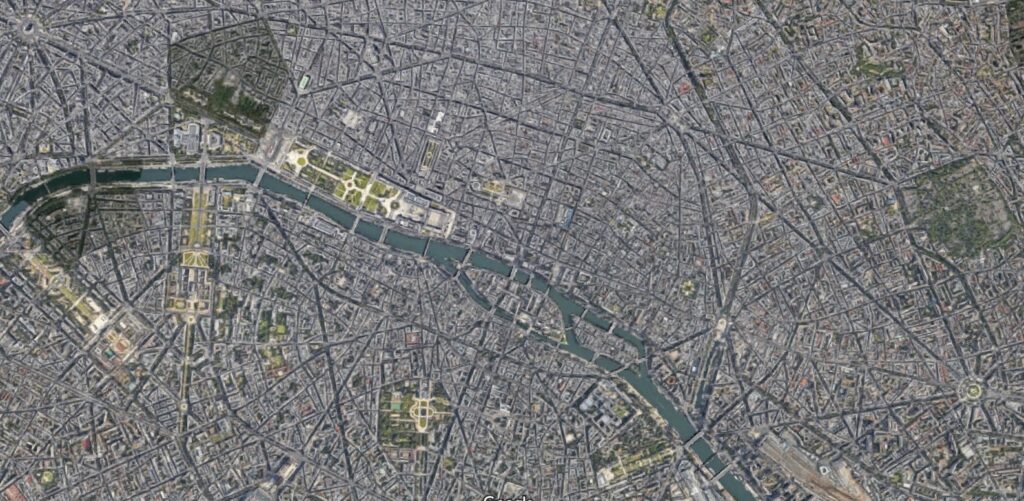
Awhile back we had looked at Colchester and York in England and remarked how the past history of those cities could still be seen in the street patterns, especially where the city walls are or were. Looking at this overhead view though, it’s not as easy to tell where the city walls of Paris were, even though Paris saw several major wall constructions as the city grew outwards on both banks of the river. As the city expanded, the walls needed to expand with it.
The first major medieval wall was built from 1190 to 1215 during the reign of Philip II. Philip was the first to be called “King of France.” At the time this wall was being built, Notre Dame was in its reasonably early years of construction, begun in the 1160s by Bishop Maurice de Sully under the reign of Philip’s father, Louis VII.
Why isn’t it as easy as some other places to detect where the walls were? It’s because in the 19th century Paris undertook several major urban renewal projects which altered the old medieval street plans.
But, if you know where to look, the city still remembers, for the past is always with us.
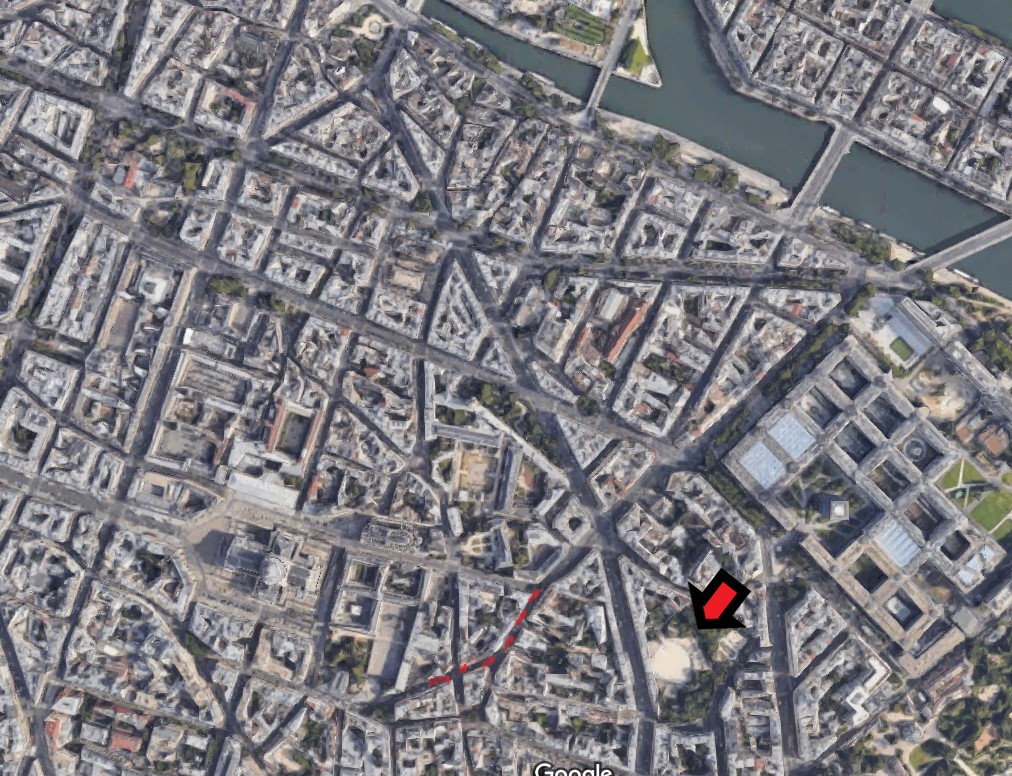
Start just south of Notre Dame at the sand-colored area, which is actually the remains of a Roman amphitheater. Go straight west to where Rue Clovis meets Rue du Cardinal Lemoine. Why does the latter curve a bit, as indicated by the dotted line? Because it goes around a section of Philip’s wall.
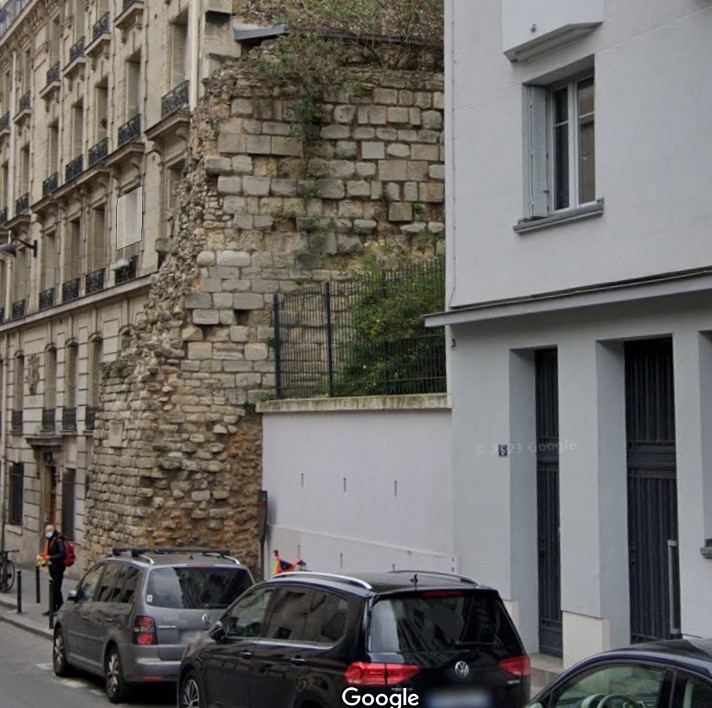
In his “Ode on a Grecian Urn”, Keats looked back on a long vanished civilization now frozen in stone and mused “Thou still unravish’d bride of quietness, Thou foster-child of silence and slow time…”
The grand Notre Dame was ravaged by fire in 2019, but it endures. The cathedral has seen centuries of threats, from wars to the madness of the French Revolution, when the cathedral was given over to the absurdly named Cult of Reason, and the Cult of the Supreme Being.
At the end of that same ode, Keats wrote “When old age shall this generation waste, Thou shalt remain, in midst of other woe…”
Notre Dame will remain, at least as long as there remain people who remember the importance of preserving our most important legacies. The French people temporarily lost sight of their heritage in the Revolution, and today there is an increasingly troubling drive to eradicate our past, to dedicate ourselves to some passing faddish cult of whatever.
Stone may last forever, but nothing guarantees that the civilizations who put stones together will last. We are here for but a breath, and it is up to us to protect that which can and should outlast us. If a generation forgets why something needs to be preserved, the next generation will forget what needs to be preserved.


July 7th, 2022 at 9:43 am
Jeff, nothing lasts forever, least of all memories which are shaped by whoever has political whip at the time. There will come a time, probably in our lifetime, when the Righteous™ will demand Colosseum and Arc de Triumph be raized to the ground and in the case of Eu, mosques will likely replace them. The exact same fate will befall Notre Dame. It is not like it had never happen before.
July 7th, 2022 at 8:09 pm
Years ago, while exploring the woods on the property where I lived at the time, I found a long mound oriented in a north to south direction. It was only about three feet high, but ran for over a hundred yards or so.
I thought it might be a burial mound. I heard about the ancient tradition of burying people in sitting up position and figured it might just be that.
I spoke to a neighbor about it.
He looked at me with quite a bit of amusement then said, “Naw, that’s just where my grandpa’s bulldozer made a pile when he was clearing a field.
Then he added, “if you find anything in your woods, be it what you think is an ancient artifact or an old 5 gallon can with an unreadable label, for your own good, shut the f**k up about it.”
July 7th, 2022 at 9:35 pm
When I lived in New England, we had a visitor who raved about the pretty stone fences around all the fields. “You mean the remnants of misery from trying to farm these fields that were placed there by hand when farming with horses and oxen?” Pretty, yes, but miserable work by folks just trying to subsistence farm.
We won’t even mention the Federal government who gave veterans “farm” plots on patches of bare granite in lieu of pay after the Revolutionary War. You can still find the remnants of those farms up in the mountains if you know where to look.