From Cornerstone To Stumbling Block, Part 1
By Jeff Kouba
Cities have memories, especially old cities. If you were walking down a street in a city you’ve lived in all your life, you probably wouldn’t stop to think this street has been here for as long as I remember. It was here in my parents’ time, it was here in my grandparents’ time. This street has been here for centuries, but if we went back far enough, there would be a time when the street didn’t exist. So why is it here, in this place? What influences dictated that this street follow this path?
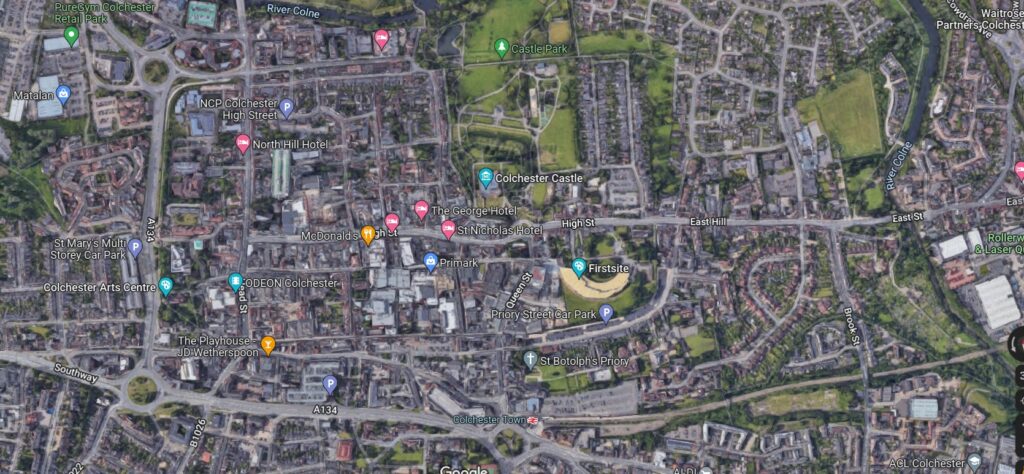
This is Colchester, in the southeast of England. It was known to the Romans as Camulodunum. The Romans invaded England in 43 A.D. and made Britain a Roman province, and Colchester is not far from where the Romans came ashore. For a time it was the administrative capital for the Roman occupation. Initially it was fortified with walls, but the walls were taken down and Colchester became a kind of retirement community for legion soldiers.
Around 60 A.D., about the exact same time the Apostle Paul was beginning his two-year house arrest in Rome, Queen Boudicca led a large-scale rebellion against the Romans. Her forces attacked the undefended town and destroyed Colchester and its inhabitants. Some residents holed up in the temple the town was known for and held out for a couple of days until they were overwhelmed. (The temple was where the castle now sits. The castle was built over the foundations of the temple.) Boudicca and her forces went on to attack what was then London and St. Albans. It is thought that upwards of 70,000 people were killed in the rebellion.
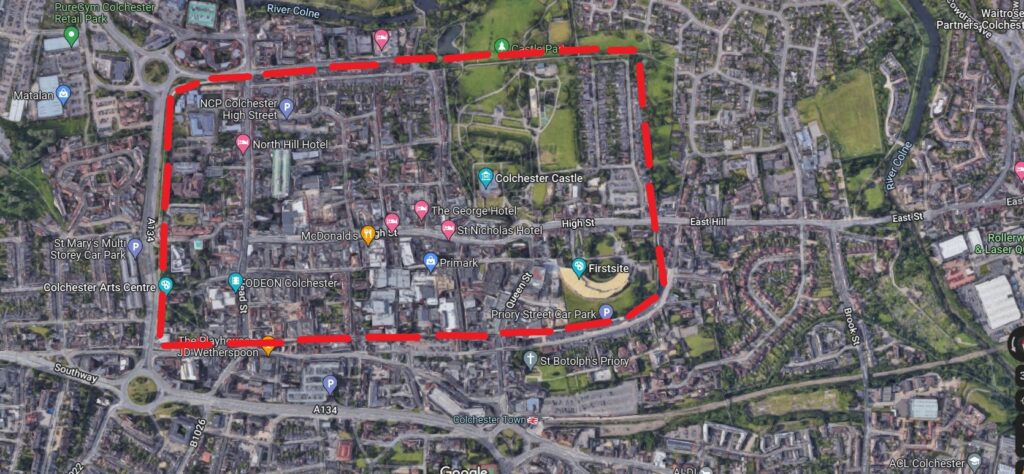
One of the Roman legions had been campaigning all the way over in Wales. When they received word of what had happened, they hurried back and helped put down the rebellion and were rather brutal about it. Having learned their lesson, and now acutely aware of the dangers in Britain, the Romans rebuilt the walls of Colchester, and rebuilt it according to doctrine. (A doctrine recorded by Vegetius in his De re militari, the only known surviving Roman field manual.) Typically their forts were four-sided, either square or rectangular, with a central road connecting two sides, and if it were large enough, another road connecting the other two sides (via praetoria and via principalis).
Just from looking at the street patterns, can you see where the fort they built was? The city remembers. Roads needed to go around these walls, long stretches of which still exist today, and today streets still follow those paths laid down millennia ago. The High Street, or Main Street, through town still follows the old Roman artery through the fort. A rough outline of the old Roman fort is after the break.
The past is still with us, sometimes even at our feet. The stone you stubbed your toe on as you walk down this ancient street may have come from an old wall, a wall once meant to keep out the darkness. The repair and maintenance of defensive walls don’t just happen. They require an act of will, an investment of resources.
We have been blessed with magnificent walls in this country, and I don’t mean a physical border wall. I mean edifices in the forms of customs, laws, beliefs and ethics that have provided us with vast power and wealth and freedom relative to much of the world and much of history.
You know as well as I that there are forces in our country chipping away at those walls, deliberately eroding our strengths in order to tear down what constrains them and put up their own temples. The people outside our walls cannot be reasoned with, cannot be persuaded, cannot be shamed. They don’t like you and you are in their way. Too many stones have already been loosened.
– the erosion of the nuclear family
– no place in the public arena for religion
– a coarsening public culture
– a false narrative that replaces our historical origins with self-hatred
– an obsession with race designed to delegitimize any view of the individual that does not fall in line
– star chambers that declare views on biology and gender which five minutes ago were conventional are now heretical
– a cancel culture designed to keep anyone from even thinking about expressing contrary opinions
– immense public debt
– toleration of or even praise for criminal forces
– any institutions that historically provided opposition and taught young people that the above list is nonsense are subverted (see popular entertainment, mass media, public and higher education, military, even Boy Scouts)
We are not yet lost, but our walls need to be repaired, and they will be repaired one stone at a time. Pick one up, mix your mortar, and let’s go to work.
In part 2, we’ll look at something else that is present in this overhead view of Colchester, something that evokes both a weakening Roman Empire and a waning American Empire.


March 17th, 2022 at 1:43 pm
Methinks that, as with Nehemiah rebuilding the walls of Jerusalem, the work will be done with a sword in one hand, and a trowel in the other.
March 17th, 2022 at 2:06 pm
VERY NICE, Jeff!
That was a very interesting observation presented with great wit.
However, I don’t think we can repair our walls; at least not while we share the country with an equal number of people who are more dedicated, and much more actively involved in advancing their agenda than we are in protecting our way of life. Today, possessing mortar and stone gets you “cancelled” from social media; your job; your credit cards; your bank account…tomorrow, you’ll be dragged off for possession of wall building materials, or even talking about walls.
In an age were giga bytes of propaganda can be spread in milliseconds, and where there are at least 100 million nitwits waiting for that propaganda all day, every day, like a dying man in the desert waits for water, the fight will at some point have to be physical. Not a rosy prospect, but I don’t see any other way out.
Anyway; great start!
March 17th, 2022 at 2:25 pm
Great read, good sir! Glad you are here!
March 17th, 2022 at 2:39 pm
In the early 70’s, I took the $4 bus ride from Juarez to Mexico City (and beyond) on Flecha Roja (Red Arrow) line.
Let’s just say the bus took the long way around and the trip was very enlightening.
What struck me the most was how the houses were constructed with walls on the street side, often topped with broken glass, and courtyards inside were most of the socializing was done.
Over time, the chaos and random threats of violence wore me down and I was relieved to return to the United States where people had spacious front yards and defended themselves and their considerable wealth with 1/4″ plate glass.
I get your point about walls, but think about the era in Camulodunum when walls were not needed. Let’s also reflect on how the (working class) Britons were abused by the (elite) Romans.
Queen Boudicca did not rebel without cause, nor did her neighbors join her rebellion without cause.
The lesson of walls is building and maintaining a society that doesn’t require them.
March 17th, 2022 at 3:37 pm
Greg – a few years ago we did a home-swap with a family near Budapest. Every front yard in their neighborhood had a tall fence and a big dog. The Hungarians couldn’t get over how wide open our neighborhood was.
March 17th, 2022 at 4:39 pm
“Initially it was fortified with walls, but the walls were taken down and Colchester became a kind of retirement community for legion soldiers . . . Queen Boudicca led a large-scale rebellion against the Romans. Her forces attacked the undefended town and destroyed Colchester and its inhabitants.”
And 2,000 years later, G.K. Chesterton yelled, “See? See? That’s what I’m on about!”
Excellent column, Jeff. Can’t wait to read more.
March 17th, 2022 at 4:46 pm
happy to be here in the House That Mitch Built among old friends 🙂
March 17th, 2022 at 4:56 pm
Quick correction for Greg; we protect our homes with plate glass of about 1/8″ thickness, not 1/4″. :^) (thermopane gets you to a total of about 1/4″, though….)
Seriously, well said. It is simultaneously true that history leaves its mark on the land, and that those marks speak to the kind of society we have. Another picture of how societies work is that in most places around Europe, you see lots of little and big towns, generally with walls (at least vestigial), but precious few people live out “in the country” as is the case in the U.S. Come to think of it, it’s telling about those walls, since they’ve been a less than effective defense ever since mechanical siege engines gave way to the cannon. But still they persist.
March 17th, 2022 at 5:03 pm
Very astute points and stated in a very interesting way. Thanks.
March 18th, 2022 at 10:04 am
When Barbarians arrived at the gate, remind me what the outcome was? History repeats itself, metaphorical walls or real.
March 18th, 2022 at 3:58 pm
[…] Shark Tank: Politifact Finds Demings’ Rubio Claim “False” Shot In The Dark: From Cornerstone To Stumbling Block, Part 1, also, Warranty The Political Hat: Seattle Madness – Handing Over Police Building To #BLM, […]
March 18th, 2022 at 4:08 pm
[…] part 1 we touched on how the past can influence the present in ways that might be easy to overlook, and […]
March 21st, 2022 at 1:26 pm
[…] part 1 and part 2, we looked at some of the stories that can be found in Roman Britain and what they had […]
July 7th, 2022 at 6:15 am
[…] back we had looked at Colchester and York in England and remarked how the past history of those cities could still be seen in the […]