Every Major’s Terrible
By Mitch Berg
Like most nerds, I read “xkcd” pretty religiously.
And last Monday’s panel was one of the funniest ever – “Every Major’s Terrible”. Go ahead, sing it to the tune of Gilbert and Sullivan’s “Modern Major General” (or “Supercalifragilisticexpialidocious”, if that’s what you know). Click on it to go to the original site, if my print is too small.
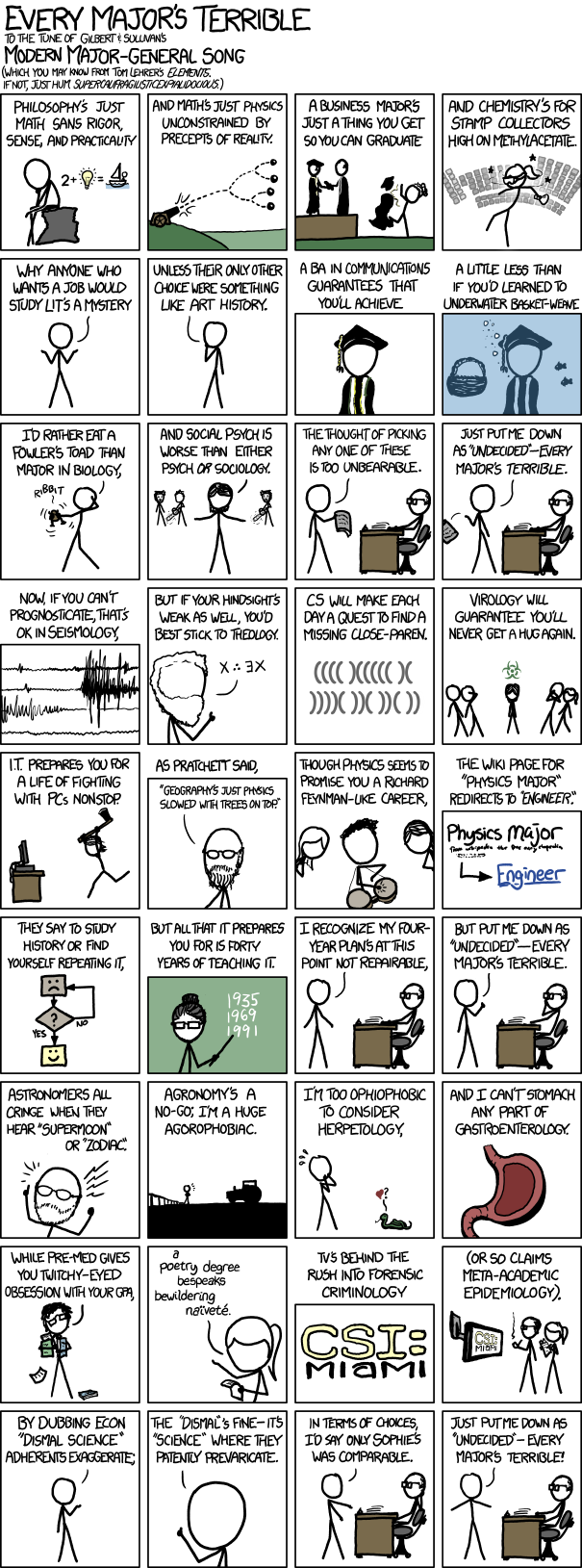
I love it.
Of course, cartoonist Randall Munroe is not only a brilliant cartoonist (I mean, the guy gives a stick figure more personality than a page full of Ken Weiner’s R-Crumb-derivative visual overemoting does) – but he’s a math snob. HIs strip constantly and positively ooozes contempt for humanities and liberal arts majors.
Which is fine – everyone brings their prejudices to the table. And as we creep up toward the inevitable deflation of the education bubble, Munroe’s particular peccadillo is hardly rare; you see it in blogs and hear it on talk shows constantly; “it makes no sense to go deeply into debt to get an arts/humanities/social sciences degree that will never earn you a living.”
The response to that statement, really, is a series of questions:
“Does it ever make sense to go into debt for any degree?” Sure, potentially; it depends on how much debt, and what the return on that investment actually is. $50K in debt for a biomedical engineering degree that will have the student earning six figures not too long after graduation? Go for it.
How about $50K for a BA in Music or $10K for a degree in Computer Science, or $100K to go through eight years of school for a PhD in Folklore? Seems stupid, doesn’t it?
Well, it really depends on two more questions: What is “Education”, and what is “Return on Investment”?
Let’s look at both of ’em.
What is “Education”? Munroe has the same conceit most academics have; your degree defines you.
Back in college, I had a friend – a business major – who used to sneer at my English major (without, by the way, any intention of becoming an English teacher or professor). “Hah, Berg”, he used to say. “I’ll be making big money right out of college, and you’ll be working in a bowling alley”.
He wasn’t much of a “friend”, come to think of it.
25 years on? He’s a customer service manager for a health insurance company – which is, to be fair, something for which a BA in Business is perfectly adequate preparation. Not sure how happy he is . I design software – something for which a BA in English was no preparation whatsoever?
In and of itself, no. But in my degree – and my related minors in German and History – I started polishing up my ability to think – to look at a problem and tear it down into logical components. Which was a no-brainer when it came to being a reporter and producer. And which paved my way to taking those skills and break down the problem of switching into technical writing, and then User Experience work.
I’m not the only one, of course. The person with the $100K in debt for a PhD in Folklore? That person was one of my mentors in my current career. He doesn’t do much work in folklore, but he has pretty much paid off those student loans with a bunch left over – so if “money” and “respect in a non-academic field” are valid measures, this guy has blown the lid off the gauge.
The guy with the music degree? Computer programmer, very talented, self-taught in the field, paid very well, and enjoys the hell out of his career.
So if you view “Education” as “preparation for a job”, then there are definitely better degrees than Arts and Humanities. If you view it as “learning how to think”, then your answer may be different…
….and lead you to a different question altogether; “are there cheaper ways to learn to “think” than accruing $30-100K in debt”? I was lucky enough to get out of college without significant debt. My kids won’t be so lucky. Should they treat education as a trade school?
That – not “should I major in English or Computer Science” – is the tough question.
Well, that and…
How Do You Define “Return On Investment” – Now, I’m a little biased. My “investment”, at least financially, paid for itself at my first job, financially.
How about the computer science major with the fairly minuscule debt who left college directly into an upper-middle-class income?
Well, he was pretty miserable. Hated it. Loved the money, of course, but hated the field. Made good money, but was bored out of his mind. Made up for it by getting into a relationship that led to a marriage that is now (just between you and I) pretty miserable and expensive. His education returned a pretty fair financial investment, but almost nothing in terms of the whole “who I am and what I really think I should do in this world” bit, which is a question whose interest, over the years, adds up just as surely as interest on student loans or bills that pile up because you don’t have the education to get a better job.
None of which is to say, of course, that this world doesn’t have blissfully happy electrical engineers, or anthropology majors walking around with six figures in debt and prescriptions for prozac besides.
But the most important questions about education today, as we near the peak of the education bubble, really are…:
- Does it make you a better person, as an individual, a provider for yourself and any future family, and member of our society?
- Does it do it at a cost that will, for years, drag you down as an individual, a provider and member of society?
- What balance works for you?
Which is a hell of a question to ask people when they’re 18 years old.
I will, of course, be humming “Every Major’s Terrible” all day.


May 9th, 2012 at 1:28 pm
These days I think you would have a hard time arguing that a university actually does much to expose you to thinking differently or to challenge you. The liberal arts are a pretty boring monoculture these days, and there’s no pretense at teaching hard analysis since relativism is rampant.
The right question to ask these days is: what should I pay for in college that I can justify for the cost and time? I would argue that much of the old “personal development” that the traditional liberal arts education offered is unavailable these days and even if it is, it is far too expensive. If you finance your $1000 “Modern American Science Fiction” class at 7% for 20 years it winds up costing you about $1900 to pay to read what you’d read anyway.
May 9th, 2012 at 5:25 pm
Don’t send your kids to college. It turns them into liberals.
Look at what happens
http://imgur.com/joB7S
May 10th, 2012 at 5:07 am
Sanity,
It turned me into a conservative.
May 10th, 2012 at 6:33 am
Mitch, that was then, this is now.
Then, academics believed in free exchange of ideas. Even if they didn’t believe it, they’d have given lip service to “I cannot praise a fugitive and cloistered virtue, unexercised and unbreathed, that never sallies out and sees her adversary but slinks out of the race, where that immortal garland is to be run for, not without dust and heat.”
Now, the political is personal; heresy must be purged (see; Emmer at Hamline).
The real question isn’t whether education is good for you, or even good for society; the question is who should pay for it. Student loans subsidized and carried forever unpaid are not loans, they’re gifts. Should society give gifts? To who and for what? Answer that and you’ve solved education, retirement, health care, housing, energy . . . .
May 10th, 2012 at 7:47 am
Well if student loans are gifts, then what are the LOWER interest rates (how about zero percent) offered exclusively to banks, which then buy T-bills with that same money? The cartoon is enlightening and may please those who think they know what is wrong with colleges. I agree with Mitch: earning a degree, particularly one where this is no definable “prize job” at the end of the rainbow, shouldn’t be considered a waste. Worried about $50,000? Go buy a an F-350 or an Explorer. Verisimilitude.
May 10th, 2012 at 11:45 am
The first two years of college at a public institution are a repeat of what could (and sometimes is) taught in four years of high school. If college is more effective at teaching it than high school, I suspect this is because everybody in college wants to be there. In public schools the troubled students take up the most resources, give the least return, and nobody encourages them to simply go away and do something else.
May 10th, 2012 at 4:38 pm
That strip is what “Fleen” would look like if LearnedFoot ever blogged sober.
May 10th, 2012 at 7:18 pm
Brag up those liberal arts degrees, Mitch; keep repeating it over and over… Would you like fries with that?