Archive for September, 2014

The Peasants $trike Back

Thursday, September 4th, 2014

In 2003, and again in 2005, when Minnesota passed its “shall issue” firearm permit law, a slew of businesses “posted” themselves; they put signs on their front doors indicating they didn’t want firearms on their premises.

Two things happened – or, rather, didn’t happen:

  1. There were no crimes in public related to legal post-2003-permitted firearm carriers.  None.  Zero. 
  2. While few anti-gun-rights people made a point of shopping posted stores, pro-Second-Amendment people made a very serious point of steering clear of posted establishments.  Many of us quietly and politely engaged with owners of posted stores, telling them that while we respected their decisions, our consciences would not allow us to shop at stores that disarmed the law-abiding and thus became victimization zones. 

Most “posted” stores quietly dispensed with their signs in the year or two after the Minnesota Personal Protection Act was re-enacted in 2005.  Things stayed pretty well put, Minnesota-wise – except, of course, the number of law-abiding citizens with carry permits, which was well over 160,000 177,000 the last I checked (far eclipsing pre-2003 legislative research estimates of 50,000-90,000 permittees). 

But the Obama Administration has been eagerly working to roll back gun rights, especially in the past two years.  And with Michael Bloomberg bankrolling his efforts, there is a concerted effort to turn law-abiding gun owners into the New Lepers – to try to re-stigmatize gun owners, the way the media were able to do in the 1960’s and 1970s. 

All are, of course, attacking the problem of violent crime by going after those who dont’, won’t, and never have committed any (and by their existence indeed deter it) – but no matter.  It’s not about crime – if it were, Washington DC and Chicago would be crime-free paradises. 

But if you read this blog, you’re probably smarter than that.

Unfortunately, a lot of uninformed and incurious people vote.  And Michael Bloomberg’s money is aimed largely at them.  And so the re-stigmatization effort is in full swing.  We’ve seen this with a small but vocal number of stores dusting off their posting signs – and, this summer, with the Minnesota State Fair posting its “no guns” signs, very possibly illegally.

It’s time for Real Americans – the ones that believe in all ten Amendments in the Bill of Rights – to come forward again and put their money where their mouths are.  Or perhaps to be more accurate, to not put their money where their mouths aren’t. 

It’s time to stop spending money at places that are posted. 

20140904-115701-43021574.jpg

So take note, local merchants; if you’re posted, I won’t spend a dime at your establishment.  If I see you or your ownership siding with the anti-gunners in the media, I’ll also cut you off, and do my best to keep you cut off until you recognize the civil rights of law-abiding Americans.   

That includes you, Minnesota State Fair.  While I broadcast from the Fair annually, and am happy to do it, I will no longer patronize any vendors at the Fair as long as the Fairgrounds are posted.

As much as it pains me to think of ten days of broadcasting at the Fair without Sausages by Cynthia’s Italian Dog, or a London Broil, or the Swiss Crepe from the Crepe stand, or a beer at O’Gara’s on a hot day, I’m not going to spend another dime at any Fair vendor, until the State Fair tears down the “Only Criminals May Be Armed!” signs. 

Be advised, Twin Cities merchants.  You have your rights to run your business any way you want.  But you’re not going far without customers. 

Can you afford to piss off 120,000 of us?   Especially since we’re the ones that tip, clean up after ourselves, and pass word of mouth along?

UPDATE:  I do need to credit the “No Guns = No Money” Facebook page for the image, and the whole “getting a movement rolling” thing.   Check out the page, and support them and, most importantly, the goal.

ABM: Wrong About Minnesota

Thursday, September 4th, 2014

I haven’t had the time to do as much in the way of digging into the DFL ad machine this cycle as in some past cycles.  It’s been a crazy summer.

Fortunately, Bill Glahn is on patrol

Glahn takes apart one of the latest flight of anti-Johnson ads from the Alliance for a Better Minnesota – the attack PR firm funded by liberal plutocrats that has run toxic sleaze campaigns against every Republican to run for office in Minnesota in the past eight years or so. 

ABM’s ads have been punctilious about punching up the phrase “Tea Party” in their ads, especially about Johnson, this cycle – even though Johnson is not especially identified with the Tea Party.  Glahn reaches one of the same observations I do:

Apparently the pejorative “Tea Party Republican” must test particularly well with low information voters. Or, perhaps its use in the ad is a sign the Democrats are concerned about turning out their base in an off-year election.

The Democrats have spent millions this past five years, trying to turn “Tea Party” into a pejorative.  If you go by what you hear in the media, it’s worked. If you go by election and polling results in red and reddish-purple states, it hasn’t.   Minnesota?  Well, the 2010 gubernatorial election showed Minnesota has 8,000 more low-information voters (along with Duplicate-Americans, Fictional-Americans and Deceased-Americans) than smart ones.  It might be a winning strategy. 

It might also show that that’s the best they can do; sputtering “Tea Partier” may be the “lowest blow” they think they can come up with. 

Anyway – the ad.  Like everything ABM puts out, it’s got an assortment of outright lies, and factoids stretched so far out of context as to be devoid of truth: 

Ms. Livermore [a “classroom teacher”] makes the dubious claim that Johnson “cut education by over $500 million” back in 2003, and then gave that money to corporations in 2005. Keep in mind that a similar ABM ad was judged “Misleading” by Minnesota Public Radio (of all places) for making those exact same claims. [The bill Johnson voted for in 2003 actually increased (rather than cut) public school spending.]

As always with ABM, though, there’s a level of stuff they don’t tell the voter (emphasis added):

No, the real lie in the ad comes from the “appeal to authority” of having an ordinary “classroom teacher” attack Johnson’s education policy. According to her LinkedIn profile, Ms. Livermore served on the governing board of the teachers’ union Education Minnesota from 2004 to 2007. [By the way, she spells the word “education” incorrectly on her profile.]

Although her service to the state teachers’ union may have given her some familiarity with decade-ago state legislation, it doesn’t exactly qualify her as a garden-variety “classroom teacher.” “Former union official attacks Republican,” just doesn’t have the same ring. Funny thing, the viewer is never informed of Livermore’s connection to the union, who happens to be the largest donor to Democrat campaigns in the state.  

And to be fair to ABM, why should the viewer be informed of this?  The campaign isn’t about informing voters.  It’s about framing the opposition, just like Saul Alinksky taught them to.

Two Steps Back

Thursday, September 4th, 2014

Joe Doakes from Como Park emails:

The UN has peacekeepers acting as a buffer in the Golan Heights between Syria and Israel. Syrian rebels associated with Al Qaeda demanded UN troops from Fiji surrender, which they did. The Fijian troops were taken hostage.

Syrian rebels also demanded UN troops from the Philippines surrender, which they refused to do. The Syrian rebels attacked the Pilipinos, who retreated into Israel as Irish UN forces covered their retreat and Syrian government forces shelled the Syrian rebels to prevent pursuit.

The captured Fijians remain captured. The Pilipinos want an investigation into why the UN commander from India ordered Phillipino and Fijian peacekeepers to surrender to terrorists. Now the officer who refused to surrender to terrorists has been placed on leave.

And that’s the problem with the UN peacekeeping idea in general. Nobody cares if the other country’s guys get killed defending some worthless land in somebody else’s back yard. It isn’t our country so we’re not going to let our guys die for it. But if yours do, well, that’s okay.

Bad enough when it’s UN troops. Worse if it’s American troops. Let Israel off the leash and the problem will be solved in days, if not hours.

Joe Doakes

“Peace” is not always synonymous with “absence of shooting”.

The Client Is Obviously My Client

Wednesday, September 3rd, 2014

Last week, I lit up MPR’s “Poligraph” feature for checking the “accuracy” of an utterly subjective bit of political smack-talk by GOP Gubernatorial candidate Jeff Johnson. 

Last Friday?  Poligraph used subjectivity to “fact-check” GOP 8th CD candidate Stewart Mills. 

To be fair, Catherine Richert did smack down one of the Democrat Congressional Campaign Committee’s more risible claims, that Mills opposes Obamacare because he is floating on a raft of insurance industry money:

To support part of its claim, the DCCC points to information collected by OpenSecrets.com, a website that tracks campaign money. The website shows Mills has taken $7,100 from the insurance industry. But that’s the entire insurance industry, not just health insurance companies.

 According to Mills’ campaign finance records, he’s gotten $1,000 from the Blue Cross and Blue Shield Association PAC, and that’s it.

OK.  So far so good.

But this next part?

Popularity!:  I suspect that if you passed a law that compelled the government to send out a $10,000 check to every citizen at Christmastime, it’d be “Popular”.  (Or perhaps a law allowing people from small radio stations to take their pick of equipment at public radio stations). 

But would “popularity” make it a good idea?  More to the point – would opposing it be wrong because it’s “popular?”

We return to Richert’s piece; as we read it, look for any objective evidence that Mills’ position is wrong: 

The DCCC also claims that Mills wants to scrap popular parts of the Affordable Care Act, including a provision that prevents insurance companies from rejecting patients with pre-existing conditions and another provision that allows children to stay on their parents’ plans until they turn 26.

Here, the DCCC is on stronger footing.

How so?

Campaign spokeswoman Chloe Rockow says Mills isn’t opposed to making sure young adults and those with pre-existing conditions have access to health insurance – he just thinks there are better ways of doing it.

 For instance, Mills wants to strengthen privacy rules for people with pre-existing conditions and to reinstate the Minnesota Comprehensive Health Association, which is a special health insurance program for people with pre-existing conditions who can’t get insurance elsewhere. That program is being phased out, because those people are now get insurance through the Affordable Care Act.

Richert’s conclusion (with emphasis added)?:

 The Verdict

 … the group is correct that Mills isn’t keen on Obamacare, including two provisions that are relatively popular with the public.

Let’s be clear, here:  Richert is checking the DCCC’s statement.  She finds half of it questionable (the insurance money), and half of it accurate (like every single Republican I can think of, Mills opposes Obamacare and thinks we can do the same job much more efficiently by tweaking existing programs). 

In other words, the DCCC says that Mills supports GOP policy?

That’s not even dog bites man.  That’s “dog sniffs dog”. 

Which is fine, if journalistically a little pointless. 

But Richert points out in several places that the programs that Mills would scrap are “popular”. 

Why? 

What earthly journalistic difference do the programs’ “popularity” have?

While Richert is correct in pointing out that the DCCC’s money claims are wrong, she’s essentially pointing out in her second point that the DCCC is, indeed, pointing out correctly that Mills is campaigning as a Republican, with what looks like a little gratuitous reassurance to MPR’s DFL-leaning audience thrown in for good measure.

So I give this episode of “Poligraph” a grade of “Huh?” 

With all due respect to MPR’s News department (and, stereotypes aside, I’ve tried to pay it where it’s been due, as with the exception of everything Keri Miller touches it often has been), it seems that “Poligraph” is explaining the obvious. 

UPDATE:  Gary Gross at Let Freedom Ring also covered this bit earlier in the week, and has unsurprisingly similar conclusions.

Reindeer Games

Wednesday, September 3rd, 2014

Sweden – which has been slowly drawing down the strength of its air force, once the world’s fourth-largest, since the end of the Cold War – is buying more fighter planes

And Finland – which has fought two wars with Russia in the past century – is noticing more Russian incursions into their airspace

Good thing we’ve got President Obama’s crackerjack diplomacy to ease tensions around the world, huh?

Coincidence?

Wednesday, September 3rd, 2014

This was the first year since the passage of shall issue firearm carry that the Minnesota State Fairgrounds loudly, visibly posted itself as a “gun free zone”.

The Fair’s spokesperson Brooke Blakey was even just a little bit obnoxious about it before the fair started. Near as I could tell, it was the first time anyone associated with the state fair has ever gotten really aggressive about alienating fairgoers with legal carry permits.

You hardly need me to tell you what happened next, do you?

According to State Fair Police Public Information Officer Brooke Blakey, at least two suspects took more than $10,000…The suspects struck when the building was closed to the public, restraining at least one person who had been working in the booth, and a beer supplier.

Police say this is the first robbery of its kind at the Minnesota State Fair.

The fair has it’s first armed robbery in 150-odd use the the month that a fair officer gets snotty about law-abiding gun owners?

Pure coincidence, I’m sure.

CORRECTION:  Flawed as her (and, mostly, the Fair Board’s) reasoning may be, I misread the piece in which Ms. Blakey was quoted.  The obnoxious bit (“She also had talks with gun-rights supporters who – contrary to fair policy – wanted to strap on their sidearms and walk down the middle of Dan Patch Avenue“) was written by Delma Francis, in the Minnesota Womens Press, reprinted in the Twin Cities Daily Planet – both of them shrill leftist outlets supported by liberals with deep pockets. 

I apologize for the error.

Yet Another Reason To Loathe Tim Walz, Tim Nolan And Betty McCollum

Tuesday, September 2nd, 2014

HR 1962 is a proposal for a press shield law. 

The beef of the bill says that…

In any matter arising under Federal law, a Federal entity may not compel a covered person to provide testimony or produce any document related to information obtained or created by such covered person as part of engaging in journalism, unless a court determines by a preponderance of the evidence, after providing notice and an opportunity to be heard to such covered person…

…is closely involved in an imminent crime or act of terrorism.

OK, so far so good. 

Except that the bill serves only to protect the mainstream media – the ones that largely kiss Democrat ass:

The term covered person means a person who, for financial gain or livelihood, is engaged in journalism and includes a supervisor, employer, parent, subsidiary, or affiliate of such covered person.

In other words, institutional media – and, likely, the institutionally-paid alt-media that have been Walz and Nolan’s BFFs, ermuhgerd, I’m writing like Sally Jo Sorenson, oh noes – are covered.

All the rest of us – the ones that actually try to hold government accountable?  We’re on our own. 

Why do representatives Walz, Nolan and McCollum hate freedom of the (non-Democrat-aligned) press?

I’m Trying. I Really Am.

Tuesday, September 2nd, 2014

To be a nicer, more civil person.  I truly am.

Here’s the deal.  I left the Libertarian Party in 1998 largely over the LP’s complete illiteracy on foreign policy and defense.

Now, many “Libertarians” are drawn to the belief, and the party, by the reductionistic magical thinking that all of the world’s questions break down into binary, black-or-white answers.  The right answer to everything lies in unbending, unyielding adherence to “principles”, any deviance from which for any reason is an unforgiveable impurity.

Which is a fine and dandy thing, if your “principles” are so well-thought-out as to account for all of the myriad gray areas life, human nature and history throw into one’s path.  For example, the idea that some “libertarians” have that one is either an isolationist peacenik…or a “warmonger”, with nothing in between.  Too stupid to mock.

Anyway.

What I’m trying to do is figure out a way to write “if everything you know about history and foreign policy is stuff you read from the inside of Ron Paul’s anterior colon, you probably are not going to be a partner in a serious debate”.

And I got nothing.

I’m open to suggestions.

The “Fact-Check” I’ll Wait Patiently For MPR’s “Poligraph” Feature To Get Around To Doing, Part II

Tuesday, September 2nd, 2014

The Claim:  Every weekend for the past forty years, Garrison Keillor has closed his “News from Lake Wobegone” segment by claiming all the men are strong, all the women are good-looking, and all the children are above-average”.

But we wanted to know – is it true? 

The Evidence: In Keillor’s favor, we note that not only is his claim – like Jeff Johnson’s statement that Governor Dayton is “in trouble” – subjective, but it is in fact dramatic license, a tag line to a series of fictional essays. 

However, the winner of the 2014 World’s Strongest Man competition is Žydrūnas Savickas, of Lithuania. 

The world’s foremost empirical test of female beauty is the Miss Universe pageant – and the most recent winner, in 2013, was María Gabriela de Jesús Isler Morales of Venezuela. 

And since Minnesota stopped requiring graduation testing in 2013, it’s impossible to empirically say what “average” is, or whether Lake Wobegone’s children – fictional though they may be – are above it.

The Verdict – So since neither the world’s strongest man nor most beautiful woman resides in Lake Wobegone, and there is no means to measure the children, we give this claim a rating of “Misleading”.

Comparing Butchers Bills

Tuesday, September 2nd, 2014

In five months of testing an operation, the “green line” has racked up five train versus auto accidents, two injured pedestrians…

… And now, a fatality – a woman wearing headphones apparently walked in front of a train near the U of M.

For comparison sake, light rail has been operating in the Twin Cities (counting the “blue line”) for about 10 years, now – almost as long as we’ve had uninterrupted handgun carry permitting.

The butchers bill for trains? It’s now up to six dead – and the “Green Line” is just getting started. In that time we’ve had one carry permittee involved in an unjustifiable homicide – and the killing itself had nothing to do with her permit.

If we can save just one life…

Of Warriors And Pals

Monday, September 1st, 2014

Throughout history, the art and craft of war – of using violence in the interest of one’s family, village, clan, tribe, city-state, state, barony, duchy, kingdom or country, has taken one of three, sometimes-interleaving paths.

In some states – mostly smaller ones with little demographic freeboard for such things as specialized militaries, but also nations ranging from Athens, Switzerland, Israel and, in theory and through about 1900 practice in the United States – “defense” was considered part of the freight, along with taxation and jury duty, of belonging to society.  The theory was that the citizen militia, fighting to defend home and hearth, would prevail over any invaders – and shouldn’t be called upon to invade.

Yep, they’re Americans. A Philadelphia “Zouave” regiment, patterned after French North African troops that were all the rage in 1861, musters at the beginning of the Civil War, in the American style – muster locally, and then serve the federal government.

In still others – from many a feudal fiefdom through Napoleon’s legions through war machines as diverse as the USA and USSR in World War 2 – the common non-warrior, be he a knave, serf, peasant or citizen – could be expected to  be impressed into some form of service as some degree of cannon-fodder or another when the duke, king or Country needed cannon-fodder, on the theory that the citizen/fyrd/serf owes some form of service, up to and including their life, to the state, and the additional theory that having as many people under arms as possible was the best way to ensure victory.

A cartoon lampooning Napoleon’s conscript military. Bonaparte introduced mass conscription, teaching his peasant soldiers the bare rudiments in a tactical doctrine that emphasized speed and brute force, and so conquering most of Europe.

Finally – in some states that developed enough size and wealth to support the specialization, and the philosophy that war was best fought by the professionals, came the idea of the professional caste of warrior elites.   These elites stated in legendary antiquity – the Spartan soldier and the Roman Legionary were both long-service elites – and carries forth in the idea of the “volunteer military” that the US, UK and most NATO countries have adopted since the end of the Vietnam and Cold Wars.  In between the two extremes, the “armies” of most European monarchies were, to one degree or another, long-serving professional military elites (fear of the repressive power of which led the United States to adopt the “citizen militia” noted above, at least in its early years).
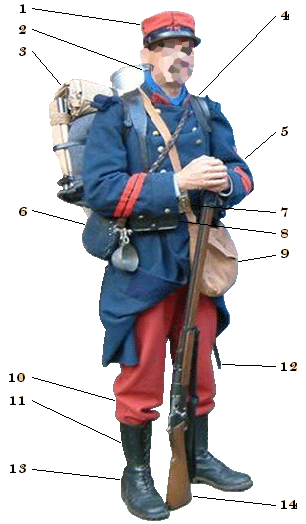
A French infantryman, 1914. By the end of the year, the red was gone – but the blue remained, on the theory that it was a difficult color to see in action. Maybe it worked, maybe it didn’t; the French army retained “horizon bleu” as its standard battledress color until 1940.

The three systems – especially the mass levy and professional military systems – have collided many times over the centuries.  But it was 100 years ago this past week that they collided in a way that is still shaking the respective societies involved to this day.

The Industrial Disease:  As Europe slid into world war 100 years ago this summer, the Continental powers – in whom the memory of Napoleon was still vivid and only 100 years in the past, and the two largest of which (France and Germany) had fought a mass, industrial war in the living memory of its political class (the Franco-Prussian war of 1871) – had all adopted large, mass armies; French, Austrian and German youth (outside the university class) were inducted for military training and decades of service in the reserves; each nation at the beginning of World War I could mobilize massive armies of reservists; 1.5 million Frenchmen were in uniform when the war kicked off; there were more Germans still.  The Russian military was larger still, formed from long-service conscripts (an institution dreaded by the peasantry of the day).

German cavalry on a training exercise, 1912.

The Warriors:  Against them, the British Army was a relatively tiny force of seven divisions each of about 15,000 men.  With cavalry and support troops, the British Expeditionary Force numbered less than 175,000 men.

BEF troops, lining up for inspection as they land in France, 100 years ago last July

The British Army of 1914 reflected centuries of British hesitancy over large militaries – Parliament still smelled the gunsmoke from the War of the Roses – and more centuries of colonial practice.  Britain’s empire was built as much through diplomatic craft, technology and exploitation of human nature as through raw force of arms.  It defeated Napoleon as much through its domination of the seas and the enlistment of continental allies as by British infantry’s guts and skill at Waterloo.  It conquered India and much of the rest of the world as much by playing coalitions of lesser tribes against larger tribes, neutralizing each other and providing loyal allies to assist the tiny numbers of British troops in maintaining control of places like India, South Africa and, for a time, the United States.  When open battle was joined, British technology – the breech-loading rifle and Gatling Gun against the Zulus, the steam frigate against the Algerian pirates – frequently multiplied the meager British forces.

The Few, The Proud:  Beyond that?  British units had something that’s foreign to most Americans, outside of those who follow the US Marines.

British infantry and cavalry, on enlisting in the military, would join a (usually) local “regiment” – which in the case of the infantry was less a fighting unit than a training depot and a repository of traditions and customs set off, usually, by some distinctive flashes in the unit uniform.  A  young man joining the infantry in the lowlands east of Glasgow, for example, would join the “Black Watch (42nd Infantry)”, a Scots regiment with several hundred years of history, dozens of battle honors, and a mythology every bit as long and exemplary as that of the US Marine Corps…

…and for exactly the same reason; to imbue in those soldiers an esprit de corps based on a standard of skill and behavior that would guide and inspire them in action.

The Royal Munster Fusiliers. The regiment was recruited in what is now the Irish Republic, and after WWI the unit became part of the Army of the Irish Republic – although the Irish disbanded the regiment by 1920. The Munster Fusiliers were heroes at the the Marne, and were reduced to a shadow of their former strength at Ypres and the Somme.

And just as it does with the USMC, it did (and to this day does) the same for the British soldier.

And at no time was that esprit de corps more firmly entrenched than with the British Army in 1914.

The Army was tiny by later standards – but every man among them was a volunteer, a long-service “regular” (backed by a “Territorial Army” of part-time soldiers that was a bit like our modern Army Reserve) who took immense pride in his skill at arms.

The Scots Guards leaving the Tower of London en route to France


And in none of those units did the Corps have more De Esprit than the Guards Regiments.  These men were screened not only for physical aptitude as infantrymen, but were all over six feet tall (so as to make the most imposing appearance on guard duty) and other martial virtues.  And in a day and age when ammunition was dirt cheap, they spent time on the rifle range that would dazzle even modern American soldiers, honing their marksmanship to a sheen not seen in any mass military before or since.

100 years ago last week, the cream of the Army – the BEF – had been held as a reserve as the French and German armies duked it out across Belgium and northern France, waiting for the situation to develop as the two belligerents met on August 22 in the Battle of the Frontier, the bloodiest single day of the war (yes, bloodier than any single day at the Somme, Verdun or Ypres).  The Frontiers battle ended in the French Army being stretched to breaking point (and the Belgians beyond theirs), with the Germans closing in in Paris.  And so the high command committed the BEF to the line at the First Battle of Mons.

BEF machine gunners at the Oise River, in the opening weeks of the war.

And at Mons the mass German force ran – over open terrain, toward shallow foxholes and ditches dug by the Brits – smack into all of that highly-trained rifle fire.  The British regulars scourged the German attacks, brutalizing them with rapid, accurate rifle fire so heavy that the German infantry thought they faced massed machine guns.  Far from it – the British issued two machine guns per battalion of 700 men, in the first year of the war.  It was British “tommies”, their skill with their bolt-action Lee Enfields such that they could work the bolts on their well-worn pieces with their thumbs without taking their fingers from their triggers, achieving rates of fire almost equal to the semi-automatic rifles the British infantryman wouldn’t get until the late 1950s, and accuracy that’d make a Navy SEAL cock an eyebrow from respect.

And the German Army – the mass of over a million draftees, recalled from the farms and factories and given rifles – battered itself half to death against the BEF’s line.  It was a scene of carnage that may have partially inspired Tolkein’s depiction of Elf fighting Orc at Helm’s Deep…

…including in its denouement.   Mons led to the First Battle of the Marne, the German high-water mark.  Then Le Cateau, and the Battle of the Aisne, where for the first time the side started digging trenches.  And then the First Battle of Ypres, in Belgium.  All between the third week of August and the beginning of October.
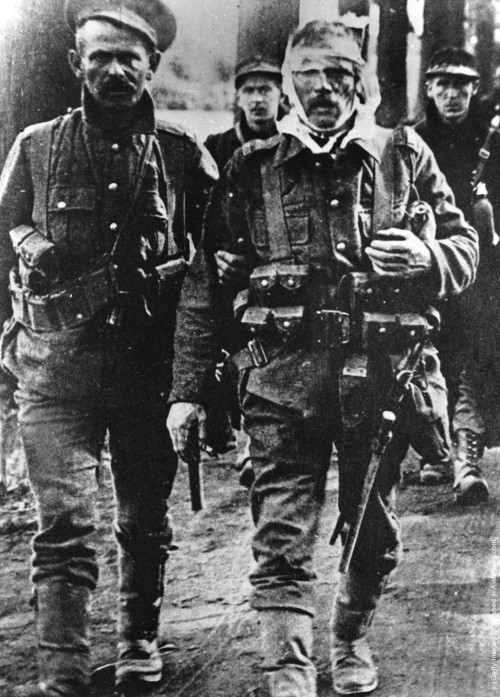
British and Belgian “walking wounded” at Mons.

And the constant attacks, and endless fighting, wore the BEF, perhaps the most elite mass army ever sent to war, down to a shadow of its former self.

The British Army had to resort to casting ever-wider nets for volunteers – eventually recruiting the “New Model Army” in time for the Somme in 1916, by which time the last of the veterans of the BEF were salted away as senior NCOs, a thin film of survivors leading a mass army of newbies and, after the bloodbath of the Somme and Second Ypres, the unthinkable; draftees.

It was the wearing down of the elite of the BEF that led, eventually, to the draft – an immense leap forward in government power over the individual that, in many ways, opened the way (in Britain as it would in the US) for further government intervention in the life of the individual even as the Great War was eating away at the barriers between the public and private sectors in the UK.

And 25 years later, when British troops went to war again, they jumped immediately to the draft, and to the mass levies that characterized, for the first time in human history, modern industrial warfare.

Just as would the US.
--> Site Meter -->