Infamy
Wednesday, December 7th, 2011It’s in all the papers; today is the seventieth anniversary of the attack on Pearl Harbor.
All the TV stations will show the familiar footage – the USS Arizona, ablaze from several bomb hits, exploding, spewing a geyser of greasy smoke hundreds of feet in the air, killing 1,000 men in a matter of seconds; the blazing and capsized battleships on Battleship Row…
…the rows and fields full of wrecked aircraft…:

All that’s true.
One thing Americans rarely see, or have to study, is that Pearl Harbor was just one of many similar attacks all around the Pacific Rim. At the same time as the Japanese carrier-based planes were attacking Pearl Harbor, more planes, launched from Taiwan (then called Formosa) attacked America’s huge base at Clark Field, in the Phillipines:

25 US bombers and dozens of fighters were destroyed on the ground.
:The Japanese also captured Hong Kong, crossing from occupied China and taking the British colony (with its garrison of Brit, Canadian, and Chinese troops) in a short, sharp, brutal battle:

Singapore – Britain’s easternmost colony and naval base – was attacked. More devastating to the Brits, the naval expedition they sent to reinforce Singapore, the battleship Prince of Wales and battlecruiser Repulse, were sunk off the south coast of Malaysia by Japanese torpedo bombers:
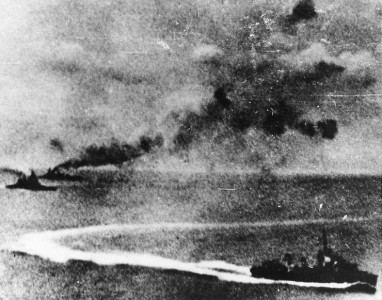
The Prince Of Wales and Repulse (background) burning on the left side of the photo. The ship moving in the foreround is a British destroyer.
At the same time, the Japanese invaded Guam…

..and attacked Wake Island, of which more later this month.
It was, in short, the the biggest – in terms of area covered – attack in the history of warfare. And it plunged the half of the northern hemisphere that wasn’t already at war with Hitler into the greatest session of human bloodletting in history. This blog focuses mostly on the smaller stories, and the unknown ones, in the war. There were many at Pearl Harbor – most notably to this blog’s audience, the fact that the first shots fired that morning were fired by Minnesotans. A gun crew of Minnesota Navy Reserve sailors from Saint Paul, crewing a cannon on the U.S.S. Ward, a refurbished World War I destroyer on antisumbarine patrol off the entrance to the harbor, spotted a Japanese midget submarine that was attempting to infiltrate the harbor.

The crew of the starboard four-inch gun on the USS Ward. Some of the men, mostly from Saint Paul, are still with us, thank God. Their gun is on the state capitol grounds, on the frontage road by the Vets building near Wabasha street.
The Minnesotans – using the very cannon that currently sits in the yard at the Veterans building, at the foot of Capitol Mall in Saint Paul – hit the submarine twice, sinking it before it could get into position. I wrote about them four years ago.
Here’s the long and short of it; to a generation of Americans who think – with reason – that 9/11 was a catastrophe…well, it was. But our nation’s power and ability to respond to the aggression was not affected. Clearly not – our military riposte was sudden and overwhelming.
Now – imagine an attack that sank three or four of our Supercarriers, the mainstays of our Navy, in the matter of an hour, and cut off and isolated, say, Korea, leaving its tens of thousands of American troops isolated, cut off from supplies, devoid of air cover, and pretty well helpless, and left us more or less unable to respond in kind without massive effort and sacrifice, at all?
Because that, adjusting for modern military doctrine, is what happened on December 7. That was where this nation was at seventy years ago at this hour; not just bloodied, not just beaten , but truly unable to respond.
And very few Americans alive today can imagine that.