Archive for the 'War On Terror' Category

Doakes Droppings #4

Wednesday, September 26th, 2012

US no longer at war with Mideast film critics: Obama Spokesman Jake Carney “self-evident . . . terrorist attack.”

Wrongfully accused filmmaker last person on earth still awaiting Obama apology.

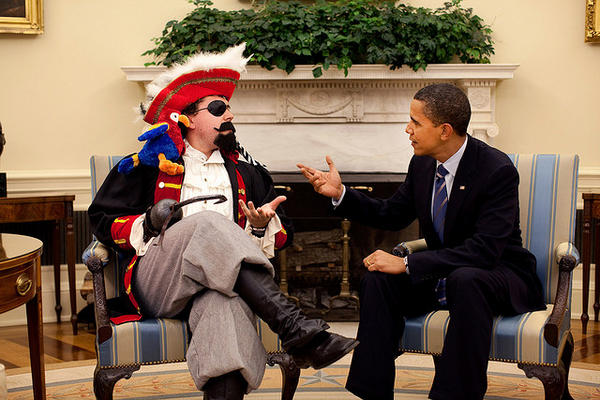
Things President Obama Did Other Than Talking With Netanyahu

Thursday, September 20th, 2012

He’s a busy, busy man.

It was in observance of “Talk Like A Pirate Day”, yesterday.

Perhaps we should respond with “Talk With An Israeli Prime Minister” day…

UPDATE:  As commenter Jeff Rosenberg (Hey, Jeff!) points out, Media Matters has leapt to the President’s defense, noting that the photo above is three years old.

The MM4A piece is silent on what the President was doing.   Playing golf with Jay-Z?  Meeting with (and bowing to) Somali pirates?   Playing video games with his daughters?  At an Eva Longoria fundraiser?  We don’t know.  All we do know is, it wasn’t “meeting with Prime Minister Netanyahu at this crucial moment in both nations’ history”.

When The 3AM Phone Call Rolls Over To Voice Mail

Friday, September 14th, 2012

Obama apparently thought he’d get three warning letters.


Back To The Future

Wednesday, September 12th, 2012

US Ambassador to Libya killed by “Islamic Protestors”.  Embassies getting stormed, burned.

Imagine how miuch worse it’d been if we hadn’t had The Light Worker making the US image abroad so very very squeaky clean.

The Best Years Of Their Lives

Tuesday, September 11th, 2012

There is nothing I can tell you about 9/11, and what it did for and to this nation, that you haven’t heard a million times from people much smarter than me.

But a while ago, I saw The Best Years Of Our LIves, the 1946 William Wyler classic that won the Academy Award winner for best picture.  It was the story of three servicemen coming home from World War II; a former bank loan officer who’d spent the war as an infantry platoon sergeant; a soda jerk who’d won a Distinguished Flying Cross as a bombardier in a B-17, and a sailor who’d lost both hands when his ship was sunk (played respectively by Fredric March, whose turn as the ex-NCE won the Best Actor Oscar, as well as Dana Andrews as the bombardier and Harold Russell, who had actually lost both hands to an accidental training explosion while serving as a paratrooper, and who won the Best Supporting Actor Oscar for the role).  The movie was about the difficulties the veterans of the day had in re-adjusting to life at home – and shows that the topic didn’t first occur after Vietnam.  If you’ve never watched it, don’t watch another movie until you see it.

It won seven Oscars – and generations of admiration from an America that got it; it told the story that so many veterans couldn’t, and for decades didn’t, tell.

And World War II was different – and almost incomprehensible to people today.  12 million Americans served, out of a population of 160 million; that’s one out of thirteen.  And around 400,000 Americans died of all causes and on all fronts during the war – one out of every thirty that served, one American out of four hundred.  Every family had a servicemember; virtually everyone knew a family that lost someone.

In World War II, just about everyone was close to the war, one way or another.

The War on Terror that switched into its “hot” phase for most of us eleven years ago today has been very different.  While most Americans of all stripes make noises about supporting the troops – and most truly do, in their own way – it’s a whole different world than in the forties.  It’s a detached thing for most Americans.  Less than one percent of Americans serve.  For most Americans, service in the war on terror is something someone else, someone else’s family, does.

In terms of loss?  We’ve suffered around 6,000 military dead in the past 11 years; an incalculable loss of some of our nation’s best people, of course, but about the same death toll as three weeks on Iwo Jima (where the oldest brother of my father’s childhood friends was killed), or two months in the waters off Okinawa (where my ex-father-in-law served).  Most Americans can name someone who died in the service of this country – but for most of America, it involves someone else’s family, someone else’s husband or son or father, frequently from some far corner of their family or social circle.

I was never that someone else.  I came close to joining the service a few times – talked with an Army recruiter in high school and again after college, and with the Navy Reserve when I was in my mid-twenties – but like 99% of Americans, I took a different path.  On 9/11 I was a 38 year old guy with a couple kids and a job in a dotcom that was already failing, with a bad knee.  Not exactly military material.

And so for me, like most of you, this war has been something fought by someone else.  It’s someone else’s family dreading deployments and watching their family climbing onto buses and planes and dreading reports of violence on the news and counting the hours until their loved ones come home, in many cases to start the cycle over again.

And so today I’ll just send my prayers and hopes and best wishes and deepest thanks to all of the “someone elses” out there; all of you who did spend the best years of your lives overseas fighting a war that most of your countrymen barely acknowledge, much less understand.

I’m hoping someone, someday tells your story in the way you deserve it to be told.

Tuesday, September 11th, 2012

What A Difference Five Years Makes

Thursday, May 31st, 2012

Joe Doakes from Como Park emails:

I can understand why you’d DO it – we have troops stationed in South Korea so we need to know what the North Koreans are up to – but why would you TELL anybody that you do it?

Signaling something to the Norks like LBJ taking ground then and giving it back in Vietnam? Taunting the North in hopes of provoking an attack so we can invade – Pearl Harbor style – just in time to distract the public from the economy and focus on Obama the War Hero for reelection?

Or is it aimed at China – you might be our largest creditor but you don’t own our country and we’ll spy on your buddies if we want to?

Too much wine for dinner?

Thought it was off the record?

Looking for the Polish Death Camps?

The whole point of black ops is they’re unseen, hidden, never talked about. “If I tell you, I have to kill you” type of stuff. Why take the wrapper off now?

Is that a rhetorical question, Joe?

When Sandy Fluke’s birth control and Barack Obama’s birth certificate isn’t distracting ’em enough from that 58 and change percent employment rate, they gotta get creative.

Also this: Glowing tribute to the war leader in the NYT. Election year propaganda piece, agonizing decisions by war hero. LBJ stuff again.

Assassination has never been official US government policy. At least, not trumpeted in the media. Why the shift in policy, and was Congress consulted and if not, why aren’t they moving to impeach him?

Here’s the part I love;  a couple of years ago, the Twin Cities’ media “elite” sat in rapt attention as Seymour Hersh claimed that Joint Special Operations Command – the black bag people – were Bush and Cheney’s personal hit squad, assassinating people without recourse or even consulting with…the State Department.  It was going to be in his new book, maaan!

And now?

Even the crickets at the Strib don’t care.

Note that at least two of the victims are specifically identified as Americans. When a federal government official proposes to deprive an American citizen of liberty or property, the Constitution requires that the citizen be given due process including, at a minimum, notice and an opportunity to be heard by an impartial tribunal.

Citizen X is a terrorist? Says who, Axelrod? I’m not arguing there must be an arrest, extradition, legal aid lawyer and televised show trial; but has there at least been some independent review of the charges and the evidence, or is this a secret Star Chamber enemies list and where’s the Constitutional authority for the President to accuse, convict and execute Americans in secret?

I have no problems with a take-no-prisoners approach if we’re serious about it. Go full Roman on them, slay every male, drive the women out of the country weeping, leave no stone atop another, salt the earth. Can’t see Obama doing it. His alternative of picking off bad guys one-by-one really is like Whack-A-Mole in the narcotics or organized crime fighting business. In a world with a billion adherents to a violent religion, there will always be another guy to take the place of the one you just killed, which is why killing Bin Laden didn’t end the problem.

It’s bad enough, trying to pretend Barak Obama reading papers in his office is the equivalent of Teddy Roosevelt leading the charge up San Juan Hill. Having the media polishing the man’s war credentials for electoral benefit by blowing operational security is worse than asinine.

Joe Doakes

Como Park

We live in a city where the media just trampled over (or enabled the trampling over) the law to get a new football stadium.

Think the NYTimes wouldn’t light Barack’s Obama’s cigar with the Bill of Rights?

It Would Be A Cheap Shot…

Friday, May 4th, 2012

…to say “Osama Bin Laden believed CNN, CBS, NBC and MSNBC would be friendly to him” – but it’s hard to read this report  from the left leaning Guardian  as much of anything but:

Osama bin Laden pondered the merits of US television news channels as he considered how to extract the best propaganda benefit from the tenth anniversary of 9/11 last year, and concluded that CBS was “close to being unbiased”.

But an American-born media adviser for al-Qaeda warned Bin Laden to beware of the broadcasters’ “cunning methods” as he described Fox News as a channel in the “abyss” that should “die in anger”, CNN as too close to the US government and MSNBC as questionable after it fired one of its most prominent presenters, Keith Olbermann.

Al Quaeda heart Keith Olberman.

No, no, no – again, a cheap shot, saying “terrorists endorse everyone but Fox”.  That’d wrong, wouldn’t it?

And of special interest to bloggers:

But [Bin Laden] also wondered if it would be good to work with an American channel, suggesting CBS as “close to being unbiased”. Bin Laden added that the organisation should approach a British journalist, Robert Fisk of the Independent, and other reporters to press home the message that the major powers would be better concentrating on climate change than pursuing al-Qaida.

Why yes, that Robert Fisk.

Obama Vs. Carter: The Matchup (Part I)

Thursday, May 3rd, 2012

Mitt Romney has been making great hay in recent weeks comparing Obama to Jimmy Carter.

In some ways, Carter had it much tougher than Obama did last year, and his big moment of command decision was a much bigger risk.

Mitt was referring to Obama’s (correct) decision to pull the trigger on the Bin Laden raid, of course.  On the one hand, it would have been a tough decision for any President – sending American troops into harm’s way deep inside a “neutral”, “friendly” country on the basis of intelligence tips.

But Obama had at his disposal a military with ten years’ experience fighting a hard war overseas – and at the point of that spear was a special forces community (including many units from all four services, including the SEALs) that has had a decade of very hard experience doing every kind of mission that can be imagined, and some that can’t be.  From tracking fugitives to winning tribal political fights to rescuing hostages, the US military, especially our various special operations forces, have done it all.  And they’ve all done it together – the Navy’s SEALs operate with the Army’s special ops helicopters and the Air Force’s special ops aircraft seamlessly, without the inter service rivalry that so paralyzed earlier US efforts.  And they flew from a base they knew well, in a part of the world in which they now have a total of a decade (maybe two) of experience, using equipment that’s been tried and refined in ten years of continuous conflict.

So while it was a tough decision, “are they capable of pulling it off?” was not one of the variables.

When Jimmy Carter pondered “Operation Eagle Claw” – an incredibly ambitious plan to rescue the American hostages in Iran – he had a few dodgier variables to deal with:

  • The US military had just gone through a traumatic, un-earned defeat, and an equally-traumatic defunding in the wake of Vietnam.  The seventies were a terrible low-point in the US military; there were Army units in Germany rated combat-ineffective due to drugs and crime; equipment was old and unreliable.  Conservatives actually short Carter a bit on defense; a few of the reforms that came to fruition under Reagan first germinated under Carter.
  • The military’s pre-Nunn/Nichols command structure was a breeding ground for political infighting and turf-guarding.  Over-officered and underutilized, the Pentagon’s inter-service rivalries made this year’s GOP primary battle look sane and rational.
  • The various special forces – not really recognizable to anyone who follows the field today – were in disarray, treated with deep suspicion by regular military officers, who regarded them as unreliable, unpredictable cowboys after the uncoordinated way they’d been employed in Vietnam.   And they’d had no real success at rescuing hostages.  While the British Army’s SAS, the German federal police’s GSG9, the Dutch Marines’ BSE and Israel’s Sayaret Matkal had all carried out successful hostage rescues (in buildings, a hijacked plane in Somalia, a railroad train and an airport, respectively), the US military’s attempt at rescuing closely-held hostages, the utterly snake-bit Mayaguez raid in 1975, had been a thoroughly-botched disaster.
  • “Delta”, the US Army’s new counterterrorism unit, was brand new and untried in this sort of action.  While its troops were all experienced and many had seen action in Vietnam, this was its first live raid.  And the other troops involved in the raid – the Navy and Marine choppers and Air Force planes that carried the unit into action, the Rangers that guarded the “Desert One” airbase from which the raid was launched – had never trained together.
  • Helicopters in 1980 were ubiquitous – and still only thirty years old.  They were still famously unreliable – much worse than today. The SEALs rode into Pakistan in choppers that benefitted from the lessons learned the hard way in 1980, not to mention 1991.  Which helped the SEALs, but not Jimmy Carter or Delta on its first big mission.
  • Iran was a much bigger country, more explicitly hostile to the US.
  • Finally, after acknowledging all those variables – the mission itself was much more complex.  It involved flying from an improvised base in a friendly but neutral country (Oman) to an improvised base in the middle of the desert (Desert One), then to another hidden base in the desert (Desert Two), travelling from the base into the heart of Teheran via truck, seizing not only the embassy and the hostages but the stadium across the street to serve as an exfiltration point for the helicopters to land in, and then flying back to Desert One, and thence by plane back to Oman.  That’s a lot of moving parts.

So Jimmy Carter pulled the trigger on a raid with many, many more variables than the Bin Laden raid, all of them bad.

And it showed.  Eagle Claw was a resounding failure, one that took down whatever part of his presidency that the economic stagflation might have left standing.

So a rare bout of kudos to Jimmy Carter.  He held, and played, a much weaker hand than Barack Obama did.

Cringeworthy

Tuesday, May 1st, 2012

Did you know that John Kerry served in Vietnam Barack Obama ordered the attack on Bin Laden?

It’s true!  He did!

It’s entirely possible that the “Would Romney Have Done It?” ad will be forgotten in a few months, long before the election.

But not if I can help it:

Brandon Webb, a former SEAL who spent 13 years on active duty and served in Iraq and Afghanistan, said: ‘Bush should get partial credit for putting the system in place.

‘Obama inherited a very robust package with regards to special ops and the intelligence community. But Obama deserves credit because he got bin Laden – you can’t take that away from him.

I mean, give credit where it’s due…

‘My friends that work in Special Operations Command (SOCOM) that have been on video teleconferences with Obama on these kill or capture situations say that Obama has no issue whatsoever with making decisions and typically it’s kill. He’s hitting the kill button every time. I have a lot of respect for him for that.’

…with the operative phrase being “where it’s due”.

But he said that many SEALs were dismayed about the amount of publicity the Obama administration had generated about SEAL Team Six, the very existence of which is highly classified.

‘The majority of the SEALs I know are really proud of the operation but it does become “OK, enough is enough – we’re ready to get back to work and step out of the limelight.” They don’t want to be continuously paraded around a global audience like a show dog.

Or a campaign pamphlet.

And Now I’ll Drive To Seattle

Thursday, April 26th, 2012

Joe Doakes from Como Park writes:

“Dear Cousin Achmed,

I write with joyful news. I have been hired as an airport screener in Atlanta! From here, we can send holy warriors anywhere in America. Tell Cousin Osama to send jihadis at once.”

We’re going from “Security Theatre” to “Security Sitcom”.

Chanting Points Memo: “How Is A Bowling Ball The Same As A Spoon?”

Wednesday, April 11th, 2012

It’s a scenario that’s launched a thousand “miscarriage of military justice” stories and more than a few movies during and after three wars, now; soldier gets into difficult, ambiguous situation; soldier, believing himself to be threatened, shoots.  Judge Advocate General jacks the soldier up over an arcane technicality in the “rules of engagement”, adjudicated by a bunch of officers and lawyers sitting in a secure base camp, an office or the Pentagon.  And the soldier(s), having followed the rules in all but the one, most arcane, most-technical sense of the term, and having acted otherwise blamelessly, get sent to prison.

Some of the dimmer bulbs on the Twin Cities’ Sorosphere’s intellectual Festivus pole were grunting and argling yesterday about this piece here, from “Think” Progess, by one Jon Soltz, claiming that Florida’s (and by extension, Minnesota’s proposed and vetoed) “Stand Your Ground” laws “gives George Zimmerman more protection than soldiers overseas”.   It’s written by one Jon Soltz, listed as founder and chairman of VoteVets.org


Soltz:

The Trayvon Martin case has gripped the nation, and forced the country to re-examine our gun laws. But the horrible affair has struck me in another way, because of my two tours in Iraq. One fact stands out in my mind: The “Stand Your Ground” law in Florida, which may let George Zimmerman off the hook for the killing of Martin, gives more leeway to shooters than our own military gives to soldiers in war.

That sounds serious.  And it is.  Seriously misleading, anyway.

We’ll come back to that.

VoteVets.org has more than 105,000 members who take a wide array of views on gun control and the 2nd Amendment,

…although the group itself is a left-leaning “veterans” group affiliated with the whacko-left “Center for American Progress”, “Moveon.org”, and which is supported by the Soros-affiliated “Democracy Alliance”.

But this is less about the organization than about the spreading of chanting points in which Soltz is participating.

but the Trayvon Martin case is less about the right to bear arms than it is the “use of force.” It’s impossible to ignore the legal protection George Zimmerman enjoys in suburban Florida vs. the Rules of Engagement that outline when one of our troops can shoot while in combat in Iraq or Afghanistan.

Soltz is half right…

…well, no.  He’s half on topic.  There is something that’s impossible to ignore.

But comparing rules for self-defense among civilians out and about in a civil society is nothing like the rules of engagement for the military in a combat zone.

The U.S. military issues Rules of Engagement (ROE) for every conflict to guide servicemembers’ ability to protect themselves from deadly threats…

…which Soltz goes on to describe in great detail and, I’ll presume, accurately (although I’d love to have some of combat veterans who read this blog go over his version of the ROE just to make sure), he misses a key point.  And by “key”, I mean, “so vital that his entire point makes absolutely no sense if you get it wrong”.

Soltz:

key component of the ROE used during the height of violence in Iraq in 2007 was the requirement to use “Graduated Force” when time and circumstances permit. Section 3.G.(1) states that if an individual “commit[s] a hostile act or demonstrat[es] hostile intent” — meaning he or she attacks U.S. or designated allied forces, nationals, or property, or threatens the imminent use of force against any of them — U.S. Force “may use force, up to and including deadly force, to eliminate the threat.”

Right.

A soldier (or sailor, airman or Marine) in a combat has a lot of firepower at hand; a selective-fire assault rifle (sometimes with a grenade launcher), a machine gun (anything from a squad automatic weapon to an M2 .50 caliber or a fully-automatic grenade launcher on top of their Hummer), or more; antitank rockets, grenades, and more.  They can be supported by tanks with cannon with cannon that can pick your nose from a mile away with a depleted-uranium dart that flies at a mile every second and a half and that can go through a foot of armor steel.  They’re a radio call away from calling in artillery – 40-to-100 pound shells in barrages of dozens of shells that can level a city block faster than a  bunch of drunk Detroit Pistons fans – or air support, in the form of Apaches with rockets and automatic cannon, A10s and F16s flying close support,  dropping 2000 GPS-guided bombs that can fly down your toilet more accurately than the Roto-Rooter guy, or even a B52 that can drop thirty or forty of them, if you really need to dig out of a jam.

The rules of engagement are there to make sure that the 19 year old kid with the aweseome responsibility of being at the business end of all that firepower knows how to use it to advance, rather than degrade, America’s interests in the area.

On the other hand, the law regarding civilian self-defense is there to judge whether homicide is justified or not.  In every state, the questions are  “is the citizen’s fear of death, rape, maiming or other injury reasonable enough to justify using lethal force”, “was the citizen a reluctant participant”, “was the force they used reasonable” and in some states, “did the citizen make a reasonable effort to retreat”.  In some states, the citizens have to prove all of the above; in others – Florida – the state has to prove they didn’t.

We’ll come back to that.

Soltz gives an example of how Rules of Engagement caused a problem for one soldier:


In fact, Richard Allen Smith, the vice chairman of VoteVets.org, recently told me a story he had heard during his time in Afghanistan, which illustrates this point.

The Scout Platoon leader for Richard’s Battalion was in a situation in 2007 where they detained someone, but he managed to get out of their truck and flee. While he was running away, the Platoon Leader fired at him and caught him in the thigh. They called for a medevac, but he bled out before the bird could get there.

Under military law and rules of engagement, the Platoon Leader was clearly in the wrong: he pursued an unarmed guy who wasn’t posing a threat to U.S. Forces and shot him to death. He was charged (although he was never tried because he was injured a few days later when his truck was hit by an IED and he was deemed mentally incompetent to stand trial).

I’m not sure why Soltz brings this up: does he think a citizen would skate on shooting a fleeing attacker?  As a rule, they would not.

But Soltz is slowly cutting to the chase, here.  He starts out with an honest admission:

Of course, comparing the Trayvon Martin case to a war situation is neither fair nor clean, and we still don’t know all of the facts surrounding Trayvon’s death.

But the facts end there:

But insofar as what I’ve read about the case, it sounds to me that if Trayvon had been an Iraqi soldier, and George Zimmerman had been a U.S. Soldier, there would have been an immediate investigation, and most likely a manslaughter charge, and victim’s family financially compensated for wrongful death.

And that goes to show you the risks in going by “what you’ve read” when, as a lefty (and I’ll be charitable and assume that Soltz isn’t purely reciting the party line, which, given his groiup’s funding, is probably more charitable than warranted, but I’m a uniter, not a divider), the stuff you read is produced  by groups that are trying to use the Martin case to fan racial tension to boost the President’s fortunes – or lefty-vetted “Experts” who are, in fact, not.

If Zimmerman was attacked, then under either military law (as Soltz recited it) or under criminal law, he was arguably justified in shooting.  I say “arguably” because these things do need to be investigated.

Was it?  Do we know the facts?  As Soltz himself allowed, we do not.

Which doesn’t justify just making up facts to fill in in place.  LIke this:

But Zimmerman is a civilian in Florida where, as the country now knows, a shooter is often immune from criminal prosecution and civil liability if he believed he had been threatened with deadly force.

But only if the investigation shows that the evidence warrants that conclusion.  After – y’know – due process, according to the law passed by the relevant legislature.  Same as in the military!

Yes, I did say “making stuff up”:

One of the striking components of Florida’s “Stand Your Ground” law — or, more appropriately, “Shoot First” law — is that it eliminated the “duty to retreat” embedded in centuries of common law about self-defense. Traditionally, a person had the duty to retreat from dangerous situations if they could, and the use of deadly force was justifiable self-defense only if a person could not have otherwise safely gotten away.

Except that’s both not true – it’s not “embedded in centuries of tradition”.  It’s a feature of some self-defense laws.  Not others.  They vary.  And simply saying “it was part of common law” isn’t a carte-blanche guarantee of validity; slavery was a part of “common law”, until it wasn’t anymore.

“Duty to Retreat” is not a feature, it’s a bug; it means that the citizen is supposed to make a “reasonable” effort to disengage (which, when you’re a civilian with a carry permit, is always a good idea even if it’s not a legal requirement).  Reasonable according to whom?  If you have a bad knee and your attacker is 18 and faster than you?  If you are outnumbered?  If you are in a stopped car and someone points a gun at you?  What is the “reasonable” course?  The answer – under the law in half of the states – is ambiguous, and entirely at the discretion of a county attorney.  It’s ambiguous.

And ambiguity makes bad law – just as it makes for lousy orders for soldiers. Which is why Rules of Engagement are so detailed.

Soltz claims that “Stand Your Ground” gives citizens more protection than it gives soldiers in the field.  Leaving aside the apples-and-axles non-sequitur of trying to compare the situations, he’s 180 degrees wrong; “Stand Your Ground” removes ambiguity from the citizen’s case, giving them a similar standard (not “the same” – combat and self-defense are not the same) as the soldier has.

It’s another entry in the library of chanting points the left is trying to use to keep the Martin case alive as a wedge issue.

Read Soltz.  Judge for yourself.
The Epic Fail

Friday, February 17th, 2012

I’d not run into the “GMan Case File” blog before; it’s written by a former FBI agent.

And he’s got a long, long piece on the utter uselessness of the kind of “security” the : TSA does.

Did I say it’s long?  It is.  I’ll just give you the conclusion:

With the congressional spotlight on the organization, TSA is finally feeling what it’s like to be screened. It has walked through the detector of bureaucratic failure and the red light has gone off. It’s time that we ask congress to have TSA “step over to this area” for a more thorough search. For once, “TSA screening” will be productive. I predict that dangerous amounts of inefficiency, derivative thinking, and reactive policy will be located, if not in their shoes, in their DNA.

The whole thing is worth a long, scary (but probably not-newsy, to conservatives) read.

“Thanks For Your Service These Past Ten Years…”

Tuesday, February 14th, 2012

“Especially all that combat and stuff.  Now pack your things and security will escort you out“.

The Pentagon plans to cut 67,100 soldiers from active and reserve Army units and the Army National Guard in the five years starting Oct. 1, as well as 15,200 from the active and reserve ranks of the Marine Corps as part of an effort to save $487 billion over a decade, according to the budget sent to Congress today. The Navy and Air Force would lose fewer people — 8,600 and 1,700 respectively — because of their role in a strategic shift toward the Asia-Pacific region and the Middle East.

I wonder if the Department of Labor will file a disparate impact suit?

Open Letter To President Obama

Monday, February 6th, 2012

To: President Obama
From: Mitch Berg, Mere Citizen
Re: Our Stature In The World

Dear Mr. President,

Maybe if you bowed deeper and more vigorously, you could fix this little mess.

That is all.

PS:  Please ask Rep. Ellison if he’ll call for not destroying all Jews now?  Just an idea.

Gap In Reasoning

Thursday, January 26th, 2012

There was good news and rejoicing; the SEALS continued their winning streak, rescuing an American and Danish hostage in Somalia.

But buried in the good news is a sign of the Obama Administraion’s myopia.

The Navy SEAL operation that freed two Western hostages in Somalia is representative of the Obama administration’s pledge to build a smaller, more agile military force that can carry out surgical counterterrorist strikes to cripple an enemy.

That’s a strategy much preferred to the land invasions of Iraq and Afghanistan that have cost so much American blood and treasure over the past decade. The contrast to a full-bore invasion is stark: A small, daring team storms a pirate encampment on a near-moonless night, kills nine kidnappers and whisks the hostages to safety.

It all sounds good.  And so far, it is.

Here’s where the logic breaks down:

Special operations forces, trained for such clandestine missions, have become a more prominent tool in the military’s kit since the Sept. 11, 2001, attacks that led to the ongoing war in Afghanistan. The administration is expected to announce Thursday that it will invest even more heavily in that capability in coming years.

Cool, except that creating special operations troops is not just a matter of “Investment”.  You can’t create them with money.  You have to start with troops – traditionally people from the infantry and airborne, although they come from all corners of all services today – who learn the basics of being a soldier (or sailor, or airman, or Marine).  Then, the ones that have the urge to try will audition – and, mostly, fail – less than half of those who try to get into the Rangers succeed; the even-more-selective elite-of-the-elite units like the US Special Forces (“Green Berets”), SEALs and “Detlas” are vastly more selective; from6-12% of those who try out make the cut over a training-and-selection regimen that runs two solid years and change…

…and starts with people who are already proficient at soldiering; you don’t enlist to be a SEAL or a Green Beret or a Delta; you make your bones as a highly-competent infantryman or tanker or gunners mate or helicopter mechanic or paratrooper or Ranger or combat engineer first; to get into “Delta”, one usually starts the selection process as a highly-regarded, supremely fit NCO, a fairly senior sergeant with the beginnings of a solid career, before even volunteering for the brutally-exclusive selection process.

And in hearing the Obama Administration’s plan, I get the impression He thinks that you create SEALs and Deltas and Green Berets and Pararescue Jumpers by throwing a lot of money at an underemployed Georgetown Public Policy grad.

Perspective

Tuesday, January 17th, 2012

This explains it pretty well:

Any questions?

Question For President Obama

Friday, January 13th, 2012

The President wants to slash the size of the regular military

…which isn’t, in and of itself, a bad thing, provided that there’s been a rational assessment of this nation’s strategy, and the military will be sufficient to cover the real needs that we see occurring.

Which is not a trivial process, and furthermore not something this nation has excelled at by habit.

If that rational reassessment has taken place – as opposed to Obama seeking an illegitimate “peace dividend” – then fine.

But one symptom that that assessment has not taken place is that while the Administration wants to slash the regular military, it wants to create more Special Forces.

Where, precisely, does President Obama think Special Forces come from?  Does he think you just go out and grab some underemployed Georgetown graduates, give them berets and teach them how to fast-rope?

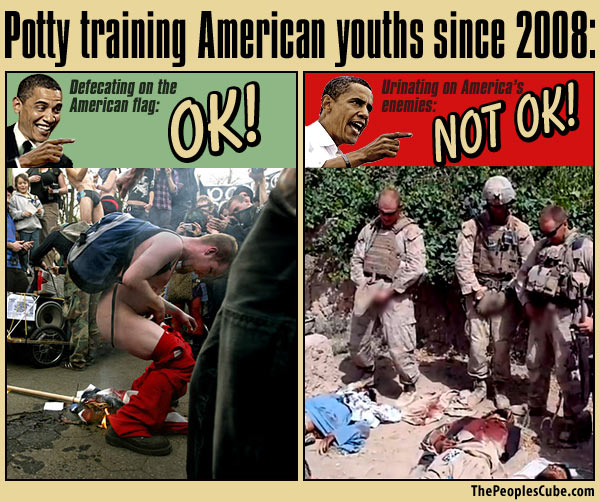
About That Whole “Peeing On Corpses” Thing

Friday, January 13th, 2012

You’re nineteen years old.

And you’re a US Marine.

You’ve been trained to kill the enemy.  Not to be a wanton slaughterer, naturally – we do shoot for better than that.  But if the word comes down the chain from the President to the Commandant to the Brigade commander to your Battalion CO to your Platoon Sergeant that Achmad Taliban is the enemy, subject to the rules of engagement, your job is to shoot him.  To kill him, not injure or scare him.

And Achmad Taliban is trying to kill you.  He’s killed plenty of your buddies, and other nineteen year old guys in your unit, going back to when you were ten years old   He wants you dead, and it was a roll of the tactical dice – a roll loaded by your training, you and your squad-mates’ tactics, and maybe a little luck – that left Achmad lying in the dirt with a bunch of holes in him, rather than you with a hole in your head or a couple of missing legs.

But you (and your buddies) got him first.  Before he could get you.  And you know that if the situation had been reversed, and Achmad had gotten ahold of your corpse, there’d be no liberal weenies in Pakistan wetting their pants over the ghastliness that’d ensue.  Because there are no liberal weenies in the Wahhabi world.

So, hyped on adrenaline and the same 19-year-old hormones that the USMC carefully cultivated to teach you unnatural things like running toward machine gun fire and shooting other humans (but only the right ones, heaven forfend), you and your buddies relieved yourself on the remains of a guy who’d just been trying to off you.

And the usual suspects here in the US are caterwauling about it.

Was it right to whiz on a corpse?  To someone sitting in a warm, tasteful, fluorescent-lit office in the US, of course not.  And even your chain of command would probably frown on it; time you spent whizzing on a corpse was probably time that a sniper could have been lining you up for a shot of his own.  I dunno – I’ve never served, much less as a combat infantryman.

Which is why I’m not going to join the crowd second-guessing you.

Because I have a hunch that if someone came barging through my front door with a gun, and tried to kill me, and I got him first, and he were lying on the floor, whizzing on him would be, um, impossible.

Merry Christmas, War Is Over

Thursday, December 15th, 2011

The war in Iraq is officially over.

Thanks to all the 1.5 million servicepeople who fought there over the past eight years.

To the families of the 4,500 who died – I’m sorry.  This country – and the people of Iraq – owe you more than anyone can ever pay.

Status Report

Wednesday, November 9th, 2011

It’s been two and a half years since the cathedra of elite Twin Citiesmainstream reporters gathered at the Humphrey Institute to giggle and fawn like a bunch of teenaged girls at a Justin Bieber autograph signing at an appearance by Seymour Hersh at the Humphrey Institute.

At that time, he said he was working on a book on how “Joint Special Operations Command” – a collection of special operations forces, “Delta” and “Seal Team Six” and other super-secret units  (and let’s note that “Delta” and “Seal Team Six” are both so secret that neither has existed under those names in over 20 years)  – that report directly to the Secretary of Defense, for hyper-secret counterterrorism missions, were “Dick Cheney’s private hit squad”.

Notwithstanding the fact that JSOF had been founded, with precisely the same mission and brief, by Jimmy Carter, whose Vice President, Walter Mondale, was sitting in the room with Hersch that night.

So why the delay on the book?

Was it because…

  • …a schlep blogger in Saint Paul pointed out that he was full of it?
  • …there really was no there, there?
  • …he now agrees with the Administration that’s using the “private hit squad?”
Just curious.

Generator Of Ex-Libertarians

Tuesday, November 8th, 2011

I used to be a big-L Libertarian.

I left in 1998 – partly because I wanted to join a party that could both be pushed toward libertarian (with a small-l) principles and still actually exert some effect on society (by, like, winning elections and stuff)…

…and partly because the Big-L Libertarians had their feet firmly in the clouds when it came to foreign policy.  Even Thomas Jefferson, the Libertarians’ secular saint, realized toward the end of his presidency that he needed to build a Navy and Marine Corps to project power against the “Barbary Pirates”; merely defending the nation’s borders, even at a time when “missiles” flew a mile from brass cannon and threats moved around the world at the stately five-knot pace of a sailing ship, was not a tenable way to remain free.

Liberty, in short, needed defending.  And while military solutions weren’t the answer for every problem, there is a place and time for it.

I watched Ron Paul yesterday on the Sunday Morning shows in response to this news – that Iran may, again, be close to getting nukes:.

According to recent leaks, Iran has carried out experiments in the final, critical stage for developing nuclear weapons – weaponization. This includes explosions and computer simulations of explosions. The Associated Press and other media outlets have reported that satellite photos of the site reveal a bus-sized container for conducting experiments.

Parchin serves as a base for research and development of missile weaponry and explosive material. It also has hundreds of structures and a number of fortified tunnels and bunkers for carrying out explosive experiments.

Now, we’ve heard this before…:

As far back as eight years ago, U.S. intelligence sources received information indicating that the bunkers would also be suitable to develop nuclear weapons. According to that information, Iran conducted experiments there to examine its capacity to simulate a nuclear explosion.

…and while I hate to sound like one of those Bush-era yapping ninnies who claimed that President Bush was “wagging the dog”, it’s a fact that responses to foreign policy threats have been the Obama Administraiton’s only real success.

Still, whatever the current status of the Iranian nuke program is, it is a fact that they will have The Bomb eventually.

And Ron Paul’s solution – “let’s make them not think we’re jerks”, essentially – is no less dumb that that of the “nuclear freeze” ninnies in the eighties.

Pining For The Fjords?

Thursday, October 20th, 2011

Gaddafi killed – maybe?

Former Libyan leader Muammar Gaddafi died of wounds suffered on Thursday as fighters battling to complete an eight-month-old uprising against his rule overran his hometown Sirte, Libya’s interim rulers said.

No confirmation at the moment.

He Who Writes The Brief Last, Writes It Loudest

Tuesday, October 11th, 2011

Remember when Senator Barack Obama and the rest of the American left waxed pious about the legal rights of anti-Ameircan combatants?

Most of the left would rather you didn’t.  But they did.  One of their favorite legal betes noir during the Bush years was Justice Department lawyer John Yoo, who wrote the memoranda that found legal justification for “enhanced interrogation”, prompting many on the left to call him, personally, a “war criminal”.

Well, he’s back, and he’s laughing last, as it were:

Let’s give partial credit where it is due.  Apparently the Obama administration argues that al-Awlaki was a legitimate target because he is a member of an enemy engaged in hostile conduct against the United States.  At least Obama has figured out that the war on terrorism is in fact a war, and that it is not limited just to Afghanistan.  We should be thankful that Obama officials have quietly put aside the arguments they made during the Bush years that any terrorist outside the Afghani battlefield was a criminal suspect who deserved his day in federal court.  By my lights, I would rather the Obama folks be hypocrites in favor of protecting the national security than principled fools (which they are free to be in the faculty lounges both before and after their time in government).

Therapists and 12-steppers ask “would you rather be right, or would you rather be happy?”

I think Yoo is probably both right now.

Above And Beyond The Call Of Duty

Friday, September 16th, 2011

Sergeant Dakota Meyer is the first living Marine to earn the Medal of Honor in the war on terror:.

In the course of six hours [after an ambush in Afghanistan in September of 2009], survivors said, Corporal Meyer and his driver, Staff Sgt. Juan J. Rodriguez-Chavez, led five fights into the ravine toward Ganjigal. Four times they helped recover wounded men, first Afghans who were pinned down and later Americans similarly trapped.

After the corporal freed Captain Swenson, the captain joined him in the fighting while an Army platoon nearby declined to help. On the last trip they recovered the remains of three Marines and a Navy corpsman. By then, according to the Marine Corps’ account of the fight, Corporal Meyer had killed eight Taliban fighters and stood up to several dozen more. (A fifth American later died of wounds suffered in the ravine.)

“Dakota later confessed,” the president said, of the fighting in Ganjigal, “I didn’t think I was going to die. I knew I was.”

The key criterion for the Medal of Honor is heroism “above and beyond the call of duty”.  That’s a phrase the world of business – and Hollywood, naturally – have devalued to the point of meaninglessness – for civilians, anyway.

It means doing things that are far, far beyond what one is ordered, or reasonably expected, to do.

The sort of thing that makes a sergeant deserve salutes from four star generals.

--> Site Meter -->