I expect conservatives and libertarians to be exercised over the news that the White House is establishing a “Nudge Squad” – a group of behavioral scientists who will work with the government bureaucracy to try to help shape citizen behavior:
“Behavioral sciences can be used to help design public policies that work better, cost less, and help people to achieve their goals,” reads the government document describing the program, which goes on to call for applicants to apply for positions on the team.
The document was emailed by Maya Shankar, a White House senior adviser on social and behavioral sciences, to a university professor with the request that it be distributed to people interested in joining the team. The idea is that the team would “experiment” with various techniques, with the goal of tweaking behavior so people do everything from saving more for retirement to saving more in energy costs.
The document praises subtle policies to change behavior that have already been implemented in England, which already has a “Behavioral Insights Team.” One British policy concerns how to get late tax filers to pay up.
On the one hand, it all sounds very Orwellian. And it is; using the government to shape peoples’ behavior is a short and utterly undefineable step away from using it to shape peoples’ thought.
On the other hand? Precisely what has the public education system been since its inception?
Friday night, I was out with some friends out at a bar on Lake Street in Minneapolis. I’d heard there was a thunderstorm warning – but I didn’t expect the deluge we got. I think the wind got up to 60-70 miles an hour on Lake. The power went out, and stayed out. As I walked back to my car (unscathed, thank goodness, unlike a few cars up and down the street), I thought “this is gonna be a doozy”.
I started trying to find my way back to Saint Paul; I drove around South Minneapolis, checking out the extent of the damage and the power outage; the damage lessened the further east you went, but many roads were blocked; there were pockets of power up into the thirties, but for the most part Minneapolis was blacked out down to 46th, sometimes 50th and further.
Along about 10 o’clock, I wondered “what’s Saint Paul like?” And for that matter the rest of the metro?
So I flipped to WCCO, expecting to hear their usual severe-storm-and-aftermath patter; Mike Lynch and a crew of newspeople talking about the storm, and taking calls from people around the metro with their observations.
LYNCH: “Tom in Prior Lake, go ahead”.
TOM IN PRIOR LAKE: “Ya, da wind come up and a maple tree about yea big fell down on da shed”
LYNCH: “How big?”
TOM IN PRIOR LAKE: “Yea big”
This is how WCCO has been doing weather since the earth’s crust cooled.
So I flipped the radio to 830 – no, it’s not a preset on my car.
SCENE: It’s May of 1912 – a few weeks after the sinking of the SS Titanic captured the world’s headlines. Scene fades in on the SS Metaphoric – a steamship billed as “The Next Best Thing To The Titanic!” – plowing through the icy North Atlantic. It’s a dark, chilly evening, with the light from a few stars illuminating the occasional glint of ice on the horizon.
CUT TO the First Class passenger lounge. A group of passengers – Garth Muller, Ludwig von Nicholaus, Joe Smith and Otto Klarinette – are drinking and discussing the affairs of the day.
CUT TO deck. Zoom in to crow’s nest, where the lookout, a plucky cockney named Tim Shaw, reacts with alarm to an oncoming apparition. He picks up a phone.
SHAW: “Iceberg! Right ahead!
CUT TO Bridge. Captain O. B. Barry, who was appointed Captain five years earlier after serving on cruise line’s board of directors for two years, picks up the phone.
BARRY: Let me be clear. It’s OK. We’re too big to sink. And we inherited our charts from the previous captain!
SCENE: Ship plows into iceberg. Montage of scenes of flooding below decks.
VON NICHOLAUS: What was that?
BARTENDER: I think we hit an iceberg, sir.
MULLER: Haw haw haw! Time to cash it in! This boat’s gonna sink! We’re all doomed!
SMITH: Um, hang on, guys; this room is crawling with wood tables, veneer, kegs, things that we can make float. There’s a spool of rope on the deck outside…
VON NICHOLAUS: Nope! It’s gonna sink!
KLARINETTE: Of course, since the cruise line is a corporation, falsely given a human-like existence to protect the banksters, nobody will be held responsible for it!
MULLER: Who cares! We’re going down! Bartender, pour me another one! Everyone’s gonna die!
VON NICHOLAUS: It’s like we were taught back in Vienna…
SMITH hauls empty tables out to promenade deck outside, slashes rope into 12 foot lengths and starts lashing tables together. BARTENDER starts frantically opening the beer taps, letting beer and soft drink kegs empty into the drains.
KLARINETTE: they’re calling “women and children first!”
MULLER: Pfft. The way this line was run, they’re better off dead anyway
SMITH and BARTENDER wrestle empty beverage kegs into place and lash them below te tables, effecting a crude but effective floatation device.
VON NICHOLAUS: If only the cruise line board of directors had listened to us!
KLARINETTE: We warned them!
VON NICHOLAUS: At the 1908 Cruise Line board meeting! “Don’t ram icebergs!”, we said. And they shouted us down!
MULLER: Well, this’ll show them!
VON NICHOLAUS: all these sheeple have it coming! They could have supported us. They deserve what they get!
SMITH and the BARTENDER attach a rope rail around the upturned table legs. SHAW moves a small kitchen grill onto the raft, and starts cooking hot hogs. The BAND starts playing “Nearer My God To Thee”.
KLARINETTE: (Watching crowds racing for lifeboat) Stupid short-sighted sheeple.
SMITH and the BARTENDER start waving women and children aboard the the raft. As the water laps up to the edge of the raft, they beckon the band aboard. They start playing “We Are The Champions”
SMITH: (as water floats the raft and starts to flow into the bar) Guys! Raft!
MULLER: Haven’t you heard? The ship is sinking. Belly up, the worlds come to and end!
VON NICHOLAUS: we’re all gonna die.
KLARINETTE: because the sheeple didn’t listen to us.
MULLER: we’ve all for it coming.
SMITH: No, listen – the raft. It floats!
VON NICHOLAUS: What? When I could be on a ship?
CAPTAIN BARRY (over the loudspeaker): Remember; it’s the previous captain’s fault, and you didn’t build or launch those lifeboats.
(Raft crowded with passengers floats free and paddles over to lifeboats as ship slips beneath the waves.)
Wonder why Obama’s gun grab legislation tanked – and, beyond that, why Obama quietly tried to appropriate the “guards in schools” idea for himself?
Because the American public – the part west of the Hudson and east of the Sierra Madre, anyway – is closer to the NRA than they are to Obama:
After the NRA school-guard strategy was roundly denounced as outright crazy by the pundits, — the editors of theNew York Times called it “delusional, almost deranged” — President Obama came out with … aproposal for armed guards in schools. It is no small feat for an out-of-touch, on-the-ropes organization to get the president to basically endorse its signature policy proposal at a time of national debate.
But, then again, it turned out that 55% of Americans supported the NRA proposal. Turns out, it was the people calling it crazy — like the editors of the New York Times— who were out of the mainstream.
Meanwhile, pundits denounced gun-rights activists who said that the right to bear arms is in part a protection against government tyranny. Only a crazed militia type could possibly believe that, right? Except that — go figure — 65% of Americans see gun rights as a protection against tyranny. And only 17% say they disagree. Once again, it’s the critics who appear to be out of the mainstream.
We Second Amendment Human Rights activists have always known this, of course.
We just have to keep coming back and proving it every few years.
My iPod collection is eclectic. Jefferson Starship’s “We Built This City (On Rock-and-Roll)” just played.
It occurs to me that if you’re talking about San Francisco, that’s probably true; Haight-Ashbury typifies that burg.
But New York or Cleveland? They weren’t built by rock-and-roll. They were built by Big Band and Swing, the music of the people who won The War and made American manufacturing the greatest force in the world throughout the 1940’s and 50’s.
Rock-and-roll was the Baby Boomers music. Rock-and-roll didn’t build those cities, it killed those cities, and many more. Detroit was Mo-Town when the old folks ran it; with Baby Boomers in charge, it’s Mo-Handout-Town. The fortunes of iron-ore-mining town Hibbing waned exactly as home-boy Bob Dylan’s waxed.
Okay, it’s only a song and not a very good one at that, not some great philosophical commentary on society.
Joe is too tactful. Starship’s “We Built This City” is perhaps the worst song in Top Forty history, rivaled only by Starland Vocal Band’s “Afternoon Delight”.
But that actually reinforces his point:
Still, I wonder how much difference it would make if popular culture turned away from “if it feels good, do it” and back to “Stars and Stripes Forever.”
Joe Doakes
Tangential thought: what does it say about either the music or the city that Minneapolis’ “Wedge” neighborhood (from Franklin to Lake between Hennepin and Lyndale) is exactly the same pompous, pretentious, overpriced wanna-be-artist’s-garret toilet now as it was before the Replacements’ heyday?
Speaking of which:
No, Joe’s right. America was the first culture in history to develop an “independent” “youth culture”. And now that those “youth” run the place, we’re completely screwed.
“We Hope For Better Things; It Shall Rise From the Ashes.” – City of Detroit’s motto.
Those words were written in 1805 to memorialize a Detroit school burned to the ground. 208 years later, Detroit still hopes for divine intervention, this time from the Michigan capitol.
Michigan Gov. Rick Snyder’s proclamation of a “financial emergency” in Detroit was the culmination of a decades-long municipal car wreck. Between 2000 and 2010, the city lost 237,500 inhabitants — an estimated 1/4th of the population. One in 20 homes were foreclosed upon during the height of the recession. The city remains $327 million in the red with $14.9 billion in unfunded city pension plans. By comparison, the entire state of Michigan’s biennial budget is $49 billion.
While Detroit has been slowly crashing into a wall of economic reality, a busload of corrupt and incompetent city officials have rubber-necked their way past the myriad of issues confronting the city. In the last decade, Detroit saw 131 convictions of government officials, a number defined by the reign of ousted Mayor Kwame Kilpatrick. Even the federal government last year withheld millions in grants from Detroit over concerns of corruption. The city’s reaction? We’re not as bad as Chicago when it comes to corruption, so what’s the big deal?
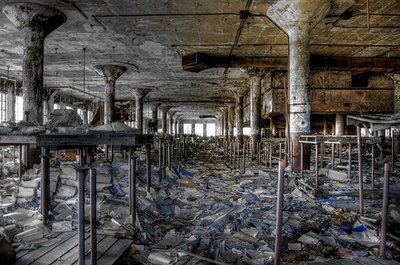
The Roosevelt Warehouse or Detroit School Book Depository. A fire in 1987 did some damage to the building but was abandoned despite most of the inventory being usable. No effort to recover science and sports equipment, scissors, crayons, and books was ever made and now all sit on the floor in ruin
Synder’s appointment of an “emergency manager” to oversee the Detroit budget and pension plans has elicited howls of protests from the usual suspects:
“[Emergency managers] can unilaterally tear up union contracts, take over pension funds, make and repeal laws, sell public assets, the list goes on,” he said in an earlier interview with The Huffington Post. “Imposition of the EM must be understood in the context of the many other methods conservatives are using today to suppress democracy –- especially among people of color and people in poverty.”
But the decision to go the EM route has also gained critics on the Right, with one National Review writer declaring Snyder’s decision, in hyperbolic form, a “uniquely American way to dictatorship.”
The Emergency Manager legislation has gone through a number of iterations over the years, including one version, Public Act 4, that was opposed by the unions and defeated on the ballot last November. PA 4 would have allowed EMs to effectively run cities, with their authority superseding that of city officials. Instead, with PA 4 defeated, Snyder is falling back on the format of an older PA – one that while still not allowing EMs to be fired by the city, doesn’t grant them the power to abrogate collective bargaining or dissolve local governments.
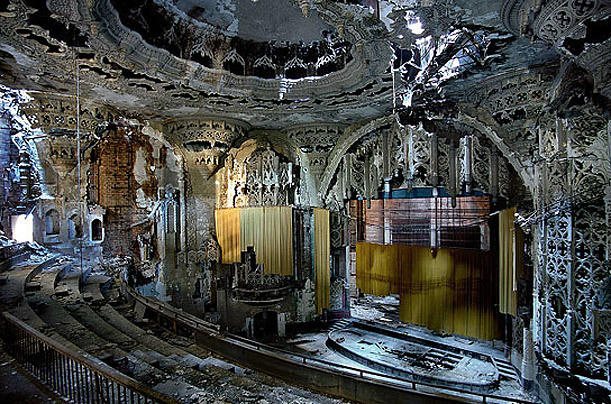
The United Artists Theater. The theater is actually part of an 18-story high rise built in 1928. The historic building was such an embarrassment that the exterior was refurbished before the Super Bowl in 2006. The interior remains as seen.
Despite the fact that no one will be declared dictator, or even Pontifex Maximus, Snyder’s decision has prompted Detroit’s City Council to fight tooth-and-nail against any EM, filing an appeal against the state. One official who isn’t planning on fighting Lansing is surprisingly Detroit’s Mayor Dave Bing. Like the rest of the city government, Bing isn’t happy about Snyder’s power play, but unlike the rest, Bing is willing to work with any EM. Speaking at a City Hall press conference, Bing stated that “we need to stop BSing ourselves,” a quote perhaps applicable to more than just an acknowledgment that an emergency manager would be imposed on Detroit whether they liked it or not.
An emergency manager invites micro concerns – with 83 cents of every Detroit police and fire payroll dollar being spent on pensions by 2017, what use is an EM without the ability to unilateral restructure pension and/or contracts? But the macro concerns of the decision are far more troubling. How do you save a city that won’t save itself?
The Lee Plaza Hotel lobby. The Lee Plaza is on the United States National Register of Historic Places.
H.L. Menchken famously declared that “Democracy is the theory that the common people know what they want, and deserve to get it good and hard.” Detroit has certainly being getting it “good and hard” for decades, and like an S&M enthusiast whose forgotten their safe-word, doesn’t know how to stop. Bankruptcy may be an option, but it doesn’t address the billions in underfunded liabilities. And considering all bankruptcy would do is force Detroit and its creditors to negotiate, there’s not much more that an EM would do for the situation except provide a political scapegoat for the necessary hard choices to come. It should be little wonder that Mayor Dave Bing isn’t fighting Snyder’s executive decision – he’s probably relieved someone else will being taking the slings and arrows (in Detroit; statewide, the move is very popular).
Yet what happens after the dust settles? Even if Snyder’s EM hacks Detroit’s budget into the black, will the political machinery or populace live with the decisions? Or, having avoided any connection to the policies implemented to take Detroit on the long road to fiscal solvency, will the business of City Hall simply revert to usual?
Snyder’s technocrat lean may be well-intended, but in the case of Detroit, is only delaying the city and its voters coming to terms with their decisions. Although on the plus side, Snyder’s move is the first job created in Detroit in years.
Part of it is that for much of my childhood – the part where real movie addicts got “going to the theater” in their blood – my hometown didn’t even have a theater. There were always other things to do.
Part of it is that I spend so very little time in front of the TV watching things – and while I spend plenty of time in front of the computer, it’s almost always writing, either for work or, well, this. The rare times I sit still and try to just consume, I usually fall asleep.
So the list of great movies I’ve never seen, or seen parts of, but not in sequence, or not the the whole thing, is a very long one.
One of them, until this past weekend, had been Schindler’s List. Believe it or not.
But it was on FX on Saturday night. And I took a rare night of doing nothing, and chugged a Red Bull and watched the whole thing.
Never seen it? Don’t go in on a night when you’re feeling down on the human race. Here’s the scene where the Nazis decide to ship the Jews out of the Krakow Ghetto:
It gets worse, and more depressing.
It’s because humanity, at its core, is rotten. That fact is at the core of the Judeo-Christian worldview, and it’s been proven in the absolute human absence of that worldview, which was one way you could describe the Holocaust.
How to describe humanity? I’ll leave it – partly for a little comic relief – to one of the greatest philosophers of our time, Dr. Perry Cox:
With that in mind, what actually separates us – the United State of America – from what you saw in the video above?
Two centuries of small-“l” liberal democracy? Sure.
A legal system that, at the moment, works? You bet.
But Germany was a western country. It was part of Western Civilization; the home of Bach, Händel, Schubert, Einstein (speaking culturally, not in terms of borders), Kafka, Beethoven. Not a “liberal democracy”, necessarily, by the time Hitler took office – Germany had suffered some very hard times.
And that’s the point.
It took a bad outcome to a war, and a decade and a half of economic misery to turn what was one of the wealthiest, most educated “first world” nations, the culture of Mozart and Schubert, into the stormtroopers. It took a demigogue at the head of a mass movement, one who tapped into long-standing cultural antipathies toward a cultural boogeyman at an opportune time, to turn the nation of Göthe into the nation of Amon Göth:
Has our Democracy ever been threatened with this?
No – leaving out all of history’s imponderable “what ifs“, we have not.
And how do we assure it stays that way?
You really have two options:
Have faith that government will always stay good. Or at least “not evil”. That judges and courts and laws and tradition will always hamstring not only the tyrants and murderers, but the tyrants who are murderers. That, irreducibly, means trusting to human nature. And it can, hypothetically, work. And it can, hypothetically, fail miserably.
But that is the leap of faith that Second Amendment opponents like Alice Hausman and Heather Martens and Rahm Emanuel want you, The People, to take.
The other option?
Make sure the people – no, The People – are equipped to make certain government stays on the straight and narrow. Make sure the people have not only the right to tell the government “you’re getting out of bounds”, but the ability to enforce it.
Want to see what the Second Amendment is about? This is it. Preventing what you see in Schindler’s List – preventing government from turning on the people, from metastasizing into a self-sustaining engine of evil.
That is the choice; trust in human nature’s desire to curb its worst aspects, or counterbalance it with sheer numbers.
I’m not saying the likes of Alice Hausman and Heather Martens are depraved totalitarians.
I am saying that depraved totalitarians need a society full of Hausmans and Martenses and Bidens and Emanuels and Michael Paymars, people more willing to empower government in spite of knowing the failings of human nature than they are to trust The People, to have a shot.
And that’s why some of us fight for the Second Amendment.
With an unemployment rate that’s been hovering around 10% for nearly four years, unemployment benefits that somehow manage to be the most generous in Europe and yet exclude thousands of eligible non-workers, and an attempted tax bracket of 75% on top earners, France clearly isn’t economically serious about domestic jobs. That hasn’t stopped them from being seriously upset at the lack of foreign capital coming to their rescue. Or when that same foreign capital criticizes the famous French non-work ethic.
When Goodyear Tire & Rubber Co’s Amiens Nord plant faced being closed, threatening 1,250 jobs, Paris attempted to mediate a sale to Illinois-based Titan International. Unable to get the French unions to move on any of their conditions, Titan’s owner, Maurice Taylor (last seen running for the Republican presidential nomination in 1996), fired off his answer on any potential purchase:
“The French workforce gets paid high wages but works only three hours. They get one hour for breaks and lunch, talk for three and work for three,” Taylor wrote on February 8 in the letter in English addressed to the minister, Arnaud Montebourg.
“I told this to the French union workers to their faces. They told me that’s the French way!” Taylor added in the letter, which was posted by business daily Les Echos on its website on Wednesday and which the ministry confirmed was genuine.
“How stupid do you think we are?” he asked at one point.
“Titan is going to buy a Chinese tire company or an Indian one, pay less than one Euro per hour wage and ship all the tires France needs,” he said. “You can keep the so-called workers.”
Taylor’s jab on going to China or India has to chafe Arnaud Montebourg, France’s Minister of Industrial Renewal, whose industrial policy has thus far been to scapegoat low-wage competitors. Montebourg even blocked Indian steelmaker ArcelorMittal from buying a French plant in 2012, apparently proving that beggers can be chosers.
Who needs employers?
Taylor’s brusque reply may dominate the headlines (who are we kidding with ‘may’?), but the real story is France slowly coming to terms with, well, their unemployment terms.
Despite the reputation of being exceptionally generous, which they are, France’s unemployment benefits are reaching fewer and fewer unemployed. Even as unemployment has increased, the percentage of beneficiaries has decreased – 44.8% of those eligible receive benefits, down from 48.5% in 2009. Many eligible are being turned away, a situation brought to greater public awareness when an eligible beneficiary set himself on fire in protest for being declined.
Why are even eligible beneficiaries being told ‘non’? Because as the French government auditor, the Cour des comptes (think of it as the French CBO), recently stated, the system of benefits is “unsustainable”:
The current funding system is expected to reach a deficit of 5 billion in 2013. According to the Cour, the French system is largely to blame for the deficit, as it is much more generous than similar benefits programs in neighboring countries. For example, the current allocation is between 63 and 93 percent of the previous incomes of the unemployed. In addition, the minimum compensation length for unemployment benefits in France is two years, compared to one year in Germany.
Such debts helped France’s credit rating fall to AA1, despite President Hollande’s pledge to reduce the deficit by the end of 2013. With familiar rhetoric coming from another left-leaning politician, it’s little wonder what Maurice Taylor chose to acknowledge in his letter:
Socialist President Francois Hollande may take some comfort in the view Taylor expressed of Washington: “The U.S. government is not much better than the French,” he wrote…
The re-taking of two Malian towns signified immediate progress for French forces fighting to prevent a Somalia-like failed state in what foreign policy experts call “the largest al Qaeda-controlled space in the world.” The instability of Mali predates NATO’s Libyan intervention but was significantly exasperated by the fall of Muammar Gaddafi’s regime. Malian fighters, both for and against Gaddafi, flowed into Libya as fast as arms flowed back into Mali once the major fighting was done (to say nothing of the present violence in Libya).
The French intervention has gained tepid material support from the U.S. and NATO allies (with onerous financial strings attached), showcasing once again the limitations of “leading from behind” – including placing a far from resolute President at the heart of the fighting in the shape of French President François Hollande:
It was supposed to be a quick and dramatic blow that would send the Islamists scurrying back to their hide-outs in northern Mali, buying time for the deployment of an African force to stabilize the situation. Instead it is turning into what looks like a complex and drawn-out military and diplomatic operation that Mr. Hollande’s critics are already calling a desert version of a quagmire, like Vietnam or Afghanistan…
Mr. Hollande, who has a reputation for indecisiveness, has certainly taken on a difficult task. The French are fighting to preserve the integrity of a country that is divided in half, of a state that is broken. They are fighting for the survival of an interim government with no democratic legitimacy that took power in the aftermath of a coup.
Hollande has continued the post-WWII French tradition of an obtuse foreign policy. Despite saying almost nothing on foreign policy during his campaign, Hollande has at once suggested that France will leave Afghanistan, NATO and yet invade Syria. It’s little wonder than that France’s stated position on Mali is equally confusing. An objective of “total conquest” (a charged word when fighting Muslims; or so we’re told when a Republican President says something similar) sounds aggressive and determined. Instead, it represents something entirely different:
Camille Grand, a defense expert and director of the Foundation for Strategic Research in Paris, said the French objective is “to return to the status quo ante, where those Islamist groups are cornered in the gray zones on the borders, with limited ability to act and not controlling population centers, where it is difficult for them to make raids or take hostages.”
Those goals, he said, are “definitely something that makes sense from a military standpoint. But “if the ultimate objective is to eradicate the presence of radical Islam in the Sahel,” he warned, “it probably won’t happen; it’s a bridge too far for anyone.”
The French offensive is designed to push the National Movement for the Liberation of Azawad (MNLA) back to their southern stronghold – a sort of Malian 38th parallel. Considering there might be as few as 3,000 Tuareg fighters for the MNLA, the French objective might be quickly reached. What remains less likely is that a French victory along these lines will accomplish anything. The MNLA, or an offshoot, will likely just regroup and march north again unless Malian government soliders, which have significantly outnumbered the MNLA, can stand their ground. Talk of French or NATO training of Malian troops sounds promising, but after a decade-plus of a similar commitment to Afghanistan, the historical results of such training don’t look promising.
So we’re left with Libya – the sequel. Neither Europe, or NATO, or the U.S. have the stomach to resolve the conflict nor stand aside and watch as Mali falls and al-Qaeda gains a new forward base for attacks abroad. The moves of the French and others thus far provide limited political or military risk, but also limited to nonexistent gains. Again, like Libya, if Europe or the West want their preferred side to prevail, they’ll likely have to do most of the fighting themselves. Considering the nomadic Tuareg opposition (literally translated into “abandoned by God”), are solid guerilla tacticians, a long-term French ground war will inevitably bring French casualties. The intervention is politically popular in France – for now. What happens if that changes? The outlook isn’t good when the man in charge is known as “Flanby,” a type of flan dessert.
The lack of U.S. leadership in the matter isn’t going unnoticed in Europe either. In the choice of victory or defeat in Mali, the American choice seems to be to vote ‘present.’
“Piss Christ”, the apotheosis of government-subsidized art. Greek geek pun intended.
No, yet again we merely pointed out our Administration’s incompetence, double standards and incompetence. I know, I wrote “incompetence” twice. I think it’s appropriate.
I can understand why you’d DO it – we have troops stationed in South Korea so we need to know what the North Koreans are up to – but why would you TELL anybody that you do it?
Signaling something to the Norks like LBJ taking ground then and giving it back in Vietnam? Taunting the North in hopes of provoking an attack so we can invade – Pearl Harbor style – just in time to distract the public from the economy and focus on Obama the War Hero for reelection?
Or is it aimed at China – you might be our largest creditor but you don’t own our country and we’ll spy on your buddies if we want to?
Too much wine for dinner?
Thought it was off the record?
Looking for the Polish Death Camps?
The whole point of black ops is they’re unseen, hidden, never talked about. “If I tell you, I have to kill you” type of stuff. Why take the wrapper off now?
Is that a rhetorical question, Joe?
When Sandy Fluke’s birth control and Barack Obama’s birth certificate isn’t distracting ’em enough from that 58 and change percent employment rate, they gotta get creative.
Also this: Glowing tribute to the war leader in the NYT. Election year propaganda piece, agonizing decisions by war hero. LBJ stuff again.
Assassination has never been official US government policy. At least, not trumpeted in the media. Why the shift in policy, and was Congress consulted and if not, why aren’t they moving to impeach him?
Note that at least two of the victims are specifically identified as Americans. When a federal government official proposes to deprive an American citizen of liberty or property, the Constitution requires that the citizen be given due process including, at a minimum, notice and an opportunity to be heard by an impartial tribunal.
Citizen X is a terrorist? Says who, Axelrod? I’m not arguing there must be an arrest, extradition, legal aid lawyer and televised show trial; but has there at least been some independent review of the charges and the evidence, or is this a secret Star Chamber enemies list and where’s the Constitutional authority for the President to accuse, convict and execute Americans in secret?
I have no problems with a take-no-prisoners approach if we’re serious about it. Go full Roman on them, slay every male, drive the women out of the country weeping, leave no stone atop another, salt the earth. Can’t see Obama doing it. His alternative of picking off bad guys one-by-one really is like Whack-A-Mole in the narcotics or organized crime fighting business. In a world with a billion adherents to a violent religion, there will always be another guy to take the place of the one you just killed, which is why killing Bin Laden didn’t end the problem.
It’s bad enough, trying to pretend Barak Obama reading papers in his office is the equivalent of Teddy Roosevelt leading the charge up San Juan Hill. Having the media polishing the man’s war credentials for electoral benefit by blowing operational security is worse than asinine.
Joe Doakes
Como Park
We live in a city where the media just trampled over (or enabled the trampling over) the law to get a new football stadium.
Think the NYTimes wouldn’t light Barack’s Obama’s cigar with the Bill of Rights?
France goes on a holiday from financial reality and makes Sarkozy pack.
The future of the European Union (and worldwide markets) may hinge on the following question: Is François Hollande a “fool or a knave”?
Hollande, seeking to become France’s first Socialist President since François Mitterrand, won a narrow victory Sunday over Nicolas Sarkozy – ending the Fifth Republic’s brief and troubled flirtation with mildly conservative economic policies. Hollande’s election was not only a victory for a Socialist Party in political disrepair but for his former domestic partner and 2007 Socialist nominee (remember, it’s France)Ségolène Royal. Whether his win proves to be a defeat for the economics of the EU will have to wait to be seen. As the UK’s Telegraph details, (having asked the above question about Hollande’s political motivations), France faces extraordinary fiscal challenges:
Keep in mind, these figures were after 5 years of Sarkozy’s supposedly “draconian” policies and political rule by his center-right Union pour un Mouvement Populaire (UMP). Hollande, in theory, wants to undo the same policies through increased progressive taxation, including the creation of an additional 45% for income above 150,000 euros and capping tax loopholes at a maximum of €10,000 per year.
In an economic era defined by deficit spending and a general lack of funds, François Hollande seems intent to upend the Franco-German alliance that has sought to force austerity measures on the rest of the EU. “Germany doesn’t decide for all of Europe,” Hollande intoned during the campaign. Yet what is the alternative? A nation drowning in debt can no more spend it’s way solvent than a fat person can eat themselves thin.
Marine Le Pen should be proud. The leader of the supposed ultra-conservative (more social nationalist) National Front and daughter of the 2002 run-off presidential candidate announced her intention to leave her ballot blank – a signal to the 18% who voted for her to ensure Sarkozy’s defeat.
Sarkozy would hardly be recognized as “conservative” across the Pond. Three of his ministers were leftists. He pushed for legislation to fight global warming. He worked to help Socialist Dominique Strauss-Kahn become head of the IMF (when Straus-Kahn wasn’t trying to plow room service). Far more damning, Sarkozy’s response to the 2008 economic meltdown was vintage Socialist – declaring that “laissez-faire capitalism is over” and decrying “the dictatorship of the market.” Yet, he raised the retirement age, cut taxes and attempted, unsuccessfully in the end, to ween France off the entitlement teat.
How the markets react may be the most important question in the aftermath of Hollande’s victory. Coupled with the showing of Alexis Tsipras in Greece – whose policies mirror Hollande in a desire to tax the rich and delay debt repayments – the concern over the fate of he EU will renew Monday morning. Greece had agreed to impose pension and wage cuts in return for two international rescues worth 240 billion euros. Either the policy continues or the payments stop. An end to payments would suggest an economic amputation from the Euro Zone, with Greece either leaving or being forced to abandon the Euro. A Greek departure could easily start a domino effect in the EU and send worldwide markets into a tailspin.
Hollande may be forced to continue may of the policies he publicly campaigned against. Short of a desire to commit economic suicide, he has little leverage to do otherwise.
Without baked goods – Rosettes, krumkake, lefse, and all the other varieties of baked sweets that make Norwegian cuisine such a joy during the holidays – having a Grinch steal Christmas is really more or less irrelevant.
And “lack of butter” is the grinch this year:
An acute butter shortage in Norway, one of the world’s richest countries, has left people worrying how to bake their Christmas goodies with store shelves emptied and prices through the roof.
The shortfall, expected to last into January, amounts to between 500 and 1,000 tonnes, said Tine, Norway’s main dairy company, while online sellers have offered 500-gramme [That’s about 14.4 ounces – Ed] packs for up to 350 euros ($465).
In the early 20th century, Argentina was one of the richest countries in the world. While Great Britain’s maritime power and its far-flung empire had propelled it to a dominant position among the world’s industrialized nations, only the United States challenged Argentina for the position of the world’s second-most powerful economy.
Former Libyan leader Muammar Gaddafi died of wounds suffered on Thursday as fighters battling to complete an eight-month-old uprising against his rule overran his hometown Sirte, Libya’s interim rulers said.
Mixed messages are useful if we want confuse, frustrate or anger another country. They are not useful in diplomacy or relationship-building. Mixed messages are dangerous because they make the U.S. appear weak and untrustworthy. Here are some of the mixed messages that we’ve given China, our biggest debtor and whose central bank owns $896 billion in Treasury bonds:
What, you think I’m doing to just paste the whole thing? Read the post.
Yeah, I know. It’s French. Although since Sarkozy took office, that’s not been anywhere nearly as derogatory as it was for much of our adult lives.
And not only is it among the most aggressively bloodthirsty national anthems in the world (the choruses end “To arms, citizens! Form your battalions! We’ll march! We’ll march, and water our fields with the blood of the impure!”), but it is a living artifact the French Revolution, a time when “liberal” populism was co-opted by “A Better France” into an epic horror, of show trials and pseudo-judicial mass-murder in the name of rule by men, not laws, of a type that served as a model for every blood-sucking tyrant, singular or group, that ever followed.
Still, this version of France’s national hymn, “La Marseillaise” (which is apparently French for “Yes, We Can!”) by Mireille Mathieu – “the Sparrow of Avignon” – has been my non-stop earworm for the past week.
And it’s a wonderful version of that vainglorious, blood-soaked tune for so many reasons.
Golly: It was recorded at the height of Charles DeGaulle’s Gallocentric era, when France may have marched to the beat of its own percussionniste, but in marched with a purpose. It was a time when the French – including pop-culteur icons like Mathieu – could sing unabashedly patriotic music without slathering it with post-modern irony.
Rdrdrdrdrdrdrdrdrd – I never took French. Oh, I hitchiked around France, getting by on my year each of high-school Latin and Spanish, my German accent, and my lack of fear of looking like an idiot in a foreign language. I could read things pretty well, and when I tried to speak, people at best figured out what I was saying, and at worst heard my fluent German accent and at least figured I wasn’t a Yanque, so they cut me a break. But real speakers of French have always tittered at my accent, especially since I roll my “r”s in a way that people who learn Parisian French – which is most of vous – do not.
So listen to Matheiu wrap that Avignon accent ardrdrdrdrdrdrdrdrdrdround the song, and rdrdrdrdrdrdroll those Rs. “Mardrdrdrdrdrdrdrdrdrdchons! Mardrdrdrdrdrdrdrdrdrdchons! She sounds like a six-barreled minigun! Glordrdrdrdrdrdrdrieuse!
Frappe-O-Licious!: The more world politics I see, the more I realize the sheer worth of enlightened self-interest, both for individuals and nations. And yeah, I know – “enlightened” and “French” aren’t usually in the same Zip code. But bonne golly, this is a version that’d make a gallic Chuck Norris or Jack Bauer or Audie Murphy sit up at attention, and jump-start the cold, post-ironic heart of the most cynical Sorbonne academic trash. It makes me marginally less ashamed of my family’s own partly Quebecois roots.
It was the first time I’d seen this song delivered outside of a fundamentally American context – which I can also not stop humming, by the way, although I guess that’s fairly obvious, since it’s the same song…
Tom Emmer has taken some heat – unjustified as usual – for a (out of context) remark in the Marshall newspaper last year:
“I don’t think you can call yourself a freedom-loving American and be a Democrat,” Emmer said. “I don’t think that’s a grassroots Democrat who says now ‘That’s not what I voted for, this isn’t the America I want.’ It’s the leaders of the Democrat party.”
Some Democrats have gotten exercised over the quote, lately – out-of-context, naturally. Of course freedom-loving people can be Democrats…
Senator Edward M. Kennedy offered to work in close concert with high level Soviet officials to sabotage President Ronald Reagan’s re-election efforts and to arrange for congenial American press coverage of General Secretary Yuri Andropov, according to a 1983 KGB document.
That’s Ted Kennedy.
The patron saint of the mainstream Left in America.
Actively working with the KGB against then-President Ronald Reagan.
That’s the KGB; they of the Lubyanka and the Black Marias and the Gulag and show trials and sixty million dead Russians, Poles, Hungarians, Czechs, Slovaks, Germans. The KGB of the Holodomor, the government-imposed starvation of Ukraine.
One more time from the heart: Ted Kennedy worked with the K G freaking B against a sitting President.
Specifically, Kennedy offered to have “representatives of the largest television companies in the U.S. contact Y.V. Andropov for an invitation to Moscow for the interview.” The idea here would be for the Soviet leader to make an end run around Reagan and make a direct appeal to the American people.
Kennedy suggested that Walter Cronkite, Barbara Walters and Elton Raul, the president of the board of directors for ABC, be considered for the interviews with Andropov in Moscow.
That’s Yuri Andropov – former KGB head, one of the architects of the “Prague Spring”, a man with rivers of human blood on his nicotine-stained hands – for whom Ted “Camelot!” Kennedy, leader of the “Mainstream” American left, was serving as a Public Relations flak.
Question for all of you liberal hamsters who were calling Michele Bachmann and the Tea Party “seditious” for fomenting suspicion of government, and who huffed “Don’t you dare question the left’s patriotism” between 2001 and 2008; where is the revulsion?
I’m sure it’ll happen as soon as the mainstream media covers Kennedy’s treachery:
The confidential correspondence between Sen. Kennedy and Soviet agents first came to light in a Feb. 2, 1992 report published in the London Times entitled “Teddy, the KGB and the Top Secret File.
To sum up: A mainstream liberal leader goes behind the back of the sitting President to double-deal with not just any foreign power, but the most murderous group of butchers in human history, because he saw them as the reasonable party.
Of course it was a rare, one-off aberration, right?
Just so we’re clear on things – this blog is an unabashed supporter of Israel. I say this as a firmly committed goy.
That is not to say Israel is perfect; it is to say that the Jewish State has extended itself in the interest of peace, over and over again, and gotten slapped for it by the “international community” every time.
Yoram Dori – an advisor to Shimon Peres – responds to Helen “Send ’em back to Warsaw” Thomas by noting that his parents, like so many Israelis, come to Israel from those countries for very good reason; his father and mother were the only survivors of their families from Austria and Poland, respectively. Over two out of three German Jews died during World War II; nine out of ten Polish Jews died as well.
That is why they went to Israel in the first place; because the only parts of the “international community” that didn’t let them down during the war were the parts that were actively hoping for their deaths. Just like today.
IN THE 62 years of our existence, we have had seven wars, thousands of terror attacks, buses which have exploded in streets, firing into schools, mortars fired on kindergartens. Yet you wish to exile us back to the inferno, as if nothing happened 65 years ago in Europe, as if our hands have not been stretched out for peace since the establishment of the state?
We were victorious in the wars imposed upon us by Egypt and we signed a peace agreement with it after yielding all the territory and all the oil. We signed a peace agreement with Jordan. We yielded all the territory and much water. We withdrew from Lebanon to the international border and, in return, we received Hizbullah katyushas on our citizens. We left Gaza and in return, we received massive firing on our citizens in the South. Are you aware, Ms. Thomas, that many children from Sderot and the area around Gaza wet their beds until a late age out of fear of the Hamas missiles? And it is us that you wish to exile? Why? Because you think that we are weak or because it annoys you that we are not defeated?
Lest you think Dori is a fire breathing Tea Matzo Partier…:
As someone, who throughout his adult life has been a member of the Israeli “peace camp,” notwithstanding you and your strange and angering views, my friends and I (and I hope also my government) will continue to turn over every stone and scour every corner to attain peace.
Would that it could be.
Thomas is only the most public, risible example of her kind.
Last year on Marty Owings’ “Radio Free Nation”, I got a chance to ask Representative Keith Ellison if he, in his capacity as the first Muslim in Congress and one of the most powerful people in the Islamic world, repudiated the Hamas charter, which calls for the destruction of Israel and the extinction of the Jews.
His response: “How many Palestinians do you know?”
As part of my continuing examination of my extremism – because Janet Napolitano believes that as a conservative pro-life low-tax second-and-tenth-amendment activist, I must be an extremist – let’s look at our culture.
“Culture” is a huge topic, and it’s hard to even define where the left and right diverge, or on what each side actually believes, to say nothing of what their opponents believe.
For example, one of the putative big battles in the “culture war” twenty years ago was the campaign by Tipper Gore, wife of then-future lisping fraud and Vice President Algore, to put warnings on music that had “offensive” lyrics. Was it conservative? Was it liberal?
Perhaps a little bit of both – and who cares? Because while that particular argument, like many, mixed elements of both sides of the aisle – conservatives fretting about the downfall of civilization, liberals about the system that’d make young males write the kind of rap and metal lyrics that’d make them be so antisocial in the first place – it was fairly irrelevant.
Because while there are many facets to what both conservatives and liberals believe what our culture is, and what is should be, it really boils down to two major differences of opinion:
Conservatives believe that our society is a free association of equals who create a government that governs by consent of the people, and should generally operate within restrictive boundaries – the Tenth Amendment, for a quick example. Liberals believe that society is – I’ve heard an amazing number of liberals use this exact description – a parent, riding herd on his/her unruly or needy children, trying to help them grow up to be good citizens, kissing their owwies and putting them in time-out and keeping them out of trouble until they’re ready to take over for themselves.
Conservatives believe that while mankind is deeply imperfect and utterly imperfectible, the concept of the United States is in and of itself one of immense nobility; it is a “shining city on a hill”, a place where government is a useful subordinate to the nobility of the individual. It’s an ideal toward which most of the world – the sane part – aspires. Liberals tend to believe that our society is perfectible, through the graces of a benevolent government rather than any intrinsic virtue in the American system.
Now, the battle is usually expressed through an endless series of group ad homina; liberals slur “Tenthers” as advocates of slavery; conservatives see liberals as hive creatures, Borg with no identity outside the larger organism.
At any rate – I believe that America works best when we not only do see ourselves as a free association of equals, but act like it. And when government limits itself, rather than you or me.
April 19 may be the most fraught date in American history – for good or evil, instruction or paranoia, right or wrong. And its’ stacked-up layers of symbolism are going to be popping out from the news, spinmeisters and commentary all day long, and beyond.
The pants-wetting class is knotted up about a couple of marches planned for today; one, a group of armed Second Amendment activists, plans to hold a demonstration at a park in Virginia – the closest point to America’s political and traditional murder capitol, Washington DC, at which a law-abiding citizen can legally carry a gun. And another group, the “Second Amendment March” or SAM, plans a march (unarmed, unfortunately) on the Capitol.
[“Second Amendment March” founder Skip Coryell] claims he chose April 19 “because it is the 235th anniversary of Lexington-Concord.” However, the date also carries a rather unfortunate significance: the day militia sympathizers Timothy McVeigh and Terry Nichols blew up the Murrah Federal Building in Oklahoma City.
Let’s stop right there.
“Militia sympathizers”? That’s chipped from the same block as Andy Birkey’s swerve into collective guilt by association last week, when he (and, one presumes, the editors at the Soros-funded Center for “Independent” Media, which former Mindy staffers themselves noted actually call the shots and want the site to be a flak organ for centrally-driven propaganda) used an irate, profanity-riddle phone message from someone who claimed to be a Tea Partier to try to impugn the entire Tea Party. McVeigh and Nichols were criminals; if they “sympathized” with the Oakland Raiders, “Iron Chef” and “Twilight”, it wouldn’t mean that football fans, foodies and dozey teenagers had some dark inner secret.
“The Militia” in the US is everyone. “A well-regulated militia being necessary for the preservation of liberty, the right of the people to keep and bear arms…” is what the Constitution says, in that little bit right after the part about freedom of speech that seems to be the only part most liberals ever read. And the Supreme Court said “The People” means all of us in the Heller decision, two years ago.
The “militia” that the pants-wetting class is exercised about is not “the militia”. It is a tiny collection of people with unfashionably acerbic views on society that the media and the pants-wetting class have set up as a boogeyman to scare society into place.
But let’s not stop with the significant anniversaries. There are two more:
April 19 also marks the end of the weeks-long siege of the Branch Davidian compound outside Waco, TX. Dan Casey of the Roanake Times reported that “[s]ome activists in the gun-rights movement have tried to talk Coryell out of organizing” the march, fearing that the “political timing is bad” or that it “might lead people to believe the gun movement is a paper tiger with a few loud voices.”
It’s also the date of the Warsaw Uprising – which should be the story that people keep in mind when they think of “militias”. The Jews of Poland had been herded into huge, miserable, starving ghettos while the Nazis built their extermination camps. By April 19, 1942 many of them were already dead, of starvation or disease or murdered by their guards.
And a small band of Jewish patriots – “extremists”, as someone like Andy Birkey or ThinkProgress might call them today – decided it would be better to die with dignity and have a chance, however thin, at liberty than to quietly be sucked into Hitler’s death machine. With a few stolen pistols and molotov cocktails, they rose, threw the Germans out of the Ghetto, and for a few weeks became a speed bump to Hitler’s “Final Solution to the Jewish Problem”.
The media and left (ptr) focus on the April 19 of Oklahoma City (where a couple of cartoon characters that belonged in a movie about fringe lunatics managed to kill 168 Americans) and Waco (where a group with very unfashionable religious views ran afoul of their own leader’s delusions, a deeply-stupid government raid, and some very bad luck with chemicals) because it fits their narrative; the big mass of people between the Hudson and the Sierra Madre need to be controlled, lest they hurt themselves.
But the April 19 of Lexington and Concord is a symbol of the power of We The People – which disturbs that other narrative. And the April 19 of Warsaw shows why it should be the duty (in the patriotic sense, if not also statutory) for every law-abiding American to own and be proficient with firearms – so that the next batch of Nazis can’t show anyone how very much more powerful than the pen the sword really is.
Of course Coryell’s fears are completely baseless. Obama has no intention of taking any anyone’s gun rights. In fact, during his campaign for president, Obama said, “I believe in the Second Amendment, and if you are a law-abiding gun owner, you have nothing to fear from an Obama administration.”
And why would Obama say that, after a career spent in gun-grabbing governments and working for gun-control-advocating non-profits?
Because of Americans who march to show Congress and the states that we are here, we’re better citizens than most, and we’re not going away.
As a boy growing up in the Soviet Union, Sergey Brin witnessed the consequences of censorship. Now the Google Inc. co-founder is drawing on that experience in shaping the company’s showdown with the Chinese government.
The internet may be many things, for better or worse, but one would have to backtrack history to the invention of the printing press to find an innovation that has done more for the free flow of information, expression and commerce.
China will never threaten America’s dominance unless and until its people enjoy the same freedoms of speech and enterprise that Americans do.
Background: Totalitarians always have a yin to play against an unruly yang. The Roman emperors had a Praetorian Guard to protect them from the Army, just in case. When the Red Army got to powerful and influential, Stalin sicced the KGB on their leadership; when the KGB in turn got big enough to threaten him, he turned the Army and the Party on them, killing its leadership. Likewise, Hitler had the SS – which pledged loyalty to him at the Party directly – to serve as an insurance policy against the Wehrmacht, whose Prussian Junker leadership was loyal to the German state, drawing Hitler’s distrust; the SS “Blackshirts” themselves were a response to what Hitler saw as the excessive power in the hands of the SA (“Brownshirts”), whom he formed the SS to counter and, eventually, dismantle. Saddam Hussein had multiple levels of backups; against the Army, he had the Republican Guards – again, smaller but better trained and better-equipped – and beyond that, a smaller, even more elite group of guards in case the Republican Guard got uppity.
Iran has had the same arrangement for most of the past thirty years. The Iranian Army – once by far the largest in the Middle East, and by far the best-equipped in the Moslem world – was cut town to size after the Revolution, and especially after the Iran-Iraq War, as the mullahs established an “elite”, or at least intensely-loyal, “Islamic Revolutionary Guard Corps” (IRGC). The IRGC were the foot soldiers and muscle of the Revolution, and developed over time into an entire parallel military, serving the mullahs directly in parallel to the regular (and now cash-starved) regular Iranian military, which is a faint shadow of its shah-era self.
On Monday, Secretary of State Hillary Clinton finally got around to acknowledging what a lot of people have known since Iran’s contested election last June — there’s been a military takeover in that country, with the Islamic Revolutionary Guards Corps (IRGC) grabbing every important lever of power. As Clinton put it during a televised town-hall meeting, “The Supreme Leader, the President [and] the parliament is being supplanted, and Iran is moving toward a military dictatorship.”
No doubt one reason it took Clinton so long to admit that the mullahs have been forced to cede power to the IRGC, Iran’s élite military force, is that Washington hates to be the bearer of bad news, especially news that moves us closer to war.
Especially when the Administration’s campaign-era pledge was that to deal with the mullahs, all you needed was love.
Since its birth in 1979, the IRGC has been the hardest of the hard core of Ayatullah Khomeini’s Islamic revolution. It thrives in confrontation with the U.S. and Israel, and does even better when Iran is at war. The IRGC looks at the 1982-2000 war in Lebanon as its most glorious moment, when its proxy Hizballah forced the West and Israel out of Lebanon. It left Hizballah with the enviable reputation of being the only force in the Middle East to have beaten both the West and Israel. Not to mention that Hizballah is now the de facto government in Lebanon. No wonder the IRGC would like an encore in the West Bank and Gaza, where it has been arming militants for more than a decade.
There’s method to what we in the West could consider the Madness:
It may make us feel better to label the IRGC as a terrorist organization, but it’s more instructive to look at things from the IRGC’s perspective. It truly believes that its brand of asymmetrical warfare can defeat a modern, well-equipped force in a limited war. It did so in Lebanon, and given the right circumstances, it would do so in other parts of the Middle East. But the real point is that in a limited war with the U.S. and Israel, the IRGC could predominate, or at least wear us down to the point that we would decide it’s better to settle.
And as western thinkers have known for centuries – nothing takes the pressure off a dictator like a perennial state of war:
With inflation and unemployment running at 30% in Iran, continuing demonstrations in the country and shaky oil markets, the Obama Administration should be considering the distinct possibility that the IRGC may welcome an open conflict with the U.S. (and Israel), its coup d’état solidified.
All by way of saying; it’s possible we’re not re-living the Carter years in nearly every coneptual particular. I’m just not seeing it.
With news filtering out of Haiti as slowly as aid is effectively able to get in, the scale of the massive earthquake’s destruction is still hard to determine. For a country already in political and economic ruin, magnitude-7 quake destroyed most of Port-au-Prince, leaving estimates as high as 500,000 dead and perhaps as many as 3 million in need of emergency aid:
Tuesday’s earthquake brought down buildings great and small — from shacks in shantytowns to President Rene Preval‘s gleaming white National Palace, where a dome tilted ominously above the manicured grounds.
Hospitals, schools and the main prison collapsed. The capital’s Roman Catholic archbishop was killed when his office and the main cathedral fell. The head of the U.N. peacekeeping mission was missing in the ruins of the organization’s multistory headquarters.
Police officers turned their pickup trucks into ambulances to carry the injured. Wisnel Occilus, a 24-year-old student, was wedged between two other survivors in a truck bed headed to a police station. He was in an English class when the earth shook at 4:53 p.m. and the building collapsed.
“The professor is dead. Some of the students are dead, too,” said Occilus, who suspected he had several broken bones. “Everything hurts.”
To put Haiti’s most recent tragedy into perspective, the earthquake may already rank as one of the deadliest in history. Only Shaanxi in China’s 1556 earthquake may have been worse with an unconfirmed 830,000 dead, but with the inaccurate of historical records, the 1976 Tangshan earthquake and it’s official death-toll of 255,000 ranks as the worst of the modern era and likely the most deadly.
There are many fine organizations assisting survivors in Haiti, but I would encourage SITD’s loyal readers to consider donating to the International Red Cross in this hour of need.