Archive for the 'Business, The Economy and The Markets' Category

Liberté, égalité, vacances

Wednesday, February 20th, 2013

France’s continued Hollande from reality gets a rude wake-up call from America.

With an unemployment rate that’s been hovering around 10% for nearly four years, unemployment benefits that somehow manage to be the most generous in Europe and yet exclude thousands of eligible non-workers, and an attempted tax bracket of 75% on top earners, France clearly isn’t economically serious about domestic jobs.  That hasn’t stopped them from being seriously upset at the lack of foreign capital coming to their rescue.  Or when that same foreign capital criticizes the famous French non-work ethic.

When Goodyear Tire & Rubber Co’s Amiens Nord plant faced being closed,  threatening 1,250 jobs, Paris attempted to mediate a sale to Illinois-based Titan International.  Unable to get the French unions to move on any of their conditions, Titan’s owner, Maurice Taylor (last seen running for the Republican presidential nomination in 1996), fired off his answer on any potential purchase:

“The French workforce gets paid high wages but works only three hours. They get one hour for breaks and lunch, talk for three and work for three,” Taylor wrote on February 8 in the letter in English addressed to the minister, Arnaud Montebourg.

“I told this to the French union workers to their faces. They told me that’s the French way!” Taylor added in the letter, which was posted by business daily Les Echos on its website on Wednesday and which the ministry confirmed was genuine.

“How stupid do you think we are?” he asked at one point.

“Titan is going to buy a Chinese tire company or an Indian one, pay less than one Euro per hour wage and ship all the tires France needs,” he said. “You can keep the so-called workers.”

Taylor’s jab on going to China or India has to chafe Arnaud Montebourg, France’s Minister of Industrial Renewal, whose industrial policy has thus far been to scapegoat low-wage competitors.  Montebourg even blocked Indian steelmaker ArcelorMittal from buying a French plant in 2012, apparently proving that beggers can be chosers.

Who needs employers?

Taylor’s brusque reply may dominate the headlines (who are we kidding with ‘may’?), but the real story is France slowly coming to terms with, well, their unemployment terms.

Despite the reputation of being exceptionally generous, which they are, France’s unemployment benefits are reaching fewer and fewer unemployed.  Even as unemployment has increased, the percentage of beneficiaries has decreased – 44.8% of those eligible receive benefits, down from 48.5% in 2009.  Many eligible are being turned away, a situation brought to greater public awareness when an eligible beneficiary set himself on fire in protest for being declined.

Why are even eligible beneficiaries being told ‘non’?  Because as the French government auditor, the Cour des comptes (think of it as the French CBO), recently stated, the system of benefits is “unsustainable”:

The current funding system is expected to reach a deficit of 5 billion in 2013. According to the Cour, the French system is largely to blame for the deficit, as it is much more generous than similar benefits programs in neighboring countries. For example, the current allocation is between 63 and 93 percent of the previous incomes of the unemployed. In addition, the minimum compensation length for unemployment benefits in France is two years, compared to one year in Germany.

Such debts helped France’s credit rating fall to AA1, despite President Hollande’s pledge to reduce the deficit by the end of 2013.  With familiar rhetoric coming from another left-leaning politician, it’s little wonder what Maurice Taylor chose to acknowledge in his letter:

Socialist President Francois Hollande may take some comfort in the view Taylor expressed of Washington: “The U.S. government is not much better than the French,” he wrote…

The Myth Of The Harmless Minimum Wage Increase

Wednesday, February 20th, 2013

The left’s been bruiting about a study that shows unemployment isn’t that badly affected by minimum wage increases.

For example, the study claims that a 10% hike in the minimum wage translates over time into about a 1% hike in unemployment among low-wage, low-skill workers – the ones that get minimum wage.

BikeBubba, over at BikeBubba’s Boulangerie, unpacks the meme in a way most of the study’s proponents seem unprepared to:

So let’s work with that.   Let’s assume, for what it’s worth, that “low wage workers” includes about the bottom quintile, or about 30 million workers.  So that 1% decrease in employment impacts about 300,000 workers, which is about the same number of people as are currently employed by Sears, Roebuck and Company–which now includes Kmart as well.  In short, three of every forty minimum wage workers would lose their jobs.

In short, even a 10% increase in the minimum wage impacts a LOT of people.  But of course, the story gets worse, as President Obama and Governor Dayton Messinger are proposing 24% and 31% increases in the minimum wage.  So we would expect, if the relationship were linear, that over 700,000 people would lose their jobs from Obama’s minimum wage proposal–seven out of forty–and we can thank God that Mark Dayton is not the President.

All true.  And, as BikeBubba notes, probably still too pollyannaish; linear behavior is for sissies:

Of course, few things are linear in real life, and so I’ve constructed a model assuming that the actual productivity of labor is normally distributed somewhere above the minimum wage, and that those workers whose productivity does not exceed the minimum wage will lose their jobs.  If we assume that the current minimum wage deprives only 2.3% of these workers of work (-2 standard deviations), then we arrive at a mean productivity of $8.95/hour with a standard deviation of about $0.85.

And that means…

Shift the minimum wage to $9/hour, and we then predict overall job losses of approximately half of minimum wage workers.   Any historical comparisons?

Glad you asked.  From 2007 to 2009, there were three consecutive increases in the minimum wage exceeding 10%.  Here’s what happened to unemployment among young people:  it more than doubled as overall unemployment went from 4.6% to 10%.  When the increases in the minimum wage stopped in 2009, the trend in unemployment quickly stabilized and started to reverse.  In short, it’s exactly what one would predict if the productivity of entry level labor were normally distributed somewhere above the minimum wage.


Now granted, there were other things going on at this time, but reality is that it shouldn’t take a PhD economist to realize that when the price of labor rises, less of it will be demanded.  So if someone tells you he’s trying to increase the minimum wage for your good, let him know that you’d be thankful if he didn’t try to “help” you that way.

The only real way to “help” minimum wage workers is to teach them how to do median-wage jobs.

And the best way to do that – barring some flash of brilliance – is to stay in school, moderate your behavior so you can actually learn things, get a job and go to it every day without all sorts of drama, so you learn the behaviors that successful workers have, and learn a skill worth more, preferably way more, than whatever the “minimum” or “living” wages  are.

Increasing the minimum wage is not just pretty window-dressing on the poverty problem; it’s geometrically counterproductive.

You Didn’t Get That Instalanche!

Wednesday, February 20th, 2013

Kudos to the Instalanche yesterday for our pal Ryan Rhodes, author of We Didn’t Build Thatthe story of he and his wife’s odyssey building a small business.

I’ve read it.  It’s worth the $4 Ryan’s charging on Amazon for it, and then some.  By all means, do!

Just Keep Repeating To Yourself…

Monday, February 18th, 2013

…that raising taxes in a recession isn’t face-palmingly stupid:

“In case you haven’t seen a sales report these days, February (month-to-date) sales are a total disaster,” wrote Murray in a February 12 email to executives. “The worst start to a month I have seen in my (about) 7 years with the company.”

The recent hike in payroll taxes is dragging down sales for discount retailers like Wal-Mart. With less disposable cash in their wallets, lower-income shoppers have less to spend.

The bad news comes on the heels of a lackluster January for the major retailer.

“Have you ever had one of those weeks where your best-prepared plans weren’t good enough to accomplish everything you set out to do?” wrote Walmart Vice President for U.S. Replenishment Cameron Geiger in a February 1 email to Walmart executives. “Well, we just had one of those weeks here at Walmart U.S. Where are all the customers? And where’s their money?”

If we – the “middle class” – have 5% less money between payroll taxes and Obamacare, then that’s 5% less to spend at Walmart.  Or Patagonia, or MPR’s pledge drive, or what have you.

Most of us know this.

Democrats in DC and Saint Paul, it seems, do not.

Democrat: “We’re Screwed”

Friday, February 15th, 2013

Even some DFLers – the thin film of them that actually have to manage things in the private sector – are figuring it out.

This piece has made the rounds; it’s from the San Fran Chronicle, in a piece that gurgitates a whooooole lotta Minnesota myths:

“We’re screwed,” [Printing company owner Dik] Bolger said, if the tax goes through. His 79-year-old company competes nationwide and overseas for work with major brands like Chanel. “If you’re bidding for a $100,000 job on a national basis and tax expenses push you a couple of percent higher, then I’m not competitive.”

And I’m hearing this from businesspeople – some political, some not, and mostly off the record – all over the place.

For generations, Minnesotans lived out the progressive argument that high taxes and high services were what gave the state its fabled quality of life.

One thing Minnesota Democrats never, ever get; the “Minnesota Miracle” – creating a high-tax, “high-service” system that actually prospers – depends on several factors:

  • Being the uncontested biggest economy…
  • …within a national economy that has no serious competition (as the USA did not, between 1945 and the mid-seventies)…
  • …allowing near-unbridled prosperity…
  • …which supports boundless government spending.

These factors – especially the whole “only economy left in the world that hasn’t been bombed into rubble, taking nearly 30 years to get back up to speed” bit – are unlikely to be repeated anytime soon, or so we can hope.

But the patience of business owners is being tried more than ever, as Dayton and the Democrats who now control the Capitol mull a menu of tax increases that would primarily hit company ledgers — just as most states are going the opposite way.

Those “company ledgers” include mine.

The piece slathers on the Minnesota Myth – that “high-service” translates into high quality of life for everyone:

Dayton wants the new money to eliminate a $1.1 billion state budget deficit. He also wants more for public schools and colleges, job-creation programs and low-income medical assistance. He’s arguing that such amenities are what perennially put the state near the top of livability lists.

“I’ve heard this for 30 years and I’m not insensitive to it,” Dayton said of the argument that high taxes make businesses look elsewhere. However, “I say we’re not the lowest-taxed state, we’re the best value for people’s taxes.” Minnesotans try not to scoff as they contrast the state’s attributes with the likes of its more down-market neighbors. Minneapolis’ bustling downtown Nicollet Mall, the Twin Cities’ array of theaters and first-class museums, and the state’s expansive parkland and its 19 Fortune 500 company headquarters — the second-most per capita in the country_are what make talented people want to be here, they said.

Make no mistake about it; Minnesota is a great place – if you’ve got yours.  If you’re already a CEO – or a highly-paid non-profit executive, or government PR consultant, or anyone that’s already made your score – then a day of shopping and theatre downtown after a long day in your Fortune 500 office is mighty nice!

But for the people who get laid off because their companies are now 5.5% less competitive?  For the companies that relocate out of state because of the newly-ugly tax climate?  They won’t be shopping on Nicollet Mall or going to the Guthrie.

It’s no coincidence that Minnesota’s unemployment rate is lower than Wisconsin’s (5.5 percent vs. 6.6 percent in December) and its per capita income higher ($44,560 vs. $39,575).

This is one of the arguments that the DFL’s been floating among low-information voters lately.  Wisconsin, addled by a more virulent strain of “progressivism” even longer than Minnesota, and stuck between two larger economies, lagged Minnesota for a generation or two.

But what’s happened lately?  We’ll go through that next week, hopefully.

The Minnesota DFL is clinging to the myths, and hoping they continue to fool enough low-information voters to keep them in office.

———-

The piece should end there.  But I couldn’t resist this next bit:

“What’s real is that quality of life is a decision-maker for the big players,” says Democratic Rep. Alice Hausman.

What “executive” wouldn’t relish a chance to play hooky at the Ordway on a tough day at the office?

A Conversation About The Minimum Wage

Thursday, February 14th, 2013

I had a chat with Avery LIBRELLE, a liberal friend of mine at a local coffee shop in Saint Paul; Avery had just gotten off from a shift of answering phones for MPR’s pledge drive.

LIBRELLE:  I’m glad the DFL are talking about raising the minimum wage.  It’s time the working poor caught a break.

ME: Well, that’s kind of untrue.  Most of “the working poor” work for more than whatever the minimum is.  The vast majority of people earning the minimum wage are young, entry-level workers.  Very few people over the age of 16 actually make the minimum wage – and those over 25 that do usually do it because of choices, good or bad or indifferent, that either they or their parents made.

LIBRELLE:  Well, it’ll be good for them, too.  More money is good, right?  It stimulates consumer spending when workers have more money!

ME:   Well, yeah, but where does that “more money” come from?

LIBRELLE:  Employers!

ME:  And…?

LIBRELLE:  They’ll pay more!

ME:  Er…why?

LIBRELLE:  Because the law will say so!

ME:  Um…no, they won’t.

LIBRELLE:  Sure they will.  $9.50 is more than $7.25!

ME:   Well, yeah – any minimum-wage worker will get more money per hour.  But it doesn’t mean their employers will spend more, especially in a tough economy.

LIBRELLE:   Well, that’s Bush’s fault.

ME:   Be that as it may, look at it this way.  Let’s say a store owner has $100 an hour to spend on payroll at her small business.  That’s her labor budget; it’s what she can afford to spend, given the revenues she brings in, on labor, on top of materials, rent, utilities and a modest wage for herself – and just to keep from going crazy, I won’t add in all the service taxes she’ll be paying under Governor Messinger’s Dayton’s tax proposal.  Currently, that allows her to employ about 14 people at minimum wage.   If the minimum wage goes up to $9.50, that means she can employ ten people.

And that’s not even counting the changes to the payroll tax, which bring it down to more like nine.  And that’s leaving out healthcare.  So – nine employees get a raise, and five get laid off.  Meaning the nine who are left are going to have to work a whole lot harder.

LIBRELLE:   The employer can just budget more for labor!

ME:  Yeah, there’s not actually room in her budget to increase her labor costs by close to 50%.  Not unless her business’ revenues zoom upward which, by the way, isn’t happening these days.

LIBRELLE:  She can take it out of her salary!

ME:  Did you catch the part about her having a “very modest” salary after all her expenses?  If she tacks $40 an hour onto her labor costs, she’ll be working for free – which is less than the minimum wage.  She may as well close the business, then – which means instead of laying off five, she’ll be putting all 14 out of work.

LIBRELLE:  Maybe the workers should unionize!

ME:  And that’ll increase revenues how?

LIBRELLE:  Why do you hate children?

(And SCENE)

My Sympathy Is, Shall We Say, Tempered

Wednesday, February 6th, 2013

Matt Yglesias, a deeply logic-challenged person with a grievously warped sense of moral order, is nothing if not a reliable toady of the Obama Administration, or for that matter any other Democrat for whom he shills.

And so it’s truly crocodile tears I cry for him as he relates the difficulties involved in starting a small business in the City That Big Progressive Bureaucracy built, Washington DC:

My wife and I bought a new place, and instead of selling our old condo, we’re going to rent it out. And thus I became a small-business man.

Or, rather, I’m becoming one. Entrepreneurship—even on the smallest and most banal scale—turns out to be a time-consuming pain in the you-know-what. My personal inconveniences aren’t a big deal, but in the aggregate, the difficulty of launching a business is a problem and it may be a more important one as time goes on.

Why yes, Matt. It just may be.

He relates in painstaking detail the rigamarole it takes to set up a “business” whose only product is an overpriced condo:

In the District of Columbia, I need to get a simple Basic Business License to rent out a single dwelling. After puzzling over the Department of Consumer and Regulatory Affairs website for a bit, it became clear that step No. 1 was actually to file form FR-500 with the Office of Tax and Revenue, which you can do online. Then it was time to hustle down to the DCRA (which closes at 4:30 p.m.) to file the paperwork. Once there, I learned that filing the FR-500 online wasn’t good enough—I needed a hard copy. Fortunately, the Office and Tax and Revenue was right across the street, so I went there and refiled. Then it was back to the DCRA to stand in line to get a number, wait for the number to be called…

It goes on from there.

Yglesias does make one good observation…:

Not that I expect your pity. I don’t even pity myself. Going through the process, I mostly felt lucky to be a fluent-English-speaking college graduate with a flexible work schedule. But the presence of a stray pamphlet offering translation into Spanish, Chinese, or Amharic seemed like it would be only marginally useful to an immigrant entrepreneur. A person who needs to be at her day job from 9 to 5 would have a huge problem even getting to these offices while they’re open.

Yep.  Very, very true.

Yglesias asked for this kid of government – and I don’t mean in the figurative, “you voted for Barack Rex, take your medicine, Ivy-League hamster!” sense of the term.  I mean literally; one of his articles was  entitled “Regulation Breeds Innovation“.

It does indeed.  Black markets and off-the-books sublets are, in fact, a form of innovation.

Side note:  He didn’t build that.

Slouching Toward Hawley

Monday, February 4th, 2013

First things first: Charlie Quimby of “Growth and Justice” and Dave Mindeman of MnpACT are two of a small, select set of Minnesota liberal bloggers who needn’t be under police surveillance or at the very least restraining orders.  I’m just giving credit where it’s due (although the idea that a group can be named “Growth and Justice” yet still stand for neither is just a tad bemusing).

But over this past week, both of them assailed Rep. Pat Garofalo’s statement on this past week’s “TPT Almanac” program; the Lakeville Republican claimed, in what struck me as a bit of hyperbole, that the broadening of the state’s sales tax to cover clothing will “destroy” border communities like Moorhead.

Always on the lookout for hyperbole to dissect, Mindeman and Quimby were on the job pronto.

Quimby was – as is his unfortunate wont – dismissive, in a post subtitled “Do We Believe Our Lying Eyes?”

Back in 2007 when Growth & Justice was presenting its Invest for Real Prosperity tax proposals to the legislature, I recall a member waxing nostalgically about his parents hauling the family across the North Dakota border to buy untaxed clothing in Minnesota.

The point of his anecdote was that if Minnesota lowered its sales tax and broadened its tax base—as economists recommend—this lucrative cross-border school clothing traffic would dry up, with terrible consequences for Minnesota’s border city retailers.

We’re hearing a version of the same tale…This week, Rep. Pat Garofalo objected on TPT’s Almanac: At the Capitol. He reported that a North Dakota Democrat was proposing eliminating the state’s tax on clothing as a form of tax relief.

“Retail businesses in border communities like Moorhead will be destroyed,” Garofalo said, attracting blogger Dave Mindeman’s skeptical response:

Mindeman interspersed some facts with the snark (which is to his style what dismissal is to Quimby’s) in his piece, noting – correctly – that North Dakota has a 5% sales tax, onto which Grand Forks and Fargo lard 2% in city sales taxes.

Oh my God….how would Minnesota compete?…Garofalo loves that flaming rhetoric doesn’t he?

Fact: North Dakota sales tax is currently 5.0%. Fargo, ND which is the booming ND metropolis across the river from Moorhead adds a 2% city tax. So here is the facts. Under Dayton’s tax proposal, Moorhead (which adds no city tax) would be 5.5%. Fargo would charge 7.0% Clothing may be exempt in the future, but Moorhead will still have clothing under $100 exempt as well.

And like most DFLers, Mindeman, like Quimby, can’t resist taking a homer shot at the Dakotas:

But let’s suppose North Dakota finally drops its state clothing tax just when the gap with Minnesota is closing.

Then what? Will Minnesota border towns really suffer? Were North Dakota retailers in the thriving cities of Fargo and Grand Forks suffering in silence all these years?

To which Quimby assents – with, to be fair, an actual study with real numbers:

As the Minnesota legislator said in that 2007 hearing, should I believe you or my lying eyes?…Looking at the literature studying economic activity in response to sales tax rates, I found research that supports the following points:

Response to differences in the sales tax depends on proximity of border communities. In other words, the farther you have to drive to avoid the tax, the less likely you are to do so.

How much does distance matter? A 2010 Utah study of local option sales taxes PDF* that investigated distance as a variable found increasing the tax rate lowers taxable sales (all else held equal) when there is a jurisdiction with a lower tax rate within 5 km, or about three miles. The effect disappears altogether within about 40 miles. This is to be expected for low-cost goods and everyday commodities. But it also appears to hold for expensive major purchases such as new or used automobiles.

All of that may be true.

But the effects of an individual tax like the Sales Tax, and its nuts ‘n bolts comparison with other sales taxes, while potentially interesting and certainly economics-class-fodder, are the trees that help you miss the forest.

For the real comparison between the states’ tax burdens – not just sales taxes, mind you, but taxes across the board – you need to ask yourself a key question:

“What did I see last time I went to the Moorhead/Fargo area?”  Or you could fill in the “East Grand Forks / Grand Forks area”, or the “Breckenridge / Wahpeton” area, or for that matter the “Worthington/Sioux Falls” metro area?

For starters, you’d know they’re called “Fargo/Moorhead”, and “Grand Forks/East Grand Forks”, “Wahpeton/Breckenridge” and “Sioux Falls”.  Because in every case, the North/South Dakota side is where the action is.

And it’s not just force of habit; it’s not even close.  The Minnesota sides of each of these metro areas (or clusters, in the case of Wop/Breck) are sleepy, moribund and dismal out of all proportion to their North Dakota neighbors.  They’re not competitors in any meaningful way.  They are all sleepy little bedroom communities with highway exits; whatever commerce, dynamism and action is happening in the area is happening west of the Red (or the Bois de Sioux, or County 17, as the case may be).

Forty years of wide tax disparity – Minnesota has the #7 overall tax burden in the US, while North and South Dakota are 35 and 49, respectively) has left a clear choice to all of those places; move west, and keep more of what you have.  The choice was more nuanced, of course, 40 years ago – when North Dakota was a sleepy agrarian backwater.  Today, with my home state an economic dynamo in both energy and technology, things are a little clearer-cut.  And at any rate – as noted by Quimby and Mindeman – fluctuations in the sales tax, or any individual tax, are background noise to the larger effect of decades of disparity; the Dakotas have better business climates; while the western 3/4 of both states are limited by their sparse populations (which is why working on the rigs out in the Bakken pays so very very well), but Fargo, Sioux Falls and Grand Forks are all well-developed cities with young, highly-educated populations and, at least in North Dakota, K-12 schools that are as good as or better than those in Minnesota.

So once you take a step back and stop the pointillistic crabbling about this remark or that individual tax rate, you see that the real issue is the long-term effects overall tax burdens have.  As the Dakotas prosper more generally and gain more people and – as seems to be their goal – turn more of that prosperity into tax relief, that disparity is only going to get starker.

Put briefly – the reforms of the sales tax won’t destroy Moorhead, because tax policies took care of that forty years ago.  There’s really not that much to destroy.  It’d be like harming business in Saint Anthony compared to Minneapolis; who’d know?

So here’s another question:  Up until 2 years ago, Wisconsin was addled by governments more dementedly “progressive”, as a rule, than ours.  That changed in 2010, right about the time Minnesota seemed to have some hope of shucking off some more of the dross of DFL legislative control.  Now, as NPR noted last week – in a report I’ll be going over later this week – Minnesota’s economy is stronger as a whole than Wisconsin’s.  But the improvement in Wisconsin since 2008 is dramatic;it’s improving fast, bouncing back from decades of neo-socialist perfidy.  What’s going to happen in Minnesota?

What do you think?  We’re raising taxes in the middle of a recession!  What happened in California, Illinois and France?

That said – we won’t know what’s going to happen until things tamp down for a while.  Will Minnesota’s government remain the shiny toy of Alida Messinger’s band of plutocrat dabblers and union fixers?  Will Republicans retain control in Wisconsin?  If so, give it a few years.  Then we’ll check back.

As to Fargo versus Moorhead?  That train left the station decades ago.  Changing the sales tax one way or another is just bouncing the rubble, as it were.

This Is Your Obama “Recovery”: Welcome To 2013, Same As 2012/2011/2010…

Monday, February 4th, 2013

The BLS numbers for January came out last Friday.  And they showed what pretty much everyone expected them to show after the holiday and the election wore off; the economy still sucks.

The headline story is that unemployment crept up again, to 7.9%, after dropping (putatively) to 7.7% in November.

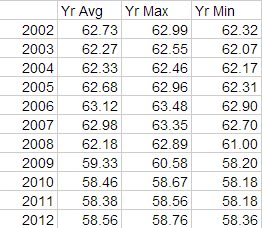
But in my book the real story is this; even with the top-line unemployment number under 8%, the work force participation rate is stuck at 63.6%, right where it’s been for three months after blipping above and below that figure for most of the past year.

Which means when you take the 7.9% unemployment rate out of that low labor force participation rate, you get 58.58% of the workforce actually working.

That compares to: 60.58% – exactly two points higher – when Obama took office (with an unemployment rate of 7.8%).  That translates to six million fewer people working in the labor force now, even with an unemployment rate that’s supposedly nearly the same.  Or to  58.50% in October 2009, when unemployment peaked at 10%.

That’s right; even with the unemployment rate supposedly two points lower than the recessions nadir, the actual portion of the population working is nearly unchanged.

And to show how in-set this recession is?  Here’s a list of

As you can see, the average of monthly employment rates (after taking the unemployed out of the participating labor force) is lower than it was when the recession supposedly bottomed out.

This isn’t a recovery.  This is an extended coma, with neither improvement nor much deterioration beyond the already awful state we’re already in.

And for 53% of the American people, it was apparently just good enough.

State Of Entropy

Thursday, January 31st, 2013

Joe Doakes from Como Park emails:

Kansas is a  right to work state.    Michigan is not.

GM plans $600M upgrade at Kansas City plant while Detroit edges closer to bankruptcy.

Just a coincidence, no doubt.  And easily avoidable under the principles of Obama-nomics:

“Detroit Council Member JoAnn Watson, who along with two other members of the city’s all-black City Council has been resisting reform measures, said she is still hopeful of a federal bailout or an injection of state money that she claims the city is owed.”

Coming soon to a location near you?

Joe Doakes

Como Park

If Moses had been a liberal, he’d still be waiting for the Coast Guard to part the Red Sea.

Not So Happy To Pay For A Better Minnesota

Friday, January 25th, 2013

Minnesota newspapers, largely, supported Governor Messinger Dayton and the DFL.  They largely not only bought the “Alliance For A Better Minnesota’s” bill of goods hook line and sinker, but most of them worked tirelessly to propagate it, and to squelch dissent from it.

They studiously avoided, almost completely, any reporting that would have impeded the DFL’s rise to power.

The Minnesota media, at large, were among the DFL’s most valuable players this past two electoral cycles.  At the highest levels – the Strib, the PiPress, and at least the programming arm of MPR – they serve as the DFL’s Praetorian Guard.

But now?  Now that the governor is tacking 5.5% sales taxes (for starters) onto print services, advertising and retail newspaper sales?

Not so much:

Business groups and retailers complain that the proposal would cost jobs. As he spoke to the Minnesota Newspaper Association, several editors and newspaper owners complained that a sales tax on newspapers would hurt their industry.

Tom West, the managing editor of the Morrison County Record in Little Falls, spoke about his concerns during a question and answer session.

“We are the ones who cover local government and state government, and we are wondering why you would think it would be a good idea to have less information about government and what government is up to,” West said.

(Cynical answer: “Because you’ve served your purpose”.  See also The Minnesota Independent).

(Slightly less cynical answer: “While your contributions to DFL hegemony were vital, you don’t have the same political clout as AFSCME, the SEIU or MPR).

(Cynical and partisan but realistic answer: “How about not just “covering local government”, but turnin a critical eye on the DFL?  For once?”)

Others said that expanding the sales tax to newspaper ink, paper and advertising would result in job losses. Dayton said he understood the concern but did not back away from his plan.

Job losses only matter if they’re union.

Small papers aren’t union.

Big papers are – and we’ll see what happens there.

As to the rest of you newspapers?  You got the government you mostly worked for, largely shilled for, and for the most part operated as in-the-bag PR agents for.  Most of your editorial stances praised Dayton and the DFL’s return to power.

So now you’re saying you’re not Happy To Pay For A Better Minnesota?

Suck it.

BONUS QUESTION FOR DFLers: What do you think happens when you tack 5.5% onto the price of something?

All other things being equal, people buy 5.5% less of it.

Ponder losing 5.5% of your business overnight.  Ponder hard.

It’s Still Only Hope For Change

Monday, January 21st, 2013

Unemployment is the same today as during the last inaugural.

Meanwhile, From The Laboratories Of Democracy…

Monday, January 14th, 2013

News flash:  States that govern according to conservative precepts – especially cutting taxes to spur growth – are doing better than “progressive” states.  Much, much better.  And yep, even government revenues benefit.

In the meantime, “closing the deficit” with taxes rather than growth is dragging “progressive” states down. And that’s presuming the tax hikes actually close the deficit, which is a dodgy proposition, given how tax hikes crush economic growth.

Question:  Which example do you suppose the MN DFL is emulating as they cackle madly over their word-processors today, cranking out bills by the pound?

Change A Vogon Can Believe In

Wednesday, January 9th, 2013

Joe Doakes from Como Park emails:

No less respected economist than Paul Krugman is recommending the US pay down its national debt by minting a Trillion-Dollar Coin. He suggests it be made of platinum because that’s really valuable. I say it should be rubber, not only because “rubber check” accurately captures its value, but because there’s precedent.

Hitchhiker’s Guide to the Galaxy:

“Its exchange rate of eight Ningis to one Pu is simple enough, but since a Ningi is a triangular rubber coin six thousand eight hundred miles along each side, no one has ever collected enough to own one Pu. Ningis are not negotiable currency, because the Galactibanks refuse to deal in fiddling small change.”

Obviously, we won’t call it a Ningi, that sounds weird (and we’d owe Doug Adams royalties). We’ll call it a $1 trillion dollar coin. But why stop at one? Why not go all out and issue 16 trillion-dollar coins to pay off the entire national debt completely?

And while we’re at it, why not raise the minimum wage to $100 so we’ll all be rich? And throw in free cosmetic surgery, paid for by Obamacare.

Rich, handsome, debt free . . . now THAT’s the kind of Hope and Change I was looking for.

Joe Doakes

Como Park.

I’m afraid to ask an esteemed economist like Prostetnic Vogon Krugman how we’re going to pay for a trillion dollars worth of platinum – or what that’ll do to the world’s platinum supply.


Due To DFL Control

Thursday, January 3rd, 2013

The Saint Paul Macy’s is closing in March.

Macy’s is closing its St. Paul store this spring, leaving downtown without a major retailer and bringing to a close 50 years of continuous department store operations at the Wabasha Street location.

Store employees were to be told this week that the store will shut down in late March, according to sources who did not want to be named.

On the one hand, it’s not really a surprise.  The place has been a morgue for years.  The only reason it stayed open as long as it did was to stay within the terms of a loan from the city back in 2002.  Since they hit the ten year nut, a few million dollars are going to be forgiven, store or no store.

So to summarize:  No store, no more payback, no anchor retail in downtown Saint Paul.

No nothing.

On some St. Paul list-servers, some DFL-leaning residents are feeling chipper about it: “maybe Target will buy the space?”

I only worked downtown for about four years – but this was actually fairly busy, as I recall.

Nonsense.  Target didn’t get to be a huge retailer by being stupid.  Saint Paul is not a retail destination – if it were, there’d be no such announcement from Macy’s.

(“But Macy’s is just stupid!”, some might respond – but their share value is clipping along rather well, so whatever their other faults, they seem to know a bit about keeping their stores profitable).

I’ll predict the following:

  • If there’s a free-market tenant for the building?  I’ll say look forward to the world’s largest Dollar Tree.  Complete with three floors of parking.
  • But much more likely?  It’ll be rented out to the State of Minnesota, or some other agglomeration of government entities.  Likely as not by consolidating people in from smaller rentals around downtown.

Bottom line?  Six decades of DFL control have left downtown Saint Paul a ghost town, populated only by wan holdouts, scrappy and bargain-hungry small businesses, a few corporations that haven’t quite pulled the trigger on relocation yet, hipsters (waaaaay down by the Farmer’s Market), a few lucky businesses (up by the XCel and the Ordway, assuming hockey comes back someday), a lot of state offices, and – for about a catastrophic third of the office space – nothing at all.

While I realize that St. Paul’s city government – strangled as it’s been by one party rule for sixty years now – didn’t specifically set out to make Downtown into a cold Flint, I have to ask – if they had, how would things be different?

Dear Saint Paul Voters:  Remember that “Definition of Insanity” joke?  Doing the same thing over and over again, and expecting a different result?

Pretty funny, huh?


Speculator!

Monday, December 31st, 2012

Joe Doakes from Como Park emails with a plan:

I’m going to stand in line for the park permit lottery and bid on Como Park, every Saturday in June and July.  Then I’m going to SCALP THEM.

Joe Doakes

Como Park

Beware, all you engaged people.

But watch out, Joe.  It’s a brave new world out there.  Ask any GM bond-holder.

Inhuman Resources

Friday, December 14th, 2012

The bad news:  Management at the KC Star is asking two employees to decide which among the two will be laid off:

You could call it the “Hunger Games” approach to layoffs – one that’s getting a big thumbs-down from workplace experts.

Hunger schmunger.  I call it the “Michael Scott” approach.

The Kansas City Star recently told two of its journalists, Karen Dillon and Dawn Bormann, that only one of them could keep her job — and the employees themselves would have to decide who should leave the company, according to the media blog JimRomenesko.com.

Dillion confirmed the report in an e-mail to NBC News, but did not provide any more details. The investigative reporter has worked for the Kansas City Star since 1991, according to her LinkedIn profile.

The good news?

Well, there really isn’t any.  Although the idea that yet another left-toady publisher is circling the drain is probably a nice consolation prize.

Correlation, Causation – Whatever

Wednesday, December 5th, 2012

To:  Dave Mindeman
From:  Mitch Berg, Non-Physicist
Re:  Elementary Logic

Mr. Mindeman,

I had yogurt, oatmeal and orange juice for breakfast this morning.  Then the sun rose.

Clearly, the yogurt, oatmeal and orange juice caused the sun to rise.

Thus, I owe it to humanity to have yogurt, oatmeal and orange juice tomorrow, lest the world be plunged into darkness.

You might respond “but Mitch, your breakfast didn’t cause the sun to rise!”.

To which I’d reply “No, it is a FACT!  I had my yogurt, oatmeal and orange juice.  And then the sun rose!”

You might reply “Mitch, that’s just stupid.  You’re taking a correlation between two factoids and claiming causation.  You’re ignoring the fact that the earth is rotating on its axis once a day, giving the sun the appearance of rising in the east…”

“Dave, Dave, Dave.  Bubbeleh.  You’re rationalizing.  And clearly afraid of something.  Now, if you don’t mind, I’m going to go play “Moby Dick” on the tabletop with pencils, to prevent the volcano from blowing up under Los Angeles.  Again”.

That is all.

(more…)

Meet The Two-Stage Snowblower Of Logic And Analysis

Monday, December 3rd, 2012

Last week, I addressed a Dave Mindeman post about the DFL whose highlight was Mindeman saying, essentially, “the beatings will continue until morale improves, and you’ll like it!”.

Well, no – his idea was the business has nothing to fear from DFL hegemony in the state.  We can debate that – indeed, we will – but in fact the bulk of my critique had more to do with his claim that business does better when Democrats are in charge. It’s just not true.

Mindeman responded last week with a post entitled, presumably with no irony intended, “Answering Mitch Berg with a Blizzard of Facts“.

The “unintended irony” bit is because most of the flakes in his “blizzard” that aren’t utterly irrelevant or non-sequiturs reinforce my point, and undercut his and, more importantly, the DFL’s and the lefty establishment’s (for whom Mindeman is a reliable crier).

Example:  He pointed out the liberal meme that “the economy does better when Democrats are in the White House”.  I responded that while that is “true”, it’s also dependent on macroeconomic context that goes way beyond the sitting President’s party.  Here – check that part out for yourself:

So when Mindeman writes…:

1. According to McGraw-Hill’s S&P Capital IQ, the S&P 500 has rallied an average of 12.1% per year since 1901 when Democrats occupy the White House, compared with just 5.1% for the GOP.

2. Gross domestic product has increased 4.2% each year since 1949 when Democrats run the executive branch, versus 2.6% under Republicans.

3. S&P 500 GAAP earnings per share climbed a median of 10.5% per year since 1936 during Democratic administrations, besting an 8.9% median advance under Republicans, S&P said.

Again, as I pointed out, there was more to it than just the “D” or the “R” attached to the guy at 1600 Pennsylvania Avenue.  The “Blizzard of Fact” completely dodges the important part – all that inconvenient context.  It merely piles data together to repeat a flawed thesis.

(And data from before 1933 is both irrelevant – the economy was fundamentally different before The New Deal – and a bit of a red herring, since there really was only one Democrat president between 1901 and 1933, the loathsome Woodrow Wilson, whose economy “benefitted” from massive wartime deficit spending).

Mindeman seems to have learned “fact checking” from the “Dog Gone” liberal obedience school: Google some figures, print ’em, and huff derisively at the fools one must suffer.  To be fair, it’s all one needs among leftybloggers.

But Dave’s not at the 331 Club anymore.  He goes on:

And just in case Mr. Berg wants to highlight Obama’s tenure….

A. Corporate profits have surged an average of 51.8% under Obama, the best out of any stretch of party control since 1933, S&P said.

Sounds good, right?

Except it’s not because business is banging along on eight cylinders.  It’s because businesses are sitting on their cash.  They’re laying off workers, and outsourcing jobs.  They are not investing in new plants, new products and new hires.

Mindeman’s factoid seems to support his thesis – but if you look at the context behind the figure, you find it supports mine.

B. The S&P 500 has also climbed an average of 12.3% each year since Obama’s inauguration, far outpacing the 3.3% mean return for his predecessor.

Asked and answered.  Businesses are sitting on cash. As noted over and over by pundits on both sides of the aisle, they took the bailout money and put it into CDs.  They’re outsourcing.  They’re getting leaner, and buckling in for a rough ride.  They are not expanding; they are sitting tight, tightening payrolls, paring back expenses, blowing out inventory.

That translates into booming profits – but not because business is healthy, thriving and growing.  Or has Mr. Mindeman not noticed the unemployment rate?

And just in case you question my sources… they all come from Fox Business News…an analysis from September 4, 2012.

Well, that’s great.

Unfortunately, they do nothing to change the fact that Mindeman’s thesis – that economies do better, historically, under Democrats than Republicans, is only true on the  most superficial level possible – a correlation between numbers and dates that ignores causation.  And, notwithstanding the unearned condescension…:

But facts never settle anything for conservatives.

…still ignores it.

Note to Dave Mindeman; your “blizzard” did nothing to address any of the historical or macroeconomic context behind the numbers; the fact that from 1945 to 1970, we were the world’s only functional export economy; the fact that some of the greatest shocks to the economy happened to occur during GOP administrations – the 1953 and 1958 Recessions, the Oil Embargo, Reagan’s sweating out of stagflation, the transition after the Cold War, the Dotbomb and 9/11 recession, the Subprime Mortgage collapse, none of which (except the 1982 constriction) had anything to do with Republican policy, or indeed, presidential politics of any stripe.

It was less a “blizzard” than a drizzle of non-sequiturs; a rhetorical version of yelling “pay no attention to the history behind that curtain!”.

And saying “conservatives aren’t convinced by facts” is a cozy bit of name-calling – but the fact (!) is, facts without analysis and context are just…well, snow.

———-

I don’t mean to be too hard on Mindeman.  He’s one of the small cadre of Twin Cities’ leftybloggers that doesn’t deserve to be under police surveillance.  Leaving the pro forma  condescension aside, the guy actually tries to debate.  Kudos to him.

But here are some bonus questions:

If business does so well under liberal Democrat rule, then…:

  • Why is Paul Krugman’s wet-dream state California floating toward the surface, its belly slowly rotating toward the sky, with a private sector that is leaving the state as fast as moving trucks can be secured?
  • Ditto Illinois, which seems, more than any other, to be the state the MN DFL most idolizes?  It’s taxes are among the country’s highest, and its debt is out of control, and it is collapsing bit by bit.
  • Indeed, why are 9 of the 10 states with the lowest unemployment not only run by GOP governors, but have fundamentally GOP cultures – while most of the worst performers are Democrat (or southern Republican, which have plenty of other problems that have little to do with politics)?
  • You say unemployment isn’t the sole arbiter of economic heath?  OK – how about business climate?  Eight of Forbes’ top ten states for business climate are Republican (and mostly the ones with the low unemployment).  Eight of the bottom 10 are run by Democrats (Alaska is mostly Federal property and a hard place to do business; Mississippi is a basket case no matter who runs it).
  • But if you’ve read my blog, you know that states are rarely purely culturally and politically Democrat.  Like the rest of the nation, even “blue” states are mostly like Minnesota – Democrat-clogged urban cores surrounded by red.   OK – every one of Manpower’s 10 Worst Cities to Find a Job” is Democrat, as are all of 24/7 Wall Street’s Worst-Run Cities in America.  Detroit, Newark, Chicago, Camden, Los Angeles, the District of Columbia, Cleveland, Toledo, Philadelphia, Sacramento – all have for generations been Democrat sinecures; all are collapsing, all are miserable business environments – entirely due to generations of Democrat policies.

Mindeman concludes, more or less, by saying he believes business will benefit from DFL control.  It’s a faith-based statement.  And that’s fine; one can cheerlead one’s team as much as they want.

But judged against actual evidence viewed in meaningful, complete context, it’s pretty clear that’s all that it is.

Nope. No blizzard here.  No need to even button your jacket.


Sums It Up Well

Wednesday, November 28th, 2012

Joe Doakes from Como Park emails:

Commenter “Troy” posted a great quip on a prior column, it deserves a post of its own:

***

President Barak “Underpants” Obama’s Plan for the Nation:

Step 1: unlimited debt

Step 2: ?

Step 3: Prosperity!

***

Genius!

Joe Doakes

Como Park

Neither Troy nor I are the first to note that Obama’s economic policy resembles this cartoon…

…which is famous among engineers and scientists, but not so much among liberal politicos.

In Which I Spike The Ball

Friday, November 23rd, 2012

Now, I’m not one of those people who’s crabbing about the way “Black Friday” has infringed on the sanctity of holidays.  Businesspeople have to do something to survive the Obama economy – and it’s the job of each and every person who believes in the sanctity of holidays like Thanksgiving, Christmas and Easter to lead from the front, as it were.

But I just wanted to say that after three days of hearing about and seeing people camping out in front of Target and Best Buy waiting for Black Friday in the wind and the snow, and seeing and hearing about people battling each other in the aisles last freaking night, I’m here, on the  morning after Thanksgiving; warm, drinking coffee, having a warm bowl of oatmeal, getting ready to go to work…

…watching all the chumps out for Black Friday.

Y’all do realize it’ll be generally cheaper later – right?

NPR’s Relentless Cheerleading Might Make You Presume…

Wednesday, November 21st, 2012

…that there’s a booming recovery underway.

Maybe it comes from the same place the Administration’s Benghazi statements did.  Because this is not what recovery looks like.

Today’s News, A Month Ago

Thursday, November 1st, 2012

Remember when the September unemployment numbers came out, showing a record .3% drop in unemployment in September, claming 800,000 jobs were created even though only 100,000 new jobs were reported?

I said it had to be a statistical problem – a disconnect between the large Jobs Survey and the small Household Survey?

Well, we won’t have the official numbers unti tomorrow.  But it’s not looking good for the President’s “recovery”.

Obfuscated In Plain Sight

Friday, October 12th, 2012


Joe Doakes from Como Park writes:

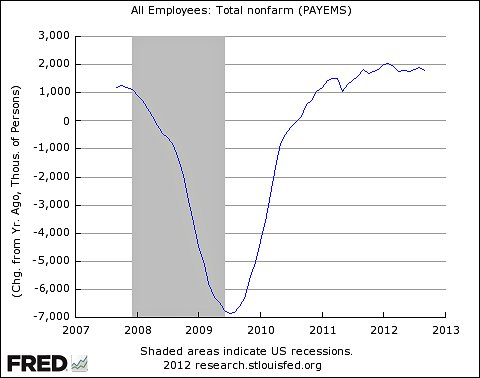
Looking at this chart, you might think non-farm employment has returned to pre-recession levels. No, the left side (Y-axis) measures CHANGE in jobs.

In other words, we’re no longer losing 7 million jobs per year as we did in 2009, we’re adding a million or so per year. But we’re nowhere close to where we were before the whole thing tanked.

Charts are supposed to make data EASIER to understand, to REDUCE confusion. What this one does is exactly the opposite. Since the guy releasing the chart is a Nobel Prize winning economics professor as well as a big Obama supporter, I have to wonder why.

Hat tip: http://www.powerlineblog.com/page/2?layout=blog

Joe Doakes

Como Park

I’ll quibble with Joe on one point.

Charts are supposed to make data…serve a purpose.  Usually, that purpose is “make it easier to understand”, it’s true.  But by no means always.

In this case, the Administration is using them to conceal facts in plain sight, and gull the low-information voter.

Gallup: “Truthers?”

Tuesday, October 9th, 2012

Gallup’s chief economist calls BS on last week’s “big unemployment drop”:

 While the payroll survey of businesses and government showed just 114,000 net new jobs created, the household survey showed a jobs boom, and it’s the latter which is used to calculate the unemployment rate. [Gallup Chief Economist Dennis] Jacobe:

“The problem is that even though the Household survey tends to be very volatile, this decline seems to lack face-validity, particularly after the prior month’s numbers. The consensus estimate was that the government would report that the unemployment rate was unchanged at 8.1% in September. GDP growth was 1.3% in the second quarter and seems to be no better this quarter. The government’s Establishment survey shows there were 114,000 new jobs created in September — very close to the consensus of 113,000 — and not sufficient to lower the unemployment rate.”

In other words, the numbers aren’t doctored; they’re just invalid.

“A quick comparison of the government’s seasonally adjusted and unadjusted employment data seems hard to reconcile with the weak economy. For example, the government shows the number of employed workers increasing by 775,000 in September from August on an unadjusted basis. This surge in hiring seems surprisingly large given the current economy, not to mention the even larger adjusted increase of 873,000. Similarly, the number of unemployed declined by 954,000 in September on an unadjusted basis. This is reduced to a smaller adjusted decline of 456,000 — but both numbers are also surprisingly large.”

His bottom line: “The Household results should be discounted. … The obvious conclusion is that a new employment measure is needed.”

Now, as Ed and I discussed on the show over the weekend, if the Household Survey was an outlier in September, it’s entirely likely that the next jobs report, due on November 2, will correct it, showing a sizeable jump in unemployment.  If that’s the case, it won’t be a jump, naturally – just the numbers returning to where they should have been in the first place.

It’ll be just as dishonest for conservatives to make hay out of that as the liberals are to try to do the same with last Friday’s number.

And I”ll remind conservatives of that fact.

On November 7.

--> Site Meter -->