Archive for the 'Minnesota Politics' Category

Calculations

Monday, November 28th, 2011

We’re heading toward the big show, when it comes to redistricting; oral arguments start next week, and we’re about five weeks away from a putative decision, just in time for Minnesotans to find out what precinct they get to caucus at.

And things are still very much in flux.

Jake Grovum at Politics in Minnesota has an excellent piece that sums up the main issues involved in the redrawing of the state’s lines.

The big yak about the Legislative (and, let’s be frank, GOP) plan is that it combines all of Northern Minnesota into one big Eighth district; it lumps a bunch of conservative northwestern Minnesota in with the always-Trotskyite Iron Range.

The single northern district plan prompted howls of protest from DFLers, especially on the Iron Range, but some say the demographics may force the five-judge panel to consider exactly that kind of realignment.

“The GOP map in the northern district is something that the panel is going to take seriously,” Jacobs predicted.

The DFL would very much like to protect the DFL’s one-time sinecure, and make it (in their dreams) easier for a DFLer to retake in 2012.

But the simple fact is the state’s demographics are changing; the Range and the Twin Cities are shrinking, along with much of outstate Minnesota – and the ‘burbs and exurbs are booming.  Those are facts, found in the census.

Not in the census, or through any other empirical source, but I will bank on it being true – the DFL-dominated regions are shrinking precisely because they are DFL-dominated regions.  The Range is dying, partly because the market for steel got priced overseas back in the sixties through the eighties, and partly because the DFL has spent decades trying to kill off any surviving parts of the mining industry (although somehow apparently believing that as long as there’s a strong union, the workers will continue to get paid for being there).

And as to the Twin Cities?

The metro-area corollary to the outstate dilemma is how to best balance the booming suburbs and exurbs with a mostly stagnant, yet distinct, urban core.

And the metro area is, I suspect, an even better example of my theory; sixty years of lock-step DFL domination, fiscal profligacy and politicized social policy have sent a fair chunk of the Metro area scampering for the ‘burbs.  You can see twenty or thirty years into the future by looking at an area’s schools – and when double-digit percentages of Minnesota’s parents, especially ethnic minorities, are decamping from the metro school systems in favor of charter schools and open enrollment in the ‘burbs, that doesn’t bode well for the Cities’ futures; to paraphrase the great political scientist George Clinton, when parents free their kids minds from the metro school systems, their asses will follow.

And they’ve been following for a generation now, and it’s only accelerating.  The DFL – and their retinue of astroturf activists at Draw the Line, Common Cause MN, the Minnesota Council of Non-Profits and Take Action Minnesota – desperately want the redistricting process to ignore this, and to give disproportionate representation to areas that do not have the population to deserve it, because the people are voting with their feet.

It’s this dynamic that points to perhaps the strongest advantage for Republicans — both in congressional and legislative districts.

The demographics are in the GOP’s favor. Republican attorneys already persuaded the five-judge panel to consider a more expansive 11-county metro area rather than the traditional seven-county region.

The entire mission of groups like Draw The LIne and Common Cause is to try to prevent, or forestall, that realization.

And they don’t care how they have to torture fact to do it.

More later this week.

Shutdown: Let’s Do It Again

Wednesday, November 23rd, 2011

Last summer’s government shutdown, according to Minnesota Management and Budget, was a wash:

A nearly three-week Minnesota government shutdown in July over a budget impasse left broad public frustration, but little impact on state finances, the state’s budget office said on Tuesday.

The longest and most expansive state government shutdown in Minnesota history left 19,000 government employees sitting at home and shuttered road construction projects, state parks, highway rest stops, the state lottery and horse racing tracks.

Costs for lost revenue from compliance with taxes, the lottery, the state parks and preparation leading up to the shutdown totaled about $60 million, but Minnesota also saved about $65 million in compensation not paid to state workers.

That, of course, was why the shutdown only lasted three weeks; Dayton left Saint Paul to go outstate, saw that nobody really cared, and realized that his gambit to squeeze Minnesotans into compliance with his tax-hiking platform was doomed.

Indeed the capsule summary shows a slim $5 million profit.  Here’s where I’ll call BS.  If the MMB – which is an executive office which reports to Mark Dayton – says it’s a $5 million profit, the state likely made out much better than that.

No, I have nothing to base that on – but experience watching the DFL-dominated bureacracy.  Which, in Minnesota, is both unsupportable and usually accurate.

Just saying.

Redistricting: Redefining “Middle”

Tuesday, November 22nd, 2011

Minnesota’s redistricting process – mandated by constitutions all up and down the governmental food chain to reallocate our congressional and legislative representation after accounting for changing populations – usually goes a little something like this:

  1. The party in the power in the legislature draws maps that favor their desired outcome, more or less.
  2. The opposing party draws maps that favor their desired outcome, more or less.
  3. Either neither of them wins legislative approval, or the sitting governor (generally) vetoes the legislature’s final product.
  4. The process goes to the courts, which draws its own map, imposes it on the state, and leaves behind some legal precedents and pseudo-legal guidelines (“preserve communities of interest”, “keep districts compact and contiguous”, etc, etc) for the next time through the process.
  5. Lather, rinse and repeat.

And we’ve followed that basic process this time.  The GOP-controlled legislature, led by Rep. Sarah Anderson, drew up a congressional and a legislative map.  According to Kent Kaiser of the “Draw The Line Minnesota” (henceforth DTLM) “Citizen’s Commission on Redistricting” (which I”ve written about at some length in the past – about the commission’s sham nature, Kaiser’s protestations about the commission’s process and DTLM’s opacity, and in the end about the joke they played on us all), the Legislature’s map hewed pretty closely to the precedents set over the past forty years or so of court decisions on the subject.  It did seemingly create a map with four safe-ish conservative seats, three safe DFL seats, and a fairly swing-y district.  The DFL association of various non-profits checkbook advocacy groups that does all the ground work for the DFL cried foul, of course.

Wrongly, I suggest.  The parts of this state that lean DFL – Duluth, the Twin Cities, the Range – have shrunk, at least partly due to people moving away from them and to the parts that actually work.  Which are largely GOP-leaning; the exurban Metro from the third tier of ‘burbs on out, the Rochester area, the drive-through land between Maple Grove and Saint Cloud.  Places with responsible, frugal, in-their-limits municipal government and good schools.

“Draw The Line Minnesota” (DTLM) submitted its congressional and legislative maps next.

And then, finally, last week, with much ado, the DFL’s current caretaker, Ken Martin, released the DFL’s official submissions (congressional and  legislative), to a chorus of catcalls…

…from the DFL.  The plan lumped Betty McCollum and Michele Bachmann into one large (and conveniently DFL-dominated) east-metro district – without telling McCollum:

The Minnesota DFL Party submitted a congressional redistricting plan Friday that would place Democratic Rep. Betty McCollum into a district with GOP Rep. Michele Bachmann…The plan has prompted McCollum’s chief of staff to send an e-mail criticizing the proposal.


“The DFL Chair and his high-paid lawyers have proposed a congressional map to the redistricting panel that is hyper-partisan and bizarre,” McCollum’s chief of staff Bill Harper said in the email. “Their plan ignores the judge’s redistricting criteria and it insults established communities of interest, particularly in the Twin Cities East Metro. Congresswoman McCollum has faith in the judges on the panel to draw fair political boundaries that will serve the best interests of all Minnesotans.”

That answers the question “is Bettymac capable of thinking a thought that isn’t blessed by her party’s higher-ups, anyway.

Dave Mindeman of mnpACT wonders:

I can’t decide for sure what the DFL strategy was here. Obviously, the elimination of Bachmann from a safe district was the main goal, but alienating your solid incumbents is an unnecesary side bar. As far as numbers go, a tweak to shore up Walz and another tweak to make Cravaack a little more vulnerable would have accomplished pretty much the same split guaranteed….a 5-3 DFL majority. The DFL lines work to that 5-3 with eliminating Bachmann….the tweaking of current lines would have been a 5-3 without Cravaack.

Mindeman, like a lot of DFL pundits, accepts it as a matter of faith that they’ll beat Cravaack next fall, in much the same way that they accepted that he’d get 30% of the ballot in 2010.  But that’s not really the subject of this post.

No, it’s that I, too, wonder what the DFL’s strategy is.

And to explain the strategy, I think I’m going to refer to the newly-minted “Berg’s Twelfth Law of Hyperbolic Empiricism”.

To wit:  “The humorous or hyperbolic explanation of “progressive” behavior is likely, in direct proportion to the recklessness, extralegality, deviance or confrontiveness of the “progressive” actions being analyzed, to be the correct explanation“.

And knowing that, the hyperbolic reason – “they are trying to release something so far removed to the left that the courts, applying their traditional Scandinavian conflict-aversion to the issue, in trying to split the difference between the DFL and Legislative plans, will find “the middle” is about as far to the left as the DFL really wanted in the first place”.

I’d put money on it.

Same-Sex Marriage: Six Theses

Monday, November 21st, 2011

As we start heading toward the next round of elections, both sides – the GOP and the DFL – are planning to make the biggest electoral hay that they can out of the Same Sex Marriage issue.

The GOP majority in the legislature put the issue of a Marriage Amendment on the ballot for next year.  The issue might just overshadow all other issues on the ballot, short of the presidency itself.

Just a couple of observations:

  1. Both Sides Need It To Be An Issue:  there’s evidence that the GOP left a lot of votes on the table in the 2010 gubernatorial election when Tom Emmer didn’t make gay marriage a key campaign issue.  Naturally, gay marriage is a bloody shirt that the DFL can wave at its constituents; they think it’ll get people to turn out.
  2. Neither side wants this issue to be resolved:  You caught the bit about this being a vote getter – or at least a perceived vote-getter – for both sides, right? It’s not just this election; however this amendment turns out next year, it’ll be an electoral carrot and stick for both parties to dangle out there for years to come…provided it’s not actually resolved, one way or the other.
  3. The GOP Has More To Gain By Keeping It As A Public Issue: While I agree with Andy Aplikowski that Minnesotans are generally a fairly socially libertarian bunch, I think that when you add up the math for the GOP, it’s a lot easier to get to “landslide win” if the evangelicans turn out for you.  And while evangelical conservatives will turn out for economic issues, throwing them some social red meat surely can’t hurt.  Can it?
  4. The DFL Has More To Lose: The Democrats nationwide are scrambling to give their base – to say nothing of independents – a reason to turn out next November.  Saddled with a turkey of a President, a Senate with approval lower than Mullah Omar, a slew of Senate seats at risk, the unions’ attempt to outsource agitation to the “Occupy” movement dissolving in a welter of filth, crime, sexual assault and counterculture dissipation, and Progressivism in the heartland rocked back on its heels by two-chamber flips in Wisconsin and Minnesota, the DFL needs to be able to wave the bloody shirt of “bigotry” at its gay and gay-sympathetic constituents.
  5. The DFL Needs It More: If the Democrats nationwide are in a public relations bind – still running against George W. Bush, looking forward to a campaign that has to answer the question “are you better off now than you were four years ago?” with “Hey! Mitt Romney has weird hair!”  – the DFL is worse.  They’re not really even a party anymore; The DFL is a shell that basically administers outsourcing contracts with “Alliance For A Better Minnesota”, “Take Action Minnesota”, “Win Minnesota”, “Common Cause”, “Draw The LIne” and other checkbook advocacy groups that do most of the “party’s” actual work; think “the Hessians”.  DFL could use something to get people to remember they exist.  (But they’ll likely subcontract this out to “Minnesotans For Marriage Equality”, a fully-owned subsidiary of “Alliance For A Better Minnesota”.  Yes, it’s fictional, but you know that’s basically how it’s going to work, don’t you?)
  6. The DFL Doesn’t Want Single-Sex Marriage Legalized: Think about it.  They’ve been nominally for gay marriage for thirty-odd years.  And from 2006, and especially 2008, through 2010 the DFL had absolute control of the Legislature; it was two chambers against Tim Pawlenty.  Now, the DFL maintains that a majority of Minnesotans support same sex marriage.  So if they actually believe that, why not push it through in the 2008 or 2010 sessions, when they had overwhelming control, were riding high on two landslide victories and the Obamascenscion?  “Because Pawlenty would have vetoed it!  Why waste the votes?” is the usual answer.  So why not bypass Governor Pawlenty and go for an amendment?  Or use that purported majority of Minnesotans that favor the issue to either override the veto, or use it to get Republicans voted out of office back in 2010?  There really are only two reasons; one would be that there just isn’t that much of an electoral demand for same sex marriage – but we just know the DFL wouldn’t blow smoke up the state’s skirt, would it?  The other reason is that it’s not in the DFL’s interest either to push this issue (in the oh-so-unlikely even they’re lying) or, I suspect most likely, they don’t really want same sex marriage legalized; that would take it off the table as a get-out-the-vote issue.
Discuss.

Victor: Wonks

Thursday, November 17th, 2011

You’ve probably heard:  Saint Paul had its first “Instant Runoff Vote” last week.

And I think the results demonstrated why so many cities that have tried to implement IRV have repealing it.

Doug Bass was less unimpressed by it than I was, and he helpfully ran an instant replay on the St. Paul Ward 2 “Instant Runoff”; 61% of Ward 2 voters initially rejected incumbent councilman Dave Thune, who won after three rounds of counting.  Bass unpacks the whole process (read the whole thing).

Bass concludes:

At this point, Im willing to accept that IRV provides a reasonable snapshot of the will of the people, until shown otherwise.  I would like to see the returns in more detail.  For example, out of all the first choice ballots for Thune, how were the second choices distributed?  Did a ballot with Thune as the fifth choice put him over the top?  Someone might say its none of my business.  But that doesnt keep me from wondering.

I have more pedestrian worries.  The campaigns this time around seemed to worry more about how to game the ranked-choice system than they did on actually talking issues.  Granted, it’s a one-party city, so they never have to actually talk issues.

Which is a signal fact of Instant Runoff Voting; it seems to get adopted in one-party cities like Saint Paul, Minneapolis, Tacoma and the like.  Could it work in a place with competitive races?

We may never know.  I’m not aware that it’s been tried.  And even many of the one-party cities that adopted it in a wave of fanfare over the past decade are quietly retiring the idea.

What do they know that we don’t?

It’s mostly a rhetorical question.

In Re The Senate Race

Wednesday, November 16th, 2011

The upcoming Minnesota Senate race, say some, is a foregone conclusion.  A-Klo in a walkover, says the conventional wisdom.

The MNGOP has three candidates vying for the nomination, so far..  Former State Representative Dan Severson is, by most accounts, the front-running.  Joe Arwood and Tony Hernandez round out the field of applicants so far.

I’ve interviewed Dan many times; in a just world, he’d be the Secretary of State today.  Hernandez ran a tireless State Senate campaign last fall in Saint Paul – which is like saying “the Light Brigade sure charged with energy!”, sure, but Hernandez is an amazingly sharp, capable guy.  And I met Joe Arwood over the weekend; I think he has a future in politics, too.   I could vote for any of them, after any of them gets nominated.

But let’s spitball for just a moment here.

What, according to the “conventional wisdom”, does the GOP need to win the Senate race?

The candidate has to be…:

  • Someone with some name ID.
  • Someone with some fundraising mojo.  That’s huge; with the departure of Bill Guidera from the race, I’m personally not seeing a fundraising superstar in the line-up.
  • Let’s be honest – conservative.  A-Klo has done a good job of fooling Minnesotans into thinking she’s “Center”-left, although she’s feeling confident enough in her chances that she’s actually come out and co-sponsored some Obama-blessed legislation – something she’s eschewed (along with most work of any kind) so far in her career in the Senate; she’ll have the media to cover for her and shade her to the center.  The GOP loses nothing by presenting voters a real ideological alternative.
  • Female.   Hey, it counts.  Minnesotans, I suspect, are hooked on the idea of their Senate delegation being a mixed doubles team.

So as I was thinking about this the other day, someone said “what do you think about Bridget Sutton?”

Sutton – a businesswoman who is currently on the Inver Grove Heights school board, is the wife of MNGOP chair Tony Sutton – which would be a two-edged sword, not only as a shrieking point for the DFL and media (pardon, as always, as always, the redundancy) but with elements of the MNGOP that are not happy with the current regime.

On the other hand, Sutton is smart, savvy, and would mulch Klobuchar in a debate.

So what does the assembled multitude think?

And who are we missing here?

Status Quo

Wednesday, November 9th, 2011

Nationally?  It was a long night last night – but one that proves only one thing; conservatives face a well-funded, entrenched enemy that can count on unions to turn all the money they need to run a defensive campaign, along with a media that is utterly in the bag for the left.

In Minnesota? The results of the Bloomington mayor and Saint Paul School Board races were disappointing – especially the SPPS race.  The Saint Paul Public Schools are a lost cause.  My kids have aged out of that sinking ship, which is the important part; unfortunately, my property has not.

Statewide, though?  Voters generally approved continuing existing levies, but (again, generally) rejected new taxes.  The voters apparently got the message – the Governor and the Legislature passed hundreds of millions in new K12 spending.  We’re already spending more.

Mostly, yesterday should be a wakeup call for conservatives.  Most Republican activists do it part-time, out of zeal and commitment one issue or another.  And for us, life gets in the way – kids, obligations, careers, even burnout cause the turnout to ebb and flow.  The Democrats and their supporters have people – organizers, demonstrators, researchers, even bloggers – who do all of these things full-time, for a living.

It’s going to be a busy year.  There’s no way around it; the next election is going to be for all the marbles.

Open Letter To Governor Dayton

Wednesday, November 9th, 2011

To: Governor Dayton
From: Mitch Berg, Bears fan
Re: Just a suggestion

Governor,

Just a quick point of order; badgering…

“It’s time for leaders of the Legislature to show some leadership to get this project approved,” Dayton said at a Capitol news conference.

…is not “leadership”.

The Democratic governor said he was prepared to unveil his stadium plan Monday but postponed his proposal last week after Republican leaders told him they opposed a special legislative session to consider a stadium bill.

Sort of like all your budget plans?

I digress:

Two rank-and-file Republican lawmakers have been drafting stadium legislation, but House Speaker Kurt Zellers and Senate Majority Leader Amy Koch have not proposed any ideas for funding a stadium and don’t want a special session to address the stadium issue until someone else offers a plan for them to consider.

Dayton asked of the leaders, “What are you for? What are you willing to support?”

Not sure what you think they’re supposed to do, Governor.  Drop everything to become the de-facto PR agent for a billionaire (or really a convention of billionaires) that’s trying to shake the citizens of this state down for another billion we don’t have and don’t want to spend?

Like you are?

Just saying.

That is all.

Top Ten Features Of The People’s Vikings

Tuesday, November 8th, 2011

There is no issue facing this state for which Representative Phyllis Kahn (DFL, Berkeley-via-Minneapolis) can’t come up with a tortuous government intervention.

The Vikings stadium? Natch; she wants to the state to sell shares, Packers-style, to give the state and “the people” a 70% share in the team:

The community ownership idea has been floated before but Rep. Phyllis Kahn, DFL-Minneapolis, said Monday she would introduce legislation to require Gov. Mark Dayton and the Metropolitan Sports Facilities Commission to work with the National Football League to make it happen. The commission owns the downtown Minneapolis Metrodome, the team’s home for nearly 30 years.

“Dayton asked for all ideas to be put on the table and that’s exactly what I’m doing here,” said Kahn. “No single idea [for funding a new stadium] has gained enough traction to pass the Legislature.”

But remember – this isn’t a 1920’s-era Wisconsin businessman proposing the idea.  It’s Phyllis Kahn, a woman for whom I’d make a joking comparison to some off-the-charts lefty whackdoodle, except that I can’t really think of anyone in Minnesota that’s farther out than her, so it just doesn’t work.

And, given that, we have to ask “what would a publicly-owned Minnesota Vikings look like under a plan involving Phyllis Kahn?

10. The Vikings would be at the Legislature begging for Local Government Aid every odd-numbered year.

9. The team would be required to participate in affirmative action to ensure they signed enough minorities.

8. The team name would need to be changed to something more reflective of Minnesota’s changing ethnography.  Something less violent.  In tune with the changing times.  Perhaps “The Minnesota Womyn”.

7. The team’s training camp would need to provide vegan options in the cafeteria.

6. The actual footballs would have to be made with no animal products.

5. NFL Players Association: Out.  SEIU: In.  (Bonus:  No need to change uniform colors).

4. The team would have to open roster spots for women, the handicapped, transgendered and non-athletic.

3. Rather than referees, each game would be decided by the crowd reaching a 90% consensus on all alleged rules violations, followed by a restorative justice process.

2. The team would be required to travel to the games via mass transit or bicycle

1. Blocking and tackling would need to be done verbally (including well-defined “safe words”) rather than via violence.

Others?

Reality Is Conservative

Monday, November 7th, 2011

Every once in a while, when I drop some factoid or another into a “debate” with a lib, I’ll wrap it with a bit of a verbal end-zone happy dance; “Sometimes”, I’ll say, “reality is just plain conservative”.

With that in mind – the five-member Judicial Redistricting Panel has ruled on the rules to be used in redistricting

…and it’s generally good news for those who support following the rules as they’ve sprung up over the past forty years or so:

For the first time, the panel said the metropolitan area should be regarded as 11 counties, not seven. As a result more exurban counties could be tied into districts in suburban and urban areas.

That was an approach Republicans favored, said Elizabeth Brama who represents the Republican party on redistricting. She said it’s unclear what effect the change will have.

“I don’t think it’s a question of one party or the other benefiting,” Brama said. “I think it’s more a question of just fairly representing where the people in the state of Minnesota live and how they organize themselves.”

Which, to be honest, is what the GOP has been shooting for all along; as Dr. Kent Kaiser has pointed out in numerous forums, the plan passed by the Legislature – really the GOP majority – did a good job of sticking to the letter and spirit of the body of law that this state has developed in its decades of sending these questions to the courts to decide.

It was the DFL that’s gone partisan; Mark Dayton vetoed the Legislature’s plan for purely partisan grounds.  (Actually, I suspect it was less “partisan” than that the unions, Alliance for a Better Minnesota and other groups that control the DFL didn’t give him permission to pass it).  And a group of groups that, by any rational measure, call at least some of the DFL’s shots – the groups behind “Draw The Line MN” – took their shot at skewing the system to favor “communities of interest” which, inevitably, are DFL constituencies.

Now, I’m going to do just a bit of place-keeping her for future debates.  I’ll add emphasis to this next bit, from Ken Martin, former head of “Win Minnesota”, one of the groups that funneled money from unions and liberals with deep pockets into the DFL’s campaign coffers, especially for their sleazy, toxic campaign against Tom Emmer last year.  He is the current chair of the DFL.

DFL party chair Ken Martin wasn’t surprised by those changes.

I think it’s pretty pro forma and certainly establishes a lot of the same principles that were in place ten years ago,” Martin said. “Again, without discussing this further with my team and being able to look at it more in detail, I can’t comment any more than that. But on the surface I think it’s fine. I don’t think it give any party an advantage over another.”

I’m emphasizing those passages now, for later.  Because you just know that if the Judicial Panel draws the lines based on these rules, the DFL and the groups that call its shots – the public employee unions, Alliance For A Better Minnesota, the Minnesota Council of Non-Profits, the League of Women Voters, Take Action Minnesota and Common Cause – will be screeching exactly the opposite, and demanding that you forget history in the bargain.

Because it’s a fairly simple thing – if you follow the rules set down in the past several court-decided apportionment decisions, the GOP should benefit; the parts of the state that support the GOP have grown, while the DFL parts have shrunk.  This represents many things – but we can not discount the fact that one of the key “communities of interest” are “people who moved to get the hell away from the cesspools the DFL has created” in the Twin Cities and Duluth.

The judical panel’s deadline to produce a redistricting map is February 21.

Attention Twin Cities Media

Wednesday, November 2nd, 2011

To: The Entire Twin Cities Media
From: MItch Berg, Schlub Taxpayer
Re:  Think, For Crying Out Loud

Jackals,

Watching your “coverage” of the Vikings stadium issue, I have to wonder if you haven’t taken a leave of absence from your DFL gigs and taken on some sabbatical work for the Vikings and the NFL.

Look – we all know your management all want a new stadium; it means more money for your organizations.  We get that.

But get real; The NFL wants and needs a franchise here; it’s one of the best football markets per capita in revenue and ratings. Jacksonville, to pick one, is a bad, former expansion team in a market that only cares about college ball; it only makes good business sense for the Jags to move – if you care about good business.  And the NFL does; it’s just that as the Minnesota Chamber of Commerce will tell you, “getting free stuff from goverment” is good business – at least, in the short term.

The NFL is bluffing us. They, and Wilf, are like a bunch of spoiled teenagers manipulating their parents.

They’re not going to move.  But they will try to make the taxpayer think they will – and like any spoiled teenager they will manipulate you, the media, with your need to keep your own bills paid (and I’ll give you the benefit of the doubt and assume you’re not actively shilling on the NFL’s behalf – which is a bit of a stretch, WCCO and Star/Tribune, if you catch my drift).

That is all.

RIP Al Stene

Monday, October 31st, 2011

Al Stene – who was thrust into the center of the Crow Wing County voter fraud scandal – has tragically passed away.

From a source close to the Stene family:

I just got off the phone with Sharon Stene. She said that Al had died yesterday of a heart attack. He had just returned home with James Stene after Crow Wing County had denied justice for the exploitation of their son James at Clark Lake Homes by Lynn Peterson. No one in Crow Wing County helped him and his son. In talking with Al before he left you could tell just how heart broken he was. I had never seen Al that way in all the years I have known him.

Let’s be clear on exactly what happened:  as we showed a few weeks back, there was clear, documentary evidence that four vulnerable adults who had been ruled incompetent to vote (along with Stene, who had never been ruled incompetent, but in testimony to the Crow Wing County Commission showed no interest in or knowledge of elections) were in the Crow Wing County Courthouse exactly when Monty Jensen said they were, and all voted, despite not only the court orders but the presence of group home workers who are supposed to keep their charges in compliance with the law.  The County Attorney convened a grand jury – which, in case the point is lost on you, essentially confirmed that everw single thing claimed by Stene, Monty Jensen and the Freedom Council was true, but nonetheless ruled (according to sources close to the case) that ignorance of the law is an excuse under Minnesota law, at least when it comes to election fraud.

This is tragedy beyond words. Please pray for his family. Al is in a better place, the is justice there.

I spoke with Al Stene.last spring,  He was furious at his son’s exploiitation at the hands of the group home staff – and at the sense of entitlement they expressed at his objections.

Adios

Wednesday, October 26th, 2011

Joe Doakes of Como Park – like me, a Ramco resident – writes:

Minneapolis wants the Vikings downtown, rather than in Arden Hills, and is willing to pay for the privilege of hosting those perennial losers.

When it comes to talking innocents out of their money, Tom Sawyer had nothing on the NFL. Minneapolis is about to learn that . . . again.

Better them than us.

Joe Doakes

Como Park

Go Bears.

The Potemkin Commission, Part III: In The Bag

Tuesday, October 25th, 2011

Yesterday, we talked about the main body of Kent Kaiser’s long, scathing letter (provided in its entirety below the jump) to the judicial redistricting panel.   In the first part, I covered his commentary about the map that “Draw The Line” and its “Citizens Commission” released.

Today – Kaiser’s comments about the commission, and about “Draw The LIne” itself. Emphasis is added.

Beyond my concerns about having only one, minimally critiqued map to consider, I have other concerns about Draw the Line, having to do mainly with the credibility and transparency of the commission’s products. As one of only two “known” Republicans (the other besides me being Anne Mason) on the commission of 15 members, I constantly stressed the need to verify that everything done by the commission was done in a nonpartisan way. Such verification was never made possible, and I really believe such verification was necessary in order to ensure the integrity of our deliberations.

And Kaiser pointed out exactly what I did a few weeks back; the “Citizens’ Commission” is nothing but a thin layer of astroturf on “Draw The Line”‘s leadership’s centralized push for a DFL-friendly gerrymandering job.

Kaiser brings up a number of points…:

My concerns about our commission’s credibility are grounded by several points and are shared by other commission members who have spoken with me individually.

• I believe the political leanings of some involved with and directing the actions of Draw the Line were problematic. The involvement of TakeAction Minnesota was of particular concern to me. TakeAction Minnesota is a liberal interest group that spent almost $200,000 on Independent Expenditures in 2010 against Republicans or in support of Democrats. The involvement of Common Cause was also of concern to me. While Common Cause supposedly stepped back from involvement with our commission once it was started, it is difficult to believe that there was no influence. Even the involvement of the League of Women Voters, with its liberal policy agenda, was of concern to me.

So Kaiser also notes the “commision’s” bias.

• There was a great deal of cross-pollination among these liberal special interest groups but no attempt to cross-pollinate with conservative groups. I do not believe that the appointment of a couple of known conservatives to the commission for the purpose of window dressing suffices in providing a balance or a cross-check.

As I noted in my earlier piece, on the Northern Alliance, and on “The Late Debate” – Kaiser and Mason are indeed Republicans and conservatives – and provided only the faintest waft of “balance” to a group, and a process, that was suffused in every other way with “progressives” and their agenda.

• In addition, I think it is problematic that the people doing the real work for the Panel’s consumption did not represent the political diversity of our state. David Wheeler, the program coordinator, is a former Duluth City Council member and is currently an elected member of the Minneapolis Board of Estimate and Taxation, who was endorsed for political office by numerous DFLers including Minneapolis Mayor R.T. Rybak, State Senator Scott Dibble (DFL-Minneapolis), Duluth Mayor Don Ness and several Minneapolis city councilmembers. In addition, the mapping specialist who was hired at the last minute (Linden Weiswerda) and whom we originally thought was independent and nonpartisan turns out to have worked for President Obama’s campaign in 2008. Here, the staff clearly missed an opportunity to provide a sort of check-and-balance within our process—they easily could have found a Republican-leaning mapping specialist.

• While our mapmaker was a undoubtedly a hardworking individual, he ultimately had to make decisions on Draw the Line’s legislative map that the majority of our commissioners did not have time to examine, change, or weigh in on. Decisions about how to draw the map, about what criteria to emphasize in drawing the map, and about publicity and messaging about the map were determined heavily behind the scenes, by staff. Commission members were asked in a hurried way to consider and approve materials. Several of us had a “trust, but verify” attitude about the arrangement, thinking that there would be an opportunity to get independent verification that the numbers used to determine political indices of the final map were legitimate, yet there ultimately was no opportunity for verification of the work.

Remember – “Draw the LIne” and its apologists tell you that they are all about “transparency”.  And yet the proof was in the pudding.  And the process Kaiser describes is about as transparent as pudding.

Even when our map and report were set, they were “embargoed” until [Friday, October 21], the very last minute to send materials to the Panel, and thus they were not open to public comment, scrutiny, or criticism. This was especially problematic, I think, for a process that was billed as being transparent—it clearly was not transparent.

Kaiser’s conclusion?

I also hope that the map put forward by our commission, as compelling and interesting as its pictorial nature might make it, does not have undue influence in the Panel’s deliberations, for it and the method by which is was developed deserve to be scrutinized in ways that they have not been to this point.

Again, I urge the Panel to reject the map submitted by Draw the Line because the map drawing process was secretive and flawed and ultimately resulted in a poor map.

So a “non-partisan” group “dedicated” to “transparancy” created a redistricting plan that was none of the above, and created a potemkin “commission” to reduce the stench of illegitimacy.

This whole charade should outrage anyone of either party who values genuine multi-partisan discussion of redistricting. .

(more…)

The Potemkin Commission, Part II: Transparency Is For Peasants

Monday, October 24th, 2011

A few weeks ago, I noted that “Draw The Line Minnesota” – a liberal astroturf group floated by fellow liberal astroturf groups Common Cause, the League of Women Voters, Take Action Minnesota and the Minnesota Council of Non-Profits, but which nonetheless protests that it is “non-partisan”- had convened a “Citizens Commission” to take public testimony on redistricting.

Kent Kaiser, one of the members of that commission, is speaking up.  In a letter sent to the judicial Special Redistricing Panel, Kaiser notes the Potemkin nature of the “citizens commission” and, much more importantly, hammers the lack of “transparency” in a process run by a bunch of groups who support “transparency for ye, but not for we”.

The full letter is displayed below the jump.  I’m going to pull some money quotes, and add a bit of emphasis.

Kaiser cuts to the chase fast.  Many critics of the “Draw The Line” process have noted that it served, essentially, as the DFL’s map-drawing process (which, by the way, the DFL never actually did; the DFL caucus submitted no map proposal, despite having a fully-budgeted redistricting office).

Kaiser points out that that seems to be the case:

 Based on my experiences with Draw the Line over the past several months, I urge the Panel to reject the map submitted to the Panel by Draw the Line because the map drawing process was secretive and flawed and ultimately resulted in a partisan map that fails to reflect the objective demographic shifts that have occurred in Minnesota over the past decade. I think that because of its high number of incumbent legislator pairings and because it pairs only Republican members of Congress, the map is too likely to benefit the Democratic Party.

And “Draw The Line’s palaver about “transparency?”:

I am especially concerned that we commission members were not allowed sufficient time or access to the map to critique it objectively or to determine its implications before we were led to approve it..

…While I believe our commission did good work in agreeing on a set of principles for redistricting and in trying to get the public involved in the process, I am concerned that the process used in producing a map was ultimately no better than the State Legislature’s process. I know that I am not the only commission member to think this way.

Bear in mind that Kaiser wasn’t condemning the Legislature’s process; on “The Late Debate” a few weeks ago, he noted that the Legislture’s map adhered to the letter and spirit of the body of law that’s grown up around redistricting in the past forty-odd years in Minnesota.

Not to speak for Kaiser – he does that just fine himself – but I think the point is that for all “Draw The Line”‘s rhetoric, they are really just another partisan effort – and, in this case, one that actually yielded nakedly partisan results:

In a documented email sent to all commission members and staff, another commission member (of unknown political affiliation) voiced concern over the commission’s process, when he was stifled from discussing map alternatives in the last of our meetings. I quote directly from the email here:

The quote is in the full email; it notes that the “Draw The Line” map was, in short, pretty blatantly gerrymandered and, more importantly, was completely at odds with what “Draw The Line” claimed was the “Citizen’s Commission”‘s purported mission; they delivered one map:

‘ With one map, the committee had only one choice. That, of course, is not a choice. And the false claim that it was a committee drawn or even a committee guided map, I could not in good conscious endorse…

I’ve been calling it “the Potemkin Commission”.  That may have been unfair – but it’s pretty clear that the map is a Potemkin Map, delivered under false, trumped-up pretenses.

Despite the committee’s purported dedication to be open and transparent, the  most important part of the map drawing process—the map drawing itself—was notably not open and not transparent, even to the committee members. It was

done in private, “behind closed doors” as Draw the Line’s website puts it, by one or two persons with occasional contributions by some committee members. This is no improvement over the legislature.

The result speaks for itself. The committee’s website says the system is broken. The map the committee ultimately endorsed is substantially similar to the map that the broken process produced ten years ago. That is a severe indictment against the committee’s work in the committee’s own terms.

All of “Draw The Line”‘s talk of “transparency” and “openness” is so much baked wind.

Kaiser continues:

Maps are captivating. They are impressive and persuasive just by virtue of their pictorial nature. Yet our commission has said time and time again, and especially after analyzing our map’s high number of “pairings” of legislators, that our principles could fit many maps, and I hope the Panel will not be persuaded that our commission’s map is the best at applying our own principles, especially inasmuch as it was rushed through production and exposed to little critique or tweaking.

And – let us not forget – painstakingly hidden from public view until the last possible moment, which was last Friday, the deadline for submission to the courts.

More tomorrow.

Gary Gross also writes about Kaiser’s letter.

(more…)

Luca Brasi Speaks

Wednesday, October 19th, 2011

I haven’t written a lot about the Vikings stadium controversy.  Partly it’s because I have little to say other than “build what you want, but don’t use any taxpayer money”. Partly it’s because I’m too busy saying “Go Bears”.

And partly because Mr. Dilettante has it covered.

His series on the ongoing Arden Hills shakedown – up to seventeen parts and counting – touched on the visit to Minnesota by the NFL brass who, in an example of the worst optics I’ve seen in this sort of a situatiion since the CEOs of GM and Chrysler flew to Washington in corporate jets to talk with Congress, pulled up to the site of the shakedown talks in a limo.

And he commented on the remarks by the NFL’s spokesman, former Goldman-Sachs employee Roger Grubman:

And in case you were thinking that the Los Angeles option isn’t real, Grubman offered this bon mot:

“To me, if I were a Minnesotan, any alternative other than Minnesota would be equally as bad,” he said.

Got the message? That Grubman is crazy, man. You don’t know what he’ll do. He’ll move the team to Wichita if that’s what it takes. He’s nuts and he’s serious. He’ll take your team away in the blink of a gimlet eye. You better pony up, rubes valued citizens of Minnesota.

So the question is out there. Do we build Zygi World in Arden Hills on the old ammo dump site? Or does the NFL drop the bomb? As much as we’ve all tried to pretend otherwise, I suspect we all knew this moment was coming. The NFL and the Wilfs are going to give Minnesota one chance to answer.

Of course, Jacksonville has worse financials and is a market that, unlike Minnesota, has almost no NFL tradition and doesn’t have a fifty-year record of selling out games even during turkey seasons like this one.  Rationally, they are a much better candidate to move to LA.

But the NFL, and our DFL governor, don’t want you to think rationally about this. They want you bouncing between hazy purple and gold nostalgia on the one hand, and Grubman’s little leash-yank on the other.

Read Mr. D’s whole series.

Grand Jury In Crow Wing County: Day One

Wednesday, October 19th, 2011

Yesterday, Crow Wing County (CWC) Attorney Don Ryan held the first day of his grand jury deliberations.  While the CWC Attorney’s offices don’t release details of grand jury probes, virtually everyone involved in last year’s Crow Wing County voting irregularities case – over a dozen people – have been subpoenaed.

What happened?

We don’t know – grand jury proceedings aren’t public.  The panel is scheduled to meet through tomorrow.

However, this is going to be a doozy of a story on Thursday, or whenever the grand jury releases its indictments.  Or doesn’t.  Either way.

Grand Jury In Crow Wing County: Today

Tuesday, October 18th, 2011

Today, Crow Wing County (CWC) Attorney Don Ryan is convening a Grand Jury.  As noted last week, county attorneys don’t customarily reveal the subject of a grand jury’s deliberation – but we do know that Monty Jensen and Al Stene, two principals in the case this blog wrote about last year in which it appeared that staffers from a home for vulnerable adults were filling out ballots for their charges.

The Grand Jury is going to be in session, officially, through Thursday.  We likely won’t hear much about the proceedings until they’re over.

I’ve run down the story’s chronology a few times, most recently last week.

I published this bit, last week – but it was buried in the middle of larger PDF file.  I thought I’d break this one out a bit.

It’s the list of people who took out absentee ballots last October 29 – the Friday before election day.

You can see Monty Jensen, who pops up at 4:31 on the list.

And you can see Jim Stene, at 4:18  – who was legally entitled to vote but, according to his father Al, had no interest in voting and no knowledge of how government works (even answering “Gerald Ford” when asked who the president was).

And you can see Daniel Carel (4:24) and Crieg Ruesken (4:21) who, as we showed last week, are under guardianship and unambiguously not allowed to vote under Minnesota law

The list shows that Stene, Carel and Ruesken all voted at the time that Jensen said he saw the group from the Clark Lake group home voting, and at which he alleged that he saw their ballots being filled out by staff.   This contradicts statements in the mainstream and alt-media that nobody from Clark Lake was in the building at the time Jensen claimed.

I’ll be bringing you the news from the Grand Jury as soon as I find out more.

Real

Friday, October 14th, 2011

Let’s be clear about this: I do appreciate the leftybloggers and lefty pundits in the Twin Cities that can have a civilized debate for more than one round without diving straight into the name-calling.  They are rare, but given the number of “progressives” in the Twin Cities, there are still plenty of them.

That’s not just smack-talk.  I grew up in a liberal household, I was a liberal til my early twenties, and my parents still are (although all three of us Berg kids did in fact see the light), so I have no interest in demonizing or pointlessly antagonizing liberals; I have to visit them over Christmas, for crying out loud.

Anyway, I get along with Jeff Rosenberg just fine.  He’s a good guy.  Wrong about most things, but then so’s my Mom, and we get along too.

Anyway, Jeff bit on that most classic bit of inter-party smack talk, “The Real American”:

According to Sarah Palin during the 2008 presidential campaign, I’m not a “Real American,” because I live in a city.

That one seems to bug a lot of libs.  Which, to be fair, is what it was intended to do.  It’s “smack talk”; sorta like saying “your momma’s so fat, they can’t even find the search party they sent down her butt crack to find the missing airplane”; it doesn’t really mean that anyone’s missing, or that any of that could fit between “your momma’s” buttcheeks, or even that any of us have met your mother.

It’s just supposed to get you too angry to think about your game.  It gets me – the smack-talker – into your head.  It puts me in control.

And it worked!

Now, it is a fact that America’s urban areas tend to vote Democrat.  And it is a further fact that Democrats, while often proclaiming the depth of their patriotism, also have a really hard time with the idea of American exceptionalism; patriotism in a red county may be chock full of God Bless America and the Troops and “Shining City On A Hill”, while in a Blue county it is frequently more a matter of “We’re a lot less unlike France than we used to be, and with 12 more years of Obama and Dayton, we’ll get even better“, and yes, I know I’m simplifying things, but work with me here.

So it is a logical deduction that an urban American is less likely to believe that America is anything special.

Rosenberg:

Apparently, Palin isn’t the only one who feels that way. Minnesota Supreme Court Chief Justice Lori Gildea feels similarly: I’m also not a “Real Minnesotan.” At least, that’s what she told an audience in Brainerd:

Jeff quotes a City Pages piece:

“I’m so happy to be in real Minnesota,” Gildea said.

Okay, well, maybe Gildea was just coming down from an acid trip, and couldn’t tell if she’d actually been in the state of her birth. Let’s give her a chance to explain.

“Outside of the Twin Cities,” Gildea clarified.

Darn those SCOM justices and their smack talk!  Now, we’re going to have 50,000 leftybloggers’ undies in a bunch!

And Rosenberg must be wearing boxers, because the bunch is obviously painful:

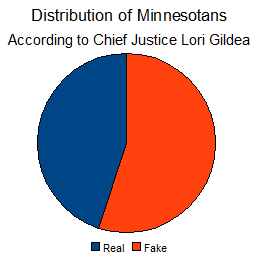
Got that, everyone? The only “real” Minnesotans are the ones who live outside of the Twin Cities, the place where most Minnesotans live. That made me wonder: Just what percentage of Minnesotans are real?

Warning:  A Democrat is about to attempt to work with empirical, geographical and demographic data.  This could get ugly.

That’s why I’ve put together a handy chart to give you an idea of how it breaks down. The chart uses the smallest possible definition of the Twin Cities, the seven-county area.

Here’s Jeff’s chart, for starters:

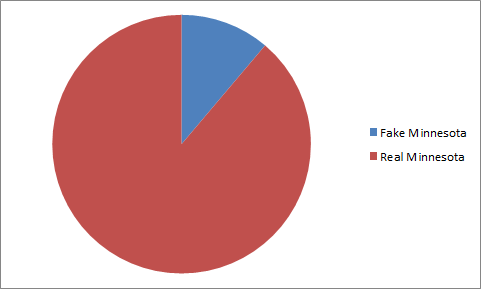
And can we get all you good Lakeville and Maple Grove “Real Minnesotans” to sound off here?  That’s not the smallest possible definition of the Twin Cities.

That would be, er, the Twin Cities; 667,646 people according to the 2010 census, between Minneapolis and Saint Paul.

So an accurate chart looks a little more like this:

I wasn’t sure if the exurbs were real; Gildea hasn’t yet clarified how many acres of land you must own to be a real Minnesotan.

All right.  Time for a cleansing breath, everyone.

(Whooosh).

OK.  If you’re going to get all knotted up over other peoples’ smack-talk, then the game is no fun.

Still, speaking on behalf of all conservatives, I’ll work with y’all on this.  Tell your buddies in the SEIU, MAPE, AFSCME, the MFT and the Teamsters to stop calling themselves “labor”, or at least “workers”.  I’m not in a union (anymore), but I most definitely work.  Indeed, among “real workers” in the private sector, 91% of us “workers” apparently aren’t “workers” according to “labor”.

As long as you wanna be all literal and all which, I stress, I don’t.  Not really.

That is all.

Grand Jury In Crow Wing County: Reset

Friday, October 14th, 2011

In this week’s coverage of the Crow Wing County voter fraud allegations, I reported that Crow Wing County (CWC) Attorney Don Ryan is empaneling a grand jury this coming Tuesday – and while Ryan hasn’t announced the subject, he’s subpoenaed Monty Jensen, who has brought allegations that Clark Lake Group Homes staff bussed mentally handicapped residents to the CWC Court House and filled out their ballots for them.

I have also learned that Al Stene – the father of Jim Stene, a 15-year resident of Clark Lake Group Home – has also been subpoenaed.   The Stenes spoke at the CWC Commission last spring in an emotional testimony that showed Jim Steme – who suffered heartbreaking brain damage in a near-drowning accident as he tried to save his sister in an accident in his teens – hadn’t the slightest interest in politics, and thought the current President was Gerald Ford.  Stene – who is not legally barred from voting – had been a Clark Lake resident for 15 years, and had never voted before last fall, and claimed before the CWC commission to have had no interest in voting.

That is as opposed to the four residents we spotlighted yesterday who were legally barred from voting, in as many words on court orders, who did in fact also vote – in every case, for the first time, last fall.

I may have more – much more – before the grand jury meets on Tuesday.

(Cross-posted at True North)

Grand Jury In Crow Wing County: The Paperwork

Thursday, October 13th, 2011

As I noted yesterday, the Brainerd Dispatch has reported that Crow Wing County Attorney Don Ryan has empaneled a grand jury for this coming Tuesday.

:While Ryan has not officially announced the subject of the grand jury, he has subpoenad Monty Jensen, the Brainerd resident and disabled veteran whose video claiming to have seen disabled adults having their ballots filled out by group home staff at the Crow Wing County Courthouse the Friday before the last election, in late October 2010.  (I carried the video here, a video that got me an Instalanche right around election day last year).

The case has followed more or less the following rough chronology:

  1. The Crow Wing County (CWC) attorney Don Ryan ordered an investigation by the CWC Sheriff’s office.
  2. After a Sheriff’s investigation (which interviewed Monty Jensen’s estranged father, but ignored at least one actual witness to the alleged voter fraud), Ryan decided that, in his discretion, there was no case.
  3. An avalanche of calumny from the media and the lefty alt-media descended on Monty Jensen.
  4. Al Stene, father of James Stene, a resident at Clark Lake Group Home, found that his son – who suffered serious brain damage in a near-drowning accident at age, and knows nothing of politics – had been apparently inveigled into voting.  Stene was outraged.
  5. Eric Shawn of Fox News picked up the story.
  6. A group of activists have spent much of this year digging for more information.

Which brings us to today.

A source close to the case has provided me with four sets of documents:  each of them a court order showing a Clark Lake Group Home resident to have been placed under guardianship and had their rights to vote explicitly rescinded, and the Crow Wing County absentee ballot lists as well as the ballot envelopes,all indicating that they voted.

Copies are provided below the jump.
(more…)

UPDATE: Grand Jury In Crow Wing County

Wednesday, October 12th, 2011

As I noted earlier today, the Crow Wing County Attorney’s office is empaneling a grand jury starting next Tuesday.

I have learned since then from a source close to the case that the Crow Wing County Attorney has evidence that four residents of the Clark Lake chain of group homes in the Brainerd Lakes area, whose names were found on the county’s absentee voter list for the 2010 election,  had court orders ruling them ineligible to vote.

More tomorrow.

Grand Jury In Crow Wing County

Wednesday, October 12th, 2011

According to the Brainerd Dispatch, a grand jury is being empaneled in Crow Wing County next Tuesday. 

Crow Wing County Attorney Don Ryan on Tuesday confirmed a petition to convene the grand jury was filed.

However, Ryan is prohibited by law from saying what the grand jury is being called to consider. By law, what transpires in the grand jury chamber is kept secret.

However, the Dispatch notes that Monty Jensen has been subpoenaed to testify:

In the fall of 2010, Jensen said he was at the courthouse when residents of a group home, who were accompanied by staff members, were voting. At the time, Jensen said what he witnessed crossed the line of proper voter assistance and amounted to the manipulation and undue influence of vulnerable adults.

We covered this last November, in what was one of the highest-traffic stories this blog has ever covered; Jensen, in a series of videos that this blog helped go viral, claimed to have seen residents of a group of group homes being assisted with their voting in a manner that allegedly violates state law.

Crow Wing County Attorney Don Ryan initially declined to pursue much of an investigation – the law allows the county attorney a lot of discretion in such matters.  Sources close to the story, however, indicate that the investigation carried out by the Crow Wing County Sheriff’s Department was “a sham”, which seemed to focus more on Monty Jensen’s bona fides than on the charges he’d made; while Jensen’s father (from whom Monty Jensen had long been estranged) was interviewed extensively, while more than one witness to the actual alleged incident went allegedly uninterviewed.

Since last winter, of course, more evidence has surfaced; at least one resident who had not been ruled incompetent to vote and stated no interest in voting turned up on the absentee voter rolls – not “illegal”, perhaps, but very possibly exploitation of a vulnerable adult.

It is not currently publicly known whether further evidence has prompted Ryan’s action.

In Minnesota, a first-degree murder charge with a life sentence may only come from a grand jury indictment. Election law issues may also be brought to the grand jury. A prosecutor may present factual information to see if there is enough to justify proceeding forward with an indictment in a bank robbery, for instance.

This represents a major reversal on the Crow Wing County Attorney’s part.  As such, a Grand Jury makes sense; while some indictments (like First Degree Murder) require grand jury findings, others are brought to give a County Attorney cover, as if to say “the indictment wasn’t my call; it was the Grand Jury’s decision”.

The Later Debate

Monday, October 3rd, 2011

Why, yes – I did spend a bit of time talking redistricting over the weekend, now that you mention it.

On the NARN, it was my pleasure to interview MNGOP Chair Tony Sutton and his deputy, Michael Brodkorb (punctuated by a surprise appearance by Wisconsin governor Scott Walker; I’ll be posting the podcast link as soon as I find it) about the redistricting process and all the outside money the left is pouring into Minnesota to try to skew the process in their favor.

And then, last night, I drove out to Ramsey to appear on “The Late Debate” with Jack Tomczak and Ben Kruse.  I was on a panel with Gary Gross of Let Freedom Ring, Mike Dean of “Common Cause Minnesota”, and Kent Kaiser, who is part of Draw The Line Minnesota’s (DTL-MN) “Citizens’ Commission”.  In the interest of accuracy, I’ll note that in my piece last week, I lumped Kaiser in with the Commission’s liberal hypermajority, because I personally didn’t know any better; Kaiser is of course well-known in GOP circles as one of the good guys; I regret the error…

…especially since he was the unquestionable star of last night’s debate.

I’m not going to try to reconstruct the whole thing from memory – you can check out their podcast at their site, and Gary Gross did an excellent rundown of the proceedings over atLFR.

I’ll recap this bit, though; I walked in there with two main points:  I walked out with four:

Who’s Politicized?:  As Kaiser noted, the GOP legislative majority’s proposal follows the letter of the law, and the spirit of the last several judicial decisions, pretty closely.  The DFL’s map was…well, nonexistant.  They never drew one up.

It was Governor Dayton’s veto that was, as Kaiser noted, exceptionally politically capricious.

And this entire process recaps a pattern we started seeing during the 2008 election, and rose to a crescendo in last year’s gubernatorial race; the DFL isn’t so much a political party as it is a political holding company, outsourcing its actual policy and boots-on-the-ground work to its “strategic partners” – the unions, and the array of astroturf pressure groups like “Alliance For A Better Minnesota”, “Take Action Minnesota”, MPIRG, and “Draw The Line”.

Outside Money: Behind all of Draw The Line and Common Cause’s noble chatter about getting people involved – nay, getting them interested – in the redistricting process, the fact remains that a raft of “progressive” organizations are doing their level best to try to jimmy the redistricting in their favor, in a census period in which GOP-leaning districts exploded and DFL-districts continued withering.  The demographics aren’t a state phenomenon – and either is the left’s effort; “Draw The Line” is a regional, not state, entity, focusing on trying to attenuate (at least) the gains the GOP should get from pure demographics.  More below.

Competition: One of DTL-MN’s priorities – because it’s one of the priorities of its supporting groups (Common Cause, the League of Women Voters, the MN Council of Non-Profits and Take Action MN), is “competitive elections”.  On a policy level, this goal – making sure that politicians are accountable to electoral pressure from their voters – is laudable enough.

It’s at the implementation level that it either breaks down or shows its ideological stripes, depending on your point of view.  Minnesota is a divided state – but not evenly or consistently divided.

Let’s look at the example of a hypothetical state of about five million people, which is closely divided on a statewide basis – but where the division stacks up as follows:

  • An urban core – three, really – of about a million people that votes about 70/30 Democrat.
  • An outer-suburban and exurban ring that votes, in a good year, maybe 52-55 percent GOP.  Let’s assume a huge year, and say it’s 55-45 GOP.
  • The rest of the state – about half the population – which, to arrive at the sort of dead-even split that the last three statewide elections have shown, would be divided about 52-48 in favor of the GOP.

Of course it’s not hypothetical at all.  Minnesota is exactly that; a couple of big blue boils, the Twin Cities and Duluth, two Congressional and 20 legislative districts that routinely deliver 70+% to the DFL, surrounded by an exurban ring that, in a blowout year, might go 55-45 GOP (only two GOP-owned legislative districts topped 70% GOP, as opposed to 20 for the DFL), and an outstate that tips a little bit GOP, but is close enough to send Tim Walz and Collin Peterson to Congress.

So to make Minnesota “competitive” across the board, the legislative map would have to look like a couple of bicycle wheels, with spokes radiating out from the Marshall-Lake Bridge (and Canal Park in Duluth) all the way out to the state’s borders; the Congressional map would look like a big Key Lime (mmm, Key Lime) pie.

That is, of course, not acceptable practice.  New boundaries must, as much as possible, preserve existing community boundaries.

The answer, of course, is that Common Cause want the Republican parts of Minnesota to be competitive, and to leave the DFL-dominated Twin Cities and Duluth, and their 20 districts, pretty much alone.

“When did you stop beating your minorities?”: As Gary noted at LFR last week, there is a noxious little bon mot tucked away in the DTL-MN’s site:  “Historically, redistricting has been done out of the public eye, without meaningful public input, and used to dilute the voting power of communities of color“.

The next sentence helpfully adds “Minnesota has a reputation for fair and clean government, but we believe we can do better“.

So if Minnesota has a “reputation for fair and clean government”, why mention trait that was a part of redistricting in Mississippi and Illinois and Alabama?  Because any thinking person knows that it’s immaterial to Minnesota’s history, right?

Of course; but the quote wasn’t included for the benefit of the thinking and literate audience; it was included to provide an inflammatory, polarizing soundbite for the ignorant – TV reporters and Strib columnists, for example – to latch onto.  Otherwise, if it has nothing to do with Minnesota’s history, why include it at all?

———-

That said, it was a fun time, and a generally good debate.  Up to the end, anyway.

I have been duking it out with Mike Dean of Common Cause for quite some time, mostly on Twitter.  I have been inviting him on the Northern Alliance to discuss Common Cause’s agenda and funding for a little over a year now; like many Twitter arguments, it’s been curt and acerbic.

And I’ll cop to the fact that I’ve had a bad attitude about Common Cause.  While they are disingenuous about being “non-partisan”, that’s fine; it’s a free country, you can say anything you want.  Hell, I can call myself “non-partisan” – but, of course, I don’t. More importantly, most of my impressions of Common Cause were formed in the early-mid 2000’s, when they agitated for a lot of really noxious policies, especially campaign finance reform speech rationing.

In person, Dean’s a heckuvva nice guy.  And he held his own pretty well, and stayed on his point, for the first 118 minutes of the show,. One of the points on which he stayed was an idea on which we all agreed at the beginning of the show; that we all wanted people to get more literate about and involved in the redistricting process, across the political board.

And so with that in mind, I reiterated my invitation to Dean to appear on the Northern Alliance one of these next weekends.

He turned it down – and then kept going.  “What do we gain from it?”  he asked, noting that in my blog’s coverage of Common Cause I (paraphrasing him closely ) published “fairy tales” and “made things up”.

Nope.  Never.  In almost ten years, this blog has published things I don’t reasonably believe to be true only when I’m pretty clearly writing satire.  No exceptions.

Oh, I may err at times, and on a point or two I was in fact wrong; as Dean noted, the Joyce Foundation doesn’t get money from George Soros.  But I can concede that point, without changing the conclusion that actually matters; while Joyce (and Common Cause MN, which is supported by Joyce) may not get money from Soros or his various shell groups, its’ goals nationwide are indistinguishable from those of the Open Society Foundation, Media Matters, the Center for Independent Media or any of the other Soros joints; to slap a phony “non-partisan” sheen on a partisan pressure industry.

So at the end of the day – literally, at two minutes to midnight – it became clear what the real mission is.  It’s not to reach out to people of all political stripes.  It’s to reach out to those who don’t know what their stripes are, but who can be inveigled into exerting themselves to fight against a vague, sorta-racist boogeyman.

And so the battle will continue.

Thank to Ben Kruse and Jack Tomczak for the invite – and to AM1280 for letting me appear off of Salem turf for an evening.

DrawTheLine MN: Giving “Potemkin” A Bad Name

Monday, September 26th, 2011

According to Russian legend, Catherine the Great’s consort, minister and general, Grigory Potemkin, built fake villages, just shells and faςades and a few serfs going through happy-serf-like motions (see also SEIU – Ed.) along the banks of the Dniepr river – which he’d just seized from the Ottomans in a costly war he’d advocated and led, to impress Catherine with the wisdom of his campaign.

“Potemkin village” – or “Potemkin” – has thus become a synonym for “a hollow, insubstantial faςade, intended to deceive”.

With that in mind, let’s take a look at “Draw The Line Minnesota’s “Citizens’ Redistricting Commission” – a body that should make Grigoriy Potemkin’s descendants sue for trademark infringement.

“Draw The Line MN” is an astroturf “activist” group, a collaboration between Common Cause Minnesota, the League of Women Voters Minnesota, the Minnesota Council of Nonprofits and TakeAction Minnesota – one of the groups behind “Alliance for a Better Minnesota”, which ran the astroturf smear campaign against Tom Emmer last year.  All of them portray themselves as “non-partisan”; all are relentlessly “progressive” astroturf activist groups, all of them fronts for Big Progressive money (and incredibly disingenuous about it).

…who’ve teamed to to masquerade under the “non-partisan” guise of “Draw The Line” (DTL) to try to influence the redistricting process in Minnesota and throughout the Midwest.

DTL’s latest scam?  The “Citizens’ Commission on Redistricting”.

The term is picked carefully; it sounds official, doesn’t it?  Like it’s something sanctioned by the state?

It’s not – no moreso that if I’d sent them out to campaign.

And who are these people?

DTL’s website provides an explanation…

The Commission Members serving on the Minnesota Citizens Redistricting Commission are volunteers, who are committing a significant amount of time and effort to this process. To that end, Draw the Line Minnesota has devised a process we feel is both transparent and limits the necessity of significant days of travel for Commission members.


The Commission will rely heavily on technology, so that much of its work can be done on the internet and by conference call. To that end, public meetings will be livestreamed (where possible) and taped and posted on our website. Any communications received by the Commission or Draw the Line Minnesota, related to map-drawing or redistricting principles, will also be uploaded to our website.


…and a list.  Let’s look into that list a bit.  I’ll add some emphasis here and there:

Lori Berg of Maplewood is a program officer for Minnesota Community Foundation and The Saint Paul Foundation and has worked in the field of philanthropy for twenty-seven years. She was born and raised in rural southwestern Minnesota and through her work is familiar with communities around the state.

Berg – no known relation – has no record of political contributions on the MN CFB, Opensecrets, Newsmeat, or the Federal Elections Commission.

Bruce Corrie of St. Paul is the dean of the College of Business and Organizational Leadership at Concordia University-St. Paul. Dr. Corrie has a Ph.D. in Economics and is an expert on the ethnic markets and has been featured in a wide range of international, national and local media. His website and blog can be found at www.ethnictrends.info.

No political contributions found: Corrie’s work seems to focus on multi-culti stuff.

 Sally Fineday of Pennington is a member with the Leech Lake Band of Ojibwe and Executive Director of Native Vote Alliance of Minnesota. With Native Vote, Sally has helped promote nonpartisan civic engagement and voter participation.

Again – no contributions found; she’s been involved in community politics in Beltrami County.

Kathi Hemken of New Hope currently serves as the community’s Mayor. Previously, she worked as a planner at Honeywell for twenty-years and served on the city’s planning commission. We’re pleased to have Kathy’s local government experience on the Commission.

No contributions listed – and very little on isplay about her tenure as mayor of New Hope, a struggling blue-collar burb west of North Minneapolis.

Kent Kaiser of St. Paul is a professor of communication at Northwestern College. Previously, he served as the communications and voter outreach director in the office of the Minnesota Secretary of State. While with the Secretary of State’s office, he serviced as liaison to the U.S. Census Bureau and on the boards of Kids Voting Minnesota and Kids Voting St. Paul.

Yet again – not a single political contribution found.

Lorna LaGue of Waubun is the Special Projects Director for the White Earth Reservation where she serves in various roles involving community organizing, planning, and development. She works with diverse agencies throughout the State and is a member of the Rediscovery Environmental Learning Center Board and Chair of an enterprise board for the Tribe.

Couldn’t find any political contributions:

Matthew Lewis of Edina is the Communications Director of the Independence Party and a master’s candidate at the Humphrey School of Public Affairs. Last year he served as press secretary to gubernatorial candidate Tom Horner. Previously, in Washington, DC, he worked as a reporter at The Center for Public Integrity covering topics including infrastructure and climate change legislation in conjunction with outlets such as POLITICO.

Lewis is on record giving $2000 to Tom Horner last year.

Elda Macias of Minneapolis is Marketing Director for a large Fortune 300 company, developing new marketing strategies for emerging markets. Elda was formerly active in the DFL Latino Caucus, the Hispanic Chamber of Commerce of Minnesota, and the Scholarship Selection Committee for the Latino Economic Development Center. She is originally from El Paso, Texas.

Macias gave $250 to Obama, and $350 to Patricia Torres-Ray, in addition to her DFL involvement listed above.

Anne Mason of St. Paul is the Assistant Director of Communications at the Humphrey School of Public Affairs. She served as a political appointee for Tax and Budget Policy for the US Department of the Treasury, Communications Director for Congressman Mark Kennedy, and Political Director for the Erik Paulsen for Congress campaign.

The person on the list with any form of Republican affiliation of any kind, Mason seems to show not a single political donation.

Sedric McClure of Brooklyn Park is a Multicultural Counselor in Student and Academic Affairs at Macalester College and has worked in multicultural settings in higher education for fifteen years. A current public policy student as well, Sedric is an avid reader of history and civil rights.

No contributions listed.

Kenya McKnight of Minneapolis is Operations Director of the Northside Economic Opportunity Network, which provides business and economic development services in the areas of training, technical assistance, and loan packaging. She is actively engaged around social and economic justice issues within ethnic communities and serves on the boards of organizations including North Point Health and Wellness and serves as a DFL Director of Senate District 58.

A DFLer (as noted above), McKnight seems to have no record of political donations.

Carl Rosen of Spring Park is a retired social worker, who worked in long-term care nursing homes and at the Hennepin County Psychiatric Unit. He is also a retired Priest and worked at St. John’s Abbey in Collegeville for thirteen years.

Hm. Not a thing.

Karen Saxe of Northfield is Chair of the Department of Mathematics, Statistics, and Computer Science at Macalester College and is actively affiliated with the Mathematics Association of American and the Association of Women in Mathematics. She was also recently elected to serve on the board of the League of Women Voters of Northfield and Cannon Falls.

No political contributions founded.

T. Scott Uzzle of Saint Paul is an attorney with Blaschko & Associates. He was previously an Assistant Commonwealth’s Attorney in Virginia. He has authored a detailed memorandum on voting rights in Richmond, Virginia. Prior to law school, he was the Committee Assistant to the Privileges and Elections Committee of the Virginia House of Delegates.

No political contributions found.

Candi Walz of Lindstrom is an adjunct professor of Political Science at Century College and the small business owner of Let’s Talk Kids, LLC. She was Legislative Correspondent at the state Capitol for fifteen daily newspapers in Northeastern Minnesota, and worked in Government Relations at Minnesota State Colleges and Universities and the Minnesota State College Association.

So there’s the “Citizens’ Commission”.

Now, I look for patterns for my day job.  What did we see above?  A group of people chock full of low-level involvement with “progressive” institutions (the DFL, various non-profits), or with institutions that are aligned with the left (the tribes, academia, especially political science), or who depend for their livelihood on institutions where a strong left-of-center pedigree is vital for survival, much less advancement (Macalester, the Humphrey Institute) – but who have, across the board, give off few of the obvious signs of high level partisanship, like lots of campaign donations, to be held against them.

Now – what are they doing?

More tomorrow..

--> Site Meter -->