The two weeks before I moved to Minneapolis, I wrapped up on my roofing and siding job.
I had a boom box to help while away the lonely hours of hammering and sawing. To save battery power (four D batteries ain’t cheap), I usually tuned it to KFYR in Bismark – the only non-country music station in range.
This being the eighties, program directors were casting some very broad nets to try to figure out what’d latch on.
And this song peered out onto the radio a few times during those few weeks. It’s by Jane Wiedlin, erstwhile rhythm guitarist for the Go Gos.
There is no rational reason why this song, of all the hours of music I listened to on that job site that month, this one stuck with me. You never hear it on the radio – ever. I doubt most of you ever have heard it, or retained it if you did.
And yet this song, for me, feels like a hot day, smelling the hay coming in, watching the sun edging down toward the hjorizon.
John Hughes wrote movies for eveyrone – but they focused through the lens of angsty upper-middle-class kids from the north burbs of Chicago. Risky Business, Sixteen Candles, Breakfast Club, Pretty in Pink. even Home Alone (angsty tween!). And their soundtracks reflected those kids; Psychedelic Furs, Orchestral Manoeuvres in the Dark, Simple Minds – just sing the big singles from each of those movies, and you’ll get a pretty decent digest of new wave pop from the early to mid eighties.
If Hughes had written movies about rangy, restless kids with huge chips on their shoulder in the middle of nowhere, he’d have had a bunch of John Mellencamp’s Scarecrow on the soundtrack.
As I knocked around Jamestown during the weeks before I moved, it felt like my social circle was constricting around me. My haunts and stomping grounds were on short time. . My friends who hadn’t graduated and moved on were all busy with their lives – there, in Jamestown. My focus was moving.
And outside the occasional night knocking back beers at “The Club”, I felt isolated. Above and beyond the isolation of living in a place far, far from the center of action I craved being in.
So as this song plied its way up the charts in early October, it couldn’t have been timed much better:
And I hear it today, and I can still feel that hollow ache of ,as Paul Westerberg put it, “waiting to be”.
Growing up working in radio, I learned an interesting bit of applied psychology from my various program directors: people tend to become emotionally attached to music they hear from puberty until their brain stops growing, around age 25.
It’s not so much that music attaches itself to important events in your life, as the music and the events happen at a time when your brain is filling in a lot of important space with events that matter to you – and, given its evocative intensity, the music that’s going on at the time.
If I ever got to be a phenomenally wealthy mad scientist, ,one of my experiments would be to pay a family to raise their children around nothing but some absurd, archaic genre of music – say, John Philip Sousa marches – through their twenties, and measure to see how many events, first dances and first crushes and first kisses, they associated with marching music.
Anyway, about this time in 1985, my brain was getting stuffed with the consequences of my following up on my drunken promise to move to the Twin Cities that I’d made about a week earlier at a college homecoming dance. And for the next two weeks as I tried to fill in the many blanks of my half-baked “plan”, my still-growing brain drank in the music that was going on around me, on the radio, on my boom box, and (when I got to the Cities) on MTV, which I finally got to watch.
And to this day, I hear one of those songs, it brings it all back. I hear one of the songs burned into my cortext from that era on an overhead or the radio or at a bar, and I still smell the must of autumn building, of the harvest coming in as I worked my roofing and siding job, the feel of the wind as I drove my barely-roadworthy car to MInneapolis, the “exhilaration” of my first rush hour on my way to an interview.
The smell of fear, the feel of the tingle of hope, and the shiver of taking a huge leap.
I’ve had a theory that the period from 1977 to about 1986 was one of the best periods of all time for popular music.
It might be because it was a fact. Or it might be because it’s associated with that most searingly immediate period in life, adolescence through leaping out into the world.
Why choose?
At the risk of indulging in nostalgia, I’m going to indulge in some of the rewards of nostalgia.
News articles we see as regularly as the rising and falling of the tide:
The spring of every election year: “Evangelicals swinging toward the left! (when a poll shows the Democrat vote among Evangelicans rose from 22% to 23%)
Every decade, during “festival” season: “Country music is moving to the left!” (when some flavor of the month singer goes on “The View” instead of the NASCAR pre-race show”
My band, “Elephant in the Room“, is playing at the “Backing the Blues“ Street dance this coming Saturday.
The event – which was an annual thing for over 40 years until the pandemic, and is restarting this year – is a benefit for the Hennepin County Sheriff Association
The event is free. Donation proceeds go to supporting scholarships for people going into law enforcement. The band is playing for free, so anyone who wants to throw a few bucks in the bucket is much appreciated.
Tina Turner is passed away yesterday, in her home 83.
It was about this time forty years ago that radio programmers were asking “Tina who?“
I mean, she popped on on “oldies” radio.
She had some staples there, in fact:
But Turner was…
…well, in her forties. No woman in the Billboard Chart era had ever had a #1 hit at anywhere near her age.
And so everyone – me included – was kind of gobsmacked when perhaps the greatest comeback in the history of popular music happened about this time forty years ago; 43 year old Tina Turner climbed back from R&B obscurity to the top of the charts – the oldest woman to ever top the Billboard charts at the time, with a series of songs from “Private Dancer”, an album cut with a who’s who of the best sidemen in the business:
Dolly Parton, Shirley Bassey and Cher all had hits after age 50 – loooong after Turner did it.
The story of the intervening years was a catalog of horrors…
…literally the stuff of movies. If you’re not aware of the, uh, turbulence in Turner’s life from 1960 to 1976…
https://www.youtube.com/watch?v=0EVwA_BrRnA
…the movie is one of the better music biopics ever.
Anyway – I loved a lot of things about Tina Turner – but perhaps most of all, the fact that Turner danced with the one that brung her, as it were – she never forgot the sheer power of a hot, fast, sweaty rave-up.
I get the impression that Gordon Lightfoot knew time was short when he recorded his last album, three years ago. At 81, it wasn’t a big stretch.
It’s the best album he’s done in quite a while – done solo, just Lightfoot on an acoustic guitar, solo, his voice nowhere near it’s strength and power of his glory days, but still very much him. And it was a surprise – in 2016, he famously retired from songwriting, saying it’d caused a lot of problemls with, and for, the people closest to him in his life.
Lightfoot’s best work wrestles with one of those most troublesome human emotions – regret. Popular culture’s current affectation is to “have no regrets” – which is only possibly if you live a life with no failures, mistakes or risks. Like Warren Zevon’s final album, The Wind, it sounds like a guy wrapping up accounts for a life spent swinging for the fence – and leaving a few broken bits and pieces in his wake.
It’s a wonderful end to a wonderful career.
I tried to figure out where to start writing something that I haven’t written dozens of times before, with a long-overdue watching of If You Could Read My Mind, the 2020 documentary about his sixty-plus year career, life and legacy.
The documentary opens, rather pointedly, with Lightfoot and his third wife watching him peforming “For Loving Me”, a semi-comic cad’s anthem that, it turned out, wasn’t nearly fictional enough to have not affected many of Lightfoot’s relationships over the years.
He’s visibly uncomfortable.
“Turn it off. I hate that f*cking song”, he says, face wrinkled in disgust that, we learn in the next 90 minutes, has a whole lot of hindsight behind it.
And the hindsight is fascinating indeed.
The first acoustic guitar part with a moving bass line that I ever learned to play, back in eighth grade, was “Sundown”.
And it occurred to me – while LIghtfoot’s music wasn’t a huge, life-altering influence at the front of my mind, like Springsteen or (in my annoying adolescent days) The Who, Lightfoot’s music was always not just there, but found a way to burrow into my mind. Lightfoot’s music was always filling – there was as substance to it. It didn’t just flit through the mind and keep going.
He was an infamously fastidious songwriter and producer (not to mention, as the documentary notes, a rhythm guitarist who was in his prime such a solid, powerful musical presence that his band didn’t need a drummer until well into the seventies). His craftsmanship was very deliberate, very personal (in sixty years, he never worked with a co-writer), and pretty much completely him.
He came to fame in the folk music revival scene of the early 60s, on the basis of a lot of live performances and several songs covered by other artists; “Early Molrning Rain” and “If You Could Read My Mind” were covered by everyone from a Johnny Cash-style version by, well, Johnny Cash, to a disco version by VIola Wells that topped the R&B charts for a month in 1980.
And that leads us to one of the things that always drew me to Lightfoot; his music, like Dylan’s, kicked the fey, mewling limitations of “revival” folk music out of the way. The covers wandered all over the waterfront – from Wills’s disco read of “If You Could Read My Mind”…
To the Replacements sloppy punk…
To Sarah McLachlan’s alt-pop:
Favorites, looking back at a sixty year carer? Leaving out some of the obvious ones, like “Sundown” and “Wrech of the Edmund Fitzgerald”?
Some days, it’s the maddeningly oblique “Summer Side of Life”, with not-subtle Gospel overtones, distinctly un-folky Hammond organ part, and one of the most glorious vocal hooks ever?
The subtle “Don Quixote”, a protest song about…well, everything, and one that runs through my mind every time I on the air, today?
The tartly autobiographical “Race Among The Ruins”?
The freezing-cold social commentary of “Circle of Steel”?
On any given day, any or all of ’em qualify.
But for today? Looking back at Lightfoot’s 84 years (and my own, uh, several decades), this one seems most appropriate; a wistful look back, wrestling with regret, and finding away to live with them and still live.
You removed the tweet, but followed up saying that you meant “exterminate at the ballot box”, although you delivered it with all the subtle grace of Sean Penn on a three day bender.
But hey, I’ll meet you halfway. Ask Sarah Palin what it’s like, having something that was meant one way passed off as something completely different. That’s politics.
And given the number of unstable, armed people on your side of the political aisle, perhaps you should moderate your tone a bit.
But while others focus on your original rhetoric, I’m going to roast you for this:
In this case the phrase was used as symbolism. I know you pathetic MAGotts don’t have the intelligence to recognize that but that’s your problem. Don’t project your mindless violence fantasies on this peace loving hippie. Exterminate at the ballot box was clearly what was meant. https://t.co/sE92Ew7CuK
— 🇺🇸🕉🇺🇦🟦Stevie Van Zandt☮️💙 (@StevieVanZandt) April 11, 2023
It’s one of an endless series of tweets in your feed where you refer to Republicans as some variant of stupid.
I’m not sure how I missed this piece, from five years ago, about supremely complicated story of Warren Zevon – a deeply flawed person who wrote some of the best music ever about deeply flawed people.
It’s a sprawling article that covers a lot of turf – too many
In an old Late Show episode from the ’90s, when Zevon was guesting as bandleader, David Letterman asks Zevon to play “Desperados Under the Eaves,” which he had never performed on the show. Zevon demurs, suggesting that he needs an orchestra backing him to do the song justice. Maybe he just didn’t want to play his big hymn about L.A. on the opposite coast from that “beautiful, sensual morgue.” Either way, Dave never was able to convince Warren to play it for him.
The best song can’t ever be your favorite song, because the best song belongs to everybody, whereas a favorite song belongs only to you. Goldsmith goes with “The French Inhaler,” a telling choice for a songwriter — it boasts a parallel narrative that references Zevon’s bitter break-up with the first love of his life and mother to Jordan, Marilyn “Tule” Livingston, and the controversy over Norman Mailer’s 1973 biography of Marilyn Monroe. It’s the sort of song — sophisticated without making a big deal about it — that professionals wish they had written.
Favorite but not “best”? Probably a three way battle between “Poor Poor Pitiful Me”, “Lawyers, Guns and Money” and “A Certain Girl”.
The rebooting of Zevon’s reputation – from untouchable to secular saint, in the two decades since he died – fills a lot of the article, and it’s fascinating, and a little bit of a blast down memory lane to the days when he was one of the most alcoholic-y alcoholics around:
One of the most haunting passages from I’ll Sleep When I’m Dead concerns “Reconsider Me,” Zevon’s most poignant love song. (Given how much Zevon labored over his lyrics, the use of “reconsider” seems especially crucial.) Crystal Zevon recounts how Warren showed up at her place at some point in the mid-’80s, before he got sober, to play her the song. In spite of everything, they were thinking about giving their marriage another go.
Their daughter, Ariel, was excited to show her daddy her report card and a drawing she made for him. But when he walked in, he ignored Ariel, instead fixating on Crystal as he played her his beautiful love song. The little girl looked on, quietly devastated.
It’s an illuminating and fascinating read if you’re a fan. And I am.
Over my years of teaching myself to play guitar in an era before the Internet and Youtube, I aped the styles of an awful lot of guitar players: Eric Clapton, Pete Townsend, Keith Richard, Mark Knofler, Mike Campbell, Hendrix…
…but there were a few that I could never even think about copying. The fingers on my left hand just didn’t move fast enough to copy Eddie Van Halen or Nils Lofgren. The fingers on my right hand didn’t move fast enough to do Richard Thompson very well.
And I could never figure Jeff Beck out at all.
Beck – who played in the Yardbirds after Eric Clapton and efore Jimmy Page, before going solo – died yesterday at 78, of bacterial meningitis.
And once I started watching music on video, and saw that he picked with right thumb, only? That added insult to envy.
And yes, he is very difficult to imitate:
A very bad couple of years for music fans continue.
Tomas Mazetti, 55, and wife Hannah, 33, have already raised more than £50,000 to banish the song to the history books – but with the rights estimated to be worth anywhere in the region of £20million they still have a long way to go…”‘It started last Christmas – pun not intended – when we asked friends how much they would be willing to pay never to hear the song again.”
Not since Omaha Beach has fate presented a generation with such a surpassing mission.
I’ve never been a huge fan of 60s-80s prog-rock band “Yes”, really.
But I am a huge fan of artistic excess.
Actual “Yes” fans dunk on me pretty hard for being much more into their eighties incarnation, with Trever Rabin replacing Steve Howe on guitar – the edition of the band that did Owner of a Lonely Heart almost forty years ago…
…and, its followup single, this weird, elliptical, “prog”-rock meets new wave detour “Leave It”, with one of the weirder videos in the early history of MTV:
Did I say “one?”
I recall a brief blurp of controversy in the eighties about the video – or videos – to this song, but I never retained many of the details.
But details, there were – a total of 18 videos, produced by Kevin Godley and Lol Creme, the art-rock polymaths behind the band “10cc”, who went on to write the figurative book on “groundbreaking”, disconcerting and, now, oddly archaic video production.
And the story just gets better and better:
I’m almost sorry I missed this the first time around.
It’s from the brief period where I could actually enjoy “Yes”, apropos not much.
For every singer who manages to keep a career going for decades, there are hundreds of flashes in the pan – people who get a one-hit-wonder in their teens or twenties, have a brief spurt of stardom, and then…
In 1987, seemingly overnight, Terence Trent D’Arby became the most arresting new pop star of his generation. To hear him sing songs such as If You Let Me Stay and Sign Your Name was to bear witness to the art of aural seduction; the knees buckled. He became terribly famous, terribly quickly. He was 25.
Of course you remember Terence Trent D’Arby.
Er, Sananda Maitreya.
“I wanted adulation and got it,” D’Arby tells me almost 35 years later, by now working under the name Sananda Maitreya, “but I had to die to survive it.”
If his ascendancy had the stuff of legend about it, then so did his demise. Like Prince before him, he began to feel himself capable of anything, each new song he composed a masterpiece. His record company felt differently – it wanted hits, not ornate rock operas – but D’Arby was not someone easily restrained. And so, in pursuit of his muse, he spent the early 90s reportedly living the life of a tormented recluse in a Los Angeles mansion. When I speak to him – which takes six months to arrange – he suggests he was grateful to move on “from such excess and artifice. I didn’t give a fuck about it then, and even less about it now that memory has been kind enough to allow me to forget most of it.”
Prince had died, Michael Jackson, too. D’Arby was still here, albeit with a name change – prompted by a dream he had in 1995 – to help him better bury the past. Today, Maitreya lives in Milan, is happily married with young children, and writes, records and produces his own music, which he releases on his own label, behaving as he damn well pleases.
And Trent D’Arby…er, Maitreya – hints at something that dogged me and my mental state through my early thirties:
The question of whether anyone is listening any more doesn’t seem to trouble him unduly. When I ask what, if anything, he misses from the old days, he replies: “I miss the unbridled, bold, naked stupidity of youth’s vibrant electric hubris.”
As someone who oozed vibrant electric hubris himself? Even though I never had a hit (or came much closer than this single glorious evening), I do miss feeling that way pretty badly, sometimes.
Not all the side-effects, of course. I’m one of those guys who wants four metaphorical Old Fashioneds, but no hangover.
As the article shows, it doesn’t work that way, literally or figuratively.
The Beach Boys sang “Wendy, Wendy what went wrong oh, so wrong/We went together for so long/I never thought a guy could cry/Til you made it with another guy” Who did she run off with? Apparently Bruce Springsteen in Born to Run, “I wanna die with you, Wendy, on the streets tonight/In an everlasting kiss”
Jefferson Starship sang “Sarah, Sarah/storms are brewing in your eyes/Sarah, Sarah/no time is a good time for goodbyes” Why is Sarah leaving? Apparently she ran off with Thin Lizzy… “When you came in my life/You changed my world/My Sarah”
Steely Dan sang “It’s like a dream come true/So won’t you smile for the camera/I know they’re gonna love it, Peg” Who did Peg leave to chase fame in the spotlight? Apparently Buddy Holly… “If you knew Peggy Sue/Then you’d know why I feel blue/Without Peggy, my Peggy Sue” And the Beatles might’ve secretly expressed their love for her with their song P.S. I Love You
Billy Joel sang “Laura/Calls me In the middle of the night/Passes on her Painful information” What was the painful information? Apparently she told Christopher Cross she didn’t have long to live… “Think of Laura but laugh don’t cry/I know she’d want it that way”
Bruce Springsteen eventually ditched Wendy for Terry on the Backstreets… “One soft infested summer Me and Terry became friends/ Trying in vain to breathe the fire we was born in” Apparently Terry left the Everly Brothers to run off with Bruce… “Goodbye to Helen Heartbreak, Rosa Rain/ Susie Sorrow, Paula Pain/Terry Teardrops, Betty Blue”
Speaking of a Terry, both Bob Geldof (Love Like a Rocket) and Jackson Browne (Waterloo Sunset) were stalking a couple named Terry and Julie… Geldof: “Terry still meets Julie every Friday night Down at waterloo underground/Nothing much has changed Except now they’re both afraid” Browne: “Terry meets Julie, Waterloo Station Every Friday night/I am so lazy, don’t want to wander I stay at home at night”
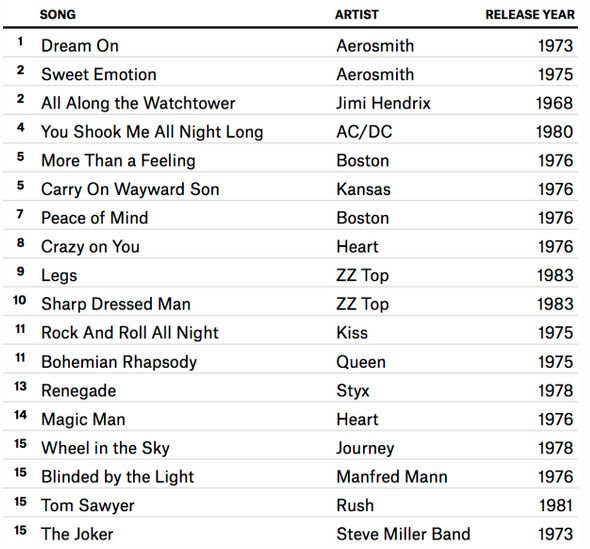
It’s not something I think about that much, but I do from time to time — why do Classic Rock stations sound the same, year after year? I wrote about this on my moribund blog a number of years ago and, based on recent listening to market-dominant KQRS, this list of faves hasn’t changed a bit:
In thinking about this list, a few things are worth noting:
The majority of the songs on this list are written in a minor key. If rock and roll is supposed to be uplifting, this group of songs isn’t it.
Of the bands listed here, the happiest band appears to be ZZ Top, who made their name initially as a bare-bones Texas blues trio, until they made their fortune hawking classic cars and leggy models. Make of that what you will.
Think back to any of the years listed here. Would you have had any interest in listening to songs that were recorded as long ago from that moment as these songs are from today? I didn’t hear much of Bob Wills and the Texas Playboys or the Andrews Sisters in 1983, for example, nor do I recall seeking such things out. In fact, I’m more likely to seek out Bob Wills today than most of the songs listed here, right or wrong.
In my youth I was reliably informed that rock and roll was supposed to be about rebellious youth and revolution. While their politics were dodgy at best, the Clash was right about this much — you grow up and you calm down; you start wearing blue and brown. And so has the music of our youth.
Gil Scott-Heron, who doesn’t get much airplay these days, argued back then that the revolution will not be televised. But rest assured it will be monetized.
At the battle of the Alamo in 1836, there were at least two Germans among the defenders, Henry Courtman and Henry Thomas. Why in the world, you may ask, were Germans at a battle in south Texas fighting Mexicans? Beginning just a few years before, and continuing over the next several decades, German immigrants came to Texas in increasingly large numbers, drawn by the prospects of farming and agriculture. Eventually Germans became one of the largest ethnic groups in Texas.
They brought with them their language and customs as well as the music they had listened to back home. One of the types of music they brought to Texas with them was a new sound, the polka.
There are various stories about the origin of the polka, but it seems to have originated as a Czech dance around 1830, and probably came out of the folk music of the region. The polka quickly spread in Europe, particularly in German-speaking lands, and especially in Poland, which all but made the polka its own. Polka even found a niche in Ukrainian folk music. The polka faded in popularity in the latter part of the 19th century, but the immigrants who went to North America brought it with them where it thrived. (It is the official state dance of Wisconsin, next door to SitD.)
The classic polka is in 2/4 time, and that contributes to the popularity of the dance. It is simple and fun. The 1-2-1-2-1-2 beat is easy to keep up with, and the typical oom-PAHoom-PAH in the bass line compels your feet to move. The accordion was probably invented in Germany in the 1820s, and it became a polka staple which the Germans brought with them to Texas.
Interaction among people across borders is part of the human condition. Languages typically influence each other across borders, but cultures also intermingle and music is a part of that. The polka music the Germans planted in Texas eventually made its way south across the border to northern Mexico, and from that Mexico’s Norteño music developed. This regional music retains the influence of the accordion and the polka beat. Here’s an example, a unique blending of Central European folk music and Mexican folk music.
This is a CD I’ve been meaning to get around to for a long time, and finally checked off that box. It features two members of Boston, Brad Delp and Barry Goudreau. It was recorded in Goudreau’s home studio and released in 2003. The cover and reverse photos were taken on the beach near Goudreau’s home.
Delp was the clear, high, strong voice of Boston, and while Goudreau (on guitar) was sometimes overshadowed by Tom Scholz, he was part of the founding of Boston and, pun intended, instrumental in the sound of the first two Boston albums that together have sold over 30 million copies.
Last week’s kerfuffle between Spotify (and their contract employee, Joe Rogan) and Neil Young, Joni Mitchell, Barry Manilow and (reportedly) Dave Grohl and Foo Fighters, may not mark the point where the iconoclasm and “rebellion” of popular music fromthe 1950s through the 2000s finally died.
But it’s certainly a waypoint on populist conservatism’s path to being the real iconoclasts.
The strongest lyric on Kid Rock’s new single “We the People” is 235 years old: “In order to form a more perfect union / Do ordain and establish this Constitution of the United States of America.”…On the day Kid Rock released his song, rock-music veteran Neil Young publicly threatened Spotify with an ultimatum: Either remove its broadcast of the political commentator and comedian Joe Rogan, or he’d remove his music from its streaming service. It’s enough to make a true rock and roller revolt…In this sudden ideological skirmish, Kid Rock wants to reclaim populism and protest against Young’s imperious assertion of authority and limited expression.
As with most things Kid Rock has done in the past three decades (but by no means all), light leaving “safe for work” right now won’t reach us for centuries. A radio edit bleeping out the profanity would sound like Morse Code.
You’ve been warned. Here goes.
Very NSFW. Probably not for family consumption, either.
Tonight – New Year’s Eve – my band “Elephant in the Room” is playing at the American Legion in Fridley. We will be starting at 8:30 PM, and ringing in the new year. The Legion has those cool edge of the metro food and drink prices, without actually being outside the metro, which is kind of cool. Hope you can make it out there.
Tomorrow on the show? I will be talking with Rebecca Brannon about her run in with the Hennepin county machine over her reporting on Sheriff Hutchinson‘s DUI.
And tomorrow night, we will be playing at Neisen‘s Sports Bar and Grill, in Savage. I love our bars, but Nissans has a stage that makes you feel kind of like a rockstar, and a sound system that makes us sound like one. No cover.
I hope we run into each other, literally or figuratively, during any or all of the above!