Archive for the 'Music' Category

And Happy Birthday, Nils Lofgren

Saturday, June 21st, 2008

And it’s a double-shot of musical birthdays, today; I had no idea until I started writing this. Anyway – today is also Nils Lofgren’s birthday. He’s 57, not that you could tell.

He’s most famous, at least among the latest generation or two of music fans, as the virtuoso third guitarist in the E Street Band.

And that’s cool; Lofgren added a depth of texture and skill that Springsteen’s put to great use in the last 24 years, leaving his mark on some of Springsteen’s best work in the past couple of decades; the blistering solo in “Tunnel of Love” (and throughout the rest of the album named after the song), the broad, crunchy slide rhythm work on “The Rising”, and much, much more.

But it also short-changes the music-listening public. I was a Lofgren fan long before he joined the E Street Band before the Born In The USA tour.

Part of the draw is that he is, as Dave Marsh memorably put it, America’s great unknown rock and roller. His pre-Springsteen stuff – “No Mercy“, “Beggar’s Day”, “Keith Don’t Go“, “Night Fades Away”, “Cry Tough” – was sometimes eclectic, and always featured out-of-scale amazing guitar work, but at the end of the day it was always great old-school rock and roll; he resisted the currents of the seventies and the eighties pretty successfully (other than the regrettable I Came To Dance, a “Miss You”-derived foray into disco of which the less said the better) and still sounded fresh and vital.

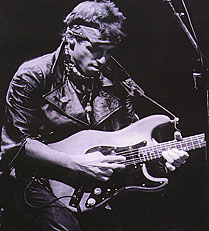
Part of it, for me as a guitar player, is that his style is just so damn inscrutable. Unlike most guitar players, he fingerpicks – which is quite common among folkies and country players, but very rare among rockers. Unlike the best-known electric fingerpickers, like Richard Thompson and Mark Knopfler, he uses steel fingerspicks – think prosthetic steel fingernails that you slip onto your fingers – which he uses to for a hard, sharp, brilliant attack. And the part that I find the most vexing and thrilling is his ability to get, at will, the most intense pick harmonics (there’s no way to explain it to non-guitarists, although the solo that starts about 4:30 into this video of his most famous solo has a ton of ’em) of anyone who ever picked up a Strat. Trying to copy Lofgren – his style, his tone, his idiosyncracies – is the only thing in the world more vexing and yet fascinating than trying to copy Richard Thompson.

So happy birthday, Nils Lofgren, and many more.

Happy Birthday, Mark Brzezicki

Saturday, June 21st, 2008

PROLOGUE:  I wrote the Lofgren piece (next) last August, and this one last January – and didn’t notice until a few weeks ago that they happened to fall on the same day.  I smell a big joint party coming up!

Anyway – onward and upward!

———-

Pick your list of the best drummers in the history of rock and roll.

Let’s leave out the ensemble drummers for a moment – Charlie Watts and Max Weinberg, both amazing drummers, largely because they fit so perfectly into a role within a larger band.

Let’s also leave out the loose cannons, the drummers who exploded into mercurial blasts of brilliance in bands that had plenty of room for lots of flashy drumming. Keith Moon jumps to the front of the list, of course, but Johnny Badanjak of the Detroit Wheels leads a long list of people right behind him. Great drummers, all of ’em.

Anyway, let’s forget about ’em.

Of course, I suppose you could have a catetory for crappy drummers like Vinnie “Mad Dog” Lopez, but that’d be just pointless.

The next category is the “Masters of Technique”; the people who’ve mastered the art and science of drumming.

Ask every single guy who grew up in middle America listening to 8 tracks and cassette tapes, and the top of the list is always Neal Peart of Rush. And Peart is, obviously, an amazing technical drummer. I’ve never seen Rush live, but I’ve seen a few concert videos, and to me watching Peart play is like watching a music grad student’s master’s performance, almost like it’s designed to be academically pure and perfect for a panel of judges who’ll decide if he gets to graduate (which, of course, he does, because in the world of Rock and Roll he is the biggest example of this kind of drummer.

That leaves the final category – the Chameleons. It should go without saying that the best session drummers – like Taylor Hawkins and Michael Bland – fit in here; they have to be stylistic chameleons, changing to match any of a zillion different styles on the drop of a hat, depending on who’s paying their bills. Can anyone imagine Keith Moon backing, say, Christina Aguilera? Well, it might be fun – but I mean plausibly? Of course not. And yet a great session drummer can go from a session with an R&B band over to a session with a bunch of punks – see Michael Bland’s career with Prince and Soul Asylum – and do it convincingly.

Among the very, very best of this lot s perhaps the most amazing drummer I have actually ever seen (indeed, met in person).

Mark Brzezicki, session drummer extraordinaire, turns 51 today.

Born in London, the son of a Polish refugee who’d flown in the RAF’s Polish Air Force in Exile during World War II, Brzezicki played on a virtual soundtrack of all that was the best and most memorable in music in the very late seventies and early eighties. Working as “Rhythm for Hire”, he and future Big Country bassist Tony Butler played as session men on an amazing variety of British music of the era, culminating in Pete Townsend’s great solo albums of the era, Empty Glass, All The Best Cowboys Have Chinese Eyes, and White City. The two of them arguably fit Townsend’s style, and drove him to do better work, than any rhythm section since the death of Keith Moon.

They also backed Simon Townsend – Pete’s much younger brother – on his much-underrated first album, Sweet Sound, as well as some of his later stuff. More on this in a bit.

And of course, Big Country.

In Big Country, Brzezicki’s drumming ranged from the restrained and delicate (“Chance” was a great example) to baroque with explosive overtones (“Wonderland“, “Steeltown“, although you’ll have to take my word for it that the studio version is much better), to martial and thunderous (“Where the Rose Is Sown“), Brzezicki was the glue that tied all of Stuart Adamson’s ambitions together.

Brzezicki went on to record a ton of session work; he and Butler worked on Roger Daltrey’s best solo album, Under a Raging Moon (along Big Country’s second guitarist Bruce Watson), The Cult’s classics “She Sells Sanctuary” and “Love Removal Machine”, and a slew of others.

I met Brzezicki in 1990, at – of all places – the Cabooze in Minneapolis. He was backing old friend and bandmate Simon Townsend, as the opening act for former Grand Funk Railroad singer Mark Farner on, of all things, a Christian music tour. Townsend’s mid-career material was Inspirational, but not especially inspiring, if you catch my drift; suffice to say, I was there to see Brzezicki. And he didn’t disappoint; restrained as he needed to be, with flashes of brilliance on cue, delivered with perfect timing.

I met Brzezicki “backstage” – actually the Cabooze’s backyard, where he was packing up his gear after Townsend’s set, while Farner was stinking up the joint. He was tired – he’d left it all out onstage – but personable, modest in the way that people who are damn good and know it and have nothing to prove to anyone anymore usually are. We chatted for (if memory serves) about five minutes as he wrapped up his stuff, talking about Big Country ephemera (the band was on hiatus, after the disaster of Peace In Our Time, before the stylistically triumphal but commercially iffy return of Buffalo Skinners a few years later) and the other session projects he was working on.

He turned down a beer – but he gave me a set of his sticks to give to my drummer.

Anyway. Happy Birthday, Brrrr.
Open Questions, Music Edition (Part II)

Tuesday, June 17th, 2008

To: Sir Elton John

From: Mitch Berg

Re: Fabric choices

 Sir John:

While acknowledging your record as a master of popular songcraft – especially on the albums of your heyday, like Goodbye Yellow Brick Road – and allowing that you certainly had a way with writing an amazing hook or two, I feel compelled to note that your longtime lyricist, Bernie Taupin, could be fairly described as “a bit over the top” sometimes, to the point where some of the songs make, regrettably, no sense at all.

For example: in your classic long-form pop song “Tiny Dancer”, the chorus – as catchy a bit of pop treacle as ever graced the airwaves – starts out wonderfully.  It is, indeed, a memorable confection, scooting from hook to hook with gay abandon (so to speak). 

But then comes the line “lay me down in sheets of leather” – and the air just zips out of the whole enterprise. 

Leather sheets sound troublesome; on hot days, they must be legendarily uncomfortable; even under ideal conditions, they must be sticky and rife with friction.

Please clarify and, if necessary, have a word with Mr. Taupin.

That is all.

So When My Kids Ask Me…

Tuesday, June 17th, 2008

…”What do you mean, Dad, about R and B having been better a long time ago?”

And I reply “dang skippy”.

And they say “Do you mean Motown?”

And I say “Motown Schmotown. Stax/Volt, baby

“Huh?”

“I said Stax/Volt“.

You Don’t Know Diddley

Tuesday, June 3rd, 2008

Bo Diddley is dead of apparent complications from a stroke:

Bo Diddley, a founding father of rock ‘n’ roll whose distinctive “shave and a haircut, two bits” rhythm and innovative guitar effects inspired legions of other musicians, died Monday after months of ill health. He was 79.

Diddley died of heart failure at his home in Archer, Fla., spokeswoman Susan Clary said. He had suffered a heart attack in August, three months after suffering a stroke while touring in Iowa. Doctors said the stroke affected his ability to speak, and he had returned to Florida to continue rehabilitation.

The legendary singer and performer, known for his homemade square guitar, dark glasses and black hat, was an inductee into the Rock and Roll Hall of Fame, had a star on Hollywood’s Walk of Fame, and received a lifetime achievement award in 1999 at the Grammy Awards. In recent years he also played for the elder President Bush and President Clinton.

The 1988 inauguration, indeed, featured the memorable lineup of Diddley, Sam and Dave, and Lee Atwater.

Diddley appreciated the honors he received, “but it didn’t put no figures in my checkbook.”

“If you ain’t got no money, ain’t nobody calls you honey,” he quipped.

Working in radio as a kid, I was aware of Diddley bright and early – but I didn’t really know Diddley until he toured with The Clash, around 1979-80.

His first single, “Bo Diddley,” introduced record buyers in 1955 to his signature rhythm: bomp ba-bomp bomp, bomp bomp, often summarized as “shave and a haircut, two bits.” The B side, “I’m a Man,” with its slightly humorous take on macho pride, also became a rock standard…Diddley’s influence was felt on both sides of the Atlantic. Buddy Holly borrowed the bomp ba-bomp bomp, bomp bomp rhythm for his song “Not Fade Away.”

The Rolling Stones‘ bluesy remake of that Holly song gave them their first chart single in the United States, in 1964. The following year, another British band, the Yardbirds, had a Top 20 hit in the U.S. with their version of “I’m a Man.”

Let’s not forget Warren Zevon’s “Bo Diddley’s a Gunslinger” and, best of all, Springsteen’s “She’s The One”.  The NYTimes has a list of songs that reference the signature beat.

Diddley was also one of the pioneers of the electric guitar, adding reverb and tremelo effects. He even rigged some of his guitars himself.

“He treats it like it was a drum, very rhythmic,” E. Michael Harrington, professor of music theory and composition at Belmont University in Nashville, Tenn., said in 2006.

Diddley’s influence was always very underrated.

Nothing Is Forgotten Or Forgiven

Monday, June 2nd, 2008

Today is the thirtieth anniversary of the release of my favorite album of the rock and roll era, Darkness On The Edge Of Town.

Thirty years? Ooof.

Here’s what I wrote two years ago – a piece I’m still kinda proud of:

———-

Tonight My Baby And Me Are Gonna Ride To The Sea

It was 28 years ago today that Darkness on the Edge of Town came out.

For the past 25 or so years, it’s been my favorite album of all time.

Everyone remembers Born to Run, a timeless procession of suicide machines and old girlfriends and happy-go-lucky petty thugs and dresses flying in the wind and visionaries in parking lots dancing to late-night radio to the light of nearby billboards.

Darkness is the album for when the cruising’s over, and you have to grow up and live your life for real.

There’s a reason the album has stuck with me for almost thirty years – and why so many Bruce fans say that it, rather than Born to Run or The River or Nebraska, is their favorite Springsteen record.

There has never been a better record written about isolation – personal, geographical, cultural, and emotional – ever. Which may be why it resonated so much for a kid for North Dakota who desperately wanted to be elsewhere. In fact, “the Promised Land” is about exactly that:

On a rattlesnake speedway in the Utah desert
I pick up my money and head back into town
Driving cross the Waynesboro county line
I got the radio on and I’m just killing time
Working all day in my daddy’s garage
Driving all night chasing some mirage
Pretty soon little girl I’m gonna take charge

CHORUS
The dogs on Main Street howl
’cause they understand
If I could take one moment into my hands
Mister I ain’t a boy, no I’m a man
And I believe in a promised land

Foreigner and Black Sabbath never wrote about being stuck in a small town, bored out of your skull. I was sold.

The first cut, “Badlands”, is a decoy; it’s almost “Born to Run”-ish, with its gleefully-sloppy guitar/sax interplay, big beat (almost danceable, by Springsteen standards) and exhortation that “it ain’t no sin to be glad you’re alive”. But after “Badlands” it’s clear – being glad you’re alive is no sin, but it’s something you gotta work for. “Adam Raised a Cain”, a brutal, plodding dirge, raises the ante; you can be glad you’re alive, but your past wants its due:

“Daddy worked his whole life for nothing but the pain
Now he walks these empty rooms looking for something to blame
You inherit the sins, you inherit the flames
Adam raised a Cain…

“Something in the Night” reads like an obituary to the teenage dream; like an almost-thirty-year-old is driving down the same route he covered ten years earlier – maybe the route “through the mansions of glory”, for all we know.

But he’s alone, this time:

I’m riding down Kingsley,
figuring I’ll get a drink
Turn the radio up loud,
so I don’t have to think,
I take her to the floor,
looking for a moment when the world
seems right,
And I tear into the guts,
of something in the night.

Well nothing is forgotten or forgiven,
when it’s your last time around,
and I’ve got stuff running ’round my head,
that I can’t live down…

So it’s been 28 years since I first heard the record, and about a quarter century since it’s been among my 2-3 favorite records ever. For me, it’s been a long stretch; a couple of careers, two and a half kids, a marriage that splintered like a Wal-mart dining room set, and a few dreams along the way that had to get wrapped up and put away for later, whenever “Later” is.

And at the end of it all – on the title and final cut on the album, the slow, mournful “Darkness on the Edge of Town” – a late-night tale by a guy who staked a big chunk of his life on a losing bet, a song that sounds like 4AM after a long bender, about the time when resignation gells into resolve:

Well, they’re still racing out at The Trestles
but that blood never burned in her veins.
I hear she’s got a house out on Fairview, now,
and a style she’s trying to maintain…

He’s been there. He’s thought about it.

He’s done:

Well, some folks are born into a good life,
and other folks get it anyway, anyhow.
And I lost my money and I lost my wife,
Them things don’t seem to matter much to me now.
Tonight I’ll be on that hill ’cause I can’t stop
I’ll be on that hill with everything I got
Where the lives are on the line, where dreams are found and lost,
I’ll be there on time and I’ll pay the cost
For wanting things that can only be found
in the darkness on the edge of town…

The album has stayed with me like none of Springsteen’s other records – partly because I associate it so closely with that part of my adolescence when I was just starting to figure out who I was and where I belonged, but mostly because it’s about things that are pretty timeless.

It aint’ no sin to be glad you’re alive. It’s also something you have to earn:

Well everybody’s got a hunger,
a hunger they can’t resist.
There’s so much that you want,
you deserve much more than this.
Well, if dreams came true, aw, wouldn’t that be nice?
But this aint’ no dream, we’re living all through the night.
You want it? You take it, you pay the price…

So earn it.

———-

The other day, area blogger and fellow Bruuuuce fan Nightwriter left this comment:

I remember a friend of mine and I staying up til midnight at the end of term in ‘78 to hear the college radio station play the long-awaited new album on its release day. After all the anticipation I found it rather anti-climatic. I didn’t really like the album the first time through; there didn’t seem to be the “BTR” or “Rosalita” type anthem or a real party song. After the last cut finished my buddy asked me what I thought. I said it sounded as if Bruce had traded the city streets for the highways. I mean, how did he get from “E Street” to “a rattlesnake speedway in the Utah desert”? Didn’t stop me from buying it, of course, and it did grow on me.

I’ve found that to be true with a lot of music; a lot of my favorite albums ever – London Calling, Empty Glass, Tunnel of Love, Exile on Main Street, Pleased To Meet Me, Poor Man’s Son and probably quite a few others – didn’t totally grab me right out of the gate. Oh, there were songs I liked on each right out of the sleeve – but it took a while for things to really insinuate themselves into my brain, and deeper.

And while it’s been a long, long time since I first heard it, some of my favorites on Darkness today are the ones I skipped past when I was in high school. Oh, things like “Badlands”, “The Promised Land” and “Prove It All Night” grabbed me in my adolescent gut, but I remember thinking “Racing In The Street” was a lab project to cram in as many traditional “Springsteen” cliches – cars, girls, driving, the shore – into one song as possible. My friend Rich actually broke out laughing when he first heard the song’s opening verse…:

I got a ’69 Chevy with a 396, fuelie heads and a Hurst on the floor.
She’s waiting tonight down in the parking lot behind the 7/11 store.

…and, truth be told, I couldn’t really object. Not then, anyway. It took me years, and a lot of life, to really figure that one out.

Which may be why I love this album so much, more even than any other Springsteen album (and I love so much of that to begin with); there’s just as much there for me now as there was when I was 17.

If Not For Shopping

Friday, May 30th, 2008

I was wandering through a store picking up some stuff for my daughter last night. One of the clerks had a boombox, tuned to “The Current” (MPR’s alt-music affiliate)…

…and I had one of those musical bolts from the blue I occasionally get.  Not sure why, but a song just stopped me in my tracks, something I hadn’t heard in probably decades.  Vaguely southwestern-sounding, with a scrummy slide-guitar part and a tenor singer I couldn’t quite place, and a sober but engrossing hook…

…anyway, I stood in the aisle for probably three minutes, watching the boombox, like if I walked away the song would stop.

I probably bought more stuff than I should have, to reassure the staff I was really OK.

Oh, it was the 1970 original of this song, by the late George Harrison – with a band featuring G.E. Smith – a guitar player whose intrusive, aggressive style I have always desperately wanted to dislike, but just can’t – on the signature slide part.

The Audacity of Nuisance

Friday, May 30th, 2008

Living in a one-party city, you see and hear some strange things.

There’s a conceit on the part of an awful lot of Twin Cities leftists – Democrats, Greenies, and all their various flavors – that “if we just showed Republicans the truth, they’d be Democrats!”

That point of view is in full foam as we head toward the GOP Convention this fall. One “local” group plans on putting “huge Jumbotrons” on both sides of downtown – on Cathedral Hill and Harriet Island – to beam videos over the city during the convention, apparently to try to convert Republicans.

These, by the way, are some of the same people who fulminate about billboards in Saint Paul. Go figure.

And now, says Schmelzer at the Minnesoros Monitor, they plan to try to “Rock some sense into the Republicans”

No, really!

“The Republican National Convention is coming to the Twin Cities in September, and wouldn’t it be a shame if there was no one to play deafening power chords just up the street?” So reads text at the website of ProVention, online homebase for a concert planned in Lowertown St. Paul on Sept. 3 and 4 to coincide with the GOP convention.

They assure us, of course, that…

…the point isn’t an antagonistic, Noriega-psyops kind of thing, but to welcome Republican guests with “music, beauty and rational engagement” (here’s the group’s platform).

We’ll come back to that “noriega” thing in a bit.

The lineup — which may change, “probably in the direction of more and more ginormously powerful”

A quick tangent; I think Americans of all creeds, colors, orientations and parties can unite behind the notion that people who use “ginormous” in any context can and should be shipped to camps in the Mojave Desert.  Can I get an amen?

Anyway – out of one corner of their mouth, they say this is no “noriega-like psyop”.  And then they say…:

— has elephantine star power: Tapes ‘n’ Tapes,

Scraaaaaaaaaaaaaaaaaaatch

Tapes ‘n Tapes.

I, for one, choose waterboarding.

Peggy Lee

Tuesday, May 27th, 2008

Scott Johnson notes that yesterday was the 88th anniversary of the birth of Peggy Lee, in Jamestown,ND.

She was a musician’s musician. Think, for example, of her terrific duets with Bing Crosby and Mel Torme. or of Paul McCartney proudly contributing the title track to Lee’s 1974 “Let’s Love.” Listening to her music today, one is struck by how far she could go on her innate sense of swing and pure taste. For a heartfelt contemporary tribute to her, check out the beautiful “Fever” by the Twin Cities’ own Connie Evingson. Last week Will Friedwald found Peggy Lee “All aglow again.”

Lee’s music oozes with sultry intimacy, but Lee had a sense of herself as something of a Gatsbyesque self-creation. Reader Bob Dodd reminds us of the story in which she was going up in a hotel elevator to put on her make-up, stage clothes and jewelry for a show. A woman stared at her and finally asked, “Are you Peggy Lee?” She replied straightforwardly, “No, not yet.”

Lee’s family lived a block from my father’s house, along mainstreet in Jamestown, across from the town’s Catholic church; the house was a kindergarten when I was a kid, and was torn down when I was in junior high to make way for a car lot.

She took a shot at Hollywood first, and then latched on at WDAY in Fargo, hired by manager Ken Kennedy (who I remember on WDAY TV when I was a kid), and thence to Minneapolis, Chicago and finally LA, where she got her big break:

It was at the Doll House in Palm Springs, California that Peggy Lee first developed the soft and “cool” style that has become her trademark. Unable to shout above the clamor of the Doll House audience, Miss Lee tried to snare its attention by lowering her voice. The softer she sang the quieter the audience became. She has never forgotten the secret, and it has given her style its distinctive combination of the delicate and the driving, the husky and the purringly seductive. One of the members of the Doll House audience was Frank Bering, the owner of Chicago’s Ambassador West Hotel, who invited her to sing in his establishment’s Buttery Room.

Benny Goodman discovered Peggy Lee’s vocalizing in the Buttery Room at a time when he was looking for a replacement for Helen Forrest. Miss Lee joined Goodman’s band in July, 1941, when the band was at the height of its popularity, and for over two years she toured the United States with the most famous swing outfit of the day, playing hotel engagements, college proms, theater dates, and radio programs.

I’m gonna have to hit ITunes sooner than later.

Today’s Earworm

Wednesday, May 21st, 2008

I finally drove the “Five Dolla Foot Long” song out of my head with this one here, “Brown Eyed Son” by a pre-“weren’t they that band from the Claritin ad?” Katrina and the Waves.

Indeed, if I have a crusade (after getting conservatives elected, exposing the madness of the anarchists coming to the Twin Cities this fall, throwing the 2009 Patriot Picnic on the ruins of the AM950 studio, druming all six of the “override six” from political life, getting “Phantom Menace” expunged from history and turning Saint Paul red), it’s getting the world to realize that the Waves were much, much more than a one-hit wonder.

Even though they had, y’know, one hit.

(And, in retrospect, I cribbed that opening Kim Rew guitar riff for one of my songs, 20-odd years ago.  Imitation and flattery and all that, donchaknow).

Separating The Trivia Wheat From the Trivia Chaff

Tuesday, May 20th, 2008

Via Centrisity, I note that a celebrated footnote in “progressive rock” has passed away; John Rutsey, original drummer for “Rush”, is dead at age 55:

Rutsey was famous for playing on Rush’s 1974 debut album, including the song “In The Mood,” before deciding to leave the group due to health concerns. Rutsey suffered from diabetes and was unable to go on extended tours with the group.

Rutsey was sort of the Pete Best of the “progressive” rock scene; Rush replaced him with Neal Peart – the famously-technocratic drummer who is to percussionists what Dungeons and Dragons is to weekend recreation – on the brink of their big leap to fame as the leading Heinlein/Ayn Rand/Tolkein-based rock band of its era.

Or any era, I guess.

Footnote:  My first “real” band – which included a reasonably-frequent commenter on this site – played “Working Man”, the best song from that first album (shaddap about “Finding My Way”), as defined by a guy who has never been a big fan of the genre, but knows great musicians when he sees them… 

Anyway – condolences to the Rutsey family.

Finally

Tuesday, May 20th, 2008

Years ago, my copy of Galore – Kirsty MacColl’s greatest hits collection – got munged.  It is, naturally, long out of print.  Which would ordinarily be no problem; most of her songs have popped up on one anthology or another.

With one notable exception.

So for those years – first on Napster, then Youtube, and finally ITunes – I’ve been searching the world for a copy of “Caroline”, a glorious little one-off single she did in the early nineties that may be just about the perfect two minute pop song.

And I’ve found nothing.

Well, til late last night.

They’re Screamin’ To Please Me, Gotta Make It Look Easy

Thursday, May 15th, 2008

It was thirty years ago this year (does anybody really know what date it was? Does anybody really care?)  We’re almost halfway through the year, so I’m as close to right as a wild guess can be) that Southside Johnny and the Asbury Jukes released one of the best albums in the history of rock and roll – Hearts of Stone.

The Asbury Jukes were a flash in the pan on the national popular chart scene – “Hearts of Stone” got on the Top40 Album charts, and their only Top40 single, “It’s Been A Long Time”, didn’t happen until 1991, with the help of Bruce Springsteen, Miami Steve “Silvio Dante” Van Zandt and Jon Bon Jovi. But they’ve flitted about the edge of the scene for over thirty years; they were the frat party band in “Adventures in Babysitting”; the band, or at least its horn section, “La Bamba’s Mambomen”, are the heart of the “Max Weinberg Seven”, on the Conan O’Brien Show (and Weinberg has sat in with the Jukes many times – but more on that in a moment).

But that was now; “Hearts of Stone” is then.

The Jukes are a fossilized remnant from an almost-forgotten era; a horn-based rock and roll band that slathered itself in Stax/Volt-era Rhythm and Blues. Their first two albums were loud, horn-driven party rock, laced with covers and throwaways – think a Lamont Cranston band album, if you’re from the Twin Cities. They remind the casual listener of the J. Geils Band, which was from a very similar genre (Geils had to rent a horn section – and while John Lyon is a great harmonica player, Geils’ Magic Dick is the Stevie Ray Vaughan of the instrument). And, most importantly, they came from the Jersey Shore, where throughout the late sixties and early seventies the various members mixed and mingled with the cast of characters that fans of the scene know well, and the casual listener probably only knows via Bruce Springsteen. The Jukes, led by “Southside Johnny” Lyon, were a long-time mainstay in the bar scene on the Jersey Shore; to read the tales second-hand in books like Dave Marsh’s “Born to Run”, Jersey Shore bands were like Twin Cities’ leftyblogs; eventually everyone played in every other band. Several E Street Band members, in fact, sit in on “Hearts”.  Max Weinberg plays drums on several tracks; Steve Van Zandt played in the band until Springsteen called him over to to the E Street Band during and after Born to Run; his distinctive, leaky, sloppy Strat playing accents several cuts on Hearts (“Got To Find A Better Way Home”, the title cut, “Light Don’t Shine” and others); Patti Scialfa hung out with the band for years before joining the E Street Band and, eventually, Bruce’s nuclear family.

Growing up in North Dakota, the Jukes were something you caught from the occasional zealot; her husband (and her brother in law) was the only other person in the history of Jamestown North Dakota besides yours truly to have actually heard of them. 

The problem with the Jukes was that they were a great bar band; at their best, they were amazing live performers – on stage.  And like a lot of great bar bands, it took a really good producer to get “their best” off the stage and into the studio.  “Miami Steve” Van Zandt was, for a few years, that producer; he married the band’s tight ebullience with the best material the band ever recorded; although Hearts has been called “the best album Springsteen never released, Bruce only wrote two songs – the title cut and the album’s single, “Talk To Me”, and co-wrote a third (the claustrophobic but propulsive “Trapped Again”) with Van Zandt and Lyon.  Van Zandt penned the rest of the album, and rode herd on the band in the studio.  The end result was that rarest of artifacts; a great bar band making a great record.  (Van Zandt repeated the feat two years later, with his uncredited production (along with Ian Hunter and Mick Ronson) of most of the Iron City Houserockers’ classic Have A Good Time (But Get Out Alive)). 

As to the individual songs?  Where do you start when every song is a highlight?  The first song, “Got to Be a Better Way Home”, is a frantic rave-up with an off-kilter beat (that is begging for a ska remake); it pops up as a bumper on the NARN occasionally.  Others – “This Time Baby’s Gone for Good”, “I Played the Fool”, “Take It Inside” – are in the same weight-class; big beefy bar-room raveups with glorious, horn-driven choruses; in an era when people thought Chicago was great music with horns, the Jukes showed the world how it was supposed to be done.  If this album doesn’t make you do something – dance, drive too fast, smile – then you must be dead.

Along with “Got To Be…”, though, the standouts are “Light Don’t Shine” – a weary, guitar-driven breakup song that sounds like cigarette smoke and too many boilermakers and too much heartache:

They came to shake my hand
I don’t want them to touch me now
They said, “Congratulations” but it’s too late now
Where were they when I called?
How could they forget it all?

Didn’t you get what you need?
The fight was lost, it wasn’t meant to be
It isn’t as hard for you to leave
There’s no easy way for me

And of course, the title cut.  “Hearts of Stone” was a Born to Run-era Springsteen song that never quite fit onto one of Bruce’s albums.  Slow, smoky, launching with a classic Van Zandt guitar solo over tinkly last-call piano, it reminds me of Springsteen’s “Racing In The Street”, which came out the same year on Darkness On The Edge Of Town – maybe less symbolic, but more personal:

You stare in the mirror at the lines in your face
And you try so hard to see
The way things were when we were at your place
Everyday was just you and me
And you cry because things ain’t like before
Well, don’t you know it can’t be that way anymore
But don’t worry baby

I can’t talk now, I’m not alone
So put your ear close to the phone
This is the last dance, the last chance
For hearts of stone

It’s the best album the Jukes ever did – and it’s well within Steve Van Zandt’s top ten, and probably up in Springsteen’s top 25, too.

So if you like the genre, check it out.  I have no idea if you can find the album on CD, anywhere in the world; I know the album is on ITunes (because, dang skippy, I bought it). 

Anyway – happy anniversary, Bruce and Steve and John.  Whatever date it actually came out.

It’s Ca-Ca-Catching On….

Thursday, May 8th, 2008

Pianomomsicle writes to let me know that I’m far from the only one to have gotten a bad case of earworm from the Subway jingle (“Five. Five Dolla. Five Dolla Footlong!”)

Indeed, according to Slate, it’s something of a trend. It’d seem the creative jingle is making a bit of a comeback; in addition to the Subway spot (whose genesis the article explains), there are a few others:

Dunkin’ Donuts hired They Might Be Giants to pen a series of short songs about coffee and smoothies and such.

Until the Subway campaign (“Five. Five Dolla. Five Dolla Footlong!”) came along, Dunkin’s jingle (“Is it French, or is it Italian? It’s FreTalian!” and “Doing things is what I like to do…YES!”) were my commercial earworm du jour.

And then…:

And the current campaign for FreeCreditReport.com makes bold use of infectious musical storytelling. While the Subway jingle is more a demi-jingle, with very little build and no verses, the FreeCreditReport.com songs are full-blown ballads—which of course include carefully enunciated mentions of the brand, in this case literally spelled out.

“F R E E, that spells Free, Credit Report Dot Com, Baybee…”

The songwriter for these spots was David Muhlenfeld of the Martin Agency, who says he “went away with my guitar and some cheap Chianti” to find inspiration. When I asked Muhlenfeld whether he used any particular tricks to make the tunes catchy, he replied: “Repetition alone will make something stick in a listener’s head. The question is, once your song is in their head, will they want to stick that head in an oven?”

My oven won’t hold my head, but fear not; I have no idea how to find a Dunkin’ Donuts (I’m more a bagel guy anyway), wouldn’t patronize Free Credit Report.com at gunpoint, and work right by a Jimmy John’s.

But dang – I do wind up singing singing those damn jingles…

However – and this one’s going out to all the musicians in the house – I almost laughed a Lattachocca out my nose reading this bit – talking with the writer of the Subway jingle:

“The chord structure does imply something dark,” [songwriter Jimmy Harned of boutique studio Tonefarmer], agreed, getting out his guitar to demonstrate over the phone. “On the word long, it goes down from a C to an A-flat,” he said, strumming, “which is kind of a weird place. It’s definitely not a poppy, happy place. It’s more of a metaly place. But at the same time, the singing stays almost saccharine.”

Back in college, I was asked to write the most irritating possible musical passage on my guitar. I came up with something that crunched between C and A flat – over, and over, and over, and over and over…

(more…)

Less Than The Sum Of Its Parts

Wednesday, May 7th, 2008

“Summer Side of Life” is one of Gordon Lightfoot’s best songs.

The scandal of the “comfort women” – girls from Korea, the Philippines, Taiwan and other Asian nations (and a few Dutch internees as well) kidnapped to serve as sex slaves to the Japanese military during World War II – is one of the great human rights scandals of the 20th Century.

Somehow, it would never have occurred to me to combine the two.

And, I must say, it still does not.

I did not know this…

Monday, April 28th, 2008

From the “I had no idea these were real people” file, the NY Daily News has tracked down Rikki, Sharona, and Rosalita.  

Yes – the ones of Steely Dan, the Knack, and Bruce fame:

“Rikki” did lose that number. “My Sharona” has a Web site.

“Rosalita” hooked up with Bruce Springsteen at the beach – as her boyfriend “Wild Billy” drank with his buddies nearby.

I figured there had to be stories behind them…:

Four decades after she briefly met Steely Dan rocker Donald Fagen, Rikki DuCornet still cannot escape the song written for her.

“I notice it walking into a sushi bar, going into a drugstore. Take an airplane, there it is,” DuCornet, 65, told More. “It’s become a constant, something to hold onto.”

After nearly thirty years of listening to Elton John’s “The Mitch is Back”, I feel her pain.

The woman who inspired the 1979 anthem “My Sharona” was a gorgeous high school senior with a killer body when a co-worker brought a boyfriend, the lead singer from an unknown band called the Knack, into the boutique where she worked.

Sharona Alperin wound up modeling for the cover of the band’s 6 million-selling record – and dated the rock star for four years.

Dating Doug Fieger?  Ewww.

Er, on second thought, maybe that’s all she deserves:

She was shocked and dismayed to find out that her namesake song is on President Bush’s iPod. “Couldn’t I be on Bill Clinton’s?” she moaned.

Bwahahaha.  You’re on mine, too.  Deal.

OK – so the cool part…:

Rosalita’s real name was Diane Lozito and she met the Boss in 1971 at a show at the Jersey Shore when he was an up-and-coming rocker.

Lozito, now a location scout, was actually the inspiration for more than one Springsteen tune. The story of their first kiss – behind a rock on the beach while her boyfriend was nearby – is retold in “Spirit in the Night.”

Soon “Wild Billy” was out of the picture. Springsteen and Lozito moved in together over her parents’ objections – “I know your mama, she don’t like me ’cause I play in a rock and roll band” – but split up after four years.

Wow.

Cool.


More Cowbell!

Tuesday, April 22nd, 2008

Sheila O’Malley’s sister Siobhan has a new album out.

Your mission is clear.

Just Like A Spirit In The Night

Friday, April 18th, 2008

Someday if I ever made a movie of my own life,  most of the soundtrack would probably be Springsteen songs.  I associate one song or another with most of the big milestones of my life – teenage angst, love found and lost, hope, determination, grief, whatever you got.

The E Street Band is just a tad greater than the sum of a bunch of great parts; the beating heart of the Weinberg/Tallent rhythm section, Miami Steve’s raw, sloppy-yet-perfect backup vocals, the Big Man’s sax garnishing the whole thing…

…but under and around and occasionally soaring above it all was the soul of the E Street Band’s sound – Danny Federici and his Hammond B-3.

Federici passed away yesterday at age 58 from complications of skin cancer after nearly forty years of playing with Springsteen:

It was Federici, along with original E Street Band drummer Vini Lopez, who first invited Springsteen to join their band.

(“Child”, with Springsteen, Federici, Vinny “Mad Dog” Lopez and Vini Roslin)

By 1969, the self-effacing Federici — often introduced in concert by Springsteen as “Phantom Dan” — was playing with the Boss in a band called Child. Over the years, Federici joined his friend in acclaimed shore bands Steel Mill, Dr. Zoom and the Sonic Boom and the Bruce Springsteen Band.

Federici became a stalwart in the E Street Band as Springsteen rocketed from the boardwalk to international stardom. Springsteen split from the E Streeters in the late ’80s, but they reunited for a hugely successful tour in 1999.

Federici and Springsteen were half of “Steel Mill”, a first-generation metal band (of all things) that predated the E Street Band by a couple of years, and whose bootlegs have been for thirty years among the most sought-after in the boot business. 

  It’s no accident that the Springsteen moments that I remember the most are, most often, the ones most keenly-accented by Federici’s raw, understated, yet always dead-on playing:

  • The figure in the chorus of “Incident on 57th Street” (The Wild, The Innocent And The E Street Shuffle); it’s only three notes repeated eight times, dissolving into a high, fat wash of chords keening above the raw longing of Bruce’s vocals; “Puerto Rican Jane – oh won’t you tell me…”, but without it, it’d be just another lovelorn guy baying at the moon; Federici’s part adds and accents the tension, the hope, the passion. 
  • “Jungleland” (from Born to Run);  The huge swell as Bruce roars “From the churches to the jails, tonight all is silence in the world…” signals that this song is going downtown to rumble.
  • “Sandy”, from E Street Shuffle, featuring Danny on an unforgettable accordion part

  • The Farfisa part that propels the choruses of Born in the USA’s “Glory Days” (and is virtually a sample of the even cooler part on “I’m a Rocker” (The River).
  • “Backstreets” (from Born to Run); Federici does two things that stand out in this song – one of my favorites, and easily the best “breakup” song of all time.  From the bridge (“Endless juke joints and Valentino drag…”) to the end, of course, Federici’s B3 howls with all the anger and longing that this angry, longing song deserves; the organ is the atmosphere.  But it’s at the beginning – the long intro Federici shared with pianist Roy Bittan – that is the most ingenious.  The organ part starts low, mournful and sad, with broad chords behind Bittan’s eighth-note riffing.  But then, when the band comes in, Federici swells up into a higher register, playing a nervous, jittery pentatonic counterpoint behind the rest of the band.  It’s so subtle you have to listen hard for it – and you usually sense it rather than hear it.  But it adds the angst-y undercurrent to the intro; while the rest of the band broadly thumps away, the organ twitches and twists in the background like all the unanswered questions behind any lousy breakup. 
  • “Jackson Cage” (The River) – Federici is the propulsion behind this, one of Bruce’s rawest sprints, almost challenging Weinberg to keep up. 

And of course, the entire album Darkness on the Edge of Town.  Dave Marsh once wrote that Born to Run belonged the Clarence Clemons and Roy Bittan – but Darkness belonged to Federici (and the low end of Weinberg’s drum kit, the toms and bass).   Marsh was right, as he usually was (when not writing about politics, anyway); Federici has almost too many great moments to catalog; the burst of howling joy in “Badlands” (especially the roaring swell in the second verse – “Poor man wanna be rich, rich man wanna be king…”), the fatigue-ridden last-call motif on “Factory”, the indigo atmospherics in the title cut…

…and, perhaps best of all, “Racing In The Street”, which constantly dukes it out with “Darkness…” for the title of my favorite Bruce song.  The song is the flip side of “Born To Run” – it’s about growing up and realizing after you’ve driven your suicide machine through the mansions of glory, that party’s got a morning after – the rest of your life. 

And the final coda, after the last chorus – “tonight my baby and me are gonna ride to the sea, and wash these sins off our hands…” – is entirely driven by Federici; slow and mournful at the beginning, and then brightening like the sun rising in the east over The Shore, as another day begins as things pick up tempo and life starts up again.

Federici was the quietest member of the band, the one who stayed the most in the background, the one whose career was most-closely tied to the band.


  Unlike Nils Lofgren, he had no previous solo career; he never forged much of a second career, like Steve Van Zandt’s acting or Max Weinberg’s now-long career as a bandleader, or for that matter Gary Tallent’s as a producer; he didn’t have the force of a supersized personality like Clarence Clemons to boot doors open.  His single solo album, the jazzy and largely instrumental Flemington, was and remains obscure.  He reportedly took the E Street Band’s extended hiatus, from 1990 to 1998, the hardest; rumors among the E Street fan hive had it that he had a bit of a drinking problem; the band’s reunion and tour in ’99 was, the rumors had it, a huge boost to his life. 

Whatever.  The fact remained that whatever the rest of the E Street’s bands parts brought to the table, Federici added the atmospherics, the foreboding, the tingle of anticipation…the soul of the band.

RIP, Danny Federici.

I Liked…

Thursday, April 17th, 2008

…the story of R’nB crooner Akon

 Compared to most of hip-hop’s leading figures past and present–50 Cent, Snoop Dogg, Eminem, Diddy, Tupac Shakur, Jay-Z, Notorious B.I.G.–Akon, 35, seems to have logged more time behind bars and, consequently, gained a better understanding of the average convict’s plight (both in and out of custody) than any of his musical peers. The New York Times has referred to him as the “prison-obsessed R&B singer” who “wants it known that crooners can evoke prison life just as effectively as rappers.” In fact, the singer not only named his company Konvict Music, but he settled on “Konvicted” for the title of his second album, which sold nearly three million copies last year.

…the first time I heard it…

 As it turns out, however, “Kontrived” might have been a more accurate choice.

Akon’s ad nauseum claims about his criminal career and resulting prison time have been, to an overwhelming extent, exaggerated, embellished, or wholly fabricated, an investigation by The Smoking Gun has revealed.

…when it was called CB4.

Mitch out.

Now That’s Impressive

Tuesday, April 15th, 2008

Powerline has quite a track record, you betcha.

Deposing Dan Rather? Yeah, OK.

Top-ten blog in the business? Okey-doke.

But this? To American males of a certain age, this is big news.

From Scott Johnson’s mailbag:

I’m Donald “Buck Dharma” Roeser from Blue Öyster Cult, lead guitarist and the author and vocalist of “Don’t Fear The Reaper.”

I’m a longtime frequent Power Line reader, and I’m enjoying the play BOC and The Reaper have recently gotten on the Power Line blog, in the “Don’t Fear the Professor” and “More Cowbell” posts.

What can one say…?

Crowd Control

Monday, April 14th, 2008

Came home yesterday after running some errands.  Living room was crowded with teenage boys (including my son) playing an XBox.  (Tangential note:  No, I don’t own an XBox.  It must have belonged to one of them).  Indoors.  On a gorgeous day.

What to do?

Went the the computer.  Fired up ITunes.  Found my “Punk/Power Pop/Loud Jersey Shore R’nB of the ’70’s and ’80’s” playlist.  Cranked the volume.

Somewhere between “Spanish Bombs” by the Clash and “Got To Be A Better Way Home” by Southside Johnny and the Asbury Jukes, they all went outside, and stayed there for an hour or two.

Just in case that helps any of you.

When Jonesing For Jazz In New Brighton

Friday, April 11th, 2008

So if you’ve got nothing else going on, and you need a Saturday night jazz fix, I think tomorrow would be a fabulous night to indulge that jones!

And to help you do that, I suggest you scamper out to see the CC Septet at Our Bar and Grill (500 Fifth Ave, New Brighton, MN. 651.332.5959 8:00-11:00 PM Saturday night). Cover? They don’t need no steenkin’ cover.

Even though to the best of my knowledge none of them is a heroin addict, they are an excellent jazz group. (And they’re tentatively playing the Dakota on May 29, which would be a fun night out, too…)

Trivia: the bass player was my instrumental music prof in college – the guy who taught me how to play drums and tune pianos – and the alto sax guy was the director of my junior high band when I was in eighth grade (which has got to make him feel old).

I gotta get out there one of these weekends – but this weekend’s just not gonna work out.

Tell ’em Mitch Berg says hi, if you get there, though!

Feel free to post a review in the comment section, if you make it out there.

Hot Gear Friday – the Martin D45

Friday, April 11th, 2008

Everyone has that “what could have been” moment” in their lives; the date with the perfect gal or guy that somehow slipped away before you could get the phone number, the chance at the break that might have changed it all if you’d have heard opportunity knocking, the glimpse of the sunset that brought the great American song or the epic poem just soooo close to the surface.

For me, there were two.

One day, I stood outside the Cartoon Network studios holding in one hand a paper carton with the unduplicated master copies of every episode of Squidbillies ever made, and in the other, a five gallon can of kerosene. In my pocket was a blowtorch.

What could have been.

And the other? The Martin D45 that my college English major advisor had picked up at a Greenwich Village flea market in the late sixties for about $100.

Today, the brand-new ones run between $7,000 and $11,000. The classic ones, from the thirties through the sixties (Dr. Blake’s was from the late forties, if I recall correctly, and I may well not) go for waaaay more than that.

I used to noodle around on Dr. Blake’s D45 when I was over at his place for English department get-togethers.

Keep your heroin. Nothing can top the D. The tone was like something Peter Jackson would have used CGI to generate for some deity speaking to Gandalf – rich, nuanced, with harmonics that played about your perceptions like little pinpricks of joy – and an action so smooth it felt like I could sit back and let it play itself for a while.

As I go through this Hot Gear Friday series I’m rapidly figuring out how I could burn through a big Powerball purse.

(H/T to Anti Strib, who are finally featuring a genuinely hot chick)

Just Because

Thursday, April 10th, 2008

Because sometimes there’s just no way around it.

Hot Gear Friday – The Ibanez SG

Friday, April 4th, 2008

Generally, knockoffs aren’t as good as the original.

Our Man Flint? Not as cool as James Bond.

Mello Yello? Not Mountain Dew. Not by a long shot.

John Cafferty? A great night out at a bar, but no Springsteen.

Hot Gear Friday? Can’t hold a candle to Hot Chick Friday.

But every once in a while, the copy confounds expectations.

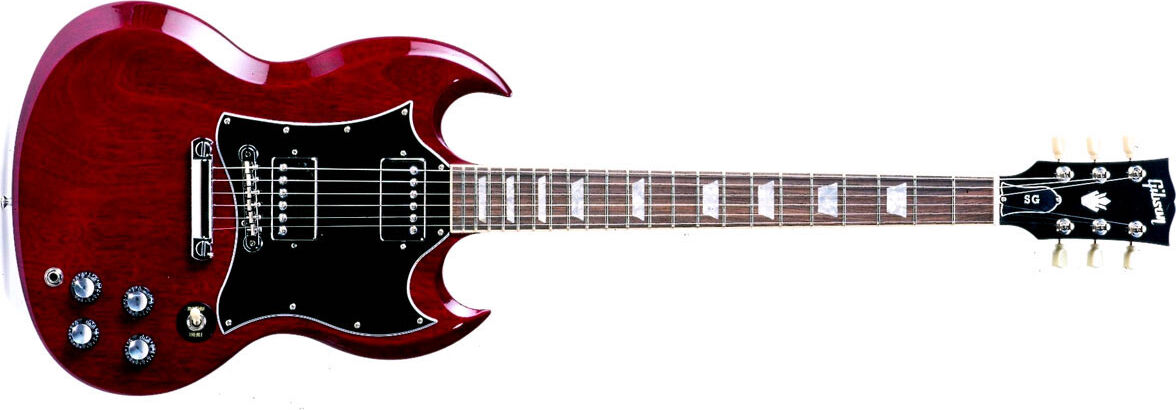
Everyone who deserves the right to vote knows the Gibson SG:

Originally putatively a lighter, double-cutaway version of the Les Paul, (whre “lighter Les Paul” makes about as much sense as “Lamborghini with a Hyundai engine”), it’s most famous as Angus Young’s main guitar this past thirty years or so.
And I always hated ’em; after years of playing the slim, elegant neck of my Fender Jazz, playing the SG felt like a thick piece of firewood; the fingerboards always seemed soft, almost porous. Maybe I’ve tried bad guitars – but every SG I’ve ever played felt cheap.

So you’d think the cheap knock-off would be a real doozy – right?

Well, no.

Ibanez guitars was, and is, a company based in Japan that started in the late sixties and early seventies making knock-off guitars. And one of their mid-seventies efforts was the SG:

If you look online, sellers will refer to various early-mid ’70s Ibanezes as “Lawsuit Models”, because – well, in 1975, Gibson sued Ibanez for copying Gibson guitars down to the absolute finest details of their designs (tuning machines, headstocks, truss rods…everything). Ibanez responded by changing some of the details…

…which is where my old SG comes in. It is a virtual dead-ringer for the red Gibson at the top of this post – but for the “Gibson” marque on the headstock, it could be the same axe.  I bought it from a friend in 1979, after he’d gotten it from a second-hand store for $90. I’m not sure if it was built immediately before the lawsuit (it looked exactly like a factory SG) or immediately after (the neck was thinner and slicker; the rosewood fingerboard was much nicer than any SG I’ve ever played). But it is a sweet guitar – especially after I dropped a Seymour Duncan “Jeff Beck” pickup in the bridge position (think “Hyundai with a Lamborghini engine”).

If you can find one, and you have a choice between saving your significant other’s life with a rare but relatively inexpensive surgery, and buying the SG – well, save you significant other. Duh. And then buy the SG.

--> Site Meter -->