Toro Toro, Taxi
By Mitch Berg
Dire Straits was, to me, the unlikeliest bunch of megastars of the Eighties.
And they were among the most interesting.
And it was thirty years ago today that the album that, to me, defined them as either “the most interesting megastars” or “the biggest interesting group” (*) was released.
Today is the thirtieth anniversary of Making Movies.
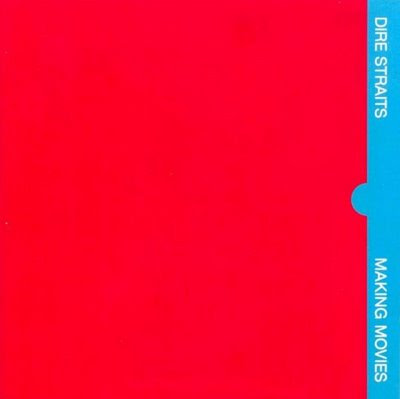
Dire Straits had come out of nowhere in 1978 with the mega-hit single “Sultans of Swing”, which introduced the world to the guitar style of Mark Knopfler, a former schoolteacher and guitar virtuoso who’d melded the styles of Chet Atkins, Richard Thompson and Eric Clapton into a thrilling melange of rootsy beauty.
Still, the first two albums – Dire Straits and Communique – were unsatisfying. They had their moments, to be sure – but by the time one listened to them both back-to-back, it was easy to write them off as an eccentric hybrid of country and pop; niche players worth a listen, certainly, but nothing that was going to take over the world.
We know how the story ends, of course. After 1982’s EP Love Over Gold, which established the band’s chops as a makers of quirky but consequential pop, came Brothers In Arms, which made them into Europe’s biggest superstars, record-movers and touring machines in the same league as Michael Jackson and Springsteen at the peak of their games.
Connecting the quirky alt-country band and the international pop powerhouse was Making Movies.
In an era of great pop songwriting, Tunnel had complex, literary lyrics – the title cut’s mad chase between a pair of lovers and the soldiers in the amusement park, starting with Bittan’s Rogers and Hammerstein-via-E-Street Band intro…
…and swerving between invocations of Chuck Berry, a sly latin influence, and a backstory that reads like a Dashiell Hammett short story.
And in place of the four-piece pub band from the first two albums, Knopfler stripped the band down to a power trio – John Illsley on bass, Pick Withers on drums, and himself – and added some judicious keyboards from Roy Bittan of the E Street Band. And in place of the air-tight, three-minute guitar-centered song arrangements came a wide-open, almost symphonic sound, with songs that stretched out toward eight minutes on the title cut, allowing room for the band to stretch out, and use Knopfler’s guitar virtuosity for atmosphere rather than mere fretboard acrobatics. “Skateaway”, a six-minute streetscape built around a reedy Stratocaster improvisation, really showcased Bittan’s organ and piano work, which paid subtle homage to Irving Berlin and George Gershwin in using the piano to evoke the atmosphere of a busy New York street and its star, a coquette on a pair of skates.
The song, with its off-handed asides to conversations up and down the street as the rollerskating heroine skittles through traffic, is almost a prototype of “Money For Nothing”, four years later – a song about an overheard conversation.
And “Romeo and Juliet”, an exhausted, last-call love song and one of Dire Straits’ most enduring masterpieces, stars Knopfler playing…the dobro, an instrument that hadn’t poked its nose out of the world of bluegrass in thirty years.
(Recorded months before MTV debuted, the video in all its painful lock-step literalism shows how very much in its infancy the art of the music video was).
While the album led with a lot less of the “geez, what an amazing guitar player is Mark Knopfler” than the first two albums, his virtuosity is, if anything, more amazing for its subtlety. Check out the skirling timbres of the soloing in “Tunnel of Love” – the tone of the Strat fills out from the middle as the solo progresses, accentuating the sub-dominant notes in his slinky patterns in a way that, thirty years later, I’m still getting new insights into. Or “Skateaway”, which is an etude on the uses of the nuance of the out-of-phase pickup pair and the volume pedal. It may be one of the most subtly gorgeous albums in the history of the electric guitar.
Making Movies made the case that pop music could be literary, virtuosic – a work of layered, nuanced beauty. It’s one of the reasons that this part of the eighties was such a glorious era in popular music. Because I can see someone making an album like this today; I just can’t see it being the jumping off point for a huge popular success.
(*) Of course it’s an absurd choice. There were many interesting groups that sold a lot of records; there were many megastars at the time that defied the stereotype that “pop is stupid”. But it’s in the English Majors’ Association Handbook; we are allowed to use one such juxtaposition a year without penalty. Step off.


October 17th, 2010 at 5:09 pm
Good post — Making Movies was one of my favorite albums at that point in my life (I was a senior in high school). I always thought of the album as Dire Straits’s version of The Wild, The Innocent and the E Street Shuffle.
October 17th, 2010 at 6:35 pm
I remember walking to Rhino Records in Claremont to buy this (perhaps the first time my wife was annoyed with my record-buying habits, as we were quite short of money that year.) The first album was exactly the sound I wished my band had — which could have been called alt-country if that term had existed in 1978. I wasn’t all that thrilled with Communique, though Once Upon a Time in the West was played constantly when I first moved to L.A. This album, though, was a godsend. I had lost track of the date, but thanks for conjuring up that memory. And I agree with Mr. D’s analogy.
But Mitch, how did you leave Expresso Love off this? That was the song that made this album for me.
October 17th, 2010 at 6:55 pm
how did you leave Expresso Love off this?
To leave room for everyone else’s memoirs?
Skateaway is my favorite…
October 17th, 2010 at 7:37 pm
FWIW: Skateaway is memorable to me only because it was the first video I ever saw on MTV. The music itself is not that memorable to me, but the video was.
The way the cable company wired our town, all the houses on the northside had cable first. High school parties on the north side back then featured groups of slack jawed teenagers drinking sneaked in beer while watching videos for hours and hours. Parties on the south side involved sneaked in beer and very loud stereos cranking The Who, Lynard Skynard and AC/DC anticipating the next north side party where we could watch videos.
October 17th, 2010 at 9:40 pm
See you tomorrow, my son.
October 18th, 2010 at 6:08 am
[…] This post was mentioned on Twitter by mitchpberg, mitchpberg. mitchpberg said: Today in music history: It's the 30th anniversary of "Making Movies" by Dire Straits: http://bit.ly/bYyxpW #narn2 […]
October 18th, 2010 at 6:33 am
“…which is an etude on the uses of the nuance of the out-of-phase pickup pair and the volume pedal.”
Which, I’m guessing, inspired at least one guy to take a Sawzall to the body of his Fender…
October 18th, 2010 at 7:07 am
Yup, Skateaway was by far my favorite, too!
October 18th, 2010 at 2:20 pm
Love Over Gold was not an EP, it was a regular, full length album. In fact, it’s my favorite of Dire Straits simply because of Telegraph Road, which is my favorite of their tunes because of the memories it evokes of hiking some serious backwoods trails with that tape wearing out my Walkman. I’m guessing I wore out at least a dozen tapes I made of that album before MP3 players came out.
This was one of their better overall efforts, though, and much more consistent than their earlier albums. Whether Tunnel of Love or Skateaway resonates more to me is more a question of mood than anything else, they each have their place.