Archive for the 'SCOTUS' Category

Words For Government To Live By

Thursday, March 4th, 2010

Paul Clement, arguing on behalf of the NRA at Tuesday’s SCOTUS hearing on McDonald Vs. Chicago, with emphasis added:

Just to dwell for a moment if I’d could on the First and Second Amendment, I think it’s striking, very striking, that if this Court’s not going to reconsider its Privileges or Immunities Clause jurisprudence, the Cruikshank case [an 1876 case that ruled that the First and Second Amendments restricted federal power] actually stands as very good precedent for incorporating the Second Amendment, just as it was the precedent this Court relied on in incorporating the assembly and petition rights of the First Amendment in the DeJonge case. And the reason is Cruikshank — the whole reason that Cruikshank said the First and Second Amendments aren’t privileges of national citizenship is because they were preexisting rights that didn’t depend on the Constitution for their existence.

That seems to me to be a pretty good working definition of what a fundamental right is, one that is so fundamental and basic that it preexisted our very Constitution. And so it’s not surprising that DeJonge cited Cruikshank as favorable precedent for incorporation.

I think the exact same logic would apply to the Second Amendment here and, as I say, I do think the consequence of that, certainly the most logical consequence, would be to carry over the jurisprudence under the Second Amendment. Now, right now that’s not carrying over a lot, right. That’s carrying over the Heller case.

But I think in a way that points up to the fact that one of the virtues of incorporation is that, because the Miller decision of this Court sowed confusion, we do not have substantial Second Amendment jurisprudence. And I would think that it’s going to be difficult enough to develop the Second Amendment jurisprudence that you wouldn’t want to make it more difficult by having to develop a Federal Second Amendment jurisprudence and then some sort of shadow version of that jurisprudence for the States.

Heller was the first time I’d ever actually read SCOTUS (or any other) transcripts.  It helps to be a lawyer and all, since they do sorta talk their little funky secret lawyer language half the time – but it’s interesting stuff.

Muzzle Blast From The Past

Wednesday, March 3rd, 2010

At the bottom of a Bloomberg column yesterday, it reads:

(Ann Woolner is a Bloomberg News columnist. The opinions expressed are her own.)

The opinions she expressed are also something I haven’t run across since West “Dirty Liar” Skoglund left office and the public eye: the kind of comical, context-challenged buncombe that more-or-less savvy gun control advocate stopped using ten years ago.

In other words, I fisk this column for the same reason “historical re-enactors” dress up in Civil War uniforms and re-enact the Battle of Antietam; partly so that people don’t forget how bad things were, and partly for the sheer joy of blasting away at a target that can’t maneuver. (more…)

Good Sign?

Wednesday, March 3rd, 2010

For a non-lawyer, trying to figure out what the SCOTUS justices are really saying when they talk is a little like the Oracle of Delphi trying to predict the next day’s action at Canterbury.  Lots of figurative sheep entrails and the like.

But in yesterday’s hearing for S McDonald V. Chicago, this bit here sounded modestly encouraging to this mere layman:

In oral arguments Tuesday, the justices signaled they are ready to pivot off a 2008 case, which overturned the handgun ban in the federal enclave of Washington and extend the right to “keep and bear arms” to states and localities.

Associate Justice Anthony Kennedy, considered the swing vote on the nine-member court, observed that the right to possess a gun has a “fundamental character” akin to freedom of speech. A decision in the case is expected this summer.

Aside:  After years of being the flip vote on issue after issue after issue, I wonder if Anthony Kennedy has double the ego of all the other justices?

Brady’s Rear-Guard PR Action

Monday, March 1st, 2010

The Supreme Court will be discussing the McDonald case tomorrow.  This case has the potential to be one of the most important human rights case in recent American history; at issue is the power of pettifogging state bureaucrats and demigogues to regulate your right to protect your and your families’ lives and property from the scumbags that the aforementioned bureaucrats and demigogues can not. 

The usual pack of orcs and their sympathizers are doing the usual public-relations maneuvering in advance of the ruling:

Gun control advocates think, if not pray, they can win by losing when the Supreme Court decides whether the constitutional right to possess guns serves as a check on state and local regulation of firearms.

In other words, anti-human-rights orcs like the Brady Factory Organization and the Violence Preservation Policy Center are hoping to lay the groundwork for many state impositions on the human right of self-defense, rather than a coordinated federal one.

The justices will be deciding whether the Second Amendment – like much of the rest of the Bill of Rights – applies to states as well as the federal government. It’s widely believed they will say it does.

But even if the court strikes down handgun bans in Chicago and its suburb of Oak Park, Ill., that are at issue in the argument to be heard Tuesday, it could signal that less severe rules or limits on guns are permissible.

Well, duh. 

This is one of the more absurd fallacies that the left brings up whenever the subject turns to the less-upmarket neighorhoods of the Bill of Rights, the Second and Tenth Amendments; most people agree that we need to have some government, some regulation, some restrictions to prevent the worst-case scenarios.  Opposing absurd, onerous and, yes, unconstitutional actions, regulations and restrictions doesn’t negate this.

The National Rifle Association and virtually every pro-human-rights organization already favor, and push, the only kind of regulations that actually matter – rules and restrictions that are onerous to criminals and those who should not have guns.

And the orcs?

The Brady Center to Prevent Gun Violence is urging the court not to do anything that would prevent state and local governments “from enacting the reasonable laws they desire and need to protect their families and communities from gun violence.”

But of course, Brady’s and the VPPC’s idea of “reasonable” always means “onerous to the law-abiding”.  No exceptions.

By some estimates, about 90 million people in the U.S. own a total of some 200 million guns.

Of which only a tiny percentage of either ever use a gun for nefarious reasons.  Which doesn’t prevent the anti-human-rights crowd, and their willing or ignorant dupes in the media, from trying to play the “scary numbers” game:

Roughly 30,000 people in the United States died each year from guns; more than half of them are suicides. An additional 70,000 are wounded.

Of the 15,000 that are not suicides, the decided majority are related to the “War on Drugs”‘; of all the foul play killings, the vast majority are carried out by people with criminal records, who demonstrably should not be allowed to have guns in the first place.

But those aren’t the ones that concern the orcs:

Chicago is defending its gun laws at the high court. Mayor Richard Daley said a ruling against his city would spawn even more suits nationwide and lead to more gun violence.

Gosh, Mayor Daley – you mean, more of the violence that our nation’s most violent city’s complete ban on all civilian gun ownership has utterly failed to dent

That would be the smart question.  But Daley isn’t talking to smart people, or people who care about human rights:

“How many more of our citizens must needlessly die because guns are too easily available in our society?” Daley said at a Washington news conference last week that also included the parents of a Chicago teenager who was shot on a bus as he headed home from school.

Annette Nance-Holt said her only child, 16-year-old Blair Holt, shielded his friend when a gang member boarded a bus and began shooting at rival gang members.

“You might ask, ‘What good is Chicago’s handgun law if so many of our young people are still being shot?'” Nance-Holt said. “All I can say is, imagine how many more would be if the law were not there.”

None.  Or, very likely, less.  Because this sort of crime – mass gang shootings with utter arrogant impunity – are pretty much the sole province of the city full of disarmed citizens sheep .

For those of you who don’t eat up SCOTUS trivia for the fun of it, the McDonald case is all about setting the precedent that the Heller decision that the Second Amendment right “of the people” means people, not the “National Guard”, must be observed by the states:

In earlier cases applying parts of the Bill of Rights to the states, the court has done so by using the due process clause of the 14th Amendment, passed in the wake of the Civil War to ensure the rights of newly freed slaves.

The court also has relied on that same clause – “no state shall deprive any person of life, liberty or property without due process of law” – in cases that established a woman’s right to an abortion and knocked down state laws against interracial marriage and gay sex.

This is the approach the NRA favors.

Justifyably so.

But many conservative and legal scholars – as well as the Chicago challengers – want the court to employ another part of the 14th amendment, forbidding a state to make or enforce any law “which shall abridge the privileges or immunities of citizens of the United States.”

Hopefully the “privilege” of citizens sheep to be “immune” from protecting themselves will get laughed out of court.

The deliberations should take place tomorrow – this blog will cover the discussion to the best of my ability.  As with Heller, we’ll probably get the decision in June.

Suffice to say I’ll be watching it.

The Orcs Are Gathering

Wednesday, December 30th, 2009

As the clock ticks toward March and the Supreme Court arguments in re McDonald v. City of Chicago, the anti-civil-rights orcs are mustering their forces:

In a few months time, the Supreme Court will revisit the Second Amendment in McDonald v. City of Chicago, which challenges a gun-control ordinance in the city.

Not surprisingly, the case is attracting heavy interest around the country.

The Sacramento Bee today reports that Sacramento’s City Council has voted to join other cities arguing in support of Chicago’s right to regulate the posssesion and use of firearms.

Other cities invited to file briefs supporting Chicago include Baltimore, Cleveland, Los Angeles, and Philadelphia.

At last check, gun control has treated those cities so well, hasn’t it?  Four of the five cities have not only among the toughest gun controls in the United States, but share an average violent crime rate of over 1,400 per 100,000 residents – well over triple the national average.

Sacramento City councilman Kevin McCarty, who supports the city’s involvement in the case, told the Bee that guns “are most likely to be used by assailants or people who shouldn’t have guns in the first place.”

Sacremento?  997/100,000, well over double the national average.

But there is plenty of firepower on the other side of the case.

Many states, including Texas, Ohio, and Pennsylvania, have filed an amicus brief arguing that Chicago’s handgun ban is unconstitutional. Here’s a link to that brief.

Note to Lori Swanson; while I’m unlikely to vote for you on any number of grounds for any office, you could certainly earn credit in heaven by filing a brief for the plaintiff here.  Whatever your other faults, you’ve been right on this issue more consistently than most politicians in Minnesota.

At issue in the McDonald case is whether the Second Amendment right to bear arms applies to states.

In D.C. v. Heller, the Supremes a few terms back ruled that Washington, D.C.’s gun-control ordinance violated the Constitution, but that ruling dealt with a federal statute, not state law. Several courts, including the Seventh Circuit in the McDonald case, have since ruled that the Second Amendment does not apply to the states.

And while I dream of the Seventh Circuit being chased down the street in their underwear by a mob wielding pitchforks and torches, I’m sure they had their (faulty) reasons.

To get at whether the Second Amendment binds states and localities may require a parsing of the 14th Amendment’s Privileges and Immunities Clause, namely whether the right to bear arms is a privilege that can not be abridged by states.

The word we’re looking for is “human right”, “endowed” to “the people” by “our creator”.  See to that.

Dear Mayor Daley

Friday, December 4th, 2009

To: Richard Daley, Mayor, Chicago

From: Mitch Berg, occasional visitor.

Re: Hahahaha

Dear Mayor Daley,

As you and your minions dig in to fight against the rule of law in the McDonald case (scheduled to go before the Supreme Court on March 2), just thought you’d like to check out a little bit of foreshadowing, courtesy of Justice Scalia in the Heller decision. I call it “foreshadowing” because I’m gonna guess it covers the tack you and your lawyers are going to try to take (I’ll add some emphasis for the benefit of your “community organizers):

Justice Breyer moves on to make a broad jurisprudential point: He criticizes us for declining to establish a level of scrutiny for evaluating Second Amendment restrictions. He proposes, explicitly at least, none of the traditionally expressed levels (strict scrutiny, intermediate scrutiny, rational basis), but rather a judge-empowering “interest-balancing inquiry” that “asks whether the statute burdens a protected interest in a way or to an extent that is out of proportion to the statute’s salutary effects upon other important governmental interests.” Post, at 10. After an exhaustive discussion of the arguments for and against gun control, Justice Breyer arrives at his interest-balanced answer: because handgun violence is a problem, because the law is limited to an urban area, and because there were somewhat similar restrictions in the founding period (a false proposition that we have already discussed), the interest-balancing inquiry results in the constitutionality of the handgun ban. QED.    We know of no other enumerated constitutional right whose core protection has been subjected to a freestanding “interest-balancing” approach.

I’m no lawyer, but to the best of my knowledge the key use of “interest-balanced” enquiry was to distinguish slaves from free men.  (I could be wrong).

The very enumeration of the right takes out of the hands of government—even the Third Branch of Government—the power to decide on a case-by-case basis whether the right is really worth insisting upon. A constitutional guarantee subject to future judges’ assessments of its usefulness is no constitutional guarantee at all. Constitutional rights are enshrined with the scope they were understood to have when the people adopted them, whether or not future legislatures or (yes) even future judges think that scope too broad. We would not apply an “interest-balancing” approach to the prohibition of a peaceful neo-Nazi march through Skokie. See National Socialist Party of America v. Skokie, 432 U. S. 43 (1977) (per curiam). The First Amendment contains the freedom-of-speech guarantee that the people ratified, which included exceptions for obscenity, libel, and disclosure of state secrets, but not for the expression of extremely unpopular and wrong-headed views. The Second Amendment is no different. Like the First, it is the very product of an interest-balancing by the people—which Justice Breyer would now conduct for them anew. And whatever else it leaves to future evaluation, it surely elevates above all other interests the right of law-abiding, responsible citizens to use arms in defense of hearth and home.

To translate it for your lawyers, Mayor Daley:  Really really really wanting to keep black people disarmed doesn’t count as a constitutional governmental power.

And in conclusion:

We are aware of the problem of handgun violence in this country, and we take seriously the concerns raised by the many amici who believe that prohibition of handgun ownership is a solution. The Constitution leaves the District of Columbia a variety of tools for combating that problem, including some measures regulating handguns, see supra, at 54–55, and n. 26. But the enshrinement of constitutional rights necessarily takes certain policy choices off the table. These include the absolute prohibition of handguns held and used for self-defense in the home. Undoubtedly some think that the Second Amendment is outmoded in a society where our standing army is the pride of our Nation, where well-trained police forces provide personal security, and where gun violence is a serious problem. That is perhaps debatable, but what is not debatable is that it is not the role of this Court to pronounce the Second Amendment extinct.

We affirm the judgment of the Court of Appeals.

I doubt the Supremes have the power to order you to be chased from office with a rock-and-garbage-throwing mob, but it’d seem just.

Arguments on March 2.  Decision sometime in June. I may take a vacation day; who knows, I might even go to Chicago.

That is all.

Tyranny For Ye, But Not For We

Tuesday, November 24th, 2009

The word “hypocrite” gets tossed around with excessive abandon in grassroots political arguments; leftybloggers throw it about like monkeys flinging poo over every perceived inconsistency or imperfection they can dredge up.

“Hypocricy” is when someone completely contradicts a moral, ethical, philosophical or other stance.

Like, say, when a Legislative body tries to inflict a socialized healthcare system on the rest of society – but carefully writes itself out of it so it can keep its own current health plan, which actually works.

Or, say, when an entire politcal class bans the human right of self-defense for most of the society it governs, but writes itself a special loophole to allow itself to carry guns.  Because, y’know, someone’s gotta govern the peasants.

Lady Logician – a Chicago native now living in Utah – writes:

Chicago not only has one of the strictist gun control laws in the country, it’s Mayor is talking all out war (in light of the Supreme Courts Heller decision) to make sure that they law is not repealed. Yet it seems that in Mayor Daley’s Chicago, gun control adnerence is only for the proletariat and not for the ruling classes.

Amazingly enough, he was not the first local public official to take the view that firearms restrictions are something for other, ordinary people to observe. Chicago politicians are zealously committed to gun control in law, but fairly relaxed about it in practice.

In 1994, state Sen. Rickey Hendon, D-Chicago, had an unregistered handgun stolen from his home in a burglary, and he didn’t feign contrition about his disregard of the ordinance.

“I have a right to protect myself,” he declared, noting that he had been burglarized before — and forgetting that the state legislature of which he is a member allows Illinois cities to deprive their citizens of that right. Asked if he would replace the lost piece, Hendon said, “No comment.” The police were kind enough not to charge him.

Nice of those Chicago cops.  D’ya suppose a regular citizen would get the same forebearance?

U.S. Sen. Roland Burris, another Chicagoan, has endorsed a nationwide ban on handguns and, in 1993, organized Chicago’s first Gun Turn-in Day. But the following year, while running unsuccessfully for governor, he admitted he owned a handgun — “for protection,” he explained — and hadn’t seen fit to turn it in along with those other firearms. Lesser mortals apparently can protect themselves with forks and spoons.

And it’s here LL is wrong.  As we’ve seen in the UK, defending oneself with kitchen utensils, or even your fists and fingernails, can be banned as easily as guns can.

But how is this – words fail – hypocrisy possible?

In the early nineties, at the near-nadir of Second Amendment human rights, Dianne Feinstein – today a Senator, back then the mayor of San Francisco – famously obtained a handgun.  And then tried to revoke all civilian carry permits in the city – but only after having herself issued a police carry permit.  It didn’t end well for Feinstein – indeed, her hypocrisy was a huge moral lift to the Second Amendment human rights movement fifteen years ago.

But San Francisco is a piker a pouring on perks for pols (emphasis added by me):

But wait, you say, State law classifies aldermen as designated “peace” officers and as such share the same rights and responsibilities as Chicago police officers. That also assumes that these aldermen are “law-abiding” as police officers are supposed to be and yet….

…and yet Chicago alderman, who actively repress the civil rights of law-abiding Chicagoans as they preside over an epic meltdown of law-and-order in the streets, give themselves the right to carry a firearm for self-defense.

Because peasants need lords, dammit.

C’mon, February!

Aim

Tuesday, November 24th, 2009

Since the Civil Rights movement’s epic victory in the Heller case two years ago, the eyes of civil-rights-loving Americans of all parties have been trained on Chicago.

The City of Chicago, and many of its suburbs, have gun control laws scarcely less onerous than those in North Korea – while the crime wave in Chicago itself remains among the worst in America, and grows ever worse as the government of Richard Daley (Orc, La-La-Land) tries to disarm the law-abiding citizen even more.

But the legislative and legal battlefield has changed in the past 25 years; indeed, it’s almost unrecognizable to this Human Rights activist, who was feeling incredibly depressed about the state of Second Amendment human rights as recently as 1994.

And we are approaching what may be perhaps the most epic battle of them all.

The National Rifle Association – perhaps America’s foremost Human Rights group  – – – filed amicus (“friend of the court”) briefs  yesterday in support of the plaintiff in McDonald Vs. Chicago.

And just to show what an “extremist” position this is, the filing was joined by a bipartisan selection of over 3/4 of this nation’s state attorneys-general:

Last week, the NRA filed its brief with the Supreme Court as Respondent in Support of Petitioner in the McDonald case. The NRA brief asks the Court to hold that the Second Amendment applies to state and local governments through the Fourteenth Amendment.

“We are pleased that more than 75 percent of America’s state attorneys general have joined this historic effort in support of our Second Amendment freedoms. The NRA and gun owners everywhere are grateful for their participation in ensuring that the Second Amendment applies across the nation, not just in federal enclaves,” said Chris W. Cox, NRA chief lobbyist. “I would especially like to acknowledge the outstanding work of Texas Attorney General Greg Abbott in authoring this historic amicus brief, as well Ohio Attorney General Richard Cordray, Arkansas Attorney General Dustin McDaniel and Georgia Attorney General Thurbert Baker for their leadership in this important effort.”

Minnesota’s Lori Swanson was joined by the Attorneys-General of North and South Dakota in supporting Human Rights.  Iowa and Wisconsin’s AGs apparently sided with the orcs, on behalf of slavery and repression.  It should go without saying that electoral vengeance should rain down on those vapid petty tyrants like vomit from the cheap seats at Lambeau Field.

The case should go to the SCOTUS in the next three months.  It should go without saying I’ll be on it.

She’s Lying

Wednesday, July 15th, 2009

…and she’s pretty good at it too.

I spent a fair amount of time watching video excerpts of the Sotomayor hearings last night.

Initially, her cool, calculated and over-enunciated responses disarmed me and left me thinking if we have to live with a SCOTUS appointee borne of Comrade Obama’s rule of the administrative branch any way, I can live with this.

…and then I slapped myself.

She’s good…or her coach is.

Sotomayor: “No, sir. As I’ve indicated, my record shows that at no point or time have I ever permitted my personal views or sympathies to influence an outcome of a case. In every case where I have identified a sympathy, I have articulated it and explained to the litigant why the law requires a different result. … I do not permit my sympathies, personal views, or prejudices to influence the outcome of my cases.”

Her repeated assertions that forging policy remains the domain of Congress flies in the face of…

Court of appeals is where policy is made…and I know, I know this is on tape and I should never say that”

I found her responses in sharp contradiction with the record she ironically kept referring to and moreover with her own widely-publicized statements of the past.

Judge Sonia Sotomayor said President Barack Obama didn’t ask her about abortion before her U.S. Supreme Court nomination, as she renewed her promise to lawmakers that she would interpret the law impartially.

“I was asked no questions by anyone including the president about my views on any specific legal issue,”

True or not, this is really immaterial. He didn’t have to. Her record and public statements are well documented. She is likely a token appointee. Furthermore, vetting has not been a strength of the Obama administration.

She is by no means unqualified – but is she suitable? Did President Obama select the best candidate at hand, or the best “Wise Latina?”

I’d like to hear what our crew of commenters think of Sotomayor and her confirmation hearings.

  1. Do you think it’s a waste of time (she’s going to be confirmed any way)?
  2. Do you believe her assertions these past couple of days or is she just reading from a prepared inventory of talking points?
  3. Does she really disagree with the president who said “[in] 95 percent of the cases, the law will give you the answer, and the last 5 percent legal process will not lead you to the rule of decision. The critical ingredient in those cases is supplied by what is in the judge’s heart.? Eighty percent of judging is the law”?
  4. Does her judgment of the New Haven, Connecticut firefighters race-bias lawsuit, subsequently overturned, unwind her repeated “look at my record” plea?
  5. How would the court (or your life) be impacted by the addition of Sotomayor, judging by her record and not her testimony?

Alternate History

Wednesday, October 1st, 2008

 Last June, democracy won a huge victory when the Supreme Court ruled for the plaintiff in the Heller case. 

As a human rights advocate (the Second Amendment being merely one right among many that needs to be jealously defended), I had been looking forward to the decision with anticipation and trepidation for quite some time. 

To the point where I basically had posts written for both contingencies – a win, and a loss.  Both posts were written, for the most part, weeks in advance. 

Naturally, we – Americans and human rights advocates – won, and I ran this jubilant-yet-defiant-to-the-point-of-belligerent post.  I’m still proud of that one.

I’ve had people ask me – “so, what did you write in case we lost?”

I remembered that question as I was cleaning some old stuff out of the Drafts folder this morning. 

Here – a little bit of alternative history written for a much uglier state of mind:

Fascism Wins.  Freedom Kicked in the Groin.  For Now. 

By a X to X vote, the Supreme Court of the United States today ruled in the Heller case that the Second Amendment of the United States Constitution is exactly the opposite of what the founding fathers intended; that a right “of the people” means “the National Guard”, not “you and I”. 

Y’know – how rights “of the people” to assemble only refer to Congress, and how freedom of speech and the press only mean the news media.

As a result of today’s ruling, the District of Columbia’s gun ban – like most gun control measures, a racist conconction intended to keep all those brown-skinned people from running amok in the nation’s capitol – stands, and will return us in deed if not in thought to the days when black people had a separate, unequal justice system…


…with hints of much, much worse…:

…shall carry forth for the moment unabated. 

As Gary Miller notes in his Categories list – Western Civilization; it was a helluvva run.

Oh, this is not the end of the war over the Second Amendment.  The orcs control much; many cities still pay fealty to the notion that a disarmed, docile citizenry is a safe one.  This is far from the end.  The movement of Real Americans who support our God-given rights is large, and sure – if I have anything to say about it – to take this as a wake-up call.

The big lesson?

Your rights are only as secure as your ability to bring political power to bear can make them.

The SCOTUS’ decision was a loathsome one, and a bad day for America:

And as Churchill noted, one does not forge victory from defeats:

And yet Americans – real Americans, the ones that are rendered nauseous by this decision, as opposed to tin-pot authoritarians like Heather Martens and Wes Skoglund – are all about fighting back against adversity, against horrible odds…


…and prevailing.  Much hard fighting remains.

The orcs will take this as a cue to continue and redouble their assault on the God-given rights of the law-abiding American.  It is inevitable; it is the way of the orc to feed on your freedom.

 But we – the Americans who’ve fought long and hard to keep this issue on the national radar – have to cinch up our belts and get back into it.  We’ve won much in the past ten years; “shall-issue” is now the law of the land in most of the US; even unabashed liberals like Barack Obama and Hillary Clinton fear the might of the NRA.

Damn right.  Let’s show the bastards what fear at the polls really is.

To the pike with the enemies of freedom.  (Speaking rhetorically, of course). 

God Bless America.

NOTE:  This blog seeks dialogue.  However, if you wish to defend the SCOTUS’ decision, you will need to make it a very, very good one to avoid having  your comment deleted or mutilated for my amusement.

Nice to see that it’s just a rhetorical curio.

DC: Keeping The Proletariat In Line Since 1975

Friday, July 18th, 2008

The DC Gun Ban is officially euthanized as of today.

I said “officially”. 

Because I think Dick Heller’s gonna be back in court sooner than later:

District residents can start registering their guns today. But at least one very high profile application was already rejected.

Dick Heller is the man who brought the lawsuit against the District’s 32-year-old ban on handguns. He was among the first in line Thursday morning to apply for a handgun permit.

But when he tried to register his semi-automatic weapon, he says he was rejected. He says his gun has seven bullet clip. Heller says the City Council legislation allows weapons with fewer than eleven bullets in the clip. A spokesman for the DC Police says the gun was a bottom-loading weapon, and according to their interpretation, all bottom-loading guns are outlawed because they are grouped with machine guns.

Look for DC to try to run out the clock – at taxpayer’s expense, and without an actual end to the game – trying to give the Second Amendment the death of a thousand paperwork cuts.

Though residents will be allowed to begin applying for handgun permits, city officials have said the entire process could take weeks or months.

“I’m shocked, shocked to see that the District of Columbia believes it’s above the Supreme Court”.   

Back to court, with copy of Scalia’s opinion in hand, baby:

We think that limitation is fairly supported by the historical tradition of prohibiting the carrying of “dangerous and unusual weapons.”… It may be objected that if weapons that are most useful in military service—M-16 rifles and the like—may be banned, then the Second Amendment right is completely detached from the prefatory clause. But as we have said, the conception of the militia at the time of the Second Amendment’s ratification was the body of all citizens capable of military service, who would bring the sorts of lawful weapons that they possessed at home to militia duty. It may well be true today that a militia, to be as effective as militias in the 18th century, would require sophisticated arms that are highly unusual in society at large. Indeed, it may be true that no amount of small arms could be useful against modern-day bombers and tanks. But the fact that modern developments have limited the degree of fit between the prefatory clause and the protected right cannot change our interpretation of the right.

Perhaps Heller should try to register one of these, as a big FU to DC.


Hey, it’s not bottom-loading…

Three Questions For You

Friday, June 27th, 2008

Question One

So after all my writing yesterday about the Heller decision (I’m supportive), what would you think if it were divulged by someone other than myself that I were getting payments from, say, the National Rifle Association to plug news releases from the Institute for Legislative Action (an NRA subsidiary), and not divulging that organizational or financial link?

Better example; what if, say, the Strib (owned by Avista Capital Partners) ran an uncritical, even fawning, report about the surpassing excellence of Frontier Drilling’s offshore exploration technology – and did it without disclosing that they are owned by the same company?

Woudl you consider that an ethical lapse on the Strib’s part?  Well, duh; pretty shady – right?  Pretty dubious ethics, perhaps?

Well, have no fear; both cases are supremely hypothetical.

Hold that thought as we proceed.

 Question Two

So how about if the Minnesoros “Independent” ran a piece uncritically fawning over a study put out by a political pressure group-cum-economics think tank that is a financial first-cousin of theirs, without disclosing the link?

Well, yeah, of course they did it, publishing a report by the Center for Economic Policy Research (about declining home values and, naturally, the wisdom of an interventionist approach to the housing crisis.

Learned Foot looks at the CEPR’s funders…:

Foundation support in 2008 includes:

The Annie E. Casey Foundation

The Nathan Cummings Foundation

The Ford Foundation

The Meyer Foundation

The Moriah Fund, Inc.

***The Open Society Institute***

The Retirement Research Foundation

The Russell Sage Foundation

The Alfred P. Sloan Foundation

The Streisand Foundation

Washington Area Women’s Foundation

There’s that “Open Society Institute” again! That name just keeps popping up like a bad Soros huffing Viagras.

And who else does the “Open Society Foundation” support?

MorOn.org – Your one-stop shop for hatchet-jobbery done on behalf of (but not in coordination with – oh no, that’d be wrong) the Democratic Party.

Media Matters – Media watchdog group that specializes in combating “conservative misinformation in the media.” As such on that site, “the media” tends to consist almost entirely of Fox News and Rush Limbaugh.

The Center for “Independent” Media – Runs several “non-partisan” (battleground) state-based “media outlets” that spew forth all manner of leftist drivel / character assassinations.

Citizens for Responsibility and Ethics in Washington: A “non-partisan” ethics watchdog that specializes in suing Republicans, and making endless FOIA requests regarding Republicans.

Approdeh – An outfit that lobbies on behalf of South American terrorist organizations.

And now…

The Center for Economic Policy and Research – Issues bogus reports that can be cited by all of the above as authoritative. Kind of like money laundering.

Or like working for a law firm with one client.  In the “construction” business. 

Question Three

Does the Minnesoros “Independent’s” “code of ethics” actually impel them to behave ethically, or does it merely give them a framework under which to rationalize their unethical behavior?


The Right Of The People

Thursday, June 26th, 2008

By a 5-4 vote, the Supreme Court of the United States today ruled in the Heller case that the Second Amendment of the United States Constitution is exactly what the founding fathers intended; that a right “of the people” means “people”, not “the National Guard”.

The court dealt forty years of erosion of civil liberties and contempt for the law-abiding citizen a sharp kick in the groin with pointy boots. The decision stands as the capstone on one of the most remarkable bits of grassroots politics in American history – a three-decade battle where the nation’s people, black and white and Republican and Democrat, fought their elites first to a standstill, and then came back to an escalating series of victories, starting in the courts of public opinion, extending through legislatures and city councils around the nation, to today.

This ruling euthanizes the DC Gun Ban – which is was, like most gun control measures, a racist concoction intended to keep all those brown-skinned people from running amok in the nation’s capitol, to return us in deed if not in thought to the days when black people had a separate, unequal justice system…

To quote Lyle Denniston of ScotusBlog:

the Court nullified two provisions of the city of Washington’s strict 1976 gun control law: a flat ban on possessing a gun in one’s home, and a requirement that any gun — except one kept at a business — must be unloaded and disassembled or have a trigger lock in place. The Court said it was not passing on a part of the law requiring that guns be licensed. It said that issuing a license to a handgun owner, so the weapon can be used at home, would be a sufficient remedy for the Second Amendment violation of denying any access to a handgun.

The decision opens up possibilities for litigation and legislation on further gun bans, like Chicago’s, and also at least partially ejects US V. Miller from its misbegotten role as definitive precedent on Second Amendment issues.

This is not the end of the war over the Second Amendment, of course. It’s not a complete victory; licensing at the end of the day is conceptually scarcely less odious or abuse-prone than a ban (as we’ve found out in Saint Paul this past year). The orcs still control much; many cities (or at least their governing elites) still pay lumpen, unthinking fealty to the notion that a disarmed, docile citizenry is a safe one.

Some of this world’s people know better…:

…that the only genuinely secure people in this world are the ones that can see to their own security.

Yes, folks – this is serious business.

This is far from the end. Indeed, as Churchill said, it’s the end of the beginning…:

…and much hard fighting remains.

The court did the right thing – and now, this is a battle we Real Americans have to consolidate, extend, and win in the legislatures, City Councils, and in Congress.

The orcs will regroup and try to consolidate and, eventually, make another assault on the God-given rights of the law-abiding American. It is inevitable; it is the way of the orc to feed on your freedom. Softcore fascists like Heather Martens and Wes Skoglund aren’t drying up and blowing away because of this ruling; it remains to us to extinguish the smoldering dung-heap of that whole school of thought, in the legislature, in court, and most importantly in the hearts of people smart enough to know the difference between “rights of the people” and “privileges granted by your masters”.

But we – the Americans who’ve fought long and hard to keep this issue on the national radar, and drive this nation back from the insane nadir of the collectivist seventies – deserve a moment, if only a moment, to relax and enjoy the fruits of today’s victory. It’s a great respite from a dismal political season, and a solid jumping-off point for what comes next.

Enjoy it. I sure am.

To all of you who’ve spent so much time, toil and treasure winning today’s victory, a salute. You’ve earned it.

Tomorrow? Well, it’s back to work. Back to the endless job of putting the enemies of freedom to the rhetorical point of the political pike – one Congressman, one Justice, one voter at a time.

The way we’ve done it all along.

Thank you. And God Bless America.

(Over the top a little? Not really. Oh, I’m doing the endzone happy dance. I’m doing to do the endzone happy dance on David Lillehaug’s neck – rhetorically speaking, of course. Today’s a great day, and I’m going to treat it as such).

Life Is Like This

Wednesday, June 25th, 2008

Tomorrow, sometime very shortly after 9AM Central Time, the Supreme Court will issue its decision in the Heller case, the most important Second Amendment case in history, one which will likely define this nation’s approach to one of our civil liberties as defined in the Bill of Rights for the unforeseeable future.

To say I’m looking forward to this is an understatement; I have had four different posts written against this day – with differing ledes for four different permutations of results – for over a month now, the faster to get a piece up and posted when the word finally comes down from on high.

I am, as they say, loaded for bear.  So to speak.  Every possible contingency but one is accounted for.

I said “but one”.  Someone has gone and scheduled a meeting tomorrow morning.

At 9AM. 

Far from my office.

And no, it’s not going to get re-scheduled.  It depends on the presence of a number of people who routinely block entire days off of their schedules, to avoid getting overbooked. 

You might be thinking “take your laptop with!”   Nice try – but naturally, I’ll be presenting a number of design alternatives to assembled management from several divisions, via overhead projector; it’d hardly do to have SCOTUSBlog and my blog editor page open as I talked to the gathered multitude.

So, like Dr. Cox in the “NBA Final” episode of Scrubs, I’m going to discharge my duties with my usual excellence, and then race like a crazed man back to my digs, avoiding all water-cooler conversation until I get back online, to figure out exactly what to post.

(The alternative – predict the result and the time of its release, and set it to post before I go to the meeting – might lend itself to endless jocularity in the all-too-likely event that I predict something, like perhaps the number of pro and con justices or, perhaps, the actual verdict, wrongly.  But I think I’ll let y’all get your yuks elsewhere, thanks).

So…Tomorrow, Then? (UPDATE: Yes)

Wednesday, June 25th, 2008

Tom Goldstein at SCOTUSBlog reports that Heller is not on the agenda for today. We should know shortly if tomorrow will be the last day the court will be issuing opinions for this term.

I’ll be up early again.

UPDATE: Chief Justice Roberts has announced that the court will issue all remaining opinions tomorrow.

So tomorrow it is.

Countdown

Wednesday, June 25th, 2008

The Supreme Court has seven opinions remaining for this term. Heller is the big one. Today’s session starts at 10AM Eastern/9AM Central.

While I’ll be at work, I’ll keeping an eye on the results. Stay tuned.

UPDATE:  So far the best place for results seems to be the SCOTUSBlog’s liveblog of today’s session; it’s an auto-updating panel that’ll be at the top of one of my monitors all day.

Seven minutes into the session, they’ve upheld the Exxon Valdez award, and granted a death-row inmate a third hearing.  Fingers crossed.

UPDATE 0912 CT:  Tom Goldstein at SCOTUSBlog notes there’s one more opinion to go.

UPDATE 0916:  The court ruled in Giles v. California, but Goldstein notes that at least one more decision is in the chute.  Stay tuned.

Stand By

Monday, June 23rd, 2008

I’m going to do a rare bit of mid-day writing to point to this bit here, which – presuming it’s accurate, and the author Tom Goldstein takes pains to temper our enthusiasm – could be excellent news for Real Americans (emphasis added):

It does look exceptionally likely that Justice Scalia is writing the principal opinion for the Court in Heller – the D.C. guns case. That is the only opinion remaining from the sitting and he is the only member of the Court not to have written a majority opinion from the sitting. There is no indication that he lost a majority from March. His only dissent from the sitting is for two Justices in Indiana v. Edwards. So, that’s a good sign for advocates of a strong individual rights conception of the Second Amendment and a bad sign for D.C.

There are signs the Supreme Court is going to release its ruling Wednesday.

Allahpundit notes:

What’s strange is that, per O’Shea, there’s likely to be a majority on the threshold question but then all kinds of splits within the court on the subsidiary questions — and Scalia, being more of an absolutist on this issue, is unlikely to represent the majority on all or most of those subsidiary questions. Roberts himself, or Kennedy, would seem to be a better bet. Is that a hint that maybe the Court’s not going to reach those subsidiary questions at all, and will content itself with a simple ruling on the individual rights issue?

I’m loathe to indulge in exuberance of any sort, hence won’t speculate “perhaps the absolutists will win on all the subsidiary questions”. It’s never that easy.

Mike O’Shea has another fascinating possibility:

If D.C.’s handgun ban is held unconstitutional in Heller (as it should be), the city of Chicago’s essentially identical ban on handguns will offer a prime target for a test case designed to present the issue of Second Amendment incorporation. A lower court that considers the issue in light of the Supreme Court’s post-1960 “selective incorporation” precedents will have a very difficult time avoiding the incorporation of the Second Amendment, at least in some form, against state and local governments. The only way lower courts might be able to avoid that conclusion is by cleaving to nineteenth century Supreme Court opinions like Presser v. Illinois and U.S. v. Cruikshank that declined to incorporate the Second Amendment, just as the Court at that time declined to incorporate the other provisions of the Bill of Rights. The Court repeatedly rejected this approach during the twentieth century.

I’ll be watching the SCOTUS wire bright and early tomorrow.

UPDATE:  Apparently Allahpundit had the wrong date for the next session in his copy; change to fit reality.

Biting Fingers

Monday, June 23rd, 2008

Along with Carnivore from TvM, I expected – indeed, hoped for – a decision from the Supremes on the Heller case today.

It’s not to be, although the wire says the SCOTUS has announced they’re going to announce some verdicts later on this week.

Carnivore is being sober about it all:

I had always believed June 23 would be the Heller decision date despite a false start two weeks ago which instead found the Court granting habeas corpus to foreign terrorists. So in Heller, as a worst case, we can expect the Court to grant the right to keep and bear arms to foreign born terrorists.

We’ll keep our fingers crossed.

Counting The Minutes

Monday, June 16th, 2008

Kevin Ecker over at True North and Eckernet notes that today just might be the big day:

Here is a pretty good roundup of what to expect from this decision, especially since it makes the distinction between upholding the Second Amendment for a number of purposes, most notably civic and personal. The author (Mike O’Shea) is right that there is a general consensus amongst airchair justices that the Second Amendment will in all liklihood be upheld….so the debate comes down to finer distinctions.

I fully expect this decision to essentially tapdance around the Miller 1939 decision, and come down in favor of private rights, leaving the argument for/against civic uses essentially twisting in the wind. Is I wrote previously, SCOTUS made it clear from the start that their decision would be limited to the case at hand, which is an issue of private usage.

Civic usage is likely to remain undecided, allowing states pretty wide latitude to ban “scary guns”. While SCOTUS, due to it’s non-elected state, is theoretically free from having to respond to public whims that may change from day to day, I don’t think most of the Justices want to come forward with a decision of essentially granting everyone the right to a howitzer.

The answer – to those of us who’ve been through this already (in my case, Minnesota’s ten-year-long battle over “shall-issue” carry permitting) is that the courts would do well to leave those decisions to the states; this is a battle that the howitzer-American community (hypothetically) needs to fight in the various legislatures.

This case – presuming the SCOTUS decides properly – will not win “the war”.  If Heller scuppers the District of Columbia’s racist gun ban, it’ll be analogous to getting across Omaha Beach.  It’ll be a signal that one of the most noxious effects of the gun control spree of the sixties and seventies has been reversed. But it’ll also mean that we civil liberties supporters will have to redouble our efforts.  We have a lot of ground yet to win, and  it’ll have to be won the hard way; one legislator, and one voter, at a time, before we can put the last anti-gun orc to the rhetorical sword.

I, for one, can hardly wait.

This One’s For Heather Martens and Wes Skoglund

Wednesday, June 11th, 2008

Just to set the stage for the Supreme Court’s Heller decision, which should be coming out in the next couple of weeks.

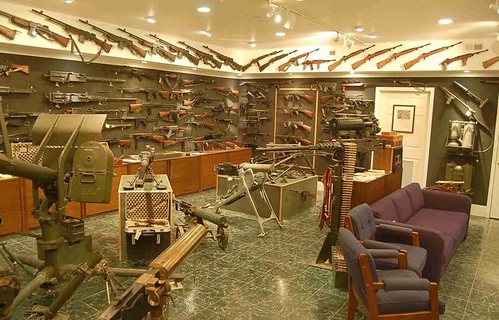
Check this out:

Wow. Lookit all those guns – most of them fully-automatic weapons. And that ain’t the half of ’em.

Here’s the other half:

Not just fully-automatic weapons by the dozen! Not just big ones – two M2HB .50 caliber machine guns, another with the WWII aerial barrel, Russian and German water-cooled Maxims, and a Pearl-Harbor-vintage Browning water-cooled M1 .50, an even dozen Tommy guns, and a few AK-series that seem downright prosaic in comparison – but a flamethrower.

Why, with all those machine guns, this guy must have killed hundreds of people out in the street!

Well, no. It’s the gun collection of the late Charlton Heston, who never killed a guy that didn’t come back to life for the second take.

I’m wondering if the estate will lend it to the MOB for “MOB Day At the Range”, coming soon to a firing range near you?

Kennedy: The Individual Right?

Tuesday, March 18th, 2008

I’m grabbing a sandwich and a mug of soup between meetings, and am just starting to look at some of the commentary on the Heller arguments.

And cross your fingers, but this could be good news:

In an argument that ran 23 minutes beyond the allotted time, Justice Anthony M. Kennedy emerged as a fervent defender of the right of domestic self-defense. At one key point, he suggested that the one Supreme Court precedent that at least hints that gun rights are tied to military not private needs — the 1939 decision in U.S. v. Miller — “may be deficient” in that respect. “Why does any of that have any real relevance to the situation that faces the homeowner today?” Kennedy asked rhetorically.

Anything that pounds a stake through the heart of Miller – one of the most deeply-flawed constitutional “precedents” of the past 100 years – so that I never have to listen to another spinny-eyed Clarence-Darrow-wannabee laboriously cite it as “the law of the land” will be a very good thing.

With Chief Justice John G. Roberts, Jr., and Justices Samuel A. Alito, Jr., and Antonin Scalia leaving little doubt that they favor an individual rights interpretation of the Amendment (and with Justice Clarence Thomas, though silent on Tuesday, having intimated earlier that he may well be sympathetic to that view), Kennedy’s inclinations might make him — once more — the holder of the deciding vote.

That’s the good part.

There’s also this bit:

There also remained a chance, it appeared, that Justice Stephen G. Breyer, one of the Court’s moderates, would be willing to support an individual right to have a gun — provided that a ruling left considerable room for government regulation of weapons, particularly in urban areas with high crime rates.

Which, of course, has worked so well.

This is, of course, the big reason conservatives need to turn out this fall.

If the Court were ultimately to rule that the Second Amendment’s promise of a “right to keep and bear arms” embraces a personal, individual right of self-defense at least in one’s home, it might also have to address what, if any, limits government might put on that right, and what constitutional standard to use in judging whether a particular law’s limitations would be valid. Thus, it was no surprise that many of the exchanges on Tuesday dwelled on both of those issues, with no sign of anything close to a consensus on the answers.

Stay tuned.

Democracy Is In The Balance

Tuesday, March 18th, 2008

Americans who care about genuine civil liberties for Americans are watching the Supreme Court today for the Heller case arguments.

Clayton Cramer – one of the best Second Amendment bloggers out there – writes about the line of people waiting, sleeping outside the Supreme Court overnight in sleeping bags to try to get seats in the Court:

I only found one person in line willing to defend DC’s position–and she was a lawyer with Legal Community Against Violence who had written their brief. I had a heck of a time getting her to defend what the Second Amendment did protect. She agreed that it did protect some kind of an individual right–but exactly what, she wasn’t prepared to articulate. She seemed focused primarily on the idea that whatever it protected, the Fourteenth Amendment could not incorporate the Second Amendment against the states–and that DC was not part of the federal government, and therefore the Second Amendment didn’t restrict DC government–only the federal government.

I sense a monumental victory coming for us when their side can’t come up with an argument better than this.

Here’s hoping.

We won’t know until June, of course – which means three glorious months of parsing oral arguments on the web.

I can hardly wait.

That gives us a few months to try to teach Hugh Hewitt about the Amendment…

Day In Court

Monday, March 17th, 2008

DC Vs. Heller goes to court this week.

Despite mountains of scholarly research, enough books to fill a library shelf and decades of political battles about gun control, the Supreme Court will have an opportunity this week that is almost unique for a modern court when it examines whether the District’s handgun ban violates the Second Amendment.

The nine justices, none of whom has ever ruled directly on the amendment’s meaning, will consider a part of the Bill of Rights that has existed without a definitive interpretation for more than 200 years.

“This may be one of the only cases in our lifetime when the Supreme Court is going to be interpreting the meaning of an important provision of the Constitution unencumbered by precedent,” said Randy E. Barnett, a constitutional scholar at the Georgetown University Law Center. “And that’s why there’s so much discussion on the original meaning of the Second Amendment.”

Of course, the “collective right” case is completely intellectually bankrupt, and has been recognized as such even by Laurence Tribe, the dean of liberal con-law wonks. But it wouldn’t be the first time the SCOTUS entertained a bankrupt notion with complete credibility.

The outcome could roil the 2008 political campaigns, send a national message about what kinds of gun control are constitutional and finally settle the question of whether the 27-word amendment, with its odd structure and antiquated punctuation, provides an individual right to gun ownership or simply pertains to militia service.

If the right “of the people” to keep and bear arms is a collective right, then the First Amendment rights “of the people” to free assembly only refers to legislatures.

The stakes are obviously high for the District, which passed the nation’s strictest gun-control law in 1976, just after residents were granted the authority to govern themselves. It virtually bans the private possession of handguns, and requires that rifles and shotguns in the home be kept unloaded and disassembled or outfitted with a trigger lock.

The law’s challengers — security guard Dick Anthony Heller is the named party in the suit — say the measure has been an abysmal failure at cutting crime or stanching the city’s homicide rate, and a success only in depriving the law-abiding of a ready weapon for protection. The District contends that banning handguns is a logical decision in an urban setting, where more guns would result in more killings.

While the SCOTUS will make its ruling with no reference to actual criminological facts, ones’ lobotomy would have to be botched pretty badly to not notice that the only way “gun-free” DC could get “more kililngs” is if they required their criminals to use grenades and flamethrowers.

The city’s lawyers argue that the Second Amendment does not provide an individual right and that, even if it does, the amendment is not implicated by legislation that concerns only the District of Columbia.

One wonders, then, if the rights to speak, worship, assemble and publish are similarly free of Constitutional pollution?

[Libertarian lawyer Robert] Levy and lawyers Alan Gura and Clark Neily were able to persuade the U.S. Court of Appeals for the District of Columbia Circuit last year to do what no other federal appeals court had ever done: strike down a local gun-control ordinance on Second Amendment grounds.The amendment says that “a well regulated Militia, being necessary to the security of a free State, the right of the people to keep and bear Arms, shall not be infringed,” and all but one of the circuits that had considered the issue previously had interpreted it as providing a gun-ownership right related only to military service.

But Senior Judge Laurence H. Silberman, a conservative icon, wrote for a 2 to 1 panel that the amendment provides an individual right just as other provisions of the Bill of Rights do. And because handguns fall under the definition of “arms,” he wrote, the District may not ban them.

The Supreme Court’s endorsement of an individual right would be a monumental change in federal jurisprudence, but perhaps not surprising. Even a small but growing group of liberal constitutional scholars — “against my political instincts,” in the words of Harvard law professor Laurence H. Tribe — have endorsed the individual-right view.

But even fundamental rights are subject to government restrictions, and whether the justices are ready to decide on the reasonableness of the District’s ban could be the crucial question of the case.

And that’s the crux of the matter; getting the official interpretation of the badly-written amendment officially recognized as an “individual right” will change the definition of “reasonable”; any law that prohibits “the people” from doing what the Amendment intended – protecting them from enemies criminal, trans-national and elected – is always reasonable if you start from the assumption that the individual’s right to defend himself and his community is granted by our creator, rather than official fiat.

(The standard-issue strawman you’ll see bandied about, by the left and even some conservatives who should know better, is “if you toss out the notion of reasonable restriction, then people will be able to buy machine guns”.  For starters – if you take a law-abiding person that’d never harm a fly but in legal self-defense, and put a machine gun (or howitzer, or flamethrower or grenade or nuclear weapon) in their hands, you’ll have a guy with a machine gun who wouldn’t harm a fly except in self-defense).

Unfortunately, support for this vacuous strawman came from a source I’d have hoped was unlikely:

The city received an unlikely lifeline from the Bush administration, which told the court that the amendment provides an individual right but that the appeals court erred in deciding that the District’s ban was automatically unconstitutional.

“If adopted by this court,” Solicitor General Paul D. Clement wrote in the government’s brief, “such an analysis could cast doubt on the constitutionality of existing federal legislation prohibiting the possession of certain firearms, including machineguns.”

And in a wonky, legal context, Clement was right. And my response is “so friggin’ what? If you have a law that infringes a constitutional liberty, you defer to the liberty first, and figure out the legal trimmings later – presuming there’s actual potential a real plague of law-abiding citizens owning machine guns, which are expensive to buy and feed; horses are probably cheaper.

(Although in the unlikely even the SCOTUS does blow things that far open, put me down for an HK21…)

Clement said that the District’s law may well be unconstitutional, but that the case should be returned to lower courts for “application of a proper standard of review” and to permit “Second Amendment doctrine to develop in an incremental and prudent fashion.”

Which, again, makes some wonkish, academic legal sense. But the state’s deprivation of the law-abiding citizen’s right to defend himself isn’t wonkish and academic; criminal scum roam DC freely, undeterred by academic canoodling or the citizenry.

Gun rights supporters were furious about the government’s position, and Vice President Cheney went so far as to join a friend-of-the-court brief that specifically rejects the administration’s view. Levy said returning the case to lower courts would be a “death knell,” and his team has urged the court to apply “strict scrutiny” to any government action that would restrict gun ownership.

Said Gura: “What we want to do is take prohibition off the table.”

Gura is, of course, correct.

The case is complicated by the District’s secondary argument that the Second Amendment is not implicated by legislation that applies only to the District of Columbia.

The challengers have received a broad array of political support, signs of the strength of the gun rights movement: More than 31 states and a majority of the House and Senate have signed friend-of-the-court briefs.

Including, it must be noted, Minnesota’s DFL attorney general Lori Swanson.  For now, anyway.

Among the presidential candidates, Republican Sen. John McCain signed on, while Democratic Sens. Barack Obama and Hillary Rodham Clinton did not.

Both of the Democrats, aware of the NRA’s power among America’s vast silent majority, will shy away from making any waves; they’ll likely model their approach after Bill Clinton’s; hide behind vagaries like “I support hunting!”, while slipping gun control into many tangentially-related issues.

The real takeaway, of course, is that the Second Amendment movement can not get complacent. We’ve won an amazing chain of victories in the past fifteen years, since the nadir of the “Assault Weapon” Ban and the ’94 “Crime” Bill. But even though the orcs are against the ropes, this ruling could make it possible for them to come out swinging again, should it go badly.

If the SCOTUS upholds Heller, or even sends it back to the federal courts on scrutiny grounds, what it means is that both sides of this debate will have to start doing what all of us Real Americans have had to do for the last forty years; take their case out in front of the people and try to convince legislatures, one legislator at a time, that their notion of good law passes constitutional muster.  Granted, we gun nuts are used to this; it’s the other side that relies on courts to do their legislating for them.

All you gun nuts out there have to stay involved – keep your NRA dues paid, get involved with GOCRA and CCRN-MN (the organizations that brought you Concealed Carry Reform in Minnesota, and have proved among the most successful grassroots political organizations in Minnesota in my adult lifetime), write and call your legislators, show up at committee hearings to show the Legislature that Real Americans have, do and will always outnumber the grabbers – and, above all, win over the skeptical one at a time.

Stay tuned to your regional Second Amendment bloggers for updates as Heller wends its way. Joel Rosenberg, Carnivore at TvM, and of course Clayton Cramer for all the news the media and the Sorosphere don’t want you to get.

UPDATE:  Pointed to the correct Clayton Cramer blog…

Of The People

Monday, November 26th, 2007

WSJ editorial on the Heller case – the striking down of the DC gun ban.  There’s some background…:

The phrase “the right of the people” or some variation of it appears repeatedly in the Bill of Rights, and nowhere does it actually mean “the right of the government.” When the Bill of Rights was written and adopted, the rights that mattered politically were of one sort–an individual’s, or a minority’s, right to be free from interference from the state. Today, rights are most often thought of as an entitlement to receive something from the state, as opposed to a freedom from interference by the state. The Second Amendment is, in our view, clearly a right of the latter sort.

…and the potential clinker…:

As a practical matter on the Court, the outcome in D.C. v. Heller might well be decided by one man: Anthony Kennedy, the most protean of Justices. However, in recent years he has also been one of the most aggressive Justices in asserting any number of other rights to justify his opinions on various social issues. It would seriously harm the Court’s credibility if Justice Kennedy and the Court’s liberal wing now turned around and declared the right “to keep and bear arms” a dead letter because it didn’t comport with their current policy views on gun control. This potential contradiction may explain why no less a liberal legal theorist than Harvard’s Laurence Tribe has come around to an “individual rights” understanding of the Second Amendment.

And for the closet autocrats nervous nellies:

By the way, a victory for gun rights in Heller would not ban all gun regulation, any more than the Court’s support for the First Amendment bars every restraint on free speech. The Supreme Court has allowed limits on speech inciting violence or disrupting civil order. In the same way, a judgment that the Second Amendment is an individual right could allow reasonable limits on gun use, such as to protect public safety.

While the Second Amendment movement can’t let down its guard even if the good guys win Heller – the price of liberty is eternal vigilance – I think it’s reasonable to think that regulations made with the assumption that the right to keep and bear arms is an individual right are likely to be less onerous than otherwise.

It’d be a great start.

--> Site Meter -->