Archive for the 'St. Paul' Category

Contribute To Change

Wednesday, July 8th, 2009

 Eva Ng is running for Mayor of Saint Paul.

The city desperately needs her.

She’s got a fundraiser tomorrow night:

We would treasure the honor of your presence at a fundraiser hosted by Martin and Esther Kellogg for Eva Ng, Saint Paul Mayoral Candidate

Thursday, July 9th – 7:00 pm

339 Mount Curve Blvd., St. Paul, MN  55105

Featured Speaker:  Governor Tim Pawlenty

Please RSVP to 651-699-1937

Saint Paul is a wonderful place, but it shows the effects of letting the inmates run the asylum; taxes are booming, but the Mayor is still threatening to cut services and hike taxes more!  Crime – heretofore very low by major city standards, and a fraction of that of neighboring Minneapolis – is rising.  The city pays for essential services like police and fire with LGA – i.e. money from the rest of the state – while financing “fluff” with the city’s bedrock revenue, property taxes.  The mortgage crisis is gutting the lower-income neighborhoods – Frogtown, the North End, Dayton’s Bluff – but the city’s policy guarantees that none of the vacant houses can ever be sold to human occupants. 

Saint Paul needs a clean sweep.  Starting over at the top would go a long way.

Please – get out and support Eva.

There Goes The Neighborhood

Friday, May 22nd, 2009

Start the death-watch on the Midway’s long, hard-fought revival; pre-construction work for the “Central Corridor” began today:

Crews have started spray-painting and chalking symbols and numbers on streets and utility poles to guide workers when they start ripping up pavement as early as next month.

Real construction — laying the rails and building the stations — won’t start until next summer at the earliest.

So long, Midway based around a relatively vibrant University Avenue.  So long, Frogtown, saved once-upon-a-time by the raw, naked capitalism of a couple generations worth of plucky immigrants.  It’s been nice knowing the both of you.

It’s for the children! 

It’s for the children! 

It’s for the children! 

It’s for the children! 

It’s for the children…

Justice Is Served With A Side Order Of Vareniki

Thursday, May 21st, 2009

One of the great joys of spring and summer in Minnesota is our small proliferation of restaurants with patios.

So I”m glad to see that the PiPress’ list of the top 25 restaurant patios includes:

Moscow on the Hill, 371 Selby Ave., St. Paul; 651-291-1236; moscowonthehill.com: This Russian restaurant’s enclosed patio is one of the best-kept secrets

Because, doy, it’s enclosed.  But the Cathedral Hill joint is one of the great joys of life in Saint Paul in the summer.

Of course, not all is well.  One of the real signal joys of life in Minneapolis – Keegans Pub’s smoking patio, out back – is under attack from city bureaucrats who want to assess fees on summer-only seating as if it were indoor, year-around real estate.  It’s a bald-faced attempt to shut down the cigar patio, and it’s further evidence that Minneapolis is a deeply stupid city.

More on that story coming shortly.

Also: Packard To Lease Space On Dayton’s Bluff

Wednesday, May 13th, 2009

Saint Paul is looking to bring…

Cray Supercomputer to downtown Saint Paul?

The St. Paul Housing and Redevelopment Authority will vote Wednesday on whether to approve a $400,000 forgivable loan for Cray Inc. to move into a downtown building.

Cray, a global supercomputer company based in Seattle, is considering moving about 200 employees from its Mendota Heights operation to 48,000 square feet of space in Galtier Plaza, 380 Jackson St.

On the one hand I, who used to be a contractor at Cray, am just a little surprised that Cray still exists (and that it’s based in Seattle), and that it still employs 20, much less 200 people.  I know there’s still a market for “supercomputers” in doing fluid dynamics and other really large-scale number-crunching applications, but I’d sort of thought that massively-parallel Unix and Linux distributed networks had eaten up the whole market.

Well, most of it; when I worked at Cray, it occupied an entire complex out on Lone Oak Road (it’s now an R&D facility for Ecolab) and was overflowing even that.   Then Silicon Graphics bought the place, and we know how that turned out, judging by how many Silicon Graphics computers you see out there anymore.

Crayons are a pretty tightly-knit clicque  Ex-Crayons have had their own website ever since Cray started shredding jobs in the mid-nineties. And while I was the lowliest contractor in the whole building (a tech writer doing a business plan for the Software Division), I still have some sentiment for the place; it was there, having been a tech writer for a year and already bored out of my mind with the field, that I first encountered Usability and User-Centered Design; it took four years of reading and self-study, but it was the first step in getting to my current career.

Anyway – glad to see ’em coming downtown. Hope they avoid the fate of every other entity that has ever taken up shop at Galtier…

Under The Influence

Wednesday, April 29th, 2009

The Saint Paul School Board is considering changing Webster Magnet to “Barack And Michelle Obama Service Learning Elementary School”.

Leaders at Webster Magnet School say they want their name change to reflect the school’s renewed focus on teaching students about community service.

One name being considered is the “Barack and Michelle Obama Service Learning Elementary School.” The other option is to call it “Webster Service Learning Elementary.”

The process involves a public voting process.  According to an email forward to me from Superintendant Carstarphen:

Thank you for your email concerns to Director Conlon on April 21 regarding the proposed Webster name change.  As with previous school name change proposals, we ensure there is a process for all people to have a voice in this process.  Anyone who lives in Saint Paul will be able to vote on April 30, 7:00 a.m. –  7:00 p.m. at the school.  Saint Paul Public Schools (SPPS) Community Relations department has worked on a notice giving all the details regarding the voting process and location which the Pioneer Press has agreed to publish.

If you live in Saint Paul, and believe that Wellstone, Ventura and Franken were embarassment enough for this state, show on up at Webster during the window tomorrow.

I’ll be there, of course.  If you’re there, and see anything – er – interesting, email me.

The Changeburger

Monday, April 27th, 2009

I was listening to a couple of Saint Paul lawmakers talking at a local restaurant the other day.

One of them said to the other “What can we do to make Saint Paul a better place” as he took a bite from a BLT.

The other put down his soup spoon and furrowed his brown in thought.  “Y’know”, he said after a moment, “what this city lacks is government workers.  Yeah, I know – half of the city’s employment base is government offices, bla bla bla, but what about the people who live here?  Yeah, I know, I know – Saint Anthony is all U of M, and the Midway is 70% teachers and AFSCME, and the East Side is half MAPE, and Highland is mostly state functionaries, and Crocus Hill is mostly government consultants, and the city’s politics are entirely dominated by the MFT and AFSCME.  But what if we were to do something to get more government workers to move to Saint Paul?”

The first guy swallowed some Coke.  “More government workers? But what’ll the taxpayers say?”

“That’s the beauty of it”, said the second guy.  “This is the era of “hope and change”; if you take a poo sandwich and call it a “changeburger”, people will pay $6 for it”.

———-

The conversation above is fictional.

The city program below – reported by Jane McClure in the Highland Villager, which is not online – is not (emphasis added):

In addition to the federally funded Take Credit! Program, which provides more than $8 million in frderal income tax credits for qualified first-time homebuyers in St. Paul and Minneapolis, St. Paul is offering the Heroes First-Time Homebuyers Program, which ioffers forgivable interest-free loans of between $1,000 and $15,000 that can be used for closing costs, down payments or even to reduce the principal on a mortgage.

Leave aside the giving away tax money (which is what a forgiveable loan is – in this case, it’s forgiven if you stay in the home for ten years) for homebuyers; there is a sort of logic to getting people into the city’s vast stock of on-the-market (to say nothing of foreclosed and vacant) houses.  Of course, the city government is a big part of the reason those houses are empty and their values are plummeting, and the fed had as much to do with the bubble as anyone did, but we digress.

The program is called the “Heroes” program.  And when DFLers talk about “Heroes”, I think of this, and get nervous.

But let’s give this a chance, shall we?

The Heroes Program is available to military veterans, active members of the armed forces, firefighters, police officers, emergency medical personnel,

Well, we certainly can’t have anything against any of them, can we?

But wait!  There’s more!

health care workers,

Mmmm – OK.  I don’t know that doctors need the help, but nurses certainly aren’t over-appreciated.

But…:

teachers and other public-sector employees.

Teachers and public sector employees?

Just thought we’d slip those in there, did we?

So the City of Saint Paul – run by a government elected by the bureaucrat class, AFSCME and the MFT – wants to use taxpayer money to move more of the bureaucrat class (along with some veterans and EMTs and cops and firemen) into the city, at our expense.  And if you have the temerity to object to, say, some junior assistant district attorney from the Truancy Intervention Program or a petty functionary with the Civil Rights department getting $15K in taxpayer love, the response will be “WHY DO YOU HATE VETERANS AND FIREMEN!?”

And that second bureaucrat at the local restaurant made a lot more sense to me.  Even though he’s utterly fictional.

What I Did This Evening

Friday, April 3rd, 2009

This is good news for Saint Paul.

Tonight, I attended the formal announcement of the Eva Ng For Mayor campaign, at the James J. Hill Mansion on Summit Avenue.

Ng (pronounced “Ing”) is about five feet of dynamite.  She’s a Vietnamese-American businesswoman with a long track record as an executive and – are you paying attention, Saint Paul? – turnaround consultant.

In a city that on the one hand complains about being short of money and on the other hand is building ice arenas and gives the mayor a staff of 22 (most of whom have one or more deputies), she’s a woman who’s had to make payroll and come in on time and under budget.

Just as important, perhaps?  In a city where the foreclosure crisis is leaving thousands of vacant homes (exacerbated by City Council policies) sending property values into the tank, she’s a property-rights advocate (and I saw not a few property rights people from across the aisle – DFLers! – at the party tonight).

Candidate Ng is going to be on the Northern Alliance Radio Network on April 11. This is gonna be dynamite.

UPDATE:  Jamie Delton was also there.

If You Live In Saint Paul…

Friday, March 20th, 2009

…nd are concerned about where your tax money goes (and that is, or should be, a non-partisan thing), then this is the time of the year you should be paying attention.

In Saint Paul, we have a de facto fifth layer of government, the “Community Councils”.  Each of Saint Pauls’ 17 historic neighborhoods has one.  They’re elected from “the community”; we’ll get back to that.

Here’s how they matter; the city’s planning and zoning gets carried out through these councils; they work with the Met Council to help develop the neighborhood components of the Council’s Regional Plan; they spend the city’s community development money.

And oy, what they spend it on.  Here in the Hamline-Midway neighborhood, they’ve spent tens of thousands of dollars on “traffic calming”; rebuilding curbs to constrict traffic, building round abouts, and putting up quirky, “Sprockets”-caliber bits of art designed to confuse people into driving more slowly.  Dumb though that is, it’s merely a waste of money.  The Coalition’s other plan to “calm” traffic is, as part of the Central Corridor light rail plan, to cut University Avenue down to one lane of traffic in either direction along the light rail route – sort of like Minneapolis did along Fifth Street by Government Center.  This will make the booming (but unfashionably “big box”) Midway Center a nightmare to get into and out of; even worse, it’ll gut and flense the miles of small, largely Asian and afro-American businesses that’ve eked out a place along Uni over the past two decades.  The various community councils have long had a vision; to turn every unfashionably declasse district into a pedestrian-friendly faux French Quarter with Thai restaurants and (organic, free-trade) coffee shops and book stores where beret-clad Macalester-spawned Current-listening hipsters take the train or bus to shop, wander, and muse.

Also to make driving impossible.

At any rate, here’s where you come in.

Elections for many of Saint Pauls’ community councils are coming up in May.  If I recall correctly, most of the councils will have some open seats.

And it’s important that people of conscience – responsible, tax-paying, hard-working people who respect property rights and free enterprise and who don’t want to use petty political power to change society in their own stunted image – run for these boards.

Part of it’s for today; the councils’ current plans are bone-chillingly stupid.  And the means by which they secure these plans would make Rod Blagojevich blanche.  Some of the councils are mere potemkin shell organizations for small cliques of community organizers and activists who do all the actual decision making.  Others might as well be DFL front organizations, as the small group of Republican activists who won the Highland Park community council found in 2006 (along with all the incompetence they uncovered).

Part of it is for tomorrow.  These councils serve as training grounds and grooming schools for the DFL activists and future politicians that are choking the life from this city.

The hard part; community councils are pretty boring.

Boring, but important.  The worst possible combination for ADD sufferers like me.

But it’s vital that people of conscience – not exclusively a GOP trait – get out and run for these councils.  Just as important, it’s important that every person who favors responsible government (or pseudo-government) gets out and votes in these elections, and votes for the right people.  These elections are pretty sparsely attended; a couple of votes in every zone (most councils are divided into zones, each zone electing a board member) is more than enough to tip theelection.

There’ll be more on this later.

We Don’t Want Her, You Can Have Her

Friday, March 13th, 2009

St. Paul Police say they’d just as soon Kathleen Soliah stay in California after her upcoming parole.

Cali agrees (I add emphasis):

“The police officers on both ends of this case are united in their opposition to Ms. Soliah’s attempt to once again run away from her crimes,” said LAPPL President Paul Weber. “Governor Schwarzenegger has the power to stop her this time, and we are asking that he exercise that power.”

Returning Soliah to the same neighborhood that harbored her during her 24-year flight from justice is hardly conducive to strict parole monitoring,” St. Paul Police Federation President Dave Titus wrote in his letter to the governor. “When Soliah has paid her entire debt to California, then and only then, should she be allowed to live where she chooses. Making parole convenient for the perpetrator is a travesty of justice.”

In 1975, Olson, as part of radical group SLA, participated in two failed pipe-bomb attempts on Los Angeles Police squad cars and a bank robbery in which one person was killed.

Let nobody forget – that “one person” was 42 year old Myrna Opsahl.   Soliah’s “Symbionese Liberation Army murdered the mother of four in utter cold blood – Opsahl was in the wrong place at the wrong time – on April 21, 1974.

In [Patricia] Hearst’s account, Olson later asks Emily Harris, who had been listening to radio reports, “How’s the woman who was shot?”

“Oh, she’s dead,” replied Emily Harris, airily. “But it really doesn’t matter. She was a bourgeois pig anyway. Her husband is a doctor. He was at the hospital where they brought her.”

Hearst says that Bill Harris mocked Opsahl’s death, referring to her as “good, old Myrna” and congratulated the robbers for having committed a “gas chamber” offense.

It was two years ago Tara McKelvey profiled Soliah’s family here in the Twin Cities in Marie Claire. They still think Soliah is the victim.

In a way, I hope California lets her come back. Having their revolutionary hero among them would certainly bring out the true colors of an embarassingly-large chunk of the St. Paul DFL.

Via A Democracy

Loyal Opposition? Meet Skullduggerous Supporters.

Tuesday, March 10th, 2009

At the MOB last weekend, the Minnesota blogosphere got to meet another of a very small, elite group; Saint Paul Republican bloggers.  Fresch Fisch made his public debut.

And oy, does this city need him.

He notes that some Democrats are upset at Mayor Coleman.  Not over soaring taxes and eroding services, mind you.

For having allowed Republicans into Saint Paul:

It’s gotta be tough to be Mayor Chris Coleman these days. The political right has never been fond of the man, and now, neither is the hard core left.A new website My Mayor is Cheating on Me is bound to have the folks loyal to Mr. Coleman all up in a fuss!

And it’s gotta be a bad time to be DFL mayor; when there’s no more blood in the turnip, the turnips get upset when you squeeze ’em too hard…

First, being a DFL’er when there is no money to spend, either at the state or local level. Just think of having to run for office and not being able to promise more stuff so everyone will vote for you.

Second, being a DFL mayor and inviting those darn Republicans to town! Just think, Karl Rove was in our town!

Then, accommodating all the leftist “protesters” before the convention and then having the gall to stop them from damaging public and private property! Hey, that’s my city you are damaging!

Mayor Coleman has tough times ahead.

Maybe, although the “My Mayor…” blog isn’t what’s gonna do it. It’s a typical lefty smearblog; anonymous, gutless, scrubbed clean of any traceable information…

…except writing style.

I have a hunch I know who it is.  No proof, so I’m not gonna go on about it.  But there are a few hints.

At any rate, Mayor Coleman has plenty to worry about.  I doubt this blog is it.

The Scales Fall

Thursday, March 5th, 2009

Normally, I can’t say as I pay much attention to the comings and goings of Vikings players.  I mean, if they, mattered, they’d play for the Bears.

So the departure of Matt Birk to the Ravens doesn ‘t really affect me in the least.

Or so I thought.

Because while I could care less about the football, Birk’s departure might at least in part explain the shuttering of “Matty B’s”, Birk’s downtown Saint Paul watering hole, former home of one of the better happy hours in downtown.

Now it’s impacting me…

So What Are You Willing To Do?

Wednesday, February 18th, 2009

Yestrday, I wrote about Saint Paul Mayor Chris Coleman’s Saint Paul Mayor Chris Coleman’s budget proposal, which attacks an awful lot of spending that directly impacts the public.  As I wrote yesterday, I suspect that’s the goal; to scare people into demanding more taxes at all levels.

In the meantime, property taxes are up sharply – 40-50% in many cases, and slated for more – even as services are slashed, crime rises,and vacant homes spatter the cityscape.

So what do we do about this?

Well, if you’re a Saint Paul Republican, the traditional answer is “grit your teeth”.  The GOP in the Fourth District doesn’t really do a whole lot.  And in all of Saint Paul, there is precisely one elected Republican official – School Board member Tom Conlon.

Living in a one-party city causes all sorts of problems for any “opposition” parties in town. Leaving aside the obvious – one party controls all levers of city government – the big problem is that the public discourse is entirely framed, in the citizens’ minds, by the arguments one side makes.  The opposition never even registers on the radar.

Now, the GOP in Saint Paul and the Fourth District tries,after a fashion; they run candidates for Congress (Ed Matthews thrashed Betty McCollum in the debates) and for most state legislative races – but it’s all very perfunctory.  The most demoralizing part?  Legislative district conventions kick off, frequently, with a stirring call from one state party functionary or another to…

…try to make a showing, to soak up DFL money and effort so it can’t go to challenge Republicans in stronger districts.

Who can’t get behind that?

The fact is, the GOP needs to do a couple of things.

  1. We need to form coalitions with other groups in Saint Paul, which are not necessarily Republican.   Property rights is a huge issue in Saint Paul; many property activists are Democrats.  We need to find the obvious common cause.
  2. We need a coherent message.  That can be hard for Republicans; we are  the nation’s only big-tent party, which makes message discipline difficult.  I’m going to suggest finding the things we agree on and hammering on them, and softpedaling the disagreements rather than trying to bash out acquiescence. To an extent, that means the Saint Paul GOP has to come to terms with the huge number of Ron Paul supporters that showed up last year.  And by the way…
  3. The Ron Paul supporters will need to deliver.  Running a guy for President is fun and all, but 99% of politics is local.  Do you really want to see Rep. Paul’s message of civil liberty and low taxes implemented?  Then you’re going to have to get together with enough other people, and find enough common ground,to make it connect with people who aren’t members of any party.  Which means using that boundless energy you devoted to Rep. Paul, certainly.  It also means compromising – something your experience on the Paul campaign didn’t teach you much about.  So whaddya say?
  4. We’ll need to make a point of running conservative candidates for every single community council. The community councils are a traditional hotbed for of DFL-centric politics, and a breeding ground for DFL politicians.  They are also where all the community development money in Saint Paul gets spent – and that is some serious political clout.  In 2007 Republicans took over the Highland Park Council; last year, we got Republicans elected to two or three other councils. It’s a start – but we need to follow through.  This means in every district, we’ll need people who volunteer to run for office, sure enough.  It ALSO means we’ll need to get people to come out and vote for Republicans.  These seats are winnable.  And we need to, because this is where we develop talent for the next stop:
  5. In 2011, we’ll need to run credible candidates for City Council in all seven wards. Not just warm bodies on the ballot, mind you – we’ll need to find people who can take a campaign to the street; find people who can put in the shoe leather to help that battle; raise money to run seven serious campaigns; most of all, to get noticed, and noticed positively.
  6. In 2013, we’ll need to take a credible shot at the Mayor’s office.

To make it a real challenge – the Saint Paul GOP will need to do this, it seems, without any help from the State or CD4 GOPs.

So how does this happen?

More later this week.

Feel The Pain

Tuesday, February 17th, 2009

Observation after a few decades of watching Minnesota politics in action:  when budget time comes around, DFL politicians do whatever it takes to wheedle more budget money out of everybody – taxpayers, government, whatever – they make the cuts that would seem to directly impact taxpayers.

For example – when school district administrations slash budgets, they start with (and publicize!) teacher layoffs, program cuts, building closings (especially in districts with lots of committed and vocal voters) and sports.

When things settle down, almost inevitably, things end up being a lot less catastrophic, for the simple reason that they never were in the first place.  The whole thing was a dog and pony show, put on to scare and bully taxpayers and legislators at all levels into paying more.
This is especially true where Minnesota’s “Local Government Aid” program, or “LGA”, is concerned.  LGA redistributes money from the parts of the state that are self-sufficient, to the parts that are not.

Pawlenty trimmed LGA six years ago (the DFL read that as “Slashed”), to balance the (at that time) unprecedented deficit the DFL and Ventura left him after squandering a billion dollar surplus on new spending.  The DFL, especially the part that runs the state’s four biggest cities (Minneapolis, Saint Paul, Duluth and Bloomington) squealed like stuck pigs – but the cities went on.

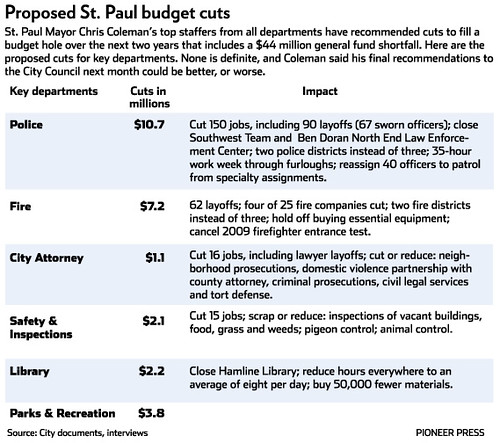
They’re baaaack:  Saint Paul mayor Chris Coleman has released his next year’s budget:

So why trim the muscle?  Coleman wants to cut police in a city where, after decades of being one of the safest major cities in the country, crime is rising.  He wants to hack away at a fire department that is by most accounts the best urban fire department in the United States.  He wants to slash criminal prosecutors in a city that has a hard time getting even simple cases to trial.

Of course, the fat remains.  Saint Paul maintains a Human Rights department which fully duplicates functions not only at the State, but in Ramsey County government.  Its police duplicate many functions of the Ramsey County Sheriff’s Department.  We’ve been on an orgy of building park and rec spending, including Mayor Coleman’s infamous push to build new outdoor hockey rinks in a city that is now screaming for money.  And of course, Mayor Coleman’s government has made it impossible to put thousands of vacant homes back on the tax rolls.

Why?

The truth is out there:

Coleman, a Democrat running for re-election, also blamed Republican Gov. Tim Pawlenty for “forcing” the cuts on the city by proposing to reduce state aid payments to local governments. Pawlenty has said the cuts were necessary to balance the state’s troubled budget.

Now, there’s plenty of fat in many of these budgets; the city got by with two police districts for many years (and does placid Highland Park need its own police station?).  The city has also spent a king’s ransom building libraries (the Rondo library at University and Dale is a gold-plated wonder) and rec centers.

In the meantime, the city plans to close the Hamline Library.  On the one hand, it’s small, old, “outdated” (I mean, all it has is books!) and the neighborhood is served by the newish Merriam Park library (about a mile away); if you HAD to pick a library (and presuming one could not bleem back in time and say “let’s spend less money on building libraries like Rondo, which are monuments to the wisdom of sitting library boards whose expense we can not possibly sustain in the long term”), it’d be a prime contender.

It’s also a library in a fanatically DFL-leaning district that’d still vote for the DFL’s hard-left majority at City Hall if the city carted our first-born off to labor camps in Idaho.

These “budget cuts” serve mainly to ratchet up the pain level for voters, to spur more public pressure on legislators (note the prominent placement of the state legislative angle in all of the coverage of this budget) to try to override any vetoes of LGA increases.

Connect The Dots

Tuesday, February 17th, 2009

Saint Paul homeowners feeling the bureaucratic pain:

Andrew Dick is trying hard to make sense of the situation he’s in.

He bought a vacant, dilapidated house on St. Paul’s East Side with the intention, and the means, to fix it up and sell it. He has a track record, a plan and money in the bank.

What he might end up with, though, is a hole in the ground and a bill. According to a recently adopted city ordinance, he shouldn’t have been allowed to buy the property, which is heading down the path to demolition.

And yet – it’s a perfectly good house?

Too bad Mr. Dick isn’t a non-profit; it seems they can get a hold of vacant houses:

I recent had a chance to hear Sheri Pemberton of Planning and Economic Development (PED) tell the Fort Road Federation what the city wants to do with all this.  The first order of business is to characterize the pockets of vacant and foreclosed homes into places where the market is still working, starting to falter, or has totally broken down. The latter is where you find empty blocks and houses being offered for $40k or less.  The strategies to deal with these are based on saving houses where the market is working and creating a new market where there is none now.

In other words, it could very well be that Mr. Dick’s attempted reno just isn’t policy.

Too bad he didn’t read Shot In The Dark last summer. As the supply of vacant homes skyrockets, Saint Paul is choking down on the rules involved in occupying them.  (Read the whole series:  Part I, Part II, Part III, Part IV, Part V).

A Word Or Two

Thursday, February 12th, 2009

Saint Paul’s Ward Four City Councilman, Russ Stark, is holding a town hall meeting.  It’s less than three weeks away:

Please join me for a conversation with your neighbors and fellow Ward
4 residents in a conversation about the status of the City and its
neighborhoods.  Tough times are upon the City of Saint Paul, leaving
my colleagues and me with the challenge of making responsible,
difficult budget decisions.  Please join the discussion to lend your
knowledge and creativity to the task of sustaining the City’s
livability despite the challenges we face.

Tuesday, March 3, 6:30-8:30pm at Goodwill Easter Seals (553 Fairview
Ave N)–
enter off the corner of Fairview and Charles.
(Goodwill/Easter Seals is conveniently located on bus lines 16, 50,
and 67.  www.metrotransit.org  If you’re driving, there is on-street
parking and a lot across Charles from the building.)

Due to the urgency of this gathering, we are unable to notice it in
community papers.  Please extend this invitation to neighbors and
friends.

If you know questions in advance that you’d like answered at the Town
Hall meeting
, please send them to Samantha Henningson
(samantha.henningson@ci.stpaul.mn.us) so we can prepare for some
questions and have the most informed conversation possible.

Thank you for considering attending this conversation, and for passing
the invitation to others.

Yes, I do believe some of us could come up with just a smidgen of feedback.

Rite Of Spring?

Wednesday, February 4th, 2009

The old North Dakota saying [*] “Hard Fall, Easy Spring” seems to be coming true – at least as far as the Midway is concerned.

We’re set to have the tapping of Flash’s kegerator – the great early indicator or spring – the earliest on record here in the Midway:

I was soooooo tempted to pick up a keg last Saturday, but knew the cold snap was coming. However, with the front moving in later in the week, and an optimistic extended forecast, this just may set up the earliest Spring in my history living in the Midway.

Break out the capris and the swim suits!

(more…)

Open Letter To Larry King

Monday, January 12th, 2009

To: Larry King

From: Mitch Berg

Re: Apologies

Mr. King,

For over two decades, I’ve mocked your USA Today newspaper column as a self-indulgent, stream-of-consciousness glob of senseless drivel. At one point or another, I may have thought to myself “it’ cant’ get any dumber than this”.

To my chagrin, I owe you an apology, Mr. King. To be fair to me, in my most toxic nightmares I had no idea that anyone had a column this really really stupid in them:

…you shouldn’t fret, dear hearts, if what you do doesn’t draw a big crowd or get written up in the papers. Be proud. If you’ve dedicated yourself to the tango, or playing drop-thumb banjo, or digging up ancient cities, or writing sonnets, you are beautiful, and please do not yearn for the bright lights. Those wombats reading the news off teleprompters are talking to the bedridden, the delusional and the criminal. The happy StairMaster president is on his way to a mansionette in Dallas, to be the decider of where to put the sofa. His successor, Mister Mambo, has cast his lot with Harvard and Yale and old Clinton hands, and soon enough, Lord knows, they will get the first of many comeuppances, and their shining faces will be chopfallen.

Mister Mambo?

As for me, I sat and wrote sonnets, including one about self-esteem.

Life is absurd. A man can count on that.

Here I am on the front page, standing alone,

Refusing to hide my face behind my hat,

Which, in my case, I do not even own.

MAN, 66, NABBED FOR PUBLIC EXPOSURE.

All I did was go take a leak in the bushes.

I didn’t run through the park with no clothes or

Flash anyone. Ridiculous. Absolutely atrocious.

The injustice! Some gumshoe at the P.D.

Was out to enhance his crime-stopping reputation

And now I am an outcast crying bootlessly

For the crime of emergency urination.

With fortune and men’s eyes I’m in disgrace

But you still love me and I refuse to hide my face.

Mr. King, I know what you’re thinking; there’s no way something like this would inspired by something as crass as public urination.

You, like I, would be wrong:

It was inspired, if you must know, by observing a man taking a leak in the bushes at a park where a Cuban band was playing, and a line of dancers formed impromptu next to the stage and did a lovely salsa step, so simple, graceful, slide slide turn slide, arms up, turn step step slide, and you had to think, O my God how beautiful we are. And beyond was the man disgracing himself, and he was beautiful, too.

Mr. King, I am so sorry. You read like Hemingway, taut and acerbic, compared to Keillor’s flabby drivel; indeed, while Jesse Ventura and Al Franken may be Minnesota’s greatest embarassments, Keillor must be closing in.

Please accept my apology. Write about toe corns and brooklyn bagel shops to your heart’s content. I have a newfound appreciation for your oeuvre.

That is all.

MPR: Not On My Street! (And Not On My Computer)

Monday, January 5th, 2009

I wrote a pretty long, involved Part IV that summed up my case.

And went to the bathroom.

And then my son got on the computer and shut down the browser.  I had saved, naturally, nothing.

So I’ll conclude the story tomorrow.

MPR: Not On My Street (Part III)

Friday, January 2nd, 2009

In a classic New Yorker cartoon, a couple of math professors are seen pondering a chalkboard. The right third of the chalkboard is covered with an impossibly complex equation. So is the left third. In the center, the other halves are joined together by a large logic cloud labelled “Insert Miracle Here”.

Even without Minnesota Public Radio’s threatened lawsuit for relief from the Central Corridor light rail line’s potential vibration and noise affects on their studio and production operations, the project’s “plan” seems highly dependent on inserted miracles.

On Tuesday, we talked about the subtleties of acoustic engineering. Today’s subject is the brawn and muscle of civil engineering, as well as the pointillistic wonkery of urban planning.

———-

The Central Corridor is intended to start in downtown Minneapolis’ Warehouse District, on the same tracks as the Ventura Trolley, rumbling down Fifth Street to the Metrodome area. There, it’ll split off from the Hiawatha, and rumble through the West Bank U of M campus to the Washington Avenue bridge, which a recent study showed would need massive remodeling to support the additional weight, and whose top, pedestrian deck has had lanes closed due to structural problems.

After the bridge, the train will roll up Washington through the heart of the East Bank campus – a stretch of street that will need to be rebuilt as a transit plaza, making car traffic through the heart of the U a sisyphean nightmare.

The train will exit the east end of the U on Washington, then turn up University. It’ll chug up the long hill through Prospect Park, cresting the hill near KSTP as it enters Saint Paul.

There’ll be stops every half-mile as the train rolls through the west Midway, a neighborhood that is part warehouse district and part business incubator (but which the long-range plans have slotted to turn into a high-density virtual third downtown of condos and mixed-use businesses).

The neighborhood becomes less tony, and the stops become more widely spaced than the trees, as the line moves into the heart of the Midway; the hardscrabble gray thirties-era small-business and housing blocks east of Prior. It’ll make a stop at Snelling – the Midway’s main street. And so will everything around the train; the intersection is already one of the busiest and most dangerous in the Twin Cities. Designed in the early horseless-carriage era, there are those that advocate levelling most of the buildings around the intersection – Midway Books, American Bank, parts of the thriving Midway Center – and building a traffic cloverleaf or half-cloverleaf, sacrificing some of the businesses that have led the Midway’s revival. For a train.

The train will demand more sacrifice as it glides east through the Midway’s tatty last mile and into Frogtown. Frogtown was a north-Minneapolis like catch-phrase for urban decay when I first drove down it, in October of 1985. While most of it will never get into Architectural Digest, the strip along Uni has undergone a revival as successive waves of Vietnamese and H’mong immigrants started new businesses along the street. It’s not always pretty, but it’s an industrious stretch of Uni, a monument to the spirit of the new Americans, and of the resilience and rugged beauty of capitalism. The construction process will gut these businesses like fish.

It’ll whish past the Capitol, and whip a noisy, creaking right down Robert Street.

And it’s there that the fun begins.

Once the train gets downtown, the intention for it to roll down Robert to the frontage road, then jog west to Cedar,where it’ll turn south and roll into downtown, including its fateful whoosh past the Taj Ma Kling.

Four blocks later, it’ll turn left – in the slow, creaking gradual way of “light rail” trains – onto Fourth Street. Unlike the smaller, slower, less “sexy” trolleys that might have been a better choice, has a pretty wide turning circle – wide enough that the line is going to have to demolish most of a block, between Fourth and Fifth, Cedar and Minnesota, to make the turn.

To be fair, the final six blocks to the Union Depot terminal are fairly problem-free.

So count up all the parts of the route that’ll need to be completely rebuilt. Count up all the parts of the route that are not currently rail routes (the technical term is “right of way”) that will need to be turned into right of way by a combination of buying and eminent-domain arm-twisting, which in the middle of a busy metro area is a process that is about as expensive as paving roads with ten dollar bills. Count up all the long stretches of busy street that will need to be shut down, torn up, widened, narrowed and rerouted.  Bear in mind that the Hiawatha Line is no guide on this; most of its right of way, the dismal straight shot down Hiawatha, was cleared for transit as early as the sixties.
Count up all the “insert miracle here” moments.

It’s called “transit planning”.

And solving the “miracles” is both mundane and hideously expensive.

———-

On Tuesday and Wednesday, we dipped a toe into the nuanced, subtle science of acoustic engineering, around which most of MPR’s complaints currently revolve; the overt noise and more-subtle acoustic rumbling of the trains past the front door of MPR’s Taj Ma Kling.

MPR has a suggestion – which swerves to engineering’s opposite extreme. They want the downtown leg of the Central Corridor re-routed:

Has MPR explored every possible way to make LRT work on Cedar Street? Has the City of Saint Paul?MPR has done everything possible to work cooperatively with the CCPO to identify and address our concerns. We have offered to work together with them to find an alternative route for these final blocks of the plan.MPR has spent years working with the CCPO to get accurate information about the project, how close the tracks would be to our building and the actual impact of the trains. That information has not been available until the last few months. Additionally, MPR has worked closely with the historic, 100-year-old Central Presbyterian and Saint Louis, King of France churches on how they can remain viable institutions faced with similar noise, vibration and access issues related to the project.

(Cheap Irony Alert: Central Presbyterian, MPR’s neighbor to the north, is where I learned to play the bagpipes.  For many years the church hosted the bagpipe band’s weekly practices. Now they’re complaining about noise. I digress).

The alternate routes they suggest on the website include Minnesota (in blue, below) and Robert (in green):

There are, of course, problems with both routes. Let’s start with engineering; we’ll work our way back out to urban planning.

One problem with “light rail” as opposed to trolleys and streetcars is that they are long in relation to their width. Which means, among other things, that they don’t turn corners well. The planned light rail line can not turn within any of the existing downtown streets. The currently-planned turn from Cedar onto Fourth Street will require tearing down the old Premiere Bank building at Fifth and Cedar (across from the Pioneer Press building) and basically turning most of the block from Cedar to Minnesota into a rail right of way. It’s not just tearing down buildings; there are utilities to move, infrastructure to relocate…
Which is fine; that’s part of any work in the big city.

But what about the other two routes – Minnesota and Robert?

We know that there’s a vacant bank at Fifth and Cedar. What about Minnesota and/or Robert?

To turn on Minnesota would involve going through the USBank Building (recently remodeled at exquisite expense) and/or the First Bank building (the classic moderne skyscraper with the big red flashing “1” on the roof).

In exchange for losing one of Saint Paul’s major landmarks, the Central Corridor will…:

  • Still need to make the two turns by the Capitol – onto the frontage road and back south into downtown. Turns are expensive, slow, and eat up tons of space (as we’ve seen).
  • Move the vibration to the other side of MPR’s block.
  • Constrict Minnesota, a busy northbound one-way street, shunting traffic onto surrounding blocks.
  • Leave the already-vacant space that is slated to be torn down to make way for the currently-planned route…still vacant.
  • Do nothing to solve the urban-planning issue we’ll talk about below.

So how about Robert Street (yellow in the picture above)? Making that turn will require tearing down either the Endicott or the Pioneer Buildings, or both. These historic buildings, built in the late 1800s and classic examples of the architecture of the era, are two of downtown’s historic treasures, two of the last remnants of the city’s pre-Urban-Renewal past. In exchange for this, we get:

  • A straighter route down from the capitol – faster and incrementally less expensive.
  • However, it’ll clog the center of Robert Street, downtown’s only major two-way north-south street.
  • Again, it’ll do nothing – even less than Minnesota – to fix the urban planning challenge below.

This doesn’t consider the less-visible challenges of either of these routes – the utilities that’ll need to be relocated, business that’ll need to be compensated and so on.

But let’s say that either of those sets of challenges are manageable. We know that MPR says they’d like either of these solutions. What about Saint Paul?

———-

As I noted on Tuesday, one of Saint Paul’s biggest hurdles as a city is dealing with the detritus of a number of government initiatives from the 1950’s. Urban Renewal’s list of crimes against Saint Paul is a long one:  the gutting of the Rondo, Midway and Dayton’s Bluff for I94, the devastation of the West End and North End for 35E are merely the most obvious.

Downtown Saint Paul’s specific Urban Renewal outbreak was called the “Capitol City” plan, a detailed vision written in the mid-late fifties for downtown that involved gutting most of the city’s old buildings Seventh south to Kellogg, from Wabasha all the way to Wabasha. The better part of twenty square blocks fell to the wrecking ball over the following thirty years. In place of the old, brick and mortar buildings, we got dismal monstrosities like the Alliance, USBank and Securian buildings; we got the airplane-hangar-like Dayton’s (now Macy’s). Worst of all, we got twenty square blocks of downtown where, if you were on foot or in your car, there was no there there. For block after block in downtown Saint Paul, there’s no reason to stop, get out of your car, shop, have a drink, eat, spend, date, live. It’s not an accident that the two parts of downtown that show any signs of life at all – the part of Uppertown west of Wabasha, from the Xcel Center up to Mickey’s Dining Car, and Lowertown’s old warehouse district, now mostly residential lofts and condos and slowly developing into an interesting neighborhood in its own right – are the parts that escaped the ravages of urban “renewal”.

And the worst part? Cedar.

From Seventh – just south of MPR’s studios – all the way to the river, Cedar is a desolate canyon. From the Wells Fargo Tower and Town Square – failed commercial and office developments – to the back side of Macy’s, there is not a single storefront on the street. Not one amenity to humanity. The only sign of life, really, is the little transit center, tucked next to Ecolab’s loading dock down by Fifth Street. Noplace to stop and grab a cup of coffee (unless you know there’s a skyway level food court, safely out of sight a floor above); no signs of any life that isn’t desperately trying to get elsewhere and fast (especially when the cold north wind sweeps down the dismal cement canyon). It’s a depressing cement gash in the heart of downtown.

At worst, bringing a train down the street will do no harm.

At best, redeveloping the street around the pedestrian traffic that the train should bring will give downtown something it desperately needs: a human-habitable link between the modestly-bustling Uppertown with its Pazzalunas and Chipotles and Fuji-yas, and the signs of human life breaking out in Lowertown.

Now, don’t get me wrong; I don’t support government social engineering to change urban geography; Urban “renewal” should have taught us our lesson. However, if we’re committed to a project anyway, why not use it to help repair the damage of the last round of social engineering?

Moving the line to Minnesota is…:

  • a throwaway: There’s no there there. Minnesota Street has few jobs, no retail destinations – it’s just something to get through, transit-wise. Indeed, transit stations are the strip’s only notable feature. It provides the city no useful payback for all the damage it’ll sustain.
  • a net loss to the city: Tearing down the buildings that’d need to go to make the turn would serve only to leave another vacant, desolate block in a downtown that has too many as it is.
  • a side-track, so to speak: Running the line down Minnesota does nothing to re-integrate downtown into a useful, habitable place.

So how about Robert? Leaving aside the engineering benefit of straightening the line, the route would have the same drawbacks as Minnesota, along with tearing down even more historic building stock and doing even less to fix downtown’s urban geography.

———-

As I noted on Wednesday, I think MPR has a case against the Central Corridor for the damage that the line could cause its operation at Seventh and Cedar. The costs of rerouting the lines as they suggest (I think it’s fair to say) would seem to so vastly outweigh the benefit to MPR as to be completely impractical.

So why even suggest it?

More Monday.
MPR: Not On My Street…

Thursday, January 1st, 2009

…will continue tomorrow with Part III.  MPR wants some serious changes in the Central Corridor’s route; some of their suggestions make sense.  Others…well, they’re about as useful, sensible and thought-out as “On The Media” with Bob Garfield and Brooke Gladstone.

More tomorrow.

MPR: Not On My Street! (Part II)

Wednesday, December 31st, 2008

Minnesota Public Radio wants the Central Corridor to reconsider its route – currently slated to roll down Cedar Avenue, a north-south street (more or less, like all Saint Paul streets) that runs the full length of the “Taj Ma Kling”, MPR’s immense, bleeding-edge studio complex filling the entire block from Seventh to Exchange in downtown Saint Paul.

The next two installments focus on engineering – indeed, two different extremes of engineering – and two different sides of downtown Saint Paul. Today focuses on the north end of downtown, and on acoustic engineering, one of the most subtle and nuanced engineering fields this side of biotech. Tomorrow, we’ll turn to civil engineering, the big, brawny, bricks-and-mortar variety on the opposite extreme (and the south side of the neighborhood).

———-

MPR states its case for noise impact to its broadcast complex, located on Cedar between Seventh and Exchange Streets:

How would LRT affect MPR’s broadcast quality?MPR’s first responsibility is to our listeners and members. We provide programming to nearly 800,000 listeners on our regional network and nearly 16 million listeners nationally. We attract the best classical and popular musicians in the country to our recording studios.The LRT creates low frequency vibration, higher frequency noise from its horns and bells, electromagnetic interference, and radio frequency interference. Each of these can negatively affect the ability of our equipment to operate properly.

All of this is true; while people observing the Hiawatha light rail comment at how relativelly quiet it is, trains of any size do create low-frequency rumbling, the result of energy being transferred via tons of metal rolling over metal rails anchored in the ground; unless you specifically plan against it (at immense cost) this energy will get transmitted through the ground. Isolating a building from that kind of low-freqency sound is very difficult, and is something that needs to be done from the foundation on up; it’s not something that you can take care of by nailing extra carpeting over your walls.

And if sound is your business, that’s a serious problem:

Any inability to operate our radio and recording studios because of vibration or noise will significantly compromise our ability to provide high quality programming and other services to our listeners. As determined by our noise tests, our producers will not be able to do their work in the MPR building.

The part of me that grew up in AM radio (in a studio near a very heavy rail line, by the way) and is not an audiphile (indeed, who loves the nearly lost art of mixing music to sound good on tinny car speakers) says “sack up, MPR producers. It’s only radio”. And for much of their programming, that might be an adequate response.

But FM radio is a lot more technologically upmarket than the business I grew up in, and classical music – especially the production side – is an audiophile’s business.

But leave all of that aside for a moment – because whatever you think or believe about MPR’s audience demographics and politics, they were there first. MPR built the first leg of its studio – a veritable palace to my commercial-radio-trained sensibilities – almost thirty years ago. And again, whatever you think about the organization, they have made a huge investment not only in their “market”, but in the area.

Given the extremely close proximity of the train to our broadcast facility, the CCPO has been unable to provide a comparable example anywhere in the U.S. where mitigation has worked.

Imagine for a moment that a commercial recording studio – run, what the heck, by a scrappy Republican punk-rocker-at-heart like, say, yours truly – had worked and scrambled and saved and scrapped for years to build a state-of-the-art recording facility in a struggling downtown. Imagine that studio eschewed government handouts, and slowly, painstakingly built itself into a success…

…only to have the big, dumb jackboot of government, in the form of a misguided social-engineering project in the form of a useless, money-pit light rail project, dump an insurmountable handicap in its lap with its customary “like it or lump it” attitude.

How would you, the free-market conservative, respond?

Of course, Minnesota Public Radio is not that scrappy, underground Republican business. It’s taken all sorts of government handouts; to be fair and accurate, government subsidy is a relatively small part of MPR’s revenue stream (although not so small that MPR’s management doesn’t pull every political string it can to protect it from budget cutting at the state and federal levels). To be equally fair and accurate, MPR’s non-profit status gives it a leg up on its commercial competitors that is, in effect, a back-door subsidy that’d be called “corporate welfare” for any business that didn’t have “public” wedged into its name.

Still and all, MPR has been there forever, it has invested all sorts of money (theirs and ours) in their facilities, and it has, without a doubt, an immense technical, “business” and financial stake in making it possible to do business in their building.

It seems pretty clear-cut so far.

It won’t stay that way, of course. You might ask in response “But didn’t they know the light rail was coming through before they built the Taj Ma Kling?”, the eleventy-jillion dollar expansion they built between 2004 and 2006 that looms over Cedar like a Garrison Keillor temper tantrum?

Yes and no (with emphasis altered from the original and added by me):

MPR knew before it expanded that Cedar Street was the preferred route for the Central Corridor. Why didn’t MPR do more to address noise and vibration during its expansion from 2004–06? Final decisions about the route and location of the tracks were not unveiled until April 2008. In 2001 when MPR, with encouragement form the City of St Paul, chose to expand its facilities on Cedar, we were given no data (and none existed) illustrating the impact of noise and vibration. We designed the new north wing of MPR’s broadcast center to deal with every noise and vibration we could envision at the time. However, 16 of MPR’s 24 recording and broadcast studios are in the south wing, designed in 1979. MPR knew that Cedar Street was being considered for the route, but neither MPR nor the two churches knew how close the train would run to our buildings. LRT trains are proposed to be just 12 feet from the front of MPR’s St. Paul broadcast center.

This brings up any number of questions.

  • What Did MPR Know, And When Did They Know It: While the MPR press release is correct inasmuch as the general timeline, it’s been pretty common knowledge that the city has wanted something to rectify downtown’s biggest open sore. Cedar was once the heart of a bustling downtown. But “Urban Renewal” in the form of the mid-Fifties “Capitol City” master plan (while we’re on the subject of misguided, hamfisted government social engineering) gutted the area in the Fifties, turning Cedar in particular into a cold, ugly, windswept canyon that could scarcely divide and isolate Uppertown and Lowertown more effectively if it had barbed wire and guard dogs. Light Rail has long been seen as a means to fixing this; more on this tomorrow. MPR can hardly not have been aware of this rather key bit of urban planning.
  • 12 Feet?: How significant is the “12 foot” figure that the MPR release cites? Would an extra six feet help? That would presume, naturally, that there was room to move the train – which I suspect there is not. Saint Paul is an old downtown, laid out in the 1800s; its north-south streets are relatively narrow, by big city standards. Cedar is not an especially wide street. I’m going to presume the answer is “no” on that.
  • Mitigation?: Some say it’s possible to use technology to mitigate the vibration. MPR’s consultants say not so. As with so many questions in so many businesses, pick your consultant.

So how did we – MPR, the City, the Central Corridor Planning office, everyone – end up in this mess? Again – I’ve taken out MPR’s emphasis and added my own:

Why didn’t The Met Council consider the potential damage to MPR earlier? We don’t know. The Federal Transportation Administration guidelines clearly require special consideration for recording and broadcast studios, concert halls, theaters and other sound sensitive areas. The federal guidelines also state: “…before mitigation measures are considered, the project sponsor should first evaluate alternative locations/alignments to determine whether it is feasible to avoid severe impacts altogether.” The required study of the impact on recording studios and historic structures was never done.

Which is of a piece with the serial negligence that’s accompanied every step of this project; the Washington Avenue Bridge isn’t strong enough, the U of M can’t absorb a train running up Washington through the middle of its campus, traffic at University and Snelling will be snarled enough to make a Mumbai rush hour look like a Saturday afternoon in Fargo, and businesses up and down University will be gutted.

What’s another flubbed study among friends?

Tomorrow – more about MPR’s suggested changes.

UPDATE: Welcome, Politics in Minnesota and Save WCAL readers. Please check out part III of the series. Part IV follows on Monday.

MPR: Not On My Street! (Part I)

Tuesday, December 30th, 2008

It’s gotten a lot of press lately: Minnesota Public Radio seems set to take the Central Corridor – the new light rail line set to connect the two downtowns via the U of M, University Avenue and the Capitol area – to court over the disruption the high-frequency noise and low-frequency vibration could cause their recording and production operations.

MPR posts its case here.

On the one hand, it’s easy – or, to put it in the possibly-more-apt pseudo-latin, “facile” – to ascribe the whole thing to the “limousine liberalism” of Bill Kling, Garrison Keillor and MPR’s well-heeled clientele; “silent acquiescence to big-government initiatives for ye, but not for we”. 

On the other hand, you will scour their website in vain for any mention of opposition to the Central Corridor over…

  • the horrible effect the Central Corridor have on traffic and noise in the Midway,
  • the crushing economic impact it’ll have on the Southeast Asian business community in Frogtown, which has been a huge, if low-key, triumph of the free market in Saint Paul in the time since I’ve lived here,
  • the cost of refitting the Washington Avenue Bridge at the U of M to carry the added weight of the LRT line,
  • the overarching fact that with its stops every mile (rather than every few blocks) and fast rolling stock designed to stop only at large, purpose-built stops (just like the Hiawatha Line), the LRT will supplant the 50 Express bus, rather than the slow, clunky, traffic-clogging 16 line between the downtowns – meaning that it’ll not only barely scratch traffic, and that…
  • …as such, it will serve primarily inter-Twin-City rather than local travel, and so might have been vastly better-served by a trolley line or other more utilitarian but less-“sexy” installation.
  • It will require immense expense to solve a number of civil engineering challenges in downtown Saint Paul…

…or other such plebeian concerns. Indeed, it seems to be all about their studios. Which may be legally appropriate but, given their support for all the other aspects of the Central Corridor, ethically obtuse.

That being said, I’ll try to stay away from some of the stereotypical (albeit sometimes fully appropriate) class-baiting that some of MPR’s conservative critics have employed in criticizing the network’s response to the LRT line.

I said “try”.

Tomorrow: Sound Engineering, Unsound Planning.

Thursday: Civil Engineering, Uncivil Project.

Friday:  Ethics, Politics and other difficult stuff.

Into The Wasteland

Monday, December 29th, 2008

The good news? Downtown Saint Paul is finally Egetting an honest-to-pete grocery store:

Lunds is coming to downtown St. Paul. While grocery stores come and go in other parts of the city, downtown hasn’t had one in decades.

(Well, the “convenience store” at 7th and Wabasha is big enough to scrape the low end of “grocery store” – but I know, they’re talking about a real grocery store. I digress.)

The good news?

That’s why the Lunds announcement is such great news for the city and its 14,000 downtown residents and 65,000 workers. In addition to providing long-needed access to a supermarket, the store will help boost the tax base, attract new residents and contribute to community building.

Early this month, Lunds Food Holdings said it will build a 30,000-square-foot store as part of an $88 million mixed-use project called the Penfield.

The bad news?

The development, on 10th and Robert streets, will include a hotel and upscale apartments. Construction is scheduled to begin in the fall.

Waaaaaay over on the wrong side of downtown.

Ah, well. It’s where the condos are, I guess. And it’s good news for downtown, in any case.

Paging Max Headroom

Wednesday, December 24th, 2008

I finally got around to reading David Brauer’s two part interview with Tom Mischke (parts one and two), about his exit from KSTP and his thoughts on the future of the business.

More on that in a bit.

———-

I remember walking into KSTP the night I filled in for Bob Davis, on January 23, 2003.  It was the first time I’d set foot in a radio station in ten years; the first time I’d done a talk show in almost sixteen.

I felt a little bit like Rip Van Winkel.  When I’d left radio, shows were recorded on cassettes; audio editing and production work was done on twelve-inch reel to reel tapes; commercials, songs and dropins came on “Carts” (which looked and worked like eight-track tapes, for those of you old enough to remember them).  At my last previous radio “job” – as a volunteer news guy at KFAI – they’d just installed a computer to download the AP wire and allow a little rudimentary editing.

At KSTP (and AM1280, which followed about a year later), everything was on computer; commercials, dropins (on a slick touch-screen array), commands to switch between recorded, live and satellite programming, even the recorded programs themselves. 

And that was the least of it.  As I’ve noted many times in the past, when I left KSTP-AM, it was the poor cousin of the Hubbard empire; Hubbard Broadcasting had been trying to sell KSTP-AM for years, with no luck – because rumors had it that AM was dead, and the band was going to get decommissioned eventually.  By 2003, that was in the past; KSTP-AM was financially carrying Channel 5, Channel 45, KS95, Estrogen 107 and the rest of the Hubbard operation.

A number of things hadn’t changed, though.

  • When radio management wants you gone?   You’re gone.
  • If you give Hubbard Broadcasting a silk purse, they’ll not only find a way to make a sow’s ear out of it, but in such a way as to make the observer wonder if sows can be on meth. 
  • ———-

Mischke on exactly why Hubbard told him they’d gassed his show:

On the day I was fired, I was handed a transcript of a conversation I had with my producer two weeks earlier. I remembered the conversation. I had been curious to know where the jingle for [Hubbard-owned] Channel 45 had come from. It’s the little sing-song way they say “45.”

I wanted to know who came up with it, how many other ways they thought to sing it, what talent they hired to deliver the jingle and how many different takes there were. I suppose I just wanted to learn the backstory behind a modern corporate jingle.

I asked my producer to call them and ask them, knowing full well these are fellow Hubbard employees. My producer refused. I think he was just tired of me having him do various things while he was busy trying to answer the phone.

So I picked up the phone and called them myself, on the air. I phoned downstairs, a receptionist answered, and I asked to speak to someone at Channel 45. She said, “Just a minute” and put me on hold. I then put the entire call on hold and asked my producer if he’d now please speak to them off the air so as to get a sense of where that jingle came from.

That’s what I was fired for. Making that call to the receptionist without getting her permission.

[David Brauer]: Isn’t such a call an FCC violation?

A: They told me it was indeed an FCC violation.

Back in 1986, Don Vogel caught wind that the afternoon guy at the old WLOL-FM, a chucklehead named “Doctor Dave”, was lifting a bit of Vogel’s (a takeoff on radio tele-shrink Dr. Harvey Ruben) on WLOL’s wacky afternoon zoo.  He told me to get “Dr. Dave” on the air.  Via a contact or two, producer Dave Elvin had their studio line number handy.  I called “Dr. Dave”, and Don put him on the air, live.  Of course, being a newbie to talk radio, I didn’t know there’d be a problem; Don, a fifteen year vet of Chicago talk, didn’t know either.

There was.  There is an FCC regulation whose number I could, until recently, recite from memory, saying that radio stations can not put someone on the air without them having a realistic expectation of knowing they are being put on the air.  You have to tell people they’re going to be on the air, we were told, by an irate station counsel who’d just gotten an irate phone call from an irate general manager at WLOL.  We spent the next day wondering if we were going to get fired.  Our own GM, Scott Meier, saved the day, basically saying that we’d forget their plagiarism if they’d forget our stunt.  It blew over.

You’re thinking “not only does every half-assed FM morning show in the world do ambush calls for yuks, but Mischke’s made an art form of those kinds of calls”.  And you’d be right.  Heck – we had a long-running bit on the Vogel show, “Random Call”, where we’d pick an area code and dial a random number, often to hilarious results (like Christmas Eve, 1985, where we got a hold of the Nome, Alaska Police Department squad room, with predictably deadpan-hilarious results).

And beyond that? Back in Mischke’s early years on evenings – one of the first times I listened to him, in the early nineties – I heard him struggling to get someone on the air, live and uninformed.  I called the studio; my old friend and colleague Joe Hansen – aka “The Jackal”, at that point – answered, and I told him about my near-miss on Vogel.  They waved off on the bit – that time.  Naturally, Mischke followed through on the bit the next umpteen jillion times.

Do you think this was news to KSTP-AM’s program director, Steve Konrad, or to his various levels of management?

If so, I have a tape from Willie Clark that I’d like to try to sell you.

———-

If you can say one thing for Mischke, it’s that he’s a comedic genius with a flair for using radio, with all of its foibles and limitations and traditions, as a tool in his comic toolbox.

If you can say one more thing for him, it’s that he’s always seemed to keep radio, with all of its foibles and limitations and corrosive dysfunction, in its place. 

Mischke said, and believes, all sorts of things that separate him from the mainstream (i.e. successful) parts of talk radio, but make it safe for the likes of Garrison Keillor to be an “out” fan.  Still, it’s hard to work in commercial radio (outside of Air America) and not understand what actually works out there these days:

I watched many people attempt radio shows over the years. I saw talk hosts come and go. In all my years at KSTP, I saw only three shows succeed — truly succeed. The only three programs to ever generate any kind of decent ratings at all were Rush Limbaugh, Jason Lewis and Joe Soucheray. That’s it.The rest of us never offered anything in the way of mass appeal. So any talk host, outside of those three, should walk away, following a firing, feeling lucky to have been given a shot.

Three hosts; a populist conservative, an intellectual conservative, and a culturally-conservative-to-the-point-of-reactionary curmudgeon. 

Mischke clearly understands something that KSTP-AM’s management does not.

[Brauer]: Where do you think KSTP is headed? The talk around town is about terrible numbers, save for Joe, and a pricey Twins contract that might not pay off, since it was signed during good times but now must be sold to advertisers during bad times. This is a strange time in radio and there’s something to say here.

A: Radio, as we’ve known it in this country, is dying. I don’t envy anyone trying to make the transition to the next stage in media. The Twins gamble has not paid off for KSTP. It has not affected ratings.

That has been very disappointing. It was a coup to steal them from ‘CCO, but oh, the cost.

You add that to the fact that Soucheray is the only talk host over there driving home each day feeling good about his ratings and you have big worries. Tack on the dismal economy with its bleak advertising picture and you have more than just worries.

But after all that – especially after my “Rip Van Winkle” riff at the beginning of this long post – we get to the interesting part; the future of talk radio. 

It’s overly obvious to say that “things have changed since Mischke and I got into the business”.  The interesting part is, “where are those things going?”

I was pondering that as Ed and I did the NARN2 show last Saturday; while talk radio was years ahead of the traditional dead-tree and showbiz-broadcast media in incorporating interactivity – phone callers with their own points to add – it was all still very hierarchic.  Callers passed through a screener to get to the host, who was the center of attention.  And that’s changing, I thought, as Ed and I worked the webcam, kept up with the chatroom and the Twitter thread and the incoming email and, by the way, did a broadcast show.  The audience’s relationship with a talk show host is changing in an analogous way to the changes the Blog brought to the reader’s relationship to the newspaper; the host isn’t necessarily in charge of the conversation by sole virtue of having the microphone. 

It’s not bad – indeed, being a blogger, I’d be dumb to do anything but embrace the change.  But it is different. 

I think every radio station in town has to pray to God they have a visionary on their staff. This is the time for change and innovation. A dramatic shift needs to occur.

I hope to end up somewhere where this idea is fully grasped, where the ideas move to the Internet, websites, video-blogging, music, live streaming. I think what is about to rise out of the ashes of the old radio model is far more exciting and interesting than what has come before. Some station in this town is going to be the first to fully exploit this. To those folks go the spoils.

The future is out there.  I sincerely hope – and believe – that Mischke is a part of it.

Among others.

Do As We Say, Not As We Do

Wednesday, December 3rd, 2008

As Minnesota finally accretes its first snow cover, we see again a local “custom” among the short-on-time and chronically-tardy; people driving down the street with snow billowing off of cars they haven’t had time to brush off.

I saw one of these snow squalls moving toward me up Hamline Avenue this morning; curls of fine snow spray covered the street in the gusty wind.

As it blew off of a Saint Paul police car.

--> Site Meter -->