Archive for the 'Conservatism' Category

Late Rally, Late Notice

Sunday, March 21st, 2010

The Minnesota Tea Party is throwing a “Kill the Bill” rally at the KARE 11 studios in Golden Valley at – gulp – 9PM tonight.

That’s about an hour from now.  The idea is to have a good showing before the 10PM newscast.

So let’s have a good showing.

I, Extremist: Part II

Thursday, March 18th, 2010

As noted on Tuesday, I’m an extremist – at least, according to the DFL, most of the Strib’s columnists and, apparently, Janet Napolitano.  This is the second of a seven-part series exploring just how extreme I am, and what being an “extremist” really means in society today.

The first and foremost reason I’m an “extremist” is that I believe in Liberty.

But what is liberty, exactly?

Liberty sounds simple, at least on the surface.  Liberty means You Have Rights. Of course, the left and the right believe in rights; a conservative believes that these rights are inalienable, endowed to us by our creator (whether God or Biology or Vishnu or a remarkable physical coincidence); a “progressive” might believe that, or that they are the output of a benign government that works in the peoples’ best interests.  Either way, nobody argues that we have the right (from whatever source) to speak, publish, assemble, worship, privacy and security in our persons and possessions, due process and vote; guns and abortion are contentions that I won’t argue here.

And for a conservative, “liberty” involves having the government keep its appetites under control, so that I have more of the “fruits of my labor” – money – for me and my family.  Larry Pogemiller’s assertions aside, I do know how to use it better than he does.  I’d also appreciate the liberty to defend myself, my family and my neigbhorhood from criminals, and it’d be great if government would quit diddling about with censorship.

But that’s the easy part.  Everyone agrees on most of those.

But what is “Liberty?”

———-

In Krzysztof Kieślowski’s 1993 classic Blue, Juliette Binoche finds herself “free”.  And it sucked.

Blue, mind you, was the first part of Kieślowski’s “Three Colors” trilogy (White and Red completed the set), a three-film series based on the colors of the French (and, by the way, American) flag.  Each installment was based on a color, and its meaning; Liberte (Blue), Egalite, or Equality (White) and Fraternite, or Brotherhood (Red).

Liberte came to Binoche’s character, Julie De Courcy, early in the film; a young mother and wife of a noted composer, Mr. De Courcy accidentally swerved off a road and smacked into a tree, killing himself and their young daughter.  Binoche’s De Courcy survived – and then had to deal, not only with surviving, but dealing with real, true “Freedom”.   Julie discovered that Liberte – genuine freedom – is not just the right to do what you want, but something that has huge, sometimes unintended, sometimes very difficult effects on everyone involved with her.  Julie De Courcy spends a good chunk of the film trying to ensure she never again experiences the pain she felt in losing her husband and child – one of life’s most epic “failures” – and found that it was impossible.  Or, rather, that one loses more by preventing failure than by failing.  (It’s a fantastic movie, by the way – one of my ten favorite of all time.  It’s not your typical Hollywood fare, though; it doesn’t even qualify as typical French fare.  Kieślowski was an interesting character himself.  But more on him, and his films, some other time).

Liberty is not just the freedom to do what you want; it’s the freedom to screw up royally.

It’s that last part that’s the problem.

Failure is hard.  Nobody likes it.  It hurts.  Sometimes, it’s disastrous.

And averting disaster – cheating the idea of failure, on a personal and societal level – is a key part of “progressivism”, which believes that human failure, or at least many of them, can be ameliorated, prevented or outlawed.  In ways small (campus speech codes) and large (the welfare state), “progressivism” tries to insulate people from failures small (being offended) and large (wanting for material necessities).

But failure is a key part of improving the human condition.  People, as individuals, learn more from failure than from success.

And what happens to a person who is never allowed to fail?  Exactly what society is learning today as the children of a generation of “helicopter parents”, insulated from serious consequences for much of anything from falling off bikes to losing baseball games to failing classes, grows up unmotivated and glutted with unearned “self-esteem” and utterly unaware of how to fail, and thus how to really learn.

The same goes for societies.   After every epic failure of capitalism has come the “creative destruction” that comes at the crossroads of enlightened self-interest and learning from failure; that, in turn, leads to success.  Or more failure.  And the cycle continues.

And societies efforts to outlaw failure (beyond the utterly necessary efforts to prevent starvation and abject misery) have backfired.  The unintended consequences of outlawing failure are worse, in many ways and in the long term, than the pain that society tried to prevent in the first place.  Generations of comprehensive welfare have led a huge subculture that seems incapable of surviving without government help (or so they seemed; welfare reform efforts, in states that implemented them, turned the pathology around, just like letting your kids sink or swim will reverse excessive dependence on you); trying to prevent a segment of society from “failing” to own houses helped lead to an epic market distortion that led to the recession/depression we’re in today.

Failure is not only a fact of life; it’s not just sometimes a good thing; failure is, in fact, essential to development, whether you’re developing a child, a business, an economy or a society.

True liberty, really, is the freedom to fail (although not the freedom to maliciously or criminally inflict the consequences of your failure on other people) and, then, to learn from the failures, to fail again, to rise, to fall, and rise again – each time just a little better, if you’re doing your job right.

To bottle that up – to ban failure – is to ban true success.

And that’s what I support – the human right, the “liberty”, to fail and to succeed on one’s merits.

Yep.  I’m an extremist.

I, Extremist

Tuesday, March 16th, 2010

I’m an extremist.

No, really.  Janet Napolitano, Nick Coleman, scads of intellectually-incontinent leftybloggers and the Coffee Parties all say so.

Calling anyone to the right of Larry Pogemiller an “extremist” was a standard practice in Minnesota politics long before any non-poli-sci wonk ever heard of Saul Alinski.  For generations, anyone in Minnesota who stood outside the great DFL-and-“moderate”-GOP, “marching-boldly-toward-the-future-hand-in-hand toward the collective vision of our betters” ideal was called an extremist (provided they were on the right. And of course, bits and pieces of it have leaked out in the national culture; the idea that Rush Limbaugh listeners were a “vast right-wing conspiracy” responsible for the bombing of the Murragh building was the moment it all got really serious – the first time the (wife of a) sitting president had ever tied a perfectly legitimate free speech activity to mass-murder and terrorism.

Since then, trying to link anything – Second Amendment ctivistm, critizing free trade agreements, being a hardliner on immigration, being a pro-lifer or an uppity Libertarian or a tax protester, whatever – gets one called an “extremist” first, with questions not asked later.  Several non-profits – including the inexplicably-well-regarded Southern Poverty Law Center – make a cottage industry out of McCarthyizing all non-“progressive” thought by linking all of it to some form of fringe extremism or another.

It’s rubbish, of course.

But I figured – maybe it’s worth a look.

Maybe I am an extremist!

This is the first part of a seven-part series, coming out on alternate blogging days ’til it’s done.

A Firebrand’s Work Is Never Done

Wednesday, March 3rd, 2010

So at the convention last night, we were debating one of the final resolutions of the evening – a proposal by a delegate to remove language supporting the Death Penalty in the current GOP platform.

It wasn’t my resolution – I submitted two at the caucuses, both of which passed easily – but I spoke in favor, for reasons discussed elsewhere in this blog.  Now, “speeches” around resolutions are pretty limited; two in favor, two against, generally short; they’re never what you’d call “great oratory”.  Mine was something like “I support the death penalty for every reason but one – the inevitability of human error.  Now, in the 34 years since the Supreme Court reinstated the Death Penalty, there’ve been over 200 complete exonerations – as in, people who were considered guilty beyond a reasonable doubt that were released directly from death row.  And it now seems absolutely certain that Texas executed an innocent man.  Since government can’t even fill in potholes correctly, should we trust them with the power of life and death?”

A woman a few rows in front of me rose to speak for the resolution.  “That just seems wrong, saying the government can’t get anything right.  Aren’t we the part of possibilities?”

The rules didn’t allow me to respond to the response, so I couldn’t leap to my feet and say “NO! We are the party that believes the people are capable of anything they set their mind to, and the government is too stupid to trust with a cardboard knife!”

We are, indeed, a huge tent.

Meet The New Meme, Same As The Old Meme

Monday, March 1st, 2010

On the one hand, I don’t know that anybody quibbles about Lori Sturdevant being a bought-and-paid-for (figuratively) tool of the left – someone who is the mirror opposite of the “extremist” conservatives she clutches her pearls and complains about during the course of every single legislative session.  She’s pretty well thrown in with the radical dogmatic left; there’s really no need to argue about it.

Except that she’s still employed by the Strib; there, she writes as a “general” columnist, which might tell the uninformed reader that she’s actually passing on unvarnished, “objective” information, rather than shilling for the DFL.  Sturdevant is no more detached or “objective”  in covering politics than David Brauer or Brian Lambert.

But how would the casual Strib reader know this?

Simple; most of them don’t.  Which is just fine by whomever is paying the bills.

Oh, yeah –Sturdevant favors single-payer healthcare, as she makes perfectly clear in her weekend mash note to Roseville senator John Marty, who I’d say has served as a sort of dimestore Paul Wellstone, except that the left and Sturdevant would likely think of that as a compliment.

The possibility that Americans would join hands and buy health care all together has found no traction in Washington.

[Aside:  Notice with Sturdevant how “bipartisanship” is always something warm and fuzzy like “joining hands” when it’s a DFL initiative like socialized medicine, but some sort of climate of mean hatred when it’s something like tax cuts?]

But at the DFL-controlled Minnesota Legislature, the idea has been quietly marching through committees, three in the Senate, one in the House.

If something is “quietly marching” – just like Martin Luther King! – then  it must be a great idea, right?

Well, no – the DFL, which never met a spending program that didn’t make a tingle run up its leg, has a supermajority in the Senate and an almost-veto-proof margin in the House.

The Minnesota Health Plan is propelled in the Senate by former and current DFL gubernatorial candidate John Marty, a seven-term legislator from Roseville. Marty recognizes that with GOP Gov. Tim Pawlenty in office, a single-payer health plan has no chance to become law this year.

But health care politics will change rapidly in the next few years as the status quo becomes increasingly untenable, the senator predicted.

The whammy here is that the system by definition can only get less tenable – because it is perfectly tenable today.  Sturdevant, being a bobble-headed repeater of DFL talking points, likely doesn’t know it, but John Marty does, and is lying; 92% of Minnesotans have insurance already, of one kind or another.  And insurance in Minnesota, regulations aside, is fairly affordable compared to states like New York or New Jersey.  And of the 8% who don’t have insurance, the vast majority either don’t want it, which should be their right, or are part of a relatively tiny minority who actually can’t get any insurance.

His plan will gain adherents because it would cure more of what ails the costly health care system. It would insure everyone, cover all medical needs, provide the purchasing clout needed to reform the way medicine is practiced, and thereby drive down premium costs.

If I can perform no other service in this debate, I want to make sure you, gentle reader, who is likely to go to a healthcare protest,can read behind the code words Sturdevant just used.

  • “Insure everyone” – even if you don’t want it, orif you like the plan you have now just fine!  Even if you move here strictly for the free health care (with no intention of paying anything meaningful into the system).
  • “cover all medical needs” – they do mean all medical needs; viagra for 68-year-old real estate agents; chemical dependency treatment; sex change operations; since John Marty and the extreme left wing of the DFL is involved, abortions will be part of the package at some point or another.
  • “provide the purchasing clout needed to reform the way medicine is practiced” – which is a nice, benign way of saying “provide a monopoly that can dictate prices to doctors”.  Who, inevitably, leave the business.  Which, inevitably, constricts the supply of care.  Which either means the state raises what they pay, or start rationing the care that is available.  Which is precisely what has happened in every single state, county or nation that has ever socialized healthcare.
  • “drive down premium costs” – in the same way that union healthcare plans “drive down co-pays” – by passing the costs on to other people.  And when it’s government involved, you know where the buck stops starts, right?

Sturdevant:

Marty pegs the savings in total state health care spending, public and private combined at 20 to 25 percent.

Provided the conditions of the “pegging” stay static – which never, ever happens.

That claim faces a mountain of skepticism, even from his fellow DFLers, because he is talking about “government-run health care.” But his notion isn’t to put the Legislature in charge. It’s to create a quasi-governmental agency with a board selected by nonpartisan county commissioners, empowered to contract with local and regional providers of health care services and manage their care.

Sturdevant, knowing she can’t dazzle you with brilliance, is baffling the gentle reader with – well, Sturdevant.Again with the code words:

  • “Quasi-governmental agency” – Being “quasi-governmental” is like being “quasi-pregnant”.
  • “nonpartisan county commissioners” – Please.  County commissioners are as non-partisan as, well, Lori Sturdevant.
  • “Empowered to contract with providers and manage their care” – A phrase that is so carefully crafted as to be almost dazzling in its misleading brilliance.  But if this board is “empowered” to compete against private health insurance companies, they do it with government subsidies, which drive down the apparent cost (because everyone’s premiums appear cheaper if someone else is paying for them!) and increase at least the initial fund of money available.  Which puts the private companies at a disadvantage and eventually drives them from the market.  Which leaves the “quasi”-public plan as the main player in the market.  Which, as more people flock to use the artificially-low-priced services, costs the taxpayers more.  Which means the board will “negotiate” lower prices with providers.  Which means providers leave the business (as they have in Canada, Sweden, the UK, France and every other place where socialized healthcare has been attempted). Which means that either the wait for services grows longer (as they have in Canada, Sweden, the UK, France…), or the “board” gives in and pays out higher prices, but then either has to make up the difference by charging higher premiums (which nobody can afford by themselves because, remember, you’re paying for Honest Eddie’s little blue pills and Dave’s sex change as well as little Raymond’s appendectomy), or raising taxes – which won’t solve the problem right away anyway, since replaceing doctors and nurses takes years, and doesn’t work if you’ve made medicine a wretched government job anyway.

Sturdevant:

That should sound familiar to the 13 rural (and Republican-dominated) counties of PrimeWest Health, a county-based health care purchasing system for low-income people that’s been turning in impressive cost savings in recent years.

But if it sounds familiar, it’s just the voices in the listener’s head, because there is virtually no similarity.

While PrimeWest Health may well run into exactly the same pathologies that we noted above, and for exactly the same reasons – like the Massachusetts health system did – it is at least something that makes more sense than Marty and Sturdevant’s fantasy; it attempts to solve the real problem (uninsured low-income people) rather than the imagined one (insuring everyone for everything).

That, indeed, has been the greatest danger of the healthcare debate lately; aided and abetted by people like Al Franken in last week’s rally, and Lori Sturdevant in the media, the left-voting crowd in Minnesota is chanting less “public option now!” and more “it’s just like free enterprise!”, without knowing just how wrong they are.

Rhetorical Paxil

Thursday, February 25th, 2010

Dave Mindemann sounds depressed:

I wonder if Pawlenty even wants to help anybody. He doesn’t care about the poor…we got that loud and clear. He’s playing games with the bonding bill, which means he is in no hurry to help with jobs. He reversed himself on climate change, which means he doesn’t give a rip anymore about the environment.

Let’s see, where to start?  The Minnesota taxpayer already pays for some of the best benefits in the United States, so much so that they attract people to move here.  There is plenty of wiggle room downward.

The bonding bill was larded with pork, and “cared about” mostly government jobs and swag for the construction unions.

And lots of people are reversing themselves on “climate change“; indeed, pretty soon the remaining Warmers will be like those Japanese soldiers who held out in the jungle for thirty years because they refused to believe Hirohito would ever surrender.

So buck up, little camper. Governor Pawlenty cares about all us poor schmuck taxpayers (remmeber us?) who are already getting sucked dry by our wortheless, spendthrift cities and counties.

Glad we could settle that.

Relax

Wednesday, February 24th, 2010

I’m a conservative.  I’m pretty ideological about it (which manifests itself in the fact that I write a conservative blog).

But I’m no purist.  I try to be pretty tough about my reasons for departing from my ideology – and let’s be honest, it’s easy for me, personally, to be pretty uncompromising, because I neither govern nor represent anyone. Just like all the other ideological purists – the Libertarians, the Greens and the Constitution Party.

Being a purist is the mark of those who sit in splendid, uncompromising isolation, unhampered by ever having to worry about governing anything.

Brown votes for Obama’s “jobs” bill:

A month after being crowned the darling of national conservatives, Republican Sen. Scott Brown of Massachusetts is being branded “Benedict Brown” for siding with Democrats in favor of a jobs bill endorsed by the Obama administration.

Like the four other GOP senators who joined him, the man who won the late Democrat Edward Kennedy’s seat says it’s about jobs, not party politics. And that may be good politics, too.

In Massachusetts, it just might.

The four other GOP senators who broke ranks – Olympia Snowe and Susan Collins of Maine, George Voinovich of Ohio and Christopher “Kit” Bond of Missouri – also were criticized on Tuesday. But Brown was the big target on conservative Web sites, talk shows and even the Facebook page his campaign has promoted as an example of his new-media savvy.

“We campaigned for you. We donated to your campaign. And you turned on us like every other RINO,” said one writer, using the initials for “Republican-In-Name-Only.”

Buncombe.  He’s a moderate guy in a whackdoodle liberal state.

And as big a waste as this “jobs” bill is, it’s small potatoes compared to Obamacare and the various stimulus and bailout bills – which Brown campaigned against.

Do RINOs exist?  Sure.

The new senator responded by calling into a Boston radio station.

“I’ve taken three votes,” Brown said with exasperation. “And to say I’ve sold out any particular party or interest group, I think, is certainly unfair.”

The senator said that by the time he seeks re-election in two years, he will have taken thousands of votes.

“So, I think it’s a little premature to say that,” he said.

Of course it is.

And let’s face it – Brown is going to have a more centrist record than a John Kyl; he represents Massachusetts. We knew he wasn’t an orthodox conservative. But let’s not talk about “RINOs” until he’s been in office 6-12 months, or until he squibs out on a promise, like Obamacare.

The bad thing about this, of course, is that the left is going to try to use this as a wedge between the GOP and the Tea Party.  To succeed, the GOP needs to share some goals with the Tea Party; the Tea Party, in turn, needs to live Ronald Reagan’s admonition; if you agree with someone on 70% of things, you need to ignore the other 30% and get along with things.

Tea Party Organizers: Checklist Item

Monday, February 22nd, 2010

All of you who are busy organizing tea parties out there?  I know you’re busy, so here’s a quick note.

You and I both cringe at some of the signs and posters that show up at tea parties.  And we all know that any political movement will draw a fringe; hell, even the Red Guards had people that embarassed the other Red Guards.

But the next time there’s a Tea Party, there should be a concerted effort to take pictures of the people with the most embarassing posters.

Because there’s a pretty decent chance that they’re working for the other guys.

Thanks. See you in April.

Dear Libs: Stay Classy

Sunday, February 21st, 2010

It’s become a media meme in recent years; grassroots conservative activists are crude, inarticulate, ignorant and prone to outbursts of anger.

Reality shows quite the opposite, of course; from the SEIU thugs beating the guy at the Carnahan Town Hall into the hospital to the whinging infants who threw bricks and bleach during the Saint Paul Republican National Convention, the left has the genuinely checkered record.

Sad to say, today’s Franken rally in Minneapolis was no exception.

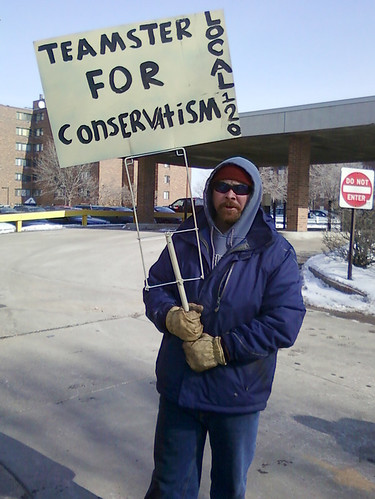
Early in the rally, a guy carrying a “Teamster for Conservatism” stood at the entrance to the parking lot at the rally site (the Labor Temple, in northeast Minneapolis).  I never did get his name.

Teamster4conservatism_web

He was standing on the curb next to the driveway.  One of the attendees in a Toyota apparently saw him, yelled something, and gunned his engine, forcing the protester to get out of the way.  The driver parked in the parking lot and went into the rally – but the protester and a couple of witnesses got the license number and called the police.  When the rally ended, the Minneapolis Police – who’d been waiting around the event – pulled him over.  Nobody was hurt, and there were no charges to place, but the cops did give the little fella a good talking to, and then made him shake hands with the protester.

As I noted in my previous post on the subject, there weren’t many pro-Obama counterprotesters.  They were pretty standard-issue stuff; not very articulate, not very well-informed, and pretty harmless.

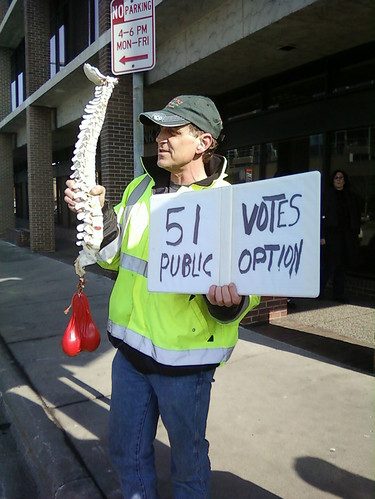
This guy was both of the above – but he brought an element of stupid to the proceedings that livened things up for all of us.  We noticed him when he stood on one of the corners across from the Temple, bellowing “Teabaggers!  Teabaggersj!” over and over again.

marquardt_spine_web

That’s a spine.  With a couple of putative testicles, ready for “Teabagging”, which the protester (whose name we got, but which I’ll keep offline) had helpfully affixed. (Because we have all been assured that when lefties yell about “Teabaggers”, they’re referring to the people who sent bags of Lipton to Congress.  Of course).

As I noted in my previous post (“It’s Fun Being Outside The Alamo For A Change“), not only is it fun outnumbering the other guys out on the streets for the first time I can remember – but I hate to think what it’s like for the lefties being stuck inside the Alamo with some of these whackdoodles.

It’s Fun Being Outside The Alamo For A Change

Sunday, February 21st, 2010

The truism about conservatives throughout my cognitive life is that we just don’t do protests.We have day jobs and families, for the most part; standing around waving signs rarely rises to the level of “something we’re interested in”.

I remember throwing counterdemonstrations at antiwar rallies that drew 15 people against 3,000 neocoms.  I did another to counterprotest a big pre-RNC warmup rally in Saint Paul in September of ’07 that drew maybe 50 people against 600 or so of the other guys.  And while 15 against 3,000 is a fair fight, I was never interested in being fair.

But the Obama Administration changed all that.  Last April 15, 600,000 workadaddy, hugammommy conservatives turned out to protest government spending.  More still turned out at subsequent rallies – and, hardest to believe of all, thousands went to congressional Town Hall meetings to show powers that currently be that not everyone is enamored of the Hope and Change we’re being presented.

In other words, there’s been a huge change in the way conservatives see public activism.

But even that observation didn’t prepare me for what I saw today. I attended a protest outide an Al Franken pep rally for Obamacare in Minneapolis today.

I parked a few blocks up Central, and walked toward the Temple; seeing a crowd gathered at Central and Uni, I steeled myself to walk a gauntlet of “Public Option Now”-chanting, preprinted-placard-holding Obamacare supporters.

And I practically fainted when I saw the assembled crowd; close to thirty anti-Obamacare people, holding homemade signs.  They were in a jovial mood.

There were perhaps three Obamacare supporters.  One was a very articulate guy and fellow User Interaction designer – yes, we talked a little shop – who stated a coherent case with not a few protesters on his way in and out of the meeting.

Another – a tallish fellow who looked like an extra from “The Crazies”, scuttled about with a big sign that said “Yes, there are Death Panels; they’re called Insurance Companies”.  I asked him “So that means Sarah Palin wasn’t lying or crazy?”, I asked him (this is basically the same thing I wrote last spring);  His eyes wobbled a bit, and he scampered away.  His idea of an argument seemed to be “you people are the minority!”.  Over and over.  And over.  Again.

And there was one more.  (Article about him to come shortly).

It was a pretty low-key time, until the rally let out.  A few hundred Obama supporters, clutching pre-printed placard that they no doubt had spent the last hour waving on cue, milled out across the sidewalk.  For the most part, they navigated the jovial, happy gauntlet of protesters without incident.  (Again, one big exception coming shortly).

But a few of them?  You could tell how bitterly they detested seeing dissent; their eyes burned with a thud-witted hatred that said, without speaking, “you were all supposed to go away after the election”.

I’d try to recap most of the arguments – but for the most part, they were ripped straight from the preceding pep rally, and made my eyes glaze over.  People say conservative talk radio is dumb!  (Actually, there’s another blog post in there, somewhere).

All in all, it was a lot of fun!  Hope we can see you at the next one!

Nancy from Freedom Dogs was there, too.

Free Market

Wednesday, February 17th, 2010

“An area in the Healthcare debate where Republicans and Democrats agree!”, NPR’s “Marketplace Money” trumpeted last night.

Only in the most trivial possible way, I’m gonna guess“, I thought, turning the radio up.

Am I ever wrong about these things?

Naturally, the Democrats favor a form of “competition” that has all the “competition” regulated out; essentially, the Tic version of the idea looks more like “privately-administered socialized healthcare”, only marginally less noxious than Obamacare itself.

The Republican plan would allow insurance companies to sell across state lines, more or less the say car, boat and motorcycle insurance works today.

Naturally, it’s sparking debate; conservatives welcome competition…:

Proponents of the idea say that the tangle of state regulation drives up costs, particularly in states with heavy mandates, and that a quick and easy way to reduce prices would be to allow people in states where insurance is expensive, like New York or Massachusetts, to buy policies in low-cost states like Minnesota.

Mr. Shadegg, who sponsored legislation to allow insurance sales across state lines in 2005 and has championed the idea ever since, likes to illustrate the lack of competition by pointing to how different the market is for automobile insurance.

“If you turn on the television station at night,” he said, “you see Allstate and Geico and Progressive and State Farm pounding each other’s heads in. ‘Drop your policy and come get a policy from us, and we’ll do two things — we’ll save you money and give you better service.’ You never see that kind of advertisement for you and I to go out and buy health insurance.”

But Mr. Shadegg adamantly opposes the Democrats’ take on the idea. He dislikes their requirement that states pass laws to create health care “compacts,” and he rejects the Democrats’ efforts to impose tight new federal regulations on insurers. Replacing many knots of state rules with a big knot of federal rules would defeat the purpose, he said.

Democrats: “But if you allow people to choose their own insurance, some of them will choose insurance that costs less and has fewer regulations!”.

No, really:

President Obama and leading Democrats, however, warn that without new regulations, private insurance companies would race to set up shop in states with lax regulation, minimal benefits requirements and the fewest consumer protections.

The nerve of those peasants – picking out the insurance they need and can afford, rather than insurance that’s larded up with all sorts of costly mandated coverage that just might not apply to them.

“If you go to full interstate shopping, you are going to need some consumer protection,” said Senator Ron Wyden, Democrat of Oregon, a supporter of the idea. Still, Mr. Wyden said he believed that compromise with Republicans is possible. “There is a lot to work with here,” he said.

In addition to bringing better, less expensive insurance to more people (even left-leaning “All Things Considered” noted that while Minnesotans might not see much benefit because our insurance is already relatively cheap, over half of the people in New York and New Jersey could find better insurance cheaper under this plan.

Presuming they can do with fewer benefits and less regulation, anyway…

Come On Down And Meet The Wedge

Tuesday, February 16th, 2010

Noted in advance; the left isn’t stupid.  Keep that in mind as we go through this.

The Tea Parties are an odd phenomenon in American politics; they’re a mass movement that more or less defies conventional party labels. 

When I spoke at the September 17 “Constitution Day” rally at the Minnesota State Capitol  last fall, I asked people to raise their hands if the word I mentioned described them.  I asked for Republicans to raise their hands (a little over half); Libertarians (10-ish percent); DFLers (a smattering, maybe 20 people, whom I urged to not feel bashful); Ron Paul supporters (a good 20%); people who’d rather pound a nail into their forehead than vote for Ron Paul (a giggly 20% or so); people who were sick of all the parties (maybe 30%).

The point – then, as now – was that the Tea Party movement, amorphous and leaderless as it was and remains, wasn’t a phenomenon tied to particular political party.  It was more in line with the GOP’s traditional limited-government emphasis, but for many Tea Partiers the burden is on the GOP to prove that it’s repented of its free-spending ways from 2000 through 2008.

Long story short; the GOP has to earn the votes of an awful lot of Tea Partiers.

Kenneth Vogel in Politico notes the challenge Republicans face with tea partiers:

Across the country, conservative tea party activists — many new to politics and unaffiliated with, if not averse to, the Republican Party — are increasingly finding themselves the target of intense GOP courting headed into the critical 2010 midterm elections.

Republican National Committee Michael Steele’s plans on meeting Tuesday with about 50 tea party leaders. The California GOP chairman recently trained tea partiers on political organizing and is planning a party-sponsored rally. The South Carolina GOP has a resource-sharing agreement with tea party groups. The North Dakota party chairman hosted a tea party-GOP rally Friday and is urging fellow state chairs to do the same.

But for tea partiers, who from the early days of their movement wanted to be heard and taken seriously, it’s a little bit of careful what you wish for.

Some have welcomed the attention, forging tentative alliances or at least opening channels of communication, usually to intense criticism from fellow tea partiers. But most have either proudly spurned Republican advances or approached their suitors apprehensively, keenly aware that while Republican resources and infrastructure could both boost the tea party movement to a new level of effectiveness, the GOP’s tainted brand could also jeopardize the independence that is part of their populist appeal.

In a sense, the Tea Parties are exactly what the GOP has needed for most of the past decade; a return to solid fiscal conservatism as a means of turning the nation around, while leaving social issues as a big black box to be decided by the individual. 

Of course, everyone knows social issues are the bedrock issue for another huge block of conservatives, the Evangelicans without whom, says conventional wisdom, the GOP faces a very uphill climb.

The ideal, for the GOP, is to follow the Reagan model; to make peace with those you agree with on the big issues – at this point, taxes and spending – and live and let live on the other issues.  The GOP, at a high level, seems to be learning this.

And this terrifies the left; the only thing that is holding the right back is its predilection for shooting itself in the foot over the real-but-overblown divide between fiscal and social conservatives.

The left knows this.  That’s why, in the immediate aftermath of the Massachusetts special election, you saw a wave of leftymedia/leftblog postings, starting with Media Matter and radiating out to their subjects, saying “ReThugLiCons just elected a pro-choicer!  They are teh Heppocreet!”

They know that if the various factions on the right can agree, at worst, to disagree on social issues, that we will be well-nigh unstoppable in 2010 and, if Obama/Reid/Pelosi stay their current course, possible 2012 as well. 

Which is why you can expect a constant drumbeat of media coverage of libertarian Tea Partiers who don’t care one iota, at least in terms of electoral politics, about abortion or gay marriage.  It’s a considered effort to drive a wedge between evangelicals and Tea Partiers.

There are two approaches the GOP needs to take to this. 

  • The Tea Party is a sign that the conservative movement has grown up and agreed to disagree.  The New Jersey Gubernatorial and Massachussets Senator elections showed that conservatism has learned how to prioritize, knowing that…
  • …a fiscal conservative tax-and-spending hawk who has a “nuanced” position on abortion is going to be a friendly representative for single-issue pro-life evangelicals than a Democrat who is wrong on taxes and is in the bag for NOW and Planned Parenthood.  Indeed, it just might be a sign of what is, for the left, the unthinkable; that Evangelicals are growing beyond single-issue voting.  And that’d be very bad news for the Dems.

And so look for the Dems to beat on this supposed, potential wedge for all they’re worth in the next eight months.  The best hope they have of turning back the Tea Party surge is by turning it against itself; by pitting fiscally-conservative Republicans against unaligned fiscal-conservatives over what is, for purposes of attacking the current orgy of spending, a side-issue.

Since We’re On The Subject

Friday, February 5th, 2010

Does anyone remember when conservatism was dead?

Of Big Tents And Tugs Of War

Friday, February 5th, 2010

It’s the biggest condundrum of conservatism; there are so many of us.

Some are social conservatives, motivated by the decay of our culture.  Others are fiscal hawks, alarmed by the Administration’s mortgaging of our great-grandchildrens’ futures. There are security conservatives motivated by the war, libertarian conservatives driven by conservatism’s fundamentally hands-off approach, and not a few Republicans, whose loyalty is to the Party first and foremost, and of course every possible permutation of these options and probably not a few others.

I described my own philosophy a few years ago: “I view politics as a tug of war. A series of tugs-of-war, really – one for each issue that’s out there, at any level, from National Security to Welfare to Cheese Price Supports. At the center of each debate is a mud pit; a ribbon in the exact center of each rope shows how well each team is doing.  My role in that tug of war is to affect that compromise by pulling to the right like there’s no tomorrow. So I pull like mad, and the ribbon over the mud thus inches a little closer to the right. Others, of course, pull against me, trying to edge the ribbon to the left. I know there’ll be a compromise; I know that the harder I pull to the right, the more people will (if I’m doing my job) be convinced to pull with me, and the farther to the right that ribbon – the “final” results of the compromise – will be.”

Now, the conventional wisdom is that the ideological differences between Republicans – all the different flavors of conservative and not-so-conservative Republicans – is going to eventually destroy the party.  My traditional response: if people fight the tug of war for all they’re worth up through the endorsement of candidates, but then get behind the winners – even the ones that aren’t perfect – come election time, we’re good.  That is, of course, historically difficult, but you have to start somewhere.

The other possible solution – one I never really thought about all that hard until the unprecedented Tea Party movement; simply accept the myriad other differences, and unite behind the issues that really matter.

And as Jonathan Martin notes, that may be starting to happen:

It may not be all that hard in a favorable political environment for skilled Republicans to bridge or blur the ideological divide between the conservative activists who dominate the party and the more moderate swing voters whom candidates need to win office.

Scott Brown has become the toast of Republicans nationally by winning Ted Kennedy’s old Senate seat in Massachusetts even though he supports abortion rights. Conversely, Republican Bob McDonnell defied predictions that he was too far to the right to attract moderate voters to win a landslide in the Virginia governor’s race.

Let’s add that two of the few bright spots in 2006 and 2008 for Minnesota Republicans – Michele Bachmann and Erik Paulsen – were both people who ran to the right of the conventional wisdom in both of their districts, the “Red with waxy Blue buildup” of the Sixth District, and the harder purple of the Third.

Much about recent events reflects basic politics: Smart politicians have always calibrated their ideological profile to fit local circumstances.

Ergo Mitt Romney.

But after conservative activists chased liberal Republican candidate Dede Scozzafava out of a special election in New York’s 23rd District last fall, some worried that activists were pushing the party so far to the right that it would be unable to compete nationally.

Earlier last year, White House press secretary Robert Gibbs crowed that Rush Limbaugh was the real leader of the Republican Party.

So far, though, it seems clear that Republicans who deviate from party orthodoxy or downplay social issues can be successful as long as they are not egregiously out of step with the base and are savvy enough to harness populist anger at Washington to their benefit.

Perfect is the enemy of good enough.  And a candidate that is for cutting spending has a head start toward “good enough”.  Because remember – a candidate that might be softer on immigration or gay marriage than you want, but is right on taxes and spending, is more likely to take your side on the social issues than their Democrat opponent anyway.

Conservatives have been looking for something to re-unite the movement ever since Reagan left office.  This time, it’s not a person.

That shouldn’t be a problem.

History Floats In A Harbor Of Language

Tuesday, February 2nd, 2010

Remember ten years and two months ago?

The world was waiting for the calendar to flip over to 2000; more importantly, we waited to see if the world’s computers would shut down, with drastic results (most of them didn’t).

And as the rest of us celebrated the new Millennium, always on the periphery of things was a thin little film of nerdy, adenoidal pedants clucking away, their voices like Comic Store Guy in “The Simpsons”; “Er, helLO?  There was no Year Zero; the Millennium doesn’t begin until 2001″.  These people – most of them frustrated wannabe scientists who worked at petty government jobs or as office temps – were largely and justly ignored.

The point?  Keep your technicalities; there’s a larger point here.  We’ celebrated the end of a thousand years of years beginning with “1” (and, for all of us in IT, the end of the biggest crash preventive maintenance job in IT history, so far).

The other point – the one I’m writing about today?  Pedants who huff and phumpher about petty technicalities often miss the forest for the trees.

Such is Jeff Van Wychen at liberal think tank “MN2020”, who recycles the hottest non-story of April 2009 among the lefty clucking classes; he’s T fussing about the purported misuse of history by the “Tea Party” Movement.

An image used by the modern tea party movement shows colonial patriots dressed as American Indians dumping tea off of ships into the Boston harbor in December of 1773.  When it comes to selecting a signature event, today’s “tea partiers” have chosen poorly.  The tax protests of modern tea partiers have nothing to do with the Boston Tea Party of 1773.

Van Wychen – whose organization exists largely to misappropriate facts for partisan ends – certainly has the textbook story of the Boston Tea Party

The impetus behind the Boston Tea Party was the Tea Act of 1773.  In response to colonial outrage, Parliament repealed most of the taxes imposed through the Townshend Act of 1767.  However, the hated tax on tea was left in place as a demonstration of Parliament’s authority to tax the colonies.  Irate colonists would have none of it.  Tea laden ships were not allowed to land in New York and Philadelphia.  In Boston, tea was taken from the ships and dumped overboard.

Which caused the good folks at “MA1820” to post handbills sniffing that they weren’t unrepresented, since His Highness George III was charged by Almighty God to represent them.

Well, no, I’m not being especially facetious.  We’ll come back to that.

The outrage of the colonists was not about the price that they were forced to pay for tea because of tax; in fact, the price of tea declined in the American colonies as a result of the Tea Act because the East India Company was allowed to directly export tea to the colonies rather than having to go through middlemen in London.  The rage of the colonists was not about the amount of the tax; rather, they objected to the principle of any tax imposed upon them by government officials that they had no voice in choosing.

Modern tea partiers can make no such claim of “taxation without representation.”

Maybe, maybe not.

Van Wychen and everyone who chants the “Tea Party is bad history!” meme are wrong for two reasons.

The first:  When I accuse Jeff Van Wychen of being a “Wet Blanket” who “doesn’t have a leg to stand on”, and that my response to his point will “knock his socks off” and “drive him up the wall”?  What do you see?

Someone reading that could, in theory, read that and wonder if Mr. Van Wychen is an amputee made from soggy wool, and that the impact of my rhetoric will literally leave him barefoot and wedged up against the ceiling.  But that someone would have had to have learned English from a 100 year old textbook in the jungles of Burma, because each of those terms has assumed different, non-literal meanings in American English.

So too with “Tea Party”.  The Boston Tea Party was indeed a historical event – but the term Tea Party has had an idiomatic meaning, referring to any group of plucky underdogs taking a symbolic stance against big, distant, uncaring government.  And until the Tea Party Movement made every leftist in America into a pointillistic historical pedant, even they understood it.  And indeed, they do today – but the mission of left-leaning “think” tanks like MN2020 is to try to discredit the opposition.  And so it goes.

But just for laughs, let’s hew to the literal, historical story of the Boston Tea Party.

Van Wychen:

At the federal level and in all 50 states, taxes are imposed by elected representatives.  You might not have voted for the current officeholders, but you still had the opportunity to vote.  Americans and Minnesotans today are taxed with representation.  Thus, there is no connection between modern tax protesters and the patriots who dumped tea into the Boston harbor nearly twelve score years ago.

This is reminiscent of Mr. Van Wychen’s colleague John Fitzgerald’s claim last summer that public schools were more accountable than charter schools, because public schools have elected boards.  I read that claim, and then compared my own kids’ charter school – where the board responds to 200-odd parents, is mostly turned-over every year, and is the launching point for nobody’s political career – with the Saint Paul School Board, which spends half a billion dollars a year, does a terrible job, and can only be gotten onto with the aid of the Teachers’ Union and the DFL and an awful lot of money.  Am I “represented” on the Saint Paul School Board, to which I pay more and more taxes every year?  In theory.   Am I better-represented there than on my charter’s board?  Don’t be an idiot.

Oh, there is an elected Saint Paul School Board.  But as a political minority in a one-party town, the only vote that really mattered in the end was my protest vote – pulling my kids out of the Saint Paul Public Schools, forever.

Now, I’ve spoken at two Tea Parties.  And the Tea Parties are really quite extraordinary events, gathering people from all political parties, and no political party at all, together with one big thought in mind; get government back under control.

And those people feel like an awful lot of fiscal conservatives felt over the past eight years; the same way we Saint Paul conservative parents feel at school board election time; that we may have an elected official out there sent from our districts who passes all sorts of legislation, but we – the people who favor fiscal responsibility – really aren’t represented at all.

And so we exercise our First Amendment right to protest, to try to change that elected government.  And we’re doing it under the banner of an idiom that, let’s be honest, everyone understands.  Just as everyone understood that 2000 was the Millennium that everyone really cared about.

And – mirabile dictu – it’s working, or starting to; Democrats are running scared, Mr. Brown is going to Washington and Mr. Christie has gone to Trenton and pretty soon Messrs Reid and Dorgan will be going back to Reno and Bismarck.

Which prompted the Big Left into a paroxysm of juvenile name-calling, and, today, inveigled Jeff Van Wychen to play history teacher.

Modern tea partiers have constitutionally protected free speech rights.  Indeed, a fact-based debate over taxation is healthy and should be encouraged

By your leave, my liege.  And that is exactly what we are doing!

.  However, those who advocate for low taxes and less public investment should not misappropriate historic events that have nothing to do with the cause they espouse.

Have a beer, Jeff.  The debate is fact-based, and the Tea Party idiom is perfectly well understood; everyone with an IQ above plant life knows it, just as they knew “Remember  Pearl Harbor” meant “shoot Germans and Japanese, build weapons, support the war”, rather than “sit and commemorate”.

Nor should they pretend to be any more patriotic than the rest of us.

I’m not sure if anyone actually has – and I doubt Mr. Van Wychen is, either.  I think that’s just become one of those strawmen liberals throw in to make sure we know they’re victims, too.

Craig Westover also tossed Mr. Van Wychen into the rhetorical harbor which, lest Mr. Van Wychen get upset, I hasten to add that I’ve qualified with the term “rhetorical”; Mr. Van Wychen need neither don a Speedo nor find a beach towel.
America’s Designated Black Conservative

Saturday, January 30th, 2010

Kevin Jackson, owner of Black Sphere.net, is worth checking out…

Obama’s New New Way Forward

Monday, January 25th, 2010

A year and a half ago, pundits speculated that Barack Obama, if elected President, would either work to move the country far to the left in pursuit of a liberal ideology and to satisfy decades of pent-up liberalism or govern from the center in the interest of furthering his personal ambitions and extending the pinnacle of his political career.

The first year of the Obama Presidency ended all speculation. Ideology trumped ambition, and it’s been a disaster for the President and for Democrats.

January 20th marked the beginning of his second year and also served as a demarcation between the pre-Brown and post-Brown era for the Obama Presidency.

This week offers peril and opportunity for the President to elucidate his New New Way Forward, if like many Democrats recently, Obama acknowledges the Coakley defeat as the comeuppance that it was.

Mr. Obama’s campaign-style speech here capped one of the most bruising weeks of his year in office. The President traveled to this swing-state manufacturing town ostensibly to deliver a speech about jobs and the economy, but instead he repeatedly veered off-script to interject pledges to battle his political foes over health care and other issues “so long as I have breath in me.”

Sadly for alert Democrats and in an inconceivable dream scenario for Republicans, instead of shifting gears from health care reform to job-creation; to align Washington with the rest of America, Obama opted this week to cement his station as an ideologue. Without regard for fairness, public sentiment or for that matter, securing a second term, the President declared war on the banking industry, sending the market into a minor (thus far) sell-off, undermining sentiment tied to economic recovery, and positioning himself within a new Democratic sub-minority, of, well, he and Nancy Pelosi. Even Barney Frank has said “Uncle.”

Save for later the discussion of the fact that his edict fails to recognize the corruption and culpability of Fannie Mae and Freddie Mac, both being spared, and the fact that we already have procedures in place such as increasing reserves and FDIC premiums to protect the system and “punish” banks for taking on excess risk. I’ll also forego the well-worn but valid discussion of the of the fact that much of the risk-taking at issue was forced upon them by government policy and that some of the corporations and practices Obama named specifically had nothing to do with the financial crisis.

[Treasury Secretary Timothy] Geithner is concerned that the proposed limits on big banks’ trading and size could impact U.S. firms’ global competitiveness, the sources said, speaking anonymously because Geithner has not spoken publicly about his reservations.

He also has concerns that the limits do not necessarily get at the root of the problems and excesses that fueled the recent financial meltdown, the sources said.

Lawrence White, a professor at New York University’s Stern School of Business and a former regulator, said Obama’s proposals were “a solution to the wrong problem.”

Ironically, these policies may result in the transfer of some pretty good jobs from Wall Street to Europe.

The new rules would ban the use of a bank’s own capital for hedge fund or private equity investment, or for trading unless it was directly connected to client activity.

However, some foreign banks believe they could escape the ban by switching their operations from Wall Street to London or continental Europe.

What Obama’s proclamation does represent is a presidency inexorably out of sync with America; especially the meaty middle, whose voice was heard load and clear in Massachusetts this week. A years’ experience has done little for a man who has never held a real job, owned a business, or exhibited a basic comprehension of the fundamentals of economics or a genuine acknowledgment of the gift that is free enterprise.

Mr. Obama’s display of anger with big financial institutions and insurers may not reassure voters who are dubious about his proposed solutions to the country’s economic problems.

Barack Obama has essentially been out of touch his entire, calculated, and increasingly apocryphal political career and may soon find his presidency floundering having sailed his most avowed mission to reform America’s health care system into a tsunami of taxpayer revolt.

Despite the fact that his policies have been soundly rejected and support within his own party is eroding, Obama’s political capital and popularity aren’t completely exhausted. The opportunity remains to move quickly to realign his presidency with the pressing needs of an American citizenry that haven’t yet completely lost hope in him.

most continue to like and respect the man they gathered around televisions to watch sworn in as president on a cold noon hour a year ago, and most still hold out hope for his presidency. Yet many also worry that, in his quest to mobilize government to solve the nation’s problems, he may have moved too far too fast.

If Obama’s upcoming State of the Union address focuses on restoring full employment, judicicious enhancements to the regulations that govern our financial system, and a renewed confidence in America’s ability to recover, rebuild and prosper once again, Obama’s may find his stock rising again.

In his State of the Union, Obama has to slim down his ambitions. It should be short and simple and focus on jobs.”

“Obama has to decide whether he wants to be a transformational president, which looks optimistic at this stage, or merely an effective president,” says Bruce Josten, head of government affairs at the US Chamber of Commerce

Odds are, Obama will continue on his latest vector: vilifying banks, demonizing those who would dare seek an honest profit, penalizing employers, mushrooming the federal government and broadening an ongoing orgy of government spending under the guise of economic timulus, which is almost as dirty a word now as health care reform.

In short, Mr Obama’s nightmare January could easily slip into a nightmare February. “Unless and until the president changes the way his White House, works, things are going to continue to go badly for him,” says the head of a Democratic think-tank.

In turn, this will continue to fuel the tea party movement, mobilize the middle, neuter the left and manifest a Jimmy-Carteresque dreamscape only the most opportunistic Republicans could envision before last Tuesday night.

Only Obama’s teleprompter knows which path the President will chose.

Wham

Friday, January 22nd, 2010

The headline is that Arlen Specter told Michele Bachmann to shut up and get back in the kitchen.

Not quite in the headlines?  Even if you leave out Specter’s little sexist jape, you hear Bachmann clobber Specter on all the points that are going to be big and key this fall; jobs; prosperity; everything but more and more and more regulation.

Had They Used Arial Narrow Coakley Would Be Senator

Friday, January 22nd, 2010

Nancy Pelosi takes a crack at interpreting Scott Brown’s win in Massachusetts:

The House speaker, Nancy Pelosi of California, said on Thursday that Democrats remained committed to passing far-reaching health care legislation, but she said that the House would not simply adopt the Senate version of the bill and send it to President Obama in part because of problematic provisions that she said contributed to the Republican victory in the Massachusetts special election on Tuesday.

Yeah, that’s it. The good citizens of Massachusetts made good use of all the time and visibility that Congress has allowed for the study of the proposed health care bills. Joe the Plumber, Bill the Banker and Sally the Social Worker gave haste to reading the Senate version, comparing it meticulously to the House version.

It was some clause of some paragraph of some provision somewhere that displeased them and made them turn on hapless old Martha and her saggy queen mother, Nancy.

I wonder if exit pollers were asking voters “was it the fourth paragraph of the Senate version as it contrasted the fifth paragraph of the House version that changed your mind? Or was it the font?”

“Unease would be a gentle word in terms of the attitude of my colleagues toward certain provisions in the Senate bill,” Ms. Pelosi said.

I can picture Pelosi saying that on camera while over her shoulder and out of focus, Democrats, overstuffed briefcases under their arms, papers streaming out of them, are seen fleeing like rats from a burning building.

America is pretty okay with their health care as it is for the time being and would rather their government help them find a job and quit spending their great great great great grandchild’s retirement. Nancy Pelosi may be the only liberal in Washington that didn’t get the message Tuesday evening.

“Other than that Mrs. Lincoln, how was the play?”

Some Folks Say That I’m A Dreamer. And A Geek.

Thursday, January 21st, 2010

Ross Douthat, writing in the NYTimes a week before the Massachusetts special election, managed to get past his internal Pauline Kael to read the signs…:

Brown’s race might actually end in triumph, rather than a close defeat.

…but he tripped onto two excellent points; the press’ brief fantasy that the left controlled the online world is over, and online political involvement is a very two-edged sword.

The Brown victory showed that the left’s bought-and-paid-for surge online from 2006-2008 has peaked:

But win or lose, he’s demonstrated there’s no necessary connection between online organizing and liberal politics. The Web is just like every pre-Internet political arena: ideology matters less than the level of anger at the incumbent party, and the level of enthusiasm an insurgent candidate can generate.

The left invested millions and millions buying an online presence after 2004; the right wing involvement in the blogosphere and in social media remains a pretty organic phenomenon.  And as we saw in Virginia, New Jersey, Massachusetts and New York, organic phenomena and passion mix pretty well.

But that’s not really new turf.  Douthat next went into perceptions:

It’s like other arenas, too, in its capacity to disappoint idealists. Indeed, it may be crueler to dreamers, because it offers an artificial sense of intimacy with politicians, without delivering any practical results. You can be Sarah Palin’s pal on Facebook, or have Barack Obama’s running-mate selection text-messaged to your cellphone. But Washington is still Washington, the legislative process is still the legislative process, and the power of an online community matters less than the power of the powerful.

Well, duh.

This is the bitter lesson many net-roots types have drawn from Obama’s first year in office. The promises of transparency have given way to the reality of backroom deal-cutting. The attempts to turn the campaign’s online community, weakly re-dubbed Organizing for America, into a permanent political force have flopped. In a recent post on the Web site Personal Democracy Forum, Micah Sifry captured the free-floating sense of anger with Obama’s governance: “The people who voted for him weren’t organized in any kind of new or powerful way, and the special interests … sat first at the table and wrote the menu. Myth met reality, and came up wanting.”

I’d say “duh”, but then I did just above, and one must not repeat oneself.

Still, we tried to warn the Obamabots about this last year; all that talk of reinventing government is the kind of thing that attracts utopians, the kind of people who think you can change human nature through sheer passion (or legislation).

But next, Douthat steers into the weeds:

If liberals are feeling disillusioned, though, their right-wing imitators [Er, no, Ross – the conservatives were here first, and we’re still better – Ed.] may be ripe for an even greater letdown. The Obama administration has at least gone some distance toward enacting an agenda that the net-roots left supports. The “right roots” activists are rallying around politicians who are promising to shrink government without offering any plausible sketch of how to do it. When Scott Brown pledges an across-the-board tax cut and sweeping deficit reduction all at once, he’s setting the conservative grass roots up for a major disappointment.

Douthat betrays his coastal media center-left myopia; just as Obama had a model for his agenda (FDR), we’ve got Reagan, who did it all; not “at once”, but it did sorta show the way.

But more importantly, Douthat’s wrong; conservatives don’t – or shouldn’t – get involved in politics to give meaning to their own lives.  And that a thin film of them might do that doesn’t change the fact that that sort of naive idealism is absolutely anathema to conservatism.  Government – even good government – is at best an enemy with whom you have a truce; at worst, it’s something to be strangled in self-defense.

If you do meet a conservative that invests themselves in politics the way Obama’s legions of naive hamsters did, please – set ’em straight.

Amen, Brother.

Tuesday, January 19th, 2010

“Air Force One made an emergency trip to Logan field…”

“when theres trouble in Massachusetts, rest assured, there’s trouble everywhere and they know it.”

-Scott Brown tonight

Proverbs 26:24-26

Sunday, January 17th, 2010

In Obama’s speeches, one favorite phrase: ‘Let me be clear’

Obama’s declarations of clarity are far more than a little presidential throat-clearing.

In a presidency in which everything is murkier than Obama could have imagined, the “let me be clear” preface has become a signal that what follows will be anything but.

“Now let me be clear — let me be absolutely clear…”If your family earns less than $250,000 a year, a quarter-million dollars a year, you will not see your taxes increased a single dime. I repeat: not one single dime.” Since then, several proposals have muddied that assertion, including the Obama-approved tax on costly health insurance plans.

Let me be absolutely clear about what health reform means for you,” he said in July. “. . . It will keep government out of health-care decisions. It will give you the option to keep your insurance if you’re happy with it.” In fact, the government’s role in health care would increase under the legislation, and the changes would, in all likelihood, result in many people ending up with different coverage through reasons not of their own choosing.

Now, let me be absolutely clear:

Proverbs 26:24-26: “A malicious man disguises himself with his lips, but in his heart he harbors deceit. Though his speech is charming, do not believe him, for seven abominations fill his heart. His malice may be concealed by deception, but his wickedness will be exposed in the assembly.”

Oh, That’s What You Meant.

Tuesday, January 12th, 2010

When Barack Obama expressed concern over the deficit, and pledged to cut it in half, I suppose there were some taxpayers that actually thought that implied a reduction in government spending.

Nope. What he meant was he was about to invent another tax and wrap it in fabricated righteousness.

President Barack Obama may propose a fee on financial-services companies as a way to fulfill a vow on cutting the budget deficit in half, administration officials said.

Despite the fact that by some miracle the government is well on it’s way to recovering much of the infusions made last year in the interest of preventing further disaster, Obama wants more. How dare the financial sector recover from a crisis seeded by the government and admittedly germinated by the avarice of a few bad apples and actually start turning a profit again!

Banks repaid the U.S. $165 billion last year, letting the government recoup about two-thirds of its total investment in the banking system through the $700 billion financial rescue, according to a U.S. Treasury Department report released today.

The Troubled Asset Relief Program also collected $12.9 billion in fees, dividends and interest, the Treasury said. So far, the U.S. has made an 8 percent return on its bank investments, a Treasury official told reporters.

Treasury Secretary Timothy Geithner has said he expects the government to be repaid for the funds put into banks at a profit.

You can’t have it both ways.

A few banks exhibit risky behavior while the government looks the other way. Risk is realized. The government bails the banks out just as the banks expected, thereby rewarding them by mitigating the risk normally realized by this behavior.

No one should be surprised that some banks are picking up where they left off, and the government is just as culpable as the banks.

Public sentiment has turned against last year’s government rescue of the financial-services industry. Almost two-thirds of Americans believe bailing out the banks was a bad idea, a Bloomberg National Poll taken Dec. 3-7 showed.

Just over half of respondents said banks should be subject to stricter regulation and 31 percent would allow troubled banks to fail.

Americans are pissed off – and they should be – but not just at the banks, rather at the bureaucrats that saw fit to reward risky behavior with taxpayer dollars.

…and ironically now seek to create yet another tax to repair the damage caused by the misuse of taxpayer dollars in the first place.

One must never underestimate a liberal’s creativity in finding new ways to confiscate capital and turn something into nothing.

While I Was Absentmindedly Pondering…

Friday, January 8th, 2010

…last night, this crossed my mind.

Remember last November?

For starters, Democrats tried to spin their crushing, upset, turnaround defeats in Virginia but New Jersey as something other than “a referendum on Obama?” It was untrue, of course, but it’s understandable that they’d float it as damage control, and I’d never expect that the utterly compliant lefty blogosphere would repeat it as anything other than fact).

Then they tried to paint the New York 23rd District race, where a virtually unknown Conservative Party candidate Doug Hoffman, running a ,last-minute, poorly-funded campaign against a liberal “Republican”, Dede Scozzafava, (who actually ran to the left of the Democrat, and spent more money against Hoffman than against her putative opponent),  very nearly won running against both of them, as a defeat for the GOP.  I’ve never really figured out the logic behind this – and being Democrat propaganda, it wasn’t intended for consumption by the logical anyway – but apparently it has something to do with Sarah Palin’s endorsement not causing the sky to open and rain ballots like it did for Obama.

Now, the “reason” given for this is that “It’s proof that the conservative movement is too partisan and extreme!” (ignoring, of course, that Scozzafava waas an extremist for the other side, in a district that had always voted for real Republicans).

But let’s take it at face value; let’s bite our tongues and accept for argument’s sake that Hoffman’s “loss” – and the temporary loss to the GOP of a fairly backwater House seat that will return to the GOP in about eleven months anyway – was a symptom of an “extremist” takeover of the GOP?

Very well.

So, all of you who were hopping up and down like poo-flinging monkeys over Hoffman; aren’t, then, the departure of the vastly more power Chris Dodd and Byron Dorgan even more-proximate symptoms of the side-effects of the inflexible extremism of the Pelosi/Reid/Obama agenda?

Hope For Change

Thursday, January 7th, 2010

Conservatives  are now #1:

The increased conservatism that Gallup first identified among Americans last June persisted throughout the year, so that the final year-end political ideology figures confirm Gallup’s initial reporting: conservatives 40% outnumbered both moderates 36% and liberals 21% across the nation in 2009.

And it’s not just a little bit:

Since 1992, there have been only two other years — 2003 and 2004 — in which the average percentage of conservatives nationwide outnumbered moderates, and in both cases, it was by two percentage points (in contrast to the current four points).

Three more years of Obama bode well for that gap, I think.

But the interesting question for me is “what does conservatism mean” these days.

Expect a much longer piece on the subject later this week.  I can say that, since I was working on it long before I saw this poll result…

--> Site Meter -->