Archive for the 'Geekery' Category

Bridges of Ramsey County – The Lafayette Bridge

Wednesday, December 5th, 2007

It’s ugly.

It’s suspect.

It’s not just a product of the most dismal age in bridge design (it opened in 1968), but it was even on the “B” list of bridges from that era; unlike the late 35W River Bridge – which opened the year before, but had the good fortune to connect urban Minnesota’s crown jewel, Downtown Minneapolis, with the north metro – the Lafayette connects a grimy, tumbledown stretch of the East Side with a utilitarian area of the West Side Flats – a canyon of state offices with Holman Field and the older downmarket ‘burbs to the southeast.

It looks like it could be found over any barge canal or toxic waste dump in North Jersey. It shudders.  It clogs tight during rush hour.  A utilitarian plate-girder span downstream from the golden age art-deco splendor of the Robert Street span and the reformist high-concept gloss of the Wabasha, the Lafayette is like a truck driver crashing an English department cocktail party.

And yet, there’s one part of the Lafayette Bridge that would be irreplaceable if they blew it up tomorrow. Right behind the late, lamented vista of downtown Minneapolis from the 35W Bridge, and the postcard view of downtown from the High Bridge, the view of Saint Paul at night from the Lafayette Bridge is one of the metro’s most striking scenes.

Viewing downtown Saint Paul from the High Bridge is like looking at a Summit Avenue mansion from…Summit Avenue; it’s the mansion’s best face, put forward for public consumption.

The same view from the Lafayette Bridge is like looking at the same mansion from the alleyway behind it. You are keenly aware of the working end of Saint Paul – railroad bridges, docks, bargeyards – as well as the scrum of turn-of-the-20th-century warehouses, cuts into the bluff, and bare infrastructure that pays (or paid) the rent for that “best face”.

The view is not online. I may have to fix that.

Bridges of Ramsey County – The Robert Street Bridge

Tuesday, December 4th, 2007

Now the Robert Street Bridge? That’s Saint Paul.

The Robert Street Bridge, completed in the mid-twenties, has something for everyone – history geeks, engineering geeks, aesthetics geeks, you name it.
From the Minnesota Historical Society:

The Robert Street Bridge is a reinforced concrete, multiple-arch bridge. The Robert Street Bridge is historically significant as an outstanding example of an unaltered, monumental, multi-span, reinforced concrete arch bridge. It is the product of a very complex engineering design process to enable this bridge to be built in this location with its established vehicular, railroad, streetcar and river-navigation demands. The resulting bridge includes a monumental reinforced concrete rainbow arch, by far the largest in Minnesota. The bridge is outstanding not only for its engineering, but for its aesthetic effect in the overall design of the bridge.

As someone who has to design things (or at least software), I can imagine those engineers back in 1921, getting all tingly at the challenge; to fit a bridge over an existing road (Shepard), and the all-important barge channel, and the Greasy Black Railroad Lift Bridge, and make it aesthetically work and serve as a monument to the wisdom of the people who were paying for it.

It’s another one of those roads…:

…where you can almost imagine Al Capone rolling down the street on his way to the Wabasha Caves speakeasy.

But you have to imagine pretty hard, at least on parts of Robert Street. Because in addition to a monument to Saint Paul’s glory years – from James J. Hill through the thirties – it and the street it carries are a tour through all that is wondrous and strong and quirky and all that is depressing and ugly about Saint Paul.

Start on the West Side (for non-Saint-Paulites, the “West Side” is actually south of downtown, and sits astride the hypothetical north-south line that bisects the city; it’s the part of Saint Paul on the west bank of the Mississippi), on the bluff high above the river, up at Robert and Annapolis. The neighborhood seems to have changed since the twenties only to make a nod to the fifties; it’s a close-knit neighborhood of corner markets and neighborhood bars, where “TV repair shops” still repair televisions for frugal locals. In a city that’s been called “fifteen small towns with one mayor”, it’s one of the originals.

Go down the monumental double ramp on Robert, down the bluff, past Concord Street Cesar Chavez Boulevard. You’re in the heart of the second-latest of the city’s great immigrant neighborhoods, centered around Nuestra Señora De Guadalupe church, which have welcomed wave after wave of newbies and their stores, bars, parties and passions to Saint Paul.

Keep going, over the West Side Flats, past the drab warehouses and offices, including the Palace of Incompetence Comcast office and the big USBank Westside Flats office, a huge building that started to reverse decades of architectural rot by at least taking a nod at the area’s past (paid for by tax increment financing that, ironically, emptied USBank employees out of several downtown offices, contributing to downtown’s spiral).

Then, over the bridge, and into downtown.

You can see hints of Saint Paul’s heritage – the City Hall skyscraper, the Pioneer and Endicott buildings – and some of its downfall, the detritus of the “Capitol Center” concept. “Capitol Center” was an Urban-Renewal-era “vision” document from the mid-fifties that, in keeping with the tenor of the era, sought to gut downtown to save it. It guided downtown’s “redevelopment” – some might say “destruction” – from the fifties through the eighties. So between Fourth Street and Seventh, from Wabasha to Sibley, the old downtown that had seen James J. Hill and Al Capone’s glory days – 3-5 stories tall, brownstone and limestone – was gutted. In its place came…progress. Excrescences like the Dayton’s/Marshall Fields/Macy’s building, with all the charm of a Brookdale anchor tenant – a big tan cube that’s more parking ramp than store. White elephants like Town Square and the World Trade Center and Galtier Plaza, and cold, oppressive misfires like the American Bank Bremer tower, mixing it up with gems like the Osborn/Ecolab tower, the Saint Paul Hartford, and so on.

So as you cross the river and drive up Robert, you pass horrors like the Kellogg Square apartments (with all the external charm of a bridge abutment), the Securian tower (a cement bunker of a skyscraper), the Met Council building, and the USBank Center – the worst detritus of the Capitol Center plan. But, like the Robert Street Bridge, there are holdouts; the nineteenth-century splendor of the Pioneer and Endicott buildings, empty (their USBank employees fleeing down Robert to the West Side Flats) as they await the Republican National Convention and the hordes of media, flaks and party functionaries that’ll fill it for a hopeful couple of months; the Golden Rule, a shiny, highly renovated art-deco holdout that has done unto downtown and should have good done unto it; the 401 Building, a shiny new edifice that at least tries to take a nod to the past.

And thence, past parking ramps and blah (or, like the dark-blue aquariium-like Metro Square, atrocious) government offices to its terminus on Capitol Heights.

It’s everything Saint Paul was, a bit of everything bad that’s been done to it, and a shard or two of hope.

Bridges of Ramsey County – The Greasy Black Vertical-lift Rail Bridge

Monday, December 3rd, 2007

Tucked under the Robert Street bridge (on which more tomorrow) is the span I affectionately have always called the Greasy Black Vertical-Lift Rail Bridge.

Oh, it has a real name and all – the St. Paul Union Pacific Vertical-lift Rail Bridge – but that hardly matters, does it?

Railroad bridges are as purely utilitarian as a structure can get; there’s not a scrap of wasted, ornamental or decorative metal anywhere on this bridge.

Wikipedia says:

It was built in 1913 and was designed by Waddell & Harrington. In 1925, the north end of the bridge was raised about 16 feet to tie in with tracks that served the St. Paul Union Depot yard.

Now, I’m kind of a fumblefinger as a handyman. Raising a bridge?

The bridge was originally built by the Chicago Great Western Railroad, which later became part of the Chicago and Northwestern Railroad. The Robert Street Bridge, built later in 1926, had to be carefully engineered around the railroad bridge.

With results that are, frankly, kinda cool – but we’ll get to that tomorrow.

In April 1997, high water on the Mississippi River reached the bottom of the span. The Union Pacific Railroad spotted a train of hopper cars laden with rocks on the bridge to help anchor it and keep it from being washed away.

Truth be told, the Greasy Black Vertical-lift Rail Bridge isn’t all that interesting on its own. It’s the efforts made to work around it that are kinda cool.

But we’ll get to that tomorrow.

Proof Is In The (Veal Brain) Pudding

Monday, December 3rd, 2007

So I got a copy of Lileks’ new book, Gastroanomalies.

How funny is it?

Bun had a bad week last week, topped off with a pretty terrible Sunday.  She was in a terrible mood Sunday afternoon.

And then she cracked it open and started reading…

…and in about five minutes, was in a wonderful mood by sixteen-year-old girl standards.

Gastroanomalies – hard-cover psychiatry!

So with a nod to my old friend James, go buy a copy.

Bridges of Ramsey County – The Wabasha Bridge

Friday, November 30th, 2007

Bridge design has gone through a lot of different phases.  In ancient Rome, the mere existence of the bridge, given the materials, labor and knowledge of engineering of the day, was a statement in its own right:

The engineering – the simple arch being the state of the load-bearing art back then – was adapted to the materials (wood, stone, iron) and workmanship of the day.  It carried weight without actually needing material below the weight itself – which was a major advance.

Over time, as developments in engineering made it possible to add less-utilitarian features – design – to the bridge:

The goal, of course, was to make bridges into statements – about the people who designed, built, and above all authorized and paid for the bridges.  “We can bridge the mighty [East/Mississippi/Colorado/James] river – we can do anything!”.  The function of the bridge was on full display – the suspension cables, the trusses, the intricate supports that, working with the materials of the day, kept these structures and their passengers up in the air where they belonged.

Then, times changed.  As materials improved (steel became cheap and ubiquitous) and architectural tastes morphed (modernism/Bauhaus/what have you intersected with Urban Renewal and the building of the Interstate highway system), the philosophy changed again.  The statement wasn’t so much “we can surmount this obstacle” as “this obstacle never existed, Winston“.  The bridge, like the obstacle it surmounted, became an unobtrusive, almost unnoticeable, element in the freeway experience.  This seemed to be the dominant philosophy from the fifties through the late eighties.

It’s the philosophy that led us to vanilla concoctions like the “Dartmouth Bridge”, carrying I94 over the Mississippi:

From the middle lanes, it’s possible to have no idea you’re on a bridge, much less crossing a stunning expanse of the Mississippi Gorge, at all.

In the nineties, the philosophy changed – again.  Thankfully. 

I push my conservative penurity aside to note that the Wabasha Bridge – crossing the Mississippi on Wabasha avenue over Raspberry and Harriet islands – was a long-awaited return of style to bridge design.

Yeah, it looks a little bit like something you’d look at at the Walker gallery, or maybe buy at Ikea.  The City of Saint Paul website on the bridge notes (in the future tense, on a page written before the bridge was built, and in dire need of update)…:

  • There are only 15 other bridges of this type in the United States with spans this long or longer.
  • The maximum span length of 397 feet is long enough to clear a football field from goal to goal,
    plus
    the end zones and some stands.
  • Over 420,000 cubic feet of concrete will be needed. That’s enough concrete to cover a
    basketball court
    89 feet deep.
  • The bridge will have over 2.8 million pounds of reinforcing steel embedded in it’s concrete.
  • High strength steel strand 0.6 inches in diameter, will be used to compress the concrete. If
    laid end to end,
    the strand would reach for 275 miles, or about from St. Paul to Milwaukee.
  • The main piers are designed to withstand a barge impact force of 3.2 million pounds.
  • The bridge will be supported on 460 vertical steel I-beams driven an average of 60 feet through the soil to bedrock.
  • The thickness of the bridge will vary from 8 feet in the middle of the span to 20 feet at the piers, about the height of a two-story house.

Facts, figures – all well and good.  But let’s talk aesthetics.  The Wabasha Bridge is OK to look at (compared with utilitarian structures like the Fort Road bridge or bland avoidances like Dartmouth or Lexington).  It shines the brightest, of course, from the perch on the bridge itself.

Saint Paul has always been a river city.  Somewhere along the way (I’m far from the first to observe this) the city turned its back on the river; Saint Paul’s riverfront for the past five decades has been an afterthought – almost a poor, embarassing cousin, to a city that seemed to labor to move its center of gravity up the bluff to the middle of downtown.

The Wabasha Bridge changes that.  Not only are you aware of a river – the river – around you as you cross, but you can actually make the river part of your actual life.  The notion of reconnecting the city to the river is part of the design.  Says Wikipedia (the source of all knowledge these days):

The color scheme of the bridge was also planned to reflect the architectural heritage of St. Paul, with a soft buff color (the color of sandstone) to reflect the colors used in many downtown St. Paul buildings. The color of terracotta roofs in the city was used to select the color of the railings, and the green patina of the St. Paul Cathedral is echoed in the ornamental color of the overlooks.

[I can imagine the howls of alarm on the bridge architects’ part when the Cathedral announced they were getting rid of the patina and refinishing the dome to its original copper, not long after the bridge was completed.  Que sera sera.

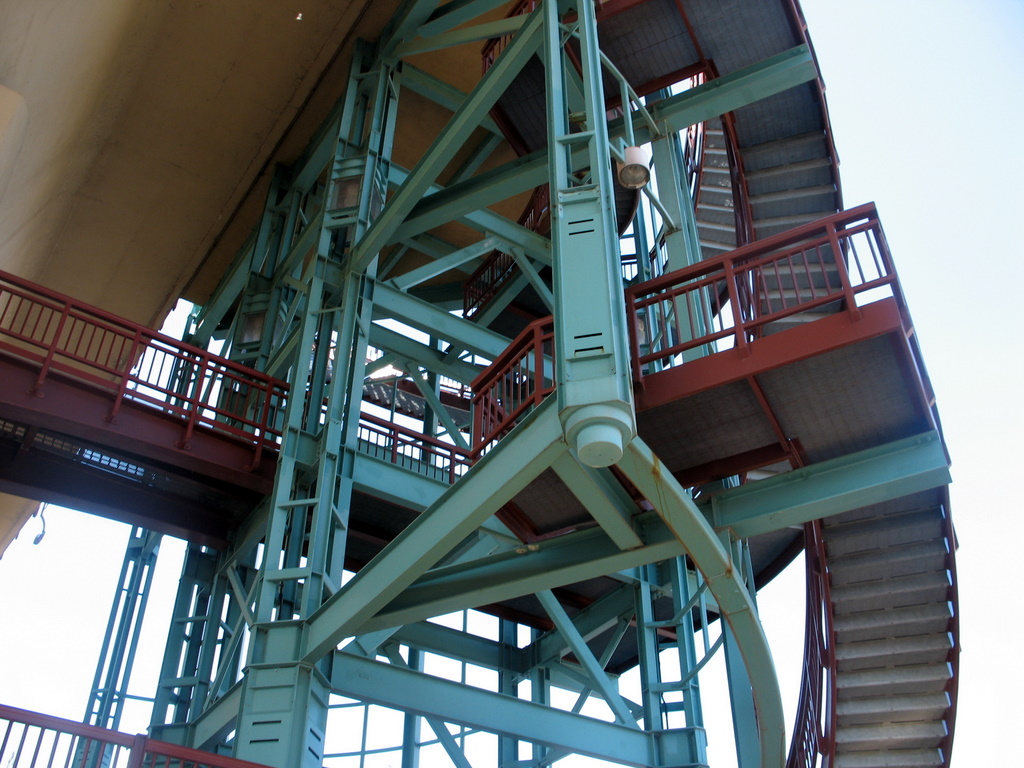
Plazas on both sides of the river allow lunch-time strollers to eat and ponder the river below them – watching the barges, the river birds, the activity down on the Harriet Island docks or the barge yards downstream.  And – a reprise of the old, 1880s-era bridge it replaced – there’s a stairway to take you down to the river…

…or at least Raspberry Island.

And it’s quite a climb:

And well worth it.

You get the sense that the river isn’t an annoying inconvenience, when you’re on or about the Wabasha Bridge.

It’s my favorite bridge in downtown Saint Paul…

…well, no.  Not quite.  But we’ll get to that.

Bridges of Ramsey County – The High Bridge

Thursday, November 29th, 2007

I’m going to skip the 35E River Bridge – officially the “Lexington” Bridge.  Who cares?

———-

After the 35W River Bridge collapse, Amy Klobuchar famously remarked that bridges just don’t fall down in America.

But if you read the history of the Smith Avenue High Bridge, you’d realize she should have added “But barely”.

First things first; when I show people the Twin Cities at night, there are two views that are were topmost on the agenda; the first was always Minneapolis, coming into town from the north on 35W at night.  The second, always, was downtown Saint Paul viewed from the south side of the High Bridge.  The vista of downtown in all its warm, brownstone glory is really stunning.

Like this view…:

…but at night.

Of course, to get to that view, you have to stomach a bit of history.  The bridge geek carries on:

Claim to fame: the ornamental iron work is made from iron salvaged from the old bridge that this bridge replaced. At 160 feet tall, it is the highest bridge in St. Paul.
The old high bridge was made of wrought iron, and opened in 1889.    

A storm in 1905 destroyed part of the bridge, which was rebuilt using mild steel.

It was a spindly looking structure that looked more like it was made out of metal toothpicks. The bridge closed in the 1980’s, and was imploded in 1985.

I moved to town not long after the old high bridge was demolished.  Now, moving from a part of the country where hardly anything was 100 years old, the notion of a working bridge being that old was kind of scary – especially when you actually got a look at the thing (and they are hard to find, although this neighborhood association page does have some photos of the old bridge – which does, indeed, look like one of those engineering-club toothpick projects).    

But the troubles weren’t over:

The new bridge opened in 1987, and was heralded as one of the seven engineering wonders of Minnesota. The huge steel supports under the bridge looked like a giant letter W, with the two bottom points sitting on piers, and the center forming a large steel arch.    

As soon as it got cold, the bridge contracted a little more than was planned, and one of the steel sections shifted, causing the center point of the W to no longer meet. Instead, the two beams shifted 11 inches, leaving a huge drop-off on the bridge. The bridge was closed several months while engineers designed a way to move the arches back into position and remove the ski-jump from the roadway.

Note to Amy Klobuchar; it wasn’t the Third World.    

Note to Nick Coleman; who was the governor in 1985?

I digress:

A newspaper account from January 22, 1962, states that a car left the old high bridge, landed upside down on a telephone line, was sprung back up into the air, and landed upright with no passenger injuries. I guess that is what makes winter driving so much fun in Minnesota.
Can’t vouch for the story, but if you’re afraid of bridges, the High Bridge – history aside – is a tall order to swallow.    

But wotta view.

As A Public Service…

Thursday, November 29th, 2007

…to the part of my readership that knits for fun, profit or enlightenment…

…I submit direct you here.

Don’t say I never did nothin’ for ya.

A Bridge Too Far

Wednesday, November 28th, 2007

I inadvertently published tomorrow’s “bridge” a day early.  Dang calendars.

All you High Bridge fans, tune in tomorrow.

Bridges of Ramsey County – The Fort Road Bridge

Wednesday, November 28th, 2007

The next bridge down the river is the Fort Road Bridge, best known as “the shortcut from Mitch’s place to the Mall and the Airport”.

I’ve kvetched in the past about the dubious aesthetics of bridges built during the Interstate Highway era, when the operating philosophy seemed to be “bridges should be un-noticeable”.  And as you saw yesterday, I do love the old, grand, monumental bridges from the twenties and thirties, when you knew you were on a bridge, and the bridge was damn proud of it.

The Fort Road bridge, through a combination of design philosophy and (one might suspect) Scandinavian penurity, though, is the most unprepossessing bridge around.  Indeed, it’s hard to know you’re actually on the bridge, if you’re focused on traffic (and one must frequently do that, since late rush-hour traffic coming to Saint Paul from 494 can clog the works up pretty easily). It’s actually hard to find pictures of the bridge online,and the bridge seems to blend pretty seamlessly into its surroundings.

And what surroundings.  Indeed, one can forgive this bridge for being such a non-entity; it’d be a shame to draw attention away from this particular part of the Mississippi gorge.  The bridge crosses at Fort Snelling, just upstream of Pike Island, one of the most gorgeous places in the Twin Cities.

So we’ll excuse the blah architecture.

But keep your eye on the damn road.

Bridges of Ramsey County – the Ford Bridge

Tuesday, November 27th, 2007

The next stop on my Lileks-like bout of architectural canoodling; the Ford Bridge. 

The Ford Bridge just screams “Saint Paul” to me. 

Completed in 1927, in the same general era as my other favorite Twin Cities bridges (the Central Avenue, Cedar, and Robert Street bridges), the Ford exudes art-deco. 

Let the bridge geek speak:

The Intercity Bridge [the Ford’s official name] is a reinforced concrete, open-spandrel, two-rib, continuous-arch bridge. Each of the three main arches has two five-centered ribs with a 300-foot span. The main spans are flanked by single arch spans of 139 feet each. The bridge is historically significant as one of the largest reinforced concrete bridges ever built in Minnesota and is a significant engineering accomplishment. The bridge is also historically significant as the major work of Norwegian-American engineer Martin Sigvart Grytbak. Although the deck was rebuilt and widened in 1972-1973, the bridge retains full engineering integrity as a monumental, continuous-arch bridge.

I grew up amid the last of the detritus of the Art Deco era; Popeye cartoons, my grandma’s toaster, the occasional thirties-era car that soldiered on in Jamestown, and (I swear I remember this) the odd old NRO poster stuck in the corner of someone’s garage.  So the Ford Bridge seems – familiar, almost?  Comfortable? 

The other impression you get – like with a lot of bridges from this era, when materials weren’t as strong and engineering was, while an exact science, very aware of its own limitations – is that it’s overbuilt. 

It’s graceful – not as clunky as, say, the Central Avenue Bridge in Minneapolis – but it still looks like a monument as much as a bridge.  It reminds you, in some ways, of the woodwork – hutches and buffets and bookcases – you find built into the houses of the era, with filigrees and ornamentation that nobody would design, much less pay for, in the dark ages of bridgebuilding that would follow a few decades later:

And of course, bridges were monuments back then; testimonials to the wisdom and foresight of the people who planned them, the skill of the designers and builders, and the power of a city that could carry people and traffic over a mighty river and a deep gorge, and do it in style. 

Intercity Bridge

You can almost imagine Al Capone in his O’Connor-era heyday, tooling across the Ford in a Dusenberg SJ (or so I imagine), snug in the knowledge that the St. Paul Police were covering his back, coming back from Lake Minnetonka to a party at the Saint Paul Hotel. 

It’s as a stop on a biking trip that the Ford excels, of course.  Although you’re in the middle of a major metropolitan area, you can stop at the peak of the Ford’s span, and look up the gorge and, with a little creative filtering (like, ignoring the few visible houses and apartments and the Minneapolis skyline six miles upstream, and the Ford Lock and Dam just downstream…), imagine the place as it was when the first US soldiers started building Fort Snelling in 1819, just a mile or two downstream. 

Bridges of Ramsey County – The Marshall/Lake Bridge

Monday, November 26th, 2007

I am a fourth-rate bar-band and karaoke singer. But I admire great singers, from Pavarotti to Allison Krause. I can’t do what they do (especially Krause, since I’m, like, a guy), but that doesn’t stop me from admiring it.

I’m a decent but not specacular guitar player. But I can watch a great guitarist – Richard Thompson, Steve Vai, Mark Knopfler, Eddie Van Halen, Chet Atkins – and be awestruck. I can’t play much of anything they do – my greatest achievement, so far, on the instrument is a pretty ham-fisted “1952 Vincent Black Lightning” – but I most definitely can admire what they do.

Now, I stank at math – I eked out a “C” as a Christimas gift in college pre-calc. And all of my artistic talent is either musical or literary; I am a less capable visual artist than anyone I know except perhaps Ken “Avidor” Weiner.

And it’s the area where math – science, really, and especially applied science in the form of “engineering” – meets applied art in the form of “architecture”, that’s been fascinating me lately.

I’m the only non-visual-artist in my family; my mom, my father’s parents, my brother and sister, and both of my kids are very talented at sketching, sculpture, painting, photography, what have you. It fascinates me. I admire it. I can’t even do it.

And while working at an awful temp job as a document coder at a “Litigation Support” company, I worked on a big lawuit involving a nuclear power plant. In reading and coding thousands of pages from among seven semi-trailers full of paperwork – four months of marinading my brain in the detritus of a huge engineering project – I got fascinated with the science and technique of making things that are physically improbable exist.

And for a while now it’s been bridges – the science and technique of moving people through the air over rivers, gorges, roads, and other things that are otherwise impassible, and the art of turning them into statements about the people who demanded, paid for, designed and built them – that’s fascinated me most. And that was even before the bridge collapsed.

So I’m going to drink a little of the Lileks Koolaid, and spend a couple of days writing about the bridges of Saint Paul, and what I think they have to say about their time and city.

Don’t like it? Scroll on.

———-

We’ll start upstream, at Saint Paul’s first bridge, the span connecting Marshall Avenue with Lake Street in Minneapolis.

It’s the new bridge, of course – it’s been in place for about fifteen years, and came at a fairly awkward time in bridge development, when architects were just starting to come out of the nightmare of the Interstate System years – when bridges were supposed to be simple, unobtrusive, functional, almost not exist from the traveller’s point of view. And, indeed, if you don’t look out your side window you might not notice you’re crossing one of America’s great rivers, but for the fact that the paving is a whole lot nicer than on either Marshall or Lake.

It replaced the classic old Marshall/Lake Bridge, the one that still stood when I moved to the Twin Cities and, occasionally, used it to get to my first decent job:

Image:Lakestbridge.jpg

Crossing the old Marshall/Lake bridge, you most assuredly did know you were suspended in the air high over a major river, trusting to the science and workmanship of engineers and ironworkers who had probably all died off by the time i was born. Biking up River Road (east or west), it was fascinating to look at that spider web of girders, transferring all of that weight to…

…that little, sunken man-made island in the middle of the river.

From this excellent guide to historic bridges:

Claim to fame: the old Lake Street-Marshall Avenue Bridge was one of the busiest two lane bridges in the US. The new bridge has the longest clear span of any bridge in St. Paul at 550 feet.

The Lake Street Bridge connects Lake Street in Minneapolis to Marshall Avenue in St. Paul. This was once a key river crossing in that it carried US-212, the main road between the twin cities. Even though I-94 is now the main highway connection between the two cities, the Lake Street Bridge still sees a large amount of traffic.
And it’s fun – twenty years later – to note how misplaced any concerns about the old guys’ engineering and workmanship may have been at the time:

The old Lake Street bridge needed to be replaced because it was obsolete…after the new bridge was completed, the old bridge needed to be removed. Crews set up explosives. After pushing the button, and the dust cleared off, the old bridge was still standing. It took a second effort with more explosives to bring the old bridge down a few weeks later.

I still miss that old bridge.

Next time – the Ford Bridge.

(more…)

Apropos Not Much…

Friday, November 23rd, 2007

…but this was something I hadn’t seen…

Thanks – The Roundup

Thursday, November 22nd, 2007

From the Speculist – more stuff to be thankful for:

The gift of gab could boost brainpower, new research suggests.A U.S. team found that talking to another person for 10 minutes a day improves memory and test scores.

They found that “socializing was just as effective as more traditional kinds of mental exercise in boosting memory and intellectual performance,” lead author Oscar Ybarra, a psychologist at the University of Michigan Institute for Social Research, said in a prepared statement.

In one investigation, they analyzed data on 3,610 people, ages 24 to 96.

They found that the higher their level of social interaction, the better their cognitive functioning. Social interaction included getting together or having phone chats with relatives, friends and neighbors.

I’m here to testify.

About this time fifteen years ago, after four years of working in bars and awful temp jobs, I got my first job around smart people that talked to each other. I could …

  1. …sense how atrophied my brain had gotten
  2. …feel it starting to stretch as I talked more with my co-workers.

More:

The good news:

We shouldn’t be surprised to learn that interacting with others makes us smarter. As pleasant as having a chat with a friend or co-worker may be, there is serious mental heavy lifting taking place every time we do it. Assuming we have a standard set of social skills in place, we are constantly checking in to see if the other party is still paying attention, is following what we’re saying, is not offended by what we’re saying, etc. Just sitting around and thinking — even thinking about some very challenging subject — could be relatively easy by comparison.

So we no longer have to worry that enjoying a chat is somehow a waste of time. It is mental time well spent.

I have to assume that blogging, and reading blogs is the same.

You’re welcome!

Moreover:

These findings have profound implications for office life. Now when the boss catches you and your buddies standing around the coffee machine chewing the fat and orders you to get back to work, you have the perfect response: “Ease up, there, Chief — we’re just sharpening our wits for the rest of the day’s work!”

It doesn’t work. Move along.

The good news? The article has much more to be thankful for. So go read it.

Back to cooking.

Clear As Snot

Wednesday, November 21st, 2007

Oh, I had to respond to this.  King Banaian – a college professor – wrote this:

Have you checked his Blog Readability? Go ahead, put the Berg blog in there and see what you get? Yes, Elementary School. Centrisity scores Junior High by comparison. All that pontification, all those twenty-years-ago-today piffle, and for what?

Yeah, what the hey, let’s go ahead and check that out:

cash advance

Get a Cash Advance

  Hm.  OK.  And SCSU Scholars?

cash advance

Cash Advance Loans

  Well, there’s a big jump!  Just for kicks, let’s try Powerline, Cap’n Ed and, say, Sheila O’Malley:

Powerline:

cash advance

Ed:

 cash advance

Sheila:

cash advanceGet a Cash Advance

So let’s get this straight:  Ed and I – the only two members of the NARN who’ve ever I written for non-academic, non-professional audiences (I as a reporter and writing instructor, both of us as technical writers) for a living, who are both trained in writing clearly and precisely (read: simply), along with Sheila, who’s a just-plain-great writer, scored “elementary school” level (i.e., simple and clear enough for pretty much any audience).  King – a capable writer, but mainly an academic – scored “junior high”, meaning more complex, ergo less clear.  In the meantime Powerline – who are lawyers, ergo trained in writing to obfuscate – scored “Post-Grad”. 

There are those who those – along with King – have tried to pass this off as a negative, or even an insult

Baloney.  Self-indulgent, gassy, bloated writing – the stuff my high school writing teacher used to call “EngFish”, because it stank like a rotting fish – is the easiest thing in the world (vide  a whole generation of business writers in this country).  Self-disciplined, simple, clear writing, on the other hand, is a goal to be sought out – among those who pay attention.

Which clearly leaves out economics professors and trial lawyers.

And how about Minnesota Monitor, City Pages and Norwegianity?

 The Mon

 cash advance

CP?

cash advance

The Wege?

 cash advance

This is getting fun. How about the Mole?

cash advance 

Good lord, how impenetrable must that be? How about The Dump?

cash advance

Huh. 

 Those of us who have the talent and self-discipline to write simply, clearly and directly should be are dang proud of it. 

Sign of Profound Hope

Tuesday, November 20th, 2007

Embedded in one of Michael Yon’s Dispatches from a few weeks ago,

A ping-pong fad is sweeping through Fallujah.[Official U.S. Marine Corps photo by Sgt. Stephen M. DeBoard]

This is a truly wonderful sign.  No people that genuinely appreciate Table Tennis – the king of sports – can stay in the wilderness for too long.

Read the rest of the post, if you haven’t already.

Bottoms Up, Kids

Monday, November 19th, 2007

Chad at the Fraters notes notes one of the things Europeans have consistently gotten right – drinking.  Specifically, drinking laws.  Chad notes the lethal effect (on few, but tragedy has no minimum threshold) of the 21 minimum age:

Instead of trying to come up with a largely arbitrary age (why twenty-one and not twenty or twenty-two?) when you let people drink legally, why not make it the same age that we legally consider people adults, eighteen? But instead of making it a milestone for being able to drink as much as you want, let’s return it to an event that carries with it added responsibility along with its freedoms.

You’re eighteen. It’s time to grow up and act like an adult. It’s time to be serious about your life. You can drink and have fun, but you’ll be expected to drink like a adult.

You can vote and join the military at 18; you can help determine this nation’s governance, operate a machine gun (in the military), become a cop in some jurisdictions, start training in any number of medical and emergency-response trades…

…but you can’t drink?

In Europe, the “forbidden fruit” aspects of alcohol just don’t exist – and the punishments for inappropriate behavior are sure and strict (you don’t want to get busted for drunk driving anywhere in Europe).  Sure, Italian and Scottish footie fans get drunk and obnoxious – but does anyone think that imposing and jacking up a drinking age would change that?

Part of this would involve introducing alcohol at an earlier age in controlled settings. There’s no reason a sixteen-year-old shouldn’t be taught how to enjoy a glass of wine or beer with the family at dinner. Alcohol shouldn’t be a taboo and drinking shouldn’t be all about getting loaded and acting stupid. Kids should be taught both the positive side and the peril of drinking. The message shouldn’t be all or nothing, that you’re either a teetotaler or an alcoholic. The path of moderation is one that far too few Americans discover until well past the time they should have.

What we’re doing now is clearly not working. You can further infantilize society by move the drinking age out again, you can prohibit people from drinking at midnight on their twenty-first birthday (as Minnesota does), and you can warn people all you want about the dangers of binge drinking. But until you change the culture of drinking in America and teach people how to drink responsibly before they reach adulthood, it’s not going to make a difference.

Chad is right.

On that anyway.  On the other hand (emphasis added)…

Eric Felten is a cocktail connuissuer

That’d be Connoisseur.  I mean, if you’re gonna be a foodie boozie, you’re gonna have to get that one straight, at least…

I’m all about the learning.

My Inner European

Tuesday, November 13th, 2007

Via John at Night Writer:

Your Inner European is Norwegian!
Dour and retiring on the outside, with an inner skraeling that is just dying to chop someone’s head off with a slash from your mighty sword. You put the “aggression” in “passive aggression”. You can be pushed,and pushed…to a point. Then, suddenly, bodies start turning up. You will feel guilty about it – mostly about enjoying it. Oh, well.

One Mystery Solved. One Mystery To Go.

Friday, November 9th, 2007

Since 1984, I have heard that in fact Big Country did do a video for my favorite song of theirs, “Where the Rose Is Sown”, from Steeltown (one of my ten favorite albums ever).

Well, thanks to the miracle of Youtube, I not only see that it did in fact exist, but was accompanied by a cool live vid of the title cut (and an atrociously-edited version of this classic homage to the Jacobites).

So the remaining question, really, is where on earth can a guy find a Yamaha SG2000?

Pulling The Wool

Tuesday, November 6th, 2007

As someone who’s been known to home-brew, I probably shouldn’t cock an eyebrow at people who shear and spin their own wool for knitting:

Hand-spinning is growing in popularity, especially among young people, said Natasha Thoreson of the Minnesota Weavers Guild (www.weaversguildmn. com) in Minneapolis. “We have quite a few members who start with the sheep,” she said, but most take advantage of the sheep farms that also sell cleaned wool, as well as a growing number of yarn shops that now sell roving — bundles of wool that’s been washed clean of lanolin and combed smooth, ready for spinning.

Thoreson said the guild can’t offer enough spinning classes to meet the demand. In addition, two weaving groups meet monthly to spin together.

For me, of course, the next obvious stop would be making my own gyros and souvlaki.

Excellence Rewarded, Assailed

Tuesday, November 6th, 2007

On the one hand, I always love stories like this –  about a couple of rural Wisconsin brothers who restore and replicate Civil War artillery for a living – for their own sake.

Civil War buffs say the Paulsons, 66, are among the nation’s pre-eminent restorers of antique cannons…”We’ve been building cannons longer than anybody in America,” Bernie says.

“We’ve seen them come, and we’ve seen them go,” Bruce says.

“Everybody wants to come in and make money, and then all of a sudden they don’t last,” Bernie says…In the 1960s, they started making historically accurate artillery pieces. Eventually, they sold their farm-machinery business to focus on Civil War cannons. 

I also like to ponder obvious offshoots of the stories – like “if the Hanson Brothers set foot on the campus of Hamline University, would they be arrested and held in a psych ward”?

One must ponder.

Mitch’s Christmas Shopping List

Tuesday, November 6th, 2007

Or maybe my next birthday present to myself

Attención, Cocinos Cubaños – Una Opportunidád!

Friday, November 2nd, 2007

Surely there must be some place in downtown Saint Paul that makes an edible Cuban Sandwich

 …mustn’t there?

Por favor?

Usually, About This Time Of Year…

Friday, November 2nd, 2007

…I’m telling y’all to get out to the Weblog awards to vote for Sheila O’Malley in the Weblog Awards’ “Best Literary Blog” contest. 

Well, she’s not in this year – but my old friend/adversary Erik Hare (AKA “Transit Geek”) is, for his litblog.

So give it a read, and if you’re so inclined, vote away!

To Know Me Is To Vote For Me

Wednesday, October 24th, 2007

This morning, commenter Angryclown noted in my piece on  my travels:

 Respectively, Mitch’s imagined Berg for America 2008 electoral map and the nations that would continue to have diplomatic relations with the U.S. under a Berg administration.

So I thought – I do tend to make a decent first impression on people.  So let’s say that that first impression COULD be turned into electoral gold; that if I run for president, every state I’ve ever visited would fall for my charms and give me an electoral plurality. 

I counted ’em up:

Mitch: 315

Non-Mitch: 223

I think the GOP’s choice is clear.

(Or, if we don’t count Nebraska, which I merely drove through, you can transfer five points.  But I think the ‘huskers are pretty sharp people, so let’s not go crazy here…)

Jarring Visions Are Made Of This

Friday, October 19th, 2007

Annie Lennox abandons stage in the face of a guy in a gas mask:

BOULDER, Colorado (October 18, 2007) – Popular singer Annie Lennox fled the stage when a man wearing a gas mask and cape appeared in the crowd towards the end of her set at Macky Auditorium on Tuesday.

Lennox spotted the man approaching the stage, tossed her microphone to the ground, and ducked backstage without saying a word to the audience. She describes the incident as “really freakish and disturbing” on her Blog.

To be fair to the guy, I thought the same thing about the video she did for “Sexcrime”

--> Site Meter -->