In the world of Rock and Roll, in the words of Neil Young, “it’s better to burn out than fade away”.
In the world of Bruce Springsteen’s music, when characters screw up, they flame out big-time – and usually take other people down with ’em.
In “Johnny 99”, from Nebraska, the protagonist – “Ralph” – gets laid off from a job at a car plant. He gets “too drunk from mixing Tangueray and Wine” – itself a major botch – and shoots a night clerk. It instantly changes his life; he goes from being a regular guy to a lifer overnight. His life is completely screwed, he declares as he’s sentenced.
Now judge I had debts no honest man could pay
The bank was holdin’ my mortgage and they were gonna take my house away
Now I ain’t sayin’ that makes me an innocent man
But it was more `n all this that put that gun in my hand
Well your honor I do believe I’d be better off dead
So if you can take a man’s life for the thoughts that’s in his head
Then sit back in that chair and think it over judge one more time
And let `em shave off my hair and put me on that killin’ line
Clearly, the character of Ralph/Johnny didn’t preconsider his actions according to the long-term consequences one might expect from them – but then if Mr. 99 had merely thrown up and gone to bed, the song would be a pretty mundane commentary on the human condition. People do act in ways that ignore their actions’ long-term consequences, in ways big and small, all the time.
And there’s the point.
Another of conservatism’s key tenets is the idea of prudence; a conservative measures actions against their likely long-term consequences, and tries to decide and act accordingly.
They also recognize – as Johnny 99 did not, until the end of the song – the consequences of failing at this.
And among the many reasons Springsteen’s music resonates with conservatives is that the characters, for decades, illustrated the princple, in ways positive and negative, in a way that sounds like…
True story – I was watching this video (embedding has been disabled, so you gotta click over) yesterday, probably about 2-3 hours before I heard that Dave Brubeck had passed away at 91. It’s jazz guitar great George Benson playing “Take Five”.
I’ve never been a huge jazz fan. Not quite to this level…:
…but it’s not like I’ve never felt that jazz, especially in its late-fifties bebop incarnation, was a self-indulgent, self-referential little musical ghetto that squares just weren’t intended to get.
Sort of like this:
But I saw Dave Brubeck in 1985 at the U of M. It was bebop, and very very very proficient…
…and unexpectedly human. Which was not something I’d expected.
“Take Five” was his biggest hit – selling a million copies, which was unprecedented in the jazz business:
Rock and roll has always been, ostensibly, about upsetting the existing order. In the beginning, its very existence upended what passed for “order” in popular culture, at least to the extent of helping create a “youth culture” – something that’d never existed before, and really started in America. As culture and the genre evolved through the sixties, pop music smeared itself in the “revolutionary” rhetoric of the rest fo the counterculture; in the seventies, the punk counter-counterculture (at least in the English art-school variety) flipped the hippies’ putative idealism on its head in an orgy of self-indulgent nihilism. Post-punks – U2 would be the most famous and enduring of the bunch) in turn, flipped that on its head in an welter of often self-righteous activism.
And against that backdrop, the music of Bruce Springsteen has always been refreshingly non-revolutionary. (more…)
It’s a little-noticed verse of a song buried in Bruce Springsteen’s biggest studio album:
Now, honey, I don’t wanna clip your wings
But a time comes when two people should think of these things
Having a home and a family,
facing up to their responsibilities
They say in the end true love prevails
But in the end true love can’t be no fairytale
To say I’ll make your dreams come true would be wrong
But maybe, darlin’, I could help them along
It’s from “I Wanna Marry You”, from The River. It’s a nice, simple, romantic little trifle. Given Springsteen’s personal life over the past 25 years, it’d be easy to call it “ironic”…
…but again, the series isn’t about any artist’s personal life, or personal beliefs. It’s about the resonances his audience finds in the music.
The next tenet of conservatism we’re covering is that conservatives adhere to custom, convention, and continuity (provided ones customs and conventions continue things that are worth continuing – which we’ll get to later on in the series).
And shelve the past twenty-five years of history – because this is about as customary, conventional and continuous as one gets:
Little girl, I wanna marry you
Oh yeah, little girl, I wanna marry you
Yes I do, little girl, I wanna mary you.
My daddy said right before he died
that true, true love was just a lie.
He went to his grave a broken heart
An unfulfilled life, darlin’, makes a man hard
No apple-carts upset here, right?
Of course, there’s a lot more to custom and tradition than that.
In the song “Darlington County” (from Born in the USA), a couple of ne’er-do-wells drive south to find a little work and raise a little ruckus:
Hey little girl standing on the corner,
Todays your lucky day for sure, all right.
Me and my buddy we’re from New York City,
we got two hundred dollars, we want to rock all night.
Girl you’re looking at two big spenders,
Why the world don’t know what me and Wayne might do
Our pa’s each own one of the World Trade Centers,
For a kiss and a smile I’ll give mine all to you…
At the end of the song, we find out how it went:
Driving out of darlington county
My eyes seen the glory of the coming of the Lord
Driving out of darlington county
Seen Wayne handcuffed to the bumper of a state trooper’s Ford
It’s comic trifle – the whole song is, really. But it hints at a theme conservatives believe as a part of being conservative; that the world has an enduring moral order. That there is a battle between right and wrong, Yin and Yang, good and evil – and that right and good are better, and should be exalted, or at least striven for.
“Wayne” ran afoul that order – with comic results, unless you’re “Wayne”, I suppose.
Before I get into the beef of the series, it seems I need to do a little remedial art appreciation, logic and rhetoric.
For starters, my thesis, and the case I’m making, is “Why Bruce Springsteen is America’s Greatest Conservative Songwriter”. Not “Bruce Springsteen is a Conservative”. He’s not. That’s all duly noted and stipulated in advance.
Not “Everything Bruce Springsteen Has Ever Written Resonates with Conservatives”. It does not. Merely most of his best stuff.
But as Socrates showed us a few millennia back, the best way to teach is to ask and to answer. In other words, it’s time for one of my Frequently Asked Questions:
“But Springsteen is a teh liberal!”: It doesn’t matter even a little. The series isn’t about him or his personal politics. They are, in fact, utterly irrelevant. Art is in the eye of the beholder. Many conservatives find resonance, even inspiration, in his music, though; this series merely explains why.
“But what if Teh Boss himself were to tell you you were wrong?”: Again, doesn’t matter. It’s not about him. It’s about what he wrote.
“What does Nate Silver say?”: Nothing.
“Don’t be teh smartass. You know what I mean. How can you empirically prove your thesis?”: There is no “empiricism” in art criticism. It’s stating a critical case for a subjective point.
“You are just trying to make teh music fit your intellectual template”: Nope. I’m stating a case for why the music not only fits my worldview, but reinforces it.
“But did you ever REALLY listen to it?”: As we’ll see in coming days, clearly, more than you have. Whoever you are.
OK. Wednesday or Thursday, we’ll get into the fun stuff!
There may be no more politically-divisive figure in popular music today.
On the one hand, he openly campaigns for liberal Democrats, and against conservatism, every election cycle. This earns the ire and contempt of many conservatives. And with a net worth of $200 million – four times Michael Moore’s portfolio – he’s the very definition of a limo liberal, even if his limo is a ’32 Ford with a 318, fuelie heads and a Hurst on the floor.
On the other hand, many of Springsteen’s highest-profile fans – Chris Christie, Tim Pawlenty, me, Laura Ingraham among many others – are one degree of conservative or another.
Now, part of that is no doubt purely visceral. Eddie Van Halen once said that rock and roll is supposed to make you feel something – angry, horny, lovelorn, whatever. And Springsteen is if nothing else an extremely gifted writer who has, for two generations now, had a gift for making people feel things – things that cross party lines, because they’re human reactions to art.
But many songwriters have that gift. And yet, in the face of perceived incongruity and even some muted, passive-aggressive hostility from the artist himself, conservatives soldier on as fans.
Why?
About a year ago a woman I know – a modestly prominent Democrat organizer – asked on Twitter “Don’t you Springsteen Republicans actually listen to his lyrics?”
To which I responded “Yes. Do you really LISTEN to them?” And by that I meant “without slathering your own worldview and ex-post-facto knowledge of Springsteen’s life and activities outside his music over the past ten years?”
Because as I started arguing a few weeks ago in response to MPR’s question on the subject “what song sums up where this nation is at right now?” (I answered with Bruce’s This Hard Land), Springsteen’s music, especially throughout his peak creative years (which I’d argue started with his collaboration with Jon Landau on Born to Run and ran through Tunnel of Love, and rebounded on The Rising) was overflowing with themes and currents and messages that resonate with political and social conservatives. And, in fact, those themes, currents and messages were the most important ones in his repertoire.
———-
“But wait, Berg – all you’re going to do is pound some isolated out-of-context odds and ends into a context you make up to define conservatism as conveniently as possible for your dubious premise! Right?”
Not even close.
I’ll be building this piece around a ten-point definition of conservatism from none other than that noted Paleocon tool, Andrew Sullivan who, back before his brain flitted away into Trig-Palin-triggered dementia, put together what I thought was a pretty good definition of a classical conservative:
According to Sullivan, the conservative…:
believes that an enduring moral order exists. Not an easy one, but an enduring one, anyway.
adheres to custom, convention, and continuity, barring any compelling reason to change.
believes in what may be called the principle of prescription – the idea that most of the great ideas on which our sociey was founded are good enough as is; improvement faces a steep curve.
are guided by their principle of prudence – we try to gauge actions against their probable long-term consequences.
believes that only true forms of equality are equality at the Last Judgment and equality before a just court of law.
believes human nature suffers irremediably from certain grave faults. Human nature is not inherently good.
believes that freedom and property are closely linked.
upholds voluntary community, quite as they oppose involuntary collectivism.
sees the need for prudent restraints upon power and upon human passions.
knows permanence and change must be recognized and reconciled in a vigorous society.
That’s a good definition of classical conservatism, from Hobbes and Hume all the way to Milton Friedman.
To that, I’d add some peculiarly American characteristics; here, a conservative believes…:
That while Humanity is not perfectable, and Americans – especially as acting through government – are far from perfect, America has coalesced into a nation around a set of ideals that are in themselves inherently noble and worth upholding.
That this nation – imperfect as it is – is a free association of equals, governed by mutual consent. Government is not a set of parents needed to discipline recalcitrant children.
I’ll be doing 2-3 of these a week for the next few weeks; showing in each case how and why Bruce Springsteen’s music (if not his personal politics, obviously) not only resonates with, but inspires, people who believe in all of the above.
So roll down the window and let the bracing wind of freedom blow back your hair! C’mon – rise up! We’ll meet beneath that giant “Friedman” sign that gives this shining city light!
Don’t end up like a dog that’s been beat too much, all you henpecked conservative Bruce fans; it’s a state full of lemmings, and we’re pulling outta here to win!
“Just sittin’ around drinkin’ with the rest of the guys
Six rounds bought, and I bought five.
Spent the groceries and half the rent.
I lack fourteen dollars of having twenty-seven cents”
— “Dang Me” – Roger Miller
My Dad had that song on a LP record album we played on the Hi-Fi in the living room. It just came up on the iPod again.
I’ve heard that song for 50 years and never understood the lyrics. Now I get it – he’s so broke from drinking with his buddies that he’d need $14.00 just to end up with 27 cents. Makes perfect sense when you see the lyrics written out. (My son the math major says that means he’s $13.73 in the hole but I never was good at story problems and besides, it doesn’t rhyme).
50 years to get a joke. I wonder what else I’ve been missing.
So after I wrote my piece on my suggestion that Bruce Springsteen’s “This Hard Land” was the song that best symbolized where America is at today, I actually got a call from ’em – they liked my submission, and interviewed me for the show.
It ran last night at 9PM – and it was a fascinating listen throughout. The MPR people did – and I mean no offense by this – a more balanced job than I expected. And the production job of getting my ten minute interview cut and pasted to slot into gaps in the song itself? From one radio production geek to another, well done.
Here’s the whole thing. I’m early in the second half of the show.
I’m around 34:30 into it, although the whole thing is worth a listen.
I’ve been doing this series of “Thirty Years Ago Today” anniversary posts about great music of the eighties for quite a while now.
Here’s the thing I’ve discovered in writing this series; for many of the records I’ve covered – The RIver, Shoot Out The Lights – it hardly seems like it’s been thirty years, since the records seem (to me, anyway) so very timeless; they’re no less a soundtrack in my forties than they were in my teens and twenties.
With others, though? They’re definitely archaeological artifacts; Boy, U2’s first album, hinted at greatness and timelessness to come, but it was very much a time capsule for an idealistic post-punk do it yourself world of music I craved being in at the time. Zenyatta Mondatta and Blizzard of Ozz seem like museum exhibits showcasing one of those rare times in music when pretty much anything went.
And it’s one of those latter that brings us to today’s anniversary. It was thirty years ago today Prince released 1999.
And it may have not only been one of the greatest albums of the eighties – but if you had to pick an album to serve as a time capsule of what The Eighties were, musically, you could pick a lot worse.
If you saw The Eighties as…:
an inflection point in R&B between the funk of the seventies and the hip-hop-inflected R&B of the nineties, 1999 was a key turning point. While there was no hip-hop on the album – the term was still on the fringe of pop music culture in 1982 – 1999 linked the big-funk-band ’70s with the technology-driven groove that has dominated R&B for the past twenty-odd years. Listen to “DMSR”, and tell me that’s not made for sampling.
an era driven by unprecedented change in music technology: In spades. There’d been synth-pop albums before 1999; there’d be many after. But when it came to integrating bleeding-edge technology (synths, a top-of-the-line Linn drum machine) with tradition (Prince’s signature Hofner guitar, a cheapo knockoff of a Fender Telecaster), 1999 was the gold standard. Listen to “Let’s Pretend We’re Married”, or the title cut, for two of the most glorious melanges of style…ever!
a period of glorious intermingling between “black” and “white” music: There’s a story – possibly apocryphal, although I remember it came from a decent source back (koff koff) years ago – that John Mellencamp, who was just starting to wiggle his way toward critical respectability, came out to do an encore at a show, carrying a boom box. As the story goes, he said “This is a great rock and roll song”, held the boom box up to the mike, and played “Little Red Corvette” for the audience. This was kind of a big deal for me; you didn’t get exposed to a lot of “black” music in rural North Dakota in those days. And learning from Mellencamp (for whom I didn’t much care at the time) that there was in fact a link between R&B and R&R kicked loose a brick in my mind that got me thinking, and sent me – thirty years ago this coming winter – into the back room at the radio station I was working at, to dig out some old Motwn records and start piecing together the great rock and roll tradition for myself.
Minneapolis’ musical glory days: this was the album that blasted the Twin Cities onto the musical map.
It’s all of that. And it was anything but timeless; how many albums give themselves a shelf-date? The world didn’t end in 2000; everyone had a bomb but we all didn’t die any day, not yet. “Tonight I’m gonna party like it’s 1999” is a statement of ironic nostalgia.
I got an email from MPR the other day. It was actually a combo email from MPR News and “The Current” asking what song we thought best summed up the state of the nation during this election season.
I wrote back with my suggestion – a song that has layer upon layer of significance to our nation, our society, our zeitgeist and the election itself. A song that’s all about dreaming a big dream, and having those dreams run up on the rocks, and hitting that moment where you have to think “was that a dream or was it a mirage?”. A song about that moment when you have to decide – do I drown, or do I sack up and carry on?
A song about truth and consequences. A song that, on a work week after a long trip across the prairie, reminds me of the huge swathe in the middle of this country, the square states full of bitter gun-clinging jebus freaks like me that are, in fact, my home and background and blood and my past. And that is, with a blessing and a tailwind, may be our nation’s future.
The song is “This Hard Land” by Bruce Springsteen.
It’s a song he wrote during a John Steinbeck jag, for Born in the USA, and that should have been on the album (be honest – would anyone miss “Downbound Train?”) and was in its day one of the most sought-after bootlegs in Springsteen’s oeuvre.
So many layers to this song, and to the reasons I chose it.
First verse?
Hey there mister can you tell me what happened to the seeds Ive sown
Can you give me a reason sir as to why they’ve never grown
They’ve just blown around from town to town
Till they’re back out on these fields
Where they fall from my hand
Back into the dirt of this hard land
Thomas Hobbes, the 18th-century British intellectual who was one of the patron saints of conservatism as we understand it today, couldn’t have expressed better the fundamental conservative ideal that “life’s a bitch”, that there are forces that are bigger and more powerful than men and their dreams.
But well return to that.
Now me and my sister from germantown
We did ride
We made our bed sir from the rock on the mountainside
We been blowin around from town to town
Lookin for a place to stand
Where the sun burst through the cloud
To fall like a circle
Like a circle of fire down on this hard land
America is a land of myths. Mostly big and glorious ones – like the ones that drew our forefathers, like the singer and his sister, from their old homes, the Germantowns and Norwayvilles and Saigon Centers, to This Hard Land. Much of what America sees as its own self-image – whether the wilderness of the Badlands or the wilderness of the tradiing floor or the inventors garage or the moon or the neighborhood or the entrenched beliefs of the human heart – is about the epic American dream of going where your ancestors have never gone before, of being something they weren’t.
And over the past seventy years, it’s become about the marketing of those dreams, whether via John Wayne or “Hope and Change”.
But like all dreams – and their cousins, the myth and the chimera – they run afoul a brutal reality:
Now even the rain it don’t come round
It don’t come round here no more
And the only sound at nights the wind
Slammin the back porch door
It just stirs you up like it wants to blow you down
Twistin and churnin up the sand
Leavin all them scarecrows lyin face down
Face down in the dirt of this hard land
The prairie is dotted with the remains of old farm homes from families that just didn’t make it, flindered remains of their back doors still slamming in the wind. Just as America is dotted with businesses that tried and failed, leaving behind empty buildings, rusty frames, doors drifting back and forth in the desultory breeze. And yes, the wreckage of government initiatives like the one that’s dominated our political life this past presidential term, a dream – a chimera from a brief majority four years ago – of an undertaking that, despite the fervency of its dreamers’ beliefs, has failed as completely as the sodbuster in the song. Whether through poor design, or being in the wrong place at the wrong time, or being fundamentally wrong or – like the singer and his sister – just from suffering a bad run of luck in the face of a merciless and uncaring Nature, all of human existence is a tough grind dominated by forces we don’t, by ourselves, control.
Being human, we attempt to control them anyway – to bring order to the chaos, and to tame the untameable:
From a building up on the hill
I can hear a tape deck blastin’ “Home on the Range”
I can see them Bar-M choppers
Sweepin’ low across the plains
Its me and you, Frank, we’re lookin for lost cattle
Our hooves twistin and churnin up the sand
Were ridin in the whirlwind searchin for lost treasure
Way down south of the Rio Grande
Were ridin cross that river
In the moonlight
Up onto the banks of this hard land
It’s human nature to try to bottle up and contain Nature, whether the nature around us or the nature inside us.
And it’s one of the great dividing lines in human nature, the one between those who are content for their “home on the range” to come recorded, to have the almighty Bar-M or The Almighty or The One out looking for the strays, for those who are just fine being “Julia“…
…and those whose dreams, or mirages, embrace the chaos that ensues where life and Nature, natural and human, are in conflict.
And the last verse is for them:
Hey frank wont ya pack your bags
And meet me tonight down at liberty hall
Just one kiss from you my brother
And we’ll ride until we fall
Well sleep in the fields
Well sleep by the rivers and in the morning
Well make a plan
Well if you can’t make it
Stay hard, stay hungry, stay alive
If you can
And meet me in a dream of this hard land
Whether it’s the pioneer seeking more elbow room from all the other settlers and their choppers and tape decks, or from bouncing back from a failure, or a big part of a nation taking a deep breath and saying “this is not the path we want”, or, I dunno, Atlas shrugging for all I know, this verse – with allusions to Okies loading up their trucks and bidding their relatives goodbye, or immigrants climbing on the boat and wishing their old lives auf wiedersehen, or men kissing their wives and kids and mustering down at Liberty Hall as the drums and the hobnails rattle on the wind, or a people saying “thanks, Julia, and all the best to you and that mysterious niece and/or nephew that appeared a few frames back, but I’m looking for something a little more…epically mythical” – is the American myth; the idea that we are a restless pack of strivers looking for a newer, better, freer horizon.
Beyond that, in terms of politics today? Every generation dreams of leaving a better world to their kids, as I do for my kids and my new granddaughter. We have a distinct chance, as things go, of leaving them a world that my ancestors in the Dust Bowl would look at and whisper “there but for the grace of God…”. And unlike the the Okies, our immigrant forefathers and protagonist in “This Hard Land”, this time there’s noplace to ride away to to start over. We’re stuck with this hard land.
For me, the song also is further evidence that Springsteen – my favorite American R&R songwriter since Johnny Cash – is America’s best conservative songwriter. Looking at his prime output from the height of his muse, there’s a case to be made that once you peel off the rhetoric and the Hollywood and the political dross of the past decade, his music was fundamentally conservative. And I’ll make the case, since American conservatism’s most important non-electoral mission is to engage in this nation’s larger non-political culture.
More on this after the election.
Anyway – ask a question, you’ll get an answer. Usually.
UPDATE: Hobbes, not Hume. Sigh. It’s been a few years.
…than European liberals writing about American culture. It’s always a smorgasbord of stereotypes – both the stereotypes they see and write about, and the ones they themselves exhibit.
And yet mixed in and among all of that is a great look not only at King’s life – he’s 87 – and the South he came from as it’s evolved over his lifetime, but there are even a few looks into how he became the guitar player he’s been for all these years.
It’s more or less in sync with the upcoming release of the documentary The Life of Riley, about King’s life and impact on music (King’s birth name was Riley B. King). And that, I need to see, wherever it shows in the Twin Cities.
Yes, today is One Hit Wonder Day, perhaps the only “Hallmark holiday” in which the honorees are denigrated as much as celebrated, victims of that peculiar human tendency to put folks on a pedestal and relish knocking them down.
As if any of us could make a song — just one — embraced by millions.
Well, it’s fun to think about.
I’ve always loved one-hit wonders – little snippets of musical history cast out into the ether, there to rattle around on late-night AM airwaves and trivia contests and “where are they now” shows.
It was one of those moments when I looked at the musical hipsterism of my twenties, and at the just-plain-fun of not being a hipster, and decided that fun was, well, more fun.
It was twenty years ago today that New Miserable Experience by the Gin Blossoms was released.
“Oh, gawd, the Gin Blossoms”, say my hipster friends. At least, that’s what they said back then – because the Gin Blossoms committed the one unpardonable sin if you were a hipster; after starting out as a scrappy little garage band playing to their drunk friends in the Phoenix/Tempe area, they made it big. Unlike their Phoenix hipster-band contemporaries the Meat Puppets and the Refreshments, they m ade it very, very big.
And there’s nothing hipsters hate more than “their” bands getting heard by millions of not-so-hip people.
And why not?
Lots of video, so I’m putting most of the article after the jump, so the rest of the page can actually load in a reasonable amount of time.
In my never-ending quest for new music, I’ve been trawling through the seventies.
And finding some interesting stuff.
For example – I’ve always known Stevie Wonder was an amazingly talented guy. A top-notch multi-instrumentalist and one of Motown’s greatest talents from the sixties to the eighties, and – this is rare – an artist whose “mega-sales” period came after he’d been an artistic trailblazer for a couple of decades, he’s one of those musicians who I just know I’m supposed to like.
As, indeed, I do – having worked at a slew of oldies stations during my radio career, I always liked his Motown output, as well as his stuff from the early to mid seventies – at least, the stuff that made it on the radio. And that’s all notwithstanding the fact that by the time I discovered him he was well into the least interesting but by far most profitable part of his career – his “Ebony and Ivory” / “That’s What Friends Are For” / “Part Time Lover” phase of his career.
So poking around the web the other day, I found this; a mini concern from French TV from 1974, when Wonder was 24 and had already been a star half his life. It bounces around through a bunch of styles, jams a lot, and is…
…well, just listen.
By the way – the black guy with the Les Paul? That’;s Ray “Who Ya Gonna Call?” Parker, Junior.
Mr. Yauch, who went by the moniker MCA, had been battling cancer since 2009, when a tumor was discovered in his salivary gland. He did not come to the Beastie Boys induction into the Rock and Roll Hall of Fame in April and his treatments for the illness forced the group to delay the release of their last album “Hot Sauce Committee, Pt. 2.”
Emerging from the hard-core punk scene in New York in the late 1970s, the Beastie Boys were the first white group to successfully sing rap songs and have remained popular for more than a quarter century. Mr. Yauch co-founded the group with Mike Diamond (Mike D) and Adam Horovitz (Ad-Rock) as a punk band in 1981 and first began experimenting with hip-hop the following year, when they released a 12-inch vinyl rap spoof “Cookie Puss.” All three were teenagers from affluent New York families when they met.
But in 1986, they crossed into the rap mainstream with “Licensed to Ill,” which was the first hip-hop album to hit No. 1 on the albums chart and featured hits like “(You Gotta) Fight for Your Right (to Party)” and “Brass Monkey.” It was just the first of a string of hit records, like 1989’s “Paul’s Boutique,” 1992’s “Check Your Head” and 1994’s “Ill Communication.”
And the fun times from my twenties just keep on passing along.
And even that’s not quite right – I favor it for every reason but one – the inevitability that an innocent person will, between human imperfection, the politics of the prosecution system, bad defense, the emotions of death-penalty cases and just plain bad luck, be executed.
I first started this series, “The Real Eighties”, at a time when I was getting fed up with my kids’ schools throwing “Eighties”-themed parties that went as deep as “Flock of Seagulls”, Members Only jackets, and “Walking On Sunshine”.
And I’ve written about an absolute ton of music in this past three years. Check it out for yourself. And there’s a bunch more to come.
But the original motivation for the entire series was my inner monologue responding to some bobblehead who’d sniveled that “eighties music was so stupid”.
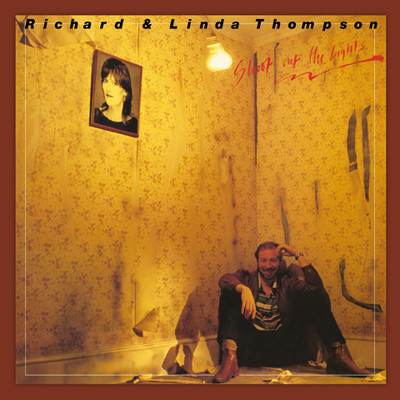
And I thought “then you haven’t heard Shoot Out the Lights, by Richard and Linda Thompson which, as it happens, came out thirty years ago today.
And that day, June 8 of 2009., I started the whoooole three year long series by starting the article you’re reading. This piece has been sitting on the schedule for 33 months, now.
Just saying.
———-
Rock and roll is full of breakup songs; boy meets girl, boy gets girl, boy loses girl, boy pines for girl.
What rock and roll is not full of is music that slices into the bloody mess when the real, true love of one’s life slowly erodes, and then quickly collapses, into a mocking ruin.
There’s a reason for that; it’s easy to write breakup songs. Breakups come and go; they’re the stuff of a million songs.
But music about the breakup of a relationship with some mileage – marriage, children, commitment, a shared body of life’s work? Not so much. The pain doesn’t lend itself to three chords and a hook line – and the pain and loss is just the beginning, leading to layers of recrimination, crippling self-doubt and worse.
It was thirty years ago today that Richard and Linda Thompson released “Shoot Out The Lights”.
The album and attendant tour happened as the couple’s nine year marriage spiraled into the toilet; by the time the album was released, The couple – who’d met in one of the middle incarnations of the classic British folk-rock band Fairport Convention, of which Richard was a founding member – had put out five albums before. All were commercial outliers and critical blockbusters, capped by 1974’s I Want To See The Bright Lights Tonight, generally regarded as one of the great accomplishments of either of their careers.
The previous year had been a period of immense stress; the Thompsons’ marital breakup was exacerbated by professional turmoil; they’d been released from one minor-label contract, had recorded an entire album floated by Thompson’s friend, the late Gerry Rafferty, a process that led to the end of the guitarists’ friendship. But in the aftermath of the Rafferty fiasco, the Thompsons – their marriage foundering, with Linda pregnant with the couple’s third child – went into the studio with producer Joe Boyd, and produced an album that was…
…not about marital discord. So they said. And that’s been their story for thirty years, and they’ve stuck by it religiously.
And yet there are mixed messages, as the album ping-pongs between the battlin’ Thompsons. The album opens with “Don’t Renege On Our Love”
Remember when we were hand in hand?
Remember we sealed it with a golden band?
Now your eyes don’t meet mine,
you got a pulse like fever.
Do I take you for a lover, or just a deceiver?
Well simple is simple and plain is plain,
if you leave me now, you won’t come back again.
Don’t renege on our love, don’t renege on our love…
z
(Pardon the terrible sound quality)
It was followed by Linda’s “Walking On A Wire”:
I hand you my ball and chain,
You just have me that same old refrain.
I’m walking on a wire, and I’m falling…
Too many steps to take, too many spells to break,
too many nights awake and no-one else.
This grindstone’s wearing me, your clothes are tearing me,
Don’t use me endlessly,
it’s too long, too long to myself…
Where’s the justice, and where’s the sense?
When all the pain is on my side of the fence,
I’m walking on a wire, and I’m falling…
The songs bounce back and forth, each of them a subtle nuance on the theme, each a classic in its own way; Richard’s bouncy, funny ode to crushing frustration “A Man In Need” led to LInda’s gaunt “Just The Motion“…
When you’re rocked on the ocean, rocked up and down , don’t’ worry
when you’re spinning and turning round and round don’t worry
’cause you’re just feeling seasick, you’re just feeling weak,
your mind is confused and you can’t seam to speak,
it’s just the motion,
it’s just the motion…
…about the seasickness that comes from having your world completely submerged in stress.
There are two observations you can make about Shoot Out The Lights. For starters, Richard Thompson is the world’s greatest living guitar player. No, I know – you’ve got your Steve Vais and and your Yngwie Malmsteens, and they’re all great – but nobody on the planet teases the warped psychological nuance out of a Strat plugged into a Twin Reverb like Thompson, as here on the album’s brutal title cut…:
…with the same version of the Richard Thompson Band I first saw at First Avenue in 1986, with the lovely Christine Collister filling the Linda role.
The other? That was a harrowing dissolution – as you read between the lines of the so many songs, especially Linda’s “Did She Jump (Or Was She Pushed)”. I can’t find a video with Linda – but Richard does it great justice:
There’s enough cheating hearts to sink a hundred country western albums; enough emotional shrapnel to make Robert Smith say “sack up buddy”, were it not delivered with either a nudge or a keening wail…
…or with “Wall of Death” capping the whole thing off.
It’s nothing as trite as “It’s better to have loved and lost than never loved at all”…
Let me ride on the Wall Of Death one more time
Oh let me ride on the Wall Of Death one more time
You can waste your time on the other rides
This is the nearest to being alive
Oh let me take my chances on the Wall Of Death
…but it’s in the ballpark.
If you don’t own a copy, it’s an injustice to music.
To: Bruce Springsteen
From: Mitch Berg, Once And Always Fan
Re: Janteloven.
Mr. Springsteen,
I’ve been a huge fan since I was a kid. Since before I became a conservative, even.
When you’re a conservative Springsteen fan, you get used to the occasional churlish phumpher from some ideology-addled lib scold; “have any of you actually listened to Springsteen’s lyrics?” To which I reply “yes – in a level of detail people like you only devote to stalking Michele Bachmann. My question for you is, have you actually listened to the lyrics, especially on his first five or six albums, without passing them through your PC filter?”
They rarely answer.
But the fact remains that you, starting in about ’84, but escalating since 2004, have been slathering yourself and your music with politics – which, like most showbiz-lefty politics, is showy, shallow, shrill, and skin-deep.
Like in your conversation with a Swedish radio station recently. Tim Blair writes:
The Boss goes all svag and hopplöst:
Bruce Springsteen wants to see the United States transformed into something closer to a Swedish-style welfare state, the rock legend said Thursday …When asked if he thought the United States should be changed into something closer to a Swedish-style welfare state, Springsteen responded enthusiastically …
Now, whenever “Springsteen music” comes up in conservative circles – as in Blair’s comment section – you get a slew of standard responses; “haters”, I believe the kids call ’em today. You hear a lot of the same lines over and over:
“Springsteen’s music sucks!” – Well, there’s no accounting for taste as a general rule, but…no. That is objectively, empirically, physically false.
“He’s got no talent” – Wrong again. He’s a great guitar player, one of the greatest songwriters of the rock and roll era (only Lennon/McCartney, Jagger/Richard, Leiber/Stoller and a few others come close to the impact he’s had, commercially and artistically). And you just try to arf out a tune, much less in tune, during a three-hour concert, even in your thirties, much less when you’re over sixty, like Bruce, much less without stripping your vocal cords bare and shooting them out your mouth with his “all lung-power” vocal technique? You can’t do it, whoever you are. No. You can’t. Any of those are talent. Together, they an amazing combination.
“Sprinsteen’s politics are dumb, and he should just shut up and sing” – Well, OK. Now we’re getting somewhere.
Good example? Blair points out Bruce’s paean to the fleabaggers:
It’s impossible to know what young Bruce would have made of the Occupy movement, but old Bruce is down with the deadbeats:
“The temper has changed. And people on the streets did it. Occupy Wall Street changed the national conversation …
“Previous to Occupy Wall Street, there was no push back at all saying this was outrageous – a basic theft that struck at the heart of what America was about, a complete disregard for the American sense of history and community.”
Springsteen is worth four times as much as Michael Moore, and he’s still bitching.
Sigh.
It is a simple fact that the “Holy Trinity” – Born to Run, Darkness on the Edge of Town andThe River – are three of the greatest albums in the history of rock and roll. There is no rational way of denying that. Absolutely incandescent albums, crammed with moments that grab me and tens of millions of other people right in the liver, sometimes sending a shiver up my spine, others a smokey glimmer of understanding. And not a partisan political moment in the bunch. Not that that’d matter, necessarily – although they’d be a tangent that’d really make no sense on any of the records. I mean, would “Backstreets” have been a better song had the estranged lovers been driven apart by evil capitalists? Would “Rosalita” have been better if Bruce had gotten a big advance from the Carter campaign instead of the record company? If what (what) Candy (Candy) wanted (wanted) was (was) his talking points list?
Of course not.
And Nebraska, Tunnel of Love, The Rising and The Wild, The Innocent and the E Street Shuffle are all wonderful in their own right, full of things – stories, lessons, hooks, characters – that have accompanied me through good and bad times throughout my entire adult life, from junior high through 9/11.
And nothing’s going to change that.
But in your own amiably earnest way, you are turning into a thinner, less-grim, less-outrageous, but vastly wealthier Michael Moore.
It’s the dirty little secret for conservatives who are Bruce fans: the more into politics he got, the less interesting his music became. Born in the USA was…good, with a few great moments. The relentlessly-political Ghost of Tom Joad got tiring. And his work since The Rising? Kinda rote and not that interesting, musically or thematically.
Ah. Bruce. Sorry you’ve gone off the rails. We’ll always have the Holy Trinity.
I’m going to take a moment out from politics to wish all the best to Slim Dunlap, long-time Twin Cities music fixture and guitarist for the Replacements, who suffered a stroke yesterday morning:
Dunlap performed with the Replacements from 1987 until their breakup in 1991, filling in for guitarist Bob Stinson after he left the group, and went on to release two solo albums, The Old New Me and Time Like This.
The title track for the latter release is serving as a bittersweet comfort for friends and fans reeling from the news of his illness this week.
3mg2BPGZZce5pw~~60_35.JPG)

 And it may have not only been one of the greatest albums of the eighties – but if you had to pick an album to serve as a time capsule of what The Eighties were, musically, you could pick a lot worse.
If you saw The Eighties as…:
And it may have not only been one of the greatest albums of the eighties – but if you had to pick an album to serve as a time capsule of what The Eighties were, musically, you could pick a lot worse.
If you saw The Eighties as…: