Archive for the 'Memoriam' Category

Harmon Killebrew

Tuesday, May 17th, 2011

The smell of fresh-cut grass.

A whiff of the “hops” from my Dad’s freshly-opened Hamm’s, and the smell of baked beans coming from the kitchen.

That hot-tar smell you get in small towns on brutally warm days, when the sun’s been beating down all day – hot tar and dust from the alley, mixing with lilacs from the back hedge as the day finally starts to cool down.

And the crackling from Dad’s old portable transistor radio, as Herb Carneal called a Twins game on WCCO (rebroadcast on KEYJ), calling out names I can still practically recite in batting order; Rod Carew, Tony Oliva, Bob Allison, César Tovar, Jim Holt, Greg Nettles, Leo Cardeñas…

…and of course Harmon Killebrew.

All, each of them inseparably, are part of remembering summer when I was a little kid.

Killebrew, the Twins’ first Hall-of-Famer, as you’ve heard, passed away this morning at age 74.

RIP Elizabeth Taylor

Wednesday, March 23rd, 2011

Elizabeth Taylor has reportedly passed away.

I don’t have much to write about her; tune in to Sheila O’Malley over the next few days, she’ll no doubt have a barn-burner of a post.  Or ten.

For my money, my favorite was her turn in Zeffirelli’s 1967 adaptation of Taming of the Shrew.

The Last Doughboy

Tuesday, March 1st, 2011

Frank Buckles – the last surviving American veteran of World War I – has rejoined the rest of his comrades.  He passed away yesterday, age 110.

Buckles, who also survived being a civilian POW in the Philippines in World War II, died peacefully of natural causes early Sunday at his home in Charles Town [West Virginia], biographer and family spokesman David DeJonge said in a statement. Buckles turned 110 on Feb. 1 and had been advocating for a national memorial honoring veterans of World War I in Washington, D.C.

There are two known WWI survivors left in the world; an Australian man and a British woman, 109 and 110 respectively.

Buckles in 1917 and 2007 - via NBC

Buckled certainly had an action-packed life:

Buckles served in England and France, working mainly as a driver and a warehouse clerk. The fact he did not see combat didn’t diminish his service, he said: “Didn’t I make every effort?”

An eager student of culture and language, he used his off-duty hours to learn German, visit cathedrals, museums and tombs, and bicycle in the French countryside…

…In 1941, while on business in the Philippines, Buckles was captured by the Japanese. He spent 3½ years in prison camps.

“I was never actually looking for adventure,” Buckles once said. “It just came to me.”

I’d often wondered; what must it be like to be the last of…any group, much less a group of nearly five million?

“I knew there’d be only one (survivor) someday. I didn’t think it would be me,” he was quoted as saying in recent years.

RIP, Frank Buckles.

Dick Winters

Monday, January 10th, 2011

Dick Winters, the Pennsylvania Quaker who became famous later in life as the commander of E  Company/506th Parachute Infantry (and later of the Regiment’s 2nd Battalion) in Stephen Ambrose’s Band of Brothers, and the eponymous TV series, has passed away:

Dick Winters led a quiet life on his Fredericksburg farm and in his Hershey home until the book and miniseries “Band of Brothers” threw him into the international spotlight. Since then, the former World War II commander of Easy Company had received hundreds of requests for interviews and appearances all over the world.

And the Greatest Generation got a lot smaller.

The Winters that came through in the book and miniseries was an estimable person:

Ambrose, the author of “Band of Brothers,” said in a 2001 BBC interview that he hopes young people say. “I want to be like Dick Winters.”

“Not necessarily as soldiers, but as that kind of leader, that kind of man, with basic honesty and virtue and an understanding of the difference between right and wrong,” Ambrose said

I had a chance to meet Herb Suerth – who was a driving force beyind getting the original veterans together for Stephen Ambrose’s book – last fall.  He’s one of two of the company’s 37 survivors living in Minnesota (Frank Soboleski lives in International Falls).

She Could Do It

Friday, December 31st, 2010

Geraldine Hoff Doyle, the woman on whom the iconic World War 2 home-front “We Can Do It” poster and template for the “Rosie the Riveter” image was reputedly modeled, passed away today.  She was 86.

She didn’t know it at the time, of course; she’d had a still snapped for a news story by an AP photographer, and the wartime art machine took it from there.

Doyle didn’t realize she had a famous face until she was flipping through a magazine in 1982 and spotted a reproduction of the poster, her daughter told The New York Times.

It’s good to remember sometimes that the name “Rosie” used to mean “the Riveter”, rather than “O’Donnell”.  If there’s justice, maybe it will once again.

Conlon Arrangements

Wednesday, December 15th, 2010

I’ve had a few people ask: the memorial service for Tom Conlon will be 2pm this coming Monday, December 20th, at Saint Louis King of France Catholic Church in Saint Paul.

The Saint Paul Republicans are throwing an Irish Wake on Sunday from 4-8pm at – where else?  – O’Gara’s Bar & Grill, at Selby & Snelling in Saint Paul.  The event promises “Irish music, laughter, reminiscing and sobbing provided”

RIP Tom Conlon

Monday, December 13th, 2010

It’s been a big week for awful news.

Tom Conlon – for many years, the only elected Republican official in any capacity in Ramsey County – died on Sunday:

Police were called to the 2100 block of Berkeley Avenue, where Conlon lived, about 5:55 a.m. Sunday.

A neighbor and a snow plow driver saw Conlon shoveling out his car in front of his home about 5 a.m., said St. Paul police spokesman Andy Skoogman.

“It appears that he got into his car and likely had some type of medical issue,” Skoogman said. Conlon’s car was found crashed into a snow bank on the block.

He’d been teaching at Metro State, and mounted a brief run for State Auditor earlier this year.

These memorial pieces I write are usually somewhat detached, third-person things.  Not so with Tom.  This time it’s personal. 

Tom was a sharp-as-nails politician – can any other kind get elected as a Republican in Saint Paul?   He was a genuine, nice guy in person.  His low-key manner disarmed you, – he was a sharp, savvy guy who, above all, exuded love for his community.

A graduate of Harding High School, he served a hitch in the United States Marine Corps’ 11th Marine Regiment.  Which led to the one big incongruity in Conlon, from what I saw.

No, it wasn’t incongruous that he served his country with pride, of course – that fit perfectly.  But I don’t imagine that anyone could ever imagine Conlon, even the 18 year old version of him, making a “war face”.  The guy always had a smile for everyone.  Even during the most byzantine school board debates with his most whackdoodle colleagues, Tom kept not only his cool, but his smile.  Or one of them.  He had a bunch; the broad “glad to meet you” smile, even if you’d met him a hundred times; the wry “there you go again” smile that’d pop  up when one of his colleagues was expounding, and more.

Tom was a  very talented photographer – I had him penciled in to do my daughter’s senior pictures.

I last talked with Tom three weeks ago, at a CD4 fundraiser.  He’d been eyeing running for School Board.  The SPPS desperately needed him back on the board.

Rest in peace, Tom Conlon.  This city is a worse place for your passing.

Malcolm McLaren

Friday, April 9th, 2010

Malcolm McLaren, punk-rock impresario behind the Sex Pistols, dead at 64.

McClaren’s longtime partner, Young Kim, said “He was a great artist who changed the world.”

And she’s probably right – except that McLaren was an artist in the post-Romantic, 20th-century sense of the term; he believed that destroying art was art.  It was a school of art that gave us a lot of really annoying, self-indulgent twaddle, and still cripples the world of art today.

But along the way?  Well, we’ll always have the Pistols:

It was McLaren who gave the name Sex Pistols to the group of young men hanging out at his store and helped pick out front man John Lydon (soon known as “Johnny Rotten.”) McLaren signed the group with EMI, and their first single, “Anarchy in the UK” came out in 1976.

The group would aggressively court controversy, becoming a household name after an expletive-packed appearance in a British television interview which drew a ban on the group’s live performances in the U.K.

After being dropped by EMI for bad behavior, the group later signed with Virgin. Their second single, “God Save The Queen,” whose title lyrics are rhymed with “fascist regime,” was released during Elizabeth II’s Silver Jubilee celebrations — was an auditory assault on the monarchy which sparked widespread outrage and saw members of the band attacked in the street.

Which, when I was a teenager in terminally-staid North Dakota, sounded like a lot of fun.

Now that I’m not a teenager, of course, the “Art-as-destruction” school of art, and the Pistols’ contrived rebellion, wear a bit thin on me.  Fortunately, the Pistols – provided that Glen Matlock rather than Sid Vicious was playing bass – were also, counterintuitively, a really, really good band.

Which, of course, wasn’t the point to McLaren:

McLaren professed a certain indifference to the talent of the band he managed, saying it never occurred to him that the group could ever be any good.

“What occurred to me was that it didn’t matter if they were bad,” he told the Times of London last year.

Sylvain Sylvain, whose group proto-punk group the New York Dolls McLaren managed before the Sex Pistols, told the AP that McLaren knew how to anticipate a trend.

“He had that vision — maybe it came from the clothing,” Sylvain said. “In the rag business you’ve got to be five to 10 years ahead of everybody.”

McLaren, like the punks and the hippies before them, decided that transient art didn’t have to leave one starving:

He helped create advertising campaigns for British Airways, went to Hollywood to make films alongside directors such as Steven Spielberg, and worked on shows with the BBC — the broadcaster which in the 70s had refused to play his group’s songs. He even wrote for the New Yorker.

And while McLaren also worked with Adam and the Ants and helped create the group Bow Wow Wow, his music career wasn’t limited to management. He had a regarded solo career in which he blended genres and acted as a kind of music curator. In the early 1980s, he had key songs in hip-hop, including the hit “Buffalo Gals,” and bringing different textures to the developing genre; in his career, he worked in electronica, pop — even opera.

RIP, Malcolm McLaren, the Great Rock And Roll Swindler.

Frustrated

Monday, February 15th, 2010

Here’s a flashback to my first year in radio: Doug Fieger, via dead at 57:

Fieger formed The Knack in Los Angeles 1978, and the group quickly became a staple of Sunset Strip rock clubs. A year later he co-wrote and sang lead vocals on “My Sharona.”

Fieger said the song, with its pounding drums and exuberant vocals, was inspired by a girlfriend of four years.

Here’s one for old times’ sake:


RIP, Doug Fieger.

Murtha

Monday, February 8th, 2010

I can say with absolute honesty that I would have preferred John Murtha left office standing up, after losing an election this fall.

Sadly, it’s not to be.  John Murtha passed away today after complication from gall-bladder surgery.

For all the policy stances I disagreed with, and the way he dealt with opposition (not well), one still must respect his story:

Born June 17, 1932, John Patrick Murtha delivered newspapers and worked at a gas station before graduating from Ramsay High School in Mount Pleasant.

Military service was in Murtha’s blood. He said his great-grandfather served in the Civil War, his father and three uncles in World War II, and his brothers in the Marine Corps.

He left Washington and Jefferson College in 1952 to join the Marines, where he rose through the ranks to become a drill instructor at Parris Island, S.C., and later served in the 2nd Marine Division.

Murtha moved back to Johnstown and remained with the Marine Reserves until he volunteered to go to Vietnam. He served as an intelligence officer there from 1966 to 1967 and received a Bronze Star and two Purple Hearts.

He spent much of his political career as a “blue-ish dog” Democrat.  Indeed, he only became the toast of the left after coming out against the Iraq War.  In this, he was both wrong…:

Murtha’s criticism of the Iraq war intensified in 2006, when he accused Marines of murdering Iraqi civilians “in cold blood” at Haditha, Iraq, after one Marine died and two were wounded by a roadside bomb.

Critics said Murtha unfairly held the Marines responsible before an investigation was concluded and fueled enemy retaliation.

…and presciently correct…:

“This is the kind of war you have to win the hearts and minds of the people,” Murtha said. “And we’re set back every time something like this happens.”

Which, eventually, we learned.

I’m not one to let a political disagreement obscure the record of a great American.

RIP, John Murtha.

Tenth Story

Thursday, January 28th, 2010

J. D. Salinger is dead.

He’s most famous – at least among the non-English-Department crowd – for Catcher in the Rye:

“Catcher” was published in 1951, and its very first sentence, distantly echoing Mark Twain, struck a brash new note in American literature: “If you really want to hear about it, the first thing you’ll probably want to know is where I was born and what my lousy childhood was like, and how my parents were occupied and all before they had me, and all that David Copperfield kind of crap, but I don’t feel like going into it, if you want to know the truth.”

Though not everyone, teachers and librarians especially, was sure what to make of it, “Catcher” became an almost immediate best seller, and its narrator and main character, Holden Caulfield, a teenager newly expelled from prep school, became America’s best-known literary truant since Huckleberry Finn.

With its cynical, slangy vernacular voice (Holden’s two favorite expressions are “phony” and “goddam”), its sympathetic understanding of adolescence and its fierce if alienated sense of morality and distrust of the adult world, the novel struck a nerve in cold war America and quickly attained cult status, especially among the young. Reading “Catcher” used to be an essential rite of passage, almost as important as getting your learner’s permit.

Musta been a baby-boomer thing; I hated Catcher

No, that’s not true; I hated Holden Caulfield.  Viscerally.  Down in the pit of my stomach, I wanted to strangle that moopy little fop.  I don’t even know why.  I last read the book when I was 18; Caulfield filled me with revulsion so intense I could taste it.  Maybe that’s the mark of a good book – or maybe someone who probably wasn’t an especially sophisticated reader.  Not sure yet.

I probably should give Catcher another try, to see if the lack of post-adolescent emotion or hormones opens something up to me that I missed before.

Until then?  Sorry.

The Original Center-Right Blogger

Monday, September 28th, 2009

Going back to my infancy as a G-list pundit – at KSTP in 1986, when I started my first conservative talk show – I was keenly aware that going on the air without a goal was a little like trying to push a hose up a hill.

My goal was to be what Hugh Hewitt would later call a “center-right” conservative; someone who was conservative on the first principles of limited government, prosperity and security, and basically a small-l libertarian (but not libertine) and minimalist on other issues.

In other words, I remember thinking back in 1986, to be more or less like William Safire.

Safire died over the weekend of pancreatic cancer.

But up ’til then?  What a run!

There may be many sides in a genteel debate, but in the Safire world of politics and journalism it was simpler: there was his own unambiguous wit and wisdom on one hand and, on the other, the blubber of fools he called “nattering nabobs of negativism” and “hopeless, hysterical hypochondriacs of history.”He was a college dropout and proud of it, a public relations go-getter who set up the famous Nixon-Khrushchev “kitchen debate” in Moscow, and a White House wordsmith in the tumultuous era of war in Vietnam, Nixon’s visit to China and the gathering storm of the Watergate scandal, which drove the president from office.

Then, from 1973 to 2005, Mr. Safire wrote his twice weekly “Essay” for the Op-Ed Page of The Times, a forceful conservative voice in the liberal chorus. Unlike most Washington columnists who offer judgments with Olympian detachment, Mr. Safire was a pugnacious contrarian who did much of his own reporting, called people liars in print and laced his opinions with outrageous wordplay.

He’s a guy who’s bounced back a few times – itself an inspiration in these times:

Critics initially dismissed him as an apologist for the disgraced Nixon coterie. But he won the 1978 Pulitzer Prize for commentary, and for 32 years tenaciously attacked and defended foreign and domestic policies, and the foibles, of seven administrations. Along the way, he incurred enmity and admiration, and made a lot of powerful people squirm.

Rest in peace, William Safire.

Let The Camelot References Begin

Wednesday, August 26th, 2009

Ted Kennedy dead at 77:

Edward M. Kennedy, the husband, father, grandfather, brother and uncle we loved so deeply, died late Tuesday night at home in Hyannis Port (Massachusetts),” the Kennedy family said in a statement early on Wednesday.One of the most influential and longest-serving senators in U.S. history — a liberal standard-bearer who was also known as a consummate congressional dealmaker — Kennedy had been battling brain cancer, which was diagnosed in May 2008.

For paleoliberals, it’ll be just like John Lennon.

But RIP, Ted Kennedy.

“My secret is to keep going, keep working”

Thursday, August 13th, 2009

And that’s what Les Paul did. 

The legendary guitarist, and even more legendary inventor, passed away today at age 94 from complications to a case of pneumonia – but not before winning a Grammy for an album recorded when he was already past 90.

His big contributions, of course, came 50 and 60 years ago:

As an inventor, Paul helped bring about the rise of rock ‘n’ roll and multitrack recording, which enables artists to record different instruments at different times, sing harmony with themselves, and then carefully balance the “tracks” in the finished recording.

With Ford, his wife from 1949 to 1962, he earned 36 gold records and 11 No. 1 pop hits, including “Vaya Con Dios,” “How High the Moon,” “Nola” and “Lover.” Many of their songs used overdubbing techniques that Paul the inventor had helped develop.

“I could take my Mary and make her three, six, nine, 12, as many voices as I wished,” he recalled. “This is quite an asset.” The overdubbing technique was highly influential on later recording artists such as the Carpenters.

“Overdubbing”, as well as the multi-track recording technology that Paul helped pioneer, arguably was one of the most important facets in creating the production style that has dominated popular music (of all genres, from rock to R’nB to country to rap to whatever) for the past 45 years; it changed recording music from an essentially technical, almost secretarial exercise of placing mikes and recording performances into a self-contained art form of its own, limited less by the performance than by the producer’s imagination.

Of course, among musicians he’s most famous for his eponymous guitar:

 Paul was working on solid-body guitars in the late 1940’s, experimenting about the idea of trying to get more “sustain” from a note – to make the tone ring as long as possible.  He figured bright and early that the mass of the guitar was the key factor in retaining the vibrations that made a guitar old a note.  He famously wired a pickup and a string/head/tail combination onto a railroad tie and, as he related it, plucked a note, went out to lunch, and came back to find the note still ringing.

He worked from there:

Now I need to take a piece of wood and make it sound like the railroad track, but I also had to make it beautiful and lovable so that a person playing it would think of it in terms of his mistress, a bartender, his wife, a good psychiatrist – whatever.

And it worked; legendarily so.  The Les Paul in its many styles did for the electric guitar what dubbing did for recording; revolutionized it. 

What a life!  Think about it; doing what he loved (playing music, tinkering with instruments) and doing it well not only made him a living, but left behind a legacy that pretty much everyone in both fields will owe a debt to forever.

Hard to beat that!

RIP, Les Paul.

“Not that I condone fascism”

Thursday, August 6th, 2009

“…or any -ism for that matter. -Ism’s in my opinion are not good. A person should not believe in an -ism, he should believe in himself. I quote John Lennon, “I don’t believe in Beatles, I just believe in me.” Good point there. After all, he was the walrus. I could be the walrus. I’d still have to bum rides off people.”

John Hughes, who produced one of my all-time favorite movies, Ferris Bueller’s Day Off, died today at age 59.

Planes Trains and Automobiles (“Those aren’t pillows!”) is one of the few movies that makes you cry almost as hard as you laughed – same as Home Alone and Uncle Buck.

Hughes didn’t just make movies in the 80’s. He made the 80’s.

I would have liked to see what he and John Candy would be doing now.

The Day The Media Died

Monday, July 20th, 2009

I don’t know if I was the last generation to grow up believing that the media had a sense of collective integrity – that the media really did observe the whole myth of “objectivity”, that the mainstream media (the only kind we had at the time) was honest and detached and really had integrity.  But there can’t have been too many after me who honestly believed, growing up and getting to learn how the world works, that the media could be trusted to just tell you the story, without larding it up with all kinds of agendas.  People who could be “believe in” someone like a Walter Cronkite.

Walter Cronkite, who (perhaps you heard)  passed away last week.

Cronkite died at 7:42 p.m. with his family by his side at his Manhattan home after a long illness, CBS vice president Linda Mason said. Marlene Adler, Cronkite’s chief of staff, said Cronkite died of cerebrovascular disease.

Cronkite was both the last person in the American media to be imbued with that legend of integrity, and the first – to my own admittedly incomplete memory, anyway – to be accused of flouting it. He was the poster boy for “the media”; in a way, he still is:

Morley Safer, a longtime “60 Minutes” correspondent, called Cronkite “the father of television news.”

Let’s run with that “Father” metaphor for a bit.

How many kids have you know who were the children of boundless privilege, who oozed that boundless sense of entitlement that the overprivileged have?  Who never had to do what their forebears had to do to earn the privileges that the kids took for granted?

If you’re talking the children of dentists flitting around in BMWs and abusing waiters, that’s one thing.

If you’re talking an industry and institution that grew up over two generations believing that people owed them  – the likes of Anderson Cooper and Lori Sturdevant and Dan Rather and Nick Coleman – respect and a presumption of detachment and integrity because, for whatever reason, the media had gotten that reputation a generation or two earlier?

Cronkite should have disowned the brats.

But Wait!

Sunday, June 28th, 2009

Pitchman Billy Mays, found dead at 50.

And if you order now, Tony Sullivan will die, too!

(Just kidding.  Sincerely condolences to the Mays family, and hopes for a long, healthy life for Mr. Sullivan).

Do You Remember the Time

Friday, June 26th, 2009

One of his lesser-known songs (and videos for that matter) Do You Remember the Time is one of my favorite Michael Jackson songs; the second track of Dangerous, released in 1991. Click the pic for the video.

As Things Were II

Friday, June 26th, 2009

Lest we not forget…

As Things Were

Friday, June 26th, 2009

It occurred to me last night; my kids have no concept of Michael Jackson, other than the freakish tabloid-fodder plastic-surgery nightmare figure he’s been their entire lives.  Indeed, I dont’ think anyone under age thirty has any other reference for Jackson.

But walking through the parking lot at Rainbow yesterday, I did hear three different people cranking Thriller and Off The Wall in their cars.
After the past twenty years of tabloid fodder, it’s easy to forget…

…well, I almost wrote “Who Michael Jackson really was”.  I don’t know if Jackson himself, much less anyone else, knew that answer.

But it is easy to forget the swathe he cut through popular music from the late sixties to about 1988.

It’s hard to remember sometimes that the Jackson Five were not just a child-prodigy novelty act,

…or that Off The Wall, cut when he was barely twenty, was not only one of the highest points of seventies R’nB…

…but a hell of a lot of fun.

Of course, there’s been plenty written about Thriller  – the biggest selling record of all time, and one of the soundtrack albums for the entire decade.

Plenty has been written about Thriller.  I really have only one thing to add.  Growing up (at that time, going to college) in one of the very whitest places in the world (I never met an Afro-American face-to-face until my late teens), I didn’t encounter a whole lot of R’nB as a kid.  Or late teen.  Or college kid.  It took an album like Thriller to crack places like…

…well, everywhere.  Especially where I was at the time.

The early eighties were one of the great periods in the history of popular music not because of Thriller, necessarily, but because of something that helped producer the album: in the early eightes, like the mid-fifties and the mid-sixties, “black” and “white” music cross-pollinated like ever before and, sadly, never since.

In 1981,popular music was divided as strictly as Berlin was.  R’nB and rock met on the top forty, but only as a measurement of sales.  Black audiences and white audiences prett much kept to themselves.  And MTV was getting beaten on for only playing white artists (back when, for those who remember, they actually played music videos).
And then, Eddie Van Halen played on a Michael Jackson song.

And for half a decade or so, the black and white divide in music evaporated.  Almost overnight, the best rock band in America was two white guys, two white girls and two black guys led by a pint-sized prodigy from Minneapolis.  Suddenly synth-pop imported R’nB conventions wholesale.  Suddenly Aerosmith led rap’s crossover to the mainstream.  For half a decade or so, black
Could that happen with music today?  At all?
Of course not.  I doubt it could ever happen again.  But while it lasted, it was amazing.

All of the King’s psychologists, and all the King’s prescription meds, couldn’t untangle the workings of Jackson’s mind; growing up with a psychotic stage father who almost literally tortured his children to stardom, the mind-warping fame in his early teens, being the biggest star in the world at a time when most kids are just getting over acne and learning to drive inside the speed limit.

Jackson was poised for a “comeback”, starting next month.  It’s tempting to wonder – could it have worked?  If it had, it’d have been a first.  Most superstars – like Jackson’s ex-father-in-law and, now, fellow casualty of fame, Elvis Presley – are motivated by very different things in their fifties than in their twenties, and so are their audiences.  Some superstars – Bruce Springsteen, Prince – lose their original muse, but manage to find another one, more or less gracefully.  Others keep flogging the same horse that got them to where they’re at.  Could Jackson have extricated himself from the baggage of his own hyper-success, to say nothing of the problems in his own mind, and found that new spark?

Anyway.  Too much thinking.  RIP, Michael Jackson.

Jacko Fade To Blacko

Thursday, June 25th, 2009

Michael Jackson, King of Pop, dead at 50

A source tells us Jackson was dead when paramedics arrived. A cardiologist at UCLA tells TMZ Jackson died of cardiac arrest.

Once at the hospital, the staff tried to resuscitate him but he was completely unresponsive.

A source inside the hospital told us there was “absolute chaos” after Jackson arrrived. People who were with the singer were screaming, “You’ve got to save him! You’ve got to save him!”

Much more tomorrow.
(more…)

HEY-Yooooooooooo!

Tuesday, June 23rd, 2009

Ed McMahon passes away at 86:

Ed McMahon, the longtime pitchman and Johnny Carson sidekick who’s “Heeeeeeerre’s Johnny!” became a part of the vernacular, has died.

McMahon’s publicist, Howard Bragman, said Tuesday McMahon passed away peacefully at the Ronald Reagan/UCLA Medical Center shortly after midnight.

McMahon had suffered a number of health problems in recent years, including a neck injury caused by a 2007 fall. In 2002, McMahon sued various insurance companies and contractors over mold in his house; he later collected a $7 million settlement.

McMahon was a WWII and Korea Marine veteran, and one of the last great pitchmen from the golden age of the craft.

Jack Kemp

Monday, May 4th, 2009

There were three people who turned me into a conservative.

Four, if you count Ronald Reagan.  But before I, who grew up very much a liberal, could embrace the idea of conservativsm that Ronald Reagan put out there – and let’s remember that to a liberal Ronald Reagan, especially the version of Reagan that liberals discussed amongst themselves, was a very scary figure –  someone had to soften me up.

The first was Jimmy Carter.  He created a lot of Ronald Reagan voters. And with the “Malaise” speech and his relentless “America Last”-ism, he gave me a good start up the ladder.

The second was Dr. James Blake.  He was the head of the English Department at Jamestown College.  He was also that rarest of creatures – a college English professor who was also a conservative. The son of a New York cop, Blake described himself as a “Monarchist”; whatever, he also made me read Paul Johnson’s Modern Times, and Doestoevskii and Tolstoii and Solzenitzyn and, for that matter, P.J. O’Rourke.  I may have been the last person in Western History to have been pushed up the ladder to conservatism while majoring in a humanity.

But Carter’s impetus was negative; Blake introduced me to the high-level reasons conservatism was not only better, but indeed vastly preferable for intellectual and personal freedom.

But it was Jack Kemp who first connected those ideas to daily life for me; to money, to jobs, to the nuts and bolts of running a government and a society.  While Reagan focused on the big picture – as, indeed, a President and leader should – Kemp tackled the machinery.

In the wake of the Carter malaise, he was one of Reagan and Stockton’s foot-soldiers for supply-side economics. He first filed his tax cut bill – which became known as “Kemp-Roth” when it finally passed, in 1981 – in 1977, long before supply side economics was a household word. Kemp was more than an adherent; he was a pioneer.

Every time in this century we’ve lowered the tax rates across the board, on employment, on saving, investment and risk-taking in this economy, revenues went up, not down”, he said – and, as a major mover and shaker during the Reagan years and George HW Bush’s HUD secretary, he worked to follow through, advocating privatizing public housing (a policy on which Clinton’s HUD boss Henry Cisneros followed through, after carefully rechristening it to get credit for his boss); many of the “welfare reforms” that happened during the Contract for America were ideas that Kemp had been instrumental in not only thinking up, but whose bureaucratic angles Kemp had worked through.  Kemp was the giant on whose shoulders the welfare reformers stood.

Kemp was a native of Los Angeles, the son of a small businessman who went to a small college, mainly because it was his best shot at getting to the pros as a football player.  He was a journeyman quarterback for years…
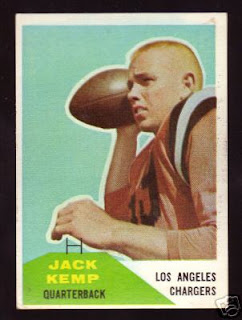
…he was present at “The Greatest Game Ever Played (before the ’86 Super Bowl)” – the Colts/Giants NFL championship game in ’58 – as a third-stringer on the Giants’ taxi squad. He was cut or traded by five teams before he latched on with the Buffalo Bills, back when the AFL was a separate league.

He led the Bills through a series of great seasons, before and after the merger with the NFL, before injuries slowed him down.  He was drafted to run for the US House in 1971 by the GOP, and he stepped away from his contract with the Bills to run his campaign.

Maybe it was the humble roots, the non-Ivy-League background, the years of struggle and failure before hitting it big, his self-taught nature that made Kemp a face of conservatism for the little guy. I’ve often said that Reagan’s great strength was that he translated Hayek and Friedman into something accessible to pretty much everyone; Jack Kemp turned those ideas into things of substance.  The supply-side claim is not a claim. It is empirically true and historically convincing that with lower rates of taxation on labor and capital, the factors of production, you’ll get a bigger economy.”

And he was always a conservative Republican who spoke to the little guy first and foremost, as befitted perhaps a Rep from Buffalo; There is a kind of victory in good work, no matter how humble“, he once said.

And as I moved to the city and started plying a trade – first as a bush-league conservative pundit, and then as a schmuck trying to make my way, and then again as yet another bush-league pundit, Kemp was consistently a voice and an inspiration to those of us who sought to break the noxious liberal strangle hold on places like Saint Paul.  And like many like me, I took inspiration from another Kemp protege in Jersey City, where Brett Schundler, a Reagan Republican who was very much in the Kemp mold, won three terms as mayor and tranformed his city.  When I’ve said that the Minnesota GOP will never really contest control of Minnesota until we make a play of it in the Cities, I’m echoing Kemp;  There really has not been a strong Republican message to either the poor or the African American community at large“, he once said, nailng one of the enduring chinks in the GOP’s (albeit not conservatism’s) armor.

People say the GOP needs another Reagan.  That’s true to a degree, of course.  But Reagan spoke of truths that are eternal enough that pretty much anyone can remember them; freedom, limited government, security. Reagan took on the world.

Jack Kemp took on mainstreet, one store-owner, voter, program and American at a time.

What the GOP really needs, stat, is a few dozen Jack Kemps; people who can spread the gospel to everyone from the local town hall meeting all the way to the Beltway, and back again.

RIP Jack Kemp

Saturday, May 2nd, 2009

Former Bills’ quarterback, Congressman, Presidential contender and conservative heavyweight Jack Kemp has passed away.

Kemp had announced in January 2009 that he had been diagnosed with cancer. He said he was undergoing tests but gave no other detail.

Kemp, a former quarterback for the Buffalo Bills, represented western New York for nine terms in Congress, leaving the House for an unsuccessful presidential bid in 1988.

Kemp was 73.

Jack Kemp was one of the political figures who helped draw me to conservatism. Much more about Jack Kemp on Monday.

Mark “The Bird” Fidrych

Tuesday, April 14th, 2009

Tigers great Fidrych found dead yesterday:

Fidrych, who won 19 games as a rookie in ’76 but had his pitching career abbreviated by injuries, was found dead by his friend Joseph Amorello beneath his 10-wheel truck at about 2:30 p.m. State police detectives are investigating the circumstances of the accident, said Worcester Country District Attorney Joseph D. Early Jr.Fidrych, who worked in trucking and construction since his baseball career ended in 1983, had a job scheduled for this morning, but the site wasn’t ready, so he returned home. Later in the day, Amorello, the owner of the A.F. Amorello & Sons construction company for which Fidrych often worked, stopped by Fidrych’s home to say hello and discuss an upcoming job, only to encounter a gruesome scene.

Neither the district attorney’s office nor the Northborough Police Department would confirm further details of the accident. Reached via cell phone tonight, Amorello said, ‘‘It was obvious there was nothing I could do at that time.’’

Fidrych’s story reads like a B movie.  Drafted low in the pecking order, pulled out of the minors more or less as an afterthought, Fidrych got his first start when the scheduled starter was out sick.  Fidrych got 19 wins in a rookie season where he was paid – this blew my mind – $16,500.

He became a flash-in-the-pan superstar, got injured, never got near the record of his rookie season, and eventually left the game.

But it was fun while it lasted.  And it may have been among the last times I personally followed the Tigers for more than a game at a time…

--> Site Meter -->