The War We Lost
By Mitch Berg
In honor of the fiftieth anniversary of the “War on Poverty” – the only “war” at which the United States has ever been comprehensively defeated unto humiliation – John C. Goodman analyzes the results.
On the one hand, avoiding poverty – or rising out of it, with time and hard work – is at least conceptually fairly simple (although obviously requires work, patience and perseverence):
We now know a lot about how behavior affects poverty. In fact, if you do these four things, it’s almost impossible to remain poor:
1. Finish high school,
2. Get a job,
3. Get married, and
4. Don’t have children until you get married.
Simple – right?
But throughout the “War on Poverty”, we’ve been disincenting those exact behaviors:
So how does welfare affect behavior? In the late 1960s the federal government sought to find that out in what Charles Murray calls “the most ambitious social science experiment in history.”
The experiments were all conducted by social scientists who believed in the welfare state and had no doubt about its capacity to be successful…Randomly selected people were assigned to a “control group” and an “experimental group.” The latter received a guaranteed income, and the program even used Milton Friedman’s term for it: a negative income tax. The largest, longest and best-evaluated of these experiments was SIME/DIME (Seattle Income Maintenance Experiment/Denver Income Maintenance Experiment) in Seattle and Denver. And the results were not pretty. To the dismay of the researchers, they largely confirmed what conventional wisdom had thought all along. As I reported in “Privatizing the Welfare State”:
- The number of hours worked dropped 9% for husbands and 20% for wives, relative to the control group. For young male adults it dropped 43% more.
- The length of unemployment increased 27% among husbands and 42% for wives, relative to the control group. For single female heads of households it increased 60% more.
- Divorce increased 36% more among whites and 42% more among blacks. (In a New Jersey experiment, the divorce rate was 84% higher among Hispanics.)
BTW, these results have been studied and studied over and over again and there is a large literature on them ? almost all of it written by researchers who detested the outcomes. Good summaries are provided by Charles Murray and Martin Anderson.
It’s like going to war – the real kind – and giving your soldiers Nerf guns.
The results?
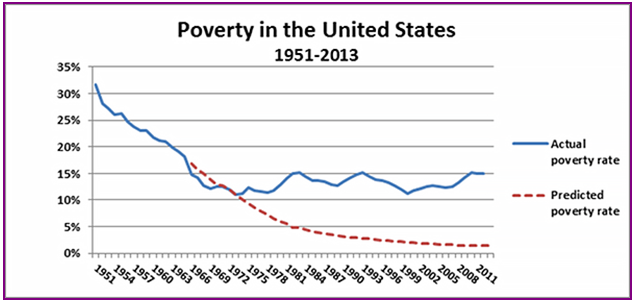
Poverty is stuck at 1966 levels, and has been for almost fifty years.
Spending has soared in absolute dollars and in share of GDP.
And it’s entirely unsustainable – and things that can’t be sustained, won’t.


February 26th, 2014 at 11:00 am
The 2 million + jobs that Obamacare will cost the US economy are lost, in large part, because Obamacare makes the climb out of poverty steeper. The phase out of the subsides means that you have to work a heck of a lot harder to get a moderate increase in income (the subsidy in the state exchanges = 0 at 400% of federal poverty level).
Effectively the subsidies transfer money from the middle class (not the rich) to the poor.
February 26th, 2014 at 11:35 am
Thank you for that dose of reality. The CBO report doesn’t say that merely the supply of workers will be reduced by 2.3 million people. It estimates that the net effect of changes to the supply of workers will result in 2.3 million less man-years worked per year by 2021. If there is truly no reduction in demand, that implies a much larger reduction in supply.
An economy with 2.3m fewer jobs will produce much less, and will reduce the wages of those who are removing themselves from the supply (yes, by choice) which will increase the inequality in society and drive the need for yet more subsidies and yet more disincentive to work. Eventually you have 40% of the working age population which doesn’t ever expect to work, with the other 60% subsidizing their poverty, and your economic problem is now a crisis of democracy.
February 26th, 2014 at 12:02 pm
If we are waging war on poverty, then it can be said that we surrender a bit of gained ground with the arrival, legally and and illegally, of each immigrant/ alien who, as do most, arrive with great need and no resources.
Those who bemoan the ever-increasing number of those below the poverty level seem to conveniently ignore this. An accurate measure should exclude those who are here illegally. Any counts made during the current influx of illegal immigration are virtually meaningless.
A count that only included all who were born here or have achieved legal citizenship would give a more accurate picture. Then, if the resulting numbers are unsatisfactory, legal immigration could be curtailed until the poverty level improves.
Any count made during the current influx of illegal immigration is virtually meaningless.
February 26th, 2014 at 1:07 pm
The claim that the country will be better off without 2 million+ productive workers should be considered in light of the controversy about using a measure like the Human Development Index (HDI) in place of GDP as a measure of a nation’s wealth.
All you really need to know to understand the difference is that GDP is determined by consumers making value decisions. HDI is determined by bureaucrats making value decisions.
February 26th, 2014 at 4:26 pm
One interesting thing about the “War on the Poor” is that among all races, the decline in marriage started a decade before LBJ moved to the White House, and is especially precipitous among blacks. So while the War on the Poor has been a disaster, it’s not the only thing going on.