Author Archive

The Tesla, my friend, is blowing in the wind…

Wednesday, April 6th, 2022

Leftism is all about harnessing the power of pixie dust and expeller pressed unicorn horn oil. I wish the laws of economics and of nature to be different, therefore they are. One way magical thinking manifests itself is the sun-dappled dream that we can get rid of fossil fuels, switch to electric vehicles, the changeover will be painless, and we won’t notice any change in our standard of living.

An electric car is, well, electric, and electric is easy because I can just plug in my Vitamix blender at home to make my artisanal kale smoothie and it just turns on and couldn’t be simpler. So having an electric car will be just as easy!

Michael Lind has a good article in Tablet outlining the difficulties in putting an electric car in every garage. Never mind how we’re going to “cleanly” produce all the electricity these vehicles would consume. Electric vehicles, and especially the batteries that power them, require the kinds of natural resources that don’t grow on trees.

But according to experts on global mineral production who belong to SoS Minerals, in a letter delivered to the British Committee on Climate Change:

The metal resource needed to make all cars and vans electric by 2050 and all sales to be purely battery electric [in the UK] by 2035. To replace all UK-based vehicles today with electric vehicles (not including the LGV and HGV fleets), assuming they use the most resource-frugal next-generation NMC 811 batteries, would take 207,900 tonnes cobalt, 264,600 tonnes of lithium carbonate (LCE), at least 7,200 tonnes of neodymium and dysprosium, in addition to 2,362,500 tonnes copper. This represents, just under two times the total annual world cobalt production, nearly the entire world production of neodymium, three quarters the world’s lithium production and 12% of the world’s copper production during 2018. Even ensuring the annual supply of electric vehicles only, from 2035 as pledged, will require the UK to annually import the equivalent of the entire annual cobalt needs of European industry. …

Challenges of using ‘green energy’ to power electric cars: If wind farms are chosen to generate the power for the projected two billion cars at UK average usage, this requires the equivalent of a further years’ worth of total global copper supply and 10 years’ worth of global neodymium and dysprosium production to build the windfarms.

There is not enough cobalt, neodymium, or lithium being mined and refined in the entire world today for Britain to meet its green transition goals in the next generation. And Britain has only 67 million people. The United States has 330 million. The world has nearly 8 billion. Do the math.

(more…)

This just in, Iran still pursuing ballistic missile program

Tuesday, April 5th, 2022

Last week the Treasury Dept imposed sanctions on an individual and four related companies that “procured ballistic missile propellant-related materials for the Islamic Revolutionary Guard Corps Research and Self Sufficiency Jihad Organization (IRGC RSSJO), the IRGC unit responsible for the research and development of ballistic missiles.”

This was in response to “Iran’s missile attack on Erbil, Iraq on March 13 and the Iranian enabled Houthi missile attack against a Saudi Aramco facility on March 25 as well as other missile attacks by Iranian proxies against Saudi Arabia and the United Arab Emirates.”

The individual had “been personally involved in high-level meetings and traveled with senior IRGC RSSJO officials and, in his role as the manager of Sina Composite, procured processing machines for nitrile butadiene rubber (NBR) from China using falsified shipping documents.”

One of the companies “has procured centrifuge spare parts used in the production of ballistic missile propellant valued in the hundreds of thousands of dollars from suppliers in China.”

In response, Iran’s Foreign Ministry said:

“This move is another demonstration of the ill-will of the US government toward the Iranian nation, which is a continuation of the failed policy of maximum pressure by that government against Iran, and this clearly proves the fact that the current US administration, contrary to what it claims, uses every opportunity to level baseless accusations against the Iranian people and impose pressure on them,” Saeed Khatibzadeh said.

“The US claims to be ready to return to full implementation of its obligations under the nuclear deal, while it continues to significantly violate the UN Security Council resolution 2231.”


2231 is the resolution (text here) in support of the original JCPOA. That’s a bit rich, accusing the US of being in violation. The resolution said this of Iran’s missile program:

Iran is called upon not to undertake any activity related to ballistic missiles designed to be capable of delivering nuclear weapons, including launches using such ballistic missile technology…

If you believe Iran isn’t trying to build a nuclear missile program, there’s a place for you in the Biden Administration. This would be the same administration currently trying to negotiate a return to the JCPOA with Iran. I always wonder if the Treasury Dept’s Office of Foreign Assets Control ever gets invited to the White House Christmas parties. They are diligent about keeping tabs on Iran. I’m always amazed the commissars in the White House let them issue all these sanctions. It makes all these negotiations in Vienna look rather silly.

What’s more, this Iranian missile program is proceeding with the assistance of China. Factor things like this in when you wonder why China was sliding stacks of dollars to the Bidens.

A thousand Sullas

Monday, April 4th, 2022

What would happen if someone in a position of authority blatantly defied the law? Would a piece of paper immediately appear and envelop them in parchment shackles?

Sulla is remembered as the first Roman dictator to take power by force. He first displayed his military prowess while serving under Marius, and a sharp rivalry developed between the two. The Senate was becoming wary of Marius’ own ambitions and when war broke out against King Mithridates, Sulla was given command of the army sent to deal with him.

In Rome, Marius maneuvered to have command given back to him, but Sulla had the messengers sent to give him the news killed and Sulla marched back to Rome. Sulla was the first to take an army past Rome’s sacred pomerium and enter the city. Sulla regained his power, Marius fled to Africa, and Sulla marched east again.

Allies of Marius (who died in 86 BC) continued to work against Sulla, and Sulla once again marched on Rome, this time decisively defeating his opponents at the Battle of the Colline Gate in 82 BC. The Senate appointed Sulla to the office of dictator, the first in 120 years, but this time with no expiration date. Sulla began a purge of people opposed to him and his friends, and Sulla used his dictatorial powers to undertake many unilateral reforms.

Our own constitution is a marvel of checks and balances designed to keep power from concentrating in a few hands. Power is pushed down towards the people and not the other way around. And yet, it is just a piece of paper. It has no inherent power. It is only our own will to abide by constitutional law and our will to enforce it against those who won’t that give the US Constitution Power.

Berg’s Seventh Law is absolute, and the Left routinely clutches its pearls and sees Republican Sullas on every street corner. Be you Trump or Dubya, you’re a dictator.

Let’s not rehash Obama’s unconstitutional use of the IRS against its political enemies, or its unconstitutional DACA, or Biden’s unconstitutional extension of the eviction moratorium.

My point in all this is a US President as dictator is not the only fear, and indeed is not necessary to erode the protections we enjoy under the US Constitution.

What if instead of one Sulla at the top, there are a thousand Sullas across the land? On school boards, in state assemblies, in bureaucracies, in entertainment executive offices, in corporate board rooms, in banks. What if people with power to affect how we live just decide “I’m going to do what I want. I’m going to take what I want. I dare you to do something about it.”

Vigilance cannot sleep. Wherever a Sulla is found, they must be met with force. I don’t mean physical force. I mean determined political resistance. If Sulla is on the school board, then we are there making ourselves heard. If Sulla is in the Speaker’s chair of a state House, then we fill the seats in front of them with our candidates.

The pieces of paper we hold dear may inspire us, and even empower us, but the foundations of freedom must rest on something stronger than paper. I don’t fear those who would do what they want whether legal or not, I fear those would let them.

Hunter the Mighty Nimrod

Friday, April 1st, 2022

Yesterday we took a brief gander at China’s Belt and Road Initiative (BRI), an infrastructure project on a grand scale meant to ensure China has access to the natural resources it needs and to facilitate trade going the other way.

In a serendipitous development in the Hunter Biden saga, yesterday the Washington Post published a story accepting as fact the reporting the New York Post did back in October 2020 based on the contents of a laptop that Hunter Biden left in a repair shop.

(This would be the same reporting the fools at Facebook and Twitter tried to stop from spreading. In addition to the reporting the New York Post did, NY Post columnist Miranda Devine wove all the disparate threads into a coherent story of corruption in her book Laptop From Hell.)

The initial reporting on the laptop focused on Hunter Biden’s involvement in Ukraine and his position on the board of Burisma even though he had no experience in Energy etc… That was not the extent of Hunter Biden’s money-grubbing, not by a long shot. He was also chasing deals in China, and the Washington Post story focuses on the China angle.

The deal was years in the making, the culmination of forging contacts, hosting dinners, of flights to and from China. But on Aug. 2, 2017, signatures were quickly affixed, one from Hunter Biden, the other from a Chinese executive named Gongwen Dong.

Within days, a new Cathay Bank account was created. Within a week, millions of dollars started to change hands.

Within a year, it would all begin to collapse.

While many aspects of Hunter Biden’s financial arrangement with CEFC China Energy have been previously reported and were included in a Republican-led Senate report from 2020, a Washington Post review confirmed many of the key details and found additional documents showing Biden family interactions with Chinese executives.

Over the course of 14 months, the Chinese energy conglomerate and its executives paid $4.8 million to entities controlled by Hunter Biden and his uncle, according to government records, court documents and newly disclosed bank statements, as well as emails contained on a copy of a laptop hard drive that purportedly once belonged to Hunter Biden.

(more…)

The China-Pakistan Economic Corridor

Thursday, March 31st, 2022

Beginning Wednesday, China is playing host to a meeting in Tunxi ostensibly on Afghanistan and attendees include various neighbors of Afghanistan. Of greater interest are the side meetings taking place there.

China will host a series of meetings about Afghanistan on Wednesday, featuring representatives of Russia, the US, the Taliban, and South and Central Asian countries, as it ramps up diplomatic engagement with its troubled neighbour.

The meetings in Tunxi, in the eastern Chinese province of Anhui, will be a rare instance of officials from Moscow and Washington meeting since Russia invaded Ukraine last month.

The Chinese foreign ministry said on Tuesday that Yue Xiaoyong, China’s special envoy to Afghanistan, would host counterparts from the United States, Russia and Pakistan for the latest “troika plus” talks.

The four-way meeting will be held on the sidelines of a conference of ministers from Afghanistan’s neighbours, at which Foreign Minister Wang Yi will host ministers and officials from Iran, Pakistan, Russia, Tajikistan, Turkmenistan and Uzbekistan, the Chinese ministry said.

Out of one of those side meetings came this little item.

Foreign Ministers of Russia and Iran Sergei Lavrov and Hossein Amir Abdollahian at a meeting in China confirmed the desire of both countries to strengthen cooperation in all areas, despite the sanctions imposed by Western countries against Moscow and Tehran, the Russian Foreign Ministry said in a statement following the meeting.

Russia talking with Iran, in China. What could go wrong? Even though Lavrov has a shooting war on his hands, and has a hostile West to deal with, he still found time to fly to eastern China. A sign, I think, of the value Lavrov saw in making the trip.

What form this joint sanction-busting cooperation might take is unclear, but there are other interesting things to keep an eye on here. China made this comment at the conference (bold is mine)…

(more…)

Might might make right

Wednesday, March 30th, 2022


One reason we study the past is because at its core, human nature is constant. Our fundamental needs and our capacity for good and evil can be recognized in any era. How people in the past reacted to circumstances can be predictive of how people in the present might react when faced with similar circumstances.

I’ll share an example of this. In a well-known passage in his History of the Peloponnesian War, Thucydides records (more like imagines, as he wasn’t there) the Melian Dialogue (Book 5, 84–116), a (one-sided?) conversation between Athens and the people of the island of Melos in 416 BC.

At this point in the Peloponnesian War, Athens was still feeling secure in its naval power. In the first part of the war, Athens had major successes against Sparta at Naupactus, Pylos and Sphacteria. Defeats at Delium and Amphipolis though led to the Peace of Nicias between the two in 421 BC. Meant to last 50 years, it barely lasted 6.

In 416 BC, then, as the peace was unravelling, Athens sent a sizeable force to conquer Melos, the reasons for which aren’t relevant to this discussion. I’ll just add that while it’s easy to think of the ancient Greeks as a bunch of bearded guys sitting around in white robes yammering in the public square about philosophy and democracy, they were very much tribal people.

(more…)

Delp and Goudreau

Tuesday, March 29th, 2022

This is a CD I’ve been meaning to get around to for a long time, and finally checked off that box. It features two members of Boston, Brad Delp and Barry Goudreau. It was recorded in Goudreau’s home studio and released in 2003. The cover and reverse photos were taken on the beach near Goudreau’s home.


Delp was the clear, high, strong voice of Boston, and while Goudreau (on guitar) was sometimes overshadowed by Tom Scholz, he was part of the founding of Boston and, pun intended, instrumental in the sound of the first two Boston albums that together have sold over 30 million copies.

(more…)

We’re in Jeopardy!

Monday, March 28th, 2022

[Author’s note: this completely unoriginal attempt to pick low-hanging fruit so low it would take a ladder to reach cantaloupe was arrived at independently from our host’s post… in the future we will strive to be unoriginal in original ways…]

This is Jeopardy! Our contestants today are our returning champion Warren, from Bakersfield CA. And, Ketanji Brown Jackson from Washington DC.

Here’s our host, Bert Convoy!

[Applause light on]

[Bert] Thank you! Let’s get right to it.

(later in the game)

[KBJ] I’ll take Facts of Life for $200.

[Bert] And it’s a Video Daily Double! What is this person?


[KBJ] I, I can’t… I’m not sure. I’m not a biologist.

[Warren] What is a woman?

[Bert] Correct!

(later in the game)

(more…)

There but for the grace of God

Friday, March 25th, 2022

This Thursday piece in the Washington Post caught my eye for reasons I’ll explain in a moment, but it is illustrative of how when war is unleashed, the shrapnel goes in all directions.

In a Minnesota classroom, two weeks after Russian President Vladimir Putin invaded Ukraine, a high school teacher asked her class where they would travel if they could go anywhere in the world. Barrett Buck, 16, who was adopted from Moscow at 15 months old, began replying, “Russia, because —” A scoff cut her off before she could finish the sentence.

Buck continued, saying she’d like to experience more of the country of her birth. Then she added, “I don’t support Russia and what’s going on.”

Putin’s invasion of Ukraine has complicated the lives of kids like Buck, one of tens of thousands of children adopted from Russia in the 1990s and early 2000s, and their families, as they navigate layers of feelings about their Russian identity amid the backdrop of an unprovoked war.

Mara Kamen, chair of Families for Russian and Ukrainian Adoption (FRUA), a volunteer-run organization shepherding a network of about 7,000 member families who have adopted children from the former Soviet bloc, says kids and teens adopted from Russia have felt intense hurt these past few weeks.

My son and daughter are both adopted from Russia, though at different times and from different places. We made a total of four trips to Russia, two for each of them. With our son, our first day with him in the orphanage was 9/11. With our daughter, the US invasion of Iraq in 2003 started the day after we got to Moscow (which, looking at the calendar, within the last week was exactly nineteen years ago.) I might share those stories at some point down the road.

(more…)

One way Ukraine matters

Thursday, March 24th, 2022

As much as the climate panic crowd wants desperately to believe in the dream that we can glue solar panels to the roof of our vehicle, nail a 3-inch diameter battery-operated fan on the back bumper, do away with all fossil fuels and still toodle down the road at 70 mph and heat our homes with a windmill in the back yard and notice no economic impact, the world runs on petroleum products. Without them, we’re living in the Little House on the Prairie.

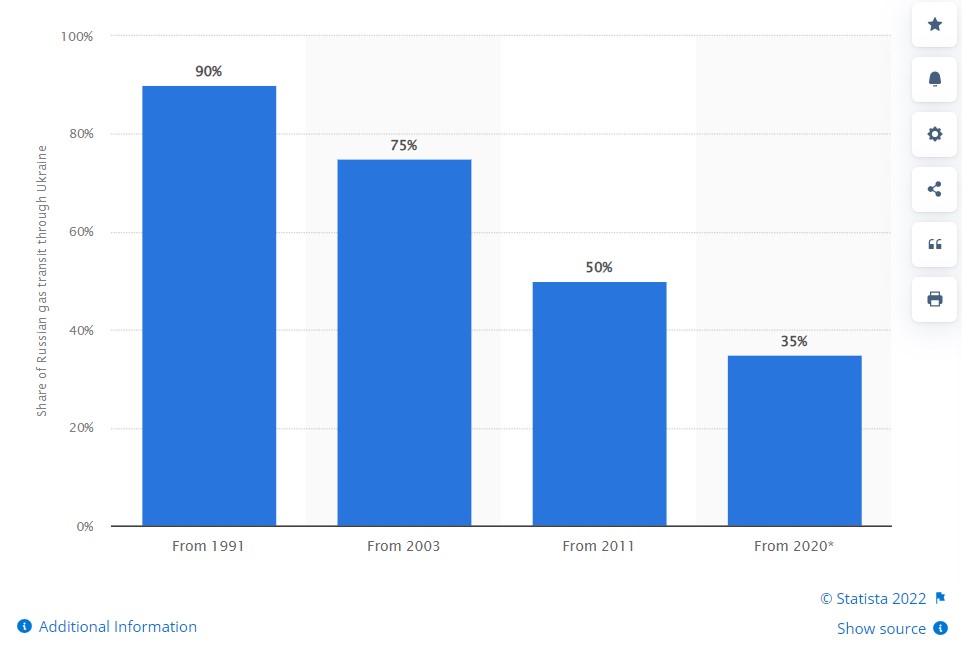
With 41% of their gas imports coming from Russia, Europe knows full well how dependent they are Russia. Go figure but they like staying warm in the winter. (And yet, with eyes wide open Germany still embarked on ending their nuclear program. Pro Tip: Never let leftists run your country) They are in a bind when it comes to imposing meaningful sanctions on Russia imports, and everyone knows it.

A significant portion of that gas transits through Ukraine. Though the percentage has dropped over time, according to Statista at least a third of Russian imports comes through Ukraine.

(more…)

Security for she, not for we

Wednesday, March 23rd, 2022

Last week the International Crisis Group unveiled their op-ed entry in the “Deep Fake: This Is Not The Babylon Bee” competition. Entitled “Another deeply gendered war is being waged in Ukraine,” it is a blinkered attempt to prove that even in the raw violence of war, the Left can still count beans, at least until hungry people taking refuge in a cold basement eat them.

But the Western supporters of Ukraine, especially the US, NATO, and the European Union, who have insisted for more than two decades now that women’s security shapes their approach to dealing with war, have done little to show that gender will be their framework, or even a framework, for addressing Ukraine’s predicament.


The author, Ms. Moaveni, is based in London. She has the freedom and safety to write sentences like the following, freedom bought by other people, many of them men, who were holding weapons, not “Give Peace A Chance” signs.

What might prove most challenging for a traditional gender-sensitive approach to this war is the emerging and dominant glorification of the militarisation of an entire society.


What the author calls the “glorification of the militarisation of an entire society” might also be called a will to survive. Ukraine is being invaded by an army that puts shells through the windows of maternity hospitals and apartment buildings. If the Ukrainian people, men and women alike, want to fight back and preferably not die cold and hungry under the treads of a Russian tank, I say we should salute them, not harangue them about why their first thoughts don’t run to identity politics.

The reference to “two decades” in the first quote is not a random one. In October 2000, U.N. Security Council adopted Resolution 1325. The text of it is here. The resolution called for, among other things, the increased participation of women in conflict resolution and in peacekeeping activities.

(more…)

Columns I Didn’t Finish

Tuesday, March 22nd, 2022

Paul Waldman, at the Washington Post

Over the multiple days of her confirmation hearings for a seat on the Supreme Court, Ketanji Brown Jackson will have to sit attentively for hours while the 22 members of the Senate Judiciary Committee speechify at her, testing both her endurance and her ability to refrain from rolling her eyes when the likes of Sens. Ted Cruz (R-Tex.) and Josh Hawley (R-Mo.) ascend the heights of inane demagoguery at her expense.

Amid all that pontification, there’s a particular phrase you should watch out for that will likely be repeated dozens of times: “judicial philosophy.” The phrase should raise red flags because it’s a signal that the person using it is about to pull a fast one, either to claim they themselves believe something they really don’t, or to pretend that an attack they’re making on Jackson is far more high-minded than it actually is. … The alternative to all this hogwash would be a little candor.


Our current vice president is a dopey gigglebox whose morning calisthenics consist of struggling to find a coherent thought. Feel the burn! She was picked solely on the basis of her skin color and gender.

Now, our current president, whose Biden Doctrine “I can’t have oatmeal before 8 am because I get gassy” will soon be of interest only to the nurses who wheel him down to the solarium, has nominated Ketanji Brown Jackson to the Supreme Court, the Left’s favorite unaccountable super-legislature. What’s more, she was picked for the exact same reasons as Harris. Given that first steaming example of affirmative action, as fresh as objets d’art on a San Francisco sidewalk, and how that is working out, might Jackson be worth a few pointed questions from a co-equal branch of government before she takes her lifetime appointment, Mr. Waldman?

Click.

From Cornerstone To Stumbling Block, Part 3

Monday, March 21st, 2022

In part 1 and part 2, we looked at some of the stories that can be found in Roman Britain and what they had to say to us today.

Let’s begin our final visit to Roman Britain by retasking our Keyhole satellite to the north of England. This is York.


Let’s do the exercise we started with. Just by looking at the street patterns, can you see where medieval York was? Here’s a rough outline.


There’s more to it though. York was founded by the Romans in 71 AD, about 30 years after they first arrived in Britain. Some of the local tribes were becoming increasingly hostile and Rome felt it needed a military presence in the area. A legion (the Ninth Legion, the so-called Lost Legion) marched up there and built a fort, and built it like they knew how. It’s a bit harder to see, but here’s a very rough outline of where what they called Eboracum was, at the point where the two rivers come together. York’s magnificent cathedral sits within the footprint of the fort.

(more…)

From Cornerstone To Stumbling Block, Part 2

Friday, March 18th, 2022

In part 1 we touched on how the past can influence the present in ways that might be easy to overlook, and how the past can remind us of the importance to defend that which we hold dear.

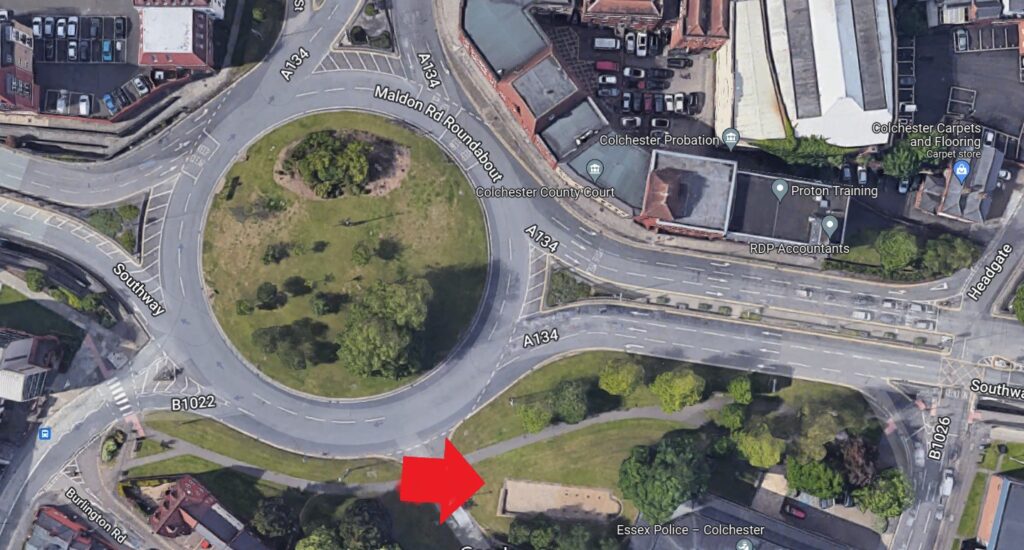
We had looked at part of the story of Colchester in England and I had said there was something else there that could add to our discussion. It is here, just outside the southwest corner of the old Roman fort, next to the traffic circle and next to the police station.


This is likely the earliest known church in Britain. It’s hard to date with exactness, but it probably dates to the mid 4th century.

Here’s a closer look, courtesy of VisitColchester.


While Christianity had likely come to Britain some time before this church was built, the ease with which Christianity could spread and flourish throughout the Roman Empire was greatly facilitated by Constantine the Great and the Edict of Milan. In a sense though, the Good News was too late for Britain. This church was a symbol of a hopeful future, but a future that ultimately was overtaken by events.

(more…)

From Cornerstone To Stumbling Block, Part 1

Thursday, March 17th, 2022

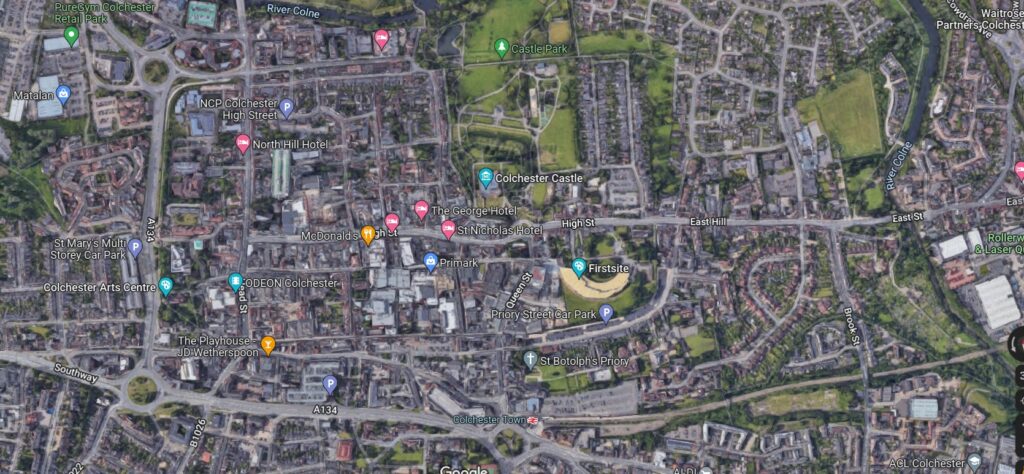
Cities have memories, especially old cities. If you were walking down a street in a city you’ve lived in all your life, you probably wouldn’t stop to think this street has been here for as long as I remember. It was here in my parents’ time, it was here in my grandparents’ time. This street has been here for centuries, but if we went back far enough, there would be a time when the street didn’t exist. So why is it here, in this place? What influences dictated that this street follow this path?

This is Colchester, in the southeast of England. It was known to the Romans as Camulodunum. The Romans invaded England in 43 A.D. and made Britain a Roman province, and Colchester is not far from where the Romans came ashore. For a time it was the administrative capital for the Roman occupation. Initially it was fortified with walls, but the walls were taken down and Colchester became a kind of retirement community for legion soldiers.

Around 60 A.D., about the exact same time the Apostle Paul was beginning his two-year house arrest in Rome, Queen Boudicca led a large-scale rebellion against the Romans. Her forces attacked the undefended town and destroyed Colchester and its inhabitants. Some residents holed up in the temple the town was known for and held out for a couple of days until they were overwhelmed. (The temple was where the castle now sits. The castle was built over the foundations of the temple.) Boudicca and her forces went on to attack what was then London and St. Albans. It is thought that upwards of 70,000 people were killed in the rebellion.

One of the Roman legions had been campaigning all the way over in Wales. When they received word of what had happened, they hurried back and helped put down the rebellion and were rather brutal about it. Having learned their lesson, and now acutely aware of the dangers in Britain, the Romans rebuilt the walls of Colchester, and rebuilt it according to doctrine. (A doctrine recorded by Vegetius in his De re militari, the only known surviving Roman field manual.) Typically their forts were four-sided, either square or rectangular, with a central road connecting two sides, and if it were large enough, another road connecting the other two sides (via praetoria and via principalis).

Just from looking at the street patterns, can you see where the fort they built was? The city remembers. Roads needed to go around these walls, long stretches of which still exist today, and today streets still follow those paths laid down millennia ago. The High Street, or Main Street, through town still follows the old Roman artery through the fort. A rough outline of the old Roman fort is after the break.

(more…)
--> Site Meter -->