Author Archive

The hill to die on

Friday, May 6th, 2022

“Everyone did what was right in their own eyes…” -Book of Judges

Remember when Bill Clinton bemoaned the “politics of personal destruction?” Good times. The snarling Left long ago declared conservatives in their private lives were fair game. And they’re at it again.

A leftist group posted on its website apparent home addresses of six conservative Supreme Court justices and is planning “walk-by” protests next week at their residences in the wake of the leaked draft from the high court that would overturn Roe v. Wade.

The group is called [not linking to them] — named after late liberal Justice Ruth Bader Ginsburg — and announced a “Walk-By Wednesday” protest set for May 11 “at the homes of the six extremist justices, three in Virginia and three in Maryland. If you’d like to join or lead a peaceful protest, let us know.”

In connection to the planned protest, the site includes a map naming the six justices — John Roberts, Clarence Thomas, Samuel Alito, Neil Gorsuch, Brett Kavanaugh, and Amy Coney Barrett — as well as links to what it says are the home addresses of the “Christian fundamentalist” jurists.

CatholicVote called on Biden to speak out against this sort of tactic.

President Biden must immediately and forcibly condemn these domestic terrorist threats. Anti-Catholic zealots are plotting to intimidate and harass Catholics across the country, along with justices and their families. This country was built on freedom of speech and freedom of religion. The President of the United States must stand up for both.

The organization also pointed to this incident reported by the CNA in Colorado.

A Catholic parish church in Boulder, Colorado was defaced with pro-abortion slogans the evening of May 3, marking the second time in less than a year that the parish has been targeted with pro-abortion graffiti.

Photos shared with CNA by the Archdiocese of Denver show vulgar slogans spray painted on the church, such as “F* You,” “F the Church, F** the State,” as well as numerous inscriptions of “My Body My Choice,” “You don’t speak 4 God,” and a symbol that appears to be an “A” signifying “anarchy.” Red paint was also used to deface a statue on the parish grounds.

The graffiti covers the church doors, several outer walls, and a white pickup truck in the parking lot. At least one of the outer windows of the church appears to be shattered.

Why is abortion, of all things, the highest priority for at least the activist Left? Why is it the one issue where absolutely no separation from the herd is permissible? Why does this issue fill people with so much hate that they erupt in vandalism and profanity against a church? Nobody takes to the streets and breaks windows over the Build Back Better bill saying “Bleep you, I want my bridge!”

I have my theory that I’ll expand on in time, but what’s yours?

Russia debt repayments

Thursday, May 5th, 2022

Russia is spending a fortune in Ukraine, perhaps as much as $20 billion a day. In turn though, Europe is sending hundreds of millions of euros a day to Russia for hydrocarbons. Putting sanctions on Russia while funding Russia is not a comfortable position. So, the EU is contemplating phasing out its dependence on Russian, and that might have enormous implications for Russia’s economy.

Maximilian Hess of the Foreign Policy Research Institute looks at some of those implications:

On April 29, Russia’s finance ministry announced that it would pay some $650m to foreign creditors on two overdue Eurobonds. And by making the payments before the bonds’ grace period expired on May 4, the Kremlin has avoided falling into sovereign default.

Ahead of the bond’s formal maturity on April 4, the Kremlin announced that it would buy back the bonds in roubles – and pay those who refused to accept the rouble buy-back as well. Nearly 75 percent of bondholders (almost certainly all domestic) agreed to the new terms .

Russia’s recent decision to pay the bonds in foreign currency enabled it to avoid the all-but-guaranteed acceleration of other debts and lawsuits that would have followed a default and further impoverished the Russian people.

However, the move also left the Kremlin in a position of extreme hypocrisy and embarrassment. In the end, what Putin did was to repay domestic bondholders with roubles, which they cannot convert freely into hard currency to spend abroad. And pay foreign holders in full, in dollars – hardly a feat worthy of praise.

In case there is any doubt just how exposed the shipping sector is to Western sanctions, one just needs to look to the actions of Russian state-owned shipping company Sovcomflot. On May 3 specialist maritime industry publication Lloyd’s List revealed that Sovcomflot was looking to sell at least 40 ships from its 121 ship fleet before wind-down authorisations expire and it becomes fully sanctioned on May 15.

If Sovcomflot fails to raise enough cash to honour its debts before then, it will fall into default and creditors will go after its ships. Just like the Russian state, Russian businesses are still fearful of defaulting on Western creditors – even amid a war.

Russia in Africa

Thursday, May 5th, 2022

This podcast from the ICG takes a look at something that’s not often on the front pages, and that is Russia’s aims in Africa.

Over recent years, Moscow has bolstered ties with countries all over the continent, particularly those plagued by internal violence and disillusioned with Western powers. Russia remains a leading arms supplier and Russian private military contractors continue to expand their presence, most recently in Mali. Whether Russia is successfully pursuing a broader strategy, or merely engaging in tactical power plays, remains a matter of debate. Russia has long sought a naval base on the Red Sea and wields its permanent seat on the United Nations Security Council for influence on the continent.

This week on The Horn, Alan is joined by Samuel Ramani, author of an upcoming book on Russia in Africa. They talk about Russia’s historic goals and current strategy on the continent, differing reactions to the invasion of Ukraine, and why some African leaders pursue closer relations with Russia. They also discuss the new significance of African relations for Moscow today and how the war in Ukraine is already changing power dynamics on the continent.

The IRGC and Mahdism

Wednesday, May 4th, 2022

The Middle East Institute has put out a PDF entitled “IRAN’S REVOLUTIONARY GUARD AND THE RISING CULT OF MAHDISM: MISSILES AND MILITIAS FOR THE APOCALYPSE.” If you’re looking for evidence that Iran is coming to its senses and will soon join the league of nations and embrace the West as brothers, you won’t find it here.

It’s worth devoting the time for a read, this is from the conclusion.

The finding of this research paper reveals three visible trends in the IRGC. The first relates to indoctrination becoming an increasing focal point in the Guard. Khamenei and his hardline circle have sought to nurture a more radical IRGC generation by dedicating more time to ideological indoctrination of its members. The promotion system within the ranks of the IRGC also favors ideological conviction over technical expertise, ensuring the most zealous members rise up within the chain of command. The second trend relates to the increasing priority given to Mahdism within the IRGC’s ideology. From the post-2009 period onwards, the doctrine of Mahdism has become one of the main prisms through which the IRGC and affiliated hardline clerics would understand the world around them and the IRGC’s actions, as well as communicate that understanding. In turn, there has been greater emphasis on viewing the IRGC as the military vehicle to prepare the foundations for the reappearance of the 12th Imam, with policy objectives such as hostility toward the U.S. and the eradication of Israel being understood through this prism. This is consistent with the goal of Khamenei and his hardline allies, such as Ayatollah Alamalhouda, the supreme leader’s representative to Khorasan and President Ebrahim Raisi’s father-in-law, to transform the concept of Mahdism from a set of feelings into an “ideological belief.” The third and final trend relates to the IRGC’s younger generations becoming more radical and extreme. In this regard, efforts by Khamenei and the Guard’s Ideological-Political Organization to nurture a more radical generation among the IRGC has paid, and is paying, dividends.

Against this backdrop, the rise of devout followers of the militaristic doctrine of Mahdism among the senior ranks of the IRGC is not inconceivable and should not be ruled out. While there is hope that the IRGC’s senior leadership will act pragmatically, internal structures within the Guard — including its indoctrination and promotion system — certainly open up the possibility that devoted Mahdists could occupy senior leadership positions. Such a scenario could have far-reaching consequences as it would bring the three pillars of the IRGC’s foreign policy — militias, ballistic missiles, and the nuclear program — under their control. Even if a small number of devout Mahdists occupy senior positions in the Guard, it is possible that they may seek to facilitate and speed up the return of Mahdi. This would have major implications for some of the policies that are being understood through the prism of Mahdism, such as Israel’s existence being the “greatest barrier” to the reappearance of the 12th Imam.

Is it a womenorah now?

Wednesday, May 4th, 2022

You might think that Israel, being in a tough neighborhood, with its survival at stake, would not allow woke nonsense to seep into its military and potentially compromise its national security. You would be wrong.

Israel for the first time ever will honor a transgender soldier with special medal of honor during the country’s annual Independence Day state ceremony, it was revealed Tuesday.

Sergeant Noam Shahar from Home Front Command’s mixed gender rescue unit will receive the President’s Medal during the country’s 74th Independence Day celebrations on Wednesday.

The soldier said she dedicated herself to setting an example even before joining Home Front Command. Last year, she chose to do her beret march- an arduous journey each IDF soldier goes through before being accepted to their respective corps – with the pride flag on her vest.

Trojan Footprint

Wednesday, May 4th, 2022

Trojan Footprint, a Special Forces joint exercise, began this week. An annual exercise, this is the largest one to date.

Trojan Footprint (TFP) 22 is set to begin May 2 and conclude May 13, with U.S. Special Operations Forces (SOF) proactively working and training together with NATO allies and European partners across Southeastern Europe, the Baltics and the Black Sea Region to demonstrate their collective military readiness to deploy and respond to any crisis that may arise.

This year’s TFP includes more than 3,300 participants from 30 nations, doubling in size from the previous year and making it the largest SOCEUR exercise to date. Land, air, and sea operations for Trojan Footprint 22 will occur across Bulgaria, Croatia, Estonia, Germany, Greece, Hungary, Latvia, Lithuania, Montenegro, North Macedonia, Poland, Romania, Slovakia, and Slovenia.

The two-week exercise also increases integration with conventional forces and will highlight the professional skillsets of land, air, and sea units to respond to hybrid threats through discreet theatre entry and exit. As an exercise in coalition building, TFP 22 is focused on cultivating trust and developing lasting relationships that will promote peace and stability throughout Europe.

As this tweet from US SOCEUR shows, it covers ground from the Baltic to the Med, a suspiciously united front facing neighbors to the east.

https://twitter.com/US_SOCEUR/status/1520743144593281024?cxt=HHwWgMC-gab14ZoqAAAA


Our civilization may be crumbling, eaten away from within, but while we can still put an talented, determined, capable military in the field, we’re not done yet. Go get ’em.

https://twitter.com/i/status/1521142469072670722

Trust but Verify

Tuesday, May 3rd, 2022

Some exciting news from sunny California… The power of the sun has now been harnessed.

Renewable electricity met just shy of 100% of California’s demand for the first time on Saturday, officials said, much of it from large amounts of solar power produced along Interstate 10, an hour east of the Coachella Valley.

While partygoers celebrated in the blazing sunshine at the Stagecoach music festival, “at 2:50 (p.m.), we reached 99.87 % of load served by all renewables, which broke the previous record,” said Anna Gonzales, spokeswoman for California Independent System Operator, a nonprofit that oversees the state’s bulk electric power system and transmission lines. Solar power provided two-thirds of the amount needed.

It is an achievement. However, Canary Media points out that there’s a bit more to the story…

Understanding the full picture requires first unpacking how CAISO calculated the 97% figure. California’s in-state renewable energy production was calculated as a percentage of energy demand after accounting for transmission losses. This demand figure omits demand met by rooftop solar, which generates power for more than 1 million California customers. Because large hydropower does not qualify for the state’s renewable portfolio standard, it is also not included in this figure.

Another important caveat: The figure does not account for all demand in California, even leaving aside demand met by rooftop solar. CAISO’s system does not include the areas served by the Los Angeles Department of Water and Power and the Sacramento Municipal Utility District, two publicly owned utilities that together make up roughly 10 percent of electricity sales in the state.

April 3 was a big wind and solar day for California, coupled with relatively low demand due to mild spring weather. Across the whole day, wind contributed 24% toward meeting demand and solar contributed 22%, followed by large hydro at 8% and geothermal at 4%. Add in minor contributions from biomass, biogas and small hydro projects, and the total renewable percentage for the day was 61%.

But even on this banner day for renewables, 39% of CAISO’s demand was met by non-renewable sources. And even at the 3:35–3:40 p.m. interval when CAISO hit 97% non-hydro renewables, other power plants in the state were running, including gas, nuclear and hydro facilities.

That means California still burned enough gas to meet about 15% of demand at the same moment that it had enough non-hydro renewable production to meet 97% of demand; again, the excess was exported to other states.

Adding large hydro and nuclear into the CAISO mix during the renewables peak yields a maximum of 107% carbon-free power that day, as shown in the chart below. During the three hours when clean electricity was being produced in excess of demand, California was exporting its carbon-free energy to neighboring states, almost certainly offsetting fossil power.

Do you want China as your loan shark?

Tuesday, May 3rd, 2022

Monday we took a look at the unfolding economic crisis in Sri Lanka. Yesterday then, some news that India heaved a life vest into the water, while China tied a concrete block to it…

Sri Lanka has extended a credit line with India by $200 million in order to procure emergency fuel stocks, the country’s power and energy minister said on Monday, as China said it supported efforts for the island nation to restructure its debt.

Colombo was also in talks with New Delhi over extending the credit line by an additional $500 million, minister Kanchana Wijesekera told a news conference, with four fuel shipments due to arrive in May.

Beijing’s ambassador Qi Zhenhong told Sri Lankan Finance Minister Ali Sabry at a meeting on Monday that China – one of the island’s largest bilateral lenders having extended about $6.5 billion in loans – supports its decision to work with the IMF to restructure its debt.

“Ambassador Zhenhong also assured Minister Ali Sabry that as a major shareholder of the IMF, China is willing to play an active role in encouraging the IMF to positively consider Sri Lanka’s position and to reach an agreement as soon as possible,” Sri Lanka’s finance ministry said in a statement.

In other words, China is saying “Sri Lanka, you’re already into us for six and a half large. Before we send more good money after bad, you can go to the IMF, but as for what you owe us, we’ll see if we can come to an “agreement.””

In return for China playing the role of angel investors, what sort of repayment might China look for from Sri Lanka?

On the southern tip of Sri Lanka, China helped finance and build the Hambantota Port project. The port opened in 2010. Often cited as an example of China’s “debt trap” approach to its victims, er, partners, China lent truckloads of money to Sri Lanka in the decade that followed, and in 2017, China Merchants Port was granted 70% of the port, as well as a 99 year lease.

The port is part of China’s so-called “string of pearls,” a chain of China-financed ports stretching from Africa to Gwadar to Sri Lanka and around SE Asia and up to Hong Kong.

In addition to that, China is building and financing the Colombo Port City in the capital city, on the west side of Sri Lanka. The project, on reclaimed land, is meant to be an international finance and economic center. It will be interesting to see if China pushes for outright ownership of one or both of these projects as Sri Lanka’s ability to pay its debt plunges.

On Tuesday, the Chinese Embassy in Sri Lanka tweeted this.

This came right after a series of tweets celebrating International Workers Day, but this was the subject of the tweets.

Message received.

As goes Sri Lanka?

Monday, May 2nd, 2022

Sri Lanka is far away, it’s not an especially large country, but current events there may have lessons for us here at home.

Over the weekend, Sri Lanka’s president, Gotabaya Rajapaksa, agreed to remove his brother, Mahinda, as Prime Minister. The Rajapaksa brothers have been at the top of Sri Lanka’s government for nearly twenty years, but this move is the fallout of a serious economic crisis in Sri Lanka that is getting worse.

Sri Lanka’s 26-year struggle against the Tamil Tigers ended in 2009. (At the time, Mahinda was President and Gotabaya was Defense Minister.) That civil war was extremely costly, and the roots of the current crisis go back to the struggle to recover from the civil war. Sri Lanka borrowed what for it was a great deal of foreign money. Today, debt has reached well over 100% of GDP. Combined with a series of tax cuts under President Gotabaya a few years ago, Sri Lanka’s ability to pay back its debt became increasingly difficult.

Beginning in 2019, two shocks served to push Sri Lanka closer to the edge. The Easter bombings in April 2019 targeted several churches and hotels and killed 265 people. The Islamic State claimed responsibility for the suicide bombings. In the aftermath tourism, which is an important industry in Sri Lanka and and brings in a significant amount of foreign dollars which is needed to pay back the foreign debt, declined sharply, putting even more pressure on Sri Lanka’s distressed economy.

Then, COVID hit in 2020 which hurt tourism even more. By February of this year, inflation was running over 17%. There are shortages of fuel and electricity. Predictably, widespread protests broke out in March. On March 31 a large group of protestors tried to get to President Gotabaya’s home. A state of emergency was declared the next day.

Events have snowballed from there. Cabinet members began to resign as the Rajapaksa brothers were unable to hold a unity government together. The value of the Sri Lankan rupee dived, and interest rates have soared.

In mid-April, Sri Lanka said it would default on its foreign debt. Sri Lanka does not have the foreign cash reserves to make the payments due this year. What money Sri Lanka does have is needed for necessities.

Sri Lanka is seeking help from the IMF, and indeed from anyone who is willing. Sri Lanka has talked to India and China about loans as well as fuel shipments. Even medical supplies are starting to experience shortages. The social unrest is not going away any time soon.

Inflation, high debt, rising interest rates, shortages, social unrest. Are we looking into a crystal ball?

Ignorance is Strength

Friday, April 29th, 2022

Inefficient nations were always conquered sooner or later, and the struggle for efficiency was inimical to illusions. Moreover, to be efficient it was necessary to be able to learn from the past, which meant having a fairly accurate idea of what had happened in the past.

Nothing is efficient in Oceania except the Thought Police.

-1984, George Orwell

On Wednesday at a budget hearing before the Committee on Appropriations Subcommittee on Homeland Security, DHS Secretary Mayorkas made some news in revealing a new Disinformation Governance Board. (His written testimony made no mention of it.) This came in an exchange with Rep. Lauren Underwood (D-Ohio). Video of the hearing is here, the exchange starts at about the 1:39:54 mark.

Underwood: Another huge threat to our homeland is mis- and disinformation. You noted that it’s a concern of yours at the border with human smuggling organizations peddling information to exploint vulnerable migrants for profit.

One of my main concerns about disinformation is that foreign adversaries attempt to destabilize our elections by targeting people of color with disinformation campaigns. After it became clear that there was more meddling in our 2016 election, the Senate Select Committee on Intelligence authored a report on the disinformation tactics used by Russia’s Internet Research Agency, the IRA, to interfere in the election. The report found that “no single group of Americans was targeted by the IRA information operatives more than African Americans.”

A newer trend that we saw in the 2020 election and already in the 2022 midterms is that disinformation is being heavily targeted at Spanish speaking voters, sparking and fueling conspiracy theories. DHS and its components play a big role in addressing mis- and disinformation in Spanish and other languages. Can you share what steps you’ve taken and what future plans you have to address Spanish language mis- and disinformation throug department-wide approach?

Mayorkas: Our Under-Secretary for Policy, Rob Silvers, is co-chair with our principal deputy general counsel, Jennifer Daskal, in leading a just recently constituted Disinformation Governance Board. The goal is to bring the resources of the department together to address this threat. I just read a very interesting study that underscores the importance of the point that you make, the spread of mis- and disinformation in minority communities specifically, and we are focused on that in the context of our CP3 and other efforts.

When asked about it, the odious Jen Psaki let the mask slip and mentioned COVID as a topic where the heavy hand of the government may be needed to keep the peasants in line.

“We know there has been a range of [disinformation] out there about a range of topics, I mean, including COVID for example, and also elections and eligibility,” Psaki said, adding that she would check for additional information on what the board plans to do.

The American Experiment also points out that SitD’s own Senator Klobuchar is in on the act, tackling “health misinformation.”

At a recent conference hosted by the University of Chicago’s Institute of Politics, Senator Amy Klobuchar failed to answer a reporter’s direct question about the nature of her proposed bill, the “Health Misinformation Act,” leaving open the possibility of government and bureaucratic control over what constitutes internet misinformation and who has the power to make that decision.

Sitting on a panel at the “Disinformation and the Erosion of Democracy” conference on April 8, Klobuchar was asked a direct question about her proposed bill by Chicago Thinker co-founder and Managing Editor Evita Duffy: “If I were to say there are only two sexes — male and female — would that be considered misinformation that you think should be banned speech on social media platforms?” Klobuchar proceeded to give a light chuckle and insisted it pertained to vaccine misinformation during a “public health crisis.” She refused to define misinformation and the parameters under which the proposed bill’s carveout would go into effect.

Klobuchar’s bill seeks to amend Section 230 of the Communications Decency Act, which gives internet platforms protection from civil liability for published content. The amendment creates a carveout that would strike immunity from those platforms that use algorithms promoting content and permit the Secretary of Health and Human Services (HHS), “in consultation with the heads of other relevant Federal agencies and outside experts determined appropriate by the Secretary, shall issue guidance regarding what constitutes health misinformation…”

Klobuchar’s evasive “answer” is not surprising considering the actual language of the bill has zero mention of vaccines and fails to define “misinformation.” But this lack of specific language and purpose in the bill — despite what Klobuchar may say at a conference — is very troubling. It leaves the door open for politicians and unelected bureaucrats in public health to determine what can and cannot be promoted on sites such as YouTube, Facebook, and Twitter, harnessing the power of the federal government to punish platforms disseminating speech it deems “misinformation.”

As Scott Johnson pointed out at Powerline, there is clearly a coordinated effort going on that has led to the creation of this board. In early April, at a conference entitled Disinformation and the Erosion of Democracy, at which Rep. Underwood was a featured speaker by the way, Barack Obama gave a lengthy address entitled “Disinformation Is a Threat to Our Democracy”. He said:

All right. With that as my starting point, I believe we have to address not just the supply of toxic information, but also the demand for it. On the supply side, tech platforms need to accept that the play a unique role in how we, as a people and people around the world, are consuming information and that their decisions have an impact on every aspect of society. With that power comes accountability, and in democracies like ours, at least, the need for some democratic oversight.

For years, social media companies have resisted that kind of accountability. They’re not unique in that regard. Every private corporation wants to do anything it wants. So, the social media platforms called themselves neutral platforms with no editorial role in what their users saw. They insisted that the content people see on social media has no impact on their beliefs or behavior — (laughter) — even though their business models and their profits are based on telling advertisers the exact opposite.

We do expect these companies to affirm the importance of our democratic institutions, not dismiss them, and to work to find the right combination of regulation and industry standards that will make democracy stronger. And because companies recognize the often dangerous relationship between social media, nationalism, domestic hate groups, they do need to engage with vulnerable populations about how to put better safeguards in place to protect minority populations, ethnic populations, religious minorities, wherever they operate.

For example, in the United States, they should be working with, not always contrary to, those groups that are trying to prevent voter suppression and specifically has targeted black and brown communities. In other words, these companies need to have some other North Star other than just making money and increasing market share. Fix the problem that, in part, they helped create, but also to stand for something bigger.

This announcement naturally gave rise to accusations that this board would be a new Ministry of Truth. I don’t think that is the right analogy, though. In Orwell’s 1984, the Ministry of Truth was the propaganda factory. It was responsible for spreading Newspeak and rewriting history.

I think a better analogy from Orwell would be the Thought Police. This organization was responsible for enforcing not only what people could say, but what they could think. It’s why the Thought Police needed to be the only effective organization. If the people are controlled, and there’s no outlet to inspire other people to action, all else falls into place.

Orwell’s insight about the Thought Police was that they knew the truth, they knew the past. They had to in order to know how to change it. Someone knew the lies, and spread them anyway.

There was no mention from Rep. Underwood about efforts to declare the Hunter Biden laptop story as disinformation, and how people and organizations have been thrown off of public platforms for mentioning it and other “unapproved” thoughts.

The threat from boards like this and where they can go isn’t that government official truly believe things such as the Biden laptop story was Russian disinformation, or that Trump colluded with the Russians, or that men can be women, or that America is a systematically racist country. It’s that they know these to be lies yet spread them anyway, and worse, work to suppress your opportunities to say otherwise.

The choppers are in the air

Thursday, April 28th, 2022

The 1st Biden Air Cav will soon start spraying Agent Green, exfoliating with borrowed dollars whatever canopy of fiscal sanity still remains below.

President Biden told reporters on Thursday that he is considering taking executive action to broadly cancel student loan debt, and a decision may be imminent.

“I am considering dealing with some [student] debt reduction,” Biden said today. However, he appeared to conclusively rule out $50,000 or more in student loan forgiveness. “I am not considering $50,000 [student] debt reduction,” he said. His comment confirms his earlier statements rejecting larger amounts of student loan forgiveness, and would seem to contradict suggestions made earlier this week by Senate Majority Leader Chuck Schumer (D-NY) that Biden was seriously considering cancelling $50,000 or more in student loan debt.

Biden did not specify an exact amount of student loan forgiveness that he is considering, although clearly it would be under $50,000. He also did not address rumors that he is considering imposing income restrictions on student debt cancellation.

The proposed debt cancellation would “only” be for the federal student loan program. Even the Socialist Squadrons at Camp Joe don’t yet dare force private lenders to forgive debt.

Schumer wants the $50,000 per snowflake. Biden may opt for $10,000 per, another number mentioned as a possibility.

Whatever the final number, there will be a cost to the taxpayer. Whatever Treasury bonds were used to lend the money still exist, and would need to paid back and are still charging interest. A freebie amount of $50,000 would cost around a trillion.

Then there’s the moral hazard. If the debt can be forgiven once, it can just as easily be forgiven again. Students will start to borrow with the expectation they won’t have to pay back the loans.

So, this is a step out the back door towards “free” education.

Another aspect that Biden needs to tap dance around is a means test, or some kind of income limit. Student loans are held by more higher income people than lower income. Biden can’t be seen to be handing stacks of cash to “rich” kids. (A lot of student debt goes for graduate schools.) So, he might just make it a welfare program and forgive debt only for lower income people.

Perhaps with their free money, the kiddies can take an economics class or two and discuss the idea that there is no such thing as a free lunch.

The Catholic vote

Wednesday, April 27th, 2022

This piece from the NCR highlights one of the factors in the upcoming election, the Latino Catholic vote.

This disconnect with immigrant voters and their values accounted in large part for the most remarkable fact about the 2020 election: Donald Trump did better among Latinos than he had done in 2016, and also among Black voters in some states.

He noted, too, that in any election, a Republican is likely to get at least 25% of the Latino vote, that the demographic has never been as monolithic as one might think listening to talking heads on television breezily pontificate on “the Latino vote.”

Fraga also noted that the disconnect between young activists and the voters they seek to reach can be “a very significant problem.” For example, the website at the voter mobilization group Voto Latino repeatedly uses the term “Latinx,” despite the fact that the Pew Research Center found most Latinos are unfamiliar with the term and do not use it.

“The best way to contact a Latino voter is with someone who is a co-ethnic and who refers to the demographic in the same way they do in the local community,” Fraga explained. In some areas, “Hispanic” is more common, and in others “Latino” is typical. Only among academics and students is “Latinx” even used.

Democrats need to figure this all out, and soon. According the projections from the nonpartisan National Association of Latino Elected and Appointed Officials Education Fund (NALEO), “At least 11.6 million Latinos will cast ballots in 2022, a 71.4 percent increase in the number of Latino voters from 2014.” That increase is expected to be in key battleground states where both parties have recognized the need to invest in voter outreach to the Latino community. “Latino voter turnout in 2022 is projected to increase from 2018 in the key battleground states Arizona (9.6 percent), Colorado (8.9 percent), and Nevada (5.8 percent),” the group said.

The Left has long had a problem talking to people of faith (ie people who actually believe something and take their faith seriously) because the Left’s default position towards such people is hostility. Biden’s campaign site had a long of list of “plans” that were going to solve everything everywhere. One such plan was for Catholics. It reads like someone who forgot to complete the essay assignment due later that same day, and so just grabbed another document out of the policy filing cabinet, erased “Labor, Women and Minorities” and penciled in “Catholics.”

First of all, the second paragraph:

Vice President Joe Biden believes that in America, no matter where you start in life, everyone should be able to live up to their God-given potential. He knows that we need to rebuild the middle class, and this time make sure everybody comes along—regardless of race, gender, religion, sexual orientation, or disability.

While that laundry list might make the ladies of the ELCA swoon, it’s not an especially Catholic-specific conversation, is it. Then, the points that follow are:

Build an economy where everyone comes along and we protect the “least of these”
Respect the dignity of work and give workers back the power to earn what they’re wort
Ensure that affordable, quality health care is a right for all Americans
Pursue a humane immigration policy that keeps families together, strengthens our economy, and secures our border
Serve as stewards of our creation and protect our planet against climate change

(And in case you were wondering, not a hint of abortion.)

Nice try. And good luck fooling those Latino Catholics who take their faith seriously. The kind of young people that David Shor wrote about last fall, the ones who have yanked the steering wheel of the Democrat Party far to the left and are standing on the gas pedal, have no idea how to reach faith voters, and it shows. Predictable results to follow in November.

Where will you be in nine years?

Tuesday, April 26th, 2022

The answer may be “in a cave up in the mountains, taking a guard duty shift at the mouth of the cave, projecting how long the canned food can last before another supply run is needed.”

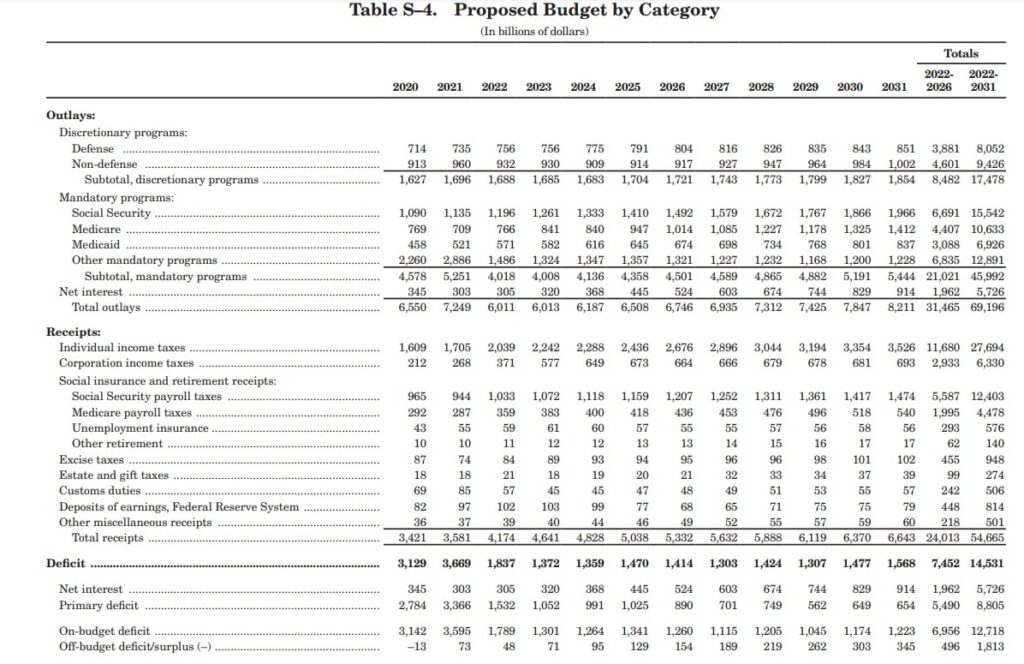
Here is a screen capture from the White House proposed budget for 2022. It shows “accounts payable” and “accounts receivable” over the next nine years. It projects budget deficits in the 1.3-1.5 trillion dollar range.


In addition, it shows expected mandatory outlays. These start at 4 trillion and go to about 5.5 trillion. Dollars. These are things like Granny’s social security check.

Discretionary outlays are in the 1.6-1.8 trillion dollar range.

So, a little back of the envelope math. Public debt is “officially” around 23 trillion dollars, and as seen here only continues to increase at a yearly clip of over a trillion dollars.

How might we get the debt and deficits under control? Well, we could take an axe to discretionary spending and just completely wipe it out. No defense spending, nothing. Does that sound likely? No.

Or, we can cut social spending by a trillion and a half each year. Does that sound likely? No.

Trouble is, reality may do that for us, though. And how smoothly do you think those social changes will go? This from a 2020 SS Trustees report:

Under the Trustees’ intermediate assumptions, OASDI cost is projected to exceed total income starting in 2021, and the dollar level of the hypothetical combined trust fund reserves declines until reserves become depleted in 2035. Figure II.D2 shows the implications of reserve depletion for the combined OASI and DI Trust Funds. Considered separately, the OASI Trust Fund reserves become depleted in 2034 and the DI Trust Fund reserves become depleted in 2065.2 In last year’s report, the projected reserve depletion years were 2035 for OASDI, 2034 for OASI, and 2052 for DI.

2021 was last year by the way, and just after these budget projects run out, Social Security keels over.

How about Medicare? Same story.

The trust fund for Medicare Part A will be able to pay full benefits until 2026 before reserves will be depleted.

That’s the same year as predicted in 2020, according to a summary of the trustees 2021 report, which was released on Tuesday. If the reserves run out for the Hospital Insurance Trust Fund, then the program’s income should be able to cover 91% of scheduled benefits. Medicare Part A covers hospital care for enrollees.

Then there’s interest on the debt. From projections, just the interest on the debt runs from about 8% of net mandatory outlays up to around 17%. And that doesn’t take into account interest rates going higher.

Then there’s interest on the debt. From projections, just the interest on the debt runs from about 8% of net mandatory outlays up to around 17%. And that doesn’t take into account interest rates going higher.

The roughly $300 billion the federal government will spend on interest payments this fiscal year is more than it is expected to spend on veterans’ services and military retirement ($185 billion); transportation ($188 billion); food and nutrition services ($172 billion), including the Supplemental Nutrition Assistance Program (“food stamps”); housing ($100 billion); K-12 and vocational education ($77 billion); and higher education ($42 billion). By FY 2031, interest costs are projected to be larger than federal spending on Medicaid and unemployment compensation, and over 90 percent as large as defense spending.

Under current law, we project interest spending will total $5.1 trillion over the 2021 to 2031 budget window. If interest rates on the projected annual debt stock were 50 basis points (0.5 percentage points) higher than CBO currently projects – reflecting the continuation of the current disparity between projections and reality – interest costs would increase by $1.7 trillion, to $6.8 trillion total. If interest rates were 100 basis points (one full percentage point) above CBO’s forecast, interest costs would total $8.6 trillion over that period, which is a $3.6 trillion increase over current law.

If interest rates begin at 50 basis points (0.5 percentage points) above CBO’s projections and gradually rise to 200 basis points (2 percentage points) above CBO’s forecast – bringing ten-year rates to just above their 30-year average of 4.3 percent by 2031 – interest costs would total $11.1 trillion over the 2021-2031 budget window, which is $6.0 trillion more than under current law.

The asteroid is heading for Earth. Impact is projected to be smack in the middle of North America. And no laser in existence is going to deflect it.

So, be careful on that supply run down into the valley. The cannibal gangs are merciless.

Traditionalism: the new radical

Monday, April 25th, 2022

“There is a theory which states that if ever anyone discovers exactly what the Universe is for and why it is here, it will instantly disappear and be replaced by something even more bizarre and inexplicable.

There is another theory which states that this has already happened.”

― Douglas Adams, The Restaurant at the End of the Universe

Rule #8 in Alinsky’s Rules For Radicals is “Keep the pressure on.” In Florida, Gov. DeSantis is taking a lot of stick because he is turning that back on the radicals, and for the Left, this is an unforgiveable sin.

The Florida legislature recently fired two salvos against the advancing Forces of Wokeness. House Bill 7 was passed last month to ban “woke indoctrination.”

Today, Governor Ron DeSantis signed House Bill (HB) 7, to give businesses, employees, children and families tools to stand up against discrimination and woke indoctrination. The bill includes provisions to prevent discriminatory instruction in the workplace and in public schools and defines individual freedoms based on the fundamental truth that all individuals are equal before the law and have inalienable rights. This legislation is the first of its kind in the nation to take on both corporate wokeness and Critical Race Theory in schools in one act. Read more here.

“No one should be instructed to feel as if they are not equal or shamed because of their race,” said Governor Ron DeSantis. “In Florida, we will not let the far-left woke agenda take over our schools and workplaces. There is no place for indoctrination or discrimination in Florida.”

The more publicized action was of course to pass HB 1557: Parental Rights in Education, taking a page from Virginia’s parental rights acts. The text of the bill is here. The core of the bill was to add Paragraph 8, which has 7 points under it. Five of them explicitly have to do with parental rights and what parents are to be informed of or give their consent to when it comes to their kids’ health or education.

Unless you’ve been vacationing on Pluto though, which is warmer than Minnesota these days, you know well that these have been overlooked and Point 3 is what set the fox among the chickens.

Classroom instruction by school personnel or third parties on sexual orientation or gender identity may not occur in kindergarten through grade 3 or in a manner that is not age-appropriate or developmentally appropriate for students in accordance with state standards.

The Walt Disney Company, understandably playing by what it thought are the customary long standing rules where conservatives may not oppose any lefty advances on the culture front, lambasted the bill and the echo chamber weighed in with the entirely predictable suite of Dezinformatsiya, that Republicans are the ones driving the culture war, conservatives are hateful intolerant bigots and the rest. In a shocking creative story-telling plot twist, DeSantis did not lie down and grovel.

The Walt Disney Company’s self-described mission statement is “The mission of The Walt Disney Company is to entertain, inform and inspire people around the globe through the power of unparalleled storytelling.”

Here’s an example of that “unparalleled storytelling.” Hulu is owned by the Disney Megacorp, and Hulu is home to The Hardy Boys, now in its second season.

I loved the Hardy Boys books as a kid, and still have a box in the basement with all the blue hardcover books in the series. Despite fears based on experience of what the modern day entertainment complex might do to a series of books that celebrated traditional values, I gave it a try. Alas, the Hulu show is the Hardy Boys in name only.

There was a supernatural element in the first season, which was fine, though an obvious attempt by these oh so creative and imaginative minds to go after the Stranger Things fan base.

The show inevitably features the rainbow coalition. The ethnic background of the cast is not the issue, but the casting was not done for story purposes, but for check-the-box purposes, and that is the issue.

The actress who plays Callie, Frank’s girlfriend, has family roots in Ecuador. Chet is black. Biff is now a girl.

Biff’s mom is an Asian woman. Trudy, the Hardy boys’ unmarried aunt, is white, and in the first season there were hints that Trudy and Biff’s mom were in a lesbian relationship. That was made explicit in season two. In addition, in season two there is a new character, a black girl who is shaping up to be Chet’s girlfriend, but she has been revealed to be bisexual. (This was the point where I stopped watching.)

This in a show about and geared towards youth, a show that shamelessly strip mines its namesake in order to attract an audience, then gleefully subverts it.

The culture war is widening. We may want to stay on the homefront and cheer on those at the front, like DeSantis, and send them care packages, but we will all need to do our part and serve in the resistance.

From the land of fruits and nuts

Friday, April 22nd, 2022

The California Legislature is currently gestating a bill declaring the work week shall be 32 hours for companies with more than 500 employees. Worse, the bill would mandate that the pay rate remain what it was for 40 years, and cannot be reduced. But wait, there’s more!

If the beleaguered employer tries to get its employers to work more hours to make up for the lost productivity, they have to pay time and a half over 32 hours. Or, the beleaguered employer can take on the added expense of part-time works to make up the lost hours.

From the text of the bill:

Existing law defines and regulates the terms and conditions of employment. Existing law generally defines “workweek” for these purposes and requires that work in excess of 40 hours in a workweek be compensated at a rate of at least 1 1/2 times the employee’s regular rate of pay, subject to certain exceptions. Existing law makes a violation of these provisions a misdemeanor.

This bill would instead require that work in excess of 32 hours in a workweek be compensated at the rate of no less than 1 1/2 times the employee’s regular rate of pay. The bill would require the compensation rate of pay at 32 hours to reflect the previous compensation rate of pay at 40 hours and would prohibit an employer from reducing an employee’s regular rate of pay as a result of this reduced hourly workweek requirement. The bill would exempt an employer with no more than 500 employees from the above provisions. By expanding the scope of a crime, this bill would impose a state-mandated local program.

What’s the worry, you say? A number of companies have experimented with a four-day work week.

I realize that when classroom instruction time is taken up with inculcating little Brandon and Ashley Snowflake on the nuances of gender bending there is less time to spend on basic economics. But, there is a difference between a private company choosing the hours their workers put in and what they get paid, and the government mandating that an employee can work 20% less for the same pay, and that the employer must bear the added cost.

While I would love to see this bill pass in California, as it would only hasten the demise of that state, and perhaps something useful could be rebuilt from the rubble, a Democrat Congressman has introduced a similar bill at the federal level. (Co-sponsored by Rashida Tlaib of Michigan.)

Prices are often described as signals because they convey information to both producer and consumer who can make rational decisions based on that information. Producers make decisions on whether to produce more or less. Consumers make decisions about consuming more or less.

The price of labor is no different. It conveys information that employers take into account when deciding how many employers it can afford, and employees decided if it is worth it for them to work at a given pay rate, or if they can find a better rate elsewhere.

When the government interferes in markets, and things like minimum wages and rent control are interferences, it introduces distortions. Distortions lead to bad information, and with bad information, producers and consumers make decisions they wouldn’t have made otherwise had they had good information.

These distortions have ripple effects. Employers cannot just absorb 20% less work for the same pay, and so these costs are passed on either in higher prices for goods, or fewer employees.

Do the people behind these bills care about the distortions they would introduce? One problem is they can’t know all the distortions they would cause. Prices are the signals that imbalances are present, and the prices would be wrong. The authors of these bills think they bribe voters by giving them other people’s money. Only a simpleton would think such a bribe wouldn’t cause problems, and only a fool wouldn’t worry that these problems can’t be completely known.

One completely predictable outcome is when you elect socialists, you wind up living under socialism.

Kevin Williamson put it this way:

We want to simplify the complex. And we want to bring down that which is high to a lower level where it’s easy to understand. So if the thing that’s wrong with the country is there are people we don’t like, and they’re getting rich by screwing us. And by messing everything up behind the scenes. That’s a pretty comforting story. If the actual story is “wow, the world is complex and we can’t actually accomplish a lot of the things that we want to. And the government can’t necessarily do the right thing even if we all agree on what it is because there are information problems and there are problems of incentives and problems having to do with complexity, that make things come out not the way we intended, and that all of our best intentions and our purest motives can produce horrifying results as they as they have over the years.” You see this in the really extreme political outcomes.

You know, the people who fought the Russian Revolution, didn’t want to build a nightmare state of gulags, but that’s where they ended up. I don’t think most of the people around the Chinese Communists in Mao’s era wanted to inflict the kind of nightmare on their people that they did. But they did. Now our situation isn’t that extreme, obviously. But it’s the same principle in the sense that nobody wants the current situation. Nobody really wants these outcomes. No one wants our healthcare system to look the way it does. No one wants K through 12 education to suck as hard as it does around the country. No one wants police who are irresponsible and trigger happy. But this is the system we’ve nonetheless managed to build for ourselves out of the interaction of our conflicting motives and incentives and information.

Roll out the gun barrel

Thursday, April 21st, 2022

At the battle of the Alamo in 1836, there were at least two Germans among the defenders, Henry Courtman and Henry Thomas. Why in the world, you may ask, were Germans at a battle in south Texas fighting Mexicans? Beginning just a few years before, and continuing over the next several decades, German immigrants came to Texas in increasingly large numbers, drawn by the prospects of farming and agriculture. Eventually Germans became one of the largest ethnic groups in Texas.

They brought with them their language and customs as well as the music they had listened to back home. One of the types of music they brought to Texas with them was a new sound, the polka.

There are various stories about the origin of the polka, but it seems to have originated as a Czech dance around 1830, and probably came out of the folk music of the region. The polka quickly spread in Europe, particularly in German-speaking lands, and especially in Poland, which all but made the polka its own. Polka even found a niche in Ukrainian folk music. The polka faded in popularity in the latter part of the 19th century, but the immigrants who went to North America brought it with them where it thrived. (It is the official state dance of Wisconsin, next door to SitD.)

The classic polka is in 2/4 time, and that contributes to the popularity of the dance. It is simple and fun. The 1-2-1-2-1-2 beat is easy to keep up with, and the typical oom-PAH oom-PAH in the bass line compels your feet to move. The accordion was probably invented in Germany in the 1820s, and it became a polka staple which the Germans brought with them to Texas.

Interaction among people across borders is part of the human condition. Languages typically influence each other across borders, but cultures also intermingle and music is a part of that. The polka music the Germans planted in Texas eventually made its way south across the border to northern Mexico, and from that Mexico’s Norteño music developed. This regional music retains the influence of the accordion and the polka beat. Here’s an example, a unique blending of Central European folk music and Mexican folk music.

(more…)

Maybe we can taunt the Taliban a second time

Wednesday, April 20th, 2022

More tragedy in Kabul, from the UN

The United Nations has condemned the deadly bomb blasts at two educational institutions in Afghanistan’s capital, Kabul, on Wednesday, which killed at least six people and wounded nearly 20 others.

The explosions took place at the all-boys Abdul Rahim Shahid high school and the nearby Mumtaz Education Centre, both located in the Dasht-e-Barchi area, a predominantly Shiite Muslim neighbourhood in western Kabul.

The attack at the Abdul Rahim Shahid high school reportedly occurred as students were coming out of their morning classes, according to the UN in Afghanistan. The blasts at the Mumtaz Education Centre followed shortly afterwards.

This Dasht-e-Barchi area is on the west side of Kabul and is a Shiite neighborhood largely populated by Hazaras. A sizeable minority spread across Iran, Afghanistan and Pakistan, the Hazaras speak a dialect of Farsi and have been persecuted in the past by the Taliban.

Here’s some brief footage from Twitter from the area of the school, which is here in Google Maps.

https://twitter.com/elyas_nawandish/status/1516312592888868877
(more…)

Remember Afghanistan?

Tuesday, April 19th, 2022

From the VOA, another sign that a troublesome group isn’t going away any time soon…

A regional affiliate of Islamic State on Monday said it had carried out a rocket attack on Uzbekistan from neighboring Afghanistan, the first strike by the terrorist group against the Central Asian nation.

Islamic State Khorasan Province fired 10 rockets at an Uzbek military base in the border town of Termez, the group said in a statement released Monday, according to Site Intelligence, which tracks terrorist propaganda.

IS Khorasan, first formed in 2015, is an affiliate of the Islamic State. Though the US and Afghan militaries did significant damage to IS Khorasan in the years following its formation, it has claimed responsibility for numerous attacks, including the bombing at the Kabul airport last August as the US was, uh, strategically advancing out of Afghanistan as fast as it could.

The site of this attack, Termez, is home to the Afghan-Uzbekistan Friendship Bridge. You may remember it as the bridge the last Soviet forces in Afghanistan used to exit the country.

The group even provided video footage to claim responsibility for the attack.

IS Khorasan has been openly hostile to the Taliban in the past and has clashed with them. The fact they can still operate within Afghanistan and now launch rockets at Uzbekistan does not bode well for peace in the region any time soon.

A Pakistani terror group, TTP, also operates within Afghanistan while launching attacks in Pakistan, such as an attack a few days ago that killed several troops. In response, the Pakistani military struck back inside Afghanistan.

The Taliban accused Pakistan on Saturday of launching cross-border military raids inside Afghanistan, which reportedly caused dozens of civilian casualties.

Local Taliban officials confirmed to VOA on condition of anonymity that Pakistani jets on Saturday bombed several villages in the border province of Khost, killing “at least 30 civilians, including women and children.”

Islamabad says the TTP, which is designated as a global terrorist organization by the United States and the United Nations, is plotting terrorism against the country from its Afghan sanctuaries.

Pakistani officials have acknowledged a recent spike in TTP attacks, particularly in northwestern districts on the Afghan border, which reportedly have killed and wounded dozens of soldiers.

The latest such attack took place Saturday when militants ambushed a Pakistani military convoy in the volatile North Waziristan district opposite Khost, killing seven troops.

The Pakistan government has repeatedly urged the Taliban rulers to rein in TTP activities since the Taliban seized control of Afghanistan last August, days before U.S.-led foreign troops withdrew from the country after 20 years.

Afghanistan is a basket case, and it’s getting basketier.

Border Schmorder

Friday, April 15th, 2022

While the Biden Administration continues to install express check-in kiosks all across the southern border, this article from the Wilson Center points out there are other implications beyond just importing what the Democrats hope will be a compliant voting bloc and dependent class.

Russian aggression against Ukraine may jeopardize Mexico’s relationship with the United States. This is the opinion of many Mexican commentators, who are generally critical of President Andrés Manuel López Obrador (AMLO). It is a war (a word forbidden by the Russian government) that has universal repercussions, something that does not seem to be understood by a president who has not shown any personal interest in international relations, unless it is to complain to Spain, to the European deputies, or to Antony Blinken for his judgment on the murders of journalists.

That is why the organization Morena Youth (Juventudes de Morena) of the State of Mexico supports Russia and receives the gratitude of the Russian ambassador; that is why certain deputies of the government majority form a Mexico/Russia Friendship Group and invite the Russian ambassador to Congress (March 23, 2022). Mexico’s former ambassador to the US, Arturo Sarukhan expressed that this, “portrays full-length the stale, rancid and aimless left that Mexico does not deserve.”

On March 24, the commander of the United States Northern Command Gen. Glen VanHerck appeared before the US Senate Committee on Armed Services Committee, and he made this comment regarding Russian agents in Mexico (transcript here, comment from page 54, bold is mine)

General VanHerck: There are actors who are very aggressive and active all across the NORTHCOM AOR, to including the Bahamas and Mexico, China and Russia. I would point out that the largest portion of GRE members in the world is in Mexico right now. Those are Russian intelligence personnel, and they keep an eye very closely on their opportunities to have influence on U.S. opportunities
and access.

(The GRU is Russian military intelligence.)

A porous border unguarded by a feckless Administration will attract malignant operators. Increasingly, migrants crossing the US border come from outside Mexico and Central America, including, ahem, this from BusinessInsider… Do we know who they are?

In December, over 2,000 Russians and 300 Ukrainians made their way to the border. Axios reported most of them had either arrived or were found at a legal port of entry in San Diego, California.

By comparison, only 53 Russians were found at the US-Mexico border in December of the previous year.

The aforementioned Arturo Sarukhan writing at Brookings a couple days ago had a few pointed comments, shockingly so for a diplomat, on Mexico’s coy game of footsie with Moscow.

Now, with the president’s MORENA party and its allies in the lower house of Congress having unconscionably launched in late March a Mexico-Russia friendship caucus — inviting Moscow’s ambassador and providing him with a bully pulpit to disseminate lies and disinformation — Mexico is blindly playing with fire. López Obrador apparently believes he can have his cake and it eat too when it comes to ties with the United States and the EU, the United States-Mexico-Canada Agreement (USMCA) framework, and Mexico’s global and multilateral diplomatic footprint.

Over the years, a combination of navel-gazing and lack of purpose, ambition, budget, and overarching grand strategy have all meant that when it comes to global or even hemispheric affairs, Mexico’s diplomatic payload tends to be woefully puny, particularly compared with other emerging economies and regional powers. Now, with López Obrador’s disdain for foreign policy and his general austerity drive eviscerating Mexico’s foreign service corps and its footprint abroad, the nation is punching even further below its weight in global affairs. Not even the best-funded diplomacy could make up for decisionmaking like López Obrador’s.

Coming soon to a state near you

Thursday, April 14th, 2022

Joel Kotkin and Marshall Toplansky produced a sobering report for Chapman University on the plight of California and its prospects for the future. It might be more accurate to refer to “the Californias”, plural, as the report describes two Californias.

The state is blessed with immense natural resources and generates riches that make Croesus seem a pauper. Yet, the wealth is far from evenly distributed.

According to the state’s Legislative Analyst’s Office, 20% of state wealth is held within 30 zip codes that account for just 2% of the population. Less than 33% of state wealth is held within 1,350 zip codes that house 75% of Californians. Since the 1970s, California middle-class incomes, once ebullient, have stagnated.

Even before the pandemic, California experienced lower growth than the other states it competes with for business and people. The most glaring losses have been in well-paying blue collar jobs. Even without adjusting for costs, no California metro ranks in the
US top ten of well-paying blue-collar jobs. But four—Ventura, Los Angeles, San Jose, and San Diego—sit among the bottom ten.

You might think that being a tech center would make California immune to disruption at the higher end of the scale, but that may be changing.

There is much controversy over the extent and importance of business flight from California, but the most recent evidence reveals that the tide of business headquarters leaving the state is accelerating. A 2021 Hoover Institution report presents a compelling set of data about recent business behavior. From January 1, 2018, to June 30, 2021, 265 companies moved their headquarters
out of the state, an average rate of 6.3 per month. The speed of exodus accelerated significantly (to 12.3 per month) in the six months from January through June of 2021.

Most of these firms departed from the Bay Area and Southern California, the state’s premier urban areas. Where did they go? Five states—Texas, Tennessee, Nevada, Arizona and Colorado… Since the beginning of 2018, some 107 companies have moved their headquarters to Texas from the Golden State.

While the über-wealthy bunker down in their coastal, leafy enclaves, the people the Left claims to care oh so much about are sinking.

(more…)

A square thought in a round mind

Wednesday, April 13th, 2022

Yesterday Mr. D posted on what any conservative more than five minutes old has learned, which is conservatives are not allowed to have certain thoughts. And, a couple days ago I posted on an irony I’ve longed noticed on the Left, that they view themselves as tolerant and open and decry attempts to enforce, as they see it, conformity, yet they themselves are wholly intolerant when faced with opposing viewpoints.

All this reminded me of a friend of mine from my school daze. He’s a genuinely gentle and nice fellow, but he’s of the Leftist persuasion.

He posted this on facebook awhile back, before the election, and the resulting tongue baths from other lefty friends were what you’d expect.

I believe that the most valuable ideal is kindness.

I believe that all people, regardless of ethnicity, race, religious belief
or non-belief, political alignment, sexual orientation and status in life
are deserving of respect.

I’m not perfect in embracing this next ideal but I do my best. It’s all
about having an open mind. I may not agree with the political positions,
religious beliefs, or phobias of others but I do my best to listen to and
respect others.

Then, pulling a 12-G turn, he posted this awhile later…

I am tired of listening to you all! And now I ask that if you truly believe
that we are better off under the current President, if you believe that we
don’t need stricter laws and bans of certain guns, and/or if you have or
intend to disparage the young people of March for Our Lives…then please
unfriend me now and save me the trouble of having to do so myself, which I already have done for some others.

I no longer have the patience to listen to you.

The resulting tongue baths from other lefty friends were what you’d expect.

(more…)

The enemy of my Yemeni

Tuesday, April 12th, 2022

Almost two weeks ago a UN-brokered ceasefire in Yemen brought a glimmer of hope for a way out of the years-long war there that according to this UNDP report has taken just under 400,000 lives.

By doing so, we found that by the end of 2021, Yemen’s conflict will lead to 377,000 deaths – nearly 60 per cent of which are indirect and caused by issues associated with conflict like lack of access to food, water, and healthcare.

The UN Special Envoy for Yemen said:

I would like to announce that the parties to the conflict have responded positively to a United Nations proposal for a two-month Truce which comes into effect tomorrow 2 April at 1900hrs. The parties accepted to halt all offensive military air, ground and maritime operations inside Yemen and across its borders; they also agreed for fuel ships to enter into Hudaydah ports and commercial flights to operate in and out of Sana’a airport to predetermined destinations in the region; they further agreed to meet under my auspices to open roads in Taiz and other governorates in Yemen. The Truce can be renewed beyond the two-month period with the consent of the parties.

The war in Yemen has become a proxy war between Iran and Saudi Arabia, and much like the dog that didn’t bark, Iran’s reaction to the ceasefire announcement was upbeat despite the supposed prospect at losing its weapons training ground. Iran’s Foreign Ministry Spokesman said:

Iranian Foreign Ministry Spokesman Saeed Khatibzadeh has welcomed an initiative put forth by the UN chief’s special envoy for Yemen to stop military operations for two months and to allow ships carrying fuel and to partially reopen the Sanaa airport.
Khatibzadeh expressed hope that this move will be the prelude to the full lifting of the blockade on Yemen and a permanent ceasefire in order to find a political solution to the country’s crisis. The Iranian Foreign Ministry spokesman reaffirmed Iran’s policy to support a political and humanitarian solution in Yemen, saying, “We hope that on the eve of the holy month of Ramadan, humanitarian issues will be prioritized, the ceasefire will hold and we will see an improvement in the humanitarian situation and a prisoner swap between the warring sides.”

This excellent report by Katherine Zimmerman out of the AEI’s Critical Threats project goes into detail about Iran’s involvement in Yemen.

Shared interests underpin the relationship between the Houthis and Iran and the Axis of Resistance. Houthi leaders uphold Iran’s Islamic Revolution as a model to follow, and Iran’s revisionist ideas and efforts to reshape the regional order resonate with them. They thus have found common ground with other Axis members seeking to change the status quo through force, including Hezbollah and Iraqi Shi’a militias, among others. For Iran, the Houthis initially presented an opportunity to threaten Saudi Arabia’s southern border, and Iran has led an effort to cultivate the Houthis as part of its network. The Houthis now rely on Iran and the Axis to retain certain capabilities necessary for their ongoing projection of power from Yemen and have begun to support Axis initiatives from which they do not necessarily benefit.

The Houthis now form an integral part of Iran’s Axis of Resistance. Iran cultivates this network to expand its own influence, leveraging its partners in pursuit of its regional objectives: expelling the United States and establishing Iranian hegemony. Members, including the Assad regime, Hezbollah, some Iraqi Shi’a militias, Hamas, PIJ, and some Bahraini militias, benefit from Iranian state support and shared resources and capabilities among Axis members. The Houthis rely on Iran and the Axis to retain certain capabilities crucial to their continued success in Yemen and have begun supporting Axis initiatives that do not necessarily benefit them directly.

In this February 2021 speech, Biden announced an end to “American support for offensive operations in the war in Yemen, including relevant arms sales.”

As players in the region deal with a disengaged United States, this ceasefire is an opportunity to clarify negotiating positions. From the Asia Times:

Iran’s expected surge following any lifting of sanctions becomes an “X” factor for all regional states, which Saudi Arabia, the UAE and Egypt will have to handle in a different way than previously by taking into account the United States’ steady disengagement from the region.

Unlike former president Donald Trump’s administration, US President Joe Biden tends to regard the past uncritical support for the Saudi-led war as a delusional mistake. This is already a tipping point, where the Houthis will negotiate without having to surrender their weaponry. The advantage goes to the Houthis. Equally, Iran emerges as the regional player to gain the most. Its robust support for the Houthis has paid off.

If the Biden Administration buries its head in the sand when it comes to Iran’s wider aims, Zimmerman summarizes what the Administration might find when it comes up for air:

Yemen is now a single theater in a larger, regional war. The Houthis have developed extensive ties across the Axis of Resistance and have integrated Axis narratives into their own. Iran is waging proxy warfare through the Houthis, and Iran’s limited investment in them has expanded the scope of the conflict beyond Yemen’s borders. Weapons in the Houthis’ arsenal threaten Gulf states and Israel, as well as maritime traffic in the Red Sea and Gulf of Aden. Iran and its Axis of Resistance oppose the deepening of relations between Israel and Arab states, particularly the UAE, and have signaled they will contest these developments. Understanding the Houthis only within the context of Yemen misses this shift in regional security dynamics. The United States must change its approach to securing its interests in the Middle East given the new reality of the Houthis as part of the Axis of Resistance.

The Beat Goes On

Monday, April 11th, 2022

Dennis Prager once wrote “whatever the Left touches it ruins.” In the 1950s, Leftists beheld Eisenhower’s America and set about trying to ruin it. In those years, America was the colossus astride the world. The only major power in the post-war years with its economy and infrastructure intact, America’s economic engine was roaring. Fueled by the GI Bill and real purchasing power, nuclear families ignited the rise of the suburbs while doubling the country’s Gross National Product.

Entertainment of the time reflected social norms. Programs such as Ozzie and Harriet, Father Knows Best, and Leave It to Beaver depicted stable, healthy families. Naturally the Left saw what was good and recoiled in revulsion.

The Beat Generation was a major Leftist reaction to 1950s culture. It began at Columbia University where Jack Kerouac and Allen Ginsberg and other early Beats attended. William Burroughs attended Harvard, but he spent a lot of time in New York City’s subculture and was introduced there to Kerouac and Ginsberg.

I don’t think it is an accident that the Frankfurt School had relocated to Columbia University to escape the Nazis. Herbert Marcuse, Max Horkheimer and Erich Fromm among others helped found the basis of critical theory, the destructive brew of Marxism and philosophy that is the grandfather of today’s wokeism.

(more…)

A slow boat to (or from) China

Friday, April 8th, 2022

I didn’t intend to make this “China Week”, it just sorta worked out that way as things caught my eye 🙂 That said, this interesting article from Prospect highlighted something that has probably flown under the radar as we go about our daily lives and wonder why our favorite Acme Widget isn’t on the shelf at Wal-mart this week.

Standardized intermodal shipping containers have revolutionized the worldwide transport of cargo. When a container can be shipped to a port, then lifted off the ship by crane and placed directly on a rail car, then transported to another hub and lifted off the train and placed directly onto a truck trailer, all without unloading that container, costs are greatly reduced.


Guess who manufactures the lion’s share of those containers, though?

Three large Chinese companies—CIMC, Dong Fang, and CXIC—produce approximately 82 percent of all containers, according to the report. Combined with some smaller firms, China makes over 95 percent of these containers, and the only other ones produced are for specific regional markets or in nonstandard sizes.

So essentially all standard-sized containers used in global shipping, roughly 44 million boxes, were manufactured in China, as well as around 86 percent of all intermodal chassis. China’s state-owned container manufacturers benefit from large government subsidies and other benefits. And in seemingly coordinated fashion, they slowed production of new containers when demand initially rose during the pandemic, leading to prices nearly doubling from early 2020 to today.

China took control of container manufacturing in the 1990s, stealing market share from South Korea, according to FreightWaves. A coalition known as the China Container Industry Association, or CCIA, directs most of the activity, and it’s dominated by CIMC, the world’s largest container manufacturer, producing about 40 percent of the world’s containers.

(more…)

Paging Pappy Boyington and Lt. Cols. Edson and Chesty Puller

Thursday, April 7th, 2022

This year will see the 80th anniversary of the Guadalcanal campaign. Guadalcanal was at the end of a chain of Japanese bases radiating from their main bases at Rabaul and Truk. Japan pushed these bases out with the aim of interdicting supply routes between the US and their ANZAC allies. After relieving the threat to Port Moresby on New Guinea with the Battle of the Coral Sea, the US saw an opportunity to check Japan’s advance towards the New Hebrides. Guadalcanal’s strategic location was ideal for the airfield Japan had under construction. The Marines invaded in August 1942 and after a tough six month battle, the US had secured a base that set the stage for Operation Cartwheel, a major campaign aimed at neutralizing Rabaul.

Gudalcanal’s location in relation to sea lanes between the US and Australia is no less strategic today, which is why plenty of alarm bells are sounding after the government of the Solomon Islands announced a security agreement with China last week.

Solomon Islands Ministers of Foreign Affairs and External Trade Hon Jeremiah Manele and Minister of Police and National Security and Correctional Services, the Hon Anthony Veke jointly announced that officials of Solomon Islands and the Peoples Republic of China have initialed elements of a bilateral Security Cooperation Framework between the two countries today.

The draft Framework Agreement will be cleaned up and await signatures of the two countries Foreign Ministers.

Solomon Islands reiterate that the Framework of Cooperation is to respond to Solomon Islands soft and hard domestic threats. Solomon Islands continue to roll out the implementation of its National Security Strategy and uphold its Foreign Policy of “Friends to all and enemies to none.”

(more…)
--> Site Meter -->