Archive for the 'Governor' Category

A Stadium Built By Unicorns

Thursday, March 1st, 2012

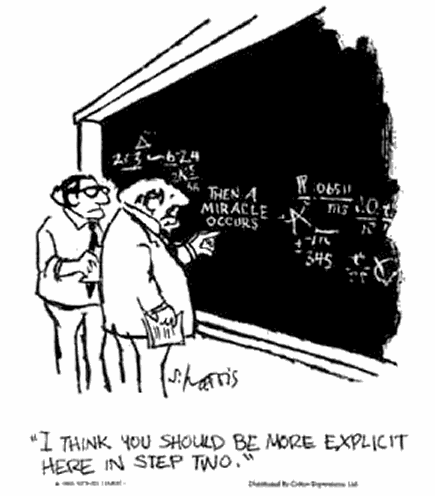
In every engineering company in America, stuck on a bulletin board or taped to someone’s cube, is this cartoon:

Everyone who’s worked in engineering or any kind of analysis has seen this sort of reasoning on projects; you start with parameters, end with a conclusion – and the details will get filled in later, once the stakeholders conquer than whole “Miraculous” thing.

It totally applies today.

——–

The Governor announced his new stadium plan today.

And if you, like me, have been adamant about not spending any public money on enriching Zygi Wilf – well, it’s mostly bad:

The officials were quick to announce the plan does not include any new taxes and includes a hefty contribution from the team.

Dayton said Rosen described the package as “the best deal available that’s possible.”

Dayton said the Legislature and the city must decide whether the state wants to be involved with professional football.

“I believe it does,” Dayton said.

Dayton said he will communicate with the Minneapolis City Council about the package shortly.

Under the “term sheet” announced today, the costs are divided 56 percent public, 44 percent private to put the facility up.

The problem?

For starters, as Gary Gross has been reporting for some weeks now, the public portion of the plan not only relies heavily on electronic gambling proceeds.  The plan presumes that revenue from these sources is going to boom – but it’s been drastically down in the past decade, over 20%.  The plan is to take all the new revenue and hand it over to the Vikes.

And that’s just on the state side.  The other public pillar of the plan involves the City of Minneapolis.

Minneapolis Mayor R.T. Rybak explained the sales tax structure and urged approval of the package.

But Doug Belden and Dennis Lien didn’t explain it.  It involves diverting the city’s convention center tax – and the City Council has already said no, no, a thousand times no, well, a thousand times.  Rybak is talking, as they say in Latin, de anus.

(Which may be one of very few cases where phrasing something in Latin is actually more gauche than the Englsh original, “out his butt”).

And like the cartoon above, this deal requires several miracles to occur.

The Minneapolis City Council needs a 180 degree change of heart on the “sales tax structure” that Mayor Rybak glossed over.

The charitable gambling market needs to counter its recent history, and not only expand, but hit a major boom.

And, by the bye, the Tribes need to not send squadrons of DFL assassin ninjas out to exact revenge for further eroding their monopoly on gaming in the state.  Which you know, if you follow the interactions between the tribes and the government at all, is about as likely as Ryan Winkler winning an arm-wrestling match with Jared Allen.

This “Deal” is no deal. It is vapor.  It counts on a miracle occurring.

And the City of Minneapolis, the Tribes, and the laws of economics have all outlawed miracles.

UPDATE:  A Capitol Hill wag wrote me: “it would be interesting to track the history of revenue projections from electronic pull tabs. seems rather variable, as in it seems to grow to fit whatever dayton wants to use it for. funny that estimates for gop initiatives never do that.”

I’m sure MPR’s “Poligraph” will get right on that.


In The Governor’s Court

Thursday, March 1st, 2012

The Gun Owners Civil Rights Alliance sends us this reminder:
“You’ve sure been posting a lot of calls for people to call people, Mitch”.

Yep.  That’s grassroots politics.  You get your people to show up – on the phone lines and in the mail bags while the sausage is being made, and then again at the polls when it’s time to give your politicians their thumbs up or thumbs down.

So let’s do this.

Remind the Governor that he ran as a “pro-Second Amendment” guy two years ago.  And not just as some chucklehead hunter; no, he sold himself as a self-defense shooter.

And tactfully remind him that his ‘law enforcement” sources are uniformly filled to capacity with sh*t are in error about the whole “legalizing murder” bit, and that we all know it.

We’re here.  We’re shooters.  We’ve swung elections before; we’re why Rod Grams went to DC, and why the GOP took the House ten years ago.

And we’re not going away.

And we prove that by, well, not going away.  By being his worst f*****g nightmare, on the phones today, and at the polls this fall.

Rewarding Failure

Monday, February 27th, 2012

Not long before the 35W bridge collapsed, the bridge was inspected by an engineering company that gave the bridge – and its ailing gussets – a clean bill of heath.

And we know how that turned out.

Last week, a couple of cables on the Sabo pedestrian/bike bridge snapped, closing the bridge and, for several days, the Ventura Trolley.

The incidents have one thing in common; the inspectors on the old 35W bridge and the engineering consultants on the Sabo were URS Corporation of San Francisco.

What better way to hold an engineering company with this kind of track record accountable than award it a consulting contract for the state’s next big make-work money pit project?

That’s right – Mark Dayton’s Met Council is in negotiations with URS to consult on their Southwest Light Rail line   According to a source in the engineering industry with direct knowledge of the Southwest LRT bidding process, the Met has gone through a round of cuts in selecting engineers, andURS is one of the contenders, if not the finalist, to get the job; the source used the term “final negotiations”.

I sent a request for information to the Met Council over the weekend, specifically asking what stage the Council was at, what firms were in contention, and if URS was one of them.  I got the following response on Sunday afternoon:

The Metropolitan Council is in the midst of evaluating proposals for the preliminary engineering contract for Southwest LRT with a recommendation to the Met Council targeted for mid-March.

I’ll give ’em points for speed.  But it didn’t really answer the question.

Let’s leave aside for a moment whether the SWLRT is a good idea (although it’s not); With the collapse of so much civil and government infrastructure work, local civil engineering firms are hurting; those firms employ a lot of good people.  At least one local firm was counted out of the race to work on the new LRT project, while San Francisco’s URS, with its record of failure on local projects, is apparently still in the running.

Why is the Dayton Administration denying work to local firms in favor of a San Francisco firm with two strikes against it in local civil engineering circles?

I’ll try the Met Council again later today, to see if they want the public to know what firms are in, what firms are out, and where they’re from.

This Is DFL Economics In Action

Friday, February 24th, 2012

Did you know Minnesota had a Lieutenant Governor?

Gotta confess, I’d pretty much forgotten about Yvette Prosser Sorum.  A long-time legislator from Duluth, she served Governor Dayton’s need for a politician with ovaries and a relentlessly party-line record, to try to shore up DFL support after defying the DFL endorsement process and beating Margaret Anderson-Kelliher.

Wait – it’s Yvonne Prettner Solon?  Whew.  That coulda been embarrassing.

But not as embarrassing as this bit here, where our “Lieutenant Govenror” tries to talk economics:

Lt. Gov. Yvonne Prettner Solon said the governor’s office wants all who are eligible to enroll in the program, which not only ensures Minnesotans have enough to eat and be healthy, but also helps the state’s economy.

“Every dollar of use of the SNAP program, there’s $1.73 that’s generated for our economy, which helps our grocery stores,” Prettner Solon said. “It helps our farmers. It helps everybody along the food supply chain.”

That’s right – food stamps help the economy!

Because the money that goes into food stamps comes from unicorns, brought to us in golden boxes.

It’s not like anyone had to pay for those food stamps (and the administrators who , well, administrate them) out of money taken from what they or their business had earned, right?

Well, not in DFL world, anyway.

This is a DFLer’s education at work.

Why Are Bakk, Dayton Taking Money From Children To Give To Zygi Wilf?

Thursday, February 16th, 2012

I’m not much of a gambler, personally – but I support legalizing it more broadly at a state level.  I support it because it’s a tax on people other than me.

Cynical?  Sure.  Pass the ketchup.

Seriously?  For better or worse, gambling has its place in Minnesota.  For over two decades, proceeds from pull tabs – the most pointless form of gambling in history, but I digress – have gone to supporting Minnesota non-profits and charities.  Everything from youth hockey to local job training programs benefit from pull tabs.

And now, Tom Bakk and Mark Dayton want to raid that pile of money to give it to Zygi Wilf, according to Gary Gross at LFR.

The clinker?  Bakk’s proposal – “E-tabs”, a zippier, more IPod-enabled version of pulltabs to attract the kids – will take money from a pot that’s already dwindling; charitable gambling is already off by a huge margin in Minnesota:

There’s more reason for concern than those mentioned by Wilson. This House Research report offers a stunning opinion. The title speaks for itself:

2006-2010: Industry under Stress

That’s just the tip of the iceberg. This information is troubling:

  • Since fiscal year 2004, gross receipts from lawful gambling have declined by over 20 percent
  • For fiscal year 2008, the industry reported its biggest drop in state gambling taxes paid—a 12.8 percent decrease from the previous year due to the drop in gross receipts
  • Total receipts have gone from $1.500 billion in 2000 to $1.032 billion in 2009, a decrease of about 31 percent
Gary notes the part that confirms Bakk’s boundless cynicism:

Let’s remember that Sen. Bakk, then the chairman of the Senate Tax Committee, knew this information when he proposed this ‘solution’ to the Vikings stadium situation. This information raises important questions, more than I can address in a single post. The biggest questions go to politicians like Gov. Dayton and Sen. Bakk.

The first question I’d want answered is this: why would Gov. Dayton and Sen. Bakk propose using revenues from an “industry under stress” the last 5 years?

Because gambling is a unicorn.

Not literally, like a flying horse with a horn.  But DFL financing is always built on the idea that some sort of magical unicorn – “gamblers”, or “the rich” – will bring money to them for their grandest plans, and all they have to do is say “heeeeeer, unicorn!”

So Tom Bakk hears “gambling”, and thinks “money for nothing”!

Conservatives know that there is no such thing as money for nothing.

And Gary would like to point that out:

The next question I’d have for Gov. Dayton and Sen. Bakk is equally simple: Why would they put funding for charities and school sports programs at risk?

Good question.

Well, Senator Bakk?  Governor åDayton?  What’s the answer?  And there really are only two choices.  And one of them is “screw the kids, if I don’t keep the Vikes here, my voters will have a cow”‘.

The Real State Of The State

Tuesday, February 14th, 2012

Governor Dayton will give the official State of the State address tomorrrow.

I figured I’d grab a jump on him, and – in my constitutional position as a freaking taxpayer – give the real state of this state.

You’re welcome.

Now – all rise.

———-

My fellow Minnesotans,

Thanks to eight years of responsible Republican – and conservative-enough – governorship, the state of Minnesota is doing…OK.   Unemployment is well below the national average.  Our schools, on a state-wide basis, don’t suck as bad as those in some other states.  As any good Scandinavian would put it, “we could be doing worse”.

But there is so much room for improvement.

Oh – you may be seated.  Sorry.

A good chunk of Minnesota’s establishment – government, educational, union and media – is stuck in the 1970’s.  It was an era when America had no economic competition – Germany and Japan were just starting to find their legs after World War II; China was still a Maoist dystopia; academic experts like Paul Ehrlich thought that India would be so wracked by starvation that it would always be what Somalia is today.

And in that environment, everyone got spoiled and fat.  The unions got used to demanding and getting pay and benefits around the country that were easy to support – provided we had no competition.  And American government, after three decades of aiming toward cradle-to-grave welfare, finally achieved it.

We did the same here in Minnesota.  Our business climate settled to favor big businesses, the kind that “partner” with big government the way that remora fish “partner” with sharks.  Our welfare state turned our cities into warehouses for the poor – an endless homework project for the state’s social service system, for which they’re always taking a grade of “incomplete”, claiming “the dog ate my homework”.

That, unfortunately, is exactly where one of our major parties, the DFL, is stuck.  They have not had a new idea since 1974.  Their entire worldview is centered around the idea “if we pretend it’s still 1978, maybe it’ll all be OK!”.

Minnesotans took a huge step toward reality in 2010.  We elected two chambers full of people who know that times have changed, and we have to stay ahead of the changes in the world around us, rather than just ignore them.

Oh, 8,000 Minnesotans who should have known better believed what the Alliance For A Better Minnesota told them rather than their own lying eyes.  And that’s being charitable; if I were a betting man, I’d say that if you left out all the ineligible voters, repeat voters and felons, it would have been Mark Dayton looking at an 8,000 vote deficit.  But that’s just a hunch.

So today we have a split government; a legislature with a powerful mandate, dividing power with a weak governor whose own party basically treats him like a coffee enema; he did beat their endorsed candidate, after all.

And so the DFL does what it always does when it’s up against the ropes; it lies.  The Alliance For A Better Minnesota – essentially a PR agency for what the “Occupy” movement, if you remember them, call “The One Percent” – has basically taken over the DFL.  And you can tell they’re lying when you see their fingers moving over keyboards, or whenever you see Denise Cardinal or Carrie Lucking on the TV.

And have any of you actually seen Denise Cardinal or Carrie Lucking in the same place?

And the media does what it always does when the DFL is up against the ropes; its editorialists declaim endlessly on the virtue of compromise.

My fellow Minnesotans, in response I say two things.

Number one?  Doy.  Compromise is part and parcel of politics.  But it’s something you do after you have the debate.  And when you debate, you bring the strengths of your own case, and explore and exploit the weaknesses in your enemy’s case. And you do your best to work the compromise in your favor – meaning, obviously, in favor of the agenda for which you were sent to office.  In other words, compromise is a negotiationl. And negotiations are always best made from a position of strength.

And so the GOP must use our strength – numbers, evolving demographics, mindshare – to make sure the “compromise” we get reflects the fact that we won.

And number two?   Bull pucks.  We won.  And we’re going to legislate like we won – like a a party with a vision for a much much better Minnesota – a Minnesota that’s not dependent on state handouts, a Minnesota that works and prospers.  A Minnesota that keeps Big Brother’s passive-aggressive benevolence in its place – there to take care of its allotted business, and there for emergencies, doing its mandated job.  And no more.

So what do we do this session?

The agenda is simple.

First – pass Reform 2.0.  Make government more user-friendly, especially for business.  Our permitting process is a sham.

Second – pass Zero Based Budgeting.  Our current cost-plus budgeting not only guarantees that we will soon not be able to afford our government, it also puts the our government – our “servant”  – in a position of being in arrogant, hectoring control of the whole state; of saying “you, the peasants, serve us first, and yourselves last”.  We need to flip that around.

Third – No budget increase.  We’re at 35 Billion. That is plenty.  Not one dime more.  Not even if the revenue forecast rises.  Minnesotans are working hard – and if the economy grows, the temptation is there to turn that into more revenue for government spending.  No.  Bullshit.  Rebate all surpluses.  And not via the DFL’s convoluted targeted rebates; rebate them in exact proportion of state income taxes paid.  If you pay in, you get back.  If  you don’t, then you already got lucky once; give someone else their turn.

Fourth – Reform our voting system.  It’s not just Voter ID – although that’d be a great start.  Abolishing vouching would also be a great next step.  Isn’t the franchise – for which so many hundreds of thousands of our ancestors fought and died – and the integrity of the election system that determines who runs our democracy, worth a tiny little bit of administrative conscientiousness on the part of someone claiming to be a “citizen” today?

Yes.  Yes, it is.

Fifth – Pass Representative Cornish’s Stand Your Ground bill.  I put it in my State of the State address for a reason; it’s not that it’s necessarily the fifth most important bill on the entire raft of legislation facing this state.  But symbolically, it’s a vital priority.  After reforming our government and our budgeting process and  holding the line on spending, letting government know, once and forever, that we the people are sovereign, and that our right to defend our lives and families supersedes both criminals’ peace of mind and prosecutors’ convenience, is vital.  Criminals should be afraid to go out at night – not we, the people.  And it’ll be a lovely thumb in the eye of the Metrocrats.  They deserve it.

Sixth – get the Met Council out of the rail baron and utopia-planning businesses.  In a metro with cheap land and horizontal sprawl, light rail makes no, zero, nada sense.  And forcing people into high-density developments to justify those rail lines is downright stupid – not just a waste of money, but a vile overreach on the part of government.

In Mitch Berg’s Minnesota, the government is the servant, not the master – and we, the people, continually affirm it.  Just like training a dog; if we, the people, give the government constant, consistent discipline, it might just learn its place and be useful enough not to put down.

Although government, like any dog, must know that if it craps on our carpet again, it’s going in the car for that drive “out to the country”.

In Mitch Berg’s Minnesota, government scrimps and saves, and the people keep most of what they work for.  We have the government we need, not the government the governing class wants.

In Mitch Berg’s Minnesota, the people work out a compromise with government from a position of strength, and the government knows its place.

And that’s the state of the State of Minnesota.  It could be worse.  It should be much better. And only Mark Dayton and his one-percenter minions stand in the way.

So to sum up the whole address; let’s show this state who’s boss.

Thank you.  God Bless Minnesota, and God Bless America.
Chanting Points Memo: Nothing Here But Us Extremists

Monday, February 13th, 2012

I was out of town last week during Governor Dayton’s frankly weird performance, referring to supporters of the “Right To Work” amendment as “Extreme”.

More on that – it ties in closely with my piece on the DFL’s new PR effort to flood the state with unsupportable memes on wedge issues designed to fool the uninformed and gullible – later this week.

It’s just interesting to note how many “extremists” there are out there, according this SurveyUSA poll covering Minnesotans’ attitudes on the Gay Marriage, Right To Work and Voter ID amendments seem to show that a majority of Minnesotans are, by Governor Dayton’s self-indulgent standard, “Extremists”.

Let’s go through the numbers one issue at a time:

Marriage Amendment

This is the weakest of the bunch so far; it’s winning by 47-39, and over the top in most of the cross tabs (other than 18-34 year olds, cell phone users, Democrats, Liberals and people making over $80K a year).

This is in line – and maybe a little better – than the results I found in the fall of 2010, when a Lawrence Poll showed that Minnesotans’ preferences swung strongly to Tom Emmer when they were clear that Emmer supported referenda or legislative rulings on the issue, while Dayton and Horner both supported legislating the issue from the bench.

The problem is that these numbers aren’t nearly good enough to pass the bill, given one quirk in Minnesota’s law when voting on constitutional amendments; blank votes are counted as “no” votes.  Everyone who supports an amendment must vote affirmatively “yes”.

So let’s assume the numbers in this poll’s “Not Sures” – 4% overall – break evenly between Yes and No on election day, bringing the actual results to 49-41 in favor; then “Not Votes” stay on the sidelines, becoming “No” votes, making the final vote a bare 51-49 against.  That’s not counting “Ritchie Votes”: the dead, people being vouched into multiple districts, people who aren’t legally entitled to vote, and the like.

Even without that, the measure loses by default. By this count, the Marriage Amendment needs to arf up at least three more points – five as insurance against “Ritchie Votes”.

With a state this polarized, it’s a tall order.

Right To Work

Minnesota is much less polarized here – and it shows.  Governor Dayton’s memes on the subject have been more fact-free and desperate than usual – “right to work states have lower wages!”, he declared, ignoring the other context (closed shop states tend to be more urban, coastal and have much higher costs of living as well as wages) – showing how hard the DFL is going to have to dig for votes on this issue.

“Right To Work” leads 55-24% overall.  It leads in every single cross tab – the narrowest is 35-32 among identified liberals.  Bad news for the DFL – it leads among women even more than among men; more among the young than the old;

More importantly?   Even if you take the 12% “not sure” vote and split it evenly among “Yes”, “No” and “Not Voting” , the numbers become 59-28-13, which really means 59-41 (remember, blank votes become “No”, as noted above).  Even if every undecided voter decides to side with the unions – in other words, the hopelessly unrealistic breaks, things about as likely as me getting a third date with Amy Adams – or just sit the issue out, the issue ends up at 55-45.

It’ll take a lot of “Ritchie Votes” to beat “the extremists” on this issue.

Photo ID

Perhaps the best news of the poll is that the left’s idiot memes about Voter ID – “it disenfranchises the poor, the elderly and college students – are falling not so much on deaf ears, but ears that mock their idiocy.

During the 2010 campaign, the meme of the right was that Voter ID had 2-1 support in Minnesota.  The SUSA poll shows it’s actually 3-1 with a bullet; the measure currently leads 70-23.

The cross tabs?  Again – the measure is more popular among women than men (73% of women favor it, vs. 66% of men); more among younger voters, with a 77-20 lead among 35-49 year old voters); more among the educated (71-24 among college grads ys 63-23 among high school grads); about evenly across all income bands; even by 69-24 in the Twin Cities.

Most significantly?  Only 4% of Minnesotans are undecided on the subject, and 4% more claimed they’ll “not vote” on the issue.  Even if every single undecided voter is convinced to vote against the issue or sit it out, the measure passes 70-31%.

Even Mark Ritchie will have a hard time rigging this one.

Takeaways

Caveat up front; the conclusions below presume the SUSA poll is accurate.  The poll is of registered voters, rather than likely voters, which is inherently less accurate on the one hand, but traditionally skews things to the left on the other hand; for purposes of the conclusions below, I’ll presume those two factors roughly cancel each other out.

GOP legislative candidates need to closely align themselves with the Right To Work and Photo ID issues.  They need to hammer on their support for Right to Work and Voter ID, and the positive things that both bring to this state – more jobs, and an election system with actual integrity (although Voter ID is only one of many reforms needed).

The Marriage Amendment strikes me as a loser for GOP candidates – not because it’s off the ideological beam (although as a libertarian conservative, I’m less enthusiastic about it than some Republicans), but because presuming that this poll is accurate, candidates will spend more time and effort supporting the amendment than being supported by it.  By tying themselves to amendments that seem likely to pass overwhelmingly and which show the deep wedge between the DFL and the GOP, on issues where the DFL is both wrong and diametrically opposed to a crushing majority of Minnesotans, the GOP wins free votes; the Marriage Amendment will cost time and effort to prop up at the polls.  Not to say the votes can’t be found, but it’s going to take a lot of time and effort – which is the job of the various pro-marriage groups, not candidates.

The other takeaway, in light of the Governor’s prate and gabble on the subject(s)?  In every case, with all three of these amendments, the conservative, “extreme” position is the mainstream.

But we knew that.

See more on the subject from Ed Morrissey.

Chanting Points Memo: “The People Love Dayton And Hate The Legislature!”

Tuesday, January 31st, 2012

This particular chanting point has been making the rounds this week – a “Public Policy Polling” (PPP) survey appears to show that Mark Dayton is dreamily popular, and the people just can’t stand the GOP-run legislature.

It’s made the rounds of most of the mainstream media, the leftyblogs, and the lowest of the bunch, the  City Pages.  I figured I’d pick on Dave Mindeman at mnpACTttp and his take on it because unlike way too many Twin Cities leftybloggers, he’s articulate, recites the chanting point pretty much verbatim, and is otherwise not an idiot.

Mark Dayton’s numbers have improved since PPP last polled Minnesota in May and he’s one of the most popular Governors in the country.

Now, the numbers would seem to bear that statement out.  Let’s unpack them before we move on.

In observing PPP polls over the past couple of cycles, their results seem to consistently fall a little to the left of how Minnesota reality eventually shakes out.  Not in an egregions-to-the-point-of-fraud kind of way, like the Humphrey Institute or Strib Minnesota polls, but it’s noticeable.

I also think – and this is a theory, not something I’m stating as fact, but a decade of observation has led a lot of us on the right to wonder if there’s something to it – that liberals are much more prone to answer polls, especially in between election cycles.

Let’s ignore both of those for the moment.  Let’s talk about the surface indicators for this polling:

A little belated birthday present for Mark. Dayton has an approval rating of 53%, while disapproval is at 34% — a 19% spread.

The numbers have led Mindeman – and most other lefties – to a misleading conclusion.  Not wrong – I’m not telling people not to trust their lying eyes – but there’s more in those numbers than meets the eye.  Mindeman and the rest of the lefties are ignoring a key bit of American political behavior.

The poll covers the time between the shutdown and the present – when Dayton really didn’t do anything.  For that matter, he really didn’t do anything during the last session, or the shutdown.  He’s been for the most part a non-entity.  And if you don’t do anything – either positive or negative – then your numbers are going to be juuuuust fine.  Or at least fairly steady.

(Opposite case in point – Tim Pawlenty, who fought a two-court DFL advantage in 2009 and 2010 with aggression and passion.  He did not sit in his office drinking Kombucha or, given his hockey-playing pedigree, PBR, and his poll numbers showed it.  They were “lived-in”.  Who was a better governor?  Depends, now, doesn’t it?)

During the session, and the shutdown, it was the Legislature that did all the heavy lifting.  Dayton sat in his office, released the occasional demand, and until his final, fatal tour around the state, where he realized that getting behind his own plan would be political suicide, really did nothing.  And after that tour, when he folded his cards, he did so quietly, minimizing if not the GOP’s victory at least his own defeat.

In other words, he’s played defense.  He’s sat back and let the other guys take the hit.  The media, naturally, abet this behavior.

And in a state as polarized as Minnesota is, when you actually do things, you will take the hit – especially given our DFL-owned-and-operated media, whose interest in fluffing Dayton is obvious and constant.

And the Legisature has done things – affirmative things during the session and the shutdown, many of which pissed off Democrats and a few of which irritated the more conservative, and also not-so-affirmative things that have been all over the news lately.  Of course, sitting back and being passive-aggressive, like Dayton, was not an option for the Legislative branch; they were sent to Saint Paul on a mission, and the mission wasn’t going to get done without some serious action, and given the number of GOP freshmen who said they didn’t care if they only served a term, some fallout was to be expected.  It was inevitable.

But there’s more.

Dayton may get himself an easier legislature to work with next year. Democrats lead the generic legislative ballot in the state by a 48-39 margin. If that holds through November they should win back a whole lot of the seats they lost in 2010. It’s not that legislative Democrats are popular- only 31% of voters have a favorable opinion of them to 49% with a negative one. But legislative Republicans have horrible numbers. Their favorability rating is 23% with 62% of voters viewing them negatively. That honeymoon wore off real fast.

And here Mindeman and the rest of the metro chattering class fall into the seductive charms of drawing using high-level data to draw high-level conclusions on low-level questions.  Mindeman – and the entire regional left – have scoped the data wrong. I suggest.  The fact is that “generic” never manages to get endorsed to run for the Legislature.

The Legislature will take popularity hits – they, as a body, did all the work.

The Legislature, as a body, will always lag a do-nothing governor under those circumstances.  Just like Congress does.

But aggregate polls of the entire Legislature – those mythical “generic” legislators – are meaningless, just like aggregate polls of Congress.  People may want to vote the bastards in general out, but people tend, generally, to support their own bastard.  There are exceptions – they voted a lot of incumbent “bastards” out in 2006 and 2010 – but as a very general rule, unless you have a wave election, incumbency has its virtues.  This election may be many things – it may return both chambers of Congress to the GOP – but I don’t think anyone’s predicting a wave yet.

Tack on the fact that PPP polls trend left, that poll respondents this early in the cycle trend left, that the PPP poll was of registered voters (who always trend left), and the fact that the poll is meaningless, and the additional fact that redistricting – provided that it reflects actual demographic shifts rather than the DFL’s rhetoric – should favor the GOP, and I’m a lot less worried about this poll than the DFL, media (ptr) and the chattering classes want you to be.

And despite those numbers the GOP legislature continues to play ultra partisan games.

Well, yeah, Dave.  They know the numbers are meaningless.  So does the DFL.

And Now Let Us Further Wallow In Nudging, Nodding And Finger-Pointing

Thursday, January 19th, 2012

The Strib  is usually pretty diligent, if not necessarily artful, about clothing its appeals to its institutional self-interest – but as they show in Tuesday’s editorial, they’re not above the naked appeals to self-interest, either:

(We hope the governor applies that thinking to the question of where a new Minnesota Vikings stadium belongs.)

Yep. I bet they do.

I bet there’s a parcel at 425 Portland they’d just loooooooove to have the governor “apply his thinking” to.

And Now Let Us Wallow In Metaphor

Thursday, January 19th, 2012

I found this quote in yesterday’s Strib editorial about Governor Dayton’s bonding bill to be oddly revelatory:

“I learned from my father and my uncles, who were pretty successful job creators in Minnesota, the importance of focusing on downtown. … If you lose the core of the downtown, you lose the vitality of the region.”

He’s talking, of course, about spending bonding money downtown – the same kind of bonding spending (at various levels) that’s helped to bring all sorts of government-blessed downtown-saving ventures as Urban Renewal, the clearing of the Gateway, Riverplace, Saint Anthony Main, Mississippi Live, the Conservatory and Block E to Minneapolis’ core.  And we all know how those worked, don’t we?

But there’s a germ of revelation in that quote.  No, not that Dayton learned anything about business – clearly all business sense in the Dayton family passed on with the Governor’s ancestors.

But Dayton – and the DFL – learned everything they knew, and know, about the economy at about the same time that the Daytons chain of stores was at its commercial and social peak, in the forties through the early seventies.

It was a time when…:

  • America was the only economy, both worldwide and regionally.  American companies faced little competition around the world, since Europe and Japan were still recovering from World War II through the sixties, and China was mired in the worst excesses of Maoism through the eighties.  It meant that…:
  • American Union Labor Was King: Since American business had no competition, it could pay American Labor what it demanded in wages and (especially) pensions.  Like American government, American business and labor spent like there was no tomorrow – because they didn’t think there was one, at least in terms of “the world changing.
  • Minnesota Dominated The Region: Minnesota was the only significant commercial center between Chicago and Denver.   Today, of course, we are surrounded by thriving regional centers – smaller, perhaps, but much more nimble and forward-looking; Fargo and, of course, Scott Walker’s Wisconsin.
  • Downtown was the only town: Back when Daytons was king, Minneapolis’ only competition was downtown Saint Paul (back before Urban Renewal tore the city’s guts out) – and they put a store there, too.  It worked – because through the sixties, Minneapolis and Saint Paul were where the people lived and worked.  Now, of course, both downtowns compete with huge shopping centers at the MOA, Burnsville Center, Apple Valley’s mass of stores, Southtown, Southdale, Eden Prairie’s huge commercial center, Ridgedale, Maple Grove’s immense Arbor Lakes area, Brookdale, Rosedale, Maplewood, Albertville, and the sprawling commercial expanse in Woodbury – all of which benefit by being where the people are, these days.  Minneapolis and Saint Paul are shrinking and getting poorer (thanks to decades of DFL hegemony); the burbs are getting bigger, and people just plain want to shop near home, barring the odd adventure.

So Dayton is right – if he climbs into a time machine and zooms back to 1955.  Today?  Not so much.

But the world views of Dayton, and the people and institutions that support him – labor, Alita Messinger and all her Rockefeller money, the Alliance for a Better Minnesota – all formed back then, in a time when American business, centered “downtown”, dominated a bomb-ravaged world; when government and business all had all the money they needed; when Minneapolis and Saint Paul towered above humble and prostrate prairies and poor hardscrabble mining towns.

The world changed.

The DFL and its minions didn’t. They got left behind.

And everybody knows it but them (and the 50% + 8,000 people who were gulled into voting for Dayton in 2010), and who apparently never figured out that Woodbury exists, that Germany and Japan and India and China have thriving economies, and that you can’t pay a guy $60,000 a year and a lifetime pension to bolt on headline bezels and expect to sell affordable cars anymore.

Kombucha Out; Koolaid In

Wednesday, January 18th, 2012

The Strib, mirabile dictu, reaches the same conclusion I did about Dayton’s “Jerbs Bill”, although a good deal more gently in this editorial:

Last week, Dayton dressed up his biennial bonding request as a “jobs bill,” and linked it with another short-term stimulus idea: a proposed one-time tax credit for employers who hire a new veteran or recently graduated or unemployed Minnesotan before June 30, 2013.

That credit — $3,000 this year, $1,500 the first half of next year — is probably too small to convince employers to shoulder the long-term commitment that hiring entails. Dayton would do better to focus on building long-term prosperity, and to cast his bonding bill in that light.

Which is exactly what I wrote on Friday.   The tax credit – as Ed pointed out on the show on Saturday – might reinforce some larger companies’ decisions to make hires they were going to make anyway, but it’s not going to affect small-business hiring in any substantial way.

The Strib; last week’s criticism of Dayton, next week.

But they’re all aboard with the $775,000,000 bonding bill – which is actually on top of the $500,000,000 in bonds floated in the last session.  They just think it’s the wrong argument:

But the argument Dayton made Tuesday as he unveiled his wish list was backwards.

“This bonding proposal is about putting thousands of unemployed Minnesotans back to work,” the DFL governor said at the top of his media briefing.

Only after touting the short-term gain for the construction industry that comes from state building projects did Dayton add: “The bill is also about investing in the future of our state.”

It’s not often I shrug my shoulders and say the Strib got something right.  But they are; Dayton’s “Jerbs Bill” at best creates a few thousand temp jobs (almost entirely to benefit his construction union benefactors) that we’ll be paying for for the next three decades.

But the Republicans make a good point: Short-term construction job gains — even the 21,700 jobs Dayton says his proposal would create — aren’t sufficient reason for the state to shoulder 30 years of debt service.

Now, bonding is a perfectly legitimate activity for state government; we’ve always paid for our major projects with the even-year-session bonding.  If we’re smart, that bonding pays for long-term capital expenses we actually need.

So what’s the shopping list of things that’ll foster all this long-term happiness?

For example, $42 million is devoted to clean-water infrastructure projects requisite to industrial expansion.

It’s worth looking at.

Higher-education buildings, many of them sites for science and technology education, comprise 22 percent of Dayton’s recommended total.

When the Strib throws in the “…many of them…” qualifier, it means it’s time to look the bill over; I suspect there’s a “Many more of them are site for administrative deadwood and PC fripperies”.

Investing $25 million to repair local bridges draws down $50 million in federal funds while keeping goods moving to markets.

Remember when the 35W Bridge collapsed?  All the caterwauling the Dems did about the need to update the state’s most critical infrastructure?

That’s about 3.3% of the bonding bill.

And guess what is going to get exactly the same amount of money?

The biggest lever for federal and local funds is the $25 million Dayton asks the Legislature to authorize for the next leg of the Twin Cities’ light-rail network, running southwest from downtown Minneapolis.

That’s a sufficient match to net $225 million in local and federal funds, a major down payment on a 15-mile rail link between Minneapolis and Eden Prairie.

And so there’s your DFL priorities; as much money spent on a nearly-useless train (albeit marginally  more useful than the two we’re already stuck with) that will shackle Minnesotans to generations of long-term spending (expense and capital) for virtually no benefit is exactly on par with repairing the bridges that the vast majority of us use daily, and that all of our commerce depends on.

Dayton’s package is unabashedly pro-downtown — not just downtown Minneapolis, but also St. Paul, Rochester, Mankato and St. Cloud. He’s backing Nicollet Mall’s renovation, a new baseball “regional sports facility” in St. Paul, and long-postponed business-backed civic center projects in Rochester, Mankato and St. Cloud.

History teaches the value of keeping downtowns strong, Dayton said.

History may show it, but it probably won’t show it for very long.

There’s a place for bonding bills; building the infrastructure this state needs.

The Strib editorial board points out several times that Dayton’s emphasis on the plan’s dubious job benefits is a “mistake”.  Their intent is right, but their description is wrong.

The SEIU, AFSCME, Teamsters, MFT, IFO, MAPE, IBEW and the various trade unions all paid lots of good money to get Dayton into office.

Chanting Points Memo: Bring A Shovel!

Wednesday, January 18th, 2012

If the local leftybloggers have it right, the Governor apparently wants to staff up a bunch of do-it-yourself projects.

I first saw it on Minnesota “Progressive” Project last night – Governor Dayton has announced his “bonding plan”.

And here was the claim:

In contrast to the upcoming ballot measure open season the Republicans will be envisioning instead of working on a bonding bill, Gov. Mark Dayton released his bonding bill proposal today. Dayton’s plan would put 25,000 Minnesotans to work in every corner of the state. It would cost $775 million.

The reverberations throughout our economy of putting 25,000 people to work would be significant. These people would spend money in their communities, increasing the income of people in the service industries.

These are the almighty “infrastructure projects” that Libs are talking about these days.


But after our experience last week – where Dayton’s “Jerbs Plan” turned out to be a meaningless deduction equal to about a month of $15/hour employment – I remembered the great dictum one must always observe when reading liberal commentators:

Distrust, but verify.  Then, almost inevitably, distrust some more.

So I ran the “numbers”, such as they are.

The “plan” calls for $775,000,000, and will supposedly provide 25,000 jerbs.

So when you divide $775,000,000/25,000, you get $31,000 per job.

That’s a little under $15 an hour, on average (and probably lower, since presumably some of those 25,000 people will have to be DFL/union-connected bureaucrats to manage everything, who are just a little  more equal.

And when Eric “Big E” Pusey gushes (or, presumably, takes dictation from some Dayton Administration spokesbot the Alliance For A Better Minnesota) that…:

The projects included in his proposal are ‘shovel ready’ and would improve our state’s infrastructure.

…perhaps he should add that the workers will actually need to bring their own shovels – because creating 25,000 $14-and-change/hour jobs out of $775,000,000 leaves no money left over for shovels.  Or concrete.  Or macadam, asphalt, aggregate, or even paint.

Pusey’s number, in short, is baked wind.

Just like every number the Dayton Administration Alita Messinger and the Alliance For A Better MInnesota have put out so far this year.

Yeah, I know – Pusey’s probably conflating the phantom jobs in the Jerbs Bill with the fantasy numbers in the Bonding Bill.   I’m probably jumping on the wrong thing, because he’s probably writing taking dictation about the wrong connection.

More on that later today.

(With a tip ‘o the hat to Sarge, who did the math just about the time I was thinking about doing the math…)

If I Were Speaker Zellers…

Friday, January 13th, 2012

…and it’s a good thing I’m not

…but if I were Speaker Zellers, and Governor Dayton Alita Messinger and the SEIU brought Dayton’s Jerbs Bill to the House of Representatives to submit, I might respond something like this.

“With all due respect to Governor Dayton, there are laws against using the Legislature for campaign purposes.  And that’s all this bill is; a meaningless campaign slogan dressed up as a tax bill.  If this bill goes forward, the Campaign Finance Board will have to investigate the House of Representatives for making an illegal in-kind contribution to 134 DFL house races this fall.  Because that’s all this bill is, and that’s all it was ever intended to be”.

Again – it’s probably a good thing I’m not the Speaker.

Strib Editorial Board: “Feed The Rider, Starve The Horse”

Tuesday, January 10th, 2012

The Strib Editorial Board has declared itself in the bag for Mark Dayton and the DFL.

Not a huge surprise, if you follow these things.

More importantly, and much worse, it expresses the Minnesota Left’s real priorities.  Although it does it in a slippery, weaselly way designed to actively disinform voters – which, of course, is another way of supporting the DFL.

The state budget is set and in the black, if only temporarily.

But that hasn’t stopped DFL Gov. Mark Dayton from expounding on the virtues of the budget proposal he touted and the GOP-controlled Legislature spurned last May.

Those virtues include a bottom line that would remain in positive territory in 2014-15, according to a new “what if” analysis by the state Revenue Department.

Wow.  Positive territory!  That sounds good – right?

Let’s read on:

It applied the Dayton offer of last May 16, which included $1.8 billion in new tax revenue in 2012-13, to the latest forecast for 2014-15. Do that, and the $1.3 billion deficit that’s been forecasted for 2014-15 disappears, leaving a $35 million surplus.

Let’s be clear on a couple of things – since the Strib and the DFL (pardon the redundancy) desperately want the reader and voter not to be clear on them:

  • The “bottom line” they’re talking about is the state budget.
  • The “deficit” is the gap between what the bureaucracy wants and is demanding, and the revenue expected at current levels.  It is not a budget passed by a legislature.
  • We, the people, elected a legislature that promised to take a different approach to how this state handles budgeting; to give this state an intervention, and wean it from its addiction to limitless spending and the assumption that we’re just going to like it or lump it during a recession.
  • This charade has nothing to do with “bottom lines” in any sense that a business owner (or family budgeteer, for that matter) would recognize.  It’s about making sure that government’s various stakeholders – who are suffering from a few mild diet pangs after the last session – needn’t want for their least desire any more.

As long as we’re clear on that, we can move on:

Dayton was seeking an increase in taxes on the wealthy plus an equivalent sum in spending cuts back in May. (The Editorial Board agreed with that split between tax increases and spending cuts, but disagreed with Dayton about which taxes should be raised.)

And, as we showed back then, the “tax on the wealthy”, in addition to being callow, DFL style (again, pardon the redundancy) class-baiting, was BS.  It would not raise the revenue it claimed, even before “the wealthy” used their wealth to shield their income.

Like Dayton does.

Instead, the final budget deal rejected tax increases and employed two one-time measures, borrowing against expected future revenues and delaying payments to schools, totaling nearly $1.4 billion. When those two measures expire in June 2013, voila! The deficit returns.

Which goes to show you the GOP bent too far in the 2011 session; we should have cut the crap and held to the $32 billion budget.

Why reprise this argument now, when the 2012-13 budget is showing an $876 million balance?

Call it Dayton’s midterm election year kickoff. He evidently wants to remind Minnesotans that there was a better way to balance the state budget in 2011 than the one divided government delivered.

“Divided Government” – AKA “democracy”.

The Strib, Dayton and the DFL (ptr) case is this:  the state’s budget is more important than yours.  It is more important to keep government satiated than to give you, the overburdened taxpayer (and the state’s economy) a break.

The DFL/Strib/Dayton want to take food away from the horse – you, the taxpayer – and feed it to our rider.

And yet again, we’re going to have to tell them “no”.

And so it begins.

Lipstick On The Pig

Tuesday, January 3rd, 2012

The Strib editorial board made the latest installment in its effort to make Governor Dayton appear to be anything other than utterly worthless and an utter failure in the first year of his misbegotten term in office.

 “But the DFL governor’s overall performance to date has been strong enough to win over skeptics, rally support from unexpected sources and earn the grudging respect of partisan opponents.

Who – Kelliher and Entenza supporters?

He has turned his political slogan — “Building a Better Minnesota” — into a credible description of not just intentions, but accomplishments.”

I was going to fisk the Strib’s fluff-job – but Luke Matthews already did it over at True North.

And his response was about the same as mine:

Huh?

Did someone set a bale of marijuana on fire in the offices of the StarTribune?  Rather than rebut the entire article, which is as laughably contrived and fictional as to make Dr. Seuss blush, I’ll give a recap of Governor Dayton’s abysmal year as the “Face of the DFL.”

Governor Dayton was inaugurated in January of 2011 and since then his performance has been going downhill fast.  He slapped together a ridiculous budget with every kind of payoff imaginable to the public sector unions and his DFL political cronies.  He proposed a gargantuan increase in spending and a myriad of tax increases.  These tax increases couldn’t begin to cover his explosive spending proposals, but that didn’t deter him.  It wasn’t just unreasonable, it was ridiculous.

The legislature looked at the farce, turned on the shredders, and calmly inserted his proposal page by page into the garbage.  Not even the minority DFL caucus put up much of a fight.  The budget ignored reality, would have stymied economic growth in the state, and didn’t even pretend to be for the population as a whole.  It was a bad joke.

Beyond that?  When the Governor went on a whirlwind tour of the state to try to flog his idiotic budget and buttress support for his shutdown, The People shut him down cold, sending him back to St. Paul with his hat in his hand.

What this is is the beginning of the media’s effort, as unpaid arms of the DFL, to try to make Governor Dayton appear to be a capable,much less formidable, opponent for the upcoming session.

Out For Drinks With “Lucky” Carroll

Friday, December 30th, 2011

I met my old friend, Inge Carroll (whom everyone calls “Lucky”) at a local watering hole to compare notes about politics the other day.  Lucky is a DFL operative.

CARROLL: So did you see teh article?  Teh Republican party said came into offices saying they were going to create jobs,but they have cost 16,000 jobs!

MITCH: For starters, why do you always pronounce “the” as “teh” after you drink cosmpolitans?  And then, huh?  You’ve missed the news? Minnesota’s unemployment rate is down.

CARROLL:  You are teh lier!  Didn’t you hear it on teh MPR?  Teh Republican policies have cost 16,000 jobs!  That means all of you Rethuglicons are TEH LIER!

(CARROLL orders another cosmopolitan)

MITCH: Um, what on earth are you talking about?  Minnesota is recovering from the recession faster than other states, largely because the GOP stood off Dayton’s orgy of taxes and regulations.

CARROLL:  Hah!  You didn’t read the article, did you?  You don’t even know what I”m talking about!

MITCH:  Well, that’d make two of us, if it were true – but yes, I read it. It says that because of LGA cuts, local government are having to either raise taxes, or cut government jobs, or both.

CARROLL:  Yep?  16,000 jobs!

MITCH:  OK.  Well, sorry to hear that – being out of work sucks. But what, you think government jobs are sacrosanct?

CARROLL:  Oh, I think people kind of like having teachers and firemen and cops and services.

MITCH:  Well, at face value, it looks more like people in towns around Minnesota like to have them – provided they can get someone else to pay for them.  When they have to pay for them themselves, not so much.

CARROLL:  (Glares at MITCH):   Why do you hate the troops?

(And SCENE).

Lucky had to get back to her job at “Alliance For A Better Minnesota”, where she power-sands memes.

Surplus: Second Thoughts?

Friday, December 2nd, 2011

I got a bunch of responses over yesterday’s piece on the $800-million-and-change budget surplus announced yesterday.

Joe Doakes of Como Park writes:

Yesterday, we were told to expect a budget shortfall of a nearly a Billion dollars. Brace for cuts.

Today, we’re told we have a surplus of a nearly Billion dollars. Spending spree!

That’s a swing of TWO BILLION DOLLARS overnight.

Two things:

A. How can the preliminary estimates be off by that much money? And

B. Do you wonder why I have absolutely no confidence in this administration?

Joe Doakes

Como Park

Lack of confidence in the Dayton regime is always, always justified.

Others wrote – via email, twitter and in the comment section – that the sudden increase smells like a ploy, and I did my endzone happy dance too early.  It means either…:

  • Dayton told his Management and Budget office to show a surplus to help bail him out on the stadium issue, or…
  • …he told them to find some more money so the GOP would relent on spending; since he can’t browbeat them into raising taxes, he’ll try browbeating us into spending money, that, quote, “we already have”.

My answer: doesn’t matter.  If the surplus doesn’t exist, the Governor needs to be called on it.  If it does, it needs to be rebated to the taxpayers, or at the very most pushed to the schools to eliminate the DFL’s big shrieking point the “budget shift”.

At any rate – either way, the Legislative GOP majority needs to stay the course that it was sent to Saint Paul to carry out.

The Republican Surplus

Thursday, December 1st, 2011

Minnesota Management and Budget announced today that, notwithstanding original reports that today’s budget forecast was going to be a billion dollars light, today it was announced that the state is 876 million in the black.

Let’s be clear about something; we have this surplus because the state’s economy grew.  And it grew because Mark Dayton’s gigantistic spendthrift agenda was thwarted in the Legislature.

And the credit goes to two groups:

  1. Minnesota’s businesses, for hiring people (or at least hanging on and laying off fewer of them), keeping them working, and paying for that work.  I think it’s safe to say they did this because of the efforts of…
  2. The GOP-controlled legislature, for holding the line on the budget even as well as they did.  While – as the Strib notes – economists note we’re not out of the woods economically, especially because we are tied to the national and international macroeconomy, it could have been a lot worse.  (And with an 8,000 vote swing, it could have been a lot better, but we can’t cry over spilled milk).
Expect a couple of things in the two months before the session starts:
  • A lot of DFL gargling about how it’s not really a surplus, since it was “balanced on the backs of property taxpayers and the poor”. Call BS on that; property taxes are set by city councils and county commissions and school boards; Local Government Aid, our state’s redistribution of wealth from the parts of the state that don’t work by the parts that do, is getting reformed; cities and counties – mainly Minneapolis, Saint Paul and Duluth – are going to have to start justifying their waste with their own taxpayers, rather than laundering it through the state.  (Did you notice how the parts of the state that don’;t get LGA raised their taxes less than the parts that do?)
  • The Vultures will be coming out to feed.  Did I say “vultures?”  I meant “Vikings”.  Expect not a few Grain-Belt-addled weekend statists to say “Hey!  We got a billion bucks to spare!  Let’s build the stadium right now!”.  No.  No, a thousand times no.  Any Republican who puts Wilfare on the agenda is going to have at least one blogger slagging him and his entire anscestry until the 2012 election, and doing his best to lead a group line-dance on his or her political grave.

Let’s call this for what it is – a huge win by the Minnesota Legislative GOP Caucus, and for the Minnesota taxpayer.

Let’s make sure we Real Minnesotans spend the next 11 months making sure the rest of Minnesota understands that.

Shutdown: Let’s Do It Again

Wednesday, November 23rd, 2011

Last summer’s government shutdown, according to Minnesota Management and Budget, was a wash:

A nearly three-week Minnesota government shutdown in July over a budget impasse left broad public frustration, but little impact on state finances, the state’s budget office said on Tuesday.

The longest and most expansive state government shutdown in Minnesota history left 19,000 government employees sitting at home and shuttered road construction projects, state parks, highway rest stops, the state lottery and horse racing tracks.

Costs for lost revenue from compliance with taxes, the lottery, the state parks and preparation leading up to the shutdown totaled about $60 million, but Minnesota also saved about $65 million in compensation not paid to state workers.

That, of course, was why the shutdown only lasted three weeks; Dayton left Saint Paul to go outstate, saw that nobody really cared, and realized that his gambit to squeeze Minnesotans into compliance with his tax-hiking platform was doomed.

Indeed the capsule summary shows a slim $5 million profit.  Here’s where I’ll call BS.  If the MMB – which is an executive office which reports to Mark Dayton – says it’s a $5 million profit, the state likely made out much better than that.

No, I have nothing to base that on – but experience watching the DFL-dominated bureacracy.  Which, in Minnesota, is both unsupportable and usually accurate.

Just saying.

Luca Brasi Speaks

Wednesday, October 19th, 2011

I haven’t written a lot about the Vikings stadium controversy.  Partly it’s because I have little to say other than “build what you want, but don’t use any taxpayer money”. Partly it’s because I’m too busy saying “Go Bears”.

And partly because Mr. Dilettante has it covered.

His series on the ongoing Arden Hills shakedown – up to seventeen parts and counting – touched on the visit to Minnesota by the NFL brass who, in an example of the worst optics I’ve seen in this sort of a situatiion since the CEOs of GM and Chrysler flew to Washington in corporate jets to talk with Congress, pulled up to the site of the shakedown talks in a limo.

And he commented on the remarks by the NFL’s spokesman, former Goldman-Sachs employee Roger Grubman:

And in case you were thinking that the Los Angeles option isn’t real, Grubman offered this bon mot:

“To me, if I were a Minnesotan, any alternative other than Minnesota would be equally as bad,” he said.

Got the message? That Grubman is crazy, man. You don’t know what he’ll do. He’ll move the team to Wichita if that’s what it takes. He’s nuts and he’s serious. He’ll take your team away in the blink of a gimlet eye. You better pony up, rubes valued citizens of Minnesota.

So the question is out there. Do we build Zygi World in Arden Hills on the old ammo dump site? Or does the NFL drop the bomb? As much as we’ve all tried to pretend otherwise, I suspect we all knew this moment was coming. The NFL and the Wilfs are going to give Minnesota one chance to answer.

Of course, Jacksonville has worse financials and is a market that, unlike Minnesota, has almost no NFL tradition and doesn’t have a fifty-year record of selling out games even during turkey seasons like this one.  Rationally, they are a much better candidate to move to LA.

But the NFL, and our DFL governor, don’t want you to think rationally about this. They want you bouncing between hazy purple and gold nostalgia on the one hand, and Grubman’s little leash-yank on the other.

Read Mr. D’s whole series.

The Later Debate

Monday, October 3rd, 2011

Why, yes – I did spend a bit of time talking redistricting over the weekend, now that you mention it.

On the NARN, it was my pleasure to interview MNGOP Chair Tony Sutton and his deputy, Michael Brodkorb (punctuated by a surprise appearance by Wisconsin governor Scott Walker; I’ll be posting the podcast link as soon as I find it) about the redistricting process and all the outside money the left is pouring into Minnesota to try to skew the process in their favor.

And then, last night, I drove out to Ramsey to appear on “The Late Debate” with Jack Tomczak and Ben Kruse.  I was on a panel with Gary Gross of Let Freedom Ring, Mike Dean of “Common Cause Minnesota”, and Kent Kaiser, who is part of Draw The Line Minnesota’s (DTL-MN) “Citizens’ Commission”.  In the interest of accuracy, I’ll note that in my piece last week, I lumped Kaiser in with the Commission’s liberal hypermajority, because I personally didn’t know any better; Kaiser is of course well-known in GOP circles as one of the good guys; I regret the error…

…especially since he was the unquestionable star of last night’s debate.

I’m not going to try to reconstruct the whole thing from memory – you can check out their podcast at their site, and Gary Gross did an excellent rundown of the proceedings over atLFR.

I’ll recap this bit, though; I walked in there with two main points:  I walked out with four:

Who’s Politicized?:  As Kaiser noted, the GOP legislative majority’s proposal follows the letter of the law, and the spirit of the last several judicial decisions, pretty closely.  The DFL’s map was…well, nonexistant.  They never drew one up.

It was Governor Dayton’s veto that was, as Kaiser noted, exceptionally politically capricious.

And this entire process recaps a pattern we started seeing during the 2008 election, and rose to a crescendo in last year’s gubernatorial race; the DFL isn’t so much a political party as it is a political holding company, outsourcing its actual policy and boots-on-the-ground work to its “strategic partners” – the unions, and the array of astroturf pressure groups like “Alliance For A Better Minnesota”, “Take Action Minnesota”, MPIRG, and “Draw The Line”.

Outside Money: Behind all of Draw The Line and Common Cause’s noble chatter about getting people involved – nay, getting them interested – in the redistricting process, the fact remains that a raft of “progressive” organizations are doing their level best to try to jimmy the redistricting in their favor, in a census period in which GOP-leaning districts exploded and DFL-districts continued withering.  The demographics aren’t a state phenomenon – and either is the left’s effort; “Draw The Line” is a regional, not state, entity, focusing on trying to attenuate (at least) the gains the GOP should get from pure demographics.  More below.

Competition: One of DTL-MN’s priorities – because it’s one of the priorities of its supporting groups (Common Cause, the League of Women Voters, the MN Council of Non-Profits and Take Action MN), is “competitive elections”.  On a policy level, this goal – making sure that politicians are accountable to electoral pressure from their voters – is laudable enough.

It’s at the implementation level that it either breaks down or shows its ideological stripes, depending on your point of view.  Minnesota is a divided state – but not evenly or consistently divided.

Let’s look at the example of a hypothetical state of about five million people, which is closely divided on a statewide basis – but where the division stacks up as follows:

  • An urban core – three, really – of about a million people that votes about 70/30 Democrat.
  • An outer-suburban and exurban ring that votes, in a good year, maybe 52-55 percent GOP.  Let’s assume a huge year, and say it’s 55-45 GOP.
  • The rest of the state – about half the population – which, to arrive at the sort of dead-even split that the last three statewide elections have shown, would be divided about 52-48 in favor of the GOP.

Of course it’s not hypothetical at all.  Minnesota is exactly that; a couple of big blue boils, the Twin Cities and Duluth, two Congressional and 20 legislative districts that routinely deliver 70+% to the DFL, surrounded by an exurban ring that, in a blowout year, might go 55-45 GOP (only two GOP-owned legislative districts topped 70% GOP, as opposed to 20 for the DFL), and an outstate that tips a little bit GOP, but is close enough to send Tim Walz and Collin Peterson to Congress.

So to make Minnesota “competitive” across the board, the legislative map would have to look like a couple of bicycle wheels, with spokes radiating out from the Marshall-Lake Bridge (and Canal Park in Duluth) all the way out to the state’s borders; the Congressional map would look like a big Key Lime (mmm, Key Lime) pie.

That is, of course, not acceptable practice.  New boundaries must, as much as possible, preserve existing community boundaries.

The answer, of course, is that Common Cause want the Republican parts of Minnesota to be competitive, and to leave the DFL-dominated Twin Cities and Duluth, and their 20 districts, pretty much alone.

“When did you stop beating your minorities?”: As Gary noted at LFR last week, there is a noxious little bon mot tucked away in the DTL-MN’s site:  “Historically, redistricting has been done out of the public eye, without meaningful public input, and used to dilute the voting power of communities of color“.

The next sentence helpfully adds “Minnesota has a reputation for fair and clean government, but we believe we can do better“.

So if Minnesota has a “reputation for fair and clean government”, why mention trait that was a part of redistricting in Mississippi and Illinois and Alabama?  Because any thinking person knows that it’s immaterial to Minnesota’s history, right?

Of course; but the quote wasn’t included for the benefit of the thinking and literate audience; it was included to provide an inflammatory, polarizing soundbite for the ignorant – TV reporters and Strib columnists, for example – to latch onto.  Otherwise, if it has nothing to do with Minnesota’s history, why include it at all?

———-

That said, it was a fun time, and a generally good debate.  Up to the end, anyway.

I have been duking it out with Mike Dean of Common Cause for quite some time, mostly on Twitter.  I have been inviting him on the Northern Alliance to discuss Common Cause’s agenda and funding for a little over a year now; like many Twitter arguments, it’s been curt and acerbic.

And I’ll cop to the fact that I’ve had a bad attitude about Common Cause.  While they are disingenuous about being “non-partisan”, that’s fine; it’s a free country, you can say anything you want.  Hell, I can call myself “non-partisan” – but, of course, I don’t. More importantly, most of my impressions of Common Cause were formed in the early-mid 2000’s, when they agitated for a lot of really noxious policies, especially campaign finance reform speech rationing.

In person, Dean’s a heckuvva nice guy.  And he held his own pretty well, and stayed on his point, for the first 118 minutes of the show,. One of the points on which he stayed was an idea on which we all agreed at the beginning of the show; that we all wanted people to get more literate about and involved in the redistricting process, across the political board.

And so with that in mind, I reiterated my invitation to Dean to appear on the Northern Alliance one of these next weekends.

He turned it down – and then kept going.  “What do we gain from it?”  he asked, noting that in my blog’s coverage of Common Cause I (paraphrasing him closely ) published “fairy tales” and “made things up”.

Nope.  Never.  In almost ten years, this blog has published things I don’t reasonably believe to be true only when I’m pretty clearly writing satire.  No exceptions.

Oh, I may err at times, and on a point or two I was in fact wrong; as Dean noted, the Joyce Foundation doesn’t get money from George Soros.  But I can concede that point, without changing the conclusion that actually matters; while Joyce (and Common Cause MN, which is supported by Joyce) may not get money from Soros or his various shell groups, its’ goals nationwide are indistinguishable from those of the Open Society Foundation, Media Matters, the Center for Independent Media or any of the other Soros joints; to slap a phony “non-partisan” sheen on a partisan pressure industry.

So at the end of the day – literally, at two minutes to midnight – it became clear what the real mission is.  It’s not to reach out to people of all political stripes.  It’s to reach out to those who don’t know what their stripes are, but who can be inveigled into exerting themselves to fight against a vague, sorta-racist boogeyman.

And so the battle will continue.

Thank to Ben Kruse and Jack Tomczak for the invite – and to AM1280 for letting me appear off of Salem turf for an evening.

Chanting Points Memo: Dayton’s New Racket

Wednesday, August 24th, 2011

Remember Governor Dayton’s first big initiative?

No?

That probably makes Governor Dayton plenty happy.

Oh, it’s likely you remember the broad outlines; Governor Daytons’ first – and, until this week, only – real platform was to “reduce” the “deficit” by taxing the “rich”.

Of course, the “deficit” was precisely the same as the one you get when your kids say “I got my last pair of jeans at Abercrombie and Fitch for $60, and they just raised their prices, so please give me $80 [*] right now”.

Your family doesn’t budget like that.  The State of Minnesota does, though – and will until we institute zero-based budgeting (which fell off the table this past session, and cannot be allowed to in the next one).

The battle between the two solutions to the phony problem eventually led to a mexican standoff that eventually brought about a government shutdown – until Governor Dayton went outstate to St. Cloud and Albert Lea, and saw exactly how little traction his plan actually had, causing him to come back to Saint Paul to negotiate a graceful less graceless exit.

He seems to have gotten a new consultant.  His latest campaign meme, stolen from his BFF Rudy Perpich?  He wants to be “the jobs governor“:

[Dayton] — who vowed as a candidate to “go anywhere in the state, nation or even world to bring a job to Minnesota” — said in an interview this week that he wants to make job creation his main goal for the rest of his term, which runs through 2014.

“This will be my No. 1 priority for the rest of my term — trying to help businesses create additional jobs in Minnesota and trying to get new jobs in Minnesota,” Dayton said. “I will go anywhere, call anybody, do what I can.”

And what can he do?

Business leaders said Dayton probably won’t make an immediate dent in the unemployment rate, but can initiate policy changes to improve the job climate over the longer term. High on their list: Lower business taxes, a stronger K-12 public school system and fewer energy regulations.

“We’re not going to wave a magic wand and suddenly have 3 percent unemployment in Minnesota,” said Bill Blazar, senior vice president of the Minnesota Chamber of Commerce.

Why, that sounds great, doesn’t it?  Cutting business taxes, including taxes on the entrepreneur class that, in the last session, he worked so hard to impose taxes on?

Perhaps Dayton will take the chains off of Minnesota’s entrepreneurial class?  Maybe by spawning the type of prosperity that Minnesota could actually use?

Well, no.

Labor leader Harry Melander said he hoped Dayton’s jobs tour would lead to new construction jobs, including another round of public works projects next year.

In other words, the state will throw more money into “infrastructure” jobs – paid for by taxpayers or via bonding.  Which are, by the nature of the work, almost all temporary – but all of them will run through the various  construction trade unions that are part owner of the DFL.  So they can get more dues.  To pay into the DFL’s war chest.

It coudln’t be any more obvious if he started smoking cheap cigars and sending goons out to bust sanitation workers’ knees.

(more…)

Astroturf Rising, 2011

Friday, August 12th, 2011

Minnesota is heading for a battle over redistricting that may just make the just-passed budget battle look like a stroll in the park.

And, just like with every such battle lately in Minnesota, there is at least one “non-partisan” non-profit claiming to have the interests of average, non-affiliated Minnesotans at heart.  There are a couple of reasons for this; for starters, the Minnesota DFL is a largely impotent organization;

In the 2010 elections, of course, it was “Alliance for a Better Minnesota” and a small circle of other groups – “The 2010 Fund”  – a group that funnelled millions of dollars from unions, the Dayton family, and their cronies to try to win the election for Mark Dayton (largely by running a toxic sleaze campaign).  Their power in “progressive” circles is remarkable; Governor Dayton has brought a fair number of ABM’s staffers to work in his office; the former head of the “2010 Fund”, Ken Martin, now runs the DFL.

And for the redistricting battle?  The new astroturf group is “Draw The Line”, an organization that spans several states where the Democrats are fighting for their organizational lives, including Minnesota.

So who’s behind “Draw the Line?”  And what are they after – and by “they”, I don’t mean “Draw The Line”, so much as the people behind them?

More next week here on Shot In The Dark.

Showy, Shallow, Shrill: Your 2011 DFL Caucus!

Monday, August 1st, 2011

As little as governmetn at any level does that’s of any worth, there is a certain amount of responsibility involved.

When it became apparent that there’s a chance the Fed might shut down (or at least cut back its non-debt spending), both Denise Cardinal “Governor Dayton” and Rep. Keith Downey made moves, via their various means (executive and legislative), to start planning how to manage the state without some or all of the billions of dollars in federal money that Minnesota gets.   It only made sense.

Then intellectual giants in the legislative DFL caucus got their two cents in:

The bill passed committee on April 28, but not before being mocked as a “doomsday scenario” by Representative Ryan Winkler (DFL – Golden Valley), who offered an amendment to also ask the state to plan for “asteroid collisions, nuclear war, extraterrestrial invasions, coup d’tat and natural disasters caused by global warming.” Winkler withdrew the amendment after being mocked by Republicans for not taking the issue seriously.

Winkler may or may not be much of a legislator – he’s the Eddie Haskell of the House – but he certainly has a flair for the dramatic (emphasis added, but only to mock the little fella):

“I think you know that this bill doesn’t address a situation that’s anywhere close to reality.  It’s fantasy. I’m afraid it might be a partisan fantasy to see failure on this colossal of a scale. Frankly if the federal government became insolvent I‘m not so concerned about the effect on state programs; I would be concerned about the looters who are gonna be running through our neighborhoods. You are talking about almost an Armageddon kind of situation happening in the country where the United States basically falls apart…”

In Ryan Winkler’s special little world, government makes life itself possible.

I’d love to watch a solid, sharp, conservative debating Winkler.  It would look like a butcher pounding veal with a big hammer.


As The Gun Belches Smoke

Monday, August 1st, 2011

Governor Dayton engineered the shutdown, specifically to cause as much pain as possible, under the command of his various union benefactors.

Andy Post ad MDE has the smoking gun:

New communications obtained by Minnesota Democrats Exposed today offer further proof the longest and largest state government shutdown in history was plotted out between Gov. Dayton and union leaders well in advance. The decision to shutdown was very much a political calculation made by the Administration at the hands of AFSCME.

A local president sent the following letter to his members to report on the results of the AFSCME Minnesota Council 5 CPC meeting in which the results of the shutdown were discussed. Here’s some of the letter:

If you haven’t read the whole thing, you should.

And then file it all away for November of 2012, and then 2014.

--> Site Meter -->