Archive for the 'Capitalism v Socialism' Category

Keith Ellison And Barack Rex

Sunday, December 8th, 2013

There are two ways to look at Rep. Keith Ellison’s statement to a group of minimum wage protesters last week; emphasis added by me:

“We in Congress will try to raise the minimum wage. We got opponents on the other side of the aisle who say that there shouldn’t be no minimum wage. So, we are in difficulty fighting these guys.

“But, we know, at the executive level, an executive order can change the situation. We demand it, right now. Mr. President, sign the executive order. We demand this federal worker work reform, federal contractors. Give the pay raise, the livable, fair wage. Let’s do it now. I gave him a letter to this effect, yesterday.”

As Ellison walked off stage, the crowd chanted: “Sign the executive order!”

Either Ellison thinks Obama is a King, with absolute control over this country, or he has very little respect for his audience and thinks he can trick them into believing so. 

I’m going to lean toward “has very little respect, and thinks he can trick them”; that a graduate of a Jesuit high school, Wayne State University and a Tier 1 law school thinks saying things like “shouldn’t be no minimum wage” is authentic reeks of distilled cynicism.

Happy Thanksgiving, America

Friday, November 29th, 2013

Video taken from a “Sign Up For Obamacare” event yesterday evening.

Nah, it was WalMart.

Probably.

Doomed To Fail

Wednesday, November 20th, 2013

Joe Doakes from Como Park emails:

Bankers were seriously panicked over the last shut-down, fearing government might actually stop paying welfare.  Bankers were willing to fund the welfare system while Democrats kept ratcheting up the hysteria to force the Narrative on the public.  How much of the bankers’ war-gaming was spent lobbying Republicans to turn the spigot back on?

Like the illegal drug business, banking is so immensely profitable that there is nearly no way to take them down from the outside.

And what happens in January, when the short-term-agreement ends?

For Christmas, all my kids are getting bricks.  Of .22’s.

Joe Doakes

This country does need a serious realignment.  Of course, every splinter party and every faction thinks the same thing. The problem is making sure the right splinter or faction drives that realignment.

Also – Joe, you’ve actually found .22LR?

A Little Knowledge

Monday, October 7th, 2013

If there’s one thing I’ve learned from my various liberal lawyer friends, it’s this; when I see news of the filing of an absurd lawsuit demanding a bizarre amount of money for an insane claim, take a step back and a deep breath.  A filing does not equal a judgment; while the occasional batspittle-crazy judgment happens, the vast majority of bizarre lawsuits end in a dismissal on summary judgment; a judge determines that no actual matters of law are involved, so there’s no need for a trial. 

And the bizarre cases that appeared in a splash of laughter and anger disappear, unlamented and

Over the weekend, the word got out among the usual circles about a Swiss proposal to give every single citizen a $2,600 monthly government-paid income

There were two reactions from among Americans I’d broadly call “conservative”; mockery, and a little bit of head-scratching.

We’ll look into the head-scratching first. 

The Big Fix: In his classic book Parliament of Whores, P.J. O’Rourke noted that if we just gave the money we currently spend on social welfare to people whose income is below the poverty line, we could bring every person in the United States up to the poverty line, and save money.  We’d do something that eighty years of “progressive” social policy has “tried” and failed to do; eradicate poverty, at least in a literal, personal-financial sense. 

The Swiss “plan” – assuming it also involved eliminating other poverty entitlement programs – might be a huge step toward simplifying poverty entitlements and, perversely, saving money…

The Swiss Reality– …if there were the slightest chance of it becoming law.

The Swiss federal system allows the National Assembly – the Swiss parliament – to refer bills dealing with major government issues – taxes, spending and big policy issues – to a national vote, very, very easily. 

Switzerland, like Minnesota, is starkly divided along what we’d call “red/blue” lines; the big cities, Zürich and Basel and Geneva, are every bit as clogged with socialist bobbleheads as Minneapolis or Duluth.  But the cantons (states) of greater Switzerland tend to be very conservative. The largest party in the National Assembly is the “Swiss People’s Party” (Scheweizerische Volkspartei, or SVP in German), a center-right party that, unlike many European “conservative” parties, could be recognized as “conservative” by an American Tea Partier. The SVP leads a coalition of center and right-leaning parties that don’t quite have a majority of the Parliament – 94 out of 200 seats in the lower house – but would require absolute unity among their opposition to effectively beat. 

But this isn’t even a parliamentary referendum.  Swiss law allows citizen petitions with 100,000 signatures – out of a population of 8 million citizens, or roughly 2% of the voting population – to force a referendum.

Andthatis how this proposal got on the ballot. 

On the one hand, it allows well-organized grass-roots groups to make a big electoral splash by getting the darnedest hare-brained ideas onto the national ballot. 

On the other?  They almost always get beaten.  A “grassroots” group of Swiss got an initiative to abolish the Swiss military onto the ballot in 2011.  It got a slew of headlines.

And it lost by about a 3:1 margin. 

The election of Jesse Ventura shows that if times are good enough, you can get up to 37% of any population to suspend their good judgement on a lark, when they don’t think it matters that much.

But here, we’re talking money.

This initiative is going to generate a lot of headlines, and a fair amount of mockery from American, left and right, who don’t get how Swiss democracy works…

…and, soon, a 2:1 electoral defeat.

With All Respect Due The Esteemed Drs. Banaian And Spry

Wednesday, August 21st, 2013

A line that hovers before me in blog and news-site comment sections like a red cape in front of a bull; “most economists agree”. 

Forbes’ Louis Woodhill has at that oldie-but-goodie:

Let’s be blunt. Whatever economics is, it is not a science. Unlike physicists, who can predict an asteroid’s closest approach to earth within a few miles when it is still 100 million miles out in space, economists can’t accurately predict this quarter’s GDP. Indeed, they are still arguing among themselves about what “really” happened 83 years ago.

In light of the economics profession’s track record, it is hilarious to hear pundits and politicians say things like, “Most economists agree…” as if this mattered…It has been said that generals are always preparing to fight the last war. Similarly, at the time that our current “Pretty Good Depression” started, most of what central bankers knew (or thought that they knew) had to do with “fighting inflation,” which was the last great monetary “war.”

The post itself is entitled “America Doesn’t Need Monetary Policy, And It Doesn’t Need Economists”.  It’s a long read, and worth every bit of it.

Although since some of my best friends are economists, I’ll stick with “America doesn’t need to pay undue attention to them on a policy level”.

What The Hell Do We Do With Our Society? (Part 1: What Can We Learn From New Orleans, The Rockaways And Detroit?)

Monday, July 22nd, 2013

I grew up in pretty boring times.  If you’re reading this and you’re under the age of 86, so did you, really. 

And let’s be clear; when it comes to the march of human history, boring is good.  “May you live in interesting times” is often attributed as an ancient Chinese curse; it appears to be as “Chinese” as Leann Chin, but the sentiment is dead-on.  For most of human history (and the entire time before it), life was fascinating, brutish and short.

In contrast to most of human history, with its wars and plagues and cataclysms, human history as known to people alive today has been blessedly, wonderfully boring. 

Some react to the boredom by turning the idea of the collapse of civilization into entertainment, from campy “zombie” fiction (The Walking Dead) to breathlessly pompous asteroid fantasies (Armageddon) to moralistic sermons about being our own undoing (The Day After Tomorrow) to conjuring genocidal invaders from the world of fiction (from the sublime Battlestar Galactica  (the 2004 version, not the loathsome seventies one) to the ridiculous Independence Day). I find “end of the world” p0rn unseemly; I didn’t spend this much time and energy raising kids to laugh about the whole world collapsing.  (And may I add “stop being an idiot”).

Others react by hedging their bets against what, throughout human history, seems to be an inevitable. sooner or later; stocking up on food, land, ammo and other supplies to ride out a bad spell the best they can. 

What goes up must come down.  Things tend to move from a state of order to disorder. 

S**t Happens.

And it’s happening all around us. 

And not only is it inevitable – sometimes it can be a very good thing.

———-

A couple of weeks back I had the pleasure of interviewing Kevin Williamson of National Review Online.  We talked in re his new book, The End Is Near (And It’s Going To Be Awesome).   Like all of Williamson’s writing, it’s as breezy and readable as it is intellectually beefy.  He’s like a modern-day Paul Johson – and that’s a huge spiff.

I recommend you read it.  Like, go get a copy.  You’ll thank me later

I’ll oversimplify; the book has a few major premises:

  • Politics is the worst possible way to allocate scarce resources.  Not because people are evil or democracy is wrong – but because while every other aspect of life has evolved, politics remains essentially unchanged over the centuries.  Politics is a perfectly valid way of dealing with many of the human condition’s issues – contracts, justice, dropping bombs on people who try to kill you, issuing restraining orders and the like.  But for purposes of driving the allocation of our society’s resources, it just doesn’t work.
  • No, really.  It’s a disaster.  Our national debt is hanging around a years’ worth of our national GDP.  But the unfunded mandates that nobody wants to talk about currently equal, roughly, the GDP of the entire planet.  As in every single bit of economic output from every man, woman and child on the planet for a full year.  Every Big Mac sold, every Android Phone built, every bag of rice hauled in from a paddy in Bangladesh, every Justin Bieber download sold, everything – just to pay our nation’s mandates.  And most of the world’s other “advanced” economies are the same, and maybe worse – they have no senses of dynamism, little familiarity with the notion of “Creative Destruction”, and even nastier senses of societal entitlement than Americans have developed.  Go ahead – tell a Greek that she can’t have nine weeks’ vacation. 
  • It literally can not go on.  It’s like trying to run a family when your significant other is running off to Ho Chunk with the credit and debit cards six days a week.  It is not sustainable.  No matter how vigorously the world’s political bodies affirm their interest in building roadmaps and finding solutions, bla di blah di blah, it is virtually inevitable that the system is going to misallocate its way straight out of business.   Only instead of a divorce or a painful stretch of credit counseling, it’s going to involve some degree or another of the government running out of money, presuming it stops short of taxing every Big Mac sold, every Android Phone built, every bag of rice hauled in from a paddy in Bangladesh, every Justin Bieber download sold, everything. 

So eventually, and pretty much inevitably, government is going to grind to a halt. 

And to Williamson, that’s the good news.  Again, read the book.  You’ll thank me.   Because once you get government out of the way, things actually look pretty good.  We’ll come back to that later.

And you can thank the good folks in New Orleans, Detroit and – soon, I suspect – Camden New Jersey for giving us a previous of how it’s going to work.  Or not work.

And if you think about it, there is some good news in there. 

More tomorrow.

Unexpected

Thursday, July 18th, 2013

This is your Obama economy, part oh-who-the-hell-remembers:

The residential real-estate rebound suffered a setback in June as housing starts unexpectedly fell to the lowest level in almost a year, curbing how much construction contributed to U.S. economic growth last quarter.

Believe harder and faster, people!

Rebuilding The State Economy

Monday, July 8th, 2013

I met my friend Avery LIBRELLE yesterday out on the bike trail.  Avery, naturally, rides a recumbant bike.  Go figure.

LIBRELLE:  Hah!  Tom Stinson, the state economist, says that Minnesota is doing pretty well!  And that our education system is one of the reasons! 

MITCH:  Well, good!

LIBRELLE: Hah!  Better than good!  It means the DFL plan for leading the state is the right one!

MITCH: What?  Give “eduation” everything it wants?

LIBRELLE: Yes!  Raise your hand for the children!

MITCH:  Oboy.  OK.  For starters, yes – a workforce that can do the job, whatever the job is, is a good thing.  But as we saw last week, to a great extent education – at least, big institutional education – follows prosperity.  Not the other way around. 

And Minnesota prospered, especially during the “Minnesota Miracle”, as much due to its human, social and economic geography as anything else.  It was the economic, social, population and communications center of a large, productive region – especially at a time when the United States as a whole had no competition.  So while it certainly helped that Minnesota had a strong education system, it helped even more that we were in the right place at the right time. 

LIBRELLE: All the more reason to spend more on education!

MITCH: Is it?  Is our education system in Minnesota worth what we spend on it now? 

Especially given the number of black, Latino and Asian Minnesotans who are being served so very very badly by our current system?  Pouring money into a status quo that is decaying fast and is doing little more than resting on the laurels of an earlier era – and let’s not even address whether those laurels were especially deserved – is a huge mistake. 

LIBRELLE: You are clearly a racist. 

MITCH:  For wanting to fix a system that discriminates against minority Minnesotans?

LIBRELLE:  Yep!  Sometimes you have to show them what’s right!

MITCH: Huh.

(And SCENE)

Back On The Shelf

Monday, June 17th, 2013

It was the humblest and most obscure among the DFL’s orgy of tax pushes this past session. 

And it may be the one that has the broadest impact fastest

The DFL imposed a tax on warehouse services this past session; basically, if it goes into a warehouse, you pay for it.  And pay.  And pay. 

And Minnesota businesses are not amused:

With a warehousing services tax looming next spring, Rochester businessman Eric Lawrence is rethinking the company’s expansion plans.

That means “not hiring any more people”.  Back to McDonalds, proles – and remember, it’s for A Better Minnesota!

The president and CEO of Red Wing-basedLawrence Transportation Company had been looking to build a new warehouse facility in Winona but tapped the brakes on the plan. While the warehousing tax isn’t the sole reason for delaying construction, he said it is a major factor.

“I want to grow this business. I want to offer the services and have the space to do it, but it’s not worth the risk,” he said.

With Hudson, Prescott and La Crosse just across the river and sharing the same (or better) transportation links that Red Wing has?  

The DFL-led Legislature approved extending Minnesota’s sales tax to commercial warehousing services last month. The proposal is expected to generate nearly $100 million for the state per year once it takes effect April 1, 2014.

It won’t, of course.   Ripping 6.75% plus out of the bottom line of the warehousers – which is not an especially high-margin business to begin with – makes it a no-brainer for any company.  

Senate Majority Leader Tom Bakk, DFL-Cook, said during a recent visit to Rochester that the warehouse tax enabled lawmakers to repeal a requirement cities and counties pay state sales taxes — a cost that got passed on to property taxpayers. It also helped fund an upfront refund for business capital equipment purchases.

“We thought (the warehousing tax) was a business-to-business service that wouldn’t harm economic growth, but we put it in effect in April so we could assess what potential issues that are with it because we’ve never had it before, and if there are some ramifications, there will be time to make some corrections to it,” Bakk said. “But right now, today, I don’t see it having a hindrance on economic output.”

“I don’t see it having an impact”. 

This is from the leader of a party that thinks “supply chain” is something you pay $20 extra for at Deja Vu. 

Critics disagree. They argue the tax will encourage Minnesota companies to warehouse their products in other states…Among the businesses concerned about the tax is Red Wing Shoes. The company declined to provide comment for this article. But in an interview with the Star Tribune’s Neal St. Anthony, Red Wing Shoes President Dave Murphy said the company has decided to delay plans for a new $20 million distribution center in Red Wing as a result of the tax.

I know of one major company in Greater Minnesota with a very large warehouse component that has been quietly renting up all the warehouses it can find in a neighboring lower-tax state (with better transportation connections and easier building permitting to boot); if that company leaves, it will gut the job market in its neighborhood.

It’s not just the warehouse tax that’s got them shopping.  But every little bit hurts, when you’re trying to be competitive with surrounding states thatjust plain get it – they understand competition, having spent the past forty years competing with their fat ‘n happy neighbor at the top of the Mississippi River. 

So when your warehouse gig moves off to Superior or Grand Forks or La Crosse, just remember – it’s For A Better Minnesota!

And They Say DFLers Don’t Get Economics

Wednesday, May 29th, 2013

Let’s say, hypothetically, that you live in a city.

And in that city there are 19 big companies.   They have everything that makes up a big enterprise – a CEO, executives, management, stores, labs, manufacturing plants – in your city.

And then the economy picks up.  And the 19 big companies hire more people, because a good economy means good sales, which means you gotta develop, build and sell all of those 19 sets of products!

So what’s the measure of the good economy?  “19”?  The number of big companies in your town?

We’ll come back to that.

Then, driven by high wages and the need to be competitive, the 19 companies outsource their manufacturing to the Philippines.  All the people in your town that earned a living from building things for those 19 companies are out of work.

How’s the economy measure?  Still a “19?”

And then the price of R and D rises, and the companies relocated their R&D labs to India and Singapore and Slovenia.  All your researchers are out of work.

Is your city still a “19?”

And then the economy tanks.  Stores scale back and lay people off, managers get RIFFed, the work force plunges.  Your town’s unemployment lines are getting longer and longer…

…but there are still 19 CEOs and corporate boards in town.  They administer companies that do their R&D and manufacturing elsewhere, and sell to whomever can afford the products through stores that are ever dingier and more understaffed.

But those 19 CEOs are still in your town.  So the town’s economy is healthy.  Right?

If you said “what, are you kidding?”, you might be a conservative.

If you didn’t, you probably think this piece by Dave Mindeman at MnpAct makes perfect sense.

North Dakota and Wisconsin taunt our borders with new signs that say – Our State Is OPEN For Business!

Everybody seems to be overlooking the basics here.

Sure taxes have some effect on business decisions….so do a lot of other things. Let’s look how Minnesota compares.

Now, let me make sure I reiterate; Mindeman is one of that tiny minority of Twin Cities leftybloggers that don’t need to be under police surveillance.

But when he says “let’s look how Minnesota compares”, what he really means is “let’s cherry-pick some non-sequiturs as absurd as the fictional list of company CEOs in my example above”.

No, literally:

The Facts: Minnesota has 19 Fortune 500 companies. Five are in the top 100. Fourteen in the top 300. United Health ranks the highest at #22. Minnesota ranks 17th in the nation for total GDP. We rank #14 in GDP per capita. Our current unemployment rate is 5.3%. Our high school graduation rate is 91.6% (National average is 85.4%) Persons with at least a Bachelor’s Degree – 31.8% (National Average – 28.2%) Median Housing Value – $201,400 (National Average – $186,200)

Let’s leave aside for a moment the factors that have nothing to do with measuring economic health (graduation rates are nice, and might – maybe – predict the future, economically.  Or they might not.  But if 100% of your town has masters degrees, but they’re all in Women’s Studies so the unemployment rate is 100%, what’s the real (hypothetical) measurement?);

We’ve got 19 Fortune 500 companies.  Bully.

Now – are those companies creating jobs in Minnesota?   Is 3M building new plants in Minnesota?   In fact, they literally exported one plant, with hundreds of jobs that used to be on the East Side of Saint Paul, to South Carolina.  And do you remember when they used to do R&D in the Twin Cities?  Welcome to Austin!

Medtronic?  Aren’t they contracting?  Well, here they are.  In Tennessee?  Not so much.

Boston Scientific?  Well, they’re not expanding anywhere – but it’s here in MN that they’re contracting fastest.

When was the last time Ecolab built a plant in Minnesota?  (Trick question; it was the seventies).

It’s not just big Fortune 500s, of course; Red Wing Shoes is eyeing a move.  Jostens is shifting jobs from Owatonna to Texas, the first of what will likely be many moves to lower-tax states.  We talked about the iron mill that’ll be built in North Dakota rather than the Range last week.

But we have 19 headquarters here.  Right?

Well, doy.  Of course we do.  If you’re a Fortune 500 CEO, where would you rather live – around Lake Minnetonka, the Guthrie, the Ordway, with Cathedral Hill restaurants and Galleria shoppping, or up in some holler in Mississippi, sweating through your underwear? It’s a no-brainer.  And that creates jobs – for management, for MBAs and upper management, sure – and their administrators and financial planners, and bartenders and caddies and nannies and gardeners, too.

But where are you going to build the plant, and create the jobs, especially for the people who aren’t management?  Who  don’t have the MBA and the BMW and the career spent networking among the corporate elite and the decades of experience in a field?

You did see the paragraph about all the “Minnesota” companies building plants elsewhere, right?

Mindeman:

So, how do we compare with our neighbors?

Vs. North Dakota: Sure North Dakota has a very low unemployment rate. A big surplus. And most of all an oil boom. But North Dakota doesn’t have a single company in the state on the Fortune 500 list.  Not one single business.

Remember that next time you run into an unemployed Ford Plant worker; “hey, you’ve got no job, but at least we’ve got lots of headquarters here!”.

Of course Minnesota has the Fortune 500s.  Minnesota benefitted from what mattered to people, and companies, when population patterns were largely set, back in the 1800s and early 1900s;  proximity to resources, plus water, rail and eventually road communication, which led to an urban center; this center became the center the upper-midwest region, the part of the country west of Chicago and north of Omaha and Saint Louis and east of Denver.   The era when the big Fortune 500s we currently have were largely formed.  An  era that, according to some thinkers on the subject, is on its tail end, and will be over someday soon.

In total GDP, North Dakota ranks 50th out of 51 US economies – and although they do better in per capita rank (20th); of what value is a low GDP with a total population that would fit into Hennepin County?

Leaving aside that Mindeman brushes aside an amazing statistical anomaly – a state that was poor, with a low, agriculture-related GDP fifteen years ago, that is now batting thirty spaces above its weight, in league with the big, inflation-adjusted coastal economies – like it’s no big thing, he gets the real question backwards.

What could Hennepin County – whose unemployment and crime lead the state, whose schools are among the worst in the state, whose achievement gap is a state disgrace, and whose major city is rapidly fulfilling Joel Kotkin’s predictions of the obsolescence of the big central city – do if they used their resources, their inherent dynamism and their talents as wisely as North Dakota has?

North Dakota may be having an economic “boom”, [Why the scare quotes, Dave?  It’s a boom.  No bones about it!] but why would any business consider a major move to a state that has a total market of about 800,000 people and a GDP that is about 1/8 of Minnesota’s? Really?

So many problems with that statement.  So many confirmations that DFLers just don’t get economics.  Where to start?

Mindeman is reliably imprecise when has asks “why would any business” move to North Dakota.

Any business?

Best Buy?  3M?  Starkey Hearing?  They’re not going to move to North Dakota.  What’d be the point?

You want to start a trucking company?  You’ll be making money hand over fist.  A machine shop in Minot?  You’ll be working three shifts seven days a week the moment you open your doors.  A house-cleaning service?  Accounting firm?  Security company?  Contract law firm?  Gas station?  Hotel?  You’ll have more business than you can handle.

Mindeman runs through all the neighboring states – focusing especially on the relative dearth of Fortune 500s in Iowa and the Dakotas – and asks:

Again, is that the type of market that can attract major business?

Why the obsession with “major” businesses?

The “Fortune 500” is an arbitrary set of companies (or was – it hasn’t actually been published in ten years), set by the editorial staff of a magazine.  It focuses, by definition, on the 500 biggest companies, in terms of sales, profits, assets, market value, and employees.

Not growth.  Not innovation.  Just sheer size.

Are these companies the major sources of American economic dynamism?  Of innovation, strength, or even new hiring?  No.  They are not.  Small business is.

Sure there are plenty of people moving out of Minnesota and heading south, but that has been a weather trend that has been going on for decades. Our population is holding better than any of the states that border us.

Another factoid that Mindeman sails past like a mile marker on 94 headed west for good.

Why have people been leaving for decades?  Why is Minnesota on the cusp of losing a Congressional seat?

If you think it’s the weather – the Dakotas are growing.

Let’s put the question this way; if you’re a financial researcher with an MBA, your best shot at a job is in one of the big metro areas, with a big company.  Ditto if you work in political non-profits – you go where the politics are.  Big cities.

But if you’re a person with a high school education, maybe with a child to support and some bills to pay, which state would you rather be in right now – North Dakota or Minnesota?

Republican talking points are only so much hot air.

Minnesota’s quality of life is thriving and we are the Midwest model for business.

That’s what the facts say.

And maybe in a future post Mindeman will explain exactly why, in terms other than “CEOs per acre”.

Maybe.

Liberté, égalité, vacances

Wednesday, February 20th, 2013

France’s continued Hollande from reality gets a rude wake-up call from America.

With an unemployment rate that’s been hovering around 10% for nearly four years, unemployment benefits that somehow manage to be the most generous in Europe and yet exclude thousands of eligible non-workers, and an attempted tax bracket of 75% on top earners, France clearly isn’t economically serious about domestic jobs.  That hasn’t stopped them from being seriously upset at the lack of foreign capital coming to their rescue.  Or when that same foreign capital criticizes the famous French non-work ethic.

When Goodyear Tire & Rubber Co’s Amiens Nord plant faced being closed,  threatening 1,250 jobs, Paris attempted to mediate a sale to Illinois-based Titan International.  Unable to get the French unions to move on any of their conditions, Titan’s owner, Maurice Taylor (last seen running for the Republican presidential nomination in 1996), fired off his answer on any potential purchase:

“The French workforce gets paid high wages but works only three hours. They get one hour for breaks and lunch, talk for three and work for three,” Taylor wrote on February 8 in the letter in English addressed to the minister, Arnaud Montebourg.

“I told this to the French union workers to their faces. They told me that’s the French way!” Taylor added in the letter, which was posted by business daily Les Echos on its website on Wednesday and which the ministry confirmed was genuine.

“How stupid do you think we are?” he asked at one point.

“Titan is going to buy a Chinese tire company or an Indian one, pay less than one Euro per hour wage and ship all the tires France needs,” he said. “You can keep the so-called workers.”

Taylor’s jab on going to China or India has to chafe Arnaud Montebourg, France’s Minister of Industrial Renewal, whose industrial policy has thus far been to scapegoat low-wage competitors.  Montebourg even blocked Indian steelmaker ArcelorMittal from buying a French plant in 2012, apparently proving that beggers can be chosers.

Who needs employers?

Taylor’s brusque reply may dominate the headlines (who are we kidding with ‘may’?), but the real story is France slowly coming to terms with, well, their unemployment terms.

Despite the reputation of being exceptionally generous, which they are, France’s unemployment benefits are reaching fewer and fewer unemployed.  Even as unemployment has increased, the percentage of beneficiaries has decreased – 44.8% of those eligible receive benefits, down from 48.5% in 2009.  Many eligible are being turned away, a situation brought to greater public awareness when an eligible beneficiary set himself on fire in protest for being declined.

Why are even eligible beneficiaries being told ‘non’?  Because as the French government auditor, the Cour des comptes (think of it as the French CBO), recently stated, the system of benefits is “unsustainable”:

The current funding system is expected to reach a deficit of 5 billion in 2013. According to the Cour, the French system is largely to blame for the deficit, as it is much more generous than similar benefits programs in neighboring countries. For example, the current allocation is between 63 and 93 percent of the previous incomes of the unemployed. In addition, the minimum compensation length for unemployment benefits in France is two years, compared to one year in Germany.

Such debts helped France’s credit rating fall to AA1, despite President Hollande’s pledge to reduce the deficit by the end of 2013.  With familiar rhetoric coming from another left-leaning politician, it’s little wonder what Maurice Taylor chose to acknowledge in his letter:

Socialist President Francois Hollande may take some comfort in the view Taylor expressed of Washington: “The U.S. government is not much better than the French,” he wrote…

Meanwhile, From The Laboratories Of Democracy…

Monday, January 14th, 2013

News flash:  States that govern according to conservative precepts – especially cutting taxes to spur growth – are doing better than “progressive” states.  Much, much better.  And yep, even government revenues benefit.

In the meantime, “closing the deficit” with taxes rather than growth is dragging “progressive” states down. And that’s presuming the tax hikes actually close the deficit, which is a dodgy proposition, given how tax hikes crush economic growth.

Question:  Which example do you suppose the MN DFL is emulating as they cackle madly over their word-processors today, cranking out bills by the pound?

Have Your Stored A Ton Of Cornmeal Yet?

Thursday, December 13th, 2012

Joe Doakes from Como Park emails:

The hype around the “fiscal cliff” reminds me of the hype around Y2K which supports my suspicion that’s all it is – hype.

If the GOP fails to cave in, we automatically enact the spending cuts adopted by John Kerry’s Super Committee and cut the monthly shortfall in half. We don’t cut the Budget in half, just the amount we’re Short each month.

We’ll still be spending ourselves into bankruptcy, only not as fast. That should be okay with Democrats, shouldn’t it? Incrementalism, and all that?

Joe Doakes

Como park

Like most of the Democrat (and DFL) agenda, it’s there to gull the gullible…

…and draw attention away from the real problem; the upcoming debt and entitlement crunches.

Hey, how about that upcoming royal baby?  Lindsay Lohan’s sex life?  X-Factor?

Anyone?

Revolution On Eternal Repeat

Monday, August 27th, 2012

I’ve been a huge Dinesh D’Souza fan since I read his Reagan: How An Ordinary Man Became An Extraordinary President over a decade ago; it may have been the best Reagan bio ever.

And I got a chance to see 2016 over the weekend.  It didn’t disappoint:

The movie’s thesis is…

(Spoiler Alert: I’m going to talk spoilers below the jump, although to be fair I think much of what’s in the movie has been in the public domain; this is just the first high-profile place I’ve seen it all collected into one coherent thesis)

(more…)

Lest We Forget

Tuesday, August 21st, 2012

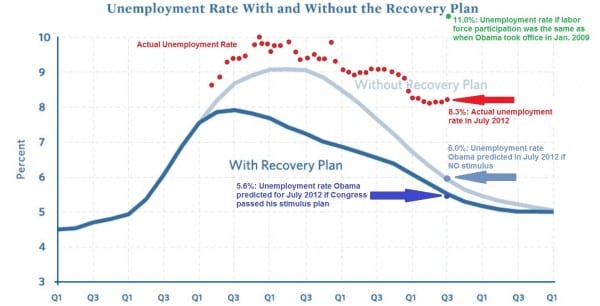
What does this chart represent?

No, it’s not the Brett Favre Media Bell Curve. It’s the comparison between:

  • Obama’s projected unemployment with Porkulus (Dark blue line)
  • Obama’s projected unemployment without Porkulus (Light blue line)
  • The actual unemployment rate (Red dots)

Question for all you Democrats; if Romney releases his tax returns, will those red dots merge with the blue line?

(Via Instapundit)

I Have Seen The Future Under Obama, Dayton And Company…

Wednesday, August 8th, 2012

…and this is it.

Expect a surge in building French restaurants in Switzerland.

Oh, yeah. And expect the French to recoup a fraction of the money they expect to recoup from it.

North Dakotans In The Mist

Tuesday, July 31st, 2012

As I’ve noted over the years, I was born, grew up and went to college in North Dakota.  I left when I was 22 – largely because everything I really wanted to do with my life involved one kind of city or another.  At that time, “things I wanted to do with my life” mostly included “have a band and take a shot at making it in a city with a decent music scene” – but over time, everything else I ended up wanting to do tended to involve living in a major city as well.

In 1985, North Dakota was in pretty dire straits.  The state had a lot in common with Minneapolis and Saint Paul, back then; it was in the throes of the deflation of a huge real estate bubble, in this case a bubble in the price of farm land which had led an awful lot of farmers to over-borrow, which led to a huge wave of foreclosures when the bubble finally burst.  Foreclosures zoomed, unemployment soared, the whole US agriculture industry reeled (no state more than North Dakota, which was at the time more dependent on agriculture than any state in the union).  The farm crisis of the eighties took place in the fly-overiest of America’s flyover lands, and so left only a few marks on the larger American psyche – some good, some pretty awful.

The state learned a few lessons from the eighties (which also included a brief boom and long bust in the oil market; the Oil Embargo in the seventies caused a brief burst of drilling in the western part of the state, which led to some rapid expansion and equally rapid contraction when the price of oil dropped the below the point where North Dakota oil made economic sense).

Of course, times have changed in my home state.  The place is floating in oil, and money to boot.  And that money is going to a lot of things – and infrastructure isn’t as high on the list as some (MPR) seem to think it should be.  There’s method to the madness, of course; during the first oil boom, North Dakota built all kinds of infrastructure that wasn’t needed when the boom shriveled.  While this boom may not shrivel in the same way, the state also knows that there’s a pattern to oil booms; the first ten or twenty years is the Boomtown phase, with hordes of workers drilling exploratory rigs all over the place.  Once all the exploring is done, and things switch over to production mode?  There’s still lots of oil, jobs and money – but it’s not the same.  It’s steadier. And a lot of the “boom” will move on to the next boomtown, wherever that is.  And the infrastructure needs will be very different.

Still, it’s very different than when other NYTimes columnists were calling for the state to be evacuated and handed back to nature – the infamous “Buffalo Commons”.

Our nation’s idiot media “elite” have never known what to make of the place.

I bring it up because the New York Times is writing about North Dakota again.  Gail Collins, as trifling and meringue-y a columnist as Maureen Dowd,  h paid the state a visit recently, and wrote a column that TMZ might have rejected as too shallow and caricature-worthy:

Right now you are probably asking yourself: “What would it be like to live in a place with an unemployment rate of 1 percent?”

Me, too! So I went to Williston, N.D., to find out. There are certain things that journalists do as a public service because you, the noble reader, are probably not going to do them for yourself — like attending charter revision meetings or reading the autobiography of Tim Pawlenty.

Or take Gail Collins seriously.

But she gets a key fact straight; there are jobs out in oil country:

Going to Williston is sort of in this category. The people are lovely, but you’re talking about a two-hour drive from Minot.

If you did come, however, you would feel really, really wanted. Radio ads urged me to embark on a new career as a bank teller, laborer, railroad conductor or cake decorator. The local Walmart has a big sign up, begging passers-by to consider starting their lives anew in retail sales. The Bakken Region Recruiter lists openings in truck driving, winch operating and canal maintenance work, along with ads for a floral designer, bartender, public defender, loan officer, addiction counselor and sports reporter. All in an area where the big city has a population of around 16,000.

There’s an oil boom…Williston’s median income, which was under $30,000 when the serious drilling started, has jumped to well over $50,000 a year…“It’s a place of opportunity,” says E. Ward Koeser, the genial head of a local communications company who has also been Williston’s part-time mayor for the last 18 years. A waitress at a restaurant that Koeser patronizes recently told him that she made $400 in tips on a single night. “Although I’m sure that’s not the norm,” he added hastily.

(As someone who used to work in part for tips in ND, it sure isn’t.  I drove an airport van for a hotel.  You could always tell when someone visited from New York or LA; I’d get a $5 tip for driving and hauling the bags.  Minneapolis?  A couple of bucks.  North Dakotans?  Nothing.  Or a quarter.  And that was meant to be a good tip).

You are probably wondering about the downside.

Indeed, if you’re in the MSM, you’re obsessing about it.  This is wealth not bestowed by government; there just has to be a dark side to it all!

Obviously there has to be one, or you and I would already have moved to Williston, or at least taken up a collection to send unemployed college graduates.

We’ll come back to that.

You would expect that, as population and incomes rose, new stores, theaters and restaurants would follow. But, in Williston, they haven’t. Lanny Gabbert, a science teacher at the high school, says his students yearn for a mall where they could shop, “but the closest thing is Walmart.” The most ambitious restaurants would be classified under the heading of “casual dining,” and the fast food is not fast, given the lunchtime lines that can stretch out for 20 minutes or more. Neither retailers nor restaurateurs are interested in investing in a place where they have to compete with the oil fields to attract workers.

So the “downside” is that relatively great wealth hasn’t brought a Rodeo Drive to Williston.

OK, fair enough.  Let’s continue.

Housing costs in Williston, N.D., are approaching those in New York City. Many of the oil workers stash their families back wherever they came from, and live in “man camps,” some of which resemble giant stretches of storage units.

“The man camps — I call them the necessary evil,” said Koeser, who added, apologetically, “that’s a little derogatory.”

If the place you love can’t quite climb out of the recession, think of this as consolation. At least you’re not living in a man camp and waiting half an hour in line for a Big Mac.

Which is as excellent a metaphor for Obama’s America, the America of Planet Upper West Side, as there is; better to have amenities than a job – even a job in a place that may not be up the street from Fifth Avenue or the Mall of America.

Not-Obama America?   I know guys who wake up in West Saint Paul on Sunday morning, drive all day to Williston, make a ton of money, and drive home after work Thursday.  I know guys – my sister’s husband among ’em – who spend two weeks driving a truck in oil country and a week at home, because it’s where the money is and a great way to blast that nest egg to the next level.  People who, by desire or by necessity, have taken the recession by the horns and done what needs to be done to keep themselves and their families not just above water, but in the black at a time when the likes of Gail Collins are sniveling about their friends’ brats who just graduated from Bard College with an art degree and somehow can’t find a job with a hedge fund.

(Via North Dakota’s official blogger, and my Mom’s neighbor, Rob Port)

Close Enough For Government Work

Monday, July 2nd, 2012

Joe Doakes from Como Park emails:

I always liked this quote from Stranger in a Strange Land:

“ . . . a politico-judicial decision unparalleled in jug-headedness since Doheny was acquitted of offering the bribe Secretary Fall was convicted of accepting.”

Well, unparalleled until [last Thursday].

United States Supreme Court upheld Obamacare requirement that everybody buy health insurance or pay a penalty on the grounds that although the law says it’s a penalty, it’s really a tax, and therefore Constitutional. But it’s not an actual tax because if it were, it would be unconstitutional. So it’s a tax, but not a tax.

Chief Justice Joseph Heller, writing in the majority…

And Minnesota Supreme Court upheld DWI convictions based on the Intoxilyzer breath test machine because the State showed that more likely than not the machine was accurate. You’re guilty beyond a reasonable doubt of .08 Or More because the .08 shown on the machine probably is correct.

And society’s downward spiral continues.

Joe Doakes

Como Park

“Because government says so and wants to” is becoming a binding precedent.

Slim Pickins

Tuesday, June 12th, 2012

Joe Doakes from Como Park writes:

I went with my son-in-law looking at used cars this weekend. Have you seen the prices? Shockingly high. With incentives, rebates and interest rates, brand-new costs the same as used.

You do, indeed, pay a lot these days for that “pre-depreciated” option.

The used vehicle market seems to be distorted: there aren’t enough used vehicles so the scarcity has driven up demand and with it, price. It’s as if some giant vacuum cleaner sucked up millions of perfectly good used cars and crushed them to get them off the market. Weird.

My son-in-law can afford a replacement vehicle so I suppose that makes him a 1%-er. I have no idea how single mothers or low income minority families do it. The burden is falling on those least able to afford it. Good thing this isn’t the result of some well-intentioned Bush-era government program or there’d be Hell to pay.

Joe Doakes

Como Park

No kidding.

Because if an Administration were to make “imposing scarcity for a necessity – affordable transportation – on low-income Americans” a “first 100 days” priority, some might think that Administration didn’t have the good of this country’s poorest at heart.

That’d be just weird, woudln’t it?

Hollande Vacation

Sunday, May 6th, 2012
Hollande, looking sauced

Hollande, looking sauced

France goes on a holiday from financial reality and makes Sarkozy pack.

The future of the European Union (and worldwide markets) may hinge on the following question: Is François Hollande a “fool or a knave”?

Hollande, seeking to become France’s first Socialist President since François Mitterrand, won a narrow victory Sunday over Nicolas Sarkozy – ending the Fifth Republic’s brief and troubled flirtation with mildly conservative economic policies.  Hollande’s election was not only a victory for a Socialist Party in political disrepair but for his former domestic partner and 2007 Socialist nominee (remember, it’s France) Ségolène Royal.  Whether his win proves to be a defeat for the economics of the EU will have to wait to be seen.  As the UK’s Telegraph details, (having asked the above question about Hollande’s political motivations), France faces extraordinary fiscal challenges:

Today, the top corporate tax is 34.4 percent (compared to 15.8 percent in Germany) and France has a €96 billion budget shortfall, which caused it to lose its high credit rating. The absurd 35 hour week largely remains in effect. Here’s the most damning statistic: government spending now accounts of 56 percent of France’s GDP. It’s only higher in five other countries in the world – including Iraq and Cuba.

Keep in mind, these figures were after 5 years of Sarkozy’s supposedly “draconian” policies and political rule by his center-right Union pour un Mouvement Populaire (UMP).  Hollande, in theory, wants to undo the same policies through increased progressive taxation, including the creation of an additional 45% for income above 150,000 euros and capping tax loopholes at a maximum of €10,000 per year.

In an economic era defined by deficit spending and a general lack of funds, François Hollande seems intent to upend the Franco-German alliance that has sought to force austerity measures on the rest of the EU.  “Germany doesn’t decide for all of Europe,” Hollande intoned during the campaign.  Yet what is the alternative?  A nation drowning in debt can no more spend it’s way solvent than a fat person can eat themselves thin.

Marine Le Pen should be proud.  The leader of the supposed ultra-conservative (more social nationalist) National Front and daughter of the 2002 run-off presidential candidate announced her intention to leave her ballot blank – a signal to the 18% who voted for her to ensure Sarkozy’s defeat.

Sarkozy would hardly be recognized as “conservative” across the Pond.  Three of his ministers were leftists.  He pushed for legislation to fight global warming.  He worked to help Socialist Dominique Strauss-Kahn become head of the IMF (when Straus-Kahn wasn’t trying to plow room service).  Far more damning, Sarkozy’s response to the 2008 economic meltdown was vintage Socialist – declaring that “laissez-faire capitalism is over” and decrying “the dictatorship of the market.”  Yet, he raised the retirement age, cut taxes and attempted, unsuccessfully in the end, to ween France off the entitlement teat.

How the markets react may be the most important question in the aftermath of Hollande’s victory.  Coupled with the showing of Alexis Tsipras in Greece – whose policies mirror Hollande in a desire to tax the rich and delay debt repayments – the concern over the fate of he EU will renew Monday morning.  Greece had agreed to impose pension and wage cuts in return for two international rescues worth 240 billion euros.  Either the policy continues or the payments stop.  An end to payments would suggest an economic amputation from the Euro Zone, with Greece either leaving or being forced to abandon the Euro.  A Greek departure could easily start a domino effect in the EU and send worldwide markets into a tailspin.

Hollande may be forced to continue may of the policies he publicly campaigned against.  Short of a desire to commit economic suicide, he has little leverage to do otherwise.

Right To Work: A Time For Choosing

Monday, April 9th, 2012

If there’s one issue where the GOP-led Legislature has dropped the ball this session, it’s in letting the “Right To Work” Amendment (henceforth RTW) proposal languish, apparently to die, in committee.

Rumor coming from the Legislature is that the leadership is afraid that the unions will dump a ton of money into Minnesota to fight legislators who support RTW.   The fact is that the unions are facing a full-court press, with RTW legislation or related campaigns (like the Walker recall) going on in more states than ever before; they’re playing whack-a-mole, and while they have a lot of extorted dues money to spend (just less than half on union members are Republicans; about 8% of unions’ political money goes to GOP candidates), they’re spread thinner than ever before; putting one more piece of legislation out there will spread them thinner.

It’s not like the unions aren’t going to go after swing-y candidates in Minnesota – they already co-own the DFL along with Alita Messinger, and they will conduct a merciless, no-holds-barred, no-boundaries-respected smear campaign of every Republican in this state no matter what’s on the ballot this year.  And in a year or two or three?  The DFL and unions will have re-filled their coffers, and have many, many fewer challenges to deal with, for better or worse.

So if not now, when?  If not here, where?

The fact is, according to sources on Capitol Hill, we are three votes shy of passing this thing, and there are six GOP Senate holdouts. 

Leadership can do something about this. I’m going to urge you to contact the leadership of the House and Senate:

  • Rep. Kurt Zellers – Speaker of the House (rep.kurt.zellers@house.mn / 651-296-5502)
  • Sen. David Senjem – Senate Majority Leader (sen.david.senjem@senate.mn / 651.296.3903)

Tell them – politely but firmly – that 2/3 of the people in Minnesota, including liberals, including union members, support this legislation.  And so do you.  And you’re a voter.

Later this week, we’ll start talking about the reported holdouts.


While The DFL Is Busy Defending ID-Free Voting…

Thursday, March 22nd, 2012

…the GOP is focused on jobs.

The “MNGOP’s “Reform 2.0” agenda moved forward yesterday with the passage of the “Tax Relief And Job Creation Act”, which passed in the House.

I wish every working Minnesotan could see this bit from yesterday – Rep. Matt Dean tearing chunks out of Ann Lenczewski, who’d just finished demigogueing against the bill:

Pass it around.

This is going to come up in the Senate soon. And while it’s not as sexy and sound-biteable as the Marriage Amendment or Voter ID, it’s much more important for Minnesota’s long-term future, especially for the parts of Minnesota that actually work.

We’ll keep you posted.

That “We The People” Thing

Tuesday, March 20th, 2012

Janet Dailey, writing in the Telegraph, notes British Minister of the Exchequer George Osborne’s visit to the US, along with Prime Minister David Cameron.

“George who, minister of what?”

George Osborne.  The “Minister of the Exchequer” is what they call their “Secretary of the Treasury” over there.

Anyway, Dailey – who is a center-right columnist at the center-right Telegraph (yaaay, Europe, for at least having a journo culture that’s honest about its biases!),  notes something that eludes our entire media and one, and sometimes both, of America’s major poitical parties:

This brings me to my original theme: why America’s recovery – which will eventually come, as night follows day – cannot be an instantly usable model for a British one, which is not inevitable. It is not federal governments that bring about economic revival in America: it is the country’s people.

From Daily’s pen to God’s ears.

John McCain got pounded by the media and America’s Stupid Class for saying, in 2008, that the fundamentals of the American economy were strong.  As wrong as he was, and is, on so many issues, he had that one as right as anyone ever has.

Because the only relationship our economy has with our government is a negative one.  Government action inevitably harms the economy (in the long run, if usually but not always the short).  It’s only when government butts out that it does no harm, which is the best it can do.

Even Franklin Roosevelt’s New Deal has finally been demythologised. All those works projects and federal programmes may have done something for national morale, but the hard economic evidence shows that the worst effects of the 1929 crash had begun to abate under Herbert Hoover, and that the Great Depression (which was arguably prolonged by FDR’s policies) did not properly end until the US entered the Second World War.

That’s the elephant in the American economic room.

We’ve got four generations of economists, now, who pay obeisance to the flawed notion that Keynesianism worked, once.

It’s wrong, of course; as Dailey notes, it was a morale booster that arguably did more harm than good, and certainly prolonged the period of extended private unemployment.

No – America’s nine economic lives come from its private sector.

Read Dailey’s entire piece.

Send it to a liberal friend.  Make a liberal friend to send it to, if you need to.

This Is Your “Obama Recovery”

Monday, February 20th, 2012

The Dems are crowing about the drop in unemployment numbers.

But if you look a little further into the numbers, you see that the American job market is not better off than it was four years ago.  Indeed, it’s a lot worse.

On Inauguration Day in 2009, when Barack Obama took office, the unemployment rate was 7.8 percent (up from 4.4% as recently as May of 2007).  Notwithstanding his promises that Porkulus would cap unemployment at 8.5%, it soared to 10% in October of 2009, and didn’t dip down below 9% in any sustained way until last fall.  Last month, after three years of Obama, it was at 8.3% – or .2% lower than where he said it’d never get above if we spent what he proposed.

That’s bad.

“But 8.3% is better than 10%, right?”

Sure – if all you’re doing is comparing numbers straight-up.  But by itself, the unemployment rate is meaningless.  It’s a percentage of people out of work – but who are those people?  They are the ones that are participating in the labor market.

And fewer Americans than ever -ever! – are doing that!

So let’s figure the actual percentage of Americans working, overall.

January 2009: According to the Bureau of Labor Statistics, the Workforce Participation rate when Obama took office was 65.7%.  That means 34.3% of the workforce wasn’t even trying to participate, through discouragement, disability or whatever case.  Add to that the 7.8% unemployed, and you reach a figure of 57.1% of the American workforce actually working.

October 2009:  At this point, the “low point” of the Obama recession, the participation rate was an even 65% just in time for unemployment to hit an even 10%.,  55% of the American work force was working.

January, 2012:  As unemployment stood at 8.3%, the workforce participation rate was 63.7% – the lowest since records have been kept.  That means that overall employment in the American workforce is now a whopping…

…55.2%.

That’s a fifth of a percent higher than it was at the lowest point of the Obama recession.

Almost two full points lower than it was when Barack Obama took office. 

(And five full points lower than June of 2003, the worst month of George W. Bush’s before the GOP lost the Congress.  That’s five percent lower employment overall.  Six and change if you take one of Bush’s better months.  And I know, Bush benefitted from a bubble, yadda yadda.  But…five points!).

The media is spinning nonstop about the “Obama recovery”.  It’s vapor; in terms of percentage of the American workforce actually working, there is no recovery.

Are you better off than you were four years ago, America?  No – you’re doing two percent worse.

The World Tax is Flat

Tuesday, October 25th, 2011

Ask yourself, tax code, do you feel lucky? Do ya, punk?

 Rick Perry stabs the tax system in the heart.  But under the plan, is it dead or simply pining for the fjords?

Steve Forbes must feel like he’s stepped into a time machine.

The 1996 & 2000 GOP presidential candidate briefly electrified the denizens of political wonkdom with his conception of a national flat tax to simplify – and eliminate – the current overcomplicated tax code over 15 years ago.  Forbes’ idea of broadening the tax base while reducing the individual tax burden proved a temporary hit – too much of one as most of his 1996 rivals embraced similar policies.  Unfortunately for flat tax advocates, the only candidate who didn’t rush towards the concept was nominee Bob Dole, and since then the tax as languished as more theory than practice despite its success in many former Soviet bloc countries.

That is until now, as Texas Governor Rick Perry has revived the concept, winning Forbes’ praise and liberal scorn.  The headlines have screamed about Perry’s new tax rate of 20%, but in most reports, the lead has been buried:

“The plan starts with giving Americans a choice between a new, flat tax rate of 20 percent or their current income tax rate,” Perry writes. “The new flat tax preserves mortgage interest, charitable and state and local tax exemptions for families earning less than $500,000 annually, and it increases the standard deduction to $12,500 for individuals and dependents.”


The plan also drops the corporate tax rate to 20 percent and will temporarily lower the rate to 5.25 percent to promote companies working overseas to move to the U.S. along with implementing a “territorial tax system,” which will  tax in-country income.


The plan will eliminate the death tax and end taxes on Social Security, which would help an estimated 17 million Americans receiving benefits today. It would also cut taxes on qualified dividends and long-term capital gains.

The drop in corporate tax rate would put the U.S. as the lowest in the world (among major competitors; there are a number of nations with no corporate taxes).  And with most foreign economies unable or unwilling to respond in-kind with similar corporate tax rate cuts, the U.S. could be looking at an immediate repatriation of up to $1.4 trillion with the addition of a “territorial tax.”  Does that mean an immediate increase in jobs?  Not exactly, but a similar “repatriation holiday” for overseas corporations in 2004 spurred massive investments in capital and employment.

Lost in the corporate tax discussion has been Perry’s proposal to cap federal spending to 18% of GDP, or what would be roughly $2.54 trillion.  That’s under the projected 2012 revenues of $2.627 trillion and significantly under the Obama adminstration’s desired $3.729 trillion of spending.  Perry is obviously expecting that projected $1.4 trillion to soften the blow as increased income would (hopefully) spur GDP growth, raising Perry’s 18% beyond projected 2012 revenue levels.

The chief compliants from the right, much like with Herman Cain’s “999” plan, are that Perry’s flat tax doesn’t go far enough.  Indeed, both leading economic fixes from the GOP field disembowel the current tax system but keep it wrapped together in some fiscal Eraserhead policy nightmare.  Both Cain and Perry’s proposals have foreign models to work from – Cain’s VATesque vision which has hindered Europe; Perry’s opt-out Hong Kong-like system which has worked well despite the complication of individuals being potentially able to switch back-and-forth from flat tax to the current system year to year.

Ultimately, Perry’s flat tax needs to be seen as the beginning of a new policy discussion, rather than as a destination.  A total overhaul of the tax code, while popular in spirit, likely polls poorly when the roughly 47% of Americans who don’t pay federal taxes figure out they might be forced to actually contribute to the system.  As proposed, few Americans will find themselves benefiting from the policy, but I think critics are thinking too short term and too little on the potential corporate effects of the plan.

--> Site Meter -->