Standards
By Mitch Berg
Or most technical “standards”, really:
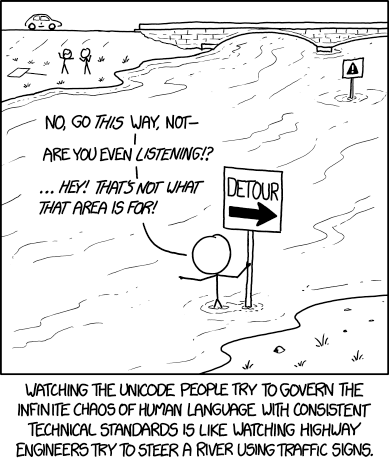
And don’t get me started on the Chicago Manual of Style…
By Mitch Berg
Or most technical “standards”, really:
And don’t get me started on the Chicago Manual of Style…
You must be logged in to post a comment.


September 14th, 2016 at 8:47 am
The Chicago Manual of Style says that if they send one of your sentences to the hospital, you send two of theirs to the morgue.
September 14th, 2016 at 9:09 am
Reminds me of the “deer crossing sign” phonecall.
September 14th, 2016 at 9:22 am
I disagree as far as ‘most technical “standards”’ go. Dealing with proprietary crap (or OTOH super cool custom APIs for application) is a big waste of time and money. It can be done, and we do it, but it doesn’t lead to an “architecture” as much as it leads to a “mess”. *shrug*
September 14th, 2016 at 9:25 am
Or “custom APIs for every application”. But I do like the cartoon: describe guys, don’t try to govern.
September 14th, 2016 at 9:29 am
Why are there other languages, anyway? How can foreigners even understand each other? I mean, I can understand some countries like having their own style of cooking, but entirely different languages?
September 14th, 2016 at 9:29 am
Reminds me of a lot of accountants & engineers I have worked with through the years that couldn’t come to terms with the fact that whatever system or series of metrics they created didn’t quite account for the unpredictability of the human mind or the laws of thermodynamics or that OSHA required an after install guard and the resulting heat build up or the drive that was designed to get free air flow blew up because of that OSHA required drive guard.
September 14th, 2016 at 10:13 am
“On the other hand, the TCP camp also has a phrase for OSI people. There are lots of phrases. My favorite is `nitwit’ — and the rationale is the Internet philosophy has always been you have extremely bright, non-partisan researchers look at a topic, do world-class research, do several competing implementations, have a bake-off, determine what works best, write it down and make that the standard.
The OSI view is entirely opposite. You take written contributions from a much larger community, you put the contributions in a room of committee people with, quite honestly, vast political differences and all with their own political axes to grind, and four years later you get something out, usually without it ever having been implemented once.
So the Internet perspective is implement it, make it work well, then write it down, whereas the OSI perspective is to agree on it, write it down, circulate it a lot and now we’ll see if anyone can implement it after it’s an international standard and every vendor in the world is committed to it. One of those processes is backwards, and I don’t think it takes a Lucasian professor of physics at Oxford to figure out which.
— Marshall Rose, “The Pied Piper of OSI”
September 14th, 2016 at 10:47 am
jedge
the OSI people are like having a dead mouse in the wall except the smell never goes away.