There may be few more frustrating jobs in American politics than being a Republican in the Twin Cities.
Minneapolis is sort of like Berkeley on the Lakes, while Saint Paul is a mini-Chicago on the Mississippi. Both are one-party liberal gulags. And Republicans in both cities continuously batter themselves against the unthinking masses of DFL droogs, year after year, with seemingly no result. Good candidates? Bad candidates? It seems to make no difference whatsoever.
Years like 2012 are especially frustrating. The GOP fielded some excellent candidates, and some hard-working campaigns in CD5 (Minneapolis) and CD4 (Saint Paul). And all of that hard work and effort and occasional inspiration held up like a stream of pee in a hurricane on November 6, as the GOP efforts ran smack-dab into the anti-marriage-amendment tsunami.
On the face of it – expressed in terms of percentages – it looked as dismal as ever – like the cities in the Twin Cities were the same 70-30, or 75-25, cesspools they’d always been.
But if you dig into the numbers a little, things brighten up nicely.
I’m going to look at a couple of races in traditional DFL country, just to see what I come up with.
———-
Tony Hernandez ran a solid, spirited race against Betty McCollum in CD4 in 2012. There were flaws in the campaign; fundraising was slow, among other things – but Hernandez worked hard, and he had a group of very hard-working volunteers.
So what happened?
Well, Betty McCollum won. She won big. Part of it was the votes siphoned off by a Ventura Party candidate that ran to Hernandez’ right. Part of it was the fact that it’s CD4. And a big part was the epic DFL turnout against the Marriage Amendment.
The first illustration shows that it’s nothing new:

The top two rows show the head-to-head vote totals between the GOP and DFL candidates in CD4 for the past seven cycles, back to 2000. The bottom two present the results as percentages. Note that some of the results will not match the Secretary of State’s numbers; I presented the numbers as DFL/GOP totals, leaving out third-party candidates.
And the news? Well, it’s not news. The 4th CD is a 70-30 district.
Right?
Sure. But look at that top row – the number of GOP votes. 109,000 people voted for Tony Hernandez in 2012, which was a fair-to-middling Republican year (against a great base-burnout campaign for the Dems nationwide, and a huge “new-voter registration” campaign in Minnesota).
This chart shows two more sets of data:
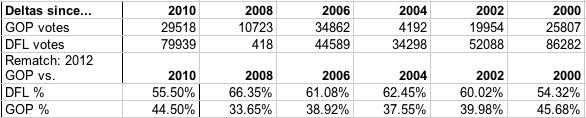
The top two rows show how many more voters there were for each party in 2012 from the selected year. In other words, in 2012 there were 10,723 more Republican votes than in 2008 (and 418 more Democrat votes).
Compare presidential years (which always have better turnout for both parties than non-presidential years). Hernandez drew 10,000 more votes than in 2008 (even without the thousands of conservatives who voted for the uncharacteristically-conservative Independence Party candidate), which was not a great year for Republicans; he was up 4,000 from 2004 (a decent GOP year) and 25,000 from 2000 (a very good GOP year).
The interesting part? The bottom two rows. They show a “rematch” of the selected years’ races using Tony Hernandez’ 2012 GOP vote totals. The 2012 match shows they actually exist (in part due to redistricting, although that wasn’t nearly as favorable to Hernandez as one might have hoped); this time, they happened to exist against the backdrop of an epic DFL turnout.
But what if those Republicans could be inveigled to turn out against a more prosaic DFL turnout?
Hernandez’ numbers against BettyMac in 2008 (which was also a great DFL year – notice the fact that the epic 2012 turnout only added 400-odd votes to McCollum’s 2008 totals?) makes it a 66-33 race. Against her 2004 numbers (blah year for Democrats, base-turnout year for Republicans) it was 60-40, which is a whole world apart from 70-30.
And against 2000 – a good GOP year with a functional state party and average DFL turnout – Hernandez’ numbers make it a nine point race.
And against off-year DFL turnout? If the GOP were to pull off a miracle and generate presidential-year turnout against off-year DFL turnout, it’d be a ten point race.
Which still isn’t victory.
But Hernandez – running an underfunded all-volunteer campaign with no outside funding to speak of, endorsed by an intensely-dysfunctional party Congressional District unit of a state party that sat out the 2012 election completely, against a cash-sodden union juggernaut and a media praetorian guard that seems sworn never to mention the great unspoken secret (that McCollum is one of the dumbest people in Congress), “aided” by a redistricting that seemed designed to be as benign as possible to the incumbent, and attenuated by a conservative third-party candidate – turned out more Republicans than the 4th has seen in decades. He had the bad fortune to do it into the teeth of a DFL GOTV wildfire.
So if he’d had $500,000 instead of less than a tenth of that? If he’d had a state party that could help, and a CD committee that could help marshal support? If he’d had experienced management, and maybe a full-time field staffer?
Just saying – not only are there grounds for optimism, but they may be stronger than we thought.
So that’s Hernandez against history. How about in the Fifth CD?
We’ll look across the river tomorrow.
Yes, I know – I’m comparing pre-and-post redistricting numbers. But I don’t think it’s especially invalid; redistricting didn’t change the Fourth all that much; the judges seemed, indeed, to have bent over backwards to keep it that way.


Leave a Reply
You must be logged in to post a comment.