Archive for the 'Planes Trains and Automobiles' Category

Railway To Financial Hell

Monday, December 10th, 2012

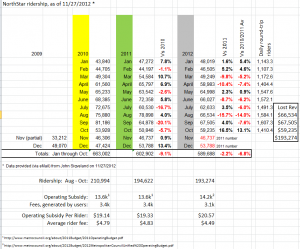
The latest numbers – from the Met Council website – show that the Northstar Line is an even bigger cash suck than we’d predicted it’d be.

Click to see chart at a readable size.

Ridership is off sharply.  Operating subsidies are up; each ride on the Northstar line costs the taxpayer over $20.  That’s per ticket.

A source at the Capitol who’s been working the numbers on Northstar writes:

“One more point. The NorthStar lovers like to point out that one of the reasons that the numbers are down is because the Twins have sucked the last two years. Well, there does seem to be some truth (taken with a two-ton tablet of salt) to that…the numbers from April to October do give you the sense that the Twins could have an impact.

The source anticipates some of the counterarguments:

Of course, this ignores the fact that we, here in Frostbite Falls, tend to be rather sedentary during the colder months. Heck, just look at freeway traffic in the summer months, which is always higher than winter months.

But look at the numbers: Even if you give them ALL the increase in riders for Twins games, the differential averages to 1,026 per game. That’s down from 1,340 per game in 2011. If you’re gonna bank your success on Twins game riders…good luck with THAT.

The fact is, the Twins could win back to back World Series and the Northstar Line would still be hemorrhaging money.

Why Do DFLers Hate Those University-Avenue Businesses?

Wednesday, September 5th, 2012

This came from the MPR 4th CD debate last Wednesday, courtesy of the MNCDConservative blog.

Independence Party candidate Steve Carlson is talking about “infrastructure”. Listen to Betty McCollum’s supporters at the end (eyewitnesses say it was, in fact, McCollum’s people doing the booing):

They’re booing Carlson for attacking the Central Corridor; to hell with the businesses it’s destoryed, and continues destroying.

Guess it’s good to have your priorities straight.

(Video courtesy Minnesota CD4 Conservatives blog)

Commentary From The Transport-American Communities

Wednesday, August 29th, 2012

A reader emails:

Driving home from [outstate] today. Going east by Monticello I saw a rig with a big picture of Obama on the rear of his trailer. Below it the caption read “Does this Ass make my Truck look Big?”

I just about lost control of the car with convulsive laughter.

I don’t suspect Obama and his gas prices and his “let’s import oil from Brazil!” policy are seeing a lot of traction among truck drivers.

A Cold Fresno

Friday, August 17th, 2012

Just for a fun Friday diversion, go through this article.

  1. Substitute all references to “the coast” to “Minneapolis and Saint Paul”
  2. Change all references to “The interior” to “The Iron Range”
  3. Change the high-speed rail references to “Minneapolis to Duluth or Rochester” or whatever the current pipe dream is.
  4. Change the other California references to Minnesota ones.
  5. Save it away in case the DFL winds up with a couple of years of majorities with a sitting DFL governor.

You’ll save some time.  You’ll need it for job-hunting.

The Potemkin Tour

Tuesday, August 7th, 2012

Joe Doakes wrote to alert me to Saint Paul’s city government springing into action:

I realize [St. Paul mayor Chris Coleman is] a busy guy, too busy to personally visit every Mom and Pop operation he’s putting out of business; still, you’d think he could have found his way down there before this. It’s been two years.

I wonder if he’ll take the bus?

Joe Doakes

Como Park

Joe linked to h this piece in the PiPress:

Business owners along Central Corridor Light Rail construction on University Avenue will have a chance to voice their opinions and concerns to St. Paul mayor Chris Coleman this afternoon.

The Asian Economic Development Association is hosting the Little Mekong Walking Tour at 2 p.m., Aug. 6, starting in front of 88 Oriental at 291 University Ave.

Topics of discussion include the impact of construction on current and future businesses in the area. A number of businesses have expressed their concerns with dramatic drops in business as the light rail construction has tied up traffic and limited access to their shops.

The tour will visit businesses in Little Mekong, an Asian culture and business district on University Avenue.

How many of those same businesspeople do you suppose attended the Met Council’s rounds of perfunctory “public meetings”, held over the past decade to gather public “feedback” about the project, to be recorded and shelved while the Met Council went ahead and built the same precise misconceived project they’d always intended to?

And I wonder how many of them even thought about voting for someone other than a DFLer – the party that regards them as interchangeable reliable votes, and their businesses as chattel – at the time?

Time to think about it, guys.

I Got A 73 Monte With A Worn Out 350, Rusty Heads And A Three On The Tree…

Wednesday, July 25th, 2012

I was at the Car-Craft Summer Nationals over the weekend, doing what has evolved into one of my favorite live broadcasts of the NARN broadcast year.

There were a lot of fun cars.  If you grew up in North Dakota in the seventies and eighties, the Nova was the semi-official state muscle car:

It was light, overpowered, and fairly inexpensive – three things that appealed to North Dakota gearheads.

(North Dakota gearheads were famous for one modification that, near as I can tell, was pretty local (although I’m sure it was more widespread and less local than I realize); they’d wash out the windshield washer tank, run the hose back to the cup holder on the driveshaft hump between the front seats, and fill it with Southern Comfort or Brass Monkey or some other, er, “durable” spirit.  Want a bump?  Hit the washer – provided you had a cup in the cup holder…)

Ditto the Chevelle;  one of my friends in high school had one of these.  I used to dream about one of ’em…:

But for me, the sentimental fave was this one; a black ’73 Malibu. This was my first car.

Well, no – not this exact car.  Mine was a northern Minnesota farm car I bought my junior year of college for $125 and a case of beer.  It was black, sort of – it had so much salt damage that the driver’s side door panel flapped in the breeze like a bird’s wing when you got over 60 miles per hour.  A chunk of the floor on the driver’s side was corroded away.

But it had a 350, and it flew.   It was the car that brought me to the Twin Cities – and I used to drive home to visit keeping it around 70ish in MInnesota, and around 85 in ND.  I could make it from the 694 River Bridge to the Jamestown exit – 335 miles – in around four and a half hours on the road (not counting the fuel stop I had to make in Fergus Falls; it wouldn’t get to Fargo on one tank).

And when it finally conked out, I dreamed about keeping it, and learning how to fix up and hot-rod cars, and doing something like what you see above.

But I was 23 and making $6 an hour at Hubbard Broadcasting and needed money, so I sold it for $50 to a guy who wrecked it a week later and ran away when the police came.

If there’s a car heaven, my old Monte Carlo is there, and looks a lot like this.

The Beatings Will Continue Until Morale Improves

Tuesday, July 17th, 2012

Twin Cities urban planners seem to think that if they just make driving a car inconvenient and headache-prone enough, drivers will throw in the towel, get a job downtown, and start riding the bus.

Which seems to be the main impetus behind this initiative – turning Charles Street (which runs parallel to light-rail-construction-addled University, two blocks north of the construction nightmare) into a “bike boulevard”, with traffic circles, bike lanes, speed bumps, and none of those dang cars.

Joe Doakes from Como Park writes:

University Avenue is impassable to bicycle traffic now, but when the light rail is done . . . it’ll still be impassable. Parking lane gone, trains down the middle, buses in the right lane and all the other frustrated motorists wedged between. So where are those cars and bikes now? On the adjacent parallel streets as far North as Minnehaha.

And down to Marshall and Selby.  The traffic nightmare hasn’t ebbed; just metastasized.

” Organizers said an overwhelming number of respondents think that there are already too many cars, often driving too fast, on Charles Avenue and that the street is unsafe for children. Residents also worried that traffic would increase when light-rail construction is complete.”

Well yeah, dummy: frustrated motorist traffic has had to self-divert to side streets because the largest, longest, busiest East-West throughway in the City has been completely shut down and it’s never going to reopen to normal levels. This is news to you? You’re just figuring this out now? Don’t urban planners ever visit the sites of their glorious triumphs? Don’t they read the papers (or SITD) to see the chaos and havoc they’ve created? Why didn’t they plan for it up front (or did they, but had to wait for a “crisis” to arise so they could “solve” it)?

Joe has too much faith in Wahhabi transit activists.  They’re a little like post-modern German artists, the type that glumly intones “Art IS destruction and ugliness” as they unveil their latest, “installation”, a dancing man clad only with a jar holding a gutted cat pickled in urine.

Like the post-moderns, the chaos – to drivers, anyway – is precisely the point.  The goal is to make driving, and drivers, miserable.  And to them, it’s no matter if you deal with that misery by jumping on the train, or by expressing your anger, fulfilling their prophecy that drivers are base, benighted, spoiled, arrogant and above it all.

They win either way.

So naturally, the same urban planning geniuses who caused the problem on Charles are springing into action to make things even worse. The City will install bike lanes, traffic circles and speed bumps to slow traffic through the neighborhood. Cars that were shoved off University to make room for the train will be shoved off Charles to make room for the bikes. That’s great in the summer but have you ever tried to plow snow around traffic circles and speed bumps? There’s already one traffic circle on Charles and the snow ridges around it are a nightmare.

I know that circle.  The winter before last, the intersection was like an Andean goat path.  The side streets in that neighborhood are very narrow; it’s hard to get a plow around that circle – so it never went around the circle!

The bicycles will be in storage but cars still won’t be able to use the street. Might as well go all the way and tear up the tar completely, sod the street and turn Charles Avenue into lawn.

Hey Mitch, get ready for even more motorists up your way, all of them late and angry. Should be . . . interesting.

Joe Doakes

Como Park

Way ahead of you, Joe.  Traffic on Thomas, Marshall, Minnehaha and Selby is all up.  And the city is reacting the way it always does.

Writing more traffic tickets.

The Two Least Reassuring Things I’ve Read All Week

Tuesday, July 17th, 2012

Needles found in turkey sandwiches on Delta flights from Amsterdam.

Not-very-reassuring thing #1:

“TSA continues to closely monitor the review of the incidents as well as the security protocols being conducted by the air carrier and the airport authority,” spokesman David Castelveter said.

And not-so-reassuring thing #2:

“Delta requires all its in-flight caterers to adhere to strict criteria in order to offer our customers the very best onboard meals,” Baur told CNN in a statement. “The safety and security of our passengers and crew is Delta’s number one priority.”

So the bad news:  Delta and TSA are on the case.  And if cases can be solved by being late or groping peoples’ nether regions, we’re gold.

The good news?  To the best of my knowledge, Al Quaeda hasn’t figured out how to fit a bomb inside a needle yet.

And I’ll just shut up right now.

Lipstick On An 800 Pound Hog

Tuesday, July 3rd, 2012

After spending the last few years doing its best to kill off businesses on University Avenue, the Met Council is embarking on yet another effort to get people to go to places most of them never went in the first place, and can’t get to now because of all the light rail construction.

Joe Doakes of Como Park responds:

I’d like to shop Central Corridor but I can’t get there – it’s torn up for miles, even cross streets – and will be until 2014. What’s the point of inviting customers to a destination they can’t get to?

Wonder who these ad people are related to, or who they knew to land this contract.

Joe Doakes

To be fair, you can get to these destinations.  Although the route resembles something from the first Indiana Jones movie at times.

More Eggs For The DFL Omelet

Friday, June 15th, 2012

What have we been telling you as long as this blog has existed?

The businesses along University Avenue that the Central Corridor doesn’t starve out of existence now, during the construction phase, it will either price out of existence in the few areas – around the stops in the less-blighted areas – that get gentrified, or starve out the business in between that are beyond easy dead-of-winter walking distance from the stops that can’t also afford to build off-street parking for customers.

But those last two are well in the future.  We’re still in phase one, starving out the businesses we already have along Uni:

Ne Dao is worried. Business at her normally bustling grocery store has slowed the past two weeks, and she fears it will only get worse once the massive light-rail transit construction project lands on her doorstep.

Ask the Panellis, from the late, great Caribe Bistro; it doesn’t get any better.

Many of the Asian businesses located along the five-block stretch of University Avenue recently dubbed the Little Mekong business district say they’re losing customers and sales. Business owners blame the road construction that is making way for the Central Corridor light-rail line connecting downtown Minneapolis with downtown St. Paul.

The road work on their stretch started in March and is expected to finish in late October. At University and Western avenues, the owner of Mai Village restaurant says she’s had to lay off the hostess and cut back from 10 servers to five because of the drop in business.

The problem was clearly inherited from George W. Bush.

Seriously?  I know the Mai Village.  The Mai was started probably close to twenty years ago, one of the wave of businesses started along Uni in Frogtown by Asian immigrants – first the Vietnamese, then the Hmong – who took the blighted stretch of the avenue between Lexington and the Capitol and turned it into, if not “Architectural Digest” fodder, at least a place with people, traffic, commerce, jobs…

…life.

Not the kind of life the DFL approves of – it’s not the kind of thing that fits the DFL’s vision of what Saint Paul’s Main Street should be.  Caribou. Patagonia, and lots and lots of government offices and non-profits.

Little Asian restaurants, founded by families who risked everything to leave Communist dictatorships to come to America, pooled their resources after years of working at scut-work jobs, leased ratty-looking little holes in the wall in blighted neighborhoods, built them into successes (and eventually nicer buildings, at least for those who kept their businesses on the avenue), and eventual hard-won prosperity?

Disposble!

This year, Mother’s Day, typically her busiest day of the year, was a dead zone.

“I don’t know how long we will survive,” said My Dung Nguyen, who along with her husband, Ngoan Dang, have owned Mai Village on University Avenue for more than 20 years.

The construction – as predicted in this space and in the spaces of everyone who really pays any attention to these things – has led to a long chain of destroyed businesses, wiped-out lifes’ savings, and misery in among all the dislocation for us Midway residents.

The sound of Bobcats and work crews, coupled with the dust they’re kicking up, have left her rose-filled haven of a patio empty because customers don’t want to sit out there in the middle of a construction zone.

“My customers, some of them tell it to me straight. They say, ‘I love your family. I love your food. But I’m sorry, I won’t come back until the light rail is done,'” Nguyen said.

What can I say?  If you’re ever down on Uni and are looking for a great Vietnamese meal, give the Mai a try.  They – and every business along Uni that isn’t part of a national chain with cash reserves to ride out the construction – will need the help.

Institutional Minnesota – the white, upper-middle-class part of it that was born here and never had to sail across a shark and pirate-infested ocean and learn a second, difficult language and start their lives over in a strange, cold land – is responding as usual; with blithe arrogance disguises as effort:

“Change is hard for many people. We’ve heard this from businesses elsewhere on the corridor and in other areas,” said Laura Baenen, a spokeswoman for the Central Corridor Light Rail Project.

“Change is hard for many people” is the “I’m sorry you were offended by what I said” of the social engineer.

Along with the arrogance, we have the out-of-context diversions:

Baenen noted that more businesses have opened on the entire corridor in the past year than have closed. From March 2011 to March 2012, 64 businesses opened on the corridor — including Washington Avenue, University Avenue, and Cedar and 4th Streets in downtown St. Paul — while 59 closed.

I’ll just bet they have.  There’s a lot of cheap space available now!

Now – how many of these “businesses” are non-profits that will bring no meaningful commerce to the Avenue?

I’ll get back to you on that.

And it looks like there’ll be more cheap space, as things are shaping up now:

The Asian restaurants are the ones that have been hardest hit, Thoj said. “Just in Little Mekong area, most of the restaurants are seeing a 25 to 50 percent loss. We have about 12 eating establishments. They all drop in customers during lunch and dinner.”

Back at Mai Village, Nguyen says the vision that the Metropolitan Council has of light-rail bringing prosperity to Little Mekong is still a long way from happening.

In the meantime, she says she and the other longtime owners are just trying to hold on to see that day.

“We put our heart, our time, our everything in here,” she said. “We would like to see it a success if the light-rail is done. But that is a big question.”

Silly eggs.  Your hearts, time and everything exist at the pleasure of the DFL’s omelet machine.

These are people who did everything right.  They rejected socialism for freedom.  They threw everything they had into succeeding – with very little to no government help – in a new, sometimes hostile land.  And they succeeded.   Indeed, the only mistake most of them made – it’s a statistical fact – was voting DFL.

And there’s noplace else to take a boat to, this time.
Killing The Competition

Friday, June 8th, 2012

I read yesterday that the Met Council is going to start whacking bus lines along the Central Corridor, to make sure that the infernal train is the only option the rider has.

I was going to write about it – but Joe Doakes of Como Park beat me to it:

Since we’re already building the Damned Train, this makes half-assed sense, I guess.

Right now, there are three busses to get from downtown St. Paul to downtown Minneapolis:

  • 16 – runs every 10 minutes on University, stops at every corner
  • 50 – runs down University but only stops at major corners
  • 94 – runs on I-94 but gets off a few places on University [and long I94]

We’ll eliminate the 50 entirely because that’s exactly what the train will do – run down University and hit major intersections. Sensible.

We’ll cut back the freeway bus to weekdays only. If you want to rush from downtowns on weekends, take a taxi or ride the train. That makes sense.

We’ll cut back on local bus service to every 20 minutes. This doesn’t make sense.

First, where’s the bus going to drive? In the parking lane? But we took out the middle of the street to install the train and that meant we changed the parking lane to a driving lane. But now we’re going to leave a bus in the parking lane? Why do we need a bus blocking up traffic on University when there’s a perfectly good train right next to it?

Second, as every bus rider knows, 20 minute departures that means the bus departs downtown every 20 minutes but traffic lights and delays make them bunch up on the route. If you want to ride from Frogtown to Walmart, wear warm clothes: the next three busses will all come in a big pack and if you miss them, you’re standing for an hour. Unless you take the train. Which, if you were going to take the train anyway, then why bother with busses?

Do we really need a simultaneous and parallel public transit system to stop at every single corner on University?

Joe Doakes

Como Park

That, of course, is the big problem – well, the second-biggest problem, behind “it’s a huge waste of money that will cost $10 in public money for every $2 ticket that’s sold” – with the Central Corridor:  it’s the wrong kind of train for the street.  “Light Rail” is supposed to zip along at 55mph between stops that are a mile or so apart – not chug along at the speed of traffic along University between stops.  And the “mass transit” traffic along University is not people zipping between downtowns; they mostly drive or take the 94 or the 50.  The traffic along Uni is people going from WalMart or Rainbow or Cub or CVS or Plasma Hut to home, where “Home” isn’t a condo along Washington in Downtown Minneapolis, but a house or apartment on Sherburne or Thomas or Iglehard, tucked away close to University.

It’s the wrong kind of train – it should have been a trolley, if you had to have a train; a “light rail” train should have gone down the median on I94, or ducked through the existing rail rights-of-way between Northeast Minneapolis and Frogtown.

This is what central planning does to peoples’ lives.

Just So We’re Clear On Things

Tuesday, May 22nd, 2012

Joe Doakes from Como Park – who has been getting used to driving down Como and Hoyt rather than University, just like the rest of us lately – writes:

A federal court judge has ordered the light rail agencies to do this study – twice – and two years later they’re finally going to START it?

http://www.twincities.com/stpaul/ci_20648864/central-corridor-constructions-impact-businesses-be-studied

At this rate, the study ought to be done about the same time as the construction.

Near the end of the article:

“Many businesses have reported losing months of revenue, and some have relocated from University Avenue or closed their doors. The 2011 assessment stated it was impossible to separate the impact of construction from “external factors” such as the economy and “world events.”

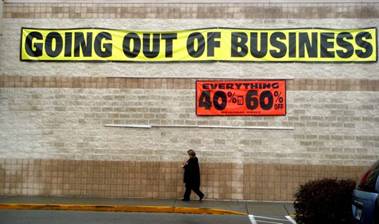
Dude, let me help you out here. This is “the economy”:

Photo courtesy the Instapundit archives: http://pjmedia.com/instapundit/category/photos/

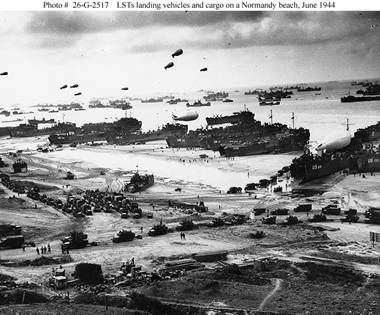
This is a “world event”:

Photo courtesy US Navy: http://www.history.navy.mil/photos/events/wwii-eur/normandy/normandy.htm

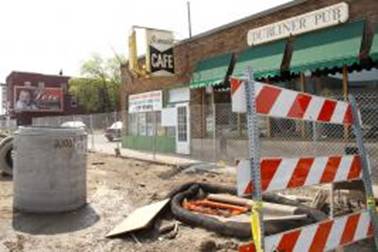
This is the “impact of construction”:

Photo courtest Minnesota Public Radio: http://minnesota.publicradio.org/display/web/2011/05/13/central-corridor-university/

Are we clear? ARE WE CLEAR???

Joe Doakes, Como Park

Oh, Joe.  If people were clear, we would not  be in this mess.

It just occurred to me – the great Saint Paul tradition of cruising the hot rods down University Avnenue – is now, forever, completely dead.  A hundred shrieking DFL-supporting biddies in Merriam Park can now rest easy; one more bit of fun in Saint Paul has been extinguished.

By world events.

More Eggs!

Wednesday, May 9th, 2012

Joe Doakes from Como Park writes:

NAACP sued over the Central Corridor Light Rail project’s impact on businesses. The federal court twice ordered an analysis of lost business revenues as an adverse impact of the projects construction.

The government entities instead told the court there would be “no significant impact” on businesses due to light rail construction.

Photo taken this morning from the parking lot of McDonalds at University and Marion.

Just another vacant building, right?

 You see the old Saxon Ford dealership, abandoned in 2004, completely rehabbed by Dr. Vang, a Vietnamese dentist and local hero.

Wrong! It used to be the Hmong MN Professional Building!

“No Significant Impact.”

Joe Doakes

Como Park

You gotta break some eggs to make an omelet, right?

And if those eggs don’t look like the kind of eggs they have where the white liberals who plan things like Central Corridors live?

Eggs is eggs!

A Remedy

Wednesday, May 2nd, 2012

Joe Doakes from Como Park writes:

Delta Airlines (which bought Northwest) is stationing older, smaller jets in Minneapolis so they can use their bigger, fancier jets elsewhere around the country.

The article quotes a guy from the Metropolitan Airports Commission, a frequent flier from West Publishing, and an Economics Professor at the U of M who discusses in-flight entertainment. All are appalled at the change.

The implication is the government ought to FORCE Delta to base nicer airplanes here, which is the typical solution for the Strib. But it’s frustrating that the entire article misses the obvious free-market solution. How stupid are these people?

And how stupid do they think WE are?

The answer to those last two questions is just too depressing.

February’s News In April

Tuesday, April 17th, 2012

People – including Governor Dayton – are asking questions about URS Engineering of San Francisco.  The firm is one of two under consideration as preliminary engineers of record for the proposed Southwest Light Rail line.

MPR’s Jess Mador did an excellent – and fairly balanced – story on the subject this morning.

Which covered a topic that first appeared on Shot In The Dark two months ago.

Mador’s piece notes that URS wasn’t directly responsible for the collapse of the 35W Bridge – although they paid out over $50 million in settlements – and they are well-regarded in the civil engineering business.

But Mador also quotes MN GOP Representative MIke Beard, who cuts to the actual chase regarding the project on which URS is bidding to work:

Michael Beard, R-Shakopee, who chairs the House Transportation Committee, said he’s less worried about URS than he is about the cost of building more light rail.

“I’m more concerned with the whole thing that the Met Council is even moving ahead with this multi-billion dollar project without identifying how we are going to pay for the subsidies to keep it operating once we build it,” Beard said.

We discussed this months ago (Part One and Part Two), as well; our proposed three rail lines will be a perpetual money pit.

Overpolled

Wednesday, April 4th, 2012

Joe Doakes from Como Park writes:

Got a phone call last night from a young-sounding woman who said she was calling from San Jose University doing a survey of public opinion about transportation.

She started out asking about the sorry condition of streets and highways in my area (which are, indeed, sorry). After the first three questions, it was clear to me that the agenda was not to fix streets but to find support for mass transit. Once I realized that, I altered my answers accordingly.

For example, in response to “Would you favor government initiatives to reduce traffic congestion?” I normally would have said “Strongly Agree” because the freeways are parking lots during rush hour. Instead I said “Strongly Oppose – because I know that by “reduce traffic congestion” you mean to take away my car and stuff me into a bus rather than build more lane miles.”

You have to watch out for these questions; they lead to polls that groups like the Met Council flog saying “there’s overwhelming support for transit!”.

There were several “educational” questions that told me how little the federal government spent on transportation now and would I favor spending more; and told me how low the federal gas tax is now and how little extra I’d pay if Congress raised the gas tax. “Strongly oppose – because I know Congress will divert the gas tax money to pay for Light Rail, just as they did in Minnesota.”

There was no opportunity to say “There is no Constitutional authority for Congress to spend money on transportation, it’s a purely local issue to be addressed by states and cities” nor to say “In 15 years, debt service on the national debt alone will exceed federal tax receipts and will bankrupt the country so more federal spending is madness.”

Alas.

I even answered the age, education and income questions, figuring why not. No doubt the poll results will show massive support for increased Congressional spending on mass transit among all except a tiny handful of privileged White skinflints.

Hey – I’m now the 1%!

Joe Doakes

Como Park

Most conservatives are – provided you’re measuring “people who think”.

Rewarding Failure

Monday, February 27th, 2012

Not long before the 35W bridge collapsed, the bridge was inspected by an engineering company that gave the bridge – and its ailing gussets – a clean bill of heath.

And we know how that turned out.

Last week, a couple of cables on the Sabo pedestrian/bike bridge snapped, closing the bridge and, for several days, the Ventura Trolley.

The incidents have one thing in common; the inspectors on the old 35W bridge and the engineering consultants on the Sabo were URS Corporation of San Francisco.

What better way to hold an engineering company with this kind of track record accountable than award it a consulting contract for the state’s next big make-work money pit project?

That’s right – Mark Dayton’s Met Council is in negotiations with URS to consult on their Southwest Light Rail line   According to a source in the engineering industry with direct knowledge of the Southwest LRT bidding process, the Met has gone through a round of cuts in selecting engineers, andURS is one of the contenders, if not the finalist, to get the job; the source used the term “final negotiations”.

I sent a request for information to the Met Council over the weekend, specifically asking what stage the Council was at, what firms were in contention, and if URS was one of them.  I got the following response on Sunday afternoon:

The Metropolitan Council is in the midst of evaluating proposals for the preliminary engineering contract for Southwest LRT with a recommendation to the Met Council targeted for mid-March.

I’ll give ’em points for speed.  But it didn’t really answer the question.

Let’s leave aside for a moment whether the SWLRT is a good idea (although it’s not); With the collapse of so much civil and government infrastructure work, local civil engineering firms are hurting; those firms employ a lot of good people.  At least one local firm was counted out of the race to work on the new LRT project, while San Francisco’s URS, with its record of failure on local projects, is apparently still in the running.

Why is the Dayton Administration denying work to local firms in favor of a San Francisco firm with two strikes against it in local civil engineering circles?

I’ll try the Met Council again later today, to see if they want the public to know what firms are in, what firms are out, and where they’re from.

The Epic Fail

Friday, February 17th, 2012

I’d not run into the “GMan Case File” blog before; it’s written by a former FBI agent.

And he’s got a long, long piece on the utter uselessness of the kind of “security” the : TSA does.

Did I say it’s long?  It is.  I’ll just give you the conclusion:

With the congressional spotlight on the organization, TSA is finally feeling what it’s like to be screened. It has walked through the detector of bureaucratic failure and the red light has gone off. It’s time that we ask congress to have TSA “step over to this area” for a more thorough search. For once, “TSA screening” will be productive. I predict that dangerous amounts of inefficiency, derivative thinking, and reactive policy will be located, if not in their shoes, in their DNA.

The whole thing is worth a long, scary (but probably not-newsy, to conservatives) read.

Train In Vain

Thursday, February 2nd, 2012

Dave Osmek – the Mound City Council member who’s running for Senate this fall – has gotten an op-ed in the Strib today hitting the same notes about light rail that he hit in this space a few weeks ago (Part One and Part Two):

Using the Met Council’s 2010 report, the cost of a single ride on the Hiawatha light-rail line is $2.46. Riders pay only 99 cents of this cost, leaving almost 60 percent to be subsidized by the public.

But this is not the true cost of a ride, as it does not include the 30-year amortized costs of bonding for the build-out of the line. Adding those costs in, at a 4 percent bond interest rate, a single ride actually costs $6.42, which means each ride is subsidized by 85 percent.

If a family of four rides the Hiawatha Line to a Twins game, the public is paying a total of $43.36, while the riders are contributing $3.96.

Right now, we are paying over $15 million each year to keep the Hiawatha Line operating. Adding in the amortized costs of building the line, it’s more than $56 million in taxpayer dollars each year. Yes, some of the costs were federally funded, and other revenue streams are bearing some of the burden. But with trillions of dollars of deficit spending, do we really want to add to the debt that future generations will pay for decades to come?

The comment-section trolls are claiming Osmek’s got the wrong numbers – which is odd, since all his numbers came from the Met Council website.

“Hell Is Other Commuters”

Monday, January 30th, 2012

Joe Doakes from Como Park writes:

I missed this when it ran last Fall:

Best line is the last line. That’s the Met Council’s Central Corridor policy to a tee.

The last line:

“People need to realize that public transportation isn’t just for some poor sucker to take to work,” Collier said. “He should also be taking it to the shopping mall, the supermarket, and the laundromat.”

There will be more room for Ted Mondale’s BMW when your 1998 Taurus is off the road.


Our Brave New Rail-Based World

Friday, January 27th, 2012

A few years ago, on a brutally-cold winter night, I was standing at a bus stop on University Avenue at Oxford with a bag of groceries. An older – or older-looking – guy, wobbling from a day of drinking, wobbled around on the sidewalk behind me (It was 7PM, although dark as midnight in mid-January).  The guy wasn’t feeling the cold.  He was muttering something under his breath.  He seemed agitated.  I kept my guard up.

I heard a car engine accelerate behind me – fast.  I turned, and saw a Saint Paul police cruiser, pouring on the steam and pulling across two lanes of traffic and heading straight toward the bus stop.

I noticed the drunk guy had started to amble north up Oxford Steet.

The cops slammed on the brakes and hit the whoopie lights just as they pulled around onto Oxford and squalled to a hard stop.  The two cops bailed out, fast, and pulled their clubs as they raced toward the old guy.  They took him down, hard.

Two more units pulled up in the next thirty seconds or so.  Whoopie lights blazing, the corner felt warmer all of a sudden.

This being University, the 16 and 50 buses were both late – so I watched as the cops cuffed the guy, bundled him into the first cruiser, and drove away.  Being a good blogger, I asked one of the cops what was up.

The cop motioned toward a bar further down University.  “He beat a guy with a chair.  Put him in the hospital, probably in critical condition”.

They took off.

And still I waited for the 16.

I thought about this when I got an email from Joe Doakes this morning:

These are the prospective riders of the Light Rail.

The link is to a piece in the PiPress about a shooting on Uni:

A man was injured in a shooting at a University Avenue bus stop in St. Paul on Thursday evening, and police believe there were multiple witnesses who have yet to come forward.

The victim, who was taken to Regions Hospital with a gunshot wound to his leg, was at a bus stop at the southeast corner of University Avenue and Dale Street when he was shot about 6:45 p.m…Anyone with information should call St. Paul police at 651-266-5650.

According to the story, three guys including the shooter crossed Dale Street, opened fire as cars sat at the light, and hit the victim.  They helpfully point out that the cops don’t believe it was a random shooting.

Back to Doakes:

Do you still think people will come from Woodbury to ride that train?

And if they don’t, who will shop at the newly renovated stores?

That’s always been my big question about the Central Corridor – especially about the choice to make it a “Light Rail” train rather than a trolley which, if you just have to have a freaking train, makes a lot more sense.  “Light Rail” is for people who whiz through the neighborhiood on their way from one downtown, or one of the colleges, to the other.  It’s not people going from WalMart or Rainbow with a bag of groceries who are trying to get down to Grotto for the four block walk to their house.  It is designed, scaled, and stationed to carry people through the Midway and Frogtown with as little interaction with the neighborhood as possible.

And the more I look at this boondoggle, the more fanciful – almost Jetsons-like – the “development” scenarios for the stretch between Cleveland and the Capitol seem.  What – someone en route from their legislative assistant job at the Capitol to their apaartment on Washington is going to stop at UniDale for a mocha?

Huh?

The train is going to largely cut the north side of the street off from the south side.  What does that do to neighborhoods that are, as urban planners euphemize, “in transition?”  It does what it did when they drove a freeway through Phillips (the part of Minneapolis between Franklin/Lake and 35/Hiawatha), or Frogtown (St. Paul from Lexington/Western and Como/94).

Any takers?

The Light Rail Money Pit, Part II

Tuesday, January 17th, 2012

Dave Osmek – who’s a businessman, a city councilman in Mound, and is running for the State Senate, either to replace Gen Olson or to run against Terri Bonoff, depending on how redistricting works out – got curious about some of the Metro Transit’s numbers on how light rail’s been working out financially.

Now, as I noted yesterday, I’m not anti-rail-transit, per se; I’m anti-anything that eats up two taxpayer dollars for every dollar it generates in user fees, with no end in sight, to serve a very dubious purpose.

I thought the current taxpayer subsidy of $4 for every $2 fare – which the Met Council admits as the current operating subsidy – was unconscionable.

As Dave notes, those numbers are too pollyannaish.

Using numbers from the Met Council website, he crunched together the numbers for the Hiawatha Line.

And they’re not pretty:

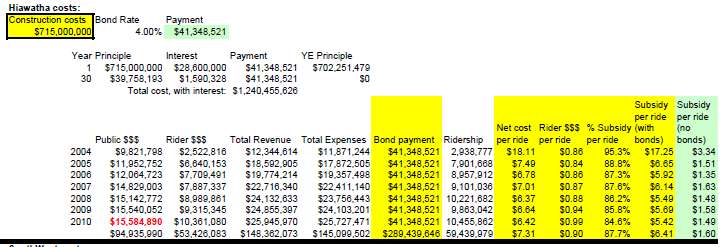
The “Total Expenses” column is what it costs to run the line for a year.  They’ve jumped 50% since the line’s first full year, by the way – way faster than inflation.

The “Rider $$$” column?  That’s how much they collect via fares.  Note that if you divide it by 2 – the $2 you pay for a fare – you do not get the correct ridership numbers; Dave included a “Ridership” column; you’ll note that the average rider pays something close to 96 cents; between special student and senior fares, promotions (like “Ride home for free on Saint Patrick’s Day”), and the many, many turnstile-jumpers that ride the line, the line gets less than a buck per rider.

And so the “Public $$$” column comes in; that’s the subsidy we pay to make the “Total Revenues” column match the “Total Expenses” column.

And that leads us to the “Subsidy Per Ride” column; that’s how much public money it takes to make the revenues cover the expenses.  For the fares the rider pays – a little over ninety cents a ride, on average – the taxpayer is tacking on an extra $1.60.  Put another way, every $2 fare that is actually paid is covered by another $3.50 or so.

But that’s really just the tip of the iceberg.

The line was paid for with bonds – $715,000,000 in bonds floated at an average of 4%.  They were floated at all levels – state, Met Council, the Feds – and eventually it’s all money that goes to the Chinese.

These bonds, like a huge mortgage, get paid every year over the course of their 30 year life.  And the annual bond payment on $715,000,000 comes to about $41,348,521, give or take.

That’s on top of the line’s operating expenses.

So if you add each rider’s share of the bond payment to the price of the subsidized ticket, it means the actual public subsidy for each ride comes to an average of $6.41 for every $.90 cents they raise in fares; put another way,  each $2 paid by the ripe sucks, the 45% who actually pay for fares, costs the taxpayers a little over $13.50.

That is an awful lot of money.

So – how about the Central Corridor?

It’s worse.  Much worse:


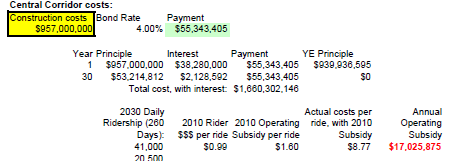
Assuming an average of $.99 a ride (same as Hiawatha using the Met Council’s ridership numbers – and I think both are generous),it adds up to a $17 million annual subsidy – that is, revenues will be $17M short at covering the annual nut.  Every year

Add the $55 million in annual bond payments; divide it by the ridersihp, and you’re talking a public subsidy of $8.77 per ride – or $17.54 per paid $2 fare.

And the Southwest Light Rail?

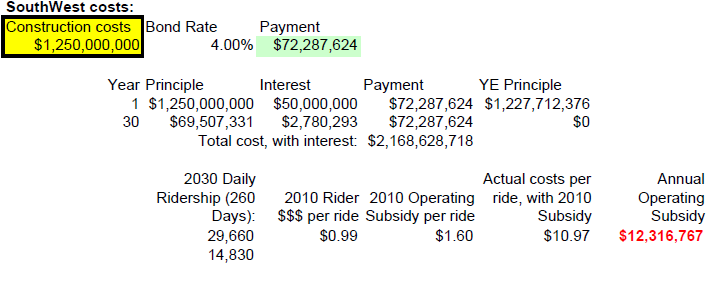
Again – using the Met’s ridership and bonding numbers, and carrying over the Hiawatha’s actual revenue per rider, it’ll actually get a little closer to covering its operating costs – but the $1.2 billion in bonds have to get paid.  Which means the subsidy per ride is going to be $10.97 – or almost $22 per full $2 fare.

Worse? The Met’s philosophy seems to be “sell at a loss, make up for it in volume”.  None of the three lines will come within 60% of breaking even – so the taxpayer will be on the hook to subsize the lines to the tune of over 60% of the budget:

  • Hiawatha: $15 million
  • Central Corridor  $17 million
  • Southwest: $12 million

Of course, that’s not all.  Not counting the annual bond payments of over $175 million (which is spread over all levels of government, from city through federal, so it’s not all coming out of the state budget) – but tacking  on the annual operating subsidy for the Northstar line ($13 million), and you get a grand total of well over $55 million dollars a year just to cover the four lines’ operating losses.

Every year.

Forever.

Even after the bonds are paid off.  Not counting for inflation or – let’s not forget – the inevitable need to replace rolling stock or stretches of line.

And barring gas jumping to $20 a gallon, it’s just not going to change – not to the tune of blasting rider revenue up by 250%.


The Light Rail Money Pit

Monday, January 16th, 2012

The Met Council has started making the same rumblings about building a new LIght Rail line to the southwest suburbs that they were making ten or so years ago about building one connecting the downtowns – the sort of noises that really mean “we’ve decided to do it, and we’re in the process of getting our political ducks in a row” – sort of like teenagers saying “I’m thinking about going to a party…”

Now, let’s be clear on one thing; I don’t oppose rail transit for the sheer sake of opposing rail transit.  And I don’t oppose it just because all the other conservative kids are doing it – far from it.  If it were shown that rail transit in any of its forms could, someday, be a fiscally-responsible form of transportation, I’d support it.

I’ll give you three examples:

  1. At one point in the study process, there were numbers that suggested that Northstar, and its companion concept (at the time, they were both concepts), the Red Rocks line (would would connect Hastings with the two downtowns via existing rail right of way in the East Metro) could have been revenue neutral (if you left the bonding out) – provided the Met Council observed a couple of caveats (bought used rolling stock, kept the stations on the austere side, and kept religiously to existing rail right of way without buying up any new land) and, of course, provided the paid ridership numbers were pretty strong.  And at the time – provided that the money, the logistics and the ridership tracked the way the report said it would (and my sniff test told me it was cooked bureaucratic books even then, but for purposes of argument, I ran with it), I figured Northstar and Red Rocks  could be wise investments.  Experience has proved those estimates…well, we’ll get back to that.
  2. The Central Corridor was going to be an expensive money pit no matter what.  But the Met Council could have gone two ways to make the line, if not a money-maker, at least less of a debacle.  They could have built it through the existing rail right of way in Northeast and through the Midway, and made it a much faster train; “Light Rail” trains are designed to go 55 miles per hour between stops that are spaced about a mile apart, and give you some actual speed advantage over riding a bus.  Or they could have built a trolley – literally, a vehicle that is intended to chug along at street speeds and stop every block or two, and replaced the 16 bus and served the traffic that really does use University, people who are carrying groceries home from Rainbow or coming home from the U of M or Concordia, or who live in the middle of St. Paul but work in one of the downtowns.  (Seriously – does anyone think that anyone travels between the downtowns for anything but business?  And if they do, why would they not drive?  And if they don’t drive, why would they not take the 94 express, which gets you back and forth faster than the train likely will?)
  3. If you just have to have a light rail train – one that zips along at 55 miles per hour between stops that are a mile or two apart – at least build one from where people are to where they want to be.  This, of course, rules out both the current trains; outside of Twins and Vikings games and a  thin film of people who commute from the eastern reaches of South Minneapolis to Downtown, the trolley connects destinations that people would mostly much rather drive to.  And the Central Corridor is the wrong train designed to do the wrong job.   But the Southwest LRT?  A line intended to connect Minneapolis to the booming southwestern suburbs?  That almost seems like it could make some sense.  It connects where people are – the bedroom burbs of the southwest, the tony garrets and apartments in the city – with where they want and need to be, the jobs downtown or at the booming IT, insurance, service and light manufacturing businesses of the southwest.  If you have to have a train, this would seem to be the one to start with, if you are focused on building a train to, y’know, do something useful.

But that’s not how or why our trains were designed.  

I’ve opposed the current rail transit “strategy” largely because it’s designed not to move people from where they are to where they need to be – something that could, hypothetically, be a less-profligtate waste of taxpayer money than what we have.

And as “profligate”, I’ve accepted on faith the numbers that the Met Council released a few years back that showed that a single passenger ride on the Ventura Trolley costs $6 – of which the passenger fare pays $2, and the taxpayer pays $4.  

If you were running a business that was losing $4 on every $6 transaction, you might hang in there for a while until you found a market.  If you ran a business that ran those kind of losses and connected places where people weren’t with places they largely didn’t want to go (at least in numbers to generate the kind of ridership that would support the numbers you used in your business plan, the one you used to buffalo your investors), you’d have been lucky to go into business in the first place.  Or unlucky.  Hard to say.

I mean, paying 2/3 of the cost of all of our current rail transit just seems like a waste. The whole story seemed bad enough to me, as it was.

That’s where Dave Osmek comes in.

Dave’s an old friend of this blog, a city councilman in Mound, and now a State Senate candidate.  And he’s been grinding some of the numbers regarding the state bureaucracy’s mania for light rail.

And it turns out I was being too pollyannaish.

More tomorrow.

Shiny Happy Person

Friday, January 13th, 2012

Riordan Frost, writing for the MN2020 site, just loooooves the Central Corridor:

After spending a semester at graduate school in Washington, DC, I returned for the holidays to find a pleasant surprise in front of MN2020: Central Corridor light rail tracks in the ground, flanked by smoothly paved roads, attractive pedestrian-scale streetlights, and aesthetically pleasing bus stops. This stretch of University Avenue looks good, and I don’t know if I ever expected to say that.

We’re on tap to spend over a billion dollars (to put in a train that will solve virtually none of University Avenue’s problems, and exacerbate some new ones.

Can you imagine how nice the street would look if we spent ten billion on it?  Fifty billion?  We could gold-plate the whole street.

Mr. Riordan’s remark illustrates the “progressive” fixation with focusing not only on outcomes, but the fairly shallow “progressive’s” focus on fairly shallow views of those outcomes.

University Avenue desperately needed reconstruction, and while the loss of on-street parking has inconvenienced some businesses, the additional foot traffic from light rail will more than make up for these spots—which, by the way, were constantly underused.

Really?

Where – outside of Twins and Vikings games and pub-crawling twenty somethings – has any “foot traffic” erupted on the Hiawatha line?

Are the people who travel University – local shoppers and people who work in the area – prone to climbing on the train and meandering about for the fun of it?

Or does Mr. Frost expect Uni to become a destination for casual wandering?

Current residents and current businesses on the corridor will benefit, of course,but new businesses and residents are quickly arriving.

Let’s place a little bet here – for bragging rights, anyway (I never gamble money); in five years, the “current businesses” within two blocks of the stops will largely be gone, replaced by Caribou and Patagonia and Dunn Brothers stores.   And the “current businesses” outside those radii will be on life support or long gone, from the lack of either parking  or foot traffic.

And five years beyond that?  Most of those gentrified businesses around the rail stops will be pretty much stagnant – because like the “festival mall” craze of the eighties, and unlike “Field of Dreams”, when you build it, unless there’s a good reason, they will not come.  And there is just no reason for a rail line down University Avenue.

We have enumerated the mobility, environmental, and economic benefits of light rail many times at MN2020, but as the progress moves to other doorsteps, we are looking at another good reason for Central Corridor: a reconstructed, aesthetically appealing avenue. One which just so happens, mind you, to now contain multimodal infrastructure, safer crosswalks, and better lighting. Now that’s progress.

Heh.

Yep. It’s progress.  And progressivism.

Because Mr. Frost has just described a bunch of outcomes, and means to an end that is nowhere evident in the Met Council’s planning for this rail line.  Aesthetics are nice; multimodal transportation is one of those things urban planners yawp about…

…and they’re all being implemented for a project that has no rational reason to exist.  VIrtually nobody who needs to go between the downtowns is going to take the train.  Virtually nobody who lives in the neighborhood and wants to shop at a store on Uni wants to schlep their bags from the infrequently-spaced stops to wherever they live (or a half mile to a store that’s not practically on top of a stop; the light rail trains, designed to blaze down mile-long stretches of right of way at 55mph between stops, are woefully overbuilt for chugging down the street in the middle of an urban area and stopping ever half mile (the line should have been a trolley, if you just have to have a train on this route at all; the “light rail” should have been built through the rail yards south of Como, which would have been faster and cost a lot less).

And – as we’ll discuss early next week – the cost of all this aesthetic rah-rah is astronomical.  As in, much worse than they’ve told you.

More later.

Not Something That The City Of Saint Paul Is Going To Put On It’s Brochure

Monday, December 12th, 2011

How many businesses along University Avenue have been driven out of existence by the Central Corridor light rail contraction?

Hard to say – nobody involved in this boondoggle seems to be publicizing the counts.

But enough that someone’s trying to help people scavenge the space:

Starlings are birds that rest their tired wings in pre-existing nests, taking advantage of readily available real estate to make their temporary homes. Perhaps the same strategy can help some landlords along the Central Corridor fill their empty storefronts, at least until a more permanent tenant comes along.

Cute name.  But I think the only birds that are going to benefit from this disaster will be seagulls – scavengers that pick off the waste others leave behind.

Or Caribou.  Which isn’t a bird – it’s a big hoofed mammal – but it’s also a coffee shop that will enjoy lots of cheap rent in abandoned storefronts, in which to serve coffee to the condo-dwellers – the few that don’t drive everywhere, and also exist.

But I digress:

On Tuesday, two graduate students launched a new volunteer-driven effort to connect University Avenue property owners with artists, entrepreneurs and community groups looking for short-term offices, galleries or event space at bargain rents.

The Starling Project focuses on “meanwhile spaces,” according to co-founder Ben Shardlow, with the intention of filling empty storefronts with evidence of creative enterprises.

OK – it’s not a dumb idea, per se.  Eventually the market will fill the vacant space – it’s a big metro, still.  And those people and businesses in turn will…

…well, either languish in the arid parking-free no-mans-lands between the big stops, or get priced out of the market by the Caribous and Patagonias and McDonalds and Dunn Brothers that can afford the newly-gentrified rents at the  intersections that the Met Council has selected to be the “winners”.

Which, in turn, will be someone else’s grad school thesis.

--> Site Meter -->