Deja No
By Mitch Berg
If you weren’t around – at least in a cognitive way – in 1984, then you have no frame of reference. You’ve only been through so many downturns, and so many recoveries.
There’s been one traditional rule of thumb; the harsher the downturn, the more dramatic the recovery.
There’ve been two exceptions; the Great Depression (the recovery from which didn’t actually end until well after the Second World War; putting everyone to work on war-related production, or drafting them into the service, wasn’t a “economic recovery”, it was the mother of all temp job programs) and the current one.
How much different is the current one?
If you were in the workforce, or old enough to think about what “the workforce” was, between 1976 and 1982, you don’t need a reminder about how terribly slow the economy was; between Stagflation, the Fuel Crisis and the Carter Malaise, it was wretched time. And when Reagan (and Fed chief Paul Volker) tightened the money supply to squeeze out inflation, things got ugly. 1981-1982 were awful times.
And yet by 1984, the economic blender had switched to puree, and Ronald Reagan coasted to the most lopsided presidential triumph in history.
If that’s what you remember – you’re right. Job growth after the 1982 recession was a virtual mirror image of the “growth” under The Lightworker.
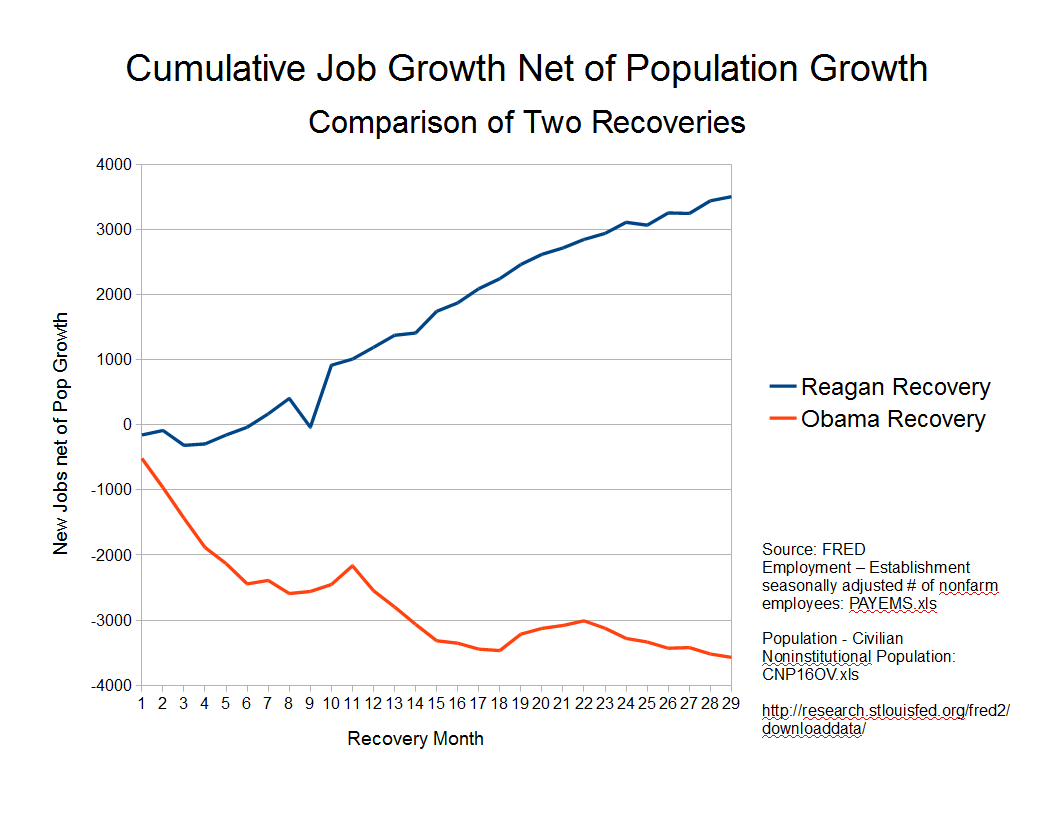
As John McCain said in 2008 (to Democrat derision), the fundamentals of the US economy are strong; lots of smart, hard-working people with ideas big and small to generate wealth equals an economy that, left to its own devices, can weather the cycle.
But the political system (both parties, although mostly the Democrats) have not left the economy to its own devices.
And that’s the problem.


May 9th, 2014 at 3:19 pm
MBerg wrote: But the political system (both parties, although mostly the Democrats) have not left the economy to its own devices.
Why didn’t they leave the economy to its own devices? Because doing so would have caused pain, and the federal government has many mechanisms to redirect this pain. It would be just and right for the pain to be absorbed by greedy and foolish mortgage sellers and consumers. Instead the federal government has distributed the pain to those who did nothing to create the crisis of 2008, namely the professional class (who have seen their taxes increase dramatically), and the middle and working classes (who have seen their wealth eroded and their aspirations diminish). A democracy is designed to be responsive to petitioners. If it were otherwise, it would not be a democracy. When you have a federal government that intrudes on virtually aspect of the economic life its citizens (including choosing their lightbulbs for them!) this is what you get. Democrat or Republican makes little difference.
May 9th, 2014 at 4:06 pm
It’s hard to claim victory (and the political rewards that come from a success) if you don’t leave a fingerprint or two, maybe even both hands, on the winning process.
May 9th, 2014 at 4:13 pm
Economy: collateral damage in the political game of getting (re)elected.